

What do you think?

La Méditerranée et le monde méditerranéen à l'époque de Philippe II #1
Civiltà e imperi del Mediterraneo nell'età di Filippo II, Volume 1
Non è esagerato dire che la pubblicazione di questo libro di Braudel ha segnato una data nella storiografia internazionale. L'opera, di lettura affascinante, ha innovato profondamente la nostra visione della vita europea e mediterranea nel Cinquecento: allo schema tradizionale della crisi sopraggiunta come conseguenza delle nuove vie di navigazione atlantica, Braudel contrapponeva - con la forza di convinzione che derivava da una conoscenza precisa di fonti sterminate - la visione di un mondo ancora pieno di traffici e di contrasti, di tensioni e scambi, di cui erano partecipi, direttamente o indirettamente, non solo i paesi rivieraschi, ma anche Stati lontani. In altre parole, la vitalità dell'area mediterranea risultava dirompente ed essenziale, per le civiltà del vecchio mondo, ancora per tutto il XVI secolo. Lo studio della storia visto come connessione di tre momenti diversi - la storia di lento svolgimento e di lente trasformazioni, secolari o addirittura millenarie, la storia ritmata in cicli più brevi, ma pur sempre pluridecennali, e infine la storia "secondo la dimensione dell'individuo" mostrava, attraverso questa indagine, la sua efficacia e il suo valore di strumento per l'analisi delle grandi età del passato.
805 pages, Paperback
First published January 1, 1949
About the author
Fernand Braudel
159 books578 followersFernand Paul Achille Braudel was a French historian and a leader of the Annales School. His scholarship focused on three main projects: The Mediterranean (1923–49, then 1949–66), Civilization and Capitalism (1955–79), and the unfinished Identity of France (1970–85). His reputation stems in part from his writings, but even more from his success in making the Annales School the most important engine of historical research in France and much of the world after 1950. As the dominant leader of the Annales School of historiography in the 1950s and 1960s, he exerted enormous influence on historical writing in France and other countries.
Braudel has been considered one of the greatest of the modern historians who have emphasized the role of large-scale socioeconomic factors in the making and writing of history. He can also be considered as one of the precursors of world-systems theory.
Braudel has been considered one of the greatest of the modern historians who have emphasized the role of large-scale socioeconomic factors in the making and writing of history. He can also be considered as one of the precursors of world-systems theory.
Ratings & Reviews
Friends & Following
Create a free account to discover what your friends think of this book!
Community Reviews
Displaying 1 - 30 of 104 reviews

May 13, 2014
We’re all familiar with Isaiah Berlin’s ‘the Fox and the Hedgehog’, and with ‘lumpers and splitters’ – a phrase, as Wiki tell us, that was first used by Charles Darwin. Yet a very brilliant young teacher I had in college -- and one who, like me, was not much for ‘lumpers’ -- used to say: ‘there are really two types of people in the world. Those who divide things into twos and those who divide things into threes.”
Fernand Braudel was certainly one of the latter.
He divides things into threes. This is true of his monumental Civilization and Capitalism, and it is true of his masterpiece, << The Mediterranean and the Mediterranean World in the Age of Philip II >>, a large, dense two-volume work that he labored on (despite a hiatus of some 15 years) from 1927, when it began life as a standard sort of historical dissertation on the diplomatic history of the second half of the 16th century (the decline of Spain under Philip II), under the direction of a certain, long-forgotten Georges Pagés, but which then came increasingly under the spell and influence of the great Lucien Febvre, co-founder with Marc Bloch of the Annales School -- whereupon it grew and grew and grew, both in size and in complexity and scope… until its first publication, marking its submission for the doctoral thesis, in 1949 ( -- the first draft was famously written largely from memory while imprisoned by the Germans at Lübeck –), and then was taken up again and thoroughly revised from 1964-1966. It is this second, revised edition that was so brilliantly translated by Siân Reynolds (who now translates Fred Vargas, the French crime writer), and that most of us know.
The Mediterranean can most justly be called a portrait of a ‘civilization’ – the ‘civilization’ being that of the Mediterranean (which runs from the Middle Ages and the revival of life after the fall of Rome, up until our own times, or at least until the 20th century), and which Braudel conceives of as being something of a ‘civilizational’ unity. It cannot be called a ‘biography’ of that ‘civilization’ – like the “Biography” of Africa by John Reader, which covers the whole of that continent from its geological formation till post-Independence – since Braudel’s concern is only to talk about the events of the second half of the 16th century (the reign of Philip II), a mere fifty years…, itself only a fragment of the so-called “long 16th century”), a phrase that some historians have used to describe the period from 1450 (the quickening after the long recession of the century of plague) to c. 1650 (when the Dutch Empire, still in many ways a continuance of this period, originally relying on Genoese bankers and ‘Mediterranean’ methods, and itself, indeed, still [at least, *formally*] a part of the Habsburg Empire until 1648 [when its independence was formalized by the Peace of Westphalia], can be said to have peaked. Well…, a somewhat Braudelian sentence…
The Ravages of Time… the youthful and brilliant Burgundian Charles I in youth
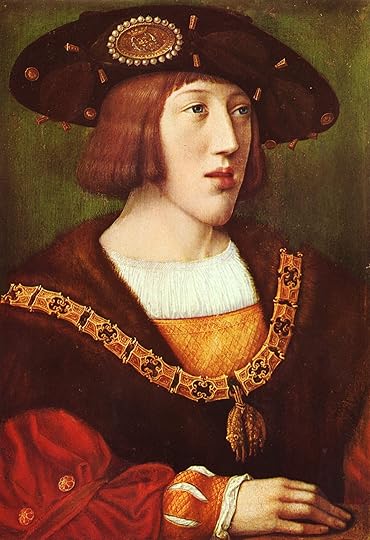
(Bernard Van Orley, 1516)
[To give some context – the first half of the 16th cen., the reign of the brilliant and cosmopolitan Charles V (see above), is the period that sees the fateful irruption of the large territorial states, Spain and France, into the Italy of the Quattrocento, and which thus foreshadows the closing of the Renaissance; it is the age of Selim I and of Suleiman the Magnificent and of the rise of the Ottoman Empire, the Turkish takings (from the Mamluks) of Egypt and Syria (1517) and the Caliphate; the Siege of Vienna (1529); it is the age of Machiavelli, who died just six weeks after the Sack of Rome (1527), of Erasmus, and of Rabelais. And of course it is the Age of Exploration.
The Age of Philip II (d. 1598), by contrast, Charles’ son, coincides with the reign of Elizabeth of England (d. 1603), Lepanto (1571), the Armada (1588), and with the maturation of Shakespeare and Cervantes (both of whom died in 1616) and of the birth, be it said, of Rembrandt (b. 1606). A brilliant age – and one that was followed by the “long” 17th century, years of of crisis and recession… not just in Europe (The Thirty Years War), but in China and Japan (the fall of the Ming Dynasty and the coming of the Tokugawa Bakufu)… ; and even, climatically, with what is known as the Little Ice Age.]
… and the aged Charles V of Spain… suffering from gout, and on the eve of his abdication
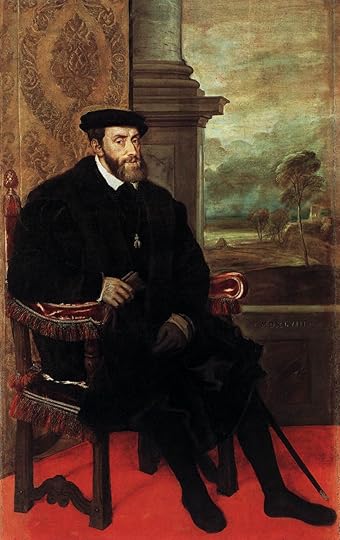
(Titian, 1548)
At any rate, like the portraits of Rembrandt, Braudel’s Mediterranean is but a snapshot of a larger whole, a laboratory “slice” of a civilization which, like the sea itself, had its many swells and ebbs…
But to understand that ‘moment’, the age of Philip, one requires context… and it is here – in his deep and remarkable contextualizations -- that Braudel found the genius that will long be associated with his name.
So as to the division into threes…, Braudel divides his subject into three planes.
-- l'histoire presque immobile, « le temps géographique » dont les fluctuations sont quasi-imperceptibles, qui a trait aux rapports de l'homme et du milieu (a movement of thought largely inspired by a French geographical school that flourished briefly around the turn of the 20th century) – and which is commonly referred to as the longue durée (http://en.wikipedia.org/wiki/Longue_d...). This is Part I = vol. 1 (pp. 23-352).
-- l'histoire lentement agitée, « le temps social », une histoire sociale, ayant trait aux groupes humains. This is Part II = vol. 1 (pp. 353-fin/642) and vol. 2 (init/657-900).
-- l'histoire évènementielle, « le temps individuel », celle de l'agitation de surface – and dealing specifically with the events surrounding the reign of Philip II. This is Part III = vol. 2 (pp. 901-fin/1244).
But in fact – and this is important – the book really breaks into FOUR parts (not three), since the two halves of Part II (Chs. 1, 2, 3, in vol. 1, dealing with “Economies” – distances, demographics, economic models; gold, silver, the inflation; the trade in pepper, in grain, and Atlantic shipping in the Mediterranean both before and after 1550; and chs. 4, 5, 6, 7, in vol. 2, dealing with the human elements, that is, with empires, the state, societies, classes, ‘civilizations’, Jews, and war – both formal and informal [piracy]…, these two halves of Part II are utterly distinct in tone and interest.
As such, the book could have been, and should have been issued not in two drooping volumes, but in four, relatively short fascicles of approximately 300-350 pages each. Had it been published in this way, I believe that the book would have had a greater readership, and been less intimidating.
So volume 1 is really two books – and can be reviewed (and, in some measure, even read) as such.
The first half of volume 1 = Part I (pp. 23-352), covers the longue durée – that quintessentially Braudelian synthesis of geography and man – and is a work (this fascicle) of sheer genius. Everyone interested in the shape and destiny of man should read this. It can be read by itself -- the rest of the book, the next 900 pages, can be ignored – and it would serve as part of the fundamental furniture of your mind evermore. I cannot recommend it highly enough. I know of nothing in the subject of history that repays study more. Read it.
The second half of volume 1, the section on “economies”, introduces the middle plane of Braudel’s universe. It is dense, difficult, and not terribly rewarding. Rather than presenting a coherent narrative of early modern economies, or of the inflation (prices rose 6-fold during the 16th century), it consists more of a series of case studies, chosen at random, or on the basis of whatever the available sources, and studies, moreover, approached haphazardly. It is as if Braudel were a man reviewing, with a wave of his hand, a deck of cards scattered face upwards across a table. The evidence is incomplete, the data is already dated, and the topic is dry.
I had feared that the rest of the book – that is, volume 2 – would be of the same sort. But it appears, as I enter into it, to be completely different (and far more rewarding) both in tone and in method.
So the upshot is – everyone should read (at the very least) the first half of this. It is a masterpiece in every sense of the word.
The tughra of Suleiman the Great
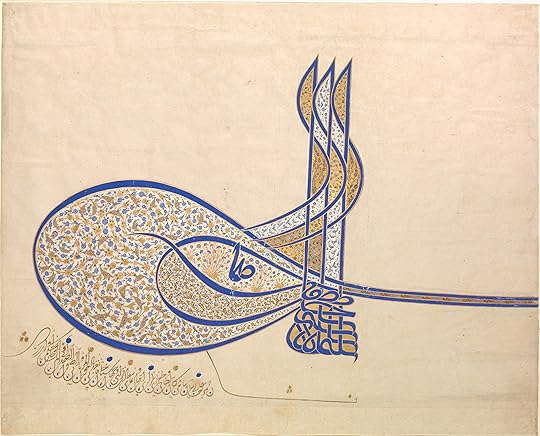
Fernand Braudel was certainly one of the latter.
He divides things into threes. This is true of his monumental Civilization and Capitalism, and it is true of his masterpiece, << The Mediterranean and the Mediterranean World in the Age of Philip II >>, a large, dense two-volume work that he labored on (despite a hiatus of some 15 years) from 1927, when it began life as a standard sort of historical dissertation on the diplomatic history of the second half of the 16th century (the decline of Spain under Philip II), under the direction of a certain, long-forgotten Georges Pagés, but which then came increasingly under the spell and influence of the great Lucien Febvre, co-founder with Marc Bloch of the Annales School -- whereupon it grew and grew and grew, both in size and in complexity and scope… until its first publication, marking its submission for the doctoral thesis, in 1949 ( -- the first draft was famously written largely from memory while imprisoned by the Germans at Lübeck –), and then was taken up again and thoroughly revised from 1964-1966. It is this second, revised edition that was so brilliantly translated by Siân Reynolds (who now translates Fred Vargas, the French crime writer), and that most of us know.
The Mediterranean can most justly be called a portrait of a ‘civilization’ – the ‘civilization’ being that of the Mediterranean (which runs from the Middle Ages and the revival of life after the fall of Rome, up until our own times, or at least until the 20th century), and which Braudel conceives of as being something of a ‘civilizational’ unity. It cannot be called a ‘biography’ of that ‘civilization’ – like the “Biography” of Africa by John Reader, which covers the whole of that continent from its geological formation till post-Independence – since Braudel’s concern is only to talk about the events of the second half of the 16th century (the reign of Philip II), a mere fifty years…, itself only a fragment of the so-called “long 16th century”), a phrase that some historians have used to describe the period from 1450 (the quickening after the long recession of the century of plague) to c. 1650 (when the Dutch Empire, still in many ways a continuance of this period, originally relying on Genoese bankers and ‘Mediterranean’ methods, and itself, indeed, still [at least, *formally*] a part of the Habsburg Empire until 1648 [when its independence was formalized by the Peace of Westphalia], can be said to have peaked. Well…, a somewhat Braudelian sentence…
The Ravages of Time… the youthful and brilliant Burgundian Charles I in youth
(Bernard Van Orley, 1516)
[To give some context – the first half of the 16th cen., the reign of the brilliant and cosmopolitan Charles V (see above), is the period that sees the fateful irruption of the large territorial states, Spain and France, into the Italy of the Quattrocento, and which thus foreshadows the closing of the Renaissance; it is the age of Selim I and of Suleiman the Magnificent and of the rise of the Ottoman Empire, the Turkish takings (from the Mamluks) of Egypt and Syria (1517) and the Caliphate; the Siege of Vienna (1529); it is the age of Machiavelli, who died just six weeks after the Sack of Rome (1527), of Erasmus, and of Rabelais. And of course it is the Age of Exploration.
The Age of Philip II (d. 1598), by contrast, Charles’ son, coincides with the reign of Elizabeth of England (d. 1603), Lepanto (1571), the Armada (1588), and with the maturation of Shakespeare and Cervantes (both of whom died in 1616) and of the birth, be it said, of Rembrandt (b. 1606). A brilliant age – and one that was followed by the “long” 17th century, years of of crisis and recession… not just in Europe (The Thirty Years War), but in China and Japan (the fall of the Ming Dynasty and the coming of the Tokugawa Bakufu)… ; and even, climatically, with what is known as the Little Ice Age.]
… and the aged Charles V of Spain… suffering from gout, and on the eve of his abdication
(Titian, 1548)
At any rate, like the portraits of Rembrandt, Braudel’s Mediterranean is but a snapshot of a larger whole, a laboratory “slice” of a civilization which, like the sea itself, had its many swells and ebbs…
But to understand that ‘moment’, the age of Philip, one requires context… and it is here – in his deep and remarkable contextualizations -- that Braudel found the genius that will long be associated with his name.
So as to the division into threes…, Braudel divides his subject into three planes.
-- l'histoire presque immobile, « le temps géographique » dont les fluctuations sont quasi-imperceptibles, qui a trait aux rapports de l'homme et du milieu (a movement of thought largely inspired by a French geographical school that flourished briefly around the turn of the 20th century) – and which is commonly referred to as the longue durée (http://en.wikipedia.org/wiki/Longue_d...). This is Part I = vol. 1 (pp. 23-352).
-- l'histoire lentement agitée, « le temps social », une histoire sociale, ayant trait aux groupes humains. This is Part II = vol. 1 (pp. 353-fin/642) and vol. 2 (init/657-900).
-- l'histoire évènementielle, « le temps individuel », celle de l'agitation de surface – and dealing specifically with the events surrounding the reign of Philip II. This is Part III = vol. 2 (pp. 901-fin/1244).
But in fact – and this is important – the book really breaks into FOUR parts (not three), since the two halves of Part II (Chs. 1, 2, 3, in vol. 1, dealing with “Economies” – distances, demographics, economic models; gold, silver, the inflation; the trade in pepper, in grain, and Atlantic shipping in the Mediterranean both before and after 1550; and chs. 4, 5, 6, 7, in vol. 2, dealing with the human elements, that is, with empires, the state, societies, classes, ‘civilizations’, Jews, and war – both formal and informal [piracy]…, these two halves of Part II are utterly distinct in tone and interest.
As such, the book could have been, and should have been issued not in two drooping volumes, but in four, relatively short fascicles of approximately 300-350 pages each. Had it been published in this way, I believe that the book would have had a greater readership, and been less intimidating.
So volume 1 is really two books – and can be reviewed (and, in some measure, even read) as such.
The first half of volume 1 = Part I (pp. 23-352), covers the longue durée – that quintessentially Braudelian synthesis of geography and man – and is a work (this fascicle) of sheer genius. Everyone interested in the shape and destiny of man should read this. It can be read by itself -- the rest of the book, the next 900 pages, can be ignored – and it would serve as part of the fundamental furniture of your mind evermore. I cannot recommend it highly enough. I know of nothing in the subject of history that repays study more. Read it.
The second half of volume 1, the section on “economies”, introduces the middle plane of Braudel’s universe. It is dense, difficult, and not terribly rewarding. Rather than presenting a coherent narrative of early modern economies, or of the inflation (prices rose 6-fold during the 16th century), it consists more of a series of case studies, chosen at random, or on the basis of whatever the available sources, and studies, moreover, approached haphazardly. It is as if Braudel were a man reviewing, with a wave of his hand, a deck of cards scattered face upwards across a table. The evidence is incomplete, the data is already dated, and the topic is dry.
I had feared that the rest of the book – that is, volume 2 – would be of the same sort. But it appears, as I enter into it, to be completely different (and far more rewarding) both in tone and in method.
So the upshot is – everyone should read (at the very least) the first half of this. It is a masterpiece in every sense of the word.
The tughra of Suleiman the Great

January 16, 2013
This is not like a normal history book. One does not simply sit down and read Braudel's Mediterranean. It is a two part thing and each part is seven hundred pages, and there really is no narrative thru-line. I think the best way to approach this book is to keep it around, and read it in chunks in between other works of history. Then you'll need to refer back to it in the future. The thing is, you're going to need to take this "total history" piece by piece and decide if it works for you.
What Braudel does here, ostensibly, is tell the story of the Mediterranean world during the second half of the sixteenth century, during the reign of Philip II of Spain. A lot of things happened, politically, during that time, most of which had to do with Phil and the Spaniards in the western part of the sea versus the Ottomans in the eastern part. According to Braudel, however, these military and political events (which are only covered in detail in final third of the book) are really not very important. They are surface manifestations of the deeper structures which truly drive the Mediterranean world. What is very important to FB is to examine, in painstaking detail, the geography of the Mediterranean, its climate, its many people, the economic ties that bind them together, the trading routes that snake north and south and east, the cyclical symbiotic fellowship between warfare and piracy over the centuries, and on and on, etc. It is only after examining these structures in detail that we can begin to understand the way both westerners and easterners saw the Mediterranean when they found themselves in conflict.
I finished this a few weeks ago, and what I find is that little bits of it stay with me. I think that is its use, really - I will remember, occasionally, hey, Braudel had that interesting bit on the four different major trade routes north from the Mediterranean, I should reread that chapter and see whether it helps me understand this other thing I'm reading. Or, hey, I wonder if Braudel's bit on pirates might help me understand that part of American history where the early republic traders were dealing with that pirate problem.
This is an amazing work of scholarship. Whether or not you like this method of examining history, you have to respect the study and craft that went into putting it all together.
What Braudel does here, ostensibly, is tell the story of the Mediterranean world during the second half of the sixteenth century, during the reign of Philip II of Spain. A lot of things happened, politically, during that time, most of which had to do with Phil and the Spaniards in the western part of the sea versus the Ottomans in the eastern part. According to Braudel, however, these military and political events (which are only covered in detail in final third of the book) are really not very important. They are surface manifestations of the deeper structures which truly drive the Mediterranean world. What is very important to FB is to examine, in painstaking detail, the geography of the Mediterranean, its climate, its many people, the economic ties that bind them together, the trading routes that snake north and south and east, the cyclical symbiotic fellowship between warfare and piracy over the centuries, and on and on, etc. It is only after examining these structures in detail that we can begin to understand the way both westerners and easterners saw the Mediterranean when they found themselves in conflict.
I finished this a few weeks ago, and what I find is that little bits of it stay with me. I think that is its use, really - I will remember, occasionally, hey, Braudel had that interesting bit on the four different major trade routes north from the Mediterranean, I should reread that chapter and see whether it helps me understand this other thing I'm reading. Or, hey, I wonder if Braudel's bit on pirates might help me understand that part of American history where the early republic traders were dealing with that pirate problem.
This is an amazing work of scholarship. Whether or not you like this method of examining history, you have to respect the study and craft that went into putting it all together.

July 19, 2020
what am i supposed to do, write a review for braudel? i think he'll be ok without one

Read
January 14, 2026Rambling Introduction
When I was seventeen, long ago and moderately far away, I bought the Mediterranean and the Mediterranean world in the age of philip II. Since I had for many a year intended to read Braudel's Civilisation and Capitalism again, over time it came to feel inevitable, even good and proper to read his Mediterranean completely from beginning to end.
The first problem was that, as mentioned above, I only had volume II. I spent some time looking for it in French bookshops. This was an amusing, but so far, fruitless quest. French bookshops seemed to have plenty of books by dead French historians, for example George Duby, just not those of the dead French historian that I was looking for. I got the impression that it would be easier and possibly more useful to sit by his graveside in Paris and attempt to commune with the man than to try and find a copy of his Mediterranean in French.
Luckily before I went as far as asking the Witch of Endor for help I was able to borrow a complete set in Dutch, leaving me with a plan to read half of that set before reverting to my own increasingly fragile paperback of volume II.
hopefully somewhat more serious bit
Early on I felt quite dissapointed with the book. It felt expansive rather than insightful and under developed. I had the sense of seeing the beginning of arguments that would reach full fruit in Civilisation and Capitalism.
Anyway I am mostly writing to say that this review is not a review, that I will write a review seperately of the whole work under an edition that covers the entire work and just use the individual volumes for something like notes. Of course this is the same plan as I had for civilisation and Capitalism and which I have so far failed to carry out.
The Mediterranean here is not a sea, but a series of seas, covered by networks of routes which might be seasonal. It is mirrored by a zone to the south and to the east. So when in winter, travel and trade across the Mediterranean slowed down - because due to the prevailing winds if you set sail from Genoa or Marseille you would quickly arrive in Algiers - in the other zone trade came to life, temperatures were cooler, there were occasional rains so it became easier to cross the deserts. To the west the Mediterranean also linked into a developing Atlantic economy, and I suppose it is a general theme of Braudel that everything is connected and interrelated. Indeed that idea underpins the entire book.
It was meant to be a study of Philip II's political engagement in the Mediterranean region, but, Braudel is saying implicitly and explicitly, in order to make sense of that, we have to understand aot of other apparently disconnected elements to the extent that taking the book as a whole, between one third and a quarter deals with King Philip's political activity in the Mediterranean while the rest discusses, well, everything else (not quite). It was an extraordinary project and suggests both deep continuities but also ruptures so deep that we need books like this to understand the past.
Anyway, the next volume is waiting...
When I was seventeen, long ago and moderately far away, I bought the Mediterranean and the Mediterranean world in the age of philip II. Since I had for many a year intended to read Braudel's Civilisation and Capitalism again, over time it came to feel inevitable, even good and proper to read his Mediterranean completely from beginning to end.
The first problem was that, as mentioned above, I only had volume II. I spent some time looking for it in French bookshops. This was an amusing, but so far, fruitless quest. French bookshops seemed to have plenty of books by dead French historians, for example George Duby, just not those of the dead French historian that I was looking for. I got the impression that it would be easier and possibly more useful to sit by his graveside in Paris and attempt to commune with the man than to try and find a copy of his Mediterranean in French.
Luckily before I went as far as asking the Witch of Endor for help I was able to borrow a complete set in Dutch, leaving me with a plan to read half of that set before reverting to my own increasingly fragile paperback of volume II.
hopefully somewhat more serious bit
Early on I felt quite dissapointed with the book. It felt expansive rather than insightful and under developed. I had the sense of seeing the beginning of arguments that would reach full fruit in Civilisation and Capitalism.
Anyway I am mostly writing to say that this review is not a review, that I will write a review seperately of the whole work under an edition that covers the entire work and just use the individual volumes for something like notes. Of course this is the same plan as I had for civilisation and Capitalism and which I have so far failed to carry out.
The Mediterranean here is not a sea, but a series of seas, covered by networks of routes which might be seasonal. It is mirrored by a zone to the south and to the east. So when in winter, travel and trade across the Mediterranean slowed down - because due to the prevailing winds if you set sail from Genoa or Marseille you would quickly arrive in Algiers - in the other zone trade came to life, temperatures were cooler, there were occasional rains so it became easier to cross the deserts. To the west the Mediterranean also linked into a developing Atlantic economy, and I suppose it is a general theme of Braudel that everything is connected and interrelated. Indeed that idea underpins the entire book.
It was meant to be a study of Philip II's political engagement in the Mediterranean region, but, Braudel is saying implicitly and explicitly, in order to make sense of that, we have to understand aot of other apparently disconnected elements to the extent that taking the book as a whole, between one third and a quarter deals with King Philip's political activity in the Mediterranean while the rest discusses, well, everything else (not quite). It was an extraordinary project and suggests both deep continuities but also ruptures so deep that we need books like this to understand the past.
Anyway, the next volume is waiting...

September 13, 2017
After just a first few pages, I am immediately placing this on my highest-ranking tier for the all-time greatest reference feats I've ever read. It's colossal. It's staggering. One of the best history books I've ever encountered.
Reminiscent of the great Gibbon; with that much sensitivity--but with more heart and urgency, more sweep and scope; more inquiry. All the flavor and spice that you ever wish'd Gibbon would've recounted about Rome, is here --even sprinkled in as 'asides' and anecdotes--in a text ostensibly focused on Philip II's Spain. It's as lively and as lurid as Herodotus, but with modern academic chops. The type of history Braudel includes but which everyone except Herodotus omits is the gritty, granular, vernacular, minutiae of those distant, romantic ages.
For instance, if you want to know what winter pastures were favored by shepherds in ancient Macedonia, Braudel has that. If you want to know the distribution of fanatic Christian vs fanatic Muslim mountain cults after the Crusades, Braudel has that. If you want to know how European wheat prices rose with the influx of Peruvian silver brought back in Spanish galleons, Braudel has that too. Routes for mule-teams through the Alps? Here. Number of foreign merchant ships docked annually in Venice during the 1510's? Here! Position of Bedouin watering-holes in the sub-Sahara? Here! Sumptuous, outlandish detail. It's as if it was written by God.
This is an epic work for keeping permanently on one's bedside table or taking along on a road trip. It's transcendent. You can thumb through any section at random; reading at whim, and be well-rewarded. Pick it up, put it down--just as you choose. The narrative never flags.
Perfect!
Reminiscent of the great Gibbon; with that much sensitivity--but with more heart and urgency, more sweep and scope; more inquiry. All the flavor and spice that you ever wish'd Gibbon would've recounted about Rome, is here --even sprinkled in as 'asides' and anecdotes--in a text ostensibly focused on Philip II's Spain. It's as lively and as lurid as Herodotus, but with modern academic chops. The type of history Braudel includes but which everyone except Herodotus omits is the gritty, granular, vernacular, minutiae of those distant, romantic ages.
For instance, if you want to know what winter pastures were favored by shepherds in ancient Macedonia, Braudel has that. If you want to know the distribution of fanatic Christian vs fanatic Muslim mountain cults after the Crusades, Braudel has that. If you want to know how European wheat prices rose with the influx of Peruvian silver brought back in Spanish galleons, Braudel has that too. Routes for mule-teams through the Alps? Here. Number of foreign merchant ships docked annually in Venice during the 1510's? Here! Position of Bedouin watering-holes in the sub-Sahara? Here! Sumptuous, outlandish detail. It's as if it was written by God.
This is an epic work for keeping permanently on one's bedside table or taking along on a road trip. It's transcendent. You can thumb through any section at random; reading at whim, and be well-rewarded. Pick it up, put it down--just as you choose. The narrative never flags.
Perfect!

October 17, 2015
The best history book still alive, read straight through once, and rifled through for 20 years, this book has helped shape my view of all things maritime, Mediterranean, commercial, and numerous processes and connections between place and event, such as hinterland and coast.
And I will never forget his reference to Venice as the place of agile and dangerous capitalism.
And I will never forget his reference to Venice as the place of agile and dangerous capitalism.

August 8, 2013
I will admit a few things before I even begin really talking about this book.
1. It is almost impossible to read this book if you are unwilling to look things up. How many times will you see words like axial or transhumance before realizing you should look them up?
2. The book was written for an audience that already would have some familiarity with time and place. Fernand Braudel expected you to have some background knowledge about the Holy Roman Empire, European royalty in general, and the geography of the Mediterranean (the greatest flaw of this book is the absence of a comprehensive map.). For instance, the fact that Charles V, the Holy Roman Emporer was Phillip II's father was mentioned only once, and this was only offhand after hundreds of pages where knowing that would have helped put things into perspective. And I don't believe it was ever made explicit that Charles V Holy Roman Emporer was once Charles I King of Spain. As much as I got out of this book, I can only imagine how deep a real student of history would have found it.
3. The book is too much to fit all into your brain at once and you will understand some parts better than others. Don't stress yourself. This really was the most challenging reading I have ever done.
4 Finally, I've seen many people complain that this book is too wordy and uses too many "big words." But I challenge you to find a single wasted word in the entire 1200+ pages! And there is never a "big word" used where a smaller one would suffice- when you look up the word, you'll see that he's using it quite specifically. However, the only other flaw in this book is the insane amount of untranslated Latin, French, Italian, and German excerpts. Like I'm just a bungler and can get the gist, but I think providing a translation would have been much better and educational.
Ok so having said all that, this was a beautiful book. A truly amazing achievement! I have nothing left for it but praise and admiration.
The book is divided into three parts. Part 1 describes the geographical and ecological reality of the place and defines the place and the people. Basically, if you walked counter-clockwise around the Mediterranean from Morocco, across Tunisia, Egypt, Syria, Albania, Italy, the South of France and across the Pyranees to Spain and Gibralter, you would find, if not the same language, the same way of life. The same plants- the olive tree, the grape, and the palm, the same weather- cold rainy winters and hot dry summers, the same houses- stone or mudbrick thick walled open air, the same rhythm of life, the same occupations, et cetera et cetera. Though the book does partially explain how it was only a political accident that left Africa so separate from Europe, Braudel explains that they really make much more sense when considered as a single unit.
He goes on to explain the other more permanent features of the place, especially explaining the communication and transport routes- including explaining the reason a shipper/retailer is almost always more wealthy than a "mere" producer/inventor, something that had always troubled me- and also explaining how market towns, big fairs, and banking towns came to exist.
After you've got all that down he explains in Part II the exact breakdown of the global and several specific regional and national (though that term isn't QUITE right) economies. He has a lot to say here about the wheat trade and the silver trade, the two things that allowed empire building in the first place, and which allowed Spain to become the most powerful empire builder of the time. Braudel, with a huge amount of backing data, shows general economic trends of the time as well as how long it took those trends to pass from place to place, which allowed him to determine where the economic trendsetters and centers of power really were, which wasn't always where the people at the time or the scholars have assumed.
In Part II, Braudel then explains, in just as much specific detail how empires and war work, showing some of the features that always surprise one to live through but are actually inevitable parts of this structure. He explain that war, piracy, and crime are really all just economic activities, which seems obvious, but which is mind blowing as he walks you through all the implications. (I will never forget the succinct beauty of his definition of brigandry, the "street-crime" of the era, which he described as "an endless and ultimately fruitless form of social rebellion." He makes sure you know the empires that existed at that time, and explains their specific clashes as well as how civilization clashes in general work.
After you've got ALL that down after reading 900 pages about environment, culture, economy, empire, and war, Braudel feels you are ready for part III, which explains the specific events and people of the 50 year period he is examining. Basically, after more than a thousand years as the political and economic center of the hemisphere, and after 500 years of power struggle leaving two big powers in the region, everything just faded away. Turkey turned to Persia and the Indian Ocean and Spain turned to the Atlantic. As you read about the events, especially the larger than any other battle naval conflict at Lepanto- a victory over the "invincible" Turk which ultimately led nowhere, you watch the glory, splendour and wealth drain away from the Mediterranean, never truly to return. And it makes sense. It's something you can mourn with the more far sighted people of the time as told in the book. Phillip II oversaw Spanish supremacy in the Mediterranean and also Spanish primacy in the Atlantic before he died.
Then, after all this information and pleasure, while facing such an abrupt ending and wondering what the book was FOR, the conclusion explains it- it wasn't JUST a book about the Mediterranean between 1550 and 1600, this book was an attempt to make a new kind of history, one that assigns more importance to the more permanent structures of our world- the geography and climate, the social structures and culture and less to the more ephemeral features, like the specific personalities and individual decisions most of our histories venerate and obsess over. Sitting in the middle, right between those two levels, is the economy and the specific culture of a region or country.
Three levels of history, of opposite levels of importance than commonly understood, which all need to be understood and accounted for if you want to understand a time and place- that is Fernand Braudel's real thesis here. A totally successful one- and one that still seems so fresh since we as a culture are still only beginning to learn how to think this way.
A really wonderful book, very worth putting in the months it will take to get through! Cannot recommend enough for anyone interested in real history.
1. It is almost impossible to read this book if you are unwilling to look things up. How many times will you see words like axial or transhumance before realizing you should look them up?
2. The book was written for an audience that already would have some familiarity with time and place. Fernand Braudel expected you to have some background knowledge about the Holy Roman Empire, European royalty in general, and the geography of the Mediterranean (the greatest flaw of this book is the absence of a comprehensive map.). For instance, the fact that Charles V, the Holy Roman Emporer was Phillip II's father was mentioned only once, and this was only offhand after hundreds of pages where knowing that would have helped put things into perspective. And I don't believe it was ever made explicit that Charles V Holy Roman Emporer was once Charles I King of Spain. As much as I got out of this book, I can only imagine how deep a real student of history would have found it.
3. The book is too much to fit all into your brain at once and you will understand some parts better than others. Don't stress yourself. This really was the most challenging reading I have ever done.
4 Finally, I've seen many people complain that this book is too wordy and uses too many "big words." But I challenge you to find a single wasted word in the entire 1200+ pages! And there is never a "big word" used where a smaller one would suffice- when you look up the word, you'll see that he's using it quite specifically. However, the only other flaw in this book is the insane amount of untranslated Latin, French, Italian, and German excerpts. Like I'm just a bungler and can get the gist, but I think providing a translation would have been much better and educational.
Ok so having said all that, this was a beautiful book. A truly amazing achievement! I have nothing left for it but praise and admiration.
The book is divided into three parts. Part 1 describes the geographical and ecological reality of the place and defines the place and the people. Basically, if you walked counter-clockwise around the Mediterranean from Morocco, across Tunisia, Egypt, Syria, Albania, Italy, the South of France and across the Pyranees to Spain and Gibralter, you would find, if not the same language, the same way of life. The same plants- the olive tree, the grape, and the palm, the same weather- cold rainy winters and hot dry summers, the same houses- stone or mudbrick thick walled open air, the same rhythm of life, the same occupations, et cetera et cetera. Though the book does partially explain how it was only a political accident that left Africa so separate from Europe, Braudel explains that they really make much more sense when considered as a single unit.
He goes on to explain the other more permanent features of the place, especially explaining the communication and transport routes- including explaining the reason a shipper/retailer is almost always more wealthy than a "mere" producer/inventor, something that had always troubled me- and also explaining how market towns, big fairs, and banking towns came to exist.
After you've got all that down he explains in Part II the exact breakdown of the global and several specific regional and national (though that term isn't QUITE right) economies. He has a lot to say here about the wheat trade and the silver trade, the two things that allowed empire building in the first place, and which allowed Spain to become the most powerful empire builder of the time. Braudel, with a huge amount of backing data, shows general economic trends of the time as well as how long it took those trends to pass from place to place, which allowed him to determine where the economic trendsetters and centers of power really were, which wasn't always where the people at the time or the scholars have assumed.
In Part II, Braudel then explains, in just as much specific detail how empires and war work, showing some of the features that always surprise one to live through but are actually inevitable parts of this structure. He explain that war, piracy, and crime are really all just economic activities, which seems obvious, but which is mind blowing as he walks you through all the implications. (I will never forget the succinct beauty of his definition of brigandry, the "street-crime" of the era, which he described as "an endless and ultimately fruitless form of social rebellion." He makes sure you know the empires that existed at that time, and explains their specific clashes as well as how civilization clashes in general work.
After you've got ALL that down after reading 900 pages about environment, culture, economy, empire, and war, Braudel feels you are ready for part III, which explains the specific events and people of the 50 year period he is examining. Basically, after more than a thousand years as the political and economic center of the hemisphere, and after 500 years of power struggle leaving two big powers in the region, everything just faded away. Turkey turned to Persia and the Indian Ocean and Spain turned to the Atlantic. As you read about the events, especially the larger than any other battle naval conflict at Lepanto- a victory over the "invincible" Turk which ultimately led nowhere, you watch the glory, splendour and wealth drain away from the Mediterranean, never truly to return. And it makes sense. It's something you can mourn with the more far sighted people of the time as told in the book. Phillip II oversaw Spanish supremacy in the Mediterranean and also Spanish primacy in the Atlantic before he died.
Then, after all this information and pleasure, while facing such an abrupt ending and wondering what the book was FOR, the conclusion explains it- it wasn't JUST a book about the Mediterranean between 1550 and 1600, this book was an attempt to make a new kind of history, one that assigns more importance to the more permanent structures of our world- the geography and climate, the social structures and culture and less to the more ephemeral features, like the specific personalities and individual decisions most of our histories venerate and obsess over. Sitting in the middle, right between those two levels, is the economy and the specific culture of a region or country.
Three levels of history, of opposite levels of importance than commonly understood, which all need to be understood and accounted for if you want to understand a time and place- that is Fernand Braudel's real thesis here. A totally successful one- and one that still seems so fresh since we as a culture are still only beginning to learn how to think this way.
A really wonderful book, very worth putting in the months it will take to get through! Cannot recommend enough for anyone interested in real history.
This entire review has been hidden because of spoilers.

Read
January 10, 2022. . .

January 4, 2011
It's great. Just what I was looking for. So lucky we have it in English. Part of the overarching theme of course. Here:
"...The great cities remained in their dominating positions, with the advantages of high prices, high wages, and many customers for their shops, while satellite towns surrounded them, looked towards them, used them and were used by them,. These planetary systems, so typical of Europe and the Mediterranean, were to continue to function virtually unimpeded.
Nevertheless, conspicuous changes, which could not be ignored, did take place: they too followed a fairly logical pattern.
In the first place, an increase in population always works both ways: it may be a source of strength or of weakness, stability or insecurity. Many ancient evils persisted and were sometimes aggravated: the sixteenth century had neither the courage nor the strength to eradicate them. Secondly, the cities were no longer undisputed rulers in the world. Their reign, which had lasted throughout the early rise of Europe and the Mediterranean, from the eleventh to the fourteenth century, was beginning to be challenged at the threshold of modern times by the territorial states which modern times suddenly projected to the centre of the stage. Finally, the rural population was still in the majority... the towns were reaching a peak, perhaps overreaching it. When the population declined in the seventeenth century, as in Venezia, where figures are available, the towns declined more rapidly than the surrounding countryside. Had the picture changed by the eighteenth century? M Moheau claimed [in 1778] that rural France was then growing faster than urban France. These rapid comparisons may help us to understand the decisive yet fragile fortunes of the towns in the sixteenth century.
'...famine and the wheat problem.' The sixteenth century was not always kind to urban communities. Famine and epidemics waged a continuous onslaught on the towns. Because of the slowness and prohibitive price of transport and the unreliability of the harvests, any urban center could be exposed to famine at any time of year. The slightest pressure could tip the balance. When the Council of Trent met for the third and last time in 1561 (and although the town was on the great Brenner-Adige route, the route taken by the Bavarian grain which sometimes served Verona). the first problem facing the delegates to the council and their staff was the difficult question of supplies, about which Rome was justifiably anxious. Both in the Mediterranean regions and outside famine was a commonplace hazard. The famine in Castile in 1521 coincided with the beginning of the war against France and the rising of the Communeros at home. Nobles and commoners alike were panic-stricken by the lack of bread during that year which was known in Portugal as the year of the Great Hunger. In 1525 Andalusia was devastated by a terrible drought. In 1528 famine brought terror to Tuscany: Florence had to close her gates to the starving peasants from surrounding districts. In 1540 the same thing happened. Again Florence was about to close her gates and abandon the countryside to its fate, when the region was saved by the arrival of ships at Leghorn carrying grain from the Levant; but that was something of a miracle. In 1575, in the Rumanian countryside, which was normally rich in cereals, the flocks died by the hundred; the birds were surprised in March by snowdrifts five feet deep and could be caught in the hand. As for the human inhabitants, they would kill their neighbors for a piece of bread. In 1583 the scourge swept through Italy, particularly in the Papal States where people starved to death.
More often however, famine did not attack entire regions, but struck only the towns. The striking feature of the famine in Tuscany in 1528 was that it extended to the entire countryside surrounding Florence, ... at Perugia in 1529 there was no grain at all for a radius of 50 miles. These were still rare catastrophes. In normal times the peasants would obtain from their own land almost all the frugal fare on which they survived. Urban famine on the contrary, within the city walls was an extremely frequent occurrence in the sixteenth century. Florence, although it certainly does not lie in a particularly poor region, experienced 111 famines between 1375 and 1791 [more than one every four years], as against sixteen very good harvests over the same period. Even the wheat ports, such as Messina and Genoa, suffered terrible famines. Every year, even at the beginning of the seventeenth century, Venice had to part with millions of gold to secure the city's food supply....and also had permanent regulations: notably in 1408, 1539, 1607 and 1628, she prohibited the export of any grain outside her 'Gulf'.
...what is in Venice known as the grain-office ... controlled not only grain and flour entering the city, but also sales in the city markets: flour could only be sold in two public places, one near St Mark's and the other near the Rialto. The doge was to be kept daily informed of the stocks in the warehouses. As soon as he discovered that the city had reserves only for a year or eight months, the College was duly informed, provision was made by the office, on the one hand, and on the other by the merchants, to whom sums of money were immediately advanced. The bakers were also supervised: they had to provide the public with loaves made from 'good grain', white, whose weight might vary according to the abundance or otherwise of supplies, but whose price per unit remained constant, as was the rule in most every town in Europe....
When famine threatened, the measures taken were everywhere identical. To the sound of trumpets it was forbidden to take grain out of the town, the guard was doubled, searches were conducted, and available supplies were inventoried. If the danger increased, sterner measures were taken: the number of mouths to feed was reduced, the city gates were closed, or else foreigners were expelled, the normal course at Venice, unless they had brought enough grain.... The Protestants were expelled from Marseilles in 1562, a double gain for the city, which was opposed to the Huguenots. At Naples during the famine of 1591 the university bore the brunt of the disaster. It was closed and the students were sent back home. After that, rationing was generally introduced, as in Marseilles in August 1583.
But naturally before taking any other steps the town would make every effort to find provisions at any price, in the first place from its usual sources. Marseilles usually turned to the interior and the gracious bounty of the king of France, or applied to 'her very dear and beloved friends', the consuls of Arles, even to the merchants of Lyons. And in order to reach the grain of Burgundy beyond Lyons and to convey it down river to Marseilles, the boats ... had to pass 'the bridges... without grand danger'.
At Barcelona in August 1557, the Inquisitors begged Philip II to allow them be sent, at least for their personal use, a little wheat from Roussillon. The Inquisitors of Valencia in the following year asked permission to import wheat from Castile, a request that was repeated in 1559. Verona, expecting a poor harvest, asked the Serenissima permission to buy wheat in Bavaria. Ragusa turned to the sandjak of Herzegovina; Venice asked the Grand Turk for authorisation to load grain in the Levant.
Every time this meant negotiations, expeditions, large expenditure, not to mention promises and extra payments to the merchants.
If all else failed, the last great resource was to turn to the sea, to watch out for grain ships, seize them, then to pay the party concerned for the cargo later, not without some discussion... And nobody was more skilled at this unpopular practice than Venice. As soon as her food supply was endangered, no ship loaded with wheat was safe in the Adriatic.... Her behavior was the source of persistent, quite justified, and completely ineffective protest from Naples, backed up by Spain: the ships seized by Venice were usually those that Naples had chartered for her own supplies. Venice's captures were likely to provoke riots in a city swarming with poor people.
All this proved a great financial burden. But no town could escape its crushing weight. At Venice, enormous losses had to be registered at the Grain Office, which on the one hand gave large bonuses to merchants and on the other often sold the grain and flour it had acquired at lower than normal prices. ... At Florence the Grand Duke made up the difference. In Corsica, Ajaccio borrowed from Genoa. Marseilles, which kept a tight hold on the purse strings, also borrowed, but always, looking ahead..."
pp 296-300 in the 3 volume ed. I have
"...The great cities remained in their dominating positions, with the advantages of high prices, high wages, and many customers for their shops, while satellite towns surrounded them, looked towards them, used them and were used by them,. These planetary systems, so typical of Europe and the Mediterranean, were to continue to function virtually unimpeded.
Nevertheless, conspicuous changes, which could not be ignored, did take place: they too followed a fairly logical pattern.
In the first place, an increase in population always works both ways: it may be a source of strength or of weakness, stability or insecurity. Many ancient evils persisted and were sometimes aggravated: the sixteenth century had neither the courage nor the strength to eradicate them. Secondly, the cities were no longer undisputed rulers in the world. Their reign, which had lasted throughout the early rise of Europe and the Mediterranean, from the eleventh to the fourteenth century, was beginning to be challenged at the threshold of modern times by the territorial states which modern times suddenly projected to the centre of the stage. Finally, the rural population was still in the majority... the towns were reaching a peak, perhaps overreaching it. When the population declined in the seventeenth century, as in Venezia, where figures are available, the towns declined more rapidly than the surrounding countryside. Had the picture changed by the eighteenth century? M Moheau claimed [in 1778] that rural France was then growing faster than urban France. These rapid comparisons may help us to understand the decisive yet fragile fortunes of the towns in the sixteenth century.
'...famine and the wheat problem.' The sixteenth century was not always kind to urban communities. Famine and epidemics waged a continuous onslaught on the towns. Because of the slowness and prohibitive price of transport and the unreliability of the harvests, any urban center could be exposed to famine at any time of year. The slightest pressure could tip the balance. When the Council of Trent met for the third and last time in 1561 (and although the town was on the great Brenner-Adige route, the route taken by the Bavarian grain which sometimes served Verona). the first problem facing the delegates to the council and their staff was the difficult question of supplies, about which Rome was justifiably anxious. Both in the Mediterranean regions and outside famine was a commonplace hazard. The famine in Castile in 1521 coincided with the beginning of the war against France and the rising of the Communeros at home. Nobles and commoners alike were panic-stricken by the lack of bread during that year which was known in Portugal as the year of the Great Hunger. In 1525 Andalusia was devastated by a terrible drought. In 1528 famine brought terror to Tuscany: Florence had to close her gates to the starving peasants from surrounding districts. In 1540 the same thing happened. Again Florence was about to close her gates and abandon the countryside to its fate, when the region was saved by the arrival of ships at Leghorn carrying grain from the Levant; but that was something of a miracle. In 1575, in the Rumanian countryside, which was normally rich in cereals, the flocks died by the hundred; the birds were surprised in March by snowdrifts five feet deep and could be caught in the hand. As for the human inhabitants, they would kill their neighbors for a piece of bread. In 1583 the scourge swept through Italy, particularly in the Papal States where people starved to death.
More often however, famine did not attack entire regions, but struck only the towns. The striking feature of the famine in Tuscany in 1528 was that it extended to the entire countryside surrounding Florence, ... at Perugia in 1529 there was no grain at all for a radius of 50 miles. These were still rare catastrophes. In normal times the peasants would obtain from their own land almost all the frugal fare on which they survived. Urban famine on the contrary, within the city walls was an extremely frequent occurrence in the sixteenth century. Florence, although it certainly does not lie in a particularly poor region, experienced 111 famines between 1375 and 1791 [more than one every four years], as against sixteen very good harvests over the same period. Even the wheat ports, such as Messina and Genoa, suffered terrible famines. Every year, even at the beginning of the seventeenth century, Venice had to part with millions of gold to secure the city's food supply....and also had permanent regulations: notably in 1408, 1539, 1607 and 1628, she prohibited the export of any grain outside her 'Gulf'.
...what is in Venice known as the grain-office ... controlled not only grain and flour entering the city, but also sales in the city markets: flour could only be sold in two public places, one near St Mark's and the other near the Rialto. The doge was to be kept daily informed of the stocks in the warehouses. As soon as he discovered that the city had reserves only for a year or eight months, the College was duly informed, provision was made by the office, on the one hand, and on the other by the merchants, to whom sums of money were immediately advanced. The bakers were also supervised: they had to provide the public with loaves made from 'good grain', white, whose weight might vary according to the abundance or otherwise of supplies, but whose price per unit remained constant, as was the rule in most every town in Europe....
When famine threatened, the measures taken were everywhere identical. To the sound of trumpets it was forbidden to take grain out of the town, the guard was doubled, searches were conducted, and available supplies were inventoried. If the danger increased, sterner measures were taken: the number of mouths to feed was reduced, the city gates were closed, or else foreigners were expelled, the normal course at Venice, unless they had brought enough grain.... The Protestants were expelled from Marseilles in 1562, a double gain for the city, which was opposed to the Huguenots. At Naples during the famine of 1591 the university bore the brunt of the disaster. It was closed and the students were sent back home. After that, rationing was generally introduced, as in Marseilles in August 1583.
But naturally before taking any other steps the town would make every effort to find provisions at any price, in the first place from its usual sources. Marseilles usually turned to the interior and the gracious bounty of the king of France, or applied to 'her very dear and beloved friends', the consuls of Arles, even to the merchants of Lyons. And in order to reach the grain of Burgundy beyond Lyons and to convey it down river to Marseilles, the boats ... had to pass 'the bridges... without grand danger'.
At Barcelona in August 1557, the Inquisitors begged Philip II to allow them be sent, at least for their personal use, a little wheat from Roussillon. The Inquisitors of Valencia in the following year asked permission to import wheat from Castile, a request that was repeated in 1559. Verona, expecting a poor harvest, asked the Serenissima permission to buy wheat in Bavaria. Ragusa turned to the sandjak of Herzegovina; Venice asked the Grand Turk for authorisation to load grain in the Levant.
Every time this meant negotiations, expeditions, large expenditure, not to mention promises and extra payments to the merchants.
If all else failed, the last great resource was to turn to the sea, to watch out for grain ships, seize them, then to pay the party concerned for the cargo later, not without some discussion... And nobody was more skilled at this unpopular practice than Venice. As soon as her food supply was endangered, no ship loaded with wheat was safe in the Adriatic.... Her behavior was the source of persistent, quite justified, and completely ineffective protest from Naples, backed up by Spain: the ships seized by Venice were usually those that Naples had chartered for her own supplies. Venice's captures were likely to provoke riots in a city swarming with poor people.
All this proved a great financial burden. But no town could escape its crushing weight. At Venice, enormous losses had to be registered at the Grain Office, which on the one hand gave large bonuses to merchants and on the other often sold the grain and flour it had acquired at lower than normal prices. ... At Florence the Grand Duke made up the difference. In Corsica, Ajaccio borrowed from Genoa. Marseilles, which kept a tight hold on the purse strings, also borrowed, but always, looking ahead..."
pp 296-300 in the 3 volume ed. I have

Want to Read
November 5, 2012Started reading this a few years ago, but never got very far into it. I would like to return to it. Braudel is of course a monumental historian of the last century, and his Civilization and Capitalism is probably thought even more highly of than this work. However I own both volumes of Mediterranean World, and only the first volume of the other (The Structure of Everyday Life).

August 11, 2013
"O adevărată demonstrație de ingeniozitate intelectuală, Mediterana ne atrage cu o poveste palpitantă de-a lungul veacurilor, urmărind cum se încheagă o lume întreagă, pornind de la aspecte deseori ignorate din viața cotidiană. Căci timpul și societatea sunt principalele teme abordate de Braudel, în această lucrare. Mesajul este destul de simplu: pentru a înțelege evenimentele curente, trebuie să avem în vedere influențele pe termen lung și impactul structurilor.
Inițial istoricul francez trebuia să explice politica externă a unei puteri încă de prim rang, Spania lui Filip al II-lea. Fernand Braudel nu s-a limitat a ne oferi doar o istorie uzuală, dimpotrivă, el extinde spațiul investigației și inovează teoretic, chiar dacă uneori lasă impresia că se pierde în detalii, după o muncă de decenii[1]. În aces sens, este mai greu de explicat de ce lucrare nu-i mai bine cunoscută în interiorul disciplinei relațiilor internaționale, mai ales ținând cont de desele discuții despre politică, economie și marile puteri.
Încadrabil în a doua generație a școlii Annales, Braudel oferă o interpretare preponderent ”materială”, cu trei contribuții majore: ”economia-univers”[2], adică ideea că spațiul mediteranean reprezintă o unitate de interacțiune, un subsistem internațional; centralitatea sa și distingere a mai multor multor durate, ce pot reflecta cauze sau structuri diferite. Stilul și capacitatea de sinteză a autorului pot impresiona orice cititor. Autorul nu se lasă influențat de prejudecăți sau reducționisme chiar dacă firul poveștii îl duce de-a lungul a mai multor culturi, culminând cu cea mai importantă bătălie navală dintre creștinii occidentali și musulmani, ultima mare confruntare a galerelor de la Lepanto, din 1571, la care au luat parte peste 400 de nave[3].
Argumentul major se referă la unitatea socială a spațiului mediteranean, cu o istorie îndelungată, care și-a menținut coerența în ciuda disensiunilor politice și religioase, mai ales a celor dintre creștini și musulmani, Braudel distanțându-se, în consecință de teza clasică a lui Henri Pirenne[4]. Lumea respectivă se bucura de autonomie din mai mule puncte de vedere, climat, social, economic. Mai mult, regiunea ”atlantică” a Europei nu ajunsese încă să domine ”sudul”.
Autorul se distinge prin metodologia complexă și prin adaptarea, fără prejudecăți, a unor tehnici provenite din mai multe discipline sociale, conform ideilor școlii Annales, în principal sociologice şi economice, la bază având un studiu serios al arhivelor, începând cu cele veneţiene. ”Am ajuns la o descompunere a istoriri în planuri etajate, sau, poate, la distingerea în cadrul noțiunii de timp cu care operează istoria, a unui timp geografic, a altuia social și a altuia individual”[5]. După cum se vede, o concepție încă în curs de elaborare.
Un prim decupaj se referă la mediu. Munți, deșert, mări, climat, traseele cabotajului, transhumanța oierilor, tabloul lui Fernand Braudel este amplu, detaliat și reprezintă unul dintre motivele principale pentru lecturarea cărții, chiar dacă teoria poate dezamăgi unii cititori[6]. Nave ragusane, administratori venețieni, păstori valahi, munteni reticenți ne arată că geografia nu ne interesează decât în măsura în care stimulează sau descurajează activitățile umane, adică transporturile, comunicațiile, economia.
Perspectiva intermediară se dezvoltă direct din cea pe termen lung, cu aspecte economice, culturale, politice. Spațiul social al Mediteranei este unul extins, include regiunea Mării Negre, părți din Estul European, din vestul continentului și Imperiul Otoman. Economia are o bază agrară[7]; unde orașele reprezintă circa 10% din cei 70 milioane de locuitori, iar meșteșugarii, spre 5%[8]; creșterea diverselor economii este sincronizată oarecum, comerțul se intensifică, creditul joacă un rol important, limitat însă ca anvergură, iar statele și imperiile se află în ascensiune dificilă.
Într-o lume îndepărtată, cea a secolului al XVI-lea, remarcăm existența unui capitalism ”incipient” în sensul braudelian de concentrare a creditului și relații strânse între marii antrepenori și instituțiile politice, dar povestea nu se limitează la economie, într-o perioadă plină de săraci sau de marginalizări și rivalități religioase. Avem diviziunea majoră dintre civilizațiile Europei Occidentale, Islamului, zone de intersecția, ca cea din Sud-Estul Europei, dintre societățile musulmane și cea ortodoxă. Spania și Înalta poartă reprezintă puterile dominante ale epocii9].
Și totuși, schimburile și politica sunt mai importante decât deosebirile de credințe; cum de exemplu, la Lepanto, relațiile dintre creștini nu erau marcate de prea multă încredere inițial[10]. Gradual, se schițează o teoretizare: ascensiunea și declinul unităților politice (orașe, state, imperii), depinde de dezvoltarea și depresiunea econonomică pe termen lung. Avantajate fiscal în timpul secolului al XVI-lea sunt Spania și Turcia, mai ales datorită abilității lor de a suporta cheluielile războaielor, ”imperii ale prafului de pușcă” cum au fost uneori denumite; Veneția își menține încă puterea economică și flota, alături de politica de balansare, inclusiv în defavoarea aliaților, dar, spre sfârșitul secolui, Înalta Poartă se lovește de dificultăți, în timp ce imperiul spaniol își pierde statutul după războiul de treizeci de ani.
Se schimbă conjunctura în 1650[11], imperiile încep să piardă teren în favoarea statelor de ”dimensiuni medii”, ”optime”[12], care pot înzestra armate moderne, fără să se prăbușească sub povara economică a conflictelor. Spania are rivali în Mediterană și Atlantic; Înalta Poartă este contestată la Dunăre și de către Iran, avem aici supraîntinderea imperială a lui Paul Kennedy avant la lettre[13]. Pe val se situează Franța, Anglia, Olanda și parțial Austria.
Punctul culminant îl constituie bătălia de la Lepanto, dintre Sfânta Ligă (Spania, Veneția, Papalitatea, în principal) și Imperiul Otoman, câștigată de creștini, pierdută cumva de către toți participanții. Căci Madridul ”niciodată nu a putut … decât să dea o lovitură la stânga, o lovitură la dreapta, mai mult după capriciul circunstabțelor decât după dorințele sale”[14]. Conflictele continuă, Mediterana își păstrează importanța pentru o vreme, dar după 1650, va intra în declin.
O lume amplă, surprinsă printr-un cadru conceptual poate abia schițat, dar plin de imaginație, fără rigidități excesive, abuzuri teoretice, care lasă cumva pe un plan secundar autori ca Immanuel Wallerstein, Paul Kennedy și vreo câțiva teoreticieni ai tranziției puterii mult mai bine cunoscuți în cadrul disciplinei relațiilor internaționale[15]. Mediterana a marca un moment important în inversarea perspectivei studiului istoriei dinspre politic, către social și de la evenimente la structuri. Chiar dacă este uneori vagă, iar perspectiva teoretică poate trezi semne de întrebare, lucrarea ne oferă o lectură plăcută, hrănindu-ne fantezia cu mii de detalii.
[1] www.librarie.net
[2]Vezi Alexandru Matei, ”Fernand Braudel și anii glorioși ai istoriei mentalităților”, Observatorul cultural, august 2002, http://www.observatorcultural.ro/Fern....
[3] Temele au fost dezvoltate în celebra sinteză Civilizație materială, economie și capitalism, tradusă de asemenea în română. În volumul al treilea, economia-univers era definită ca o parte a planetei, economic autonomă, capabilă în esență să se satisfacă pe sine și căreia legăturile îi oferă o anumită unitate organică”, în Fernand Braudel, Timpul lumii, Editura Meridiane, 1989, vol I, p. 14, model adaptat de Immanuel Wallerstein. Ea ar fi caracterizată de schimbări pe termen lung, predominanța temporară a unui centru urban, ierarhie internă, vezi Timpul lumii, vol I, p. 19-45.
[4] Fernand Braudel, Mediterana, vol. V, p. 321-322
[5] Henri Pirenne, Mahomed și Carol cel mare, Editura Meridiane, 1996.
[6] Fernand Braudel, Mediterana și lumea mediterană în epoca lui Filip al II-lea, Editura Meridiane, vol I, p. 43
[7] Vezi și dezbaterea desfășurată în 1985, tradusă ca O lecție de istorie cu Fernand Braudel, Corint, 2002.
[8] Fernand Braudel, Mediterana, vol. II, p. 325.
[9] Braudel op. cit.¸vol. II, p. 330-331.
[10] Paul Kennedy, Ascensiunea și decăderea marilor puteri, Polirom, Iași, 2011, p. 43.
[11] Braudel, op. cit.¸ vol. V, p. 320.
[12] Braudel, op. cit., vol IV, p. 327.
[13] Braudel, op. cit.¸ vol. III, P. 367-370.
[14] Pe larg în Paul Kennedy, op. cit.
[15] Braudel op. cit., vol V., p. 326
[16] Vezi Immanuel Wallerstein, Sistemul Mondial Modern, Editura Meridiane, București, Vol I-V, 1992-1993, A. F. K. Organski, Jacek Kugler, The War Ledger, University of Chicago Press, 1981 sau Joshua Goldstein, Long Cycles: Prosperity and War in the Modern Age, Yale University Press, 1988. "
http://semnalesirecenzii.tumblr.com/p...
Inițial istoricul francez trebuia să explice politica externă a unei puteri încă de prim rang, Spania lui Filip al II-lea. Fernand Braudel nu s-a limitat a ne oferi doar o istorie uzuală, dimpotrivă, el extinde spațiul investigației și inovează teoretic, chiar dacă uneori lasă impresia că se pierde în detalii, după o muncă de decenii[1]. În aces sens, este mai greu de explicat de ce lucrare nu-i mai bine cunoscută în interiorul disciplinei relațiilor internaționale, mai ales ținând cont de desele discuții despre politică, economie și marile puteri.
Încadrabil în a doua generație a școlii Annales, Braudel oferă o interpretare preponderent ”materială”, cu trei contribuții majore: ”economia-univers”[2], adică ideea că spațiul mediteranean reprezintă o unitate de interacțiune, un subsistem internațional; centralitatea sa și distingere a mai multor multor durate, ce pot reflecta cauze sau structuri diferite. Stilul și capacitatea de sinteză a autorului pot impresiona orice cititor. Autorul nu se lasă influențat de prejudecăți sau reducționisme chiar dacă firul poveștii îl duce de-a lungul a mai multor culturi, culminând cu cea mai importantă bătălie navală dintre creștinii occidentali și musulmani, ultima mare confruntare a galerelor de la Lepanto, din 1571, la care au luat parte peste 400 de nave[3].
Argumentul major se referă la unitatea socială a spațiului mediteranean, cu o istorie îndelungată, care și-a menținut coerența în ciuda disensiunilor politice și religioase, mai ales a celor dintre creștini și musulmani, Braudel distanțându-se, în consecință de teza clasică a lui Henri Pirenne[4]. Lumea respectivă se bucura de autonomie din mai mule puncte de vedere, climat, social, economic. Mai mult, regiunea ”atlantică” a Europei nu ajunsese încă să domine ”sudul”.
Autorul se distinge prin metodologia complexă și prin adaptarea, fără prejudecăți, a unor tehnici provenite din mai multe discipline sociale, conform ideilor școlii Annales, în principal sociologice şi economice, la bază având un studiu serios al arhivelor, începând cu cele veneţiene. ”Am ajuns la o descompunere a istoriri în planuri etajate, sau, poate, la distingerea în cadrul noțiunii de timp cu care operează istoria, a unui timp geografic, a altuia social și a altuia individual”[5]. După cum se vede, o concepție încă în curs de elaborare.
Un prim decupaj se referă la mediu. Munți, deșert, mări, climat, traseele cabotajului, transhumanța oierilor, tabloul lui Fernand Braudel este amplu, detaliat și reprezintă unul dintre motivele principale pentru lecturarea cărții, chiar dacă teoria poate dezamăgi unii cititori[6]. Nave ragusane, administratori venețieni, păstori valahi, munteni reticenți ne arată că geografia nu ne interesează decât în măsura în care stimulează sau descurajează activitățile umane, adică transporturile, comunicațiile, economia.
Perspectiva intermediară se dezvoltă direct din cea pe termen lung, cu aspecte economice, culturale, politice. Spațiul social al Mediteranei este unul extins, include regiunea Mării Negre, părți din Estul European, din vestul continentului și Imperiul Otoman. Economia are o bază agrară[7]; unde orașele reprezintă circa 10% din cei 70 milioane de locuitori, iar meșteșugarii, spre 5%[8]; creșterea diverselor economii este sincronizată oarecum, comerțul se intensifică, creditul joacă un rol important, limitat însă ca anvergură, iar statele și imperiile se află în ascensiune dificilă.
Într-o lume îndepărtată, cea a secolului al XVI-lea, remarcăm existența unui capitalism ”incipient” în sensul braudelian de concentrare a creditului și relații strânse între marii antrepenori și instituțiile politice, dar povestea nu se limitează la economie, într-o perioadă plină de săraci sau de marginalizări și rivalități religioase. Avem diviziunea majoră dintre civilizațiile Europei Occidentale, Islamului, zone de intersecția, ca cea din Sud-Estul Europei, dintre societățile musulmane și cea ortodoxă. Spania și Înalta poartă reprezintă puterile dominante ale epocii9].
Și totuși, schimburile și politica sunt mai importante decât deosebirile de credințe; cum de exemplu, la Lepanto, relațiile dintre creștini nu erau marcate de prea multă încredere inițial[10]. Gradual, se schițează o teoretizare: ascensiunea și declinul unităților politice (orașe, state, imperii), depinde de dezvoltarea și depresiunea econonomică pe termen lung. Avantajate fiscal în timpul secolului al XVI-lea sunt Spania și Turcia, mai ales datorită abilității lor de a suporta cheluielile războaielor, ”imperii ale prafului de pușcă” cum au fost uneori denumite; Veneția își menține încă puterea economică și flota, alături de politica de balansare, inclusiv în defavoarea aliaților, dar, spre sfârșitul secolui, Înalta Poartă se lovește de dificultăți, în timp ce imperiul spaniol își pierde statutul după războiul de treizeci de ani.
Se schimbă conjunctura în 1650[11], imperiile încep să piardă teren în favoarea statelor de ”dimensiuni medii”, ”optime”[12], care pot înzestra armate moderne, fără să se prăbușească sub povara economică a conflictelor. Spania are rivali în Mediterană și Atlantic; Înalta Poartă este contestată la Dunăre și de către Iran, avem aici supraîntinderea imperială a lui Paul Kennedy avant la lettre[13]. Pe val se situează Franța, Anglia, Olanda și parțial Austria.
Punctul culminant îl constituie bătălia de la Lepanto, dintre Sfânta Ligă (Spania, Veneția, Papalitatea, în principal) și Imperiul Otoman, câștigată de creștini, pierdută cumva de către toți participanții. Căci Madridul ”niciodată nu a putut … decât să dea o lovitură la stânga, o lovitură la dreapta, mai mult după capriciul circunstabțelor decât după dorințele sale”[14]. Conflictele continuă, Mediterana își păstrează importanța pentru o vreme, dar după 1650, va intra în declin.
O lume amplă, surprinsă printr-un cadru conceptual poate abia schițat, dar plin de imaginație, fără rigidități excesive, abuzuri teoretice, care lasă cumva pe un plan secundar autori ca Immanuel Wallerstein, Paul Kennedy și vreo câțiva teoreticieni ai tranziției puterii mult mai bine cunoscuți în cadrul disciplinei relațiilor internaționale[15]. Mediterana a marca un moment important în inversarea perspectivei studiului istoriei dinspre politic, către social și de la evenimente la structuri. Chiar dacă este uneori vagă, iar perspectiva teoretică poate trezi semne de întrebare, lucrarea ne oferă o lectură plăcută, hrănindu-ne fantezia cu mii de detalii.
[1] www.librarie.net
[2]Vezi Alexandru Matei, ”Fernand Braudel și anii glorioși ai istoriei mentalităților”, Observatorul cultural, august 2002, http://www.observatorcultural.ro/Fern....
[3] Temele au fost dezvoltate în celebra sinteză Civilizație materială, economie și capitalism, tradusă de asemenea în română. În volumul al treilea, economia-univers era definită ca o parte a planetei, economic autonomă, capabilă în esență să se satisfacă pe sine și căreia legăturile îi oferă o anumită unitate organică”, în Fernand Braudel, Timpul lumii, Editura Meridiane, 1989, vol I, p. 14, model adaptat de Immanuel Wallerstein. Ea ar fi caracterizată de schimbări pe termen lung, predominanța temporară a unui centru urban, ierarhie internă, vezi Timpul lumii, vol I, p. 19-45.
[4] Fernand Braudel, Mediterana, vol. V, p. 321-322
[5] Henri Pirenne, Mahomed și Carol cel mare, Editura Meridiane, 1996.
[6] Fernand Braudel, Mediterana și lumea mediterană în epoca lui Filip al II-lea, Editura Meridiane, vol I, p. 43
[7] Vezi și dezbaterea desfășurată în 1985, tradusă ca O lecție de istorie cu Fernand Braudel, Corint, 2002.
[8] Fernand Braudel, Mediterana, vol. II, p. 325.
[9] Braudel op. cit.¸vol. II, p. 330-331.
[10] Paul Kennedy, Ascensiunea și decăderea marilor puteri, Polirom, Iași, 2011, p. 43.
[11] Braudel, op. cit.¸ vol. V, p. 320.
[12] Braudel, op. cit., vol IV, p. 327.
[13] Braudel, op. cit.¸ vol. III, P. 367-370.
[14] Pe larg în Paul Kennedy, op. cit.
[15] Braudel op. cit., vol V., p. 326
[16] Vezi Immanuel Wallerstein, Sistemul Mondial Modern, Editura Meridiane, București, Vol I-V, 1992-1993, A. F. K. Organski, Jacek Kugler, The War Ledger, University of Chicago Press, 1981 sau Joshua Goldstein, Long Cycles: Prosperity and War in the Modern Age, Yale University Press, 1988. "
http://semnalesirecenzii.tumblr.com/p...

May 20, 2009
"If Italy took no part in the great movement of colonization of distant territories the reason is perhaps partly to be sought in her preoccupation with reclaiming all available land within her own frontiers, from the flooded plains to the mountain peaks."
"The importance of the shore was such that the coastal route was scarcely different from a river ... Only the big specialized salt and grain ships had any resemblance to the destination-conscious shipping of today. The others were more like travelling bazaars."
"The importance of the shore was such that the coastal route was scarcely different from a river ... Only the big specialized salt and grain ships had any resemblance to the destination-conscious shipping of today. The others were more like travelling bazaars."

February 22, 2009
Quite some time ago, there was a photo on BGG of a bookshelf with the poster's references for a game on the Battle of Lepanto (I have no idea how the game is coming along), and Braudel's two volume work on the period was on it. A little while later, I spotted them in my local used book store, and I picked them up.
They're an interesting set. Really, the book is a series of two to four page essays. These are grouped into larger subjects (subchapters), and those into chapters, and those into three parts split across two volumes. It is big, weighty, history and it is not something to read to get interested in the subject, it is for when you already are interested, and want as much information as you can get on the Mediterranean (and surrounds) in the period 1550-1600. It will certainly stay on my shelf as reference.
Braudel organized his material to proceed from the things that change the least, to the things that change the most. So the first part deals with the geography of the Mediterranean and the surrounding lands. Ironically, the 'large picture' of geology is where our understanding has changed the most, and the early parts are noticeably out of date. Past that, he starts talking of agriculture, and peoples, and movements, and starts the slow process of building up a detailed picture of the world he is writing about.
Part two (which is split between the two volumes) deals with long-term trends, which in the first volume mostly means the economy. From the flow of metals into Europe from the New World, to patterns of trade, there is, again, a lot here. Unfortunately, he does assume you already know about certain things, like bankruptcies of the Spanish crown, so there is not always an explanation when I could use one.
They're an interesting set. Really, the book is a series of two to four page essays. These are grouped into larger subjects (subchapters), and those into chapters, and those into three parts split across two volumes. It is big, weighty, history and it is not something to read to get interested in the subject, it is for when you already are interested, and want as much information as you can get on the Mediterranean (and surrounds) in the period 1550-1600. It will certainly stay on my shelf as reference.
Braudel organized his material to proceed from the things that change the least, to the things that change the most. So the first part deals with the geography of the Mediterranean and the surrounding lands. Ironically, the 'large picture' of geology is where our understanding has changed the most, and the early parts are noticeably out of date. Past that, he starts talking of agriculture, and peoples, and movements, and starts the slow process of building up a detailed picture of the world he is writing about.
Part two (which is split between the two volumes) deals with long-term trends, which in the first volume mostly means the economy. From the flow of metals into Europe from the New World, to patterns of trade, there is, again, a lot here. Unfortunately, he does assume you already know about certain things, like bankruptcies of the Spanish crown, so there is not always an explanation when I could use one.

August 15, 2021
Ostensibly, this book is about the Sixteenth Century in the Mediterranean. In particular the rise of first Spain and then England and Holland as dominant economic and military powers in the region as replacements for the Italian city-states. In reality the book is so much more. The book describes the Mediterranean of the period as a system, with external and internal influences circulating through the system that shaped its human history. Mr. Braudel starts with the geography of the Mediterranean world and how this geography affects human development and migration. He gradually works his way in Volume I through the evolution of trade between East and West, the development of early financial capitalism and the shock to the Mediterranean produced by the Spanish encounter with the New World and the Portuguese opening of a route to India around the Cape of Good Hope.
The writing is very different than other academic works of history I have read (perhaps because the first edition dates from the 1940s?). In the first place, at times the writing is like a paean or ode to the Mediterranean of the Early Modern Period. Mr. Braudel does not employ technical jargon to make a point. He does however describe very lovingly the geography and people of the Mediterranean region. Second, the first edition of the book appeared in 1947 in French. I read an English translation of the Second Edition from 1966. Mr. Braudel does not hesitate to state when his original thinking was wrong or has evolved and why. He states this in the first person, which makes this feel like an exploration of the historical records with Mr. Braudel. He tells of new archives discovered or other works of history he has read between editions and how that has altered his thinking. Subtly, Braudel reminds us that our interpretation of the past evolves and we should be flexible and non-dogmatic enough to change our views as we evolve. Third, many current academic works of history which I have read (and I am no academic) start with a theoretical overlay and then move to the story. This makes the works feel deterministic and pre-ordained. Mr. Braudel does not start that way. He starts with the story he wants to tell and leads us to his conclusions, but they feel tentative and he does not shy away from contrary evidence. The conclusions we draw also feel nuanced and more reflective of the actual complexity of human behavior and history.
The book is not in a narrative form. Mr. Braudel moves from geography and demographics to migration and the development of shipping and trade. He doe not employ a narrative arc with a beginning and an end. He does painstakingly describe the records available (series of wheat prices, shipping insurance ledgers, customs registers, etc.) and develops a description of the evolution of trade in the Mediterranean. The book jumps from place to place and period to period with no seeming chronological or geographic pattern. The book is also very detailed and voluminous (volume 1 was 642 pages). I had to read this book in small chunks. Perhaps a more academic reader could pick it up and read it cover to cover. I could not.
Mr. Braudel assumes a deep and broad knowledge of European history in the period. In particular, the book assumes the reader knows about the various wars of the Italian city states with the Ottomans and each other and the history of Spain in the 15th and 16th centuries. While I have a 10,000 foot view of these events, I did not know the history in near enough detail. I found myself constantly accessing Wikipedia to familiarize myself with the basic political events to which Mr. Braudel makes frequent reference. I have no idea how readers in 1947 could approach this work.
Mr. Braudel has a whole section on how climate affected the development of the Mediterranean, and then asks if the evidence he is reviewing indicates that climate was changing. Remember he wrote this in 1947. As far as I know, I don't no of another historian before or contemporaneously with Mr. Braudel who was aware of climate change and the effects it produced on human history. Ultimately, he does not have enough evidence to draw a conclusion (and he explicitly states so). However, he does find the record curious and wants further study. He wrote this without climate models or our knowledge of climate science (the Jet Stream was not even known of until 1945). I would like to understand how this discussion of the historical record on climate influenced historians who came after Mr. Braudel.
Because the work was written in 1947, Mr. Braudel's maps and tables (made without the benefit of Excel or PowerPoint) look primitive to me. He does make some calculations by summing records, but their are no real statistical analysis available on almost all computers (even cell phones) today. Are there historians who document the use of Microsoft Office by the profession and what impacts it had?
Volume I ends with the evolution of trade and the rise of financial capitalism in the Sixteenth and early Seventeenth Centuries. Again, Mr. Braudel assumes a familiarity with financial transactions of the period (negotiating bills of sale, transferring large amounts of physical currency, floating government loans, etc.). The lay reader may need a background reading for this. A good background reading for this subject (although far more deterministic and single factor explanatory) is Going the Distance: Eurasian Trade and the Rise of the Business Corporation 1400-1700 by Ron Harris.
One final note. Apparently (according to Wikipedia), Mr. Braudel drafted this work while he spent 1940 to 1945 as a prisoner of war of the Nazis. He relied mainly on his memory and a local library to write this work. Somehow, this story makes the achievement even more epic. I feel as if Mr. Braudel is the Rambo of history professors.
I look forward to reading Volume II. However, I need a break. Volume I was great, but exhausting. I would analogize the experience to running a marathon. Slow and steady leads to an achievement that looks insurmountable at the start. No matter how exhilarated you are at the end, you need to recover before the next one.
The writing is very different than other academic works of history I have read (perhaps because the first edition dates from the 1940s?). In the first place, at times the writing is like a paean or ode to the Mediterranean of the Early Modern Period. Mr. Braudel does not employ technical jargon to make a point. He does however describe very lovingly the geography and people of the Mediterranean region. Second, the first edition of the book appeared in 1947 in French. I read an English translation of the Second Edition from 1966. Mr. Braudel does not hesitate to state when his original thinking was wrong or has evolved and why. He states this in the first person, which makes this feel like an exploration of the historical records with Mr. Braudel. He tells of new archives discovered or other works of history he has read between editions and how that has altered his thinking. Subtly, Braudel reminds us that our interpretation of the past evolves and we should be flexible and non-dogmatic enough to change our views as we evolve. Third, many current academic works of history which I have read (and I am no academic) start with a theoretical overlay and then move to the story. This makes the works feel deterministic and pre-ordained. Mr. Braudel does not start that way. He starts with the story he wants to tell and leads us to his conclusions, but they feel tentative and he does not shy away from contrary evidence. The conclusions we draw also feel nuanced and more reflective of the actual complexity of human behavior and history.
The book is not in a narrative form. Mr. Braudel moves from geography and demographics to migration and the development of shipping and trade. He doe not employ a narrative arc with a beginning and an end. He does painstakingly describe the records available (series of wheat prices, shipping insurance ledgers, customs registers, etc.) and develops a description of the evolution of trade in the Mediterranean. The book jumps from place to place and period to period with no seeming chronological or geographic pattern. The book is also very detailed and voluminous (volume 1 was 642 pages). I had to read this book in small chunks. Perhaps a more academic reader could pick it up and read it cover to cover. I could not.
Mr. Braudel assumes a deep and broad knowledge of European history in the period. In particular, the book assumes the reader knows about the various wars of the Italian city states with the Ottomans and each other and the history of Spain in the 15th and 16th centuries. While I have a 10,000 foot view of these events, I did not know the history in near enough detail. I found myself constantly accessing Wikipedia to familiarize myself with the basic political events to which Mr. Braudel makes frequent reference. I have no idea how readers in 1947 could approach this work.
Mr. Braudel has a whole section on how climate affected the development of the Mediterranean, and then asks if the evidence he is reviewing indicates that climate was changing. Remember he wrote this in 1947. As far as I know, I don't no of another historian before or contemporaneously with Mr. Braudel who was aware of climate change and the effects it produced on human history. Ultimately, he does not have enough evidence to draw a conclusion (and he explicitly states so). However, he does find the record curious and wants further study. He wrote this without climate models or our knowledge of climate science (the Jet Stream was not even known of until 1945). I would like to understand how this discussion of the historical record on climate influenced historians who came after Mr. Braudel.
Because the work was written in 1947, Mr. Braudel's maps and tables (made without the benefit of Excel or PowerPoint) look primitive to me. He does make some calculations by summing records, but their are no real statistical analysis available on almost all computers (even cell phones) today. Are there historians who document the use of Microsoft Office by the profession and what impacts it had?
Volume I ends with the evolution of trade and the rise of financial capitalism in the Sixteenth and early Seventeenth Centuries. Again, Mr. Braudel assumes a familiarity with financial transactions of the period (negotiating bills of sale, transferring large amounts of physical currency, floating government loans, etc.). The lay reader may need a background reading for this. A good background reading for this subject (although far more deterministic and single factor explanatory) is Going the Distance: Eurasian Trade and the Rise of the Business Corporation 1400-1700 by Ron Harris.
One final note. Apparently (according to Wikipedia), Mr. Braudel drafted this work while he spent 1940 to 1945 as a prisoner of war of the Nazis. He relied mainly on his memory and a local library to write this work. Somehow, this story makes the achievement even more epic. I feel as if Mr. Braudel is the Rambo of history professors.
I look forward to reading Volume II. However, I need a break. Volume I was great, but exhausting. I would analogize the experience to running a marathon. Slow and steady leads to an achievement that looks insurmountable at the start. No matter how exhilarated you are at the end, you need to recover before the next one.

March 29, 2022
Volume I of Fernand Braudel's "The Mediterranean and the Mediterranean World in the Age of Philip II" is an absolutely magical work in which each page teams with wonderful anecdotes that Braudel melds into a coherent thesis. On page 551, the reader learns that bezoars were an important component of the Red Sea trade in medicinal plants which evokes the memories of "Harry Potter and the Half-Blood Prince" in which Harry saves his best friend Ron Weasley from an otherwise sure death by administering a bezoar. Braudel has somehow written a book that is both historical and fantastic.
Braudel's main argument is that human history which is heavily influenced by geography and climate is primarily a matter of broad social, economic and trends. The prime makers of history are farmers, shepherds, sailors, merchants and bankers. Elected politicians and elected kings play a relatively small role. Braudel's great talent is to make fig trees, winds, droughts, land elevations, price inflation, ship designs and commercial lending so much interesting than tales of monarchs and generals.
Braudel's book is absurdly long but the reader willing to enter into his game will find it to be great source of pleasure.
Braudel's main argument is that human history which is heavily influenced by geography and climate is primarily a matter of broad social, economic and trends. The prime makers of history are farmers, shepherds, sailors, merchants and bankers. Elected politicians and elected kings play a relatively small role. Braudel's great talent is to make fig trees, winds, droughts, land elevations, price inflation, ship designs and commercial lending so much interesting than tales of monarchs and generals.
Braudel's book is absurdly long but the reader willing to enter into his game will find it to be great source of pleasure.

Read
September 12, 2015Possibly the most important work of history of the 20th cen. I probably wouldn't argue this, but my point is the case can and has been made. It's a major major work -- and tremendously written. When we talk about Jared Diamond, we're talking about big, long, slow processes as determining the shape of history. That's Braudel, in a nutshell--except he tried to deal with everything from trade, warfare, religion, urbanism, naval technology, culture, individual agency, etc. He may not have succeeded in explaining everything, but he literally changed the game in France in the 1950s and 60s (and 70s in America, when his work was translated into English).
July 17, 2009
This is a seminal work by a great historian. Two volumes written after 1940 when Braudel was a prisoner of war in Germany, working from memory. The breadth of this is astonishing.First submitted as a doctoral thesis to the Sorbonne in 1947, it established Braudel as a leader of the Annales school. The scale of his topic is breathtaking. Arguing that the Mediterranean is a sea sourrounded by mountains, he then goes on to explain how civilizations in the Mediterranean are shaped by their geography. Impressive.

February 18, 2010
I didn't even really need to read 200 pages to get this guy's deal- particularly when about 100 of it (or maybe that's just how long it felt) was about sixteenth century grain prices.
Love the idea. His statement of purpose at the beginning makes me want to hug him. The execution.... could have used a pick me up or two, to say the least.
Love the idea. His statement of purpose at the beginning makes me want to hug him. The execution.... could have used a pick me up or two, to say the least.

September 9, 2016
Total history. That shit cray.

June 29, 2024
This idea of this book has fascinated me for years, since my undergraduate days and my Methods in HIstory course in which the Annales school of history was first explained to me. So, when I found it in a astonishingly good second book store in Manitoba, I jumped at the chance to buy it. And, eventually to read it. For, as those of you who glance at the reading dates will realize, a long time. It has taken me over a year to read this, mostly because it is not a book you can rush through. It is, without a doubt, a tour de force, but it is not easy. Not at all.
The book is written as a total history. It is not just about Philip II's prodigious activities in the Mediterranean. It is, in an important sense, about the Mediterranean, which is, arguably the real hero of the narrative, if you accept it as a kind of tragic hero- noble, but in decline. Braudel is, probably, most interested in processes, rather than events, so he focuses on the cycles and structures in which history plays itself in the Mediterranean. That makes him consider the region over a long period of time, as well as thinking about the cyclical patterns as well, and after that (and only after all that), the events of Philip II's reign. This tripartite structure is Braudel's claim to fame and is often considered the unique contribution of the Annalistes. Never mind that the only person who has ever achieved this structure fully is Braudel himself and, really, only in this book. The approach remains fascinating, if only in theory, especially for those who, like me, are drawn to the very big picture. It does drive the more event focused completely bats.
Some caveats though. This book is looonnnggg! Two volumes of not especially easy prose (here in translation). It is, as my wife calls difficult books, 'stirring concrete with your eyelashes' at times. I mean, it's still fascinating and a tribute to Braudel's vast reading and erudition because the long duration is as densely packed with examples as the event focused last third of the book. But this is not popular history, so be ready to wade through the often sluggish prose. The sheer erudition and insight is worth the work, but, do not doubt it, it is work. A fast read this is not. This is best read slowly and carefully, and probably with lighter reading as a chasers.
But it is so much worth the effort to do, well, at least once. It is legitimately a classic in 20th century historiography and gloriously complex. And I say that as someone for whom the 16th century and Spanish history is distinctly a side interest. Read it, if only to see what a total history might look like. Or just for the spectacle of the Mediterranean in history. Or for the innovative ideas about historiography. Whatever. just read it.
The book is written as a total history. It is not just about Philip II's prodigious activities in the Mediterranean. It is, in an important sense, about the Mediterranean, which is, arguably the real hero of the narrative, if you accept it as a kind of tragic hero- noble, but in decline. Braudel is, probably, most interested in processes, rather than events, so he focuses on the cycles and structures in which history plays itself in the Mediterranean. That makes him consider the region over a long period of time, as well as thinking about the cyclical patterns as well, and after that (and only after all that), the events of Philip II's reign. This tripartite structure is Braudel's claim to fame and is often considered the unique contribution of the Annalistes. Never mind that the only person who has ever achieved this structure fully is Braudel himself and, really, only in this book. The approach remains fascinating, if only in theory, especially for those who, like me, are drawn to the very big picture. It does drive the more event focused completely bats.
Some caveats though. This book is looonnnggg! Two volumes of not especially easy prose (here in translation). It is, as my wife calls difficult books, 'stirring concrete with your eyelashes' at times. I mean, it's still fascinating and a tribute to Braudel's vast reading and erudition because the long duration is as densely packed with examples as the event focused last third of the book. But this is not popular history, so be ready to wade through the often sluggish prose. The sheer erudition and insight is worth the work, but, do not doubt it, it is work. A fast read this is not. This is best read slowly and carefully, and probably with lighter reading as a chasers.
But it is so much worth the effort to do, well, at least once. It is legitimately a classic in 20th century historiography and gloriously complex. And I say that as someone for whom the 16th century and Spanish history is distinctly a side interest. Read it, if only to see what a total history might look like. Or just for the spectacle of the Mediterranean in history. Or for the innovative ideas about historiography. Whatever. just read it.

September 25, 2026
Uzun yıllar sonra tekrar okumak, yıllar içinde öğrenilenler sayesinde, ilk okumada gözden kaçan ve anlaşılmayanları görmeyi sağlıyor. Böyle bir detaydaki kitabı , mahkumken kafasında kurgulaması da , Braudel’e hayranlığı artırıyor. Daha sonra yapılan baskılardaki eklemelerinin azlığına bakınca, kurgunun baştaki sağlamlığı daha aşikar hale geliyor. Bu arada Annales Okulunun coğrafya , ekonomi ve toplumu öne alan yaklaşımının da gayet iyi bir örneği. Akdeniz’i varsaydığımızdan çok farklı hali ile öğrenmeyi ve Sahraaltı Afrika’dan Kuzey Avrupa’ya, İran’ın ötesine taşan geniş Akdeniz coğrafyasında , yaşanan bir çok olayın, savaşın ve değişimlerin yönlendirici nedenlerini görmeyi mümkün kılıyor. Bazen Oran Cezayir’de, bazen Halep kervanında, bazen bir Hansa birliği ticaret gemisinde, Sicilya limanlarında buğday yüklerken, Mısır’da biber komisyoncuları ile pazarlık ederken , yeni keşfedilen kıtadan gelen altın ve gümüşü İspanyol limanlarından alçak ülkelere aktarırken veya Dersaadet’te akçeye bakır ekleyip darb ederken, Giritte zeytin sıkarken , vebadan ve kuraklıktan ölenlere şahit olurken , normalde çok detay gelecek paragrafları dahi okuma arzusu uyandırıyor. İkinci bölümde, okuyanlar için Halil İnalcık’ın , Şevket Pamuk’un ve Lütfi Barkan’ın Akdeniz , Avrupa ve Osmanlı Ekonomisi yazıları çağrışım yapacak. Nitekim Braudel Barkan’ın çalışmalarından bahsediyor. Tabii kitabın yazın Akdeniz kıyısında bir yerlerde okunmasının ayrı bir tadı olacağını söylemek lazım. Özellikle Akdeniz’i coğrafya , insanlar üzerinden anlattığı ilk bölümü.
September 29, 2025
I wrote my BA History paper 3 years ago.
In Braudel's writing, the Mediterranean becomes an entity with its own growth and decline. Environment, society, and events are understood through the Mediterranean's inherent structure and its self-generated “voltage difference.” This allows Braudel to maintain structural historiography while also possessing a rich metaphorical quality.
Admittedly, Braudel mentions at the beginning of Part Three that “the hourglass can be turned upside down.” Yet interpreting events in reverse order versus following Braudel's intended sequence yields different outcomes. Thus, the assertion that “the long beat ultimately prevails” is placed in Part One. From the outset, Braudel positioned himself structurally, thereby eliminating traditional event-based interpretations and charting a distinct course for his work. If the construction beginning with the long duration forms an upright pyramid, then the approach starting with events creates an inverted pyramid. Readers can readily discern the differing intentions and central themes of these two approaches.
In Braudel's writing, the Mediterranean becomes an entity with its own growth and decline. Environment, society, and events are understood through the Mediterranean's inherent structure and its self-generated “voltage difference.” This allows Braudel to maintain structural historiography while also possessing a rich metaphorical quality.
Admittedly, Braudel mentions at the beginning of Part Three that “the hourglass can be turned upside down.” Yet interpreting events in reverse order versus following Braudel's intended sequence yields different outcomes. Thus, the assertion that “the long beat ultimately prevails” is placed in Part One. From the outset, Braudel positioned himself structurally, thereby eliminating traditional event-based interpretations and charting a distinct course for his work. If the construction beginning with the long duration forms an upright pyramid, then the approach starting with events creates an inverted pyramid. Readers can readily discern the differing intentions and central themes of these two approaches.
July 4, 2019
Kitabın kendisi 5 yıldız iken çevirmen basiretsizliği yüzünden 3 yıldız.
Bir eser Türkçeye kazandırılırken nasıl rezil edilir sorusunun cevabı Braudel'in bu kıymetli kitabında... İki oku, 2 sözlük aç şeklinde geçen bir okumaydı. Akdeniz, şehirler, yaşam gibi pek çok yönden ele alınan konuda okudukça bakış açısını geliştirecek bir yapıt.
Dilerim yeniden bir başkası tarafından çevrilir de tekrar okuma şansına erişiriz. Mümkünse İngilizce ya da bildiğiniz dilin kaynağından okuma yapın. Şu haliyle Türkçe çeviri malesef fecaat.
Bir eser Türkçeye kazandırılırken nasıl rezil edilir sorusunun cevabı Braudel'in bu kıymetli kitabında... İki oku, 2 sözlük aç şeklinde geçen bir okumaydı. Akdeniz, şehirler, yaşam gibi pek çok yönden ele alınan konuda okudukça bakış açısını geliştirecek bir yapıt.
Dilerim yeniden bir başkası tarafından çevrilir de tekrar okuma şansına erişiriz. Mümkünse İngilizce ya da bildiğiniz dilin kaynağından okuma yapın. Şu haliyle Türkçe çeviri malesef fecaat.

February 16, 2025
What can I say about a book that has such a sweeping scope *and* such granular detail? I feel like Braudel painted us a gigantic mural of this corner of the 16th century world, one which will richly reward many return visits.
And this one isn't even the volume about the most well-known events or people! It's mostly about coins and ships and geography and people writing angry letters about losing money on their salt or tunny shipments. One thing is for sure: totalityheads will be feasting.
And this one isn't even the volume about the most well-known events or people! It's mostly about coins and ships and geography and people writing angry letters about losing money on their salt or tunny shipments. One thing is for sure: totalityheads will be feasting.

June 27, 2023
A truly comprehensive view of life in the Mediterranean and its rythm, when it is good it is excellent - Braudel is able to write in an engaging way about a variety of topics. While some topics I didn't find interesting (spice trade), nonetheless it is an enlightening read. While I find the geographic determinism not convincing, it is an interesting perspective.

February 21, 2022
A fundamental work of the highest quality by Braudel, combining passion for his beloved region and meticulous gathering of data in order to make his points.

April 29, 2024
I suoi anni si fanno sentire, alcune tesi scricchiolano, ma resta comunque una pietra miliare della storiografia

Currently Reading
July 22, 2025fascinating. so well written. so good. one of my fav histoery books so far and i ve barely red shit.

June 5, 2024
Sure this is one of the most notable books written by a historian and it’s a cornerstone of how many of us approach the discipline but consider this: I didn’t like it :/
October 9, 2025
bu ilk kitap (mekan ve tarih), ikincisinden (insanlar ve miras) daha başka bir yazarın elinden çıkmış gibi sağduyulu ve gerçek. ikinci kitabı ayıp olmasın diye karalamış hissi, ikisi bitince kendini gösteriyor
This entire review has been hidden because of spoilers.
Displaying 1 - 30 of 104 reviews