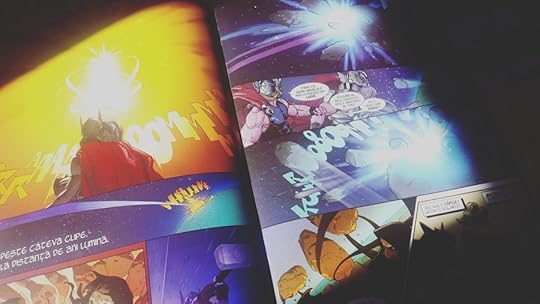
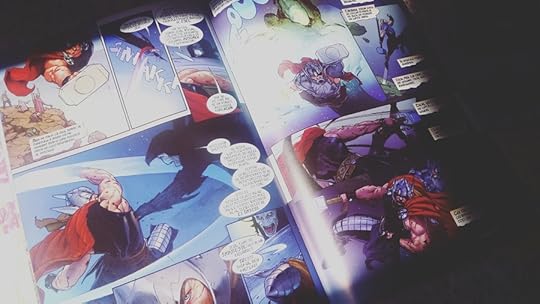
GODBOMB, Part Three of Five Three Thors, side by side at last, united in battle! But will even that be enough, as Gorr the God Butcher's grand plan nears completion and his powers grow beyond anything we've seen before?
Jason Aaron grew up in a small town in Alabama. His cousin, Gustav Hasford, who wrote the semi-autobiographical novel The Short-Timers, on which the feature film Full Metal Jacket was based, was a large influence on Aaron. Aaron decided he wanted to write comics as a child, and though his father was skeptical when Aaron informed him of this aspiration, his mother took Aaron to drug stores, where he would purchase books from spinner racks, some of which he still owns today.
Aaron's career in comics began in 2001 when he won a Marvel Comics talent search contest with an eight-page Wolverine back-up story script. The story, which was published in Wolverine #175 (June 2002), gave him the opportunity to pitch subsequent ideas to editors.
In 2006, Aaron made a blind submission to DC/Vertigo, who published his first major work, the Vietnam War story The Other Side which was nominated for an Eisner Award for Best Miniseries, and which Aaron regards as the "second time" he broke into the industry.
Following this, Vertigo asked him to pitch other ideas, which led to the series Scalped, a creator-owned series set on the fictional Prairie Rose Indian Reservation and published by DC/Vertigo.
In 2007, Aaron wrote Ripclaw: Pilot Season for Top Cow Productions. Later that year, Marvel editor Axel Alonso, who was impressed by The Other Side and Scalped, hired Aaron to write issues of Wolverine, Black Panther and eventually, an extended run on Ghost Rider that began in April 2008. His continued work on Black Panther also included a tie-in to the company-wide crossover storyline along with a "Secret Invasion" with David Lapham in 2009.
In January 2008, he signed an exclusive contract with Marvel, though it would not affect his work on Scalped. Later that July, he wrote the Penguin issue of The Joker's Asylum.
After a 4-issue stint on Wolverine in 2007, Aaron returned to the character with the ongoing series Wolverine: Weapon X, launched to coincide with the feature film X-Men Origins: Wolverine. Aaron commented, "With Wolverine: Weapon X we'll be trying to mix things up like that from arc to arc, so the first arc is a typical sort of black ops story but the second arc will jump right into the middle of a completely different genre," In 2010, the series was relaunched once again as simply Wolverine. He followed this with his current run on Thor: God of Thunder.
Așteptam de mult timp confruntarea dintre Thor și Zeul Măcelar, Gorr. Se pare că așteptarea a luat sfârșit, și chiar am reușit să mă bucur de o confruntare în care am avut parte nu de un Thor, ci de trei!
Lupta pe care am tot așteptat-o și la care am sperat de atât de mult timp mi s-a părut destul de intensă, însă mi-aș fi dorit să o simt mai mult. Cele trei ciocane adunate laolaltă, puterea celor trei zei măreți reunită la un loc, fulgerele și tunetele toate în același spațiu și timp, îmi dădeau impresia că ceva mai măreț avea să ia naștere.
Finalul mi-a dovedit însă contrariul, dar în acest mod m-a lăsat și în suspans. Dacă nu exista acest final, probabil nu așteptam la fel de nerăbdătoare următorul număr din această bandă desenată.
Nu am mai asista la folosofie și alte polologhii de această dată, dar am apreciat cum lupta a fost prezentată cititorului printr-o împletire atentă dintre cadrele care alternează între întuneric și lumină, replicile personajelor care își exprimă tăria interioară pentru a lupta, și narațiunea care adaugă un ton oarecum grav asupra evenimentelor.
Am citit numărul cu interes, însă simțeam nevoia de ceva mai mult de această dată. Poate că voi fi surprinsă în aceea ce urmează să se întâmple. Poate la fel de surprinsă ca și familia lui Gorr care nu știe ce va urma după aceea... după ce bomba va exploda, și sfârșitul zeilor va veni.
"Y Thor miró su obra. Y supo que era sólo el principio. Thor el padre. El señor de Asgard. Thor el rey de reyes. El joven Thor tenía un martillo en la mano y un grito de guerra vikingo en los labios. Bajo la furia, sonreía. Thor el hijo de Odín. El príncipe de Asgard. Thor el redentor sangriento. Thor el vengador luchó con el espíritu de una multitud. Thor el héroe sagrado. Campeón del cosmos. Thor el martillo del cielo. Los tres Thors. Los mayores de todos los dioses. O eso dice la Historia."
This is mostly one long action-type fight, and with the best will in the world I'm never that interested in those. What I am interested in is the characterisation of Avenger-Thor as the god who doubts. Because, retreading old ground that he is, Gorr is still right in that all these deities do seem fairly useless from the perspective of the ordinary individual. We all have to grapple at one stage or other with the what-good-are-you? question, and it seems the gods have, in general, been putting this off. I hope this is something that's further explored in later issues, because more characterisation and less throwing around of hammers is what's going to appeal most to me, I think.
#9 – Faith in the Storm Thor, in a rare act of vulnerability, prays. It’s a moment of humility and growth, symbolizing his evolution across the timeline. Meanwhile, Gorr’s son fully turns on him, recognizing that his father has become what he hated. Emotionally heavy and thematically rich.
This issue features a change in writing style to mimic the way a myth might be told. This new style was very successful at making this issue and the story seem like an ancient myth. Although the actual story was a bit boring.