Jump to ratings and reviews
Rate this book

A Little Tour in France

Rate this book
From Tours to Dijon, James tells of the towns and cities, the church and inns, the museums and palaces. "I am ashamed to begin with saying that Touraine is the garden of France; that remark has long ago lost its bloom. The town of Tours, however, has something sweet and bright, which suggests that it is surrounded by a land of fruits. It is a very agreeable little city; few towns of its size are more ripe, more complete, or, I should suppose, in better humor with themselves and less disposed to envy the responsibilities of bigger places. It is truly the capital of its smiling province . . ."

160 pages, Paperback

First published January 1, 1884

25 people are currently reading
282 people want to read

About the author

Henry James

4,563 books3,952 followers
Henry James was an American-British author. He is regarded as a key transitional figure between literary realism and literary modernism, and is considered by many to be among the greatest novelists in the English language. He was the son of Henry James Sr. and the brother of philosopher and psychologist William James and diarist Alice James.
He is best known for his novels dealing with the social and marital interplay between émigré Americans, the English, and continental Europeans, such as The Portrait of a Lady. His later works, such as The Ambassadors, The Wings of the Dove and The Golden Bowl were increasingly experimental. In describing the internal states of mind and social dynamics of his characters, James often wrote in a style in which ambiguous or contradictory motives and impressions were overlaid or juxtaposed in the discussion of a character's psyche. For their unique ambiguity, as well as for other aspects of their composition, his late works have been compared to Impressionist painting.
His novella The Turn of the Screw has garnered a reputation as the most analysed and ambiguous ghost story in the English language and remains his most widely adapted work in other media. He wrote other highly regarded ghost stories, such as "The Jolly Corner".
James published articles and books of criticism, travel, biography, autobiography, and plays. Born in the United States, James largely relocated to Europe as a young man, and eventually settled in England, becoming a British citizen in 1915, a year before his death. James was nominated for the Nobel Prize in Literature in 1911, 1912, and 1916. Jorge Luis Borges said "I have visited some literatures of East and West; I have compiled an encyclopedic compendium of fantastic literature; I have translated Kafka, Melville, and Bloy; I know of no stranger work than that of Henry James."

Ratings & Reviews

What do you think?
Rate this book

Friends & Following

Create a free account to discover what your friends think of this book!

Community Reviews

5 stars
18 (16%)
4 stars
38 (34%)
3 stars
42 (37%)
2 stars
10 (9%)
1 star
3 (2%)
Displaying 1 - 21 of 21 reviews
Profile Image for TBV (on hiatus).
307 reviews70 followers
October 17, 2019
Henry James has taken me on an interesting tour of France, starting in the Loire valley, then on to Brittany via Loches and Bourges, also visiting the Bordeaux region before heading south to Provence and then returning to Paris via the Burgundy region. However, I had to take some detours en-route. The first was to read Le Curé De Tours by Honoré de Balzac* as this novella is discussed at the start of James’s tour which commences in Tours, the birthplace of Balzac. Mr James had a companion with him, but we weren't introduced; instead said companion was referred to as "my companion" or "we". This travel memoir certainly had me poring over my own photos of many of the places he visited. Here is my own photo of
La Cathédrale de Saint-Gatien
 photo IMG_0034_zps9wch03lg.jpg

which features in Balzac's novella and in James's discussion of Tours. “Balzac, in the maturity of his vision, took in more of human life than any one, since Shakspeare, who has attempted to tell us stories about it; and the very small scene on which his consciousness dawned is one end of the immense scale that he traversed.” The building of the cathedral commenced in the 12th century, but took centuries to complete.

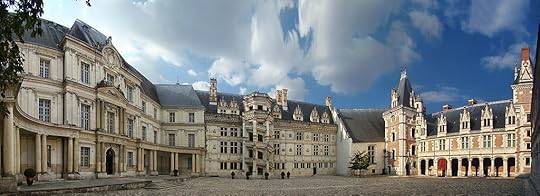
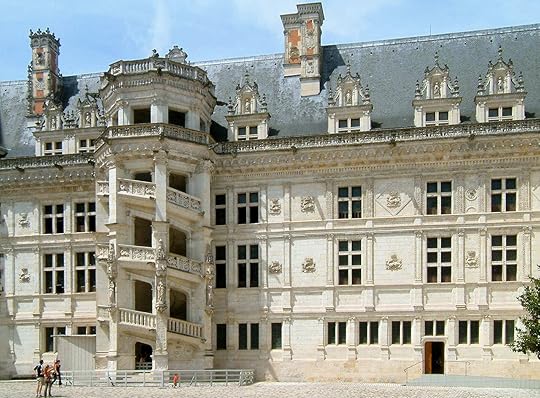
Of the entire tour he mentions how few tourists there were. One wonders what he would have said had he seen the vast numbers of tourists who now visit these historic sites in order to take their almost obligatory selfies. However, Henry James ponders and mentions the history of these places, and what he sees on the way: “… the women in the fields, the white caps, the faded blouses, the big sabots”. The châteaux, cathedrals and other historic sites are of course still the same age-old buildings (give or take a restoration or two), but life has changed. Fortunately many of these places have been cleaned and given a new lease of life as some of the places he visited were dirty and dingy at the time. Of the erstwhile residence of Louis XI (known as the Spider King), Plessis-les-Tours, James comments: “The dreadful Louis is reduced simply to an offence to the nostrils.” Of the Château de Blois, previously the home of several kings, he says: “This exquisite, this extravagant, this transcendent piece of architecture is the most joyous utterance of the French Renaissance.” Today tourists are allowed to sit under a canopy decorated with the fleur de lys, and take selfies with which to proclaim "I was at Blois Castle!”. This, however, you won't find today: “Every spot connected with the murder of the Duke of Guise is pointed out by a small, shrill boy, who takes you from room to room, and who has learned his lesson in perfection. The place is full of Catherine de' Medici, of Henry III., of memories, of ghosts, of echoes, of possible evocations and revivals. It is covered with crimson and gold. The fireplaces and the ceilings are magnificent; they look like expensive sets at the grand opera.” The fireplaces and evocations are there but no small boy to expertly guide you.

Château de Blois**


And so Henry James visits several more châteaux, saying as he drives away from the Château de Chambord: “The light had already begun to fade, and my drive reminded me of a passage in some rural novel of Madame Sand.”

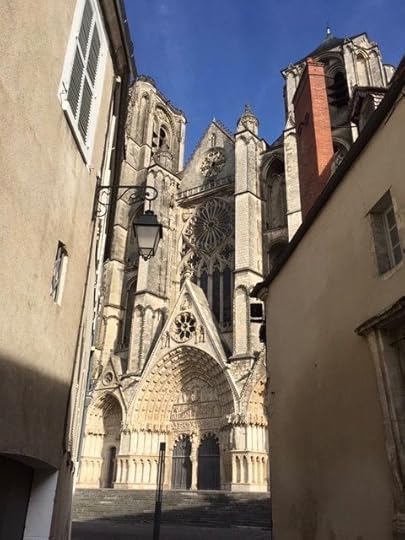
James is enchanted by Loches, and suitably impressed by the enormous cathedral at Bourges. He describes how he first saw it from a little side street - so did I:
 photo IMG_0879_zpsihcopkaa.jpeg
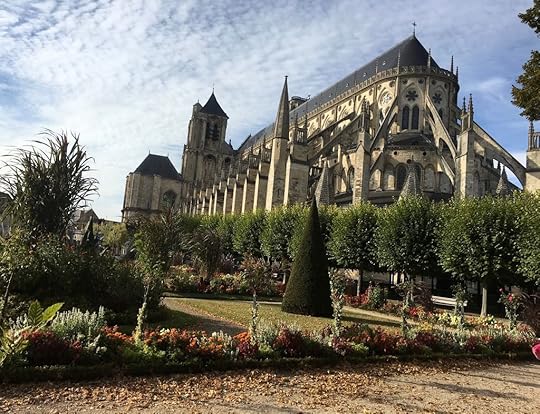
He also delighted in the gardens of the Archeveche at the cathedral:
 photo IMG_0891_zpskn95vfhy.jpg

Of La Rochelle he says: “It was strange to think, as I strolled through the peaceful little port, that these quiet waters, during the wars of religion, had swelled with a formidable naval power. The Rochelais had fleets and admirals, and their stout little Protestant bottoms carried defiance up and down.”

He is impressed by the magnificent Carcassonne. “For myself, I have no hesitation; I prefer in every case the ruined, however ruined, to the reconstructed, however splendid. What is left is more precious than what is added: the one is history, the other is fiction; and I like the former the better of the two, it is so much more romantic. One is positive, so far as it goes; the other fills up the void with things more dead than the void itself, inasmuch as they have never had life. After that I am free to say that the restoration of Carcassonne is a splendid achievement.” Carcassonne had recently (1853) been restored by the famous Eugène Viollet-le-Duc. James travels in the eighteen eighties.
Carcassonne
 photo IMG_1903_zps08houoy0.jpeg

And so his travels continue around the country with his anonymous companion. Sometimes his comments are phlegmatic and on occasion they are acerbic; mostly his humour is wry. He describes the art and architecture, recounts historic snippets, there are literary references, comments on his lodgings and meals. He finds time to chat to a local here and there. On a train he finds himself with characters straight out of Balzac's La Comédie Humaine.

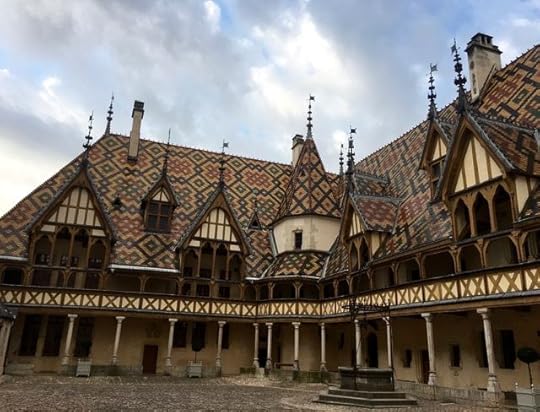
In Burgundy he stopped briefly (between trains) at Beaune where he managed a very short visit to the Hospices de Beaune founded in the 15th century:
 photo IMG_0787_zpsaduxvcy7.jpg

*Le Curé de Tours is story #32 in Honoré de Balzac's magnificent opus La Comédie Humaine. These stories may be read out of sequence.

**Photos are my own except for the photo of the Château de Blois which is from Wikipedia - attribution

#
Although I read a Kindle edition of Henry James's A Little Tour of France, I also own the beautiful Library of America edition: Collected Travel Writings: The Continent: A Little Tour in France / Italian Hours / Other Travels
As the former is full of typographical errors, I suggest that you opt for the latter if you can as it is also beautifully illustrated.
Profile Image for Kim.
426 reviews542 followers
May 10, 2013

Updated with a few pics from my recent trip to France

I’m a bit afraid of Henry James. It’s not that I actively dislike his writing. It’s just that I’ve not been tempted to re-read those of his novels I’ve read and, having sighed over his verbosity and resented having to hunt back through the text to find the beginning of a particularly convoluted sentence, I’ve always thought of him as a “difficult” writer.

Reading this book – which until a few weeks ago I didn’t even know existed - has given me a whole new appreciation for James’ writing. Originally published in serial form in The Atlantic Monthly in 1883-1884, it’s an account of James’ travels in provincial France in the early 1880s. Starting with the idea that "France may be Paris, but Paris is not France", James spent six weeks travelling to various provincial towns, starting in the Loire Valley, going south-west to Bordeaux, through various towns in the south of France, before heading north through the Rhône Valley to Dijon in Burgundy. He describes the churches, castles and other buildings he visited, the inns he stayed in, the meals he ate and the people he met. However, this is no Lonely Planet guide. (Not that there’s anything necessarily wrong with a Lonely Planet guide, I hasten to add). Rather, it’s a learned, witty and erudite discussion of art, architecture, history and culture, interspersed with insightful observations on the joys and discomforts of travel, all of it communicated in accessible prose and blessedly short sentences.

One of the things about this work that most endeared me to James comes early on. In Chapter II, James describes looking at some old houses to the north of the cathedral in Tours. Why? Because characters in a Balzac novella – The Vicar of Tours - lived in one of them. I love that Henry James went on literary pilgrimages, one of my favourite travel activities.

I may not have enjoyed reading this delightful work quite so much if I'd not recently completed my own little tour in France, covering some of the same territory James covered more than 130 years ago. Remembering those places I’d visited such a short time ago certainly enriched the reading experience. I found myself reading passages aloud to my husband, marveling at how similar James’ experiences of particular places had been to our own and at how much more skilled he was at describing those experiences. I could give many examples of this, but I’ll limit myself to James’ description of the landscape in Provence, of which he writes:
…[F]or there is an inexhaustible sweetness in the gray-green landscape of Provence. It is never absolutely flat, and yet is never really ambitious, and is full both of entertainment and repose. It is in constant undulation, and the bareness of the soil lends itself easily to outline and profile. When I say the bareness, I mean the absence of woods and hedges. It blooms with heath and scented shrubs and stunted olive; and the white rock shining through the scattered herbage has a brightness which answers to the brightness of the sky.

From châteaux in the Loire Valley to Nîmes, to Arles, to the Pont du Gard, to Les Baux, to Avignon, to Lyon, I love that I unknowingly followed in Henry James’ footsteps, walking the same streets and seeing the same sights. I wouldn’t have known that I’d done so, if it hadn’t been for this book turning up in my GR friend Jane Steen’s update feed. Thank you, Jane!

A word of caution: I read this on my Kindle and, cheapskate that I am, made the mistake of downloading the free version. It was full of punctuation and spelling errors. Not so bad that it was unreadable, but enough to be annoying. James would be appalled to see how his work has been digitised. He would, I’m sure, have a very sharp word to say to the person responsible.

ETA:

This seems a good a place as any to post a few photos taken on my recent trip to France.

First, my favourite place in Provence, St Paul-de-Mausole, the asylum where Vincent Van Gogh was a voluntary patient for a year:

[image error]

Vincent's room:

[image error]

The medieval town of Les Baux:

[image error]

The Roman acquaduct Pont du Gard, not far from Nîmes:

[image error]

Le pont Saint Bénezet in Avignon, on which I danced while I sang the old French song:

[image error]

Chinon castle in the Loire Valley, where Henry II lived with Eleanor of Aquitaine:

[image error]

More photos to come ....
Profile Image for Laura.
7,134 reviews607 followers
July 16, 2013
Free download available at Project Gutenberg.

Locations 43-44:
The great dike which protects it, or, protects the country from it, from Blois to Angers, is an admirable road; and on the other side, as well, the highway con- stantly keeps it company.

Locations 53-55:
The Palais de Justice was the seat of the Government of Leon Gambetta in the autumn of 1870, after the dictator had been obliged to retire in his balloon from Paris, and before the Assembly was constituted at Bordeaux.

Locations 56-57:
It is hardly too much to say that wherever one goes in, certain parts of France, one encounters two great historic facts: one is the Revolution; the other is the German invasion.

Locations 63-65:
The most interesting fact, to my mind, about the high-street of Tours was that as you walked toward the bridge on the right-hand trottoir you can look up at the house, on the other side of the way, in which Honore de Balzac first saw the light. That violent and complicated genius was a child of the good-humored and succulent Touraine.

Locations 108-109:
The cathedral of Tours, which is dedicated to Saint Gatianus, took a long time to build. Begun in 1170, it was finished only in the first half of the sixteenth century;

Locations 246-249:
If you come down to Tours from Paris, your best economy is to spend a few days at Blois, where a clumsy, but rather attractive little inn, on the edge of the river, will offer you a certain amount of that familiar and intermittent hospitality which a few weeks spent in the French provinces teaches you to regard as the highest attainable form of accommodation.

Locations 255-256:
The Chateau de Blois is one of the most beautiful and elaborate of all the old royal residences of this part of France, and I suppose it should have all the honors of my description.

Location 375:
Chambord has a strange mixture of society and solitude.

Locations 468-469:
I had but a rapid and partial view of Cheverny; but that view was a glimpse of perfection.
Locations 524-525:
Amboise was a fre-quent resort of the French Court during the sixteenth century; it was here that the young Mary Stuart spent sundry hours of her first marriage.

Locations 565-566:
It was in the castle (Chinon) that Jeanne Darc ????? had her first interview with Charles VII., and it is in the town that Francois Rabelais is supposed to have been born.

Locations 568-569:
"In 1747," says Jean-Jacques Rousseau, in his "Confessions," "we went to spend the autumn in Tou- raine, at the Chateau, of Chenonceaux, a royal resi- dence upon the Cher, built by Henry II. for Diana of Poitiers,

Locations 706-707:
Langeais is rather dark and gray; it is perhaps the simplest and most severe of all the castles of the Loire.

Locations 757-758:
Loches is certainly one of the greatest impressions of the traveller in central France, - the largest cluster of curious things that presents itself to his sight.

Locations 847-848:
The cathedral of Bourges is indeed magnificently huge; and if it is a good deal wanting in lightness and grace it is perhaps only the more imposing.

Locations 1009-1010:
Here (Cathedral of Le Mans) is the house of Queen Berengaria, - an absurd name, as the building is of a date some three hundred years later than the wife of Richard Coeur de Lion, who has a sepulchral monument in the south aisle of the cathedral.

Locations 1068-1071:
Angers figures with importance in early English history: it was the capital city of the Plantagenet race, home of that Geoffrey of Anjou who married, as second husband, the Empress Maud, daughter of Henry I. and competitor of Stephen, and became father of Henry II., first of the Plantagenet kings, born, as we have seen, at Le Mans.

Locations 1143-1146:
The chateau (Nantes) is naturally not wanting in history. It was the residence of the old Dukes of Brittany, and was brought, with the rest of the province, by the Duchess Anne, the last representative of that race, as her dowry, to Charles VIII. I read in the excellent hand-book of M. Joanne that it has been visited by almost every one of the kings of France, from Louis XI.


Locations 1154-1155:
The man who showed me the castle in- dicated also another historic spot, a house with little tourelles, on the Quai de la Fosse, in which Henry IV. is said to have signed the Edict of Nantes.

Location 1172:
On the south side stands the tomb of Francis II., the last of the Dukes of Brittany, and of his second wife, Margaret of Foix…

Locations 1214-1215
La Rochelle, which from the moment I entered it I perceived to be a fascinating little town, a most original mixture of brightness and dulness.

Locations 1334-1335:
The lion of Poitiers, in the eyes of the natives, is doubtless the Palais de Justice, in the shadow of which the statue-guarded hotel,

Locations 1405-1406:
For the rest, Bordeaux is a big, rich, handsome, imposing com- mercial town, with long rows of fine old eighteenth- century houses, which overlook the yellow Garonne.

Locations 1479-1480:
Except the church of Saint- Sernin and the fine old court of the Hotel d'Assezat, Toulouse has no architecture;

Locations 1548-1549:
For the rest, the picturesque at Toulouse consists principally of the walk beside the Garonne, which is spanned, to the faubourg of Saint-Cyprien, by a stout brick bridge.

Locations 1649-1651:
The writer makes a jump to the year 1209, when Carcassonne, then forming part of the realm of the viscounts of Beziers and infected by the Albigensian heresy, was besieged, in the name of the Pope, by the terrible Simon de Montfort and his army of crusaders.

Locations 1794-1796:
The place (Montpellier) is charming, all the same; and it served the purpose of John Locke; who made a long stay there, between 1675 and 1679, and became acquainted with a noble fellow-visitor, Lord Pembroke, to whom he dedicated the famous Essay.

Locations 1806-1808:
He (Francois Fabre) was the hero of a remarkable episode, having succeeded no less a person than Vittorio Alfieri in the affections of no less a person than Louise de Stolberg, Countess of Albany, widow of no less a person than Charles Edward Stuart, the second pretender to the British crown.

Locations 1921-1922:
It was my belief that Aigues-Mortes was a little gem, and it is natural to desire that gems should have an opportunity to sparkle.

Locations 2044-2045:
On my way from Nimes to Arles, I spent three hours at Tarascon; chiefly for the love of Alphonse Daudet, who has written nothing more genial than "Les Aventures Prodigieuses de Taitarin," and the story of the "siege" of the bright, dead little town (a mythic siege by the Prussians) in the "Conies du Lundi."

Location 2236:
We knew in advance, my companion and I that Les Baus was a pearl of picturesqueness;

Locations 2381-2382:
The fact, indeed, is simply that the palace (Papal Palace in Avignon) has been so incalculably abused and altered.

Locations 2776-2777:
The principal lion is the Hopital-Saint-Esprit, or the Hotel-Dieu, simply, as they call it there, founded in 1443 by Nicholas Rollin, Chancellor of Burgundy.

Locations 2781-2783:
The treasure of the place is a precious picture, - a Last Judgment, attributed equally to John van Eyck and Roger van der Weyden, - given to the hospital in the fifteenth century by Nicholas Rollin aforesaid.

Profile Image for Bettie.
9,976 reviews6 followers
March 6, 2014
Opening: We good Americans - I say it without presumption - are too apt to think that France is Paris, just as we are accused of being too apt to think that Paris is the celestial city. This is by no means the case, fortun- ately for those persons who take an interest in modern Gaul, and yet are still left vaguely unsatisfied by that epitome of civilization which stretches from the Arc de Triomphe to the Gymnase theatre. It had already been intimated to the author of these light pages that there are many good things in the doux pays de France of which you get no hint in a walk between those ornaments of the capital; but the truth had been re- vealed only in quick-flashing glimpses, and he was conscious of a desire to look it well in the face. To this end he started, one rainy morning in mid-Septem- ber, for the charming little city of Tours, from which point it seemed possible to make a variety of fruitful excursions. His excursions resolved themselves ulti- mately into a journey through several provinces, - a journey which had its dull moments (as one may defy any journey not to have), but which enabled him to feel that his proposition was demonstrated. France may be Paris, but Paris is not France; that was perfectly evident on the return to the capital.

St Martin's, Tours

Chateau de Blois

It was Laura's flister Kim who came across this travelogue and she mentions in her review that the punctuation is bad in the Gutenberg edition and I have to agree; this paragraph will highlight how an.;no-.yin:g it is:

The immediate successors of Francis I. continued to visit, Chambord; but it was neglected by Henry IV., and was never afterwards a favorite residence of any French king. Louis XIV. appeared there on several occasions, and the apparition was characteristically brilliant; but Chambord could not long detain a monarch who had gone to the expense of creating a Versailles ten miles from Paris.

That aside, I have just revisited via Henry James, fond memories of past excursions.

Shrapnel.
Profile Image for JodiP.
1,063 reviews2 followers
February 8, 2013
This made me want to go to France, this book in hand to see all the sights James had done. And, oh, to be able to go back in time, and see things as he did! Everything of course would be so changed. An utterly delightful travelogue that helped me with my insomnia.
Profile Image for Dana.
56 reviews3 followers
February 3, 2013
Wonderful to read this while planning my own tour of the same places more than 100 years after this was written. Amazing how little some places have changed.
Profile Image for Liam Murray.
49 reviews3 followers
April 6, 2022
From the Introduction:
‘“France may be Paris, but Paris is not France.” Wishing to see what lay beyond the bounds of the 'celestial city', Henry James devoted much of the autumn of 1882 to his 'little tour'. Beginning at Tours, the birthplace of Balzac, he went on various excursions to the great châteaux of the Loire - including Blois, Chambord and Chenonceaux. Then he made his leisurely way south to the heart of the Midi and to the glorious historic cities of Nantes, Bordeaux, Carcassonne, Nîmes and Avignon.’

I’ve never managed to finish any of James’ books so I started A Little Tour in France with low expectations only to be very pleasantly surprised. James was 39 when he made this journey, fit enough to walk across the Alps the previous year, fluent in French and thus capable of digging deeper into the people and places he visits. He travels with a guidebook that he cherishes, referring to it in turns as ‘the judicious Murray’, ‘my faithful Murray’ and ultimately ‘my indispensable Murray’ [I tried, unsuccessfully, to get my wife to use these terms when addressing me], and I came to have similar feelings about this book.

He lived in a period when travel was more difficult but also more leisurely, and with James filling the senses there’s plenty of time to stop and smell the flowers. Here he is in Carcassonne, escaping from his enthusiastic tour-guide:

‘There was a relief in separating from our accomplished guide, whose manner of imparting information reminded me of the energetic process by which I have seen mineral waters bottled. All this while the afternoon had grown more lovely; the sunset had deepened, the horizon of hills grown purple; the mass of the Canigou became more delicate, yet more distinct. The day had so far faded that the interior of the little cathedral was wrapped in twilight, into which the glowing windows projected something of their colour. This church has high beauty and value […] and, shut up in its citadel like a precious casket in a cabinet, it seems or seemed at that hour to have a sort of double sanctity.
After leaving it and passing out of the two circles of walls, I treated myself, in the most infatuated manner, to another walk round the Cité. It is certainly this general impression that is most striking-the impression from outside, where the whole place detaches itself at once from the landscape. In the warm southern dusk it looked more than ever like a city in a fairy-tale. To make the thing perfect, a white young moon, in its first quarter, came out and hung just over the dark silhouette. It was hard to come away-to incommode one's self for anything so vulgar as a railway-train; I would gladly have spent the evening in revolving round the walls of Carcassonne. But I had in a measure engaged to proceed to Narbonne, and there was a certain magic in that name'. [145]

Even when he’s less infatuated he’s no less incisive. In Angers:

‘It is fair to say that the Château d'Angers is by itself worth a pilgrimage; the only drawback is that you have seen it in a quarter of an hour. You cannot do more than look at it, and one good look does your business. It has no beauty, no grace, no detail, nothing that charms or detains you; it is simply very old and very big.’

In Nantes:

‘The château is naturally not wanting in history. It was the residence of the old Dukes of Brittany, and was brought, with the rest of the province, by the Duchess Anne, the last representative of that race, as her dowry, to Charles VIII. I read [...] that it has been visited by almost every one of the kings of France, from Louis XI downward; and also that it has served as a place of sojourn less voluntary on the part of various other distinguished persons.'

In Beaune:

'I turned […] with that sense of defeat which is always irritating to the appreciative tourist, and pottered about Beaune rather vaguely for the rest of my hour: looked at the statue of Gaspard Monge, the mathematician, in the little place (there is no place in France too little to contain an effigy to a glorious son); at the fine old porch-completely despoiled at the Revolution of the principal church; and even at the meagre treasures of a courageous but melancholy little museum, which has been arranged-part of it being the gift of a local collector-in a small hôtel de ville. I carried away from Beaune the impression of something mildly autumnal-something rusty yet kindly, like the taste of a sweet russet pear.’ [180]

In Toulouse:

‘And then my note-book goes on to narrate a little visit to the Capitol, which was soon made, as the building was in course of repair and half the rooms were closed'. [126]
[They don't rush these things in France: when I visited Toulouse in the summer of 2021 it was still 'in course of repair' with half of the rooms shut off.]

I’d heard that Toulouse was beautiful (‘the famous pink city’) but it underwhelmed, so this description rang true:

‘It came to me, then, that in all this view there was something transalpine […] the softness and sweetness of the light and air, recalled the prosier portions of the Lombard plain. Toulouse itself has a little of this Italian expression, but not enough to give a colour to its dark, dirty, crooked streets, which are irregular without being eccentric, and which, if it were not for the superb church of Saint-Sernin, would be quite destitute of monuments. […] The shops are probably better than the Turinese, but the people are not so good. Stunted, shabby, rather vitiated looking, they have none of the personal richness of the sturdy Piedmontese; and I will take this occasion to remark that in the course of a journey of several weeks in the French provinces I rarely encountered a well-dressed male'. [124/5]

To be well-dressed, to be elegant, to be noble: there are the biggest compliments James can pay, to be vulgar his biggest insult. Here he is, brilliantly insightful if characteristically snobbish, on the difference between an Englishman and a Frenchman:

‘one is reminded at every turn, of the democratic conditions of French life: a man of the people, with a wife en bonnet, extremely intelligent, full of special knowledge, and yet remaining essentially of the people, and showing his intelligence with a kind of ferocity, of defiance. Such a personage helps one to understand the red radicalism of France, the revolutions, the barricades, the sinister passion for theories. […] In just the nuance that I have tried to indicate here, it is a terrible pattern of man. Permeated in a high degree by civilisation, it is yet untouched by the desire which one finds in the Englishman, in proportion as he rises in the world, to approximate to the figure of the gentleman.’

He can be caustically dismissive of his fellow travellers - ‘the visitor is doubtless often an ignoramus’- but he has a felicity at capturing the working class at work that is almost unequalled, as when he arrives at Narbonne:

‘The Canal du Midi flows through the town, and, spanned at this point by a small suspension-bridge, presented a certain sketchability. On the further side were the vendors and chafferers-old women under awnings and big umbrellas, rickety tables piled high with fruit, white caps and brown faces, blouses, sabots, donkeys. Beneath this picture was another- a long row of washerwomen, on their knees on the edge of the canal, pounding and wringing the dirty linen of Narbonne- no great quantity, to judge by the costume of the people. Innumerable rusty men, scattered all over the place, were buying and selling wine, straddling about in pairs, in groups, with their hands in their pockets and packed together at the doors of the cafés. They were mostly fat and brown and unshaven; they ground their teeth as they talked; they were very méridionaux'. [150]
[‘presented a certain sketchability’ -James describes many places as worthy of a sketch but never appears to actually sketch any of them.]

He also uses Stendhal’s travel book as a guide:

‘I have met him at Tours, at Nantes, at Bourges; and every where he is suggestive. But he has the defect that he is never pictorial, that he never by any chance makes an image, and that his style is perversely colourless, for a man so fond of contemplation. [….] It was a pleasure to me to reflect that five-and-forty years ago he had alighted in that city, at the very inn in which I spent a night, and which looks down on the Place Graslin and the theatre. The hotel that was the best in 1837 appears to be the best to-day'. [155]

I read and re-read many passages in this book, savouring the richness of the language and the penetrating eye of the author. Here he is at the aqueduct in Arles:

‘The preservation of the thing is extraordinary; nothing has crumbled or collapsed; every feature remains; and the huge blocks of stone, of a brownish-yellow (as if they had been baked by the Provençal sun for eighteen centuries), pile themselves, without mortar or cement, as evenly as the day they were laid together. All this to carry the water of a couple of springs to a little provincial city! The conduit on the top has retained its shape and traces of the cement with which it was lined. When the vague twilight began to gather, the lonely valley seemed to fill itself with the shadow of the Roman name, as if the mighty empire were still as erect as the supports of the aqueduct; and it was open to a solitary tourist, sitting there sentimental, to believe that no people has ever been, or will ever be, as great as that, measured, as we measure the greatness of an individual, by the push they gave to what they undertook’. [162]

Like Henry James, I spent some time travelling around France; where he spent a few months, I took a year, travelling and working from Paris to the Loire, then on to the French Alps, Lyon, Toulouse, Nice and back to Angers and the countryside of Burgundy. As I read this book I tried to imagine what must it have been like to travel with such a man, or just to be able to see the world as he sees it or -even better if even less likely- to be able to describe that world. He misses nothing and has an unerring eye for detail, and these details accumulate to create vivid and fascinating sketches of people and places and journeys, such as when he shares a carriage with two monks, the younger of whom wears

'a scourge round his waist, a stout leather thong, and he carried with him a very profane little valise. He also read from beginning to end, the Figaro which the old priest, who had done the same, presented to him; and he looked altogether as if, had he not been a monk, he would have made a distinguished officer of engineers. When he was not reading the Figaro he was conning his breviary or answering, with rapid precision and with a deferential but discouraging dryness, the frequent questions of his companion, who was of quite another type. This worthy had a bored, good-natured, unbuttoned, expansive look; was talkative, restless, almost disreputably human. He was surrounded by a great deal of small luggage, and had scattered over the carriage his books, his papers, the fragments of his lunch, and the contents of an extraordinary bag, which he kept beside him a kind of secular reliquary- and which appeared to contain the odds and ends of a lifetime, as he took from it successively a pair of slippers, an old padlock (which evidently didn't belong to it), an opera-glass, a collection of almanacs, and a large sea-shell, which he very carefully examined. I think that if he had not been afraid of the young monk, who was so much more serious than he, he would have held the shell to his ear, like a child. Indeed, he was a very childish and delightful old priest, and his companion evidently thought him most frivolous. But I liked him the better of the two. He was not a country curé, but an ecclesiastic of some rank, who had seen a good deal both of the church and of the world; and if I too had not been afraid of his colleague, who read the Figaro as seriously as if it had been an encyclical, I should have entered into conversation with him'. [119]

In the Languedoc:

‘Spent but a few hours at Carcassonne; but those hours had a rounded felicity, and I cannot do better than transcribe from my note-book the little record made at the moment. Vitiated as it may be by crudity and incoherency, it has at any rate the freshness of a great emotion. This is the best quality that a reader may hope to extract from a narrative in which "useful information" and technical lore even of the most general sort are completely absent. For Carcassonne is moving, beyond a doubt; and the traveller who, in the course of a little tour in France, may have felt himself urged, in melancholy moments, to say that on the whole the disappointments are as numerous as the satisfactions, must admit that there can be nothing better than this'. [Chapter XXII]

To be moving, to have the freshness of a great emotion: if this is the essential quality in a travel book, then ‘A Little Tour in France’ fully passes James own test. As I put it down it occurred to me that a reader is in many ways like a traveller: we all visit many of the same places, we meet similar people, stay -all too often in France- in the same hotels, and we look at similar sights. And yet, and yet … there is another way to look, and although we can’t expect to have the descriptive powers on Henry James, we can opt to see with different eyes, so that if we don’t see the value in something it simply means we’re not looking closely enough.

Perhaps it’s time I gave The Portrait of a Lady another go.
Profile Image for Carol.
825 reviews
May 11, 2013
"France may be Paris, but Paris is not France." -- written by Henry James. Originally published in 1882, James takes the reader on a tour beginning at Tours (birthplace of Balzac), and on several excursions to the chateau of the Loire, Blois, Chambord and Chenonceaux. James then traveled south, to Midi, Nantes, Bordeaux, Carcassonne, Nimes, and Avignon. James was a thorough traveller and loved France's countryside.

Originally published in 1884 without illustrations but in 1900 a new edition appeared with 94 watercolors reproduced in black and white. An now a century later, beautiful colored paintings by many 19th century artists.
Profile Image for Deb (Readerbuzz) Nance.
6,460 reviews336 followers
December 30, 2025
I was in the mood for a bit of travel. Why not take a little tour of France? And how about having Henry James as my tour guide?

A Little Tour in France is based on a six-week trip to the provincial towns of France taken by writer Henry James and first published as a serial in 1883 through 1884 in the Atlantic Monthly. James takes us through Tours, Bourges, Nantes, Toulouse, La Rochelle, Caroassonne, and Avignon.

I enjoyed the conversational style of James and he starts each chapter with a strong lead. But he focuses on architecture and he never mentions food, and how can you possibly have a good travel book about France without mention of food?

I'd love to see someone take this book and use it as a starter for a contemporary version of A Little Tour. What is still there? What has changed?
Profile Image for Rachel Glass.
657 reviews4 followers
April 27, 2020
In many ways this is a charming little book, full of humorous comments, where James frequently admits to ignorance of central information about places he's visited, and is particularly interesting if you have visited any of the places he describes. Having spent some time living in Tours, I enjoyed the descriptions of Touraine and its chateaux, and was on James' side the moment he started to praise Tours itself.

What's interesting is that of course the historical monuments are practically unchanged since James' day, and you could still undertake his entire journey by train, but the normal French people he describes, as well as the hotels he complains about, would be quite different now.

The descriptions of cathedrals and churches I haven't seen, and the architecture of unknown towns, was not the most exciting. This definitely wouldn't be a book for everyone, and wouldn't be a practical guide to modern France, but it is gently entertaining for lovers of France and of James' wry observational powers.
Profile Image for Eliel Lopez.
124 reviews
September 26, 2024
I found this book in a quaint second hand store recently and as I flipped through it's pages I saw that there were sketches of the various places where the author had been and described in detail. As an avid drawer myself I had to have this book.
Given the fact that it was originally written in 1900 (!) and it was about a trek through France - pre WWI, I thought it would be an interesting read.
The prose was in an eloquent style of the old school and as I read through it, I imagined it being told to me in the late Peter Ustinov's voice, which he used in portraying the famous detective Hercule Poirot. It was witty and detailed and sometimes dry, but a fun read in that people usually don't speak like this in this present age.
Being a WWI history buff, I wondered if any of the places the author described still exist. After two world wars, perhaps not much if any does. Not having actually been to France, I guess much has changed with the times.
21 reviews
February 7, 2021
Parigi è la Francia ma la Francia non è Parigi.
Questo sarà il leit motiv del libro dove l'autore compie un viaggio nella Francia di Provincia del 1800.
Ovviamente i luoghi che visita sono diversi da quelli che ritroviamo ora.
Profile Image for 4EVER2Binluv.
67 reviews
January 17, 2022
An interesting read but hard to follow sometimes. I find it hard to totally visualize what is going on, but it was intriguing nonetheless.
Profile Image for Geoff Dodds.
2 reviews2 followers
July 24, 2016
The premise of Paris being France but France not being Paris is a delightful one. Whilst we are aware of this, in most pieces of literature about France, it is seemingly forgotten.
A little tour in France delivers a beautiful trip around France where James exposes his fantastic grasp of French history and these places position within the history of the nation. Juxtaposing these images of France with modern day France is a delightful process and one I would be interested to hear James's views on if he were writing today.

I knocked a star off as it gets a bit same-y after a while, this is no bad thing in general; I would simply have preferred a different focus now and again to spice things up.
Profile Image for Barbara.
219 reviews19 followers
August 29, 2016
This history of James's exploration of provincial France in the 1880s kept me charmed by its reflections on architecture, history, landscape, food, the condition of the population - delivered in prose in which an occasionally elevated style is salted with dry wit. I listened to a well-read Librivox version (obviously of a much earlier edition) .
Profile Image for Ginger.
8 reviews6 followers
March 24, 2013
I read this book during my first trip to France.
265 reviews2 followers
April 16, 2016
This really makes you want to visit France. And it makes you regret you couldn't make the trip in 1882 with Henry James.
Displaying 1 - 21 of 21 reviews

Can't find what you're looking for?

Get help and learn more about the design.