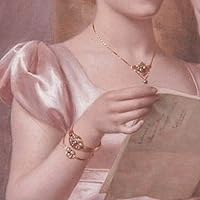
The enigmatic Anne Boleyn comes to life in this charming, brilliant portrayal by acclaimed British novelist Margaret Campbell Barnes.
The infamous love of King Henry VIII and the mother of Queen Elizabeth I, Anne Boleyn undertook a rocky journey from innocent courtier to powerful Queen of England. A meticulous researcher, Margaret Campbell Barnes immerses readers in this intrigue and in the lush, glittery world of the Tudor Court. The beauty and charms of Anne Boleyn bewitched the most powerful man in the world, King Henry VIII, but her resourcefulness and cleverness were not enough to stop the malice of her enemies. Her swift rise to power quickly became her own undoing.
The author brings to light Boleyn's humanity and courage, giving an intimate look at a young woman struggling to find her own way in a world dominated by men and adversaries.
Margaret Campbell Wood was born on 17 February 1891 in Rotherfield, Sussex, England, UK. She was the youngest of ten children, who had a happy childhood in the Sussex country side. She was eventually educated at small private schools in Paris and London.
She married Peter Barnes in 1917,( a furniture salesman), and the couple had two sons, Michael and John. Michael, a Royal Armoured Corps Lieutenant, was killed during WW II.
She died on 1 April 1962 in Yarmouth, Isle of Wight.
Her books are historical novels, called Shadows of the Crown, that follow the history of the English Crown. The majority of her books were written between the 1940's and 1950's. Her last and posthumous novel Lady on the Coin was finished by the novelist Hebe Elsna
Over two million copies of Margaret's historical novels have been sold worldwide.
The story of Anne Boleyn as mistress-turned-queen to Henry VIII is well-known. However, lesser known (quite near nonexistent), is any evidence of her personal stance on the situation and the state of her heart. Margaret Campbell Barnes allures readers with an introspective view of Anne Boleyn in, “Brief Gaudy Hour”.
True to traditional Barnes style, “Brief Gaudy Hour” suffers from a slow start with large lapses in chronological storytelling. There is a sense of detachment in Barnes’s work both in terms of the characters and the plot. However, don’t give up on “Brief Gaudy Hour” just yet; as it noticeably quickens in pace and improves in its plotline around page 80.
“Brief Gaudy Hour” has a narrative voice which won’t satisfy all readers, reminiscent of a theatrical play with an external narrator. Yet, this is softened by a tone strong in historical settings, making the novel vivid and illustrative (albeit, sometimes it is too stiff). Also delightful is Barnes’s ratio of literary language with accurate historical speech. “Brief Gaudy Hour” is more akin to literary historical fiction novels than many contemporary novels (this was published in 1949).
“Brief Gaudy Hour” focuses on an embellished plotline of Anne Boleyn’s relationship and love for Henry Percy. In Barnes’s novel, Anne doesn’t strive for the King’s bed or to necessarily rise on the Court ladder. Nor does she instigate Henry’s divorce from Queen Katherine with Henry VIII already following that path on his own. It is quite refreshing to not have Anne be either too much of an angel or oppositely too much of a whore, as most novels depict her. This is one of the strongest HF novels in terms of depicting Anne as a ‘real person’ with regular growth.
In fact, all of the characters in “Brief Gaudy Hour” are well-rounded and have ample arcs. Another highlight is Barnes not embarking on the “As you know, Bob”- method of explaining historical figures and events which is so common in HF novels; making “Brief Gaudy Hour” great for both novice and expert readers on the topic.
Barnes does takes historical liberties in the novel (with the relationship between Anne and Henry Percy, with Anne’s governess being the one to push her into the King’s bed, and with the existence of a stepmother, etc); and also displays dated errors in the historical timeline of events. Despite these issues, “Brief Gaudy Hour” is tolerable with these negatives and is still far from fluffy.
One of the major annoyances with Barnes - and she does the following in all of her novels- is her obsession with starting sentences with the words, “And” and “But”. Grammarian readers will not be pleased. Barnes is also guilty of overly foreshadowing events which is unpleasant when most readers already know the true outcome of Boleyn’s life but want to be kept in temporary, imaginary suspense.
Barnes successfully weaves creative explanations of well-known events into the plot (such as how Henry’s love letters to Anne arrived at the Vatican) while also including emotionally-charged climaxes (for instance, the reunion between Henry Percy and Anne); strengthening the fictional-end of “Brief Gaudy Hour”. On the other hand, much of the story acts too freely and smoothly; lacking enough complexity to make it “real”.
Approximate three-quarters through, “Brief Gaudy Hour” weakens noticeably becoming even more predictable with heightened foreshadowing and turns Anne into an angelic victim of circumstances. Barnes also straddles more into pure fiction territory and is completely incorrect with many historical facts. The novel is still enjoyable but loses pizzazz in comparison to the path leading to this point. Similarly, the concluding chapters are rushed while the ending scene depicting Anne’s execution isn’t as poignant as other HF Tudor novels. Regardless, it still stirs some emotions.
For staunch history lovers, Barnes disappoints by not including notes explaining her historical liberties or any genealogical charts. There are also some spelling errors sprinkled throughout the text.
Although novels on Anne Boleyn saturate book shelves; “Brief Gaudy Hour” stands out. Although not 100% accurate and not a masterpiece; Barnes illuminates Anne in a new way versus simply as a stereotype. “Brief Gaudy Hour” is recommended for both Tudor and Anne Boleyn fans.
I always approach a new book about Anne Boleyn wondering which aspects of her life or personality are going to be be followed and which will be played with. It is part of the fun of Tudor fiction! In this case, the author is using Anne as the older sister, being 18 when she served the Queen. I'm personally of the opinion that Anne was the younger sister based on all the non fiction I've read but it doesn't greatly bother me.
Anne's love life is the cental theme to the book and she tries to distance herself from the love that Thomas Wyatt has for her, knowing that he would love and cherish her but also knowing that she would never love him that way. However marrying Thomas is more acceptable than marrying James Butler and being forced to live in Ireland just to gain the Boleyns a title. The book then covers in detail the forbidden relationship between Anne and Henry Percy and Anne's determination to marry him at all costs. I was interested by the author's twist that Anne and Henry did consumate the relationship to make the betrothal stand in law but as she is about to confess it to her father to get his support, the bombshell is dropped that the King wants Anne and she wisely says nothing for fear of Henry Percy's life.
Anne in this book is a very colourful character. We see her affection for her brother, Thomas and his sister, her first love for Henry and her rage and fury at being forced to part from him. She goes into deep depression especially on hearing that Henry has been forced to Mary Talbot. She is determined to stay faithful to him, and equally determined to defy her family and ignore the King. We see her soften towards the King when she gradually gets to know him but her heart is not with him. The idea of being Queen does grow on her though, with her idea of revenge on Woolsey.
The plot thickens with this author! She adopts the view that Henry was already looking for a way to divorce Katherine before the idea of marrying Anne came along, due to French concerns over Princess Mary being illegitimate. I also liked the little war between Woolsey and Anne as they battle to discredit each other with the King. Anne's thirst for revenge turns her hard and sharp, and she is aware that she is not always being a nice person now.. She is still obsessed with her first love and it is only when she meets him after Woolsey's downfall that she realises how far apart they now are.
One of the best things here was the way Anne's anger and spite affected her husband. Anne herself realises that she has turned the jovial King into a man who is cruel to the wife and daughter he used to love. Where he was willing to give them small concessions, the jealous and bitter Anne who wanted to win so much, was on his back until he agreed to do her bidding instead. I liked that Anne was aware that what she was doing was needlessly cruel but she just couldn't seem to stop herself. By persuading the King that Woolsey had plotted against him, the King became paranoid, seeing plots everywhere and becoming a very different man. Anne tries to salvage things by making an effort with Mary but of course is rebuffed by the angry young woman. This was extremely well written and I enjoyed seeing all the good and bad sides to Anne and I feel that this made her character complex and you could really see what she was thinking and feeling.
When Anne loses their unborn boy after the King's affair and accident, Anne declares that she never loved him and he wasn't her first lover. This puts the King into a black mood that Anne cannot drag him from and she knows that she is in trouble. This was another interesting twist, used to explain why the King wanted her dead instead of just divorced.
I really enjoyed this book with Anne's wonderful portrayal. All of her family and friends relationships are explored nicely-her devoted brother and the sister who never did anything right, the sulking Smeaton who wants her love, the spiteful Jane Parker who couldn't wait to spread her poison, her nasty Uncle Norfolk who was happy to bring her down, her ambitious father and scheming maid, the besotted Thomas Wyatt...the supporting cast were beautifully written to give real depth to the various plots.
This was another well written Tudor novel which plants you in the middle of the intrigue as if you were really there. I've really enjoyed the two books I've read by this author, who is one of the best Tudor storytellers that I've read. Highly recommended.
I wasn’t sure what to expect from this book, being the first older historical novel (first published in 1948) that I’ve read on the Tudors. Margaret Campbell Barnes back catalogue was reprinted by Sourcebooks in 2008. After finishing this novel I can see why, this easily outshines a lot of contemporary offerings.
You might be surprised that a lot of novels on Anne Boleyn are written from another characters point of view, from ladies-in-waiting to fools, to other historical figures. You will not be surprised, if you’ve heard of Anne Boleyn that is, that most novels (and some historians) paint her as a scheming shrew. Barnes seems to have flouted these conventions.
Instead we get a refreshingly human portrayal of one of the most enigmatic women in Tudor History, following Anne from her childhood at Hever right up until her execution.
On the historical accuracy side, the actual timeline of events is a bit muddled, and we skip about six years. The fictional liberties are not outrageous (considering the actual source material available at the time) and develop the plot reasonably.
There are some major points in this book that impressed me. Firstly the strong relationships between Anne and her friends and family, and notably her brother George and her sister Mary. There is a great passage where George promises to give Anne a copy of the (then first) English translation of the bible, providing a catalyst for her love of the new religion.
The author doesn’t gloss over the fact that Anne was deeply religious and was a central figure in the beginnings of the Reformation. It’s not touched on extensively, but enough to remind people that Anne as Queen was interested in bettering religion and education and helping the poor. And I think enough historical novelists conveniently forget that.
The fact that women had no power over their own destinies and were at the mercy of their families and husbands is really driven home here, she presents the very realistic situation that Anne was in regarding her first betrothals and how she was handled after she caught the King’s attention. Anne herself is portrayed as a beautifully complex character. She is of course full of the fire, passion and fierce intellect she is famous for, but we also see the very young and vulnerable side of her that is so often neglected.
This is nicely written, well-paced and detailed, and an enjoyable read. Recommended.
I did enjoy this book, although I found myself analyzing it from as being historical fiction first publish over 50 years ago. This came into play with Margaret Campbell Barnes' depiction of Anne's alleged sixth finger and mole on her neck - two rumors about her that most recent historians discount. I also sometimes the portrayal of Anne as dated (again, as in notions and beliefs about her from the 1890s and the turn of the 20th century).
The main "flaw" in this book, to me, is the passage of time. A lot of Tudor historical fiction books will give you more dates; Barnes' gives you seasons... every now and then. She also doesn't spend huge amounts of time on certain periods so that at times it seems that Anne has just consented to be Henry's mistress and then she is at court plotting Wosley's downfall. The period of 6 years that passes from Henry courting her to their marriage feels more like maybe a year. Anne's first miscarriage is dealt with in about 1 sentence.
Nevertheless, I did find the majority of this book engrossing and I was unable to put it down for the first few chapters even though, of course, we all know the ending. I believe I enjoyed Barnes' portrayals of some of the supporting characters the most - especially George Boleyn, Henry Percy and Thomas Boleyn.
First published in 1949, this novel of Anne Boleyn paints a compelling portrait of one of the most ambitious women in history, the mother of the great Elizabeth I and a player in the Reformation. With sensitivity and insight, Margaret Campbell Barnes brings to light Anne Boleyn’s humanity and courage in the face of her adversaries. Barnes was known for her meticulous research and accurate portrayals of historical events. (So if you have been a victim of any of the inaccurate trash that has been flooding the book market and large and small screens this season, be sure to check this one out to get the real story!)
This also marks my debut as a published writer. While the book was in production, I was asked to contribute supplemental materials to enhance the new edition. At the front of the book, readers will find genealogical tables to help clarify the relationships and resulting tensions between the key characters in the book. At the end of the book is an accompanying Reading Group Guide of 14 discussion questions for possible use by book clubs. Margaret Campbell Barnes has been my favorite author since I first read My Lady of Cleves (due out later this year) in the 9th grade, and it has been my dream to see her work back in print. For it to coincide with my own debut as a writer is a special joy.
If you've read it, let's talk about it! I hope you love it as much as I do.
The book starts with young Anne who is called to court by her father, telling her that she is to attend the King’s sister to France. Anne is excited to go and while in France she grows into beautiful woman who gets the attention of men. She also witnessed the love between Mary and Charles Brandon, and vows that one day she too will have great love story.
Back in England she fells in love hard but when that is destroyed she wants revenge. But she’s also gotten the King’s attention.
I quite liked this older book about Anne Boleyn. The book was first published in 1949, which can be seen at times. The sixth finger was mentioned and Anne also had step-mother called Jocunda. I actually liked to see the relationship between Anne and Jocunda so it didn’t bother me that much. Relationship between her and George was close but there wasn’t any hints about incest which as refreshing.
Anne was portrayed both vain and selfish at times but she was also loyal to her friends. The only thing that bothered me was when Anne slept with Henry Percy which I thought was little too far-fetched but I liked to see them together and how Anne was really heartbroken after their break up. Later in the book was a great a scene where both are older and meeting again after long time, and both are thinking how the other has changed.
I’ve read one of the author’s book before but I liked this one much more. Few things were outdated but all in all I think it stands well with newer books.
I read this book for the first time 25 years ago, I found it on my mothers bookshelves. It was one of the first historical novels I read and it helped create my love for historial fiction in general and books about the Tudor family specificly. The quality of this book lies in the fact that it pictures Anne Boleyn as a young girl and is not so negative about her as many other historic novels. Mrs Campbell Barnes managed to write a fascinating story, that I very much enjoyed reading again after all this time.
One of the better novels I have read about Anne Boleyn.It seemed the author portrayed her with a good deal of realism and kept many of the qualities that we know about her.I liked how it was told from Anne's viewpoint and that her relationship with Henry Percy was included.I also thought it was nicely written.However,it was a bit outdated and some parts of the story just didn't work for me.I think it might be a good book to start out learning about Anne's story as it definitely leaves you with the feeling of wanting to read more about her.
Wow.. the version I have was published in 1949. I wonder if that will affect anything.
UPDATE: I really enjoyed this book about Anne Boleyn. The only thing I was confused by was the appearance of Jocunda, Anne's stepmother. STEPMOM? It seemed to infer her own mother had died. I've never read that anywhere else. I wonder if that was a rumor that has since been dispelled or something.
After finishing the book, I turned to the inside cover and was surprised to find that it had been orginally published in 1949. That may account for some of the historical inaccuracies that more recent research has set aside.
I found this novel's view of Anne Boleyn to be a more balanced portrayal of her character than that found in other novels I have read. She was a young, beautiful, intelligent but somewhat self-absorbed woman, whose family coveted more influence and power in King Henry VIII's court. In fact, she was a commodity to be bartered by her ambitious father and uncle. Anne lived during a time in which women had very little control over their own lives, so she knew she would have to be very clever and even ruhtless to avoid becoming a total pawn. But after being forced to give up the love of her life, she became quite desperate in trying to determine her own desitiny. In the end, despite her beauty, clever mind, and position as Queen of England, she found that her own ambition and need for revenge was no match for that of King Henry's court or the king himself. Overall, I think the author did a very nice job of showing Anne within the context of her time and illustrated her character well - making her neither saint nor sinner - but real.
Oh, those Tudors, oh that Anne Boleyn. Yeah, I've read many, I've enjoyed most mainly because I'm always curious to how an author will twist Anne's tale; will they show her in a positive light or portray her as the vindictive creature who fooled Henry VIII. This book is definitely the best novels on Anne's life and probably just as genius as The Other Boleyn Girl.
First thing is that this book was originally written in the 1940s so the prose is much different from more modern Tudor novels. It lends an almost authentic feel to the book, like it was written during Anne's lifetime. Campbell Barnes did an excellent job of marrying the two sides of Anne as well, the good and the bad. And in so, portrayed her as a lovable, while still haughty, creature who never really wanted the crown nor Henry but took the card she was dealt and played it to it's fullest until Henry tired of her.
If you're going to read a novel based on Anne's life, this world definitely be the go-to one in my opinion for it paints her extremely well without taking away her negatives.
Everyone that knows me relatively well knows that I'll read nearly anything involving the Tudor family. (So long as it's not one of those ridiculous bodice-ripper novels) This means that I've done my research and have a pretty good idea of what's gone on and what not. At least more so than the average person on the street. (What, you mean the average person can't even NAME all of Henry's wives, let alone have a favorite one? Gah! ;))
With that being said, I think I'm automatically going to deduct stars for any novel that still includes the whole "Anne's deformed/sixth finger".
Yes, I know this was published in the late 1940s.
But those rumors were disproved in 1876. Come on now.
If I ignore that, this was a decent book. I did enjoy it, and it was well-written. I might even read more of the author's works at some point. (And she's definitely better than Jean Plaidy, that's for sure!)
This book was first published in 1949 and it’s the first “older” work that I read about the life of Anne Boleyn. At the beginning I struggled with the book, but once I read the first hundred pages I was drawn into the story. Then again, books about Anne (one of my favourite woman in history) always tend to do that. Although this book is written a long time ago (even another century ) it is more accurate than most of the modern books that feature the Tudor Dynasty. Barnes tells the story from Anne’s point of view and never judges her for her actions. Lots of books that handle the subject of Anne Boleyn try to picture her as a witch and a schrew. Maybe it is because I am so fond of Anne, but I hate that type of carather casting. For me Anne was a lady well ahead of her time. A woman who changed the course of history. Yes she schemed her way to the throne, but not without the help of a king who moved heaven and earth to have her and a family who’s whole life was centred around power and political moves. Anne was not the helpless pion some books make her. She knew dam well what game she was playing. But she is also not the cold hearted woman so many other books make of her. Anne was a human being who made mistakes just like any of us. And the author gives us a pretty accurate picture of that woman. She takes us back to her happy days at the French court and the merry moments in Hever. She shows us how Anne grew to became the woman who went into history as the second wife of Henry. What absolutely impressed me was the fact that the author stayed strong and made the relationship between Henry and Anne never a romantic one. True to history she portraits Henry as a man on fire who will do anything to bed the woman he has set is mind to. Anne is never in love with Henry, even tries to keep him at bay. But when all love is lost she takes the only step she could take and gambles on his love for her own safety and ambition. I hate that in so many modern books they make their love a romantic one. It was not! So why make it something it never was? This book gives a true picture and I can only be happy about it! More people should read historical accurate books instead of watching the tudors and claim they know the real historical setting and relations. (Not that I didn’t like The Tudors. I did, but let’s be honest most of it is complete nonsense. ) One note of comment on the book though. The author doesn’t give you any dates. What doesn’t bother me when the story is written out well and you can get the right time frame. It’s a shame that you can’t get that here. Some parts go really slow. (The author spends a lot of time writing about her youth at Hever.) Other parts are really quick, the courting of Henry leading up their marriages took about 6 years in real life. In the book it seems like a few months. I understand that book can’t keep on going eternally, but a right time frame is for me essential when I read historical fiction.
I can't say that I hate this, but there's far too much inaccuracy and sloppiness for me to have really enjoyed it. Yes, history marches on, and we do know more about Tudor times than we did in 1948, but even taking that into account the author plays far too lightly with the facts.
To give a few examples:
* This Anne is said to have been born in 1503. We now know that's two or three years too late, but fair enough: it's a good guess for the time. But how could she then be 18 years old in 1515, when she accompanies Mary Tudor to France? Internal inconsistency.
* We knew even then - we've always been rock-solid certain of this - that Katherine of Aragon died on January 7, 1536 and Anne on May 19 of that year. How then did this Anne manage to sneak in a seven months' pregnancy *and* a ten-month recovery period between the two? Temporal magic.
* How did this Jane Parker, daughter of Lord Morley, bring George the title of Lord Rochford, when we have always known that the title of Viscount Rochford was originally bestowed on George and Anne's father by King Henry, and George held it as a courtesy title? Factual manipulation.
This merely scratches the surface, too: there are many other deliberate factual inaccuracies, meant (I suspect) to lend narrative coherence to real life. I guess it was easier to manipulate the facts to fit a preconceived notion of how life is supposed to happen than to remodel that preconceived notion to the historical record as it was then known.
What's good about the book? Anne's internal monologue, for one, and the relationship between her and Henry. Far too many novelists discount the seven-year wait Henry and Anne endured and how that must have affected their relationship. I especially liked how Anne changes over the years, and how all the sharp little edges develop that flay away her own and Henry's empathy and compassion, dooming her in the end.
"Brief Gaudy Hour" is an earlier Tudor fiction piece, and what you first need to bear in mind while reading this is that some of the language is going to be dramatically different from what you're used to. For instance, 'lovemaking' is courtship, not sex. I know I was certainly confused at first upon reading Henry saying that surely 'many men have made love to you before' (not an exact quotation) to Anne, and then going on and calling her a virgin. Anyway, there are many novels of Anne Boleyn so what makes this piece particularly unique? (Aside from the language of course.) "Brief Gaudy Hour" is romantic. Many authors get caught up in how the story of Anne Boleyn and Henry VIII ends that they are already setting Henry up as a monster, so that Anne is without a 'Prince Charming' to fall in love with. Whether Anne was ever truly in love with Henry or simply working with him in a partnership of politics and ambition, we can never be sure, but their vivid and gripping romance in this book convinces you it was a passionate alchemy of both. If you've been looking for a book of Anne Boleyn that is as much history as it is love story, then "Brief Gaudy Hour" is the book for you.
Another impressive facet of this book is its inclusive coverage of the trials of Anne and particularly her brother George. If you're tired of the stereotypical 'gay' and 'obnoxious' George Boleyn, you'll be glad to know that he is portrayed kindly and accurately. "Brief Gaudy Hour" has a lot going for it, but its outdated language and fact (Anne Boleyn has a sixth finger) make it less likable. Naturally this was no fault of the author given the year of its publication. To me, the reason I have to subtract a star is the incompleteness the reader will feel at the ending. Given her harrowing journey and great legacy, it just was not satisfying to me. However, the ending is but one part, and detracts little from this romantic and emotional Tudor masterpiece.
I am an Anne Boleyn fanatic, and I relish in any book I can find about her, fiction or non. I was very pleased with this book and thought it accurately depicted the life of histories most remarkable woman.
Anne Boleyn comes to life in this volume and the author uses a lot of the queen's real documented words to make the story more real than any fiction I've read in the past. Also compared to books from others, Miss Barnes presents Anne in a better light since she starts the novel in her younger years, before she became King Henry's obsession. This therefore shows how she shaped herself the way she did, and held Henry at bay for so long, having witnessed the suffering and abandonment of her sister, who had also been Henry's mistress.
I would have given this book a five star rating if the author had spent a little more time writing about Anne as queen, after the birth of Princess Elizabeth. It seemed to me that the years went by so quickly between her coronation and demise. I wish the author had just given another 50 or so pages to Anne's two miscarriages, and how she had to keep Henry within her grasp after those misfortunes. The ending came too quick for me, as it did for poor Anne Boleyn.
Thus far, as I said before, this is the best book of fiction about Anne Boleyn, and I will recommend it to all my Tudor fanatic friends out there.
Margaret Campbell Barnes was a wonderful author. She wrote these books in the forties but they don't have the Plaidy-esque style to them that makes them read like "old books". She comes across as refreshingly modern-sounding in her writing and I loved that she never hinted at actual incest between George and Anne. Mary was viewed more sympathetically here, and despite his courage failing him I loved Henry Percy and felt deeply sorry for both him and Anne. The author ended dramatically without making it seem overwhelmingly tragic and I enjoyed Anne's personality. People draw too negatively on Anne Boleyn but Margaret Campbell Barnes is sensitive and sympathetic in her writing and challenges us to see everyone's side. Marvelously done. I loved her portrayal of my favorite Boleyn, George, and though I would have liked to have seen more scenes with him and peer more inside his marriage with Jane, his character was portrayed very well.
An interesting look at Anne Boleyn. I liked this version of Anne better than many of the others I've come across. MCB makes her a sympathetic person, one that you can actually feel sorry for. In this version, Anne recognizes her ambition and what it is doing to her but can't figure out a way to stop it and does admit to herself that she loves the power she is gaining. It is also obvious in this telling that Anne was very in love with Henry Percy and that THAT really affected what she did later in life. This is the way I believe Anne was - a good girl who was kept from the one she loved because of a king that couldn't take no for an answer and got swept away with power and ambition. I liked it.
You would think that the story of Anne Boleyn wouldn't change, after all the outcome is always the same, poor girl always looses her head! But, this comes from a different angle, it looks at the young Anne before she became Queen, when Henry was doing all the chasing and when she was in love the Henry Percy, and the heart ache of loosing him. She blames Wolsey for the break-up of the affair with Henry Percy and sees a way of destroying him. She (obviously)eventually succumbs to Henry VIII constant letters and tokens of love and therefore gets her revenge - all be it bitter sweet.
The writing is wonderful and we get to see a more gentle, sympathetic and more caring side to Anne than other books portray. A wonderful, highly recommended read :-)
I found this to be a very interesting take on the story of Anne Boleyn. Unlike most interpretations, Anne is presented as a more innocent recipient of the King's initial favour. I found it rather refreshing than the usual scheming, bewitching Anne we are exposed to.
Again, I am most pleased with Margaret Campbell Barnes' writing, and can not believe that it was written over 60 years ago!
I would say that this book is a "must-read" for any who love Tudor-era novels.
Great retelling of the Anne Boleyn story. Not 100% accurate but never mind. I kinda like it when historical fiction writers make Anne out to be a bit of a seductress. Recommened for all fans of The Tudors. I just never seem to tire of reading about Anne Boleyn. I think she must be(for me anyways) the most interesting person history has to offer.
A better review to follow...but quickly.... I had had this book on my shelf for time, but finally got around to reading it....and wondered why I had waited so long. I have read so many historical fiction books revolving around Anne Boleyn that I did not think that I could find "another point of view".....but that's just what I found in this book.
I read this book for our first book club discussion. The book is beautifully written, weaving fiction into a historical account of Ann Boleyn's relationship with Henry VIII. I loved the ending.
I was surprised to learn it was originally published in 1949. The quality of writing reflects this date. It is not fluffy or sensationalized. Nicely written from Anne Boleyn's perspective.
I was positively surprised by this book. There are few books about Anne Boleyn that portrays her as a person full of flaws, who was living in a dangerous time and I don't think she even realized how dangerous until it was too late.
Nice to see more about her love life before she became H8's obsession and the fact that she was fully aware of it. I imagine that a person with a strong personality like hers would definitely take advantage of the moment and try to make the best of it all. Seeing a more ambitious Anne trying to get revenge for some offenses in the past was wonderful, actually.
This is a 5⭐️ read the story of Anne Boleyn a tragic figure of history love her or loath her it’s a well written story of her life at court and her horrible ending …… a great author
To be honest I almost put the book down after having read no more than a few pages.
First Anne has a sixth finger and a step mother named Jocunda, not to mention the mole on her neck and so on. I realized only afterwards how this book had been written prior to the new historical findings and theories showing how Anne could not have been deformed as her enemies had alleged. Though I managed to get through all of it and and the reading did not drag on for so long as it sometimes does when a book really bores me, I did not like it as much as other historical novels I have read. Maybe because, though I appreciate the fact that it is a novel and so fiction based on historical facts, I wish those facts had been more accurate. I can't deal with the Thomas Boleyn selling his daughters out for his ambition, nor with Anne being in it merely for power. Also what about Mary being the French King's mistress? But then I guess those are things that must be attributed to the age of the book itself.
I think the pace of the book is also way too quick at times, especially during Henry's courtship where you feel that no more than a year must have passed between Anne's acceptance of his affections and their marriage. And the first miscarrage is litterally dealt with in one line…
Henry Percy and Anne's first encounter was also ludicrous to me, the way they fall in love being way too quick. At least the way that "romance" ends is a little bit more realistic.
What was also missing in this novel was Anne's real faith. Not that I wanted to be preached about protestantism in the book, but as the back cover of my version says Anne is one of the most intriguing woman of English history. She's mysterious, enigmatic. But the reason why we're interested in her is because of her impact on England's history and especially on the reformation. We wouldn't care for her being enigmatic had she married Henry Percy for instance.
My last negative point would be that, before reading this book I read a few reviews saying how for once Anne wasn't described as completely shrewd and overly ambitious. Well the other novels I've read about the Tudors didn't show her more ambitious and superficial than this. On the contrary. I think the portrait drawn of Anne here is not consistent with what we know of her. I don't want to see an angel, I don't want to see a whore, I wanted to see something realistic and consistent with what we know and I haven't found that in this book. But hey, at least the incest allegations were not presented as true.
The one thing that I must grant this book is the language. I really enjoyed the prose and the fact that the dialogues were a lot more realistic than in other similar works.
I also enjoyed the portrayal of other characters such as Thomas Wyatt or George Boleyn.
I guess it is a good read as a fictional work, but for me on a historical point of view it was too full of inaccuracies.