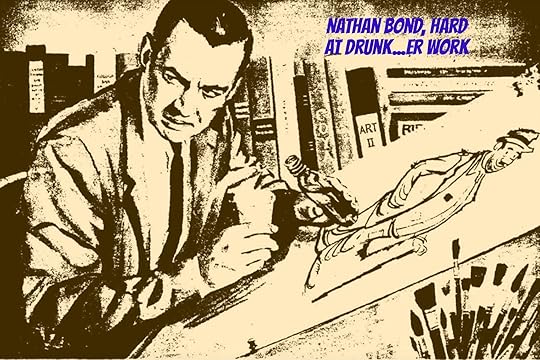
Sloan Wilson (May 8, 1920 – May 25, 2003) was an American writer. Born in Norwalk, Connecticut, Wilson graduated from Harvard University in 1942. He served in World War II as an officer of the United States Coast Guard, commanding a naval trawler for the Greenland Patrol and an army supply ship in the Pacific Ocean. After the war, Wilson worked as a reporter for Time-Life. His first book, Voyage to Somewhere, was published in 1947 and was based on his wartime experiences. He also published stories in The New Yorker and worked as a professor at the State University of New York's University of Buffalo. Wilson published 15 books, including the bestsellers The Man in the Gray Flannel Suit (1955) and A Summer Place (1958), both of which were adapted into feature movies. A later novel, A Sense of Values, in which protagonist Nathan Bond is a disenchanted cartoonist involved with adultery and alcoholism, was not well received. In Georgie Winthrop, a 45-year-old college vice president begins a relationship with the 17-year-old daughter of his childhood love. The novel The Ice Brothers is loosely based on Wilson's experiences in Greenland while serving with the US Coast Guard. The memoir What Shall We Wear to This Party? recalls his experiences in the Coast Guard during World War II and the changes to his life after the bestseller Gray Flannel was published.
Wilson was an advocate for integrating, funding and improving public schools. He became Assistant Director of the National Citizens Commission for Public Schools as well as Assistant Director of the 1955-56 White House Conference on Education.
Sloan Wilson never seems to miss. His novels have always been interesting, engaging, informative and close to the bone. A Sense of Values should be read by males and females of all mature ages.
(And I speak of him as still living, because an excellent writer never dies.)
“A Sense of Values” is a love story from young courtship through mature middle age when life’s problems are getting resolved... or not. (Remember those first days of any school year when girls and boys had butterflies in the pit of their stomach, anticipating getting with old friends and new possibilities?)
Life is defined by tragedy and, if told in full, it is a sad tale.
Wilson was not a flamboyant man. He lived life well, if not sometimes dangerously. He’s never tacky or supercilious. His way of telling a story relaxes you and if you were lucky enough to live in the 1950’s, you might picture yourself lying down near a humming window fan, glad you’re not having to be in the humidity outside for the rest of the day and beginning a new novel by Wilson.
After reading Sloan Wilson two or three times, he becomes your friend. I can't explain it. Then you want to read all his novels.
Nathan Bond is a man who has never really been okay with his life. He feels driven to do more be more and be the best and we see he achieves and backslides and deals with all the emotions that come along with it and this is the story of how it can affect not only his mental state but those he loves.
I read Sloan Wilson's The Man in the Gray Flannel Suit a few years back and fell in love with the gritty pulpy book. I loved how it was written, i could just feel the "Mad Men" sense of it without it being a copy (hello, it was written during the actual era). But like some books with a specific taste, reading one of it's kind is satisfying for a while until the itch to to revisit the style and the time period. So, now was that time again.
The book opens with Nathan in an apartment in New York contemplating his life at present where his wife Amy is divorcing him and his children aren't talking to him and he's finally stopped drinking and lost some of the weight he's been meaning to. But he's alone and lonely and not working probably going downhill without the constant demands of work work work. Then he get's a phone call that says the house he and Amy shared and was going to be put on the market was vandalized and he needs to come see the damage. He gets in touch with Amy and they two agree to go since they suspect it's their elder child who is responsible.
I loved the first person account of Nathan and his wife Amy and how he feels the need to make money to support his family and to work at a job that gives him all the prestige and bragging rights.But you can't really have your "things" and time to be with your family at the same time. I loved how different life seemed to be back then, the language use and etiquette of living etc.
So between arranging the meeting in the house and the actual meeting of the house we slip into several parts of the book- the history of Nathan and how he fell in love and despite that led a life riddled with betrayals, habits, addictions and bad decision making (definitely my kind of character). The almost 500 pages (which didn't seem so much could be packed in my pocket sized copy) we see how Nathan grew up, met Amy and convinced her to marry him only to enlist in the military to spend 4 years aboard a ship that is sure to get sunk. By a stroke of luck he is sent home due to injury and the couple begin their life with luxurious tastes and the stress of affording it. Nathan starts a job as a reporter and ends up doing cartoons which take off in a huge way- hello hollywood. His mother falls ill and lands in a mental institution after his father passes and soon he has two children. There seemed to be a general sense of dissatisfaction in life with Nathan. He goes back and forth with what's important and seems to make hasty decisions that pan out to disasters.
It was a book that critics didn't like for some reason. It was similar to The Man in the Gray Flannel Suit but different enough that it wasn't repetitive. I thought the writing was gorgeous and I totally dropped in every time I opened the (very smelly) book. If you've never heard of him and want a break from all the contemporary blockbuster new streamlined books I recommend this one. Domestic dysfunction galore.
I just reread Sloan Wilson’s A SENSE OF VALUES some 58 years after I first read the book while in High School. I was given the book as a birthday gift from my Uncle in 1960. I don't think the book is still in print but one should be able to find a used copy for sale on the internet. Sloan Wilson’s two earlier 1950 based books THE MAN IN THE GREY FLANNEL SUIT and A SUMMER PLACE still are in print and were bigger hits and both were made into movies. VALUES was the first “grown up” book I had ever been given and the first I recall reading that was not assigned in school. I have since read all but one of Sloan Wilson's other books. But nothing has stayed with me as much as the memory of my Uncles gift and the title of the book A SENSE OF VALUES and its theme of how one has to fight to live one's life with a sense of values. The story is told in the first person by a 1950s male narrator, Nathan Bond who at age 40 is facing a divorce and is increasingly recognizing his alcoholism and now also suspects that his teen age son Steven has destroyed the inside of the family home. Nathan is a fabulously wealthy cartoonist and WWII war hero (with survival guilt) who has a great looking wife, Amy and two children (a boy and a girl, Sally). The book opens with Nathan trying to come to terms with his life which leads to him telling the reader his thoughts, dreams, and view of events. His story questions the pressures of ambition and the sacrifices made to achieve his view of the American Dream. I’m not sure there is a book that connects more with a male characters perspective on his thoughts, fears, decisions, consequences, and culture of the time better than does VALUES. When I read VALUES for the first time while in High School I think the story hit me as a moral lesson that success was more than fame and money and that we are all plagued by self-doubt and the divergence that compromise brings to our life choices and dreams. And how those choices affect those we say we “love”. If this novel were written today I would expect the author might alternate perspective and give Amy, Nathan’s wife more of her own voice other than dialog and maybe even the son speaking for himself. Yet the mystery of Sloan Wilson’s work is the unknown truth of other characters emotions because we only have Nathan’s story to judge by. Wilson puts the reader into Nathan Bond’s head with doubts, temptations, temper, and jealousy. And now some 60 years later that perspective makes for most interesting reading. It has been said that VALUES is autobiographical and Wilson hints to this in an author’s note where he says “The narrator’s story is wildly different from the author’s life in most sections, and the net result truly is fiction, not disguised autobiography”. I think this book and Sloan Wilson's other books still hold up today as we continue to seem to recycle the same questions over and over. I suggest Sloan Wilson’s books if you want to meet and enjoy a wonderful author who writes well of American society coming into modern post WWII world in the 1950's. These books capture the original MAD MEN era to a tee.
Read the Cardinal Pocket Book edition sometime in the 60's. Still on my shelf but pretty beat up; trying to get myself to get of some books but whether I do or not is still not decided. Somehow the older books seem to be better to me but I have so many new ones to read, I can't get back to reread.
Four books in one, from Readers Digest, along with Ä Christmas Carol”, “The Colonel’s Son”, and “Two hours to darkness” Not sure when finished this, but guessing 1964