Jump to ratings and reviews
Rate this book
Rate this book
Dear Los meet apocalypse. You have one day left. Unless, of course, someone decides to save you. Possible saviors a foul-mouthed struggling screenwriter who moonlights as a car thief, an obscenely wealthy rapper, a dying cosmonaut on his way back to Earth and one very deranged little boy. Good luck.

127 pages, Kindle Edition

First published December 12, 2012

4 people are currently reading
145 people want to read

About the author

Aleš Kot

268 books177 followers
Aleš Kot is a post-Chernobyl, pre-revolution, Czech-born, California-based writer/producer who started in graphic novels and now makes films, television, and an occasional novella.

A. believe in art and community.
A. doesn't believe in borders nor cops.
A. believes in love, which they know is a very Libra answer. And what about it?

Ratings & Reviews

What do you think?
Rate this book

Friends & Following

Create a free account to discover what your friends think of this book!

Community Reviews

5 stars
37 (15%)
4 stars
64 (26%)
3 stars
81 (34%)
2 stars
42 (17%)
1 star
14 (5%)
Displaying 1 - 30 of 31 reviews
Profile Image for Chad.
10.4k reviews1,061 followers
July 22, 2019
Too metaphysical for me. If I hadn't read the summary, I wouldn't have known what was going on.
Profile Image for David Allison.
266 reviews5 followers
January 4, 2015
EXPOSITION: From the first few pages onwards it’s clear that this is one of those LA stories, an everyday apocalypse in which a strung out and savvy cast of screenwriters, rappers, astronauts, agents and cultists collide against a genre-mashed backdrop; the prophetic screenplay that drives the story is modeled on The Last Boy Scout, but Richard Kelly’s media-frazzled sci-fi meltdown Southland Tales seems the more fitting tonal counterpoint for this story of a city stuck on an apparently endless cycle of destruction.

You might remember reading about all this in the early hype, but if not you can always obtain the first issue for free online and get a flavour for it yourself.


The main characters in CHANGE are lost and ambitious souls, tilting after people and projects like a set of modern day Don Quixotes, struggling to find their way to an imaginary elsewhere that might just resemble home if they can stick the landing.

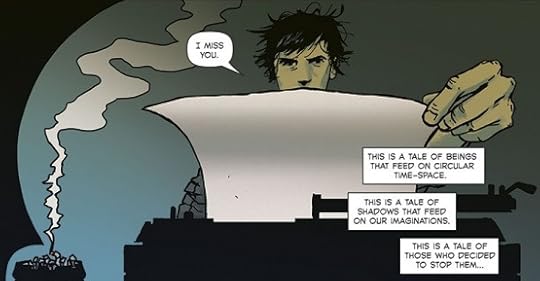
If there’s a criticism to be raised here it’s perhaps that the women in this comic tend to be framed at the centre of the madness, while the men are given more active roles as explorers.  Richard Doublehead (“the Virginia Woolf of screenwriters”) and rapper turned movie producer W-2 and find themselves instigating the plot and exploring it respectively, and in their dueling roles both men are spurred on by the loss of their partners.  Charlie Kaufman style maverick screenwriter and surprisingly competent car thief Sonia has a more active role than either of the female love interests, but her ability to write what’s about to happen still positions her as being somehow in tune with the madness where her fellow protagonists affect and are affected by it:


Thinking about Sonia’s character, I keep coming back to Angela Carter talking about her experience with the surrealists:
...I had to give them up in the end. They were, with a few patronized exceptions, all men and they told me that I was the source of all mystery, beauty, and otherness, because I was a woman – and I knew that was not true. I knew I wanted my fair share of the imagination, too. Not an excessive amount, mind; I wasn't greedy. Just an equal share in the right to vision.
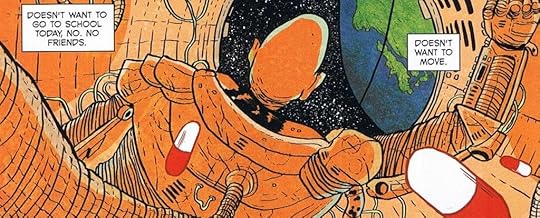
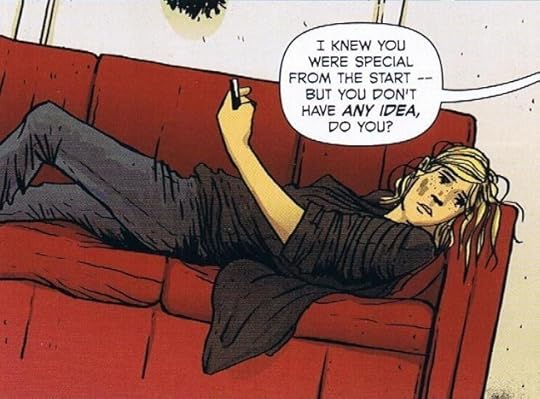
If Sonia has anything, it’s vision, but somehow her goals seem less tangible those of her male counterparts; for all that her voice is the most purely entertaining one in the comic, I still can’t help but feel that her arc is also the least satisfying.  Even the astronaut, who spends most of his page time cut off from the other characters, finds himself on a journey to be reunited with them and with himself:


DEVELOPMENT: The great strength of this comic is that Ales Kot seems to trust and understand his collaborators, who provide page after page of the sort of vivid physical and mental trauma that the script demands.  Morgan Jeske’s gloriously repugnant linework supplies the former, grounding the book in the world of the flesh even as symbolism and psychedelia threaten to overwhelm reality:


If, as the narration claims, CHANGE is a story about “beings who feed on circular space-time”, perhaps it makes sense that it packs a startling amount of physical decay into its four issues/that it plays out like a Vine video in which kids turn to skeletons and back again in the blink of an eye.   Most previously available examples of Jeske’s work had a slick PulpHope vibe to them, but whether the demands of the story or the shift in technique (this was the first comic he drew entirely on his Clintiq tablet, apparently) guided his hand provide this level of rotten sensuality, the book wouldn't be half as effective without it.

Sloane Leong’s hot, queasy colours make the psychic devastation every bit as inescapable as the physical decay on display.  Compelling as the heightened reality of the first issue is, the latter parts of the story are far more ambitious, forgoing vain mimetics in favour of blazing artifice and making use of the full possibilities of colouring in a way that few contemporary pop comics artists have either the head or the heart for.

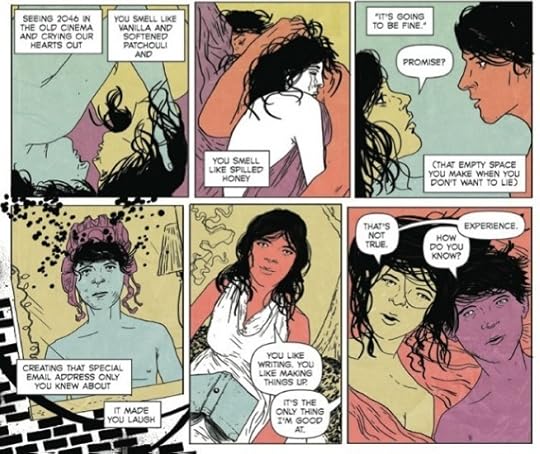
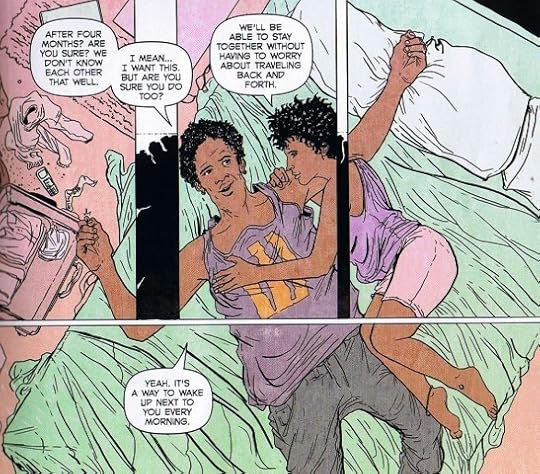
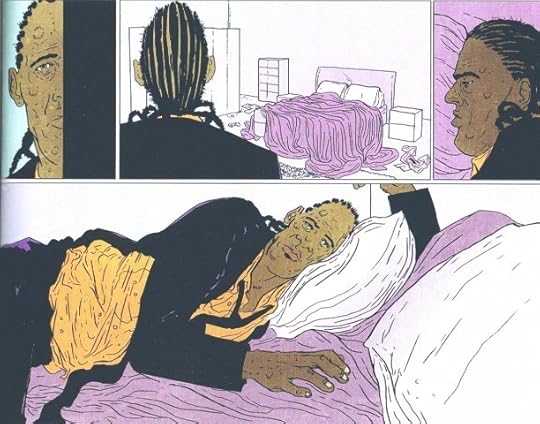
Take the following excerpt, in which a couple cycle through a series of sickly colour shifts during a sequence of startling intimacy:


I praised Jeske for bringing ugliness to this book a few paragraphs ago, but these panels make it obvious that he provides a lot of genuinely beautiful images too.  I'm particularly fond of the second panel above, where Doublehead's arm seem to expand towards infinity at the bottom of the frame, promising an equally endless supply of comfort in the process.  Still, while Jeske and Kot provide a jumble of overlapping moments that add up to an intensely tender portrait of young love, Leong makes sure that the "sepsis" that taints this story is present throughout, corrupting the past with the sickness of events yet to come.

As the series goes on you can detect the confidence of the art team increasing, and this brings out the best in Kot, who seems to know that whatever nuances of story that aren’t conveyed between the art and the fragments of text he scatters on top of it are all the more suggestive for being trapped between the two:


Working together like this the CHANGE crew maintain a tone of disorientated clarity: narration and dialogue from one plot thread bleeds over another, sometimes punning on the visuals in a style that's been popular since Alan Moore's beard first screamed "Look ma, it's art!" (see above), but more often blurring the boundaries between different narratives until they finally converge in the cathartic finale.  The sense of synaesthetic overload is palpable, to the extent that you might not quite be sure which sense is being triggered and which is being simulated in the end.

RECAPITULATION:   Speaking of endings, let's... let's just throw a little *SPOILER* warning in the air, so we can all feel comfortable living through this one.

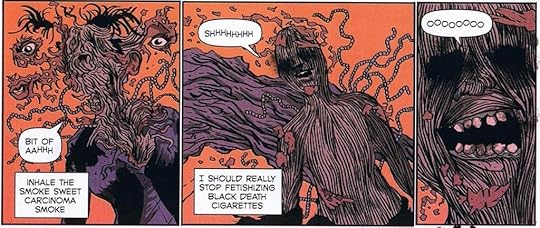
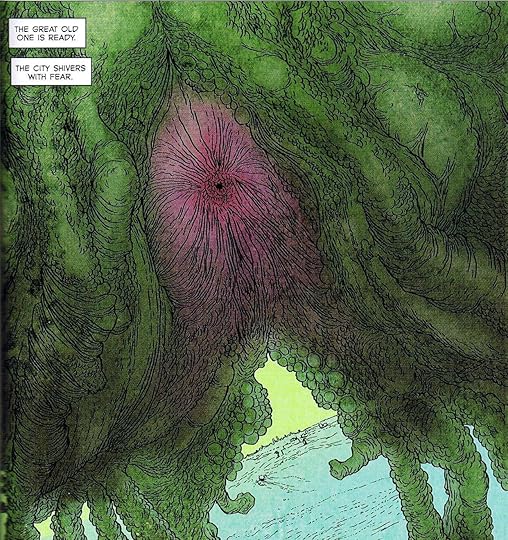
If the first issue of CHANGE established a lived-in vision of LA that echoed many of its fictional representations, and if the second and third issues saw this vision corrupted by the desperate longing in the hearts of its male characters (seriously, check the way the characters move from realised locations to toxic soulscapes as the story progresses) then the fourth and final issue threatened to obscure the whole thing by ramming it up the arsehole of a Lovecraftian monstrosity:


Thankfully neither the "Great Old One" nor his bowel movements can entirely obscure the emotional throughline of Change.  The grotty texture of Jeske's line finds its apex in his depictions of the inner-workings of this unnameable, unimaginable thing, as Leong lets the unreality bleed out of her colours, all of it in the name of bringing everything together, of finding a way out of the cycle of creation and destruction that haunts the book.

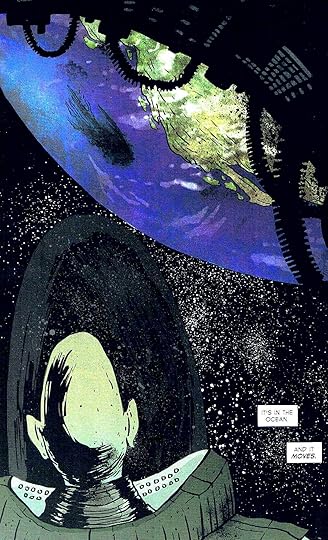
Doublehead's trip into the unspeakable beast's colon and back might initially feels like flatulent punchline to a threat that seemed genuinely real and terrifying when seen from the Astronaut's cockpit in issue #1...


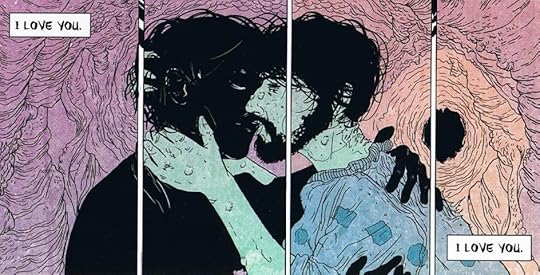
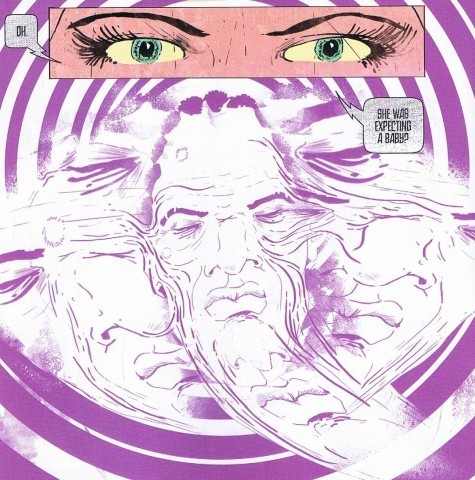
...but it also provides a key insight into CHANGE's version of the apocalypse.   CHANGE's tonal antecedent Southland Tales dealt with America's toxic interventions in global politics in terms of the harm it had done to America itself (rather than, say, Iraq) and CHANGE follows suit for the most part, with the hot Stiffler-on-Stiffler reconciliation of Southland Tales' finale being echoed in the pile up of alternate Doubleheads that we find here, a rapid blur of collisions and separations that ends with a kiss:


Words flit through from a hospital beside bleached white with memory, Doublehead's mother, speaking to her son after a failed suicide bid: "People don't actually forget things.  You'll just have to live with it instead."

CHANGE, then, is an attempt to deal with childhood trauma, an acknowledgement that some things never really get better, a letter to lost loves, an attempt to imagine back into being that which has been forever lost, and - FINALLY - a stealth account of an earnest attempt to care for someone with mental health issues.  It's also a story in which the failure to deal with seemingly irresolvable problems becomes a seemingly irresolvable problem of its own.  The transformation of otherworldly horror into a process of the body can be seen as a a description of the way internal pressures can end up feeling like the rot at the heart of everything one day and a manageable condition the next.

And so as Richard Doublehead staggers out of the ocean, fresh from giving his inner Patrick McGoohan a good seeing too, everything seems possible: "Nothing is too beautiful to happen," we're told.  "Nothing is too good to last."  It's a welcome reminder that the seemingly inescapable horrors of our current condition aren't "just" facts of life, but the CHANGE team are careful make sure that we know it's never quite as easy as that:


Sonia wakes up with a hole in her head, still perfectly in tune with the madness of the world.

Doublehead looks out over the city and sees a cycle broken, a world of possibility laid out before his feet.

But W-2?  Shit, that poor bastard just gets to go home to an empty bed.

The apocalypse is averted in the end but comic book time -- the source of potentially limitless energy in Kot’s debut, Wild Children -- provides the blight of eternal recurrence for the reader. The only way to properly break the cycle, to stop this loop from existing in its complete form until the sun melts the ground beneath our feet, would be to travel the world burning every copy of this comic you could get your hands on and smashing every device that holds a digital copy.

Failing that, you'll just have to learn to live with (through?) it, just like the comic said, safe in the knowledge that it could be you who's left lying on your own at the end of this rotation, dreaming up new ways for the world to end...

***

Soundtrack:

Marnie Stern – ‘The Year of the Glad’

Marnie Stern – ‘Nothing Is Easy’

Marnie Stern – ‘Hell Yes’
Profile Image for Juju.
271 reviews24 followers
December 9, 2013
How do you write an experimental postmodern sci-fi comic about some real personal stuff? Like this. Imagine Grant Morrison and Paul Pope made a comic together back in 1993, when they were not yet at the height of their craft, but the talent was palpable. An intriguing, ambitious mess, and considering this is only Ales Kot's second printed comic, pretty impressive.

That said, I'm really giving this 3 1/2 stars, but it gets the extra half star for effort. This is the rough draft of a really great story, and I would've preferred the creators spent more time growing this story and letting it breathe. I mean, why set your story in future LA, if your characters are mostly just going to hide out inside? But ultimately, this feels like a snapshot. Having read some interviews with Ales, I have some idea what this story is about. You know, certain choices we make have immense ripples through our lives in both temporal directions, and in the end we need to be generous with our forgiveness and realize these choices are about changing. Once you're on the other side, dealing with the alien-ness of your feelings, learning to live with the pain, realizing, wow, this was what I wanted. How crazy is that?
Profile Image for Jake Nap.
416 reviews7 followers
August 17, 2019
Borderline incoherent but there is something salvageable from this book. I really dig the art, the paneling, the coloring and the lettering, my main problems are with the plot and writing. Stuff kinda just happens and I’m sure there’s deeper elements I’m missing but the plot wasn’t engaging in my opinion.

A comic with a cerebral style of storytelling in my opinion has to be somewhat appealing on a surface level. That’s where books like Flex Mentallo and The Invisibles shine, they are approachable. I think this book isn’t very approachable.

4/10
Profile Image for Paulo Vinicius Figueiredo dos Santos.
977 reviews12 followers
June 25, 2023
Sabe quando você tem um bando de ideias completamente desconexas, porém divertidas e depois de uma noitada com os amigos decide colocar tudo dentro de um caldeirão e mexer até virar alguma coisa? É mais ou menos isso que é Change. Me lembro de que quando estava lendo o primeiro capítulo as minhas primeiras impressões foram estranheza e vontade de abandonar a HQ. Mas, decidi ficar para ver no que ia dar já que era uma história pequena e fechada. A maluquice só vai aumentando mais e mais até que no final você fica se questionando se bebeu demais ou se não entendeu nada do que leu antes e não tem a menor vontade de reler. E o pior de tudo: a arte é até legal e entrega alguns conceitos bons, mas caramba... Vou tentar fazer uma resenha e explicar mais ou menos do que se trata a história e tenho certeza que não vou conseguir nem a 10% de fazer sentido. Spoiler: não foi uma boa experiência.


Tudo começa quando W-2, um rapper que teve uma ideia genial para um roteiro de cinema, envia suas ideias para Sonia, uma roteirista que está tentando ganhar seu espaço no difícil mundo de Hollywood. W-2 imaginou uma história envolvendo uma mulher grávida que nunca teve relações sexuais e um monstro nascido dos piores horrores da humanidade. Só que Sonia acaba criando um roteiro "criativo" demais para os padrões de W-2. Isso faz com que ele tenha um xilique em pleno escritório e demita Sonia que, para se vingar, rouba o carrão favorito dele. Isso provoca toda uma sequência de eventos incontroláveis envolvendo um culto ligado aos Velhos Deuses, um astronauta retornando do espaço e que possui muitas questões a serem resolvidas, e um garoto que teme perder sua mãe que se encontra em uma profunda depressão. Alianças improváveis nascerão e o próprio destino da humanidade vai estar nas mãos de Sonia e de W-2. Ou seja: estamos ferrados.


Para combinar com essa atmosfera de terror bizarro, Morgan Jeske empregou uma arte bastante irregular e incomum ao longo da HQ. O resultado final me fez pensar em HQs underground onde os artistas realizam diversas experimentações com quadros, requadros e design. Aqueles que gostam de entender como o autor usa os quadros ou se existe um padrão nisso, podem esquecer. Jeske nem sempre vai pelo mesmo caminho. Nas primeiras edições ele chega até a usar miniquadros focados em expressões faciais dos personagem seja um close nos olhos, na boca, no perfil do rosto. O que percebo é que o artista entende os quadros realmente como janelas para a observação dos personagens. O leitor é convidado para dar uma olhadinha no que está acontecendo. Mais para o final, quando a história toma proporções mais "cósmicas", ele passa a empregar quadros maiores ou até sequências de quadros lado a lado em que uma cena ou um conceito é construído. Um bom exemplo disso é no capítulo 5 quando Jeske dispõe 4 quadros lado a lado com o formato de números simbolizando uma contagem regressiva. O design de personagens puxa mais para o sujo e o cinza e, para quem gostou de Projeto Manhattan (do Jonathan Hickman e do Nick Pitarra) a arte é bem parecida com a do Pitarra, mas menos vinculada às cores como o autor faz ali. A colorização de Sloane Leong vai se concentrar mais no emprego de verde e cinza, o que geralmente é uma escolha estranha, mas em se considerando o que acontece na HQ é até lógico. Falo dessas duas cores, mas tem uns momentos nojentos que se passam dentro da massa encefálica rósea de um personagem. O visual é chocante e as cores ajudam a dar mais vivacidade à cena.


O que posso falar do roteiro? Bom, o que dá para perceber é que toda a história dos cultistas e da conspiração envolvendo a NSA é mais um simbolismo para uma narrativa sobre três pessoas com seus problemas e suas vidas abaladas por uma situação-limite. Vou comentar mais abaixo sobre esses personagens, mas sob um aspecto geral o roteiro é bastante confuso. Se o leitor não tiver um mínimo de atenção, os detalhes vão lhe escapar e perder o fio da meada é bem simples. Me incomoda que o roteiro é bastante desatento e meio cortado em partes. Na hora de fazer o processo de edição alguns trechos sensíveis devem ter sido cortados do produto final, mas como se trata de um texto denso e que apela para o aspecto figurativo, qualquer corte acaba produzindo uma quebra na compreensão do todo. O resultado é algo que parece incoerente (e provavelmente é mesmo), mas que transborda ambição e ousadia. Sabe quando você tem uma história completamente insana e inacabada, mas dá aquele ar de que tudo é friamente calculado? É isso. Até tem algumas boas reflexões, mas as coisas se perdem em algo que inventa demais e entrega de menos. Na minha visão, se o roteiro fosse mais contido e intimista e contasse histórias reais, de pessoas reais com problemas reais, sem apelar para o terror lovecraftiano nonsense, Change seria mil vezes melhor.


W-2 é um rapper que ambiciona construir o seu legado. E para isso ele não quer apenas continuar na música e ganhar rios de dinheiro. Ele quer produzir mais. Quer mostrar que sua mente é criativa o suficiente para explorar outros veículos de comunicação. Para isso ele cria a sua história de terror insana com aquilo que ele visualiza colocar através de filme e música. Mas, não dá certo. O rapper se depara com a realidade de que não tem metade da criatividade que imaginava ter. Rhuibarb, sua companheira, vive brigando com ele e ele está ficando triste e cansado com isso. Depois que ela disse a ele que está esperando um filho, sua relação com ela mudou do vinho para o vinagre. W-2 não sabe se fica feliz pela chegada de um filho ou com ciúmes de ter perdido a mulher que ele conheceu, que curtia sua música e sua vida. Depois de despedir Sonia, Rhuibarb e W-2 começam a ser perseguidos por um estranho culto que alega estarem a mando dos Deuses Antigos. Para o nosso personagem, tudo não passa de uma pegadinha de algum dos seus amigos idiotas. Só que as coisas começam a ficar cada vez mais sérias. E a questão que fica é: o que W-2 realmente deseja? Essa postura de estar acima dos outros vai precisar ser deixada de lado para que ele assuma suas responsabilidades. Principalmente se ele deseja manter Rhuibarb ao seu lado por muito tempo. Quanto aos cultistas? Bem... ele precisa descobrir quem diabos são esses caras.


Já Sonia tem um colapso nervoso total depois de ser demitida por um rapper idiota metido a roteirista de cinema. Ela não consegue acreditar na audácia do sujeitinho. Misógino e babaca, W-2 coloca todo o trabalho e esforço de Sonia no ralo por um xilique. Ela explode no telefone com a pessoa que a indicou a ele e decide fazer uma maluquice: roubar o carro favorito do rapper e sair dando a louca na cidade. Sonia parece finalmente ficar em paz consigo mesma, embora saiba que sua carreira de roteirista foi para o ralo e vai se abrigar na casa de alguns conhecidos que ela julga serem seus amigos. Lá no fundo ela sabe que está sozinha em LA e nada poderá ajudá-la quando a desgraça vier. É então que ela vem, mas não na forma como ela esperava. Um grupo de agentes da NSA em uma missão que tem toda a cara de ser ilegal começa a matar todas as pessoas que estavam na casa. E parecem realmente estarem atrás dela, especificamente. Sem entender o motivo, ela se esconde na banheira e aguarda pelo pior. Para poder fugir dessa, ela vai precisar buscar abrigo no lugar mais improvável possível: junto de W-2.


Também temos a história de um jovem garoto e sua mãe que precisam lidar com a difícil realidade de suas vidas. Um cotidiano sem graça cujos obstáculos parecem ser intransponíveis. A mãe está lutando para continuar sã, mas a vida é mais do que a luta e a resiliência. E esta parece estar chegando ao fim. A mãe está decidida a tirar sua própria vida e seu filho tenta a todo custo demovê-la dessa ideia. O que veremos a seguir é o menino fazendo todo o possível, mas falhando miseravelmente no processo. O que isso o tornará no futuro? Aliás, parece que há algum problema ou doença com ele, algo que faz sua mãe chorar e se desesperar e levar a tomar tamanha atitude. Anos depois veremos o mesmo rapaz refletindo sobre o que aconteceu no passado e pensando se a culpa daquilo tudo não seria do próprio mundo ou do universo que permitiu que algo assim se sucedesse. Sua mente se divide entre um coração puro e uma pessoa revoltada com o rumo de sua vida. E isso, no momento adequado, pode ser a diferença entre a condenação ou a salvação do mundo.


O que eu fiz nessa resenha foi espremer ao máximo o limão que é essa HQ. Tirar leite de pedra. Sinceramente não recomendo essa história, a menos que você seja um fã do autor ou do artista. É algo que nem vou encostar mais e vai para algum outro leitor que talvez tenha mais afinidade do que eu. Coerência é um assunto sério e por mais ambicioso que um roteiro almeje ser, ele precisa ser compreensível. Caso contrário estarei escrevendo para o meu grupo seleto de amigos e não para leitores em geral. O roteiro é fraco, a escrita é incoerente embora a arte seja até muito boa. O desequilíbrio no cômputo geral é evidente.
Profile Image for Alex Sarll.
7,083 reviews364 followers
Read
March 11, 2014
I might have enjoyed this riff on the Cthulhu Mythos, eternal recurrence and lost love if I hadn't read it during a break from True Detective, which handles those themes so very well (and thus far, more bravely). There are also echoes of Grant Morrison's more personal and experimental work, and the intricacies of Jonathan Hickman, while the art recalls the deliberate, crumpled ugliness of Paul Pope - and yet the overall effect is too often less powerful than these reference points suggest.

(Why is it than even entirely and self-evidently self-contained comics collections still tend to acquire a 'Volume 1' on here? Three was the same, and neither of them is any more likely to get a Volume 2 than The Great Gatsby)
Profile Image for Heather Harvey.
40 reviews
August 11, 2017
Once again my co-worker recommended this comic to me, I have read Ales Kot once before and found it strange. This is no different.

Art: It is very different than what I am use to. I don't hate it but it is...different.

Story/Setting: I have absolutely no idea what is going on. Ha ha. Like everything is going to Hades in a hand-basket that is all I know.
Characters: Truthfully, I didn't find any of these characters memorable. I found them bland and boring.

Eh, I am not really a fan of this one. I had to force myself to read it. I couldn't tell what was going on. I could care less about the characters and the only thing I really like was the okay art work. So if you really want to read it, go ahead and try it. It might suit someone's tastes other than mine.
Profile Image for Mark Sutherland.
410 reviews5 followers
April 22, 2020
As an Avant Garde experiment in comics this is definitely a success, it plays with the medium and the readers expectations in almost every way it can. But despite circling round a fairly powerful personal story, the end result is a bit of a mess and doesn't quite land the surrealist logic of Lynch et al. Technically brilliant but a bit overwrought.
Profile Image for Marco.
264 reviews35 followers
September 6, 2018
Pretty mind-blowing. :D
I'll definitely need to read it again sometime soon.
Profile Image for Bene Vogt.
461 reviews3 followers
January 27, 2023
Well, not everyone grows up to be Grant Morrison.

Or Paul Pope, for that matter.
Profile Image for Art.
11 reviews
January 5, 2024
A bit Lovecraft, a bit Lynchian, and a bit dystopian sci-fi. A very mind bending story that gives you a lot to chew on once you’ve finished.
Profile Image for Book Nerd Shenanigans.
81 reviews3 followers
February 9, 2018
A bit Lovecraft, a bit dystopian science fiction, and a bit Phillip K Dick. Sounds like a phenomenal idea but it didn’t hit the mark. Not a total loss though. It is definitely a story to mull over and chew on for awhile. Mind bending and layered storytelling.
Profile Image for John Pistelli.
Author 9 books364 followers
February 4, 2016
I’ve heard good things about Ales Kot, so I decided to read this, as it is self-contained and not a multivolume series or corporate property. And it’s all right, a pleasant enough evocation of things that were done in the 1990s. Several reviews imagine this book as a lost collaboration between Grant Morrison and Paul Pope—and Kot and Jeske are indeed clearly imitating Morrison and Pope, but aside from the drone references and the Chris Brown joke, is there anything new or distinctive here? anything that couldn’t have been done in 1997? Morrison and Pope were assimilating diverse and unusual-for-comics influences and making wild narratives out of them; Change assimilates Morrison and Pope (and what they had assimilated) themselves. Lyrical pop-postmodernism, done well enough, sure, but does it need to be done again at all, and in the same style, and with the same rhythms? Also, I might note that Morrison and Pope were, or are, intense personae in themselves, ideologically unpredictable and therefore exciting, because they had clearly thought for themselves, while Kot’s online persona (and I am talking about the persona, which in contemporary pop culture is legitimately part of the text, rather than the person, who is unknowable) is sadly that of another social-media follower, repeating as if on command all the same memes and jokes and outrages as everybody else, though in his case with added Red Guard levels of grandstanding, the sort of it-takes-fascism-to-fight-fascism hypocrisy a writer who quotes Jung, as Kot does, ought to be a lot warier of—it’s called projection, and it’s probably going to sink the cultural left (and, let us hope and pray, social media too) for at least a generation, as it has in the past. Whereas I doubt this book, this footnote to The Filth, will linger until next week in my memory. The coloring by Sloane Leong, however, is very impressive.
Profile Image for Rory.
89 reviews
April 19, 2014
This book is strange. Very strange. It is, however, endlessly intriguing. I'm not sure I understand it, but I enjoyed it and will read it again, in search of further meaning.

The art is tremendous and the colours are awesome.
Profile Image for Bogi Takács.
Author 64 books659 followers
Read
February 16, 2017
Lovecraftian psychedelic apocalyptic... thing. Based on those topics, I was quite sure this graphic novel would be my thing, but it didn't really cohere for me. There is a difference between chaos and entropy, and this one tended toward the latter IMO.
Profile Image for Bri.
449 reviews
April 2, 2013
Hmmm. The story is told in a very abstract way, and it's kind of bizarre. I think I liked it though. I definitely loved the cover art and the colors throughout.
Profile Image for Jason Ragle.
295 reviews2 followers
July 22, 2013
Amazing. If you like Grant Morrison, you'll love Ales Kot.
Profile Image for Brian.
551 reviews
December 14, 2015
HG Wells meets Grant Morrison and Paul Pope...Yeah that's my comparison. Weird that I actually understood some of the references.
Profile Image for Scotch.
136 reviews5 followers
November 29, 2014
The beautiful illustrations drew me in. The story is a little opaque and could have used some fleshing out, but a nice read.
Profile Image for JJ.
156 reviews2 followers
September 2, 2015
This was bonkers, and a load of fun.
Displaying 1 - 30 of 31 reviews

Can't find what you're looking for?

Get help and learn more about the design.