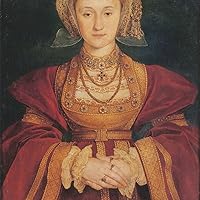
Succeeding to the throne at the age of only nine months, Henry VI had a turbulent reign: he inherited a war with France and, in time, found himself at war with his own nobles. James Ross surveys this eventful life, including Henry's deposition at the hands of Edward IV and his eventual return to the throne.
Another great little book in the Penguin Monarchs series. I really these books because they're not too dense and give you a really good introduction to monarchs you're not so familiar with. Henry VI is one of these monarchs for me; I know a bit, but not too much.
Ross does a really good job of explaining some of the more complex concepts and movements clearly. Henry VI's reign is often a difficult one to get to grips with as there are different regents, and lots of battles and the crown changing hands. It's interesting but can be complex to decipher everything going on. I think Margaret of Anjou's influence possibly deserved more page space as she was such a huge influence but only merited a few mentions.
The book is lacking in detail at times, but I guess the point of this book is to whet your appetite and give you the basics, so that you can go off and do more research on your own. It certainly offers insights into Henry VI on whether he was made for kingship, his mental state, and his religious devotions. Henry VI comes across as a man who struggled with being king and would have been more suited to the religious life than a public life of service.
James Ross brings Henry VI to life and makes me want to know more, particularly about him as a person and how he grew up and into his kingship. Well-researched and written.
Short but very readable and thoroughly researched. This is a complicated time period politically and this biography isn't long enough to give as much detail as I'd have liked.
James Ross’s short biography of Henry VI, subtitled A Good, Simple and Innocent Man, is one of the most insightful accounts of Henry VI’s life and kingship I’ve come across. Ross is clearly sympathetic towards Henry but also retains a distance to critically engage with Henry’s rule. He tackles the questions of Henry’s character and his policies, confronting the assumptions about him and delving into the questions of just how involved Henry was actively involved in the ruling of the country.
The portrait that comes out is a man woefully unsuited to kingship but not as passive as typically believed. His faults are enumerated but not brutally, his mental illness is dealt with sympathetically, and I felt like I gained a lot of insight into his character without ever feeling that Ross was writing too emotively or too narratively.
My one complaint is that the biography is just too short – which is part and parcel of any volume in the Penguin Monarch series. These are short, ‘bite-sized’ biographies that could be read in a couple of sittings, around 100-150 pages long, and written by some of the best historians of each monarch’s era. However, the length sometimes has drawbacks – the biography might be focused on a particular aspect of the monarch’s reign (e.g. Laura Ashe focuses Richard II’s image in Richard II: A Brittle Glory and Jonathon Sumption focuses mainly on the first stages of the Hundred Years War in Edward III: A Heroic Failure) or that the biography cannot delve into detail or thorough analysis. Or readers looking for “something new” are disappointed that this is brief overview or may not touch on as many matters as they’d like.
Ross’s entry clocks in at 101 pages (excluding notes) and I was impressed by how efficient his text is. He does not delve too deeply into Henry’s minority (1422-1436) nor the forceful personalities surrounding Henry VI, either in his minority or after, but that is fair: the analysis is focused on Henry’s character and personal rule and Ross does not have the luxury of space. But still, this is so detailed and insightful that I wished there was a longer biography of Henry by Ross I could read.
A sympathetic biography of one of England's most unsuccessful monarchs. Ross examines Henry's famous piety as well as his periods of mental illness, likely inherited from his maternal grandfather, King Charles VI "the mad" of France. Henry VI emerges as neither an entirely passive figure nor a consistently active monarch. Henry was easily influenced by his courtiers and queen and prone to abrupt changes in policy, from excessive generosity to severe repression. Perhaps the most poignant moment in the book is the evidence that Henry was aware of his own shortcomings as monarch. When asked if he wished to be buried next his father, Henry V, the victor of the Battle of Agincourt, Henry VI stated "Nay let him alone: he lieth like a noble prince. I will not trouble him."
This is the first book I’ve read in the Penguin Monarchs series. I’m going to read one a month.
It is a short book, but despite its brevity it contains a lot of fascinating information about King Henry VI.
The pronouncement on the reign of the Lancastrian king, much like other books about Henry, is that he was woefully ill-suited to the demands of medieval kingship - much happier at prayer than fighting on the battlefield.
If the book sparks a desire to learn more about Henry VI, there is a useful list of ‘further reading’ suggestions.
Good read, the author is sympathetic to Henry VI while also arguing that he was bad at the job of being king in that time period, because it's not exactly Henry's fault that he was born. It looks into which parts of his kingship seem to have been his own choice and which were likely him signing off on the initiatives of others. I liked that it didn't try to pin down the exact nature of his illness, but a bit more about Margaret of Anjou would have been nice. However that's something I think about most Penguin Monarch books, which tend to barely mention consorts due to their brevity. Yet the brevity is what I like about them, they usually give a solid overview without being 500 pages long.