

What do you think?

Daredevil Epic Collection
Daredevil Epic Collection, Vol. 1: The Man Without Fear
Born to a past-his-prime prizefighter, Matt Murdock's luck always ran a step behind his good intentions. When a daring act to save a man's life blinds young Murdock, he finds that the same accident has enhanced his remaining senses to superhuman levels! He becomes Daredevil, a gritty hero born from murder but tempered with the desire to protect the downtrodden. Writer Stan Lee and artists Bill Everett, Joe Orlando, Wallace Wood, John Romita Sr. and Gene Colan lay the foundation of Marvel's Man Without Fear, including the first appearances of core characters Foggy Nelson and Karen Page - and classic villains like the Owl, the Purple Man, Stilt-Man and the Gladiator! Collecting DAREDEVIL (1964) #1-21.
472 pages, Paperback
First published August 1, 2016
About the author
Stan Lee
7,595 books2,405 followersStan Lee (born Stanley Martin Lieber) was an American writer, editor, creator of comic book superheroes, and the former president and chairman of Marvel Comics.
With several artist co-creators, most notably Jack Kirby and Steve Ditko, he co-created Spider-Man, the Fantastic Four, Thor as a superhero, the X-Men, Iron Man, the Hulk, Daredevil, the Silver Surfer, Dr. Strange, Ant-Man and the Wasp, Scarlet Witch, The Inhumans, and many other characters, introducing complex, naturalistic characters and a thoroughly shared universe into superhero comic books. He subsequently led the expansion of Marvel Comics from a small division of a publishing house to a large multimedia corporation.
With several artist co-creators, most notably Jack Kirby and Steve Ditko, he co-created Spider-Man, the Fantastic Four, Thor as a superhero, the X-Men, Iron Man, the Hulk, Daredevil, the Silver Surfer, Dr. Strange, Ant-Man and the Wasp, Scarlet Witch, The Inhumans, and many other characters, introducing complex, naturalistic characters and a thoroughly shared universe into superhero comic books. He subsequently led the expansion of Marvel Comics from a small division of a publishing house to a large multimedia corporation.
Ratings & Reviews
Friends & Following
Create a free account to discover what your friends think of this book!
Community Reviews
Displaying 1 - 30 of 42 reviews

February 4, 2025
Aside from the now-familiar and iconic origin story this volume featured some extremely pulpy one-off issues and arcs that I found deeply frustrating* but, fortunately, at around the issue 14 mark it started to turn things around and become more of the Daredevil comic that the world would come to know and, it not love, at least respect.
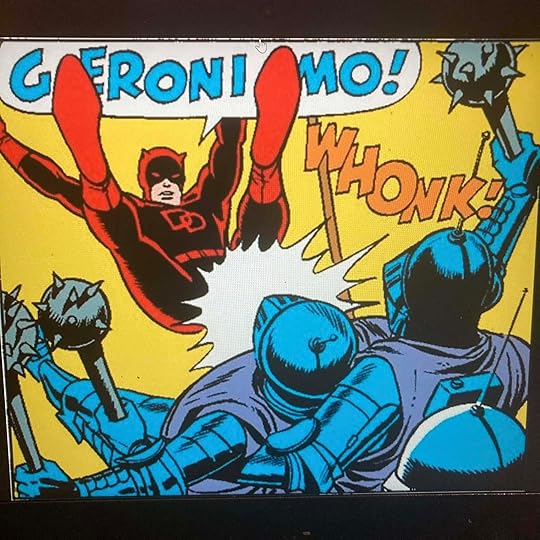
Let's dive in.
Some very memorable characters were introduced in these pages (Killgrave the Purple Man! The Owl! The Gladiator!) and also some regrettable ones (The Matador! Stilt Man! The Masked Marauder! The *shudders* Plunderer!) but it's the chemistry of Matt Murdock leading his double life at the law firm alongside Foggy Nelson and Karen Page that makes it all click when it's working.
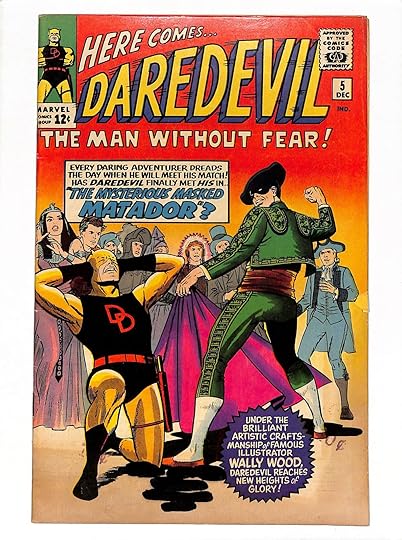
Fairly typical of the kind of villain-of-the-week issues that dominate the first half of the volume
Worth checking out for DD fans and those keenly interested in Marvel Comics history as, apart from Stan Lee on the scripts, there were some noteworthy artists like John Romita, Sr., and Wally Wood (not to mention design and layout input from King Kirby) involved.
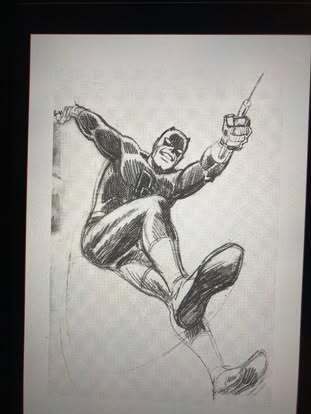
John Romita, Sr.'s first ever sketch of DD included in the Bonus Materials.
* I nearly abandoned the project, truth be told, and only my GR comics reading chums support helped me overcome my malaise.
Let's dive in.
Some very memorable characters were introduced in these pages (Killgrave the Purple Man! The Owl! The Gladiator!) and also some regrettable ones (The Matador! Stilt Man! The Masked Marauder! The *shudders* Plunderer!) but it's the chemistry of Matt Murdock leading his double life at the law firm alongside Foggy Nelson and Karen Page that makes it all click when it's working.
Fairly typical of the kind of villain-of-the-week issues that dominate the first half of the volume
Worth checking out for DD fans and those keenly interested in Marvel Comics history as, apart from Stan Lee on the scripts, there were some noteworthy artists like John Romita, Sr., and Wally Wood (not to mention design and layout input from King Kirby) involved.
John Romita, Sr.'s first ever sketch of DD included in the Bonus Materials.
* I nearly abandoned the project, truth be told, and only my GR comics reading chums support helped me overcome my malaise.

June 15, 2026
Well, you can't deny it its legacy, its history and the nostalgia. After the first couple of issues though, and besides the nice guest appearances of villains and whatnot that stayed until modern times, DD falls under the same tropes of plot lines and cliches that were the norm back then.
The artwork as always, is amazing!
The artwork as always, is amazing!

November 13, 2016
Including one of the most drastic costume changes in comic book history, this first volume of DD adventures features issues 1 to 21, and although there are no truly memorable villains to speak of, this is a sound set of comics that you can be sure will be entertaining. Daredevil's main problem for a long time was that he didn't have any really memorable villains that he could call his own. There are a few encounters with Spider-Man and Ka-Zar, and The Owl turns up more than once, but it's only thanks to the main characters keeping things lively that this didn't turn into another short-lived book. Still, I enjoyed it, regardless of the poor calibre of villains.

March 26, 2024
Daredevil #1 - Stan Lee & Bill Everett are credited with the creation of the Man Without Fear, but with Lee’s track record I’d lean toward giving most of the credit to Everett. In any case, Daredevil is a rather unique concept for a character and his abilities will evolve with some fine tuning over the coming years as much as any early character at Marvel. The core concept is pretty well established right off, but the “radar sense” was not well thought out initially. It’s a shame that Everett only contributed to this issue, it would have been nice to see how the character might have developed had he stayed on the title.
Daredevil #2-4 - Joe Orlando replaces Everett as artist and collaborator with Lee, and we get our first taste of colorful baddies with Electro (fresh from the pages of Amazing Spider-Man #9), the Owl, and the infamous Purple Man. But first off is Electro and a guest appearance by the Fantastic Four in a wild story that stretches credibility as only a comic book adventure can (old DD isn’t off to the great start). The next story delves back into the more real-world threats, like the first issue, with the introduction of a criminal mastermind, the Owl. For quite some time the Owl will be portrayed as Daredevil’s arch-nemesis (it’s still early days, we haven’t gotten to the Jester, Bullseye or Kingpin yet). The last of these first three villains is Killgrave, the Purple Man. This is a character with a really insidious ability, unfortunately his true potential for evil never seems to get fully realized for years and even then not until David Tennant portrays him in the Jessica Jones TV series.
Daredevil #5-8 - Wallace Wood comes aboard as the regular artist, replacing Orlando, and he’s immediately made some streamlined modifications to Daredevil’s costume, creating the more familiar double-D chest insignia. New opponents for these issues begin with The Matador, a colorful looking character, but someone Daredevil should be able to take down with ease. This makes the story feels more than a bit contrived in order for it to play out. This is also the first issue that gives a visual idea how Daredevil’s radar-sense works, it is a crude depiction but it certainly helps establish this unique signature ability. Next up: the Fellowship of Fear (comprising Mister Fear, the Ox & the Eel) provide a team of antagonists. Of these, Mister Fear will become a reoccurring menace for awhile. We’re also starting to see some characterization of Daredevil that is in some ways making our titular character more and more like Spider-Man, as he is spending more and more time on the rooftops. Speaking of Spider-Man, the sptorytellers borrow a villain from that hero’s growing usual suspects and the Eel comes from the pages of Strange Tales, an opponent of the Human Torch, to round off our trio of baddies. For all the potential they ought to have, it’s effectiveness is nullified by having Mister Fear coerce the others into working for him by putting them under the effects of his fear gas. And the juvenile love-triangle shenanigans between Matt, Foggy and Karen is already wearing thin (and we’re only been through 6 issues!). The next issue offers the biggest change to Daredevil’s costume yet. The “hood” to carry his clothes around has already come and gone, we have seen the arrival of the double-D chest insignia, and now the full red suit arrives, but almost as important is the first use of the cable concealed inside his billy club, this enables him to do even more “swinging” action through the city like Spider-Man. Oh, and least we forget, there’s no true villain this time, as Daredevil is merely trying to subdue Namor. Almost laughable actually. Conceptually, this is a fascinating story. But it doesn’t provide a good, strong moral as the narrative unfolds. And I think part of that is because it serves more as an introduction to Namor’s upcoming series in Tales to Astonish and is therefore not really a Daredevil story, but actually a Namor story (and as it’s included in Namor, the Sub-Mariner Epic Collection, Vol. 1: Enter the Sub-Mariner I feel extremely justified in saying so). Next up? The Siltman arrives on the scene for the first time. It’s interesting how some super-villains are just plain silly, but the method of operations, their gimmick(s), might make or break them. Stiltman’s introduction leaves a lot to be desired, and it signals that Daredevil would be headed down a route filled with gimmicky opponents that aren’t going to set him aside from any other masked vigilante and direction of the comic isn’t really going to be unique in any substantial way.
Daredevil #9-11 - At this point Daredevil was only coming out every other month, this is not a good sign. Without being about to build up a steady readership, Daredevil was never going to find an audience. In an attempt to ease the work load and get things moving quicker to get the title out every month, Bob Powell is brought in to add his talents to Lee and Wood. This run of issues opens with a long teased plot notion of Matt going to have an operation to fix his blindness. This is compounded with the tiny European country overrun by a tyrannical dictator that Daredevil has to fight in order to liberate the populace. It’s an old tired comic book cliché and it works about as well here as anyway. It would have been better and probably more interesting had it been Latveria and Doctor Doom, particularly with the robot palace guards and all. Next is a 2-part story that pits Daredevil against a mob-style boss and his costumed hired hands who are attempting to take over the city by rigging an election (pretty much what’s happened in Ohio and exactly how Donny-the-Whining-baby runs his brand of politics). This makes for an interesting story and is probably my favorite so far, also interestingly is that the first half has Wood credited as the writer and the second half has Lee credited. In any case, it seems that things are starting to get better, what with breaking up the Matt-Foggy-Karen love triangle with the introduction of Debbie, and a focus on the characters and pulling away from what new gimmicky villain can be thrown at Daredevil this month. But this was not to be the direction the title would continue in. Nope. There were even more BIG changes coming for ol’ Hornhead.
Daredevil #12-14 - Jack Kirby & John Romita Sr. join Lee on the series, and we get a VERY unusual adventure for Daredevil. This is pure Kirby non-stop action and it re-introduces Ka-Zar, previously seen in X-Men #10, to the Marvel readers; but getting old horn head from the wild streets of NYC to the jungles of the Savage Land in the Antarctic - stretched the incredible talents of Kirby beyond the suspension of disbelief (at least for me). While I enjoyed this tale, it is so contrived and disjointed and … well, unbelievable … that it just doesn’t work for me. Too bad because Kirby and Romita’s art works pretty well together (even if Kirby wasn’t around to help with the 3rd chapter).
Daredevil #15-19 - John Romita Sr. takes over the art chores, Kirby was most likely just far too busy to continue, and we get some real classic Daredevil stories in this batch. First off it’s DD against the Ox, but with some mind-swapping shenanigans, so it’s not simply the same “Ox” as before. Then the Masked Marauder strikes by pitting DD against Spider-Man, a diabolical plan indeed, too bad that our masked crime fighters have already met (see: Amazing Spider-Man Epic Collection, Vol. 1: Great Power) and wouldn’t fall for such an absurdly childish plot … oh wait … never mind. Still, it’s a fun (if typical) Marvel superhero misunderstanding mash-up. The next pair of issues not only continue the mystery of the Masked Marauder, but they also introduce another classic villain for DD: the Gladiator. These are some classic yarns and Romita is in great form. The only real distraction is that the subplot of the love triangle between Matt, Karen, and Foggy gets replaced (and complicated) with Karen now believing that Foggy is Daredevil. More childish Lee lunacy.
Daredevil #20-21 - Gene Colan comes on to help out an overworked Romita and his take on DD is gorgeous. This 2-part tale is hokey and clichéd, but it’s an enormous ton of fun featuring the return of the arrogant Owl. But the real treat is Colan’s initial issues on the title, he’ll become one of DD’s classic artists and really gives ol’ horn head a distinctive look and feel.
Daredevil #2-4 - Joe Orlando replaces Everett as artist and collaborator with Lee, and we get our first taste of colorful baddies with Electro (fresh from the pages of Amazing Spider-Man #9), the Owl, and the infamous Purple Man. But first off is Electro and a guest appearance by the Fantastic Four in a wild story that stretches credibility as only a comic book adventure can (old DD isn’t off to the great start). The next story delves back into the more real-world threats, like the first issue, with the introduction of a criminal mastermind, the Owl. For quite some time the Owl will be portrayed as Daredevil’s arch-nemesis (it’s still early days, we haven’t gotten to the Jester, Bullseye or Kingpin yet). The last of these first three villains is Killgrave, the Purple Man. This is a character with a really insidious ability, unfortunately his true potential for evil never seems to get fully realized for years and even then not until David Tennant portrays him in the Jessica Jones TV series.
Daredevil #5-8 - Wallace Wood comes aboard as the regular artist, replacing Orlando, and he’s immediately made some streamlined modifications to Daredevil’s costume, creating the more familiar double-D chest insignia. New opponents for these issues begin with The Matador, a colorful looking character, but someone Daredevil should be able to take down with ease. This makes the story feels more than a bit contrived in order for it to play out. This is also the first issue that gives a visual idea how Daredevil’s radar-sense works, it is a crude depiction but it certainly helps establish this unique signature ability. Next up: the Fellowship of Fear (comprising Mister Fear, the Ox & the Eel) provide a team of antagonists. Of these, Mister Fear will become a reoccurring menace for awhile. We’re also starting to see some characterization of Daredevil that is in some ways making our titular character more and more like Spider-Man, as he is spending more and more time on the rooftops. Speaking of Spider-Man, the sptorytellers borrow a villain from that hero’s growing usual suspects and the Eel comes from the pages of Strange Tales, an opponent of the Human Torch, to round off our trio of baddies. For all the potential they ought to have, it’s effectiveness is nullified by having Mister Fear coerce the others into working for him by putting them under the effects of his fear gas. And the juvenile love-triangle shenanigans between Matt, Foggy and Karen is already wearing thin (and we’re only been through 6 issues!). The next issue offers the biggest change to Daredevil’s costume yet. The “hood” to carry his clothes around has already come and gone, we have seen the arrival of the double-D chest insignia, and now the full red suit arrives, but almost as important is the first use of the cable concealed inside his billy club, this enables him to do even more “swinging” action through the city like Spider-Man. Oh, and least we forget, there’s no true villain this time, as Daredevil is merely trying to subdue Namor. Almost laughable actually. Conceptually, this is a fascinating story. But it doesn’t provide a good, strong moral as the narrative unfolds. And I think part of that is because it serves more as an introduction to Namor’s upcoming series in Tales to Astonish and is therefore not really a Daredevil story, but actually a Namor story (and as it’s included in Namor, the Sub-Mariner Epic Collection, Vol. 1: Enter the Sub-Mariner I feel extremely justified in saying so). Next up? The Siltman arrives on the scene for the first time. It’s interesting how some super-villains are just plain silly, but the method of operations, their gimmick(s), might make or break them. Stiltman’s introduction leaves a lot to be desired, and it signals that Daredevil would be headed down a route filled with gimmicky opponents that aren’t going to set him aside from any other masked vigilante and direction of the comic isn’t really going to be unique in any substantial way.
Daredevil #9-11 - At this point Daredevil was only coming out every other month, this is not a good sign. Without being about to build up a steady readership, Daredevil was never going to find an audience. In an attempt to ease the work load and get things moving quicker to get the title out every month, Bob Powell is brought in to add his talents to Lee and Wood. This run of issues opens with a long teased plot notion of Matt going to have an operation to fix his blindness. This is compounded with the tiny European country overrun by a tyrannical dictator that Daredevil has to fight in order to liberate the populace. It’s an old tired comic book cliché and it works about as well here as anyway. It would have been better and probably more interesting had it been Latveria and Doctor Doom, particularly with the robot palace guards and all. Next is a 2-part story that pits Daredevil against a mob-style boss and his costumed hired hands who are attempting to take over the city by rigging an election (pretty much what’s happened in Ohio and exactly how Donny-the-Whining-baby runs his brand of politics). This makes for an interesting story and is probably my favorite so far, also interestingly is that the first half has Wood credited as the writer and the second half has Lee credited. In any case, it seems that things are starting to get better, what with breaking up the Matt-Foggy-Karen love triangle with the introduction of Debbie, and a focus on the characters and pulling away from what new gimmicky villain can be thrown at Daredevil this month. But this was not to be the direction the title would continue in. Nope. There were even more BIG changes coming for ol’ Hornhead.
Daredevil #12-14 - Jack Kirby & John Romita Sr. join Lee on the series, and we get a VERY unusual adventure for Daredevil. This is pure Kirby non-stop action and it re-introduces Ka-Zar, previously seen in X-Men #10, to the Marvel readers; but getting old horn head from the wild streets of NYC to the jungles of the Savage Land in the Antarctic - stretched the incredible talents of Kirby beyond the suspension of disbelief (at least for me). While I enjoyed this tale, it is so contrived and disjointed and … well, unbelievable … that it just doesn’t work for me. Too bad because Kirby and Romita’s art works pretty well together (even if Kirby wasn’t around to help with the 3rd chapter).
Daredevil #15-19 - John Romita Sr. takes over the art chores, Kirby was most likely just far too busy to continue, and we get some real classic Daredevil stories in this batch. First off it’s DD against the Ox, but with some mind-swapping shenanigans, so it’s not simply the same “Ox” as before. Then the Masked Marauder strikes by pitting DD against Spider-Man, a diabolical plan indeed, too bad that our masked crime fighters have already met (see: Amazing Spider-Man Epic Collection, Vol. 1: Great Power) and wouldn’t fall for such an absurdly childish plot … oh wait … never mind. Still, it’s a fun (if typical) Marvel superhero misunderstanding mash-up. The next pair of issues not only continue the mystery of the Masked Marauder, but they also introduce another classic villain for DD: the Gladiator. These are some classic yarns and Romita is in great form. The only real distraction is that the subplot of the love triangle between Matt, Karen, and Foggy gets replaced (and complicated) with Karen now believing that Foggy is Daredevil. More childish Lee lunacy.
Daredevil #20-21 - Gene Colan comes on to help out an overworked Romita and his take on DD is gorgeous. This 2-part tale is hokey and clichéd, but it’s an enormous ton of fun featuring the return of the arrogant Owl. But the real treat is Colan’s initial issues on the title, he’ll become one of DD’s classic artists and really gives ol’ horn head a distinctive look and feel.

June 5, 2025
I'm not going to pretend this was a great collection because it was a very tough read. These are obviously classic stories that laid the groundwork for Daredevil as a character, but the writing has honestly not aged well. You can really feel Stan Lee struggling to get in touch with the character initially too.
That said, this is a bit interesting as far as getting character backstory from the very beginning. Having dipped into a few random issues of Daredevil from later in the run because they tie in to my X-Men read, I honestly feel lost because so much character development, especially for the secondary cast, is assumed by that point. I'm sure it doesn't help that Frank Miller came along and totally reshaped the character at some point too, but even so, there are things all the way back here that are relevant, or that are at least nice to know.
Not to say every story here is important. There are some that can probably be skimmed with no ill effects to the overall read. A lot of the fight scenes in general can be skimmed because Stan's pithy dialogue gets old and repetitive after a while too.
I am curious about the villains we're meeting here. With a couple exceptions, I've never heard of most of them, and I'm really not sure if any of them survive the 60's other than The Owl and possibly Stilt Man. Too many of them just feel like bad filler villains, or the sort of bad guys that were pulp fiction tropes regurgitated for the superhero world.
But yeah, I won't say this was absolutely terrible, but it's definitely a read for the hardcore fans and completionists. The casual reader might have a hard time with the writing style and clunky flow to the stories.
That said, this is a bit interesting as far as getting character backstory from the very beginning. Having dipped into a few random issues of Daredevil from later in the run because they tie in to my X-Men read, I honestly feel lost because so much character development, especially for the secondary cast, is assumed by that point. I'm sure it doesn't help that Frank Miller came along and totally reshaped the character at some point too, but even so, there are things all the way back here that are relevant, or that are at least nice to know.
Not to say every story here is important. There are some that can probably be skimmed with no ill effects to the overall read. A lot of the fight scenes in general can be skimmed because Stan's pithy dialogue gets old and repetitive after a while too.
I am curious about the villains we're meeting here. With a couple exceptions, I've never heard of most of them, and I'm really not sure if any of them survive the 60's other than The Owl and possibly Stilt Man. Too many of them just feel like bad filler villains, or the sort of bad guys that were pulp fiction tropes regurgitated for the superhero world.
But yeah, I won't say this was absolutely terrible, but it's definitely a read for the hardcore fans and completionists. The casual reader might have a hard time with the writing style and clunky flow to the stories.

September 9, 2016
It's the beginning of the Man without Fear, and it's pretty...actually it's not very good. The book really seems to be trying to replicate the success of Spider-Man, but it just can't do it. For one thing, Daredevil doesn't really have the expanded cast that Spidey does. It's basically Matt, Karen, and Foggy. Spider-Man had a pretty big cast which enriched the stories, and Daredevil would have a hard time doing the same with such a small cast.
Daredevil also falls pretty short in the villain department. The Purple Man makes his first appearance, but it would be a long time before the comics code would allow such a character to truly shine. The only other notable villain is The Owl, who comes off as being tired to be made to be Daredevils main nemesis, but he is pretty lackluster.
Art wise the book really delivers as Bill Everett, Wally Wood, John Romita Sr. , and Gene Colan handle the art chores. Daredevil might not have the most interesting stories, but he sure looks good in them!
Not to sure I want to continue reading any of the Daredevil Epic Collections after this one. He just doesn't seem like a character who got much going till Frank Miller, and that's all collected else where.
Daredevil also falls pretty short in the villain department. The Purple Man makes his first appearance, but it would be a long time before the comics code would allow such a character to truly shine. The only other notable villain is The Owl, who comes off as being tired to be made to be Daredevils main nemesis, but he is pretty lackluster.
Art wise the book really delivers as Bill Everett, Wally Wood, John Romita Sr. , and Gene Colan handle the art chores. Daredevil might not have the most interesting stories, but he sure looks good in them!
Not to sure I want to continue reading any of the Daredevil Epic Collections after this one. He just doesn't seem like a character who got much going till Frank Miller, and that's all collected else where.

July 5, 2026
3.25🌟
Love Daredevil, but DC comics are better
Love Daredevil, but DC comics are better

June 23, 2024
The third star is for history and some good artists that come through the door.
For Marvel’s remarkable run of successes in the 60s, DD never quite finds his feet. But the pieces are around. And there’s some successes. But their marriage to the Spider formula hampers the book ever getting its own flavor.
First appearance of
Matt Murdock/Daredevil
Foggy
Karen
Jack Murdock
The Fixer
The Owl
The Purple Man (Killgrave to the Netflixers)
Mister Fear (shooting fear toxins years before Stephen Crane)
Stiltman
The Matador
The Unholy Trinity before they are such
Debbie Harris
The Masked Marauder
Gladiator
Also you get the origin of Ka-zar
Furtherance of some Spidey outcasts
Doffing the yellow for the red
As for artists:
Bill Everett
Wally Wood
John Romita (Sr) before Spidey
And ending with Gene Colan (who I adore in his DD stretch)
There are positives. But you should probably skip this and start at Miller. This is better than the Mike Murdock stretch coming up though.
For Marvel’s remarkable run of successes in the 60s, DD never quite finds his feet. But the pieces are around. And there’s some successes. But their marriage to the Spider formula hampers the book ever getting its own flavor.
First appearance of
Matt Murdock/Daredevil
Foggy
Karen
Jack Murdock
The Fixer
The Owl
The Purple Man (Killgrave to the Netflixers)
Mister Fear (shooting fear toxins years before Stephen Crane)
Stiltman
The Matador
The Unholy Trinity before they are such
Debbie Harris
The Masked Marauder
Gladiator
Also you get the origin of Ka-zar
Furtherance of some Spidey outcasts
Doffing the yellow for the red
As for artists:
Bill Everett
Wally Wood
John Romita (Sr) before Spidey
And ending with Gene Colan (who I adore in his DD stretch)
There are positives. But you should probably skip this and start at Miller. This is better than the Mike Murdock stretch coming up though.

October 14, 2017
Man, I loved this collection. Lots of talent on view, too.
And, it has one of my favorite villains, the origin of Stilt-Man. Stilt-Man!
Art by Wally Wood, Bill Everett, Joe Orlando, John Romita, Bob Powell, and Gene Colan. Even covers I never knew by Jack Kirby.
Recommended.
You'll have to ignore the wooden - or lack of - characterization of Karen Page, though. Sometimes, when dealing with stories scripted by Stan featuring Karen Page or Gwen Stacy, I think of his attractive wife, the late Joan Lee.
And, it has one of my favorite villains, the origin of Stilt-Man. Stilt-Man!
Art by Wally Wood, Bill Everett, Joe Orlando, John Romita, Bob Powell, and Gene Colan. Even covers I never knew by Jack Kirby.
Recommended.
You'll have to ignore the wooden - or lack of - characterization of Karen Page, though. Sometimes, when dealing with stories scripted by Stan featuring Karen Page or Gwen Stacy, I think of his attractive wife, the late Joan Lee.

December 2, 2017
While I do love 1960s era Marvel for its campiness and the general ability for comics from that era to reflect larger social and philosophical issues, the issues collected here do not all retain the freshness I felt while reading the original Avengers, Black Panther, or Nick Fury of S.H.E.I.L.D. While all these texts have problematic elements, they represent a milestone in the evolution of the superhero in the American consciousness and often offer critiques of the world around them. What leaves me feeling less satisfied with Daredevil is not for its lack of quality villains- the Owl, Purple Man, Stilt-Man, Namor, the Organizer, Mr. Fear, and the Masked Marauder all were entertaining and/or interesting characters, but that the stories themselves in the volume did not always feel as if they were communicating the same kind of symbolic depth that other issues in this collection do. Because of this unevenness, some of the issues have a filler quality to them.
What these stories do well though is balancing the tension between Matt Murdock’s life as Matt Murdock and his life as Daredevil. Although at times it feels that the way Lee and his team handle Matt’s character seem problematic from a disability studies perspective (a perspective I am nowhere near an expert on), it is interesting reading about a superhero whose disability gives him access to abilities beyond what he would have had otherwise. Sadly, like many comics from 1960s Marvel, the women who appear are fairly problematic in a way that limits their thinking to stereotypically gendered interests, with one of their few redeeming qualities being their linkage to the romance comics that predate Marvel’s powerhouse pantheon of superpowered individuals.
What these stories do well though is balancing the tension between Matt Murdock’s life as Matt Murdock and his life as Daredevil. Although at times it feels that the way Lee and his team handle Matt’s character seem problematic from a disability studies perspective (a perspective I am nowhere near an expert on), it is interesting reading about a superhero whose disability gives him access to abilities beyond what he would have had otherwise. Sadly, like many comics from 1960s Marvel, the women who appear are fairly problematic in a way that limits their thinking to stereotypically gendered interests, with one of their few redeeming qualities being their linkage to the romance comics that predate Marvel’s powerhouse pantheon of superpowered individuals.

April 3, 2023
A fun foray into the earliest Daredevil stories. While the more popular titles of the time (Fantastic Four, Amazing Spider-Man, The Avengers) boasted talent like Jack Kirby and Steve Ditko, Daredevil was labored by frequent artist changes and lack of clear creative direction. While artists like Wallace Wood, John Romita and Gene Colan would make their stamps on the character early on, these early Daredevil comics didn't quite have the winning formula of Marvel's more popular titles.
But that aside, these are still some solid superhero comics. Stan Lee's unnecessarily verbose scripts aside, the stories are imaginative and create an interesting mixture of rogues for the Man Without Fear to take on. The issues collected in this volume introduce staple villains like the Owl, the Purple Man, Mister Fear, Gladiator, and of course, Stilt-Man. Some memorable romps include the Fantastic Four recruiting Nelson & Murdock to complete a lease renewal on the Baxter Building (Daredevil #2), Namor trying to sue the entire human race (Daredevil #7) and Matt trying to deduce the true owner of the Stilt-Man IP (Daredevil #8). Prevalent through many of the stories is the love triangle between Matt, Foggy & Karen, where Matt and Foggy often find themselves resenting each other but not quite to the point of compromising their friendships. It's never subtle since Stan's script will always include every single character's thoughts, but it does ultimately add an interesting dimension to the early Daredevil comics.
There is set of issues where Spider-Man thinks Daredevil has gone corrupt and (falsely) deduces that Foggy Nelson is the Man Without Fear. It leads to a hilarious set of follow up issues where Karen is convinced Foggy is Daredevil and the deception is kept up further when the Gladiator challenges Foggy (as Daredevil) to a fight. It's funny and light-hearted stuff - quite different in tone to those more familiar with the post-Frank Miller's era of Daredevil.
The artists are all solid. Joe Orlando and Jack Kirby capably do some fill in issues, but the rest is handled by Wallace Wood, John Romita and Gene Colan, who are all remarkable in their own ways. The action is always great and the artwork always manages to supercede Stan's more lacklustre writing. It's quite remarkable how many great artists were working at Marvel during that early stretch. And I'd be amiss to not include the contributions of Bill Everett, the foundational artist responsible for creating Hornhead's iconic aesthetic. This volume includes some amazing original pages done by Everett and are worth poring over.
But that aside, these are still some solid superhero comics. Stan Lee's unnecessarily verbose scripts aside, the stories are imaginative and create an interesting mixture of rogues for the Man Without Fear to take on. The issues collected in this volume introduce staple villains like the Owl, the Purple Man, Mister Fear, Gladiator, and of course, Stilt-Man. Some memorable romps include the Fantastic Four recruiting Nelson & Murdock to complete a lease renewal on the Baxter Building (Daredevil #2), Namor trying to sue the entire human race (Daredevil #7) and Matt trying to deduce the true owner of the Stilt-Man IP (Daredevil #8). Prevalent through many of the stories is the love triangle between Matt, Foggy & Karen, where Matt and Foggy often find themselves resenting each other but not quite to the point of compromising their friendships. It's never subtle since Stan's script will always include every single character's thoughts, but it does ultimately add an interesting dimension to the early Daredevil comics.
There is set of issues where Spider-Man thinks Daredevil has gone corrupt and (falsely) deduces that Foggy Nelson is the Man Without Fear. It leads to a hilarious set of follow up issues where Karen is convinced Foggy is Daredevil and the deception is kept up further when the Gladiator challenges Foggy (as Daredevil) to a fight. It's funny and light-hearted stuff - quite different in tone to those more familiar with the post-Frank Miller's era of Daredevil.
The artists are all solid. Joe Orlando and Jack Kirby capably do some fill in issues, but the rest is handled by Wallace Wood, John Romita and Gene Colan, who are all remarkable in their own ways. The action is always great and the artwork always manages to supercede Stan's more lacklustre writing. It's quite remarkable how many great artists were working at Marvel during that early stretch. And I'd be amiss to not include the contributions of Bill Everett, the foundational artist responsible for creating Hornhead's iconic aesthetic. This volume includes some amazing original pages done by Everett and are worth poring over.

December 14, 2023
I can see why so many other readers have problems with this book. This Daredevil collection is a very average romance comic from the mid 60’s. It’s surprising Stan Lee could not do a better job as he had been writing romance comics for a decade or more at this point.
Matt Murdock may be blind, but his super sensory powers make up for most of his shortcomings. He calls himself “the man without fear”, but he is afraid of showing his feelings to any of his love interests Karen Page, Foggy Nelson, and the Matador. And where these romances fail is that Matt never moves past his insecurities. As a result, the relationships never develop.
Foggy Nelson is another poorly developed character. He is so conflicted that he vacillates between loving Matt and wishing he was dead, all based on a word from Karen. He is so torn up that he rapidly gains and loses weight between issues. His insecurities reach a breaking point when he dresses up like Matt just to get Karen to love him.
Don’t even get me started on poor, sad Karen Page. She can’t catch a clue, even when both Matt and Foggy constantly faun over her, constantly nudging up to her in the office and occasionally groping her face. She figures Matt could never love her because he’s blind, which is possibly the reason he seems so cold and unemotional.
Anyway, I have criticized this book enough. It does have some fine qualities. Great art by Bill Everett, Wally Wood,and Gene Colan. Though most won’t agree, the introduction of romantic antagonists Masked Marauder, Gladiator, and Stilt Man is pretty cool. All three are a bit nuanced due to their insecurities. One wishes he was taller. Another has an ugly face with a mustache that makes him look worse. And another has stupid powers. I won’t tell you which is which I don’t want to spoil it.
But this book is a setup for later, better stories. Give it a try if you are patient enough to read the next book.
Matt Murdock may be blind, but his super sensory powers make up for most of his shortcomings. He calls himself “the man without fear”, but he is afraid of showing his feelings to any of his love interests Karen Page, Foggy Nelson, and the Matador. And where these romances fail is that Matt never moves past his insecurities. As a result, the relationships never develop.
Foggy Nelson is another poorly developed character. He is so conflicted that he vacillates between loving Matt and wishing he was dead, all based on a word from Karen. He is so torn up that he rapidly gains and loses weight between issues. His insecurities reach a breaking point when he dresses up like Matt just to get Karen to love him.
Don’t even get me started on poor, sad Karen Page. She can’t catch a clue, even when both Matt and Foggy constantly faun over her, constantly nudging up to her in the office and occasionally groping her face. She figures Matt could never love her because he’s blind, which is possibly the reason he seems so cold and unemotional.
Anyway, I have criticized this book enough. It does have some fine qualities. Great art by Bill Everett, Wally Wood,and Gene Colan. Though most won’t agree, the introduction of romantic antagonists Masked Marauder, Gladiator, and Stilt Man is pretty cool. All three are a bit nuanced due to their insecurities. One wishes he was taller. Another has an ugly face with a mustache that makes him look worse. And another has stupid powers. I won’t tell you which is which I don’t want to spoil it.
But this book is a setup for later, better stories. Give it a try if you are patient enough to read the next book.

May 21, 2024
"Mmhhh, I can sense the yerba mate stains on this keyboard; this is definitely my computer! Also, the immense smell of ink and paper is a clear indication that I'm on a website about books! And the huge nerdy reader energy coming out of the screen lets me be sure that I'm in Goodreads!"
That's basically Stan Lee's Daredevil for you: a continuous explanation of how he does stuff and/or understands what's going on despite being blind.
Well, that's not actually true. We also have the most important subplot of the whole series: the non-romance, non-love triangle between Matt, Karen, and Foggy. It's a "non" thing because all they do is think about their love. ALL. THE. TIME. and never do anything about it (except that time Foggy impersonated Daredevil to impress Karen, which went well for him 👀). It's funny at first but then it's silly even for the sixties.
So, yeah, not the most inspired Stan Lee. You can tell he is not inspired because he just fills those pages with text upon text repeating the same thing over, and over, and over. This wasn't the easiest read. We do have a bunch of classic villains showing up, though, like Purple Man, The Owl, Mr. Fear... Stilt Man? The Ox? El... Matador.....?
On the other hand, we have an incredible lineup of artists! The classic first issue by Bill Everett, a couple of not-so-great Joe Orlando issues, but then we get the great Wally Wood (changing DD's costume), John Romita, and Gene Colan. The art looks amazing and, to me, the Colan issues are part of the early wave of Bronze Age style; the contrast between those and the Romita issues is HUGE.
So, this one requires patience. But by the end, once Colan gets on board, things start to change pace.
Also, as an extra bonus, there are some rough layouts from Kirby at the end, and it's great to see his famous notations in the margins, with all his story details and dialog indications.
That's basically Stan Lee's Daredevil for you: a continuous explanation of how he does stuff and/or understands what's going on despite being blind.
Well, that's not actually true. We also have the most important subplot of the whole series: the non-romance, non-love triangle between Matt, Karen, and Foggy. It's a "non" thing because all they do is think about their love. ALL. THE. TIME. and never do anything about it (except that time Foggy impersonated Daredevil to impress Karen, which went well for him 👀). It's funny at first but then it's silly even for the sixties.
So, yeah, not the most inspired Stan Lee. You can tell he is not inspired because he just fills those pages with text upon text repeating the same thing over, and over, and over. This wasn't the easiest read. We do have a bunch of classic villains showing up, though, like Purple Man, The Owl, Mr. Fear... Stilt Man? The Ox? El... Matador.....?
On the other hand, we have an incredible lineup of artists! The classic first issue by Bill Everett, a couple of not-so-great Joe Orlando issues, but then we get the great Wally Wood (changing DD's costume), John Romita, and Gene Colan. The art looks amazing and, to me, the Colan issues are part of the early wave of Bronze Age style; the contrast between those and the Romita issues is HUGE.
So, this one requires patience. But by the end, once Colan gets on board, things start to change pace.
Also, as an extra bonus, there are some rough layouts from Kirby at the end, and it's great to see his famous notations in the margins, with all his story details and dialog indications.
February 13, 2021
Interesting read if you like to see how a character is formed. In Daredevil's case it is two fold. I think Stan Lee had an idea for a blind superhero but then got bored and no one knew what to do with him. He had a decent cast of Matt Murdock as Daredevil and a lawyer, his partner Foggy Nelson and their secretary and love interest Karen Page. They wanted him to fight street crime but that seemed to fizzle too. It wasn't until issue 5 when Wally Wood comes on board as artist that we see a little growth in the characters. It is also here where we get Daredevil's classic red costume. Wood brought a clean style to the story telling for Daredevil. Wood is followed by John Romita Sr. who it feels does a good job enhancing what wood has started in terms of the look and feel of Daredevil and introducing two of Daredevil's early nemesis, the Gladiator and the Masked Menace. Alas, Romita left daredevil to become the regular artist for Spider Man. He is followed by Gene Colan who finally makes Daredevil HIS character and for the next 80 or so issues draws Daredevil in a moody dark style that resonates with the character all the way through to today. So this first Epic Volume shows a pretty solid view into the formation of Daredevil as a character. He still isn't fully developed but he has some direction. I really enjoyed everything about this book. It shows in how long it took me to read as I started this in early January. If you like Daredevil you might enjoy this book.

June 15, 2019
What a bizarre sequence of issues! They're not un-fun. Especially as the series goes on, there's a palpable bounciness to Daredevil's adventures that's hard not to smile at. And DD has some of the most well-developed civilian supporting cast of any comic this side of Spider-Man at this point--it's melodramatic soap operatics, but the Foggy friendship and Karen love interest are at least consistent and show signs of development. The villains and other threats vary, coming down most solidly on the wacky side; Purple Man and even the Owl turn out to eventually be worthy foes, and there's always the Gladiator (the world's first and best tough guy street thug supervillain mannequin costume tailor)--but the Masked Marauder, Plunderer, the Ani-Men, and others who are too forgettable to note just do not cut the mustard.
There's a lot said about the representation of Matt Murdock as a blind man, and for its time, I can see how it would have been ground-breaking. There is an awful lot of Matt using his blindness to make it seem like the notion of being heroic is ridiculous, though, and various emasculating comments made about him because of his disability. It's one of those baby steps we should be glad we got, but I'll be looking forward to seeing those conventions and misconceptions slough off.
There's a lot said about the representation of Matt Murdock as a blind man, and for its time, I can see how it would have been ground-breaking. There is an awful lot of Matt using his blindness to make it seem like the notion of being heroic is ridiculous, though, and various emasculating comments made about him because of his disability. It's one of those baby steps we should be glad we got, but I'll be looking forward to seeing those conventions and misconceptions slough off.

February 5, 2021
There’s nothing quite like working through silver age Marvel. Stan Lee was on fire, producing title after title and creating legendary characters every month. In 1964, just months after the first appearance of The Avengers, Lee and artist Bill Everett (with help from Jumpin’ Jack Kirby) developed Matt Murdock, a blind attorney who shared the dual identity of the high flying Daredevil. A lack of sight is the only explanation for that yellow costume, by the way.
The Man Without Fear collects the first 21 issues of Daredevil’s run. While at its heart it is silver age silliness, theres something more to this title than a great deal of the other books of the era: Lee takes Murdock seriously, and the character feels real. I’d say he is on par with Peter Parker as the best alter-ego of the silver age.
With issue 7, veteran (even then) artist Wally Wood returns to the Sun-Mariner and pencils a string of beautifully detailed issues. Wood truly is my favourite artist of the golden age, and it’s a shame he didn’t do more work for Marvel before his death.
Again, this isn’t for everyone, but Marvel history isn’t complete without reading the first appearance of Stilt-Man, right?!
The Man Without Fear collects the first 21 issues of Daredevil’s run. While at its heart it is silver age silliness, theres something more to this title than a great deal of the other books of the era: Lee takes Murdock seriously, and the character feels real. I’d say he is on par with Peter Parker as the best alter-ego of the silver age.
With issue 7, veteran (even then) artist Wally Wood returns to the Sun-Mariner and pencils a string of beautifully detailed issues. Wood truly is my favourite artist of the golden age, and it’s a shame he didn’t do more work for Marvel before his death.
Again, this isn’t for everyone, but Marvel history isn’t complete without reading the first appearance of Stilt-Man, right?!
November 30, 2024
This was an extremely frustrating volume. I think I can sum up most of my problems with just two words: Stan Lee. The artistic side of the creative team for this book was, largely, very erratic. Bill Everett was the artist of the first issue, then Joe Orlando for a couple issues, then Wally Wood for a couple more, then finally settled on John Romita for a stretch before Gene Colon took over. And without a solid voice from that side of the creative team, we are left with just Stan Lee's subpar writing.
The book came out of the gate running, I loved it at first, but before long it turned into bland mediocrity. I think Romita was a pretty new artist at this point, and that would explain why Stan Lee didn't have a stronger co-plotter to help make the issue better. Like, for example, Jack Kirby and the Fantastic Four.
So while the first bunch of issues definitely seemed focused on making Daredevil a street level crime story, with the departure of Wally Wood, we suddenly have Daredevil becoming a typical zany over the top Stan Lee creation and most of what made the character special is left in the dust.
The book came out of the gate running, I loved it at first, but before long it turned into bland mediocrity. I think Romita was a pretty new artist at this point, and that would explain why Stan Lee didn't have a stronger co-plotter to help make the issue better. Like, for example, Jack Kirby and the Fantastic Four.
So while the first bunch of issues definitely seemed focused on making Daredevil a street level crime story, with the departure of Wally Wood, we suddenly have Daredevil becoming a typical zany over the top Stan Lee creation and most of what made the character special is left in the dust.

June 2, 2018
This is where it all started. Stan Lee provides most of the writing duties along with art from some iconic comic book artists - Bill Everett, Wally Wood, John Romita & Gene Colan. The regular cast consist of Foggy Nelson the law partner of DD's alter ego, Matt Murdock. Karen Page, Nelson & Murdock's office secretary and love interest. Notable villians are Electro, The Purple Man, The Owl, Stilt Man, The Matador, The Fellowship of Fear, Sub-Mariner, The Ani-Men, The Plunderer, The Ox, The Masked Marauder, & The Gladiator. Special guest heroes are Spider-Man and Kazar.
The stories are a bit hokey and the battle for the attention of Karen Page between Murdoch & Nelson is a bit of a snore. It was still pretty cool to see where these characters came from. This volume is packed with 21 issues and a few pages of some awesome drawings of penciled pages and character designs are found in the back of the book.
If you were to buy 21 actual comic book issues at a comic shop or EBay they would cost a small fortune but you can get them all in one book for 40 bucks. Now that's a deal!
The stories are a bit hokey and the battle for the attention of Karen Page between Murdoch & Nelson is a bit of a snore. It was still pretty cool to see where these characters came from. This volume is packed with 21 issues and a few pages of some awesome drawings of penciled pages and character designs are found in the back of the book.
If you were to buy 21 actual comic book issues at a comic shop or EBay they would cost a small fortune but you can get them all in one book for 40 bucks. Now that's a deal!

December 12, 2019
This wasn't the bizarre collection of rough drafts parading around as a collection that Fantastic Four Vol. 1 was.
That said, it still wasn't nearly as great as the Spider-Man volumes.
Daredevil's early days make you appreciate the Frank Miller influences, which would come twenty years after the hero's inception. Daredevil has no real rogues gallery here: while Spidey has Mysterio and Vulture, and the FF at least had Doctor Doom, Daredevil gets to fight a literal matador, a dude with stilts, and Killgrave, who would eventually get poached for Jessica Jones. All of the Elektra, Hand Ninja, Kingpin goodness is absent here.
Daredevil comes off as a second-rate Spider-Man as he flips, bounces, swings, and monologues. The action is well-done, but whereas Peter Parker enjoyed a lively world, Matt Murdock only has Foggy Nelson and Karen Page to bounce off of. The b-plots of a young, tiny law firm aren't as engrossing as those of an alienated teenager.
It's a fun time, but it's not the best that 60's Marvel had to offer.
That said, it still wasn't nearly as great as the Spider-Man volumes.
Daredevil's early days make you appreciate the Frank Miller influences, which would come twenty years after the hero's inception. Daredevil has no real rogues gallery here: while Spidey has Mysterio and Vulture, and the FF at least had Doctor Doom, Daredevil gets to fight a literal matador, a dude with stilts, and Killgrave, who would eventually get poached for Jessica Jones. All of the Elektra, Hand Ninja, Kingpin goodness is absent here.
Daredevil comes off as a second-rate Spider-Man as he flips, bounces, swings, and monologues. The action is well-done, but whereas Peter Parker enjoyed a lively world, Matt Murdock only has Foggy Nelson and Karen Page to bounce off of. The b-plots of a young, tiny law firm aren't as engrossing as those of an alienated teenager.
It's a fun time, but it's not the best that 60's Marvel had to offer.

September 21, 2026
Habiendo leído Daredevil posterior y teniendo una preferencia por un cierto tipo de tono o historia, no esperaba una buena impresión de este periodo tempranero. He visto con personajes como Hulk y Iron Man que al menos el primer año de un personaje de Marvel en esta década puede ser aburrido o genérico. Fui persuadido. Esto no es perfecto ni me gusta tanto como lo que había leído antes, pero tiene su lugar; mucho más confiado y distintivo que la mayoría de estos periodos tempraneros que he leído. Acción dinámica, personajes con muchos pensamientos, un balance divertido entre situaciones absurdas y tomarlas 100% en serio, y cuando empieza a volverse serializado es casi adictivo. Hay algunas cosas aquí que para mí no van, pero en general esto está entre lo mejor de Marvel tempranero que he leído. Aún no encuentran el tono que definirá al personaje en el futuro, pero varios aspectos clave de su caracterización ya los tienen aterrizados desde temprano. 75/100!
March 28, 2025
7/10
It's alright because it's Daredevil. I just don't think Marvel comics Pre 90s are my thing as they are rather wordy which doesn't allow the art work to do some of the talking.
I didn't really enjoy how the characters I've grown to love (From the show) are written in this, don't know if it's just a 60s thing but I mainly didn't like the characterisation of Karen or Foggy as I just don't see Foggy as a jealous guy who acts like a complete dick towards Matt.
My favourite issues from this collection were probably the crossover ones specifically the Namor one (can't believe I said that I enjoyed a Namor appearance).
It's alright because it's Daredevil. I just don't think Marvel comics Pre 90s are my thing as they are rather wordy which doesn't allow the art work to do some of the talking.
I didn't really enjoy how the characters I've grown to love (From the show) are written in this, don't know if it's just a 60s thing but I mainly didn't like the characterisation of Karen or Foggy as I just don't see Foggy as a jealous guy who acts like a complete dick towards Matt.
My favourite issues from this collection were probably the crossover ones specifically the Namor one (can't believe I said that I enjoyed a Namor appearance).

September 10, 2026
Amazing artists not always doing amazing art (Orlando, Wood, Kirby), but it seems like the series is kicking into a higher gear with Romita then especially with Colan.
Gems include DD causes Fixer's heartattack & curtains Electro, Owl cages DD & Karen, Purple Man enthralls Page, Murdock claims Matador is DD, Fellowship of Fear hospitalizes Nelson, Namor defeats DD, DD shrinks Stiltman, DD kills a Doom knockoff, Spidey thinks Nelson is DD, DD manipulates JJJ, Gladiator wrecks Nelson posing as Daredevil & Marauder, & Owl plays judge & debuts his mechaOwl.
The Ka-Zar & Ox storylines are of much less quality
Gems include DD causes Fixer's heartattack & curtains Electro, Owl cages DD & Karen, Purple Man enthralls Page, Murdock claims Matador is DD, Fellowship of Fear hospitalizes Nelson, Namor defeats DD, DD shrinks Stiltman, DD kills a Doom knockoff, Spidey thinks Nelson is DD, DD manipulates JJJ, Gladiator wrecks Nelson posing as Daredevil & Marauder, & Owl plays judge & debuts his mechaOwl.
The Ka-Zar & Ox storylines are of much less quality
This entire review has been hidden because of spoilers.

April 14, 2023
It shows the growth of Marvel during the 1960s that this isn't as bad as the Ant-Man/Giant-Man stuff that came out earlier ... but that's not say it's just good. Some snappy lines and some amazing art but most of the stories don't amount to much; characterization is mediocre too. Stan Lee really leaned hard on lovers who can't speak their feelings aloud (Scott and Jean, Don Blake and Jane Foster, Tony Stark and Pepper Potts) and this is another case.
There are some fun stories, such as DD battling a high-tech pirate who engages in talk-like-a-pirate cosplay, but they're the minority.
There are some fun stories, such as DD battling a high-tech pirate who engages in talk-like-a-pirate cosplay, but they're the minority.

July 6, 2026
Vistos desde nuestra perspectiva los inicios de casi todos los superhéroes estadounidenses del siglo XX tienden a ser un poco ridículos. Los bueno de esta colección es ver cómo Daredevil pasa de ser un héroes bastante genérico a ser poco a poco diferentes. El equipo creativo va encontrando detalles que crean una personalidad para Matt Murdock, una estilo gráfico particular y hasta un estilo narrativo, que lo comienza a inclinar hacia temas más adultos que los que normalmente enfrenta un Spider-Man, por ejemplo.
April 6, 2026
Sorry to any Daredevil fans out there but ... this was bad. Like really bad.
The love triangle was not believable and it just seemed to go in circles with the characters saying the same thing over and over. Don't get me started on the whole "if he wasn't blind he'd love me" nonsense.
The storytelling was the thing about Marvel 60s that I really dislike. Even things that should be exciting weren't (Namor, Gladiator, Ka-Zar).
Only positive was the art tended to be good.
Overall - 2/5
The love triangle was not believable and it just seemed to go in circles with the characters saying the same thing over and over. Don't get me started on the whole "if he wasn't blind he'd love me" nonsense.
The storytelling was the thing about Marvel 60s that I really dislike. Even things that should be exciting weren't (Namor, Gladiator, Ka-Zar).
Only positive was the art tended to be good.
Overall - 2/5
October 30, 2022
I really enjoyed this for the most part. Still not the biggest fan of Foggy. The artwork got a lot better as time went on with Wood then Romita and Gene Colan. The story starts out super simple which is typical for the time but gets a bit better towards the end.

March 12, 2026
The beginning of Daredevil comics this is fun pulp adventure. The dynamic between Matt, Foggy, and Karen is already great in the first issues and it was cool seeing how the character first developed. Peak comic artists also made this great. 1964-1966. 10/10

July 14, 2019
A wacky start to one of the most consistent Marvel character of all.

January 2, 2022
Appreciate the history, weak silver age writing.
August 21, 2023
The original Daredevil comics: #1–21 (1964–1966). Some of the original comics series are cringy, this one was really good.
Displaying 1 - 30 of 42 reviews