Jump to ratings and reviews
Rate this book

River of Shadows: Eadweard Muybridge and the Technological Wild West

Rate this book
The world as we know it today began in California in the late 1800s, and Eadweard Muybridge had a lot to do with it. This striking assertion is at the heart of Rebecca Solnit’s new book, which weaves together biography, history, and fascinating insights into art and technology to create a boldly original portrait of America on the threshold of modernity. The story of Muybridge—who in 1872 succeeded in capturing high-speed motion photographically—becomes a lens for a larger story about the acceleration and industrialization of everyday life. Solnit shows how the peculiar freedoms and opportunities of post–Civil War California led directly to the two industries—Hollywood and Silicon Valley—that have most powerfully defined contemporary society.

320 pages, Paperback

First published January 1, 2003

177 people are currently reading
4747 people want to read

About the author

Rebecca Solnit

117 books7,983 followers
Writer, historian, and activist Rebecca Solnit is the author of more than twenty books on feminism, western and indigenous history, popular power, social change and insurrection, wandering  and walking, hope and disaster, including Call Them By Their True Names (Winner of the 2018 Kirkus Prize for Nonfiction), Cinderella LiberatorMen Explain Things to Me, The Mother of All Questions, and Hope in the Dark, and co-creator of the City of Women map, all published by Haymarket Books; a trilogy of atlases of American cities, The Faraway NearbyA Paradise Built in Hell: The Extraordinary Communities that Arise in DisasterA Field Guide to Getting LostWanderlust: A History of Walking, and River of Shadows: Eadweard Muybridge and the Technological Wild West (for which she received a Guggenheim, the National Book Critics Circle Award in criticism, and the Lannan Literary Award). Her forthcoming memoir, Recollections of My Nonexistence, is scheduled to release in March, 2020. A product of the California public education system from kindergarten to graduate school, she is a columnist at the Guardian and a regular contributor to Literary Hub.

Ratings & Reviews

What do you think?
Rate this book

Friends & Following

Create a free account to discover what your friends think of this book!

Community Reviews

5 stars
679 (42%)
4 stars
580 (36%)
3 stars
248 (15%)
2 stars
63 (3%)
1 star
24 (1%)
Displaying 1 - 30 of 190 reviews
Profile Image for Eric Byrd.
623 reviews1,168 followers
May 4, 2010
Out west, the complex responses to industrialization and its transformation of time and space include things never dealt with by the impressionist painters and avant-garde poets usually talked of as modernist, include Indian wars and identity shifts, a landscape being claimed and renamed, photography as art, and a comic literature.

Rebecca Solnit doesn’t explicitly oppose the history of San Francisco to Walter Benjamin’s characterization of Paris as “capitol of the nineteenth century” (Baudelaire and Manet, those painters of modern life, are a bit hard to dismiss), but there’s no mistaking her view that the photographic genius and railroad fortunes gathered to California in the late nineteenth century helped seed the most intense and influential of all the mass cultural upheavals precipitated by the Promethean shit Europe and Euro-America were tinkering with. I’m usually wary of big theses like this. George Steiner argues that the nervous style of Austria-Hungary’s urban Jewish intelligentsia provide the mopey whining and self-derisory shtick of Smart People Today, which is true. Some other book argues that Enlightenment Edinburgh in the persons of Adam Smith and David Hume made the modern consciousness of godless mercantilism, which might also be true. And at some point, I hear, the Irish Saved Civilization. It’s impossible to be so mocking about Solnit because she has a vision of things rather than an easy thesis, and because the guy who took the pictures, Eadweard Muybridge, and the guy who owned the horses, railroad oligarch/senator/governor/university founder Leland Stanford, invented photographic techniques and founded research institutions whose “unimaginable consequences” were to be movies and computers, Hollywood and Silicon Valley. Not to mention an entirely new worldview. The innovation wasn’t just technical—-it was radically spiritual. Motion pictures and the shifts in perception and landscape brought about by rail travel touched the deepest questions of time, reality, identity, of life’s pace and rhythm.


That inquiry into the meeting of science and art is what I love about Solnit. It’s all too easy to write technological history with a sense of the inhuman inevitability of certain discoveries; the global possession of influential technologies tends to obscure the context of the original devisers. Solnit insists that though cinematic technology from which flows the “river of shadows”—-the visual mediation and abstraction of experience we take for normal today—-was formed from numerous global contributions, the pioneering motion studies of Eadweard Muybridge were marked by their creation in the hands of a peculiar individual in a particular place. Muybridge was a good-natured wandering Englishman who arrived in 1850s San Francisco and soon made out quite well as a fine bookseller. The city may have been a boomtown at the end of the world, but it was an insanely rich one, and among the first things new princes wish to buy is Culture. Passing through Texas on his way back East, he was thrown from a stagecoach when the team of half-tamed Mustangs suddenly bolted off the road. Muybridge suffered a frontal lobe injury that made him irritable and erratic, but that also seems to have released some previously hidden creativity, unlidded some magic eye, because after wandering around Europe and the eastern states during the Civil War years, he returned to San Francisco and began to take some amazing landscapes, social documentaries, and proto-cinematic motion studies.


Muybridge’s images of Yosemite are the stark, brooding compositions of a sensibility attracted, "by temperament or by brain injury," to a fierce disorientation of perspective and to debris, wrack, rubble, and scars of violent geological movement. Muybridge led a mule train bearing his tripods, portable darkrooms and huge glass plate negatives through dangerous passes and up rocky trails to get shots that often look menacing next to the photographs and paintings being made by his friends and contemporaries - like Alfred Eisenstadt - working in the same landscape, and in whose work the vertiginous cliffs and scantly-treed ledges of Yosemite often appear horizontally stabilized by lush foreground meadows and bathed in divinely serene light appropriate to the God-given Eden that most Americans wanted the west to be. Not Muybridge, the connoisseur of vertigo; he also had a back-file of ominous cloud formations that he’d print onto other pictures to make the landscapes even more harsh and threatening.

description


The eeriness of Muybridge’s early still photography supplies one of the most curious parts of Solnit’s biography, the scrap book of Muybridge’s young wife Flora. Flora was half her husband’s age, in her early 20s. By accounts she was a fast, flirty, excitable young woman enamored of theater, nightlife and expensive clothes.


description


While Muybridge perched on the some contemplative precipice in Yosemite or followed U.S. Army campaigns against the restive Modoc, Flora cuckolded him, got herself knocked up by a sponging, rascally swell. Muybridge shot this man through the heart at a poker table. Muybridge was acquitted of murder. He had a good lawyer who anchored an insanity defense around the fact that Muybridge was on a few occasions diffident about payment for his photographic services. To a jury in San Francisco, a city built on the Gold Rush, such diffidence seemed proof of insanity. And their Not Guilty verdict was to them confirmed when at the reading Muybridge suffered a spectacular seizure in the courtroom; he was prostrate for a while, but eventually rose and walked outside, to be greeted by a cheering crowd.


After the trial Muybridge left Flora. He went to photograph ruined, vine-choked Baroque churches in the jungles of Guatemala. She dramatically wasted away, died, and was committed to a mass grave of paupers. Her son was sent to an orphanage; he grew up to be a ranch hand with a strong resemblance to Muybridge. In the 1950s, her scrapbook turned up in a junk store. In its assembly she had used prints of her husband’s uncanny landscapes to border and background pouting portraits of her favorite matinee idols and music hall performers.


description


Think Joseph Cornell without French Symbolism or Surrealism, more juvenile and inclusive (the dream life of the masses is always stranger than the experiments of “high modernism”). Flora’s scrapbook is at Stanford University library, and probably well worth examining; and it seems just the sort of bizarre codex Taschen should reprint. Solnit writes:

One imagines Flora at home while Muybridge was away on an expedition, pasting his work into her album, proud perhaps of her husband’s achievements, but altering and arranging them to fit her own vision of the world, making them scenic background to her urban demimonde.


An irritable Victorian eccentric with a tangled patriarchal beard, Muybridge doesn’t fit the part of Father of Cinema, but his wife surely represents the people who would become the first adoring audience for movies. Solnit found that the pauper’s grave Flora is buried in lies behind a movie theater, and uses her as just one example of the human hunger for images that would only increase in the years after her husband perfected multiple high-speed exposures capable of capturing all the minute motions of a galloping horse and settling for a good a bet Leland Stanford had made with another wealthy racehorse collector, that at some point in the stride all four hooves are off the ground.

[image error]


I’m very eager to see more of Muybridge’s 1869 series on the Central Pacific’s eastward race to join the Union Pacific in the first transcontinental railroad. The images from this series that Solnit includes are so spooky, primal scenes of the westward expansion. Muybridge was one of those rare artists who could discern and dramatize essential forces, currents in the air, history-in-the-making, the noise of time. One shot shows a line of track running level and smooth between two halves of a dynamited rock formation. The massive rock halves dominate the image, are characteristically looming and formidable. The image is such a precise register of the scale of what’s being done. An era’s ambition compressed to an image. What an audacious feat this is, Muybridge reminds us, to impose our industrial will, our straight-and-smooth, on such daunting, ancient natural forces. The image communicates awe for the land and for the organized, unstoppable strength of its exploiter. Captain Ahab, Shakespearian symbol of all the subduers of American nature, soliloquizes from the stern of his whale ship:

The path to my fixed purpose is laid with iron rails, whereon my soul is grooved to run. Over unsounded gorges, through the rifled hearts of mountains, under torrents’ beds, unerringly, I rush! Naught’s an obstacle, naught’s an angle to the iron way.


description


Another striking shot is of a Shoshone family Muybridge photographed along the Central Pacific spearhead in Utah. Surrounded by what appears to be his three children in intricate finery and his mysteriously beautiful, half-shrouded wife, an adult warrior pugnaciously aims his bow and arrow at Muybridge’s lens--but the defiant dignity and demure covering of the adults’ poses, so suggestive of charms against the potentially soul-possessive camera, are neutralized, undercut, by signs of the subtle dissolution of their context: some kind of building in the distance to the group’s right, a telegraph pole, and a rail car closer on their left. Defiant, independent gestures against an background being reamde by and for whites. Considered up close, they are proud and fine; in the context of the background, which is basically a rail yard, they look out of place, homeless, utterly dispossessed and slightly ridiculous. Theft of land and theft of meaning in a single image.


description


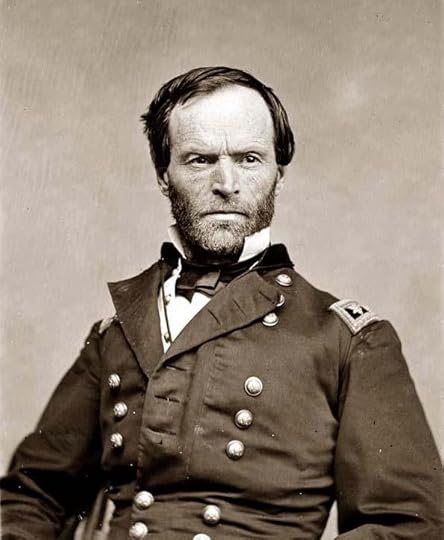
And this was how America’s leaders knew it would go. General William T. Sherman is always said to have transferred his depredations from the rebellious South directly to the Indian west because the campaigns he oversaw as General-in-Chief of the Army (Grant’s old post, before he was promoted to the White House) incorporated the big strategic lesson of the Civil War: that you can subdue vast amounts of territory and population when your military force is equipped by an invulnerable industrial base and projected by railroads and steam-powered river fleets (the U.S. Army would drive across Western Europe into Nazi Germany after the same fashion, though with massive numbers of trucks, jeeps and tanks named after Sherman augmenting rail networks and providing troops with personal mobility). The land area of the Confederacy had been massive—-as big as Spain, Italy, France, Germany and Poland combined—-and by the end of the war the Union army’s higher commanders like Grant and Sherman were experienced handlers of whole-continent geopolitical strategy.

description

Sherman, who had been a banker in 1850s San Francisco, knew that rail companies like the one owned by Stanford, subsidized and protected by the government, would win the west without the massive levee of troops that would signal war to the war-weary American voter. (Hitler, always an avid reader of Wild West dime novels, so associated the militant use of railroads with the US that he named his personal armored train “Amerika.”) In the West the railroads would shuttle troops, and, importantly for permanent conquest, carry civilian development along with it; as Solnit writes, this rail system wasn’t built to serve existing needs, but to create them.

Much fuss has been made over the idea of the frontier, as though it were a line advancing east to west, but the West was settled piece meal, and Indians fled in many directions to escape the tightening noose of the railroad lines and towns.


I’ve been reading a lot lately about the American West, its legacy of butchery and theft, its mythic violence, and Solnit’s writing and Muybridge’s photography combine in what is the most unsettling summation of the period I’ve yet to encounter.

Profile Image for Geoff.
444 reviews1,525 followers
November 9, 2012
I left the theater after my second viewing of The Master last night with Muybridge on my mind. There are many reasons for this. One might be that The Master was being shown in 70mm, it’s the first film I’ve seen in that resolution, and it is magnificently sharp, with bright, vivid, and subtle coloring, more expansive sound. It is the next advance in the medium that Eadweard Muybridge helped to inspire over 150 years ago. I am far removed from that time, but I’m living in a sensory world that has been in a startling way determined and delineated by the reverberations of what Muybridge accomplished- making time stand still on a portable medium and then developing ways to reanimate it, dismantling and reconstructing time and space as to know them better. This process began in the middle of the 19th century by taking a picture of a horse. The result is someone like me walking dreamily out of a movie theater in 2012, my head full of someone else’s visions, dreaming someone else’s dream, considering a world through multiple layers of lenses. Another reason Muybridge was so much in my thoughts last night is that scene near the beginning of The Master where Freddie Quell wanders onto the docks in San Francisco bay and stows away on Lancaster Dodd’s boat, and the boat drifts Westward out toward the setting sun on the oneiric lilt of the waves, under a light-strung Golden Gate Bridge. It’s an hallucinatory scene. Muybridge once took a photo of himself from around the same vantage point, gazing out across the Golden Gate, before the bridge was built. The light in that photograph was hallucinatory as well, as I suppose light considered as an object always is; the bay became a luminescent white plain and the mountains dark, angular, high-contrast forms in the distance. Muybridge himself is situated near the middle of the frame, his back turned to the camera, but is almost lost among the bramble and stone- an observing object fused with the landscape.

”What you have to do is enter the fiction of America, enter America as fiction. It is, indeed, on this fictive basis that it dominates the world.”
-Jean Baudrillard

When Baudrillard started coming to California in the 1970’s to seek out “the capital of postmodernism” there is something he missed entirely: that modernity, that spectacle, that artifice and illusion, cultural amnesia, life as representation, that hyper-violence and hyper-reality had existed in that place for at least a century. So argues Solnit in her long, digressive essay on Muybridge. If modernism in art is meant to show and engage a particular alienation that human beings experience in relation to the industrialized world, then a kind of modernism certainly arose in fascinating ways in California during the middle of the 19th century. Modernism is not only those European impressionists playing with how objects are rendered on a canvas, or Rodin’s figures sculpted in weighty, sorrowful forms, or Flaubert and Baudelaire and Nerval approaching a new literature that did away with Romanticism and redefined Realism. Modernism is also economics, labor, technology, new ways of waging war, architecture, the altered cityscape, the idea of nature as something separate from mankind. While the high art of Europe was transmuting the classical world into new languages, America was creating its own style of modernism, one that displayed itself not on museum walls but on the very land, one that created the first corporations and millionaires, that gridded the continent with railroad tracks and consumed forests and bison and native populations as if they were fuel for a monstrous smelting furnace. Technological modernism is the real legacy of the Wild West; the cowboy stories and Indian legends and vast unsettled Edens are the mythology, the preferred remembrance, the whitewashed history that only exists in images and narratives- films. New dominant forms of technological representation and fiction are the true children of California.

That the information-saturated reality we wade through today is a mode of existence created by the products of Silicon Valley is inarguable; also inarguable is that Silicon Valley had its origins in Leland Stanford’s wealth and hubris. Leland Stanford made his fortune in ruthless competition building the first transcontinental railroad. He also funded the motion studies of Eadweard Muybridge. At the very beginning of American modernism, which is also to say in the very last days of the old world and the dying old modes of life, were the dual forces of money and industry, remaking the land, remaking time and space and our experiences relative to them. The new world takes root and is born in the senses, in perception. Solnit’s thesis is that the first signs of this shift in perception can be traced back to the concurrent development of three technologies- the railroad, the telegraph, and photography. The railroad and the telegraph worked to annihilate space and time and shrink the size of the Earth by increasing the speed of travel, commerce, communication. In doing so, they also began delocalizing experience, making the landscape uniform, eliminating particularities of place that were for centuries determined by the limited capabilities of the transit of resources and information. These changes in commerce led inevitably to another, more profound and broad change in Time. Time had to be made uniform between greatly separated places to sync up the new forms of trade. Before the railroad and the telegraph and the factory, it was seasons and the amount of daylight, the ringing of church bells, that determined the way time was comprehended. It wasn't until a person in Philadelphia could communicate instantly with a person in California that it became necessary to synchronize clocks. It wasn't until a train load of timber coming from the Midwest had to be met at a station in New York City at a specific hour that people had to standardize time. So we descend from watching seasons and months to weeks and days on down to fractions of seconds, and with it limn the workday, the meeting promptly at 10 am, and the idea of someone being “late to work” and facing punishment for the infraction, the intrusion of strictly regulated and monitored time into lives unacquainted with such a thing, and that new Time largely being determined by the requirements of the money-making machines of the new industries.

"His [Muybridge's] was part of the anxiety of an age shifting its rhythms from those of the heavens to those of the machine."(pg. 61)

The third development, photography, plays a stranger and more ambiguous role in the 19th century’s changing perception of space-time. A product of the same forward thrust in technological innovation, it stands somewhere indistinct between a science, an art, and a commodity. It engenders new ideas about time and space and humanity’s relation to those things, but it also fragments and makes those observations both less and more real; it answers so many questions but raises so many more. A photograph is necessarily a lie, but it is a more accurate reproduction of a scene than what our memories can supply. Photographs divide and chop up and scatter time, make time portable, allow the dead to live, allow time to stand still, allow a single event to be revisited endlessly. A photograph determines facts while muddling them, ennobles as well as degrades the bodies that are its subject, replaces and supplants what it represents. The paradox of the represented image is that the more ever present and vivid it becomes, the less the source of the representation seems to matter or even exist outside of its depiction, and the image comes to speak of a reality with more force than the reality the image contains. Thus Solnit's idea that in our modern age we are more than ever those people raised in Plato's cave, confusing shadows with the world.

Questions such as these didn't exist for people in the early 1800’s. Straddling the pre- and post-technologically representational worlds is Muybridge and his team of scientist-artists. From early on in his career Muybridge was interested in the photographic medium as a way of capturing the ephemeral, and even his mammoth-plate landscapes of Yosemite, considered among the finest ever produced, would often focus on such transient things as water in various states of motion, the mutability of clouds, the debris of landslides, the slow migration of glaciers. Even then it was as if he sensed that the photograph could grasp at something beyond the limits of our perceptions. Muybridge’s motion studies, funded by Stanford, were the first instances of photography moving faster than the eye, of photography amplifying the capability of our senses, revealing “those immaterial events of which time itself is made.” The motion studies of horses and other animals were scientific gestures. When he began reassembling those images into sequences and animating them with his zoopraxiscopes and magic lantern slides he was taking that science into the realms of art. Edison and the Lumiere brothers and a handful of others made the final steps toward cinema, but in the 1880’s Muybridge met with Edison and discussed the motion studies and ideas of combining his magic lantern shows with Edison’s phonograph- the merging of moving pictures and sound- the fundamentals of cinema, and when merged with the transmissive properties of the telegraph, the essentials of what were to become computers. One can see in the Stanford/Muybridge collaboration, in latent form, a large swath of the features that would come to define America in the 20th and 21st centuries: vast wealth funding discovery with both brilliant and tragic results, faith in material progress as a saving grace and our inexorable trajectory toward a technological civilization, the fragmenting of time and space into more abstract and complex and alienating notions, the simultaneous shrinking and decentering of the world, the “everywhere that is nowhere” of the information age.

I didn’t speak at all here of the particularities of Muybridge’s biography, the accident that may have caused damage to part of his brain and spurred his career onto unprecedented creative achievements, his involvement in the Indian wars, the murder he committed, his travels far across the United States and Europe, the triumphs and failures of his shadowy, later years. For these I direct you to Eric's wonderful review of this book, which he has been kind enough to punctuate with a number of Muybridge’s pictures, and of course to Solnit’s remarkable study itself.
Profile Image for Reenie.
257 reviews16 followers
March 30, 2012
This book is interesting, although at times that fact was almost obscured by the writing style, which has a recurring tendency to extremely florid prose. Isn't it odd how these days fiction writers generally avoid anything floral or lengthy in description to avoid being 'purple' or Victorian, while non-fiction writers can get away with writing sentences that would make a Bronte sister roll her eyes? Not that they always do it, but the mystical floralness does crop up more often, and at least for me, it detracts from the point. But when I made an effort to sift through the parts of the writing that made me want to eye roll and forget about even trying to take seriously some of the mystical coincidence parallels that were being drawn off and on without much in the way of support, I did find some of the information and in this book quite interesting, and an addition to the perspective of social history over the time period it was covering, and how that informs what we make of technologically-driven social change today.
Profile Image for Jeff.
738 reviews27 followers
October 26, 2010
The reviews on this site have it about accurate, though they may value Solnit's speculations about the twin cultures of technology and film, for which Muybridge and California Victoriana are viewed as responsible, slightly more than I do. (I prefer her book about California painters of the post-war period.) She is of course not the first to connect tech history with the film industry; similarly, her work on Muybridge is indebted to scholars to whom I can't find all that much of her book's value added. That said she is a marvelously fluid thinker with a keen appreciation of how discourse is a material basis for its technological troping. She's the right person to make the dead hand of academic historiography twitch.
Profile Image for Christine.
8 reviews21 followers
March 23, 2009
What strikes me about Rebecca Solnit's writing is her ability to come off as a modest writer, one who is trying to "figure out" her books, her storylines, her history, right alongside the reader, but at the same time, is rich with research and knowledge about her topics. The intelligence oozes through, but never once does her writing read as showy or grandiose -- it is simply engaging, thought-provoking, involved stuff. More than worthwhile, it is necessary.
Profile Image for Jan Priddy.
890 reviews195 followers
September 1, 2025
One thing leads to another. This is among the best works I have ever read. Solnit's weaving of personality and achievement and national character with how we understand time and place is masterful. I bought this book when it first came out because it focuses on Edward Muybridge, a man I knew from the Dover reprints of his photographic motion studies. However, when I first tried reading it more than twenty years ago I realized that it was not only about Muybridge but about how he and others changed modern society's understanding of time and distance. I stopped reading. That was a mistake. Big, big mistake.

I am a Muybridge fan going back decades, and a horse fan for longer. The bet about Occident, a trotting horse, fascinated me. In the past, I had written to many online sources who wanted that imaginary bet to be about a galloping horse. Even the horse people I knew did not believe all four feet are off the ground all at once in a trot. Even the photos failed to convince them, which was a hurdle Muybridge himself had to overcome.

This really is not a book about Muybridge, though it details the facts of his life, cradle to grave. Leland Stanford, who drove the golden spike in the rails joining east to west and founded Stanford University has a role but so do many others.

This is a book about ideas and how our understanding of our world has so dramatically changed with barely any notice. If you ever saw the BBC series The Day the Universe Changed, this is what Solnit's book accomplishes. How we look at our world and what we take for granted has irreversibly changed since Muybridge began photographing a horse.

Now that I have finished this book, and enjoyed its complexity and intimacy, its weaving of railroad time and Plato and Eakins' paintings and modern cinema and television, its sophisticated satire and wry humor, and the intelligence of the analogies Solnit commands, I feel foolish to have set it aside for so long.
"A history streams forward from the events of the 1870s, one that sometimes feels like a relay race, a torch-passing, a game of telephone: something is transmitted, but it changes with every transmission, every carrier. The places themselves seem to tell the story best" (242).

I learned a great deal I had not known and recognized connections I had never considered before. I connected Solnit's observations to prior knowledge, and while I might have taught sentences, even passages, I doubt high school or college freshmen would grasp the whole of this book. It is demanding, perhaps even exhausting, but a deeply satisfying read.

I must add that this is the book a man was explaining to Solnit, the book she had herself written and he would not listen to her long enough to hear that. That led to Men Explain Things to Me, which is also wonderful and which I first read as a short essay. I read it immediately, and the book, and the memoir that came next... it still took too long to get to this book which is best of all.
Profile Image for Bryan Alexander.
Author 4 books318 followers
May 13, 2014
River of Shadows is an imaginative look at the origins of modernity. Its main focus is the photographer Eadweard Muybridge, best known for inventing the motion study method of breaking down rapid motion into viewable scenes. Rebecca Solnit uses Muybridge's biography to explore great themes of modernity's emergence: the reduction of space, the recreation of time, the destruction of nature, speed's rapid acceleration, the rise of giant figures, and the defeats of many.

The biography nicely balances the grandeur of these big ideas. Muybridge and the time are about huge creations and terrible losses. Despite its subject's globe-trotting range, River focuses on California's role in these grand themes, ultimately settling on Muybridge as a kind of godfather to Hollywood and Silicon Valley. As Solnit puts it, "Muybridge was photographing the journey to modernization" (122).

River is, simply put, a pleasure to read. Solnit's style is elegant, often direct, yet also lyrical and witty. "As a young man [Leland Stanford] had the smoldering good looks of a stage villain, but as he became stouter, he came to look like a badly taxidermized badger." (69) Solnit can sweep together concepts into intriguing, even pithy syntheses, as in:
Cinema can be imagined as a hybrid of railroad and photography, an outgrowth of these two definitive nineteenth century inventions... (219)
What Europeans and European Americans had lost gradually as the Industrial Revolution loosened their ties to earthly place and celestial time, Native Americans would lose suddenly, as war took them away from familiar places and ancient practices... (110)
In other words, cinema would itself be a kind of Ghost Dance... The Ghost Dance itself was an effort to make time run backward like a film, so the whites vanished, the game reappeared, even death reversed itself. (115-6)
In earlier times racers, human and equine, only competed against each other, but by the late nineteenth century they matched their bodies to ideas and records: they raced the clock. (77)

Her voice races across subjects, or pauses to think hard about one item, with equal power. The opening chapter repeats several phrases as if in wonder or ritual, summoning up the topic and the intellect to master it.

The physical book is also a treat. It's nicely stocked with photographs, which isn't a trivial matter when some require unusual layout, like the grand San Francisco panorama. A little flip-book of Muybridge running in the nude decorates the opening chapter.

The book relies on several excellent set pieces, such as the Modoc War (1872-3), the sad story of Muybridge's wife and lover (he killer the latter, but evaded hanging by reason of insanity), and the exploration and defense of Yosemite. Each of those stands alone as a powerful essay. Together they give context or depth to the book's biographical subject.

Considered as a nonfiction book, River instructed me very well. I have never lived on the West coast, nor do I know its history in detail, so the California decades were fascinating to me. My knowledge of photography and film history received a fine expansion here. Solnit's major themes appeal to me, and were fairly persuasive.

So what's not to like?
First, the survey of technology is curiously narrow. Solnit dives deeply into photography and, to a lesser extent, the railroad, but leaves out equally powerful contemporary inventions: the telegraph, the gramaphone, the telephone. Each of these would add wonderfully to her argument. I can see excluding them for reasons of space, but I think a writer of Solnit's capabilities could have done something with each, or at least justified leaving them off.
Second, Solnit raises a terrific subject, the combination of railroad strikes, native American rebellion, and social panic in 1877, but gives them unusually short shrift. There's a hint of possibility when the book connects Muybridge's time studies to Taylorism (212); that's the kind of path I wish River has followed.
Third, the concluding chapter brings the book's themes fully into the present, but shortchanges the digital world. Solnit offers uncharacteristically flat observations ("war American-style is a lot like video games", the internet as an "everywhere that more and more becomes nowhere", 254). Cyberspace offers few delights and less intellectual interest to her, beyond the empire of Silicon Valley.
Fourth, and this is not the writer's fault, the index is too basic. Many key terms from the book don't appear.

But forget those criticisms until you finish the book. Grab a copy and dive in.

Some intriguing details:
"Photographers sometimes scraped the [glass] plates clean to start over, and many of the negatives of the Civil War were recycled into greenhouse plates without being scraped, their images of the harvest of death gradually fading away to let more and more light in on the orchids or cucumbers beneath." (36)

"While recuperating in England and receiving treatment from Sir William Gull..." (38) Now that could make a fun Jack the Ripper story, if you accept Gull as Jack.

"A technology is a practice, a technique, or a device for altering the world or the experience of the world." (114) Pretty close to Crowley's definition of magick.
Profile Image for Fil Krynicki.
62 reviews3 followers
June 1, 2015
I didn't really like this book. I didn't even quite finish it. I believe I am on page 220 or so (of 250). When I couldn't even motivate myself to pick it up on a plane ride home, I knew it was done.

Something about this part-history, part-biography, part-metaphor just doesn't do it for me. All of its subjects are touched on only in moments, and the use of a metaphor of condensing time to connect the disparate pieces always struck me as forced. I learned a little bit, but not a lot, and I was uninspired.
1,090 reviews73 followers
January 14, 2014
If you think of Eadweard Muybridge at all, you probably remember him as an obscure l9th century photographer, the man who first proved through time lapse photography that when a horse gallops, all four hooves are off the ground at the same time. Okay, but 300 pages about his life?

What Solnit does is to simultaneously place him within the context of his time, the geographical west of 19th century California, opened up by the transcontinental railroads, and at the same time, a culture of onrushing technological changes, reflected in his work. She finds in him an individual whose efforts foreshadowed both the growth of the film industry in Hollywood and the technological innovations of Silicon Valley.

Muybridge was an early photographer who captured the grandeur and ruggedness of the western wilderness (sites such as Yosemite Valley) . In doing this, he was creating a myth of the west, photographs of a reality that was out of most peoples’ reach – beautiful landscapes, exotic Indian cultures, (ignoring many realities), and preparing the way for the escapism of what would become known as the movies.

Later, he did extensive work in photographically recording cityscapes and experimenting with the use of time in photography. His photography of galloping horses meant the development of a photographic process fast enough to capture bodies in motion. He invented a machine he called a zoogyroscope which enabled viewers to see figures in apparent motion. He perfected this process in the late l870’s and it was a clear forerunner of the motion picture projector with its 24 frames a second tricking the human eye into the sensation of seeing steady motion, not the actual fact of 24 still images.

What makes this historical study interesting are the connections that Solnit makes with what else was happening during the period. For example, she asks the question of what movies do, if they do not preserve a vision of the past? Wasn’t this the same impulse that moved the westen Indians to perform their “ghost dances”, an attempt to bring back the past, vanished days of prosperity before being overrun by white expansion? Similarly, during the period, the same impulse is found in the popularity of spiritualism, the attempt to communicate with the dead, those beings who have succumbed to time an the past. It’s as if there are currents in the psychic air of the time, ones that were technologically harnessed by individuals such as Muybridge.

She makes a further case that in an individual such as Muybridge many of the forces of what could be called modernism can be found. One way of looking at modernism is that it’s a process in which capitalistic processes, using new inventions, have broken up traditional forms of life. Looked at in this way, Muybridge is at the center of the process. His photography erased established ways of looking at the world, and it would later influence abstract art which questioned the reality of our senses. On a practical level, Muybridge’s time-motion studies were used by industrialists to streamline the factory mass production system. Muybridge did not work in an ivory tower, though; he was employed by Leland Stanford, the railway magnate, who did so much to build the railroads that would transport emigrants to California and radically change its culture which to this day remains a center of technological and cultural innovation.

Solnit’s type of history is one that begins with an individual and examines him to see how his influence spreads in surprising ways. Motion pictures, modern art, tourism, much of the content of modern American life, she contends, was anticipated by Muybridge. Muybridge, she writes, “was at the zero point of the dawn of moving pictures, and he is everywhere as the ghost of those trails of images rushing by” – movies, television, smart phones, changing all the time. Is this making too much of one person? Possibly, but it’s a pleasure to see a historian’s creative mind at work.
Profile Image for Sara Watson.
132 reviews136 followers
August 5, 2013
Annihilating Time and Space: Reading River of Shadows

It has been a crazy couple of weeks. I was running on full steam wrapping up my thesis through July 22, and then went straight into cleaning-packing-moving mode moments after my return from the Exam Schools. And even after we got nearly all the unpacking done at the end of last weekend (save for the boxes of artwork), I still felt a little brain dead this past week. It was starting to get frustrating, because I wanted desperately to get into the swing of things, to get caught up on thesis follow-ups and the news I had missed. And more than anything, I was eager to get started in earnest on the book. But I just couldn't get my head back in the game. I found myself wandering from coffeeshop to public library trying to find a comfortable place to reengage my brain. My sense of space and time was all out of whack.

On Wednesday night I picked up Rebecca Solnit’s River of Shadows: Eadweard Muybridge and the Technological Wild West, and it was just the cure for this transition/adjustment malaise. There were so many things about this book that made it just the right thing for me to read at this very moment, and for that I’m thankful. I had come across it when I saw that Tech Book Club read it, and when I bought my mom a copy of Wanderlust: A History of Walking, but I was most recently reminded of it in an essay of Solnit’s I’d saved to Instapaper from a tweet.

In the most basic sense, I had been interested in the book because it covers the life and historical context of Eadweard Muybridge, who essentially developed the means to take rapid shutter speed photographs and thus paved the way for modern cinema to capture moving images. His motion studies of horses and human bodies revealed novel detail that had been previously inaccessible to the naked eye; in gallop, all four of a horses’ hooves do, in fact, leave the ground. I enjoyed reading into the founding story of this period of photography and early cinema, given my background in film studies. We have a lovely print of Muybridge’s dancing couple that we displayed at our wedding (vintage hipster gag, I know) that we had picked up from 20x200. I had a soft spot for the man and his work already, and was eager to learn more.

What I wasn't expecting to find in this book were all the connections to my recent work on the Quantified Self. In many ways, Muybridge was dissecting motion of human bodies, revealing objective, abstracted detail about the body’s movement in much the same way that sensors now enable us measure activity and movement in even greater detail. Muybridge froze time to show the patterns in a walker’s gate. Now instead of freezing time, we’re collecting data all the time, with sensors that track our gate throughout the day and monitor our movement while we sleep. Data now does what celluloid did then, parsing information into smaller and smaller knowable units. But it’s also sometimes uncanny: “Those gestures—a gymnast turning a somersault in mid air, a nude pouring water—were unfamiliar and eerie stopped because they showed what had always been present but never seen." As Solnit puts it: “With the motion studies that resulted it was as though he were returning bodies themselves to those who craved them—not bodies as they might daily be experienced, bodies as sensations of gravity, fatigue, strength, pleasure, but bodies become weightless images, bodies dissected and reconstructed by light and machine and fantasy." I relished the opportunity to connect those dots in my own intellectual history, from film history to internet studies, in a new way in reading this book.

Solnit’s book is about a man, an innovator, but it is also about a place in time. Solnit writes a lot about landscape, the west, San Francisco, etc. I’ve been thinking a lot about the impact that the ideology and the lifestyle of the makers of technology have on its design and adoption in broader contexts, especially now as it enters the intimate realm of our bodies and our minds. I loved the rich descriptions and sweeping connections Solnit makes from the early mining days of San Francisco directly to the emergence of Silicon industries, all happening on the same soil. It made more acute a hankering I’ve been having to spend more time in the Valley, if only to get something of an ethnographic understanding of the contexts and circumstances in which our technologies are built. She described that period in which Muybridge was working with such energy and drama; it made me want to be that much closer to the history that’s happening now.

Solnit has a knack for drawing out these sweeping connections. She does it with such finesse that you don’t want to try to poke holes. She’s connecting a lot of dots, and doing a fine job of telling you precisely why a technological innovation has turned out to be really important. I like the way her mind works, pulling threads together across time and space. I try to do that in my own work. It’s the work of an interdisciplinarian: the railroad and the cinema and silicon valley all begin to make sense together if you are looking at the right pieces.

Reading this got me thinking about what we’re trying to do in if/then. Solnit weaves a story about the rippling effects of converging technologies on the way we see and experience the world. Our book will weave a story about the rippling effects of current technologies, drawing out these connections and pointing to where these moments of change are happening around us right now. The only difference is the clarity and confidence that hindsight affords. I want to write about the near future in the way that Solnit writes about the past.

Solnit writes about how the Victorians worried about losing a sense of place and time, of embodiment: “It is as though the Victorians were striving to recover the sense of place they had lost when their lives accelerated, when they became disembodied. They craved landscape and nature with an anxious intensity no one has had before or since." We’re still worried about technology’s effects on what is lost and what is gained when we change our perceptive abilities. The Victorians grappled with the dichotomy between the natural and the technologically-mediated worlds. Seeing that dichotomy spelled out so clearly through this book, it made all the more clear to me that I think that we’re getting closer and closer to the collapse of these binaries.
Profile Image for Joshua Buhs.
647 reviews132 followers
April 23, 2015
Rebecca Solnit explains things to me. Brilliantly.

This book, of course, is the one that inspired her essay “Men Explain Things to Me,” and launched mansplaining. (Which word is recognized by spell check!) Famously, she was at a party and told a man she had just written a book on Eadweard Muyrbidge; the man went on to declaim about a Muybridge based on a book review he had read in the Times. It took Solnit’s companion three times to get the man to understand that that was the book she had written. He looked discomfited, but continued to lecture her anyway.

The Times was right, though—and the man, too, in his blowhard way—that this is a very important book. It’s instructive to have read it just before I read Conniff’s Species Seekers, since both cover ground that is well known in the history of science—Muybridge is a constant reference in books on modernism and modernity and its connection to science and technology—but while Conniff remains superficial and blithely ignores some of the more interesting historical work on his subject, Conniff probes and pushes and finds new connections.

She is also an excellent writer, and the book is at times almost poetic, but nonetheless with a driving narrative force that is motivated by the circle of connections she finds, and her foreshadowing: the book starts in 1872, with Muybridge taking what amount to stop-motion photos of a horse owned by Leland Stanford, but we don’t get there till late in the book. In the meantime, we get to consider Muybridge’s biography, which is put together with great difficulty—he left scant traces here and there—except, of course, for his murder trial. Yeah, he was an artist and a murderer. And a prophet of modernity.

The first chapter introduces the swirl of themes that will concern the rest of the book. Muybridge’s photographic technology, which allowed him to capture images faster than the eye could otherwise process, was part of a number of nineteenth-century technologies that ushered in the modern world and created a rupture between current civilization and the rest of human civilization because of the way space and time could be not only annihilated (a favorite phrase of the time), but cur up, measured, rearranged and reordered according to human imperatives rather than natural cycles. The steam train was the sine qua non of this technological shift, making it possible to cross the United States in days rather than months (and forcing the US to adopt time zones and get rid of local time). Telegraphy did something similar. At the same time photography was able to completely freeze time.

These changes in the lived world help explain the Victorian fascination with landscapes—it was a way of seeing time played out over the centuries, as well as a distant looking back on natural cycles that were becoming less important—and probably explain why today, the so-called fast world, we look back to Victorian’s for advice, since they were the first to really have to deal with these issues.

Solnit also connects Muybridge to other time and space-destroying technologies. Muybridge was a link between photography and cinema—which of course would become central to creating fictional places and allow experiments in the experience of time—and also connected to the birth of Silicon Valley, through the personage of Leland Stanford, railroad barron, governor of California, corruptor of democracy, and founder of Stanford University. It is an open question how much Muybridge and Stanford influenced each other int he technological innovations that Muybridge created to make nearly instantaneous photographs of horses in motion, and that he would spend the rest of his life perfecting and playing with, studying bodies of all kinds, including naked humans and dancers and gymnasts and birds in flight.

These themes recur throughout the book in chapters that are roughly chronological—although always built with the knowledge of what will come later—trains and horses, photographs and the changing nature of time: the modern world created on the wild frontier, in the San Francisco Ba Area just after the Gold Rush, when social roles were in flux generally. Tied in with this is a biography of Muybridge, who used the fluidity of the West to create and recreate himself again after migrating from England. Soling tracks Muybridge through the scanty traces he left, in censuses and newspaper advertisements and the recollections of others.

Muybrdige, she notes, was an artistically gifted photographer. He was busy taking pictures of the West at a time when Yosemite and similar places were becoming the very Victorian monuments and tourist traps that memorialized different views of time. His vision, Solnit argues, though, was different than others—and here interpretation of his photographs is one of the things that makes the book so great. She is not just oriented around sociological or psychological concerns, but is also attentive to the aesthetic dimension. (I couldn’t help thinking of Susan Sontag, another great writer on photography.) Muybridge won plaudits of the time, too, and had gallery showings.

Eventually, though, Muyrbidge gave up the artistic approach to photography, promising though it was, to concentrate on the technological applications, which lead to his breakthrough in increasing shutter speed and decreasing the time needed for exposure. Solnit argues that the link between the landscape photography and stop-motion photography was a panoramic style of photography that Muybridge practiced on the City of San Francisco itself, figuring out a way to “skin” the city, or compile various photographs into a giant panorama of the city that allowed the viewer to see all of San Francisco in a single photograph.

Solnit herself makes good use of cutting and splicing time and focusing on her theme. There are bits of Muybridge’s life that do not get a long treatment, such as his travels through Central America. Maybe that’s because the sources for it aren’t great, but it’s also a nice narrative strategy, as that would simp;y distract from the themes she is developing, working over and worrying again and again. The book is relatively short, but it feels dense with thought, while never feeling sluggish or hard. It’s an amazing balancing act, a brilliant bit of chronological reconstruction.
Profile Image for Megan Highfill.
136 reviews2 followers
March 4, 2021
Okay. I'm struggling with what to include here, because I have so many thoughts, just like the author, who must have struggled with what to include, because instead, she just included it all. In a short 260 pages, she covered the history of time zones, the railroad, a few indigenous wars, some murders, the tech industry, the movie industry, a carriage accident in Texas(?), something happening in Europe with painting, national parks, photography, porn (seriously?), and lots and lots of other things. But the book was supposed to be about photography, specifically Muybridge's photography. Instead, with her endless metaphor and prose, completely ridiculous connections (a statistician would flip out given all her correlation when there wasn't any), and her extraordinary lack of direction, she created a book full of interesting information, but with little to no purpose. One minute, we would be focused on Muybridge's work, she'd mention Yosemite, then she'd mention the indigenous people displaced from Yosemite, then the Indigenous wars, and suddenly, 20 pages later, I forgot, what are we talking about again?

I found myself pretty hooked to the sometimes ethereal and non-committal way she spoke of time. The way the railroad industry fueled time zones, and physically changed how people experienced time due to the speed of the train. This did connect well to movies and photography, allowing people to experience time in motion, sometimes fast, sometimes slow, and to experience an event more than once. This was mostly in the first third of the book, and had the author continued on this theme, I think, even in her philosophical exposition, it could have worked. But alas, there's the whole "no direction" thing.

Obviously, lots of people like this book. Usually, I can figure out why. It took such a long time for me to read, plodding through page by page, and losing my patience well before the halfway mark. I'd like to say "I didn't love this book, but I would recommend it to_____", but I have no idea who would go there. Artists, maybe? If you skip the first half. Or mathematically-minded people, if you skip the second? Well rounded people? I feel like there are podcasts that serve up the same dish in a more engaging use of your time. Anyway, I am glad I read it, so I guess there's that.
Profile Image for Myles.
635 reviews33 followers
November 27, 2014
(4.7/5.0) Solnit is so obviously influenced by her subject, this pretentious, determined photographer who climbed to the tops of mountain peaks and robber barons' mansions just to find a new perspective. Her take on history is so out there, so committed to linking unexpected events and actors, so refreshing.

She was my professor my last semester at Cal, and she speaks just as she writes, is spider-like in her ability to weave in circles, rapidly and with serious elegance.
Profile Image for Brad B.
161 reviews16 followers
July 8, 2022
I am in awe of Rebecca Solnit. By coincidence, I finished reading River of Shadows after an inspiring day spent walking though multiple San Francisco neighborhoods. Having moved around a lot during my life, I feel a strong connection to Solnit's depiction of San Francisco as a place where people come to reinvent themselves, as Muybridge did in the 1850s. Part of me feels like a failure at having failed to make the kind of mark in the world that Muybridge did, but another part of me is kind of glad. Maybe some of that technology, with its capacity to draw us out of the real world and into the imagination, the place where alternate facts and conspiracy theories are born, was better left alone. Either way, River of Shadows is a remarkable book that will leave every reader with a lot to think about.
Profile Image for Emma.
675 reviews107 followers
April 23, 2023
I finally understand how the motion studies were made now. This book is as much about California as it is about Muybridge and his work. I liked the parallels she draws between the speeding up of life and changing of human relationship to time caused by the railroads and the invention of fast photography, leading into cinema, with a string California throughline. It’s good. Solnit is always reliable.
Profile Image for Jeff Friederichsen.
94 reviews6 followers
April 3, 2015
Solnit's diligent reportage ties a multitude of social movements and technologies into a tight web, revealing the less obvious forces of history. Sometimes the rubber bands of connection come pretty close to snapping, but the result of so much scholarship is impressive. Eadweard Muybridge seems to have been at the very nexus of our modern age—the author leaves no stone unturned in her analysis of his place and time, and the import of his famous motion studies. We know what he did, and when—less about why. The result is a fairy tale of coincidences, failures and successes that results in the guts of your cellphone and the nature of modern popular entertainment. Quite poetically tied up into a neat bundle at the end.
Profile Image for Greg Brown.
402 reviews80 followers
March 4, 2012
Basically amazing. Rebecca Solnit surveys Eadweard Muybridge's life and career, tracing the changing effects of space and time throughout his photographic work. At the same time, Muybridge is but a tiny corner in the story, simply the distillation of the larger cultural currents at play—the annihilation of space and time by railroads, telegraphs, and photography that radically changed our sense of what distance meant and made the world accessible (in a certain sense) to all.

Solnit also pulls off one of the my favorite opening chapters of all time, up there with Caro's survey of Robert Moses' power in the opening to The Power Broker. Read it!
Profile Image for Sugarpuss O'Shea.
426 reviews
June 2, 2022
This book is a hot mess. Ms Solnit's writing style is both flowery & ponderous at the same time. It's maddening! There were so many tangential storylines, the reader just gets lost in all the unnecessary noise. I think if the book ended with Ch 9, I may have given this book a higher rating, but because the final chapter was so annoyingly extraneous, I can't give anything higher than an okay rating. If you are looking to learn about Muybridge & his contribution to photography, I'd suggest you save your sanity & look elsewhere.
Profile Image for David.
865 reviews1,664 followers
July 14, 2007
Friends raved about this book, and - indeed - it did seem like the kind of subject that I would find interesting. But. I. just. could. not. finish. it. The prose was like molasses, infused with lead. Plodding. Pedestrian. Unreadable. Godawful.

A shame. Because there was probably an interesting story in there somewhere, trying to get out.
Profile Image for Malcolm.
1,977 reviews577 followers
December 24, 2023
I suspect those of us who know of, can name Eadweard Muybridge (however he was spelling his name at any given time – it regularly changed), know of one thing: his photographic sequences of people and animals in movement. For many of us it is more specific than that; it’s the photos of horses in action. Taken in the early 1870s, they were the cutting edge of technological sophistication, and while the scientific questions of how creatures move was important, this impressive biography makes a different case – arguing that his contribution was as much to the technology of moving pictures as it was biomechanics.

Muybridge – born and died in England, but most noted for his work in California – lived at a difficult time for a biographer. It was a question of highly mobile populations, poor record keeping, fluid identities, and poorly developed state systems. Yet, as we’d expect from Rebecca Solnit, the narrative here is surprisingly comprehensive. There is little doubt that towards the end of his life – from the late 1870s or so – he would have been less difficult than many to trace; his circles included State Governors, Federal Senators, and others about whom we know a lot. But there are earlier times when Solnit can do little more than note that there years on end where we don’t and probably can’t know what was going on.

Even so, Muybridge was very much in the public eye, at least once he got to California where he worked as a landscape photographer, at various times also acting for the military in their wars against the region’s Indigenous peoples – Solnit focuses on the ‘Modoc Wars’ of 1873/4 in particular. Here, for instance, we see Solnit’s ability to make links and find resonances. Much of this discussion is informed by her reading of his landscape work, which tends to the enigmatic rather than the spectacular, and which engages quite distinctively with the hostile landscape this war was fought in. She also visits the area, to find a small village that had been built around the time of the conflict, and repurposed as an internment camp for the USA’s Japanese citizens during WW2, including a infant George Takei (of Star Trek fame). It’s a quirky aside, but I love this kind of linkage where the guy who was responsible for one of the major technological developments in the creation of cinema is linked by a small town in upstate California to one of the most iconic figures from one of an era’s most iconic TV shows.

It’s not just enigmatic associations – in fact it is very little of that. This is a solid, sharp, insightful biography of both a fine photographer and a major figure in the technological developments that gave us one of our major entertainment media. He also comes across as not all that likeable and difficult to get on with, but also with a tendency to see things and options in imagery that others did not see: Solnit suggests that this might have been a consequence of brain damage after a stage coach accident, which might also account for at least part of his less sociable style.

It’s an engagingly written biography, well-illustrated (as it should be for the topic), and packed with technical, cultural, and contextual insight as well as rich biographical insight. It’s sat in my to-be-read pile for altogether far too long, and turned out to be the ideal companion for afternoons sitting in the park for a little holiday quiet time.
Profile Image for John David.
381 reviews382 followers
August 17, 2021
Outside of historians of photography or the occasional cinephile, the name Eadweard Muybridge (born Edward Muggeridge) doesn’t ring many bells anymore. If anything, he is perhaps recognized in passing for his 1870s collaboration with former California Governor and future Senator Leland Stanford and their mutual interest in trying to tell whether the four feet of a horse ever leave the ground all at once while a horse is at a full canter. Muybridge’s technological innovations revealed that in fact they do – to the surprise of many of his contemporaries. But aside from his fascination with studying the motion of horses, he led a fascinating life. In her book “River of Shadows,” Rebecca Solnit takes Muybridge’s life and accomplishments as a centerpiece, but slowly works outward to the study of his environment of the newly populated Western United States, and then ultimately to the now almost unnoticed impact he has on human perceptions of time and motion.

Muybridge was born along the shores of the Thames in 1830. When he was twenty, he came to the United States, eventually finding himself in San Francisco as a bookseller. In 1860, he suffered a massive head injury in a stagecoach accident near Fort Worth, Texas. Afterwards, some friends and acquaintances claimed that they experienced in him a significant personality change during which he grew more introverted and less observant of social customs and mores (what we euphemistically would call “eccentric”). This has led later neurophysiologists to believe that Muybridge’s injury may have been akin to the orbitofrontal cortex lesion that Phineas Gage suffered just twelve years earlier in 1848. It was shortly after his accident that Muybridge began to develop a fascination for photography. His first exhibitions of his work largely consisted of nature photography – mostly in the Yosemite Valley. These images are among the first which would earn him worldwide recognition.

One of the recurrent themes Solnit explores is how the West, rife with self-mythologization and constant reinvention, was the perfect place to go and completely reconstruct oneself. Muybridge engaged in this with a series of name changes throughout his career. Born Edward James Muggeridge, he went on to later use Muggridge and Muygridge, finally settling on Muybridge only in the 1860s. During a trip back home to England in 1882, he changed the spelling of his first name to Eadweard. I can’t help but think of the smirk that must have crossed his face when looking for a name under which to display his early photography: Helios. During the late 1860s and 1870s, Muybridge immersed himself in photography, twice accompanying Carleton Watkins where he made gigantic plates of the natural scenery around him. He also took countless photographs of San Francisco landscapes and cloud banks.

It wasn’t until the middle part of his career that Muybridge became increasingly interested not just in photography itself, but in how photography manipulated human perceptions of time and space. Around this time, he was approached by Leland Stanford to ask whether his favorite horse, Occident, ever lifted all four of his legs off the ground. He was able to take photographs of Occident at speeds of about 1,000 per second (or one picture every 1/1,000 of a second). He went on to engage in time and motion studies of just about anything one could imagine, from human nude figures to “amputee walking with crutches” to “legless boy climbing in and out of chair.” In 1880, Muybridge invented what he called a zoopraxiscope, a spinning disc with a number of apertures bored into it, that if spun quickly enough, appeared to result in a continuous, moving image. Now not only was he an accomplished photographer, but also one of the pioneers of early cinema.

In 1926, twenty-two years after Muybridge’s death, Virginia Woolf wrote in response to the bourgeoning world of cinema, “The eye licks it all up instantaneously, and the brain, agreeably titillated, settles down to watch things happening without bestirring itself to think.” One of the major criticisms of cinema was that it consisted of a flood of images which the eyes were forced to take in faster than the mind could possibly process. Whether or not Muybridge anticipated such a massive, consciousness-shifting change in the gradual conversion from a text-based culture to an image-driven one is unknown. But it’s an irrevocable one, and one that he played a major part in.

Solnit’s prose is readable and engaging enough, but not as compelling as I would have thought considering the wide amount of popular praise her books frequently get. In some ways, Solnit uses Muybridge as a tool to talk about wider themes of America in the nineteenth century, which is quite a feat for a book that is barely 250 pages in length. Sometimes it’s unclear precisely which theme she is trying to exemplify with a given point. Nevertheless, Solnit reintroduces the reading public to a figure whose contributions have forever shaped the ways in which time and space transform themselves, revivified, on the living screen. There isn’t a lot of new scholarly ground being tread in the book, or many new interpretive vistas being explored regarding Muybridge’s life or work. Sometimes a popular, narrative-driven history re-centering a neglected figure from the past just hits the spot, and this is exactly what makes this book so thoroughly enjoyable.
Profile Image for Lindsay.
149 reviews16 followers
March 11, 2018
I loved this book. Having a newborn meant it took me way too long to read it. Solnit's first chapter alone on the theme of the annihilation of time and space in the 1800s (through trains, telegraphs, and photographs) is really beautiful. I've been interested in Muybridge since an exhibit about him at my college (I was working in the gallery on k-12 outreach programs, so I brought in my old plastic zoetrope for the kids). This is not only a really interesting biography of Muybridge, but also of how he connects to his time: from American expansion in the West and the displacement of Native Americans to the technological developments which led to the film industry. All of this tied, wonderfully, to the themes of the annihilation of time and space.
Profile Image for Sierra Hansen.
1 review3 followers
February 8, 2019
Rebecca Solnit has a gift. In her writing, she traps time as if in a sieve, bringing to mind the tools used to harvest the promised wealth of the gold rush. She locates a subject, and bends it all the way back to the muscle so you can see the fibers, much like the chronological nature of trees when they're cored.
In so many words, that process is what she details in River of Shadows, except in this case, she hearkens back to a time which to those alive today may as well be part of prehistory: Time before motion picture, when photography was a long afternoon of sitting still. Solnit manages to capture the expansion of nationalism and cultural norms so fluently, that you can almost see the edges of the American colonial empire roaring onward in a time lapse, and along with it, the scofflaws and greedy settlers crowding the Natives out of their homelands. She outlines the signing of treaties, documented promises never kept, and the killing of bison for sport which effectively erased the outline of a way of life, one that had been in existence for thousands of years previously but was swept off the plains by rifles, all but eradicating the Native tribes' food supply.
Above all, a book which professes to be about technological enterprises in the West, from railroads to the first motion picture, is actually about increased regulation of time and a greater focus on simultaneity, which gave rise to two giants of contemporary life: Hollywood and Silicon Valley. In the book, we learn that the ball drop on New Years Eve is a vestige of a ceremony in which a golden spike was driven into the transcontinental railroad upon its completion. The moment, and the falling dominoes that lead up to it, are chronicled alongside the life of Eadweard Muybridge, but as is the case with her other non-fiction, there are larger ideological ramifications to focus on. In a choice moment, Solnit invokes Henry David Thoreau in the middle of his Walden experiment:
"What factories had done for work time--impose a standardized, inflexible schedule on workers--the railroads did to the world at large. Midway through that century, Henry David Thoreau was living at Walden Pond, outside the community but near the railroad line. Standard time had not yet regulated America, but the railroad already dominated the experience of time. Thoreau commented, 'I watch the passage of the morning cars with the same feeling that I do the rising of the sun, which is hardly more regular. Their train of clouds stretching far behind and rising higher and higher, going to heaven while the cars are going to Boston, conceals the sun for a minute and casts my distant field into the shade, a celestial train beside which the petty train of cars which hugs the earth is but the barb of the spear. ... They go and come with such regularity and precision, that the farmers set their clocks by them, and thus one well-conducted institution regulates the whole country.' The railroad had eclipsed the sun."
Profile Image for Luke.
257 reviews
May 24, 2022
I’ve been reading this book for way too long. It’s great, but if I could give it 4.5 stars I would, because it’s sometimes a little tricky/clunky to read. The story and the approach are awesome, though—such a great author and such a unique, probing approach to Muybridge. When people ask me what the book is about, I list like 10 subjects and then I shrug and say “well, everything.”
5 reviews
April 6, 2018
It’s an interesting read that uses the life of Muybridge, and to some extent Stanford, to describe the the beginnings of modernity. It took me a moment to figure out where I was being lead. I would be following a narrative and find I’d walked into amazing ideas about the loss of place and the shortening of time.
Profile Image for Greta.
1,003 reviews5 followers
November 23, 2021
California history is not something I studied in school, much of Eadweard Muybridge's life in the technological "wild west" is news to me. He has an interesting story, too complicated to summarize in a book review. Suffice it to say, this is a non-fiction gem.
Profile Image for Margaret B.
85 reviews4 followers
July 3, 2024
You can tell this is an early Solnit work: the seeds of her signature (awesome) style are there especially in the intro and conclusion, but they aren’t nearly as developed. This is much closer to a traditional history book. It’s not bad, but unless you have a particular interest in the subject matter or are a Solnit Completionist you can probably give this one a miss.
Profile Image for Carl Williams.
583 reviews4 followers
July 4, 2022
A very interesting exploration of a complicated man who had a significant impact on our culture today. Many recognize the photo series of the horse running to see if all the feet are off the ground at any point, but that is only the beginning of Muybride's contribution to it all--the film industry and the world of data crunching and virtual realities. And his scathing deep understanding of the exploitation of the American West only underlines the complexities of this Victorian.
Displaying 1 - 30 of 190 reviews

Can't find what you're looking for?

Get help and learn more about the design.