

What do you think?

Big Ideas Simply Explained
The Shakespeare Book
Learn more about the work of William Shakespeare with The Shakespeare Book, packed full of infographics, inspirational quotes, character guides, and more bonus material that illuminates the bard's work, from Shakespeare plays like Twelfth Night, Julius Caesar, Hamlet, and As You Like It, to his best-loved sonnets, and even obscure lost works. Every comedy, tragedy, history, and poem of Shakespeare's is collected here in this comprehensive guide.
Shakespeare's canon comes to life with images, idea webs, timelines, and quotes that help the reader understand the context of Shakespeare's plays and poems. Each play includes a glance-able guide to story chronology, so you can easily get back on track if you get lost in Shakespeare's beautiful language. Character guides are a handy reference for casual readers and an invaluable resource for playgoers and students writing reports on Shakespeare. The Shakespeare Book includes the best of Shakespeare, and it's set to become a staple for theater lovers, Shakespeare students, and Shakespeare fans because its information is delivered in such an understandable and inspirational way.
Shakespeare's canon comes to life with images, idea webs, timelines, and quotes that help the reader understand the context of Shakespeare's plays and poems. Each play includes a glance-able guide to story chronology, so you can easily get back on track if you get lost in Shakespeare's beautiful language. Character guides are a handy reference for casual readers and an invaluable resource for playgoers and students writing reports on Shakespeare. The Shakespeare Book includes the best of Shakespeare, and it's set to become a staple for theater lovers, Shakespeare students, and Shakespeare fans because its information is delivered in such an understandable and inspirational way.
352 pages, Hardcover
First published March 1, 2015
About the author
Stanley Wells
189 books47 followersStanley William Wells, CBE, is a Shakespeare scholar and Chairman of the Shakespeare Birthplace Trust
Ratings & Reviews
Friends & Following
Create a free account to discover what your friends think of this book!
Community Reviews
Displaying 1 - 30 of 71 reviews

April 28, 2023
Few have achieved the immortality of William Shakespeare, the actor and playwright. There are likely more performances of his works on this one day than were performed in his lifetime. So much has been written about him that one of the first questions a reader may ask is: “What makes this book worthy of reading?”
A good summary of his life, and the world around him and the context of theater at that period (including his fellow playwrights).
This book offers a nice analysis of his writing virtues "…he was a master of both prose and verse. He could construct powerful pieces of rhetoric, such as Mark Antony’s speech to the Roman citizens in the Forum in Julius Caesar, and the king’s address to his troops before the battle of Agincourt in Henry V. He could write beautiful passages of lyrical verse, such as the love scenes of Romeo and Juliet and the exquisite speeches of Oberon and Titania in A Midsummer Night’s Dream. He could write speeches that are both witty and comic, such as those that Lance addresses to his dog Crab, in The Two Gentlemen of Verona, or those of Bottom and his colleagues in A Midsummer Night’s Dream."
"He could write with powerful simplicity, piercing our hearts with simple statements such as Leontes’s “O, she’s warm!” in The Winter’s Tale, or Prospero’s “Tis new to thee” in response to Miranda’s “O brave new world, / That has such people in it” in The Tempest, or the largely monosyllabic reunion of King Lear and Cordelia.
"This is the excellent foppery of the world: that, when we are sick in fortune—often the surfeits of our own behaviour—we make guilty of our disasters the sun, the moon, and stars.""
I found this point interesting to contemplate: "Crucially, he is not judgmental or moralistic. Even the characters who behave badly, such as Paroles in All’s Well That Ends Well, (perhaps above all) Falstaff in the Henry IV plays, or a villainous murderer such as Macbeth, can make us feel what they feel rather than pass judgment on their sins
After the introductory analysis we turn to his works: Each play is covered is several ways ranging from plot to themes. For instance, here is some of the sketch of Macbeth
"THEMES -- Ambition, kingship, fate, the supernatural, betrayal
SETTING -- Scotland and England SOURCES 1587 Raphael Holinshed’s Chronicles describes the reigns of King Duncan and Macbeth and features a woodcut illustration of the weird sisters.
LEGACY -- 1664 William Davenant’s adaptation of Macbeth includes flying witches.
1812 Famed Welsh actress Sarah Siddons performs Lady Macbeth for the last time.
1847 Giuseppe Verdi’s opera Macbeth is first performed.
1913 Arthur Bourchier directs and stars in a German silent film version of the play.
1957 Akira Kurosawa’s film Throne of Blood, transposes Macbeth to feudal Japan.
1967 The sci-fi TV series Star Trek uses Macbeth as material for two episodes.
1976 Ian McKellen and Judi Dench play the Macbeths at Stratford-upon-Avon."
Not for the Shakespeare scholar, this book allows one to explore his work in a linear or non-linear way. The graphics are useful and each play is given its own “history.” Nicely conceived and executed.
A good summary of his life, and the world around him and the context of theater at that period (including his fellow playwrights).
This book offers a nice analysis of his writing virtues "…he was a master of both prose and verse. He could construct powerful pieces of rhetoric, such as Mark Antony’s speech to the Roman citizens in the Forum in Julius Caesar, and the king’s address to his troops before the battle of Agincourt in Henry V. He could write beautiful passages of lyrical verse, such as the love scenes of Romeo and Juliet and the exquisite speeches of Oberon and Titania in A Midsummer Night’s Dream. He could write speeches that are both witty and comic, such as those that Lance addresses to his dog Crab, in The Two Gentlemen of Verona, or those of Bottom and his colleagues in A Midsummer Night’s Dream."
"He could write with powerful simplicity, piercing our hearts with simple statements such as Leontes’s “O, she’s warm!” in The Winter’s Tale, or Prospero’s “Tis new to thee” in response to Miranda’s “O brave new world, / That has such people in it” in The Tempest, or the largely monosyllabic reunion of King Lear and Cordelia.
"This is the excellent foppery of the world: that, when we are sick in fortune—often the surfeits of our own behaviour—we make guilty of our disasters the sun, the moon, and stars.""
I found this point interesting to contemplate: "Crucially, he is not judgmental or moralistic. Even the characters who behave badly, such as Paroles in All’s Well That Ends Well, (perhaps above all) Falstaff in the Henry IV plays, or a villainous murderer such as Macbeth, can make us feel what they feel rather than pass judgment on their sins
After the introductory analysis we turn to his works: Each play is covered is several ways ranging from plot to themes. For instance, here is some of the sketch of Macbeth
"THEMES -- Ambition, kingship, fate, the supernatural, betrayal
SETTING -- Scotland and England SOURCES 1587 Raphael Holinshed’s Chronicles describes the reigns of King Duncan and Macbeth and features a woodcut illustration of the weird sisters.
LEGACY -- 1664 William Davenant’s adaptation of Macbeth includes flying witches.
1812 Famed Welsh actress Sarah Siddons performs Lady Macbeth for the last time.
1847 Giuseppe Verdi’s opera Macbeth is first performed.
1913 Arthur Bourchier directs and stars in a German silent film version of the play.
1957 Akira Kurosawa’s film Throne of Blood, transposes Macbeth to feudal Japan.
1967 The sci-fi TV series Star Trek uses Macbeth as material for two episodes.
1976 Ian McKellen and Judi Dench play the Macbeths at Stratford-upon-Avon."
Not for the Shakespeare scholar, this book allows one to explore his work in a linear or non-linear way. The graphics are useful and each play is given its own “history.” Nicely conceived and executed.

September 9, 2015
I think this book would be of most use to those that haven’t read much Shakespeare. There is a short summary of each play and a breakdown of each act along with its accompanying scenes. This would be a good thing to go through prior to reading a play; it may help the reader to understand the basics of the plot on an initial and fast reading if they struggle with the language.
A basic introduction to the Bard

That being said though, this book offers little to those that have studied some of the plays deeply and on an academic level. In here is some shortened down, almost verbatim, repeating’s of a few more in depth explanations that I’ve read in other works. I’m not saying that this book has copied, but what I am saying is that this book has taken someone else’s interpretation, simplified it, and made it approachable. There presented in a concise manner that provides a good place to start when researching the plays or all the information you need if you just want to know the very basics.
I found little to gain in the sections on the plays I’ve studied at university or read myself. However, in the sections on the plays I’ve not read, I found an okay introduction to them. Before I read anymore Shakespeare’s plays in the future, I will, again, read the introductions in here. So, that way, I’ll have an idea of what I’m reading before I go to read it. This will make understanding the play much easier. But, I do think, introductions equally as good could be found on numerous websites or, better yet, the introductions in the oxford and penguin paper back classics would send these ones away in shame.
Friendly Layout
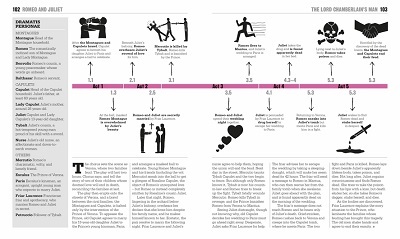
I liked the layout because it is simple and easy to approach. Each play has its own timeline. This, again, is handy if you’ve not read the work in detail or have found parts of it confusing. It’s even good to serve as a reminder for what actually happened if you read a play a while back. But, the chances are, if you bought a book about Shakespeare’s work it wasn’t because you found it confusing; it was most likely because you wanted to explore the work in more detail. So, this book, and its layout would be quite useless.
Overall, this book is worth trying if you want an introduction to his plays before reading them. And by introduction, I mean a simple explanation of what actually happens in the play rather than an in depth discussion of themes and motives. I found this helpful somewhat, but it was very limited in its scope and practicality. It’s more of a summary of each play than anything else. I suppose, if anything, this book would be incredibly helpful for young readers or those taking their English GCSEs.
A standard 2.5 stars
A basic introduction to the Bard
That being said though, this book offers little to those that have studied some of the plays deeply and on an academic level. In here is some shortened down, almost verbatim, repeating’s of a few more in depth explanations that I’ve read in other works. I’m not saying that this book has copied, but what I am saying is that this book has taken someone else’s interpretation, simplified it, and made it approachable. There presented in a concise manner that provides a good place to start when researching the plays or all the information you need if you just want to know the very basics.
I found little to gain in the sections on the plays I’ve studied at university or read myself. However, in the sections on the plays I’ve not read, I found an okay introduction to them. Before I read anymore Shakespeare’s plays in the future, I will, again, read the introductions in here. So, that way, I’ll have an idea of what I’m reading before I go to read it. This will make understanding the play much easier. But, I do think, introductions equally as good could be found on numerous websites or, better yet, the introductions in the oxford and penguin paper back classics would send these ones away in shame.
Friendly Layout
I liked the layout because it is simple and easy to approach. Each play has its own timeline. This, again, is handy if you’ve not read the work in detail or have found parts of it confusing. It’s even good to serve as a reminder for what actually happened if you read a play a while back. But, the chances are, if you bought a book about Shakespeare’s work it wasn’t because you found it confusing; it was most likely because you wanted to explore the work in more detail. So, this book, and its layout would be quite useless.
Overall, this book is worth trying if you want an introduction to his plays before reading them. And by introduction, I mean a simple explanation of what actually happens in the play rather than an in depth discussion of themes and motives. I found this helpful somewhat, but it was very limited in its scope and practicality. It’s more of a summary of each play than anything else. I suppose, if anything, this book would be incredibly helpful for young readers or those taking their English GCSEs.
A standard 2.5 stars

April 18, 2016
The Shakespeare Book is an excellent companion book for anyone interested in reading Shakespeare or simply wanting to familiarize himself better with Shakespeare's works. This book covers the entire canon of Shakespeare. With each play there is a plot summary, a discussion of themes, and listing of characters. Often a timeline with graphics is provided along with historical context and the theatrical legacy.
I am a huge fan of DK books because of their accessible nature and encompassing scope, and this book is no exception. I hope this book would help someone who otherwise may feel intimidated about reading the genius works of Shakespeare. I am feeling inspired to revisit Macbeth.
Many thanks to DK Books for my Goodreads giveaway copy!
I am a huge fan of DK books because of their accessible nature and encompassing scope, and this book is no exception. I hope this book would help someone who otherwise may feel intimidated about reading the genius works of Shakespeare. I am feeling inspired to revisit Macbeth.
Many thanks to DK Books for my Goodreads giveaway copy!

February 25, 2020
Yes indeed, with regard to what contributors Stanley Wells et al have thematically (and textually) written about William Shakespeare, The Shakespeare Book: Big Ideas Simply Explained is definitely and without a doubt a truly wonderful and enlightening general introduction to the so-called Bard of Avon. For not only does The Shakespeare Book: Big Ideas Simply Explained feature a detailed but also never too academically strenuous and analytical examination of both William Shakespeare’s biography and his literary legacy as England’s (if not perhaps even the world’s) greatest and most universally known and feted playwright, with detailed analyses of each of Shakespeare’s (known) plays, the simplicity of the presented text imbued with a plethora of useful and necessary Shakespeare (and Shakespearean times) knowledge and information also renders The Shakespeare Book: Big Ideas Simply Explained into not only a delightfully and easily understood and internalised learning resource, no, this book is also (in my opinion) a very much useful academic tool for both school teachers and homeschooling parents. And really, my one main and actually only (but still very much annoying) complaint (and as such my primary reason for a three and not yet a four star rating for The Shakespeare Book: Big Ideas Simply Explained) is that in my humble opinion, there really should also and equally be a bibliography with suggestions for secondary reading choices on William Shakespeare and Elizabethan and Jacobean England included. And yes, in my opinion, the complete absence thereof does to a certain extent rather lessen the educational value of The Shakespeare Book: Big Ideas Simply Explained for me (especially with regard to being able to without academic scruples make use of The Shakespeare Book: Big Ideas Simply Explained at the college and university level for essay and term paper level type research).

January 31, 2015
Okay, I am not truly 'finished' with this book, but have read - or used - enough of it to know its value. What I am currently doing is reading - and re-reading - as many of Shakespeare's plays as I am able. While doing so, I am using The Shakespeare Book, which I won in a GR giveaway, as a sort of 'companion book,' to help me understand, untangle, and better appreciate the plays.
So I will come back now and then to add comments as I finish a play; I am giving myself a week on each. I don't know how this will go, but I am presently finishing up 'Two Gentlemen of Verona,' which right away I am seeing as a very good play with a somewhat tarnished reputation. It has been rather harshly criticized, especially for one scene in particular and for its ending. I am loving it, though, and that enjoyment has only been increased by The Shakespeare Book.
Thusly, I am satisfied most heartily, and not by half! The Shakespeare Book arrived at a very timely moment in my reading life!
Yeah, I'm kind of silly, but loving the word play and puns in this play, along with the insights provided by this book.
So I will come back now and then to add comments as I finish a play; I am giving myself a week on each. I don't know how this will go, but I am presently finishing up 'Two Gentlemen of Verona,' which right away I am seeing as a very good play with a somewhat tarnished reputation. It has been rather harshly criticized, especially for one scene in particular and for its ending. I am loving it, though, and that enjoyment has only been increased by The Shakespeare Book.
Thusly, I am satisfied most heartily, and not by half! The Shakespeare Book arrived at a very timely moment in my reading life!
Yeah, I'm kind of silly, but loving the word play and puns in this play, along with the insights provided by this book.

May 14, 2018
If you love Shakespeare, if you are interested in Shakespeare or just need a study guide better than Spark Notes, this is the book for you.
The book is gorgeously to look at, with illustrations and photos and interesting diagrams. It contains the whole body of Shakespeare‘s works explained in detail, with source material, inspiration, different analyses, takes on it and notes to memorable productions. It also gives a short and poignant overview of the Bard‘s life.
In short, this is a treat for every Shakespeare and really, fan of theater and literature, out there.
The book is gorgeously to look at, with illustrations and photos and interesting diagrams. It contains the whole body of Shakespeare‘s works explained in detail, with source material, inspiration, different analyses, takes on it and notes to memorable productions. It also gives a short and poignant overview of the Bard‘s life.
In short, this is a treat for every Shakespeare and really, fan of theater and literature, out there.

December 20, 2016
Technically I'm not finished, as I've only skimmed over the plays I'm yet to read, but I don't want to keep this on my GR shelf for the next 20 years, which is about how long it will take me to get through them all.

July 13, 2021
كانت تجربة ثرية وممتعة وأشبه بإعادة اكتشاف لواحد من أعمدة الأدب والمسرح على مر التاريخ وعبر كل عصوره، استمتعت واستفدت وتأملت كثيرا في كل ما كتب شكسبير وهي تجربة أتمنى أن تتيسر لي مع كتاب آخرين بمثل قيمته وقيمة أعماله، فلعل ذلك أن يكون قريبا.
مودتي
مودتي


July 27, 2025
User-friendly resource guide for all Shakespeare plays. I especially appreciate the timeline format and visuals.

May 14, 2015
I said it before, but I'll say it again: If The Shakespeare Book existed while I was in high school, I might've appreciated William Shakespeare more. You see, ye old English is not exactly the easiest thing to read if you have no idea of the language. I struggled immensely with Hamlet, and found Romeo & Juliet to be a bore in high school, but with The Shakespeare Book I might actually have a shot at understanding what's happening. After all, the bard had a way of putting a meaning behind a meaning, didn't he? The Shakespeare Book is packed with tidbits of inspirational quotes, character information, basic plot descriptions, etc. It's a colourful, modern representation of what you need to know to fall in love with William Shakespeare's works.
This hardback book is not only informative (incredibly informative for someone who knows less than the basics of Shakespeare), but it's also beautiful (especially if you love pretty books) and the contents are concise and accurate (according to my fiance). Though, I've not yet tested out how much help this book is whilst re-reading some of the plays, I'm certainly going to try when I have some spare time. However, my fiance - a die-hard Shakespeare fan - did approve wholeheartedly of The Shakespeare Book.
In other words, it's a must-have for everyone struggling with Shakespeare or who have a love for Shakespeare.
Review originally posted at:

This hardback book is not only informative (incredibly informative for someone who knows less than the basics of Shakespeare), but it's also beautiful (especially if you love pretty books) and the contents are concise and accurate (according to my fiance). Though, I've not yet tested out how much help this book is whilst re-reading some of the plays, I'm certainly going to try when I have some spare time. However, my fiance - a die-hard Shakespeare fan - did approve wholeheartedly of The Shakespeare Book.
In other words, it's a must-have for everyone struggling with Shakespeare or who have a love for Shakespeare.
Review originally posted at:

May 9, 2016
A good reference guide for the true Billy Shakes novice and pleasantly visually engaging as you'd expect from the reliable DK Publishing. The Shakespeare Book works better as a one-off reference then a straight-through page one to page 350 read.
The plot summaries were too simplistic for me to feel comfortable that I "knew" the work after working through each one. I had to augment with podcasts and Youtube videos before I felt comfortable awarding a check-mark for each work and moving on to the next play.
The plot summaries were too simplistic for me to feel comfortable that I "knew" the work after working through each one. I had to augment with podcasts and Youtube videos before I felt comfortable awarding a check-mark for each work and moving on to the next play.

February 21, 2022
3.5 stars
For whatever insane reason Shakespeare's plays have been on my mind lately and I thought this book might be a good way to exorcise the demon. Like all the Big Ideas Simply Explained books, this one was well narrated, entertaining and covered an amazing amount of material as succinctly as possible.
For whatever insane reason Shakespeare's plays have been on my mind lately and I thought this book might be a good way to exorcise the demon. Like all the Big Ideas Simply Explained books, this one was well narrated, entertaining and covered an amazing amount of material as succinctly as possible.

February 12, 2019
The best. Pictures, explanations, in order.
April 23, 2019
Full disclaimer, I have read all of Shakespeare (including the Sonnets) and was given this book by a friend (I am guessing as a joke). However, I find this to be an excellent reference book. When writing, sometime I want one of my character to mention a play or character (or even line from Shakespeare) and I cannot always recall it. This has been invaluable for me because it breaks each play down with basic plots and characters so I can easily thumb through it, find the play I am thinking of, then grab my copy and look for the quote. Sometimes the quote has been in this book because it's that well known, so less work for me. Granted, this is probably not meant for a writer, but for high school or even college students. But I think even professors would find it a good reference book to have because it's not always feasible to lug around every single Shakespeare play (though I am fully ware Kindle makes this possible, but it's not easy to search a Shakespeare play on Kindle because I've tried). While my friend may have meant it as a joke, I think I quite like it and highly recommend it.

December 26, 2015
Fun infographics, cultural and historical context, mentions of memorable stagings...
this book was easy to read and I highly recommend it to any Shakespeare fan. Or anyone looking to better understand plays and language that don't always translate well in modern day.
this book was easy to read and I highly recommend it to any Shakespeare fan. Or anyone looking to better understand plays and language that don't always translate well in modern day.

April 24, 2016
A trivia-jammed collection and quite engaging at times. It doesn't top Shakespeare from A to Z for me though.

April 2, 2026
Shakespeare, the pillar and foundation of English literature and theatre. Reading about him and his works is integral to media literacy.
This is a satisfactory overview of all plays, poems, and written stories that were written, even partially, by him. Though, it has felt overwhelming reading them all back-to-back. Here's the layout for the vast majority of the book:
1) 2 page title card with a quote, title of story, and a picture to encapsulate it.
2) A 2 page outline of the play, divided with the top half outlining and summarizing the timeline of events in the Acts in bullet points, with the bottom half being several paragraphs explaining the plot to you. This section was the most overwhelming to me because it speed-runs through mentioning characters I've never heard of in an unfamiliar setting, with near nonsensical actions of these strangers.
3) 2-6 pages covering the story's historical or cultural significance, detailing who these characters are, giving context to the setting, public reception, adaptations of it, and other cool insights. Thus, almost all stories are 6-10 pages long, with most being 8.
This section is where most of the fun lies in reading, for me.
Like with all Big Ideas Simply Explained (BISE) books, it's full of info boxes, diagrams, and pictures.
Other than the layout, what sets this apart from other BISEs is the lack of Glossary, and the lack of the chapter where they include rows upon rows of mini articles explaining other relevant information that didn't make the cut into the meat of the book; what they've added: a) large info boxes quoting a poem, that I am surprised weren't include in The Poetry Book: BISE, and b) character dialogue with the names in bold letters.
Unlike other BISE books where I wanted the book to convince me to see the relevance or interest in its field of study from the start, I started reading this feeling like Shakespeare was very important to read, but halfway through started questioning whether it is relevant to keep retelling his stories in yee old English? My conclusion is that reading Shakespeare teaches us linguistics in learning another language on familiar turf, where it's a halfway point between familiar English and a foreign language, and that lesson of learning to read/speak in such a different way may be reason enough to read him.
This is a satisfactory overview of all plays, poems, and written stories that were written, even partially, by him. Though, it has felt overwhelming reading them all back-to-back. Here's the layout for the vast majority of the book:
1) 2 page title card with a quote, title of story, and a picture to encapsulate it.
2) A 2 page outline of the play, divided with the top half outlining and summarizing the timeline of events in the Acts in bullet points, with the bottom half being several paragraphs explaining the plot to you. This section was the most overwhelming to me because it speed-runs through mentioning characters I've never heard of in an unfamiliar setting, with near nonsensical actions of these strangers.
3) 2-6 pages covering the story's historical or cultural significance, detailing who these characters are, giving context to the setting, public reception, adaptations of it, and other cool insights. Thus, almost all stories are 6-10 pages long, with most being 8.
This section is where most of the fun lies in reading, for me.
Like with all Big Ideas Simply Explained (BISE) books, it's full of info boxes, diagrams, and pictures.
Other than the layout, what sets this apart from other BISEs is the lack of Glossary, and the lack of the chapter where they include rows upon rows of mini articles explaining other relevant information that didn't make the cut into the meat of the book; what they've added: a) large info boxes quoting a poem, that I am surprised weren't include in The Poetry Book: BISE, and b) character dialogue with the names in bold letters.
Unlike other BISE books where I wanted the book to convince me to see the relevance or interest in its field of study from the start, I started reading this feeling like Shakespeare was very important to read, but halfway through started questioning whether it is relevant to keep retelling his stories in yee old English? My conclusion is that reading Shakespeare teaches us linguistics in learning another language on familiar turf, where it's a halfway point between familiar English and a foreign language, and that lesson of learning to read/speak in such a different way may be reason enough to read him.

January 21, 2025
Shakespeare is a super common trivia subject, and while I am pretty familiar with the Bard's tragedies, I am much less familiar with the histories and comedies. So this book seemed like a great place to go to brush up on my Shakespeare knowledge.
For the most part, I found this book to be helpful. For each play, it includes a short plot summary, the dramatis personae, analysis of key themes, and an abbreviated performance history. It is the latter element that I found to be especially lacking. Perhaps more specifically, I would have liked to see more about the many works inspired by each play. For example, while I think the book may have mentioned 10 Things I Hate about You for the section on Taming of the Shrew , I don't think it mentioned She's the Man for Twelfth Night . And it doesn't even get into the more tangential references (e.g., Tomorrow and Tomorrow and Tomorrow referencing Macbeth 's outstanding soliloquy, What Dreams May Come taking its title from the "to be, or not to be" soliloquy in Hamlet ). I would have found that to be especially helpful for my trivia knowledge.
I'll also say that the book could have done a better job of highlighting the key quotes from each play. In some cases, it does provide the highlights, but then it brushes over the aforementioned "tomorrow, and tomorrow, and tomorrow" soliloquy, and I don't think it mentions the "to be, or not to be" soliloquy at all. Perhaps the authors felt that those speeches are too famous, but at the same time, the book devotes more pages to the famous plays than the lesser plays (as it should).
So overall, I found this book to be helpful, but there are a few things that could have made it better. It's still a good starting point for learning more about Shakespeare and his many, many works.
For the most part, I found this book to be helpful. For each play, it includes a short plot summary, the dramatis personae, analysis of key themes, and an abbreviated performance history. It is the latter element that I found to be especially lacking. Perhaps more specifically, I would have liked to see more about the many works inspired by each play. For example, while I think the book may have mentioned 10 Things I Hate about You for the section on Taming of the Shrew , I don't think it mentioned She's the Man for Twelfth Night . And it doesn't even get into the more tangential references (e.g., Tomorrow and Tomorrow and Tomorrow referencing Macbeth 's outstanding soliloquy, What Dreams May Come taking its title from the "to be, or not to be" soliloquy in Hamlet ). I would have found that to be especially helpful for my trivia knowledge.
I'll also say that the book could have done a better job of highlighting the key quotes from each play. In some cases, it does provide the highlights, but then it brushes over the aforementioned "tomorrow, and tomorrow, and tomorrow" soliloquy, and I don't think it mentions the "to be, or not to be" soliloquy at all. Perhaps the authors felt that those speeches are too famous, but at the same time, the book devotes more pages to the famous plays than the lesser plays (as it should).
So overall, I found this book to be helpful, but there are a few things that could have made it better. It's still a good starting point for learning more about Shakespeare and his many, many works.

September 11, 2024
THIS REVIEW IS PULLED FROM THE MIDDLE OF A REVIEW ON SHAKESPEARE'S "TWELFTH NIGHT."
I had my eye on a few Shakespeare reference books for quite some time. (I told you, I’m a fan.) Since I didn’t have any prior interaction with Twelfth Night, I went ahead and ordered DK Publishing’s The Shakespeare Book from their Big Ideas Simply Explained series. Twelfth Night is covered in six pages with a few small illustrations, a timeline, and a character-relationship map. While interesting and a good coffee table book (in a writer’s house, at least), it’s not the most thorough or even thoughtful book. That does not mean I won’t be referencing it in the future. I will be referencing it in the future. For one thing, it gives enough of the basics to put the play in context and help a reader know what to expect, how to read it, basically. And it has some fun factoids too.
It’s a light, useful book to get your bearings with any Shakespeare play. Is it Shakespeare? (Haha.) No. Is it on the grad-student level? Not even in the same ballpark. But it is essentially a For Dummies book and I’ll be hanging on to it. It would be real nice sitting on the shelf in a classroom full of highschoolers or maybe even middle schoolers. There’s no direct translations or detailed information, but it also has an introduction with general information and section introductions talking about each stage of Shakespeare’s life. A decent jumping-off point or, if you aren’t a big Shakespeare fan, a way to work out some of the basic facts and meaning for, say, a test or a book club.
***REVIEW WRITTEN FOR THE STARVING ARTIST BLOG***
I had my eye on a few Shakespeare reference books for quite some time. (I told you, I’m a fan.) Since I didn’t have any prior interaction with Twelfth Night, I went ahead and ordered DK Publishing’s The Shakespeare Book from their Big Ideas Simply Explained series. Twelfth Night is covered in six pages with a few small illustrations, a timeline, and a character-relationship map. While interesting and a good coffee table book (in a writer’s house, at least), it’s not the most thorough or even thoughtful book. That does not mean I won’t be referencing it in the future. I will be referencing it in the future. For one thing, it gives enough of the basics to put the play in context and help a reader know what to expect, how to read it, basically. And it has some fun factoids too.
It’s a light, useful book to get your bearings with any Shakespeare play. Is it Shakespeare? (Haha.) No. Is it on the grad-student level? Not even in the same ballpark. But it is essentially a For Dummies book and I’ll be hanging on to it. It would be real nice sitting on the shelf in a classroom full of highschoolers or maybe even middle schoolers. There’s no direct translations or detailed information, but it also has an introduction with general information and section introductions talking about each stage of Shakespeare’s life. A decent jumping-off point or, if you aren’t a big Shakespeare fan, a way to work out some of the basic facts and meaning for, say, a test or a book club.
***REVIEW WRITTEN FOR THE STARVING ARTIST BLOG***
May 9, 2021
Having ordered an audiobook of this title, I found it difficult to follow without a copy of the book in hand. Once I got a copy, it made far more sense, while the chapters were read aloud to me. Essentially, this is a summation of William Shakespeare's plays and poetry, told in the order in which historians believe they were penned.
Each chapter is one play. There's a synopsis of the plot, the themes of the play, some of the most famous lines found in the play, character lists, and settings. The author shows a timeline of the scenes. There are also photos of noted performances and movies. The idea is to make the plays of Shakespeare more accessible to someone not familiar with aspects of the Bard's plays.
As a text (not an audiobook), this would be a great reference. As an audiobook, I found this to be just about worthless. The truth of the matter is that some information can best be delivered in text form and this is one of them. I am not a rabid bibliophile, dedicated to the printed word. I read over half of my books on a Kindle-type platform. This information simply isn't conveyed easily in audio form.
The narrator has an engaging style; I found no fault with him. Shakespeare has a large body of work and this volume also discussed his sonnets. The thing I gleaned from this book was that Shakespeare was a wildly talented bard with wide-ranging interests and skills. His comprehensive understanding of history is truly amazing. He wrote plays so rapidly that he must have thought in blank verse!
Each chapter is one play. There's a synopsis of the plot, the themes of the play, some of the most famous lines found in the play, character lists, and settings. The author shows a timeline of the scenes. There are also photos of noted performances and movies. The idea is to make the plays of Shakespeare more accessible to someone not familiar with aspects of the Bard's plays.
As a text (not an audiobook), this would be a great reference. As an audiobook, I found this to be just about worthless. The truth of the matter is that some information can best be delivered in text form and this is one of them. I am not a rabid bibliophile, dedicated to the printed word. I read over half of my books on a Kindle-type platform. This information simply isn't conveyed easily in audio form.
The narrator has an engaging style; I found no fault with him. Shakespeare has a large body of work and this volume also discussed his sonnets. The thing I gleaned from this book was that Shakespeare was a wildly talented bard with wide-ranging interests and skills. His comprehensive understanding of history is truly amazing. He wrote plays so rapidly that he must have thought in blank verse!
October 4, 2023
Barnes and Noble one published an excellent series of Shakespeare plays that I really liked it. Each page of the play had a facing page full of notes explaining the dialogue, making it very easy to decipher the archaic Shakespearean verbiage as you read. Unfortunately, the series hit all the big plays and stopped there. No The Winter's Tale, no Titus Andronicus, not even Henry IV Part 2 between Henry IV Part 1 and Henry V (let alone Henry VIII). I was really disappointed when I discovered that the series would not include all the Shakespeare plays.
Which is why I sought out The Shakespeare Book: Big Ideas Simply Explained. I like the challenge of Shakespeare, but I can always use a bit of help understanding it, and I would like to tackle some of the lesser known plays someday, maybe even the Sonnets. When I do, this book will come in very handy.
In the meantime, it was nice to get some insight into the plays which I have not yet read.
Which is why I sought out The Shakespeare Book: Big Ideas Simply Explained. I like the challenge of Shakespeare, but I can always use a bit of help understanding it, and I would like to tackle some of the lesser known plays someday, maybe even the Sonnets. When I do, this book will come in very handy.
In the meantime, it was nice to get some insight into the plays which I have not yet read.

January 25, 2023
“All the world’s is a stage, and all the men and women merely players.”
We have all heard of the Dummies and Idiots series of books but few “We Happy Few” have found the “Big Ideas Simply Explained” series. One book that stands out is the book “The Shakespeare Book.”
We all have favorites; my favorite is Hamlet. However, after reading this book you may change your mind or ass more to your favorites. We get snippets of the play, the background, the context, pictures from the films, a running timeline, family trees, relationship trees, and new perspectives.
I have to admit that it helps to know most of the content before reading so you can pick out the jewels that you may have missed.
I read from front to back; however, this makes a great reference just before watching the particular play or reading a sonnet.
This book is “…such stuff that dreams are made of.”
We have all heard of the Dummies and Idiots series of books but few “We Happy Few” have found the “Big Ideas Simply Explained” series. One book that stands out is the book “The Shakespeare Book.”
We all have favorites; my favorite is Hamlet. However, after reading this book you may change your mind or ass more to your favorites. We get snippets of the play, the background, the context, pictures from the films, a running timeline, family trees, relationship trees, and new perspectives.
I have to admit that it helps to know most of the content before reading so you can pick out the jewels that you may have missed.
I read from front to back; however, this makes a great reference just before watching the particular play or reading a sonnet.
This book is “…such stuff that dreams are made of.”

January 13, 2024
"To speak of Shakespeare as the world's greatest dramatist is inadequate. It would be closer to the mark to speak of him as a philosopher, a psychologist, or a poet possessed of the artistry that enables him to express his perceptions in dramatic form, and in so doing render them with unique subtlety and communicative power."
"'Even here she sheathèd in her harmless breast/A harmful knife, that thence her soul unsheathed. /That blow did bail it from the deep unrest/ Of that polluted prison where it breathed'"
"'If we shadows have offended, / Think but this, and all is mended: / That you have but slumbered here,/ While these visions did appear;/ And this weak and idle theme,/ No more yielding but a dream.'"
"'His heart's his mouth.'"
"'Even here she sheathèd in her harmless breast/A harmful knife, that thence her soul unsheathed. /That blow did bail it from the deep unrest/ Of that polluted prison where it breathed'"
"'If we shadows have offended, / Think but this, and all is mended: / That you have but slumbered here,/ While these visions did appear;/ And this weak and idle theme,/ No more yielding but a dream.'"
"'His heart's his mouth.'"
Read
October 22, 2024Shakespeare okumaları için arada baktığım kaynaklardan. Başından sonuna kadar okumadım fakat bu yorumu Alfa Kitabın Alfa DK serisindeki eserlerle ilgili şikayetlerimi dile getirmek için yazıyorum. Bu kitapların ilk baskılarında çeviri ve editörlük sorunlu. Shakespeare kitabında kısa bir bölüm İspanyolca kalmış, çevrilmemiş. Matematik kitabında da İngilizce bırakılmış kısımlar vardı. Yine Shakespeare kitabında çevirmen şairin eserlerinin çevirisini Talat S. Halman, Özdemir Nutku gibi tercümanlardan almak yerine kendi yapmış galiba çünkü şiirsellik verilememiş. Telif sebebiyle böyle yapılmış muhtemelen ama şairin eserlerini başka baskılardan okuduysanız hoşunuza gitmez. Kitabı satın almayı düşünenler belki bu hususları dikkate almak ister.
August 24, 2018
This reference books goes chronologically through Shakespeare's plays and poetry collections. For each, it lists the Dramatis Personae; gives a visual timeline of the plot followed by a narrative brief of the plot; lists central themes, the setting, possible sources, and some dates associated with its performance; and then has a couple pages of analysis.
It's really good! The only thing that would keep me from wanting to own it as a reference book is the typical DK publisher's graphic design style. It's elegantly light and simple to read, but a little too clinical to be enjoyed in repeated readings.
It's really good! The only thing that would keep me from wanting to own it as a reference book is the typical DK publisher's graphic design style. It's elegantly light and simple to read, but a little too clinical to be enjoyed in repeated readings.

June 22, 2018
A great and detailed look into Shakespeare's work which helps the reader understand the plot, themes, influence and their historical connection, without actually having to read each one. I find that very helpful because I wouldn't want to read something like "The rape of Lucrece", "Measure for measure" or "As you like it"; also i have absolutely no interest in his historical plays about kings Richard and Henry so this book saved me some yawns and disappointments.

August 11, 2018
Bold, clear graphics and accessible text create a dynamic guide to Shakespeare’s plays and sonnets. A definite keeper. Surprisingly much is learned about each of Shakespeare’s play considering the book is a commendable length of 350 pages. The format is cleanly laid out with the play’s timeline, background, summary, and insights. Provided photographs and illustrations add appreciated dimension to the text.

May 10, 2022
I liked the break down of all of Shakespeare’s works and how different time periods dealt with the playwright’s plays -
All time favorite has to be the comedy “Twelfth Night” ⛵️🌊🌊👫🏻🌊🌊💨💇🏻♀️🙋🏻♂️💂🏼💂🏼👩🏻🦰😍🧑🏻👩🏻 Gosh - impossible to show the events with emojis - I tried but I quit
Least favorite Shakespeare works are probably the histories and Titus 🗡🔪🗡🗡🥧😲🫢
All time favorite has to be the comedy “Twelfth Night” ⛵️🌊🌊👫🏻🌊🌊💨💇🏻♀️🙋🏻♂️💂🏼💂🏼👩🏻🦰😍🧑🏻👩🏻 Gosh - impossible to show the events with emojis - I tried but I quit
Least favorite Shakespeare works are probably the histories and Titus 🗡🔪🗡🗡🥧😲🫢

October 22, 2022
This is a book that reviews Shakespeare’s work and explains many different aspects of the plays. I did learn many new things from this book. However it was a little dry to listen to on the way to work. I did learn about some of Shakespeare’s plays that I haven’t read that sounded very interesting so I will probably pick those up soon.
Displaying 1 - 30 of 71 reviews