

What do you think?
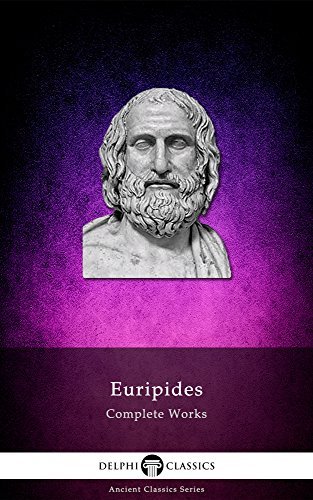
Delphi Complete Works of Euripides
During the Hellenistic Age, the great tragedian Euripides became a cornerstone of ancient literary education, his plays exhibiting an iconoclastic, rationalising attitude toward both religious belief and the ancient myths that formed the traditional subject matter of Greek drama.. The Ancient Classics series provides Kindles with the wisdom of the Classical world, with both English translations and the original Latin and Greek texts. This comprehensive eBook presents the complete works of the Athenian playwright Euripides, with beautiful illustrations, informative introductions and the usual Delphi bonus material. (Version 1)
* Beautifully illustrated with images relating to Euripides’ life and works
* Features the complete extant plays of Euripides, in both English translation and the original Greek
* Concise introductions to the tragedies and other works
* Images of contemporary Greek art and famous classical paintings that have been inspired by Euripides’ works
* Excellent formatting of the texts
* Easily locate the plays or works you want to read with individual contents tables
* Includes Euripides’ rare dramas RHESUS and CYCLOPS
* Features two bonus biographies - discover Euripides’ ancient world
* Scholarly ordering of texts into chronological order and literary genres
Please note: some Kindle software programs cannot display Greek characters correctly, however they do display correctly on Kindle devices.
Please visit www.delphiclassics.com to browse through our range of exciting titles
CONTENTS:
The Translations
ALCESTIS
MEDEA
HERACLEIDAE
HIPPOLYTUS
ANDROMACHE
HECUBA
THE SUPPLIANTS
ELECTRA
HERACLES
THE TROJAN WOMEN
IPHIGENIA IN TAURIS
ION
HELEN
PHOENICIAN WOMEN
ORESTES
BACCHAE
IPHIGENIA AT AULIS
RHESUS
CYCLOPS
The Greek Texts
LIST OF GREEK TEXTS
The Biographies
INTRODUCTION TO EURIPIDES by Arthur S. Way
EURIPIDES by T. W. Lumb
Please visit www.delphiclassics.com to browse through our range of exciting titles
* Beautifully illustrated with images relating to Euripides’ life and works
* Features the complete extant plays of Euripides, in both English translation and the original Greek
* Concise introductions to the tragedies and other works
* Images of contemporary Greek art and famous classical paintings that have been inspired by Euripides’ works
* Excellent formatting of the texts
* Easily locate the plays or works you want to read with individual contents tables
* Includes Euripides’ rare dramas RHESUS and CYCLOPS
* Features two bonus biographies - discover Euripides’ ancient world
* Scholarly ordering of texts into chronological order and literary genres
Please note: some Kindle software programs cannot display Greek characters correctly, however they do display correctly on Kindle devices.
Please visit www.delphiclassics.com to browse through our range of exciting titles
CONTENTS:
The Translations
ALCESTIS
MEDEA
HERACLEIDAE
HIPPOLYTUS
ANDROMACHE
HECUBA
THE SUPPLIANTS
ELECTRA
HERACLES
THE TROJAN WOMEN
IPHIGENIA IN TAURIS
ION
HELEN
PHOENICIAN WOMEN
ORESTES
BACCHAE
IPHIGENIA AT AULIS
RHESUS
CYCLOPS
The Greek Texts
LIST OF GREEK TEXTS
The Biographies
INTRODUCTION TO EURIPIDES by Arthur S. Way
EURIPIDES by T. W. Lumb
Please visit www.delphiclassics.com to browse through our range of exciting titles
2835 pages, Kindle Edition
Published November 30, 2015
About the author
Euripides
2,954 books2,164 followersEuripides (Greek: Ευριπίδης) (ca. 480 BC–406 BC) was a tragedian of classical Athens. Along with Aeschylus and Sophocles, he is one of the three ancient Greek tragedians for whom any plays have survived in full. Some ancient scholars attributed ninety-five plays to him, but the Suda says it was ninety-two at most. Of these, eighteen or nineteen have survived more or less complete (Rhesus is suspect). There are many fragments (some substantial) of most of his other plays. More of his plays have survived intact than those of Aeschylus and Sophocles together, partly because his popularity grew as theirs declined—he became, in the Hellenistic Age, a cornerstone of ancient literary education, along with Homer, Demosthenes, and Menander.
Euripides is identified with theatrical innovations that have profoundly influenced drama down to modern times, especially in the representation of traditional, mythical heroes as ordinary people in extraordinary circumstances. This new approach led him to pioneer developments that later writers adapted to comedy, some of which are characteristic of romance. He also became "the most tragic of poets", focusing on the inner lives and motives of his characters in a way previously unknown. He was "the creator of ... that cage which is the theatre of William Shakespeare's Othello, Jean Racine's Phèdre, of Henrik Ibsen and August Strindberg," in which "imprisoned men and women destroy each other by the intensity of their loves and hates". But he was also the literary ancestor of comic dramatists as diverse as Menander and George Bernard Shaw.
His contemporaries associated him with Socrates as a leader of a decadent intellectualism. Both were frequently lampooned by comic poets such as Aristophanes. Socrates was eventually put on trial and executed as a corrupting influence. Ancient biographies hold that Euripides chose a voluntary exile in old age, dying in Macedonia, but recent scholarship casts doubt on these sources.
Euripides is identified with theatrical innovations that have profoundly influenced drama down to modern times, especially in the representation of traditional, mythical heroes as ordinary people in extraordinary circumstances. This new approach led him to pioneer developments that later writers adapted to comedy, some of which are characteristic of romance. He also became "the most tragic of poets", focusing on the inner lives and motives of his characters in a way previously unknown. He was "the creator of ... that cage which is the theatre of William Shakespeare's Othello, Jean Racine's Phèdre, of Henrik Ibsen and August Strindberg," in which "imprisoned men and women destroy each other by the intensity of their loves and hates". But he was also the literary ancestor of comic dramatists as diverse as Menander and George Bernard Shaw.
His contemporaries associated him with Socrates as a leader of a decadent intellectualism. Both were frequently lampooned by comic poets such as Aristophanes. Socrates was eventually put on trial and executed as a corrupting influence. Ancient biographies hold that Euripides chose a voluntary exile in old age, dying in Macedonia, but recent scholarship casts doubt on these sources.
Ratings & Reviews
Friends & Following
Create a free account to discover what your friends think of this book!
Community Reviews
Displaying 1 - 4 of 4 reviews

August 4, 2023
Taken me a long time to read but I cannot rush the classics and this is one of the best.

July 25, 2022
(See review of ‘The Orestia’, and ‘The Complete Plays of Sophocles’). Read for my University Course on Greek Tragedy. An avid fan of the Iliad and the Odyssey, I found these ancient dramatic renditions of much-loved myths thoroughly enjoyable. Re-familiarising myself with the generational curse on the House of Atreus, the text picks up the tragic debris from the siege of Troy. where the siege of Troy. I was thrilled to encounter my childhood favourites from a fresh, un-Homeric perspective, their personalities and motives detailed with remarkable cogency on account of the dramatic form. I usually struggle to immerse myself in plays as I would a novel, yet the comfort of familiar names had me immediately invested. I excitedly await the coming term, enthusiastic to further my classical knowledge, and broaden my awareness of the characteristics of the tragic mode.
December 1, 2024
Re-reading these tragedies back-to-back after so many years (Oh Columbia's Humanities requirement!) was stimulating, instructive and rewarding. Most stiriking: through numerous, sharply drawn characters and various choruses, Euripedes constantly celebrates/advances Greek virtues of democracy, diplomacy, temperance, justice, peace and reason, even while the same characters, and action are usually driven by passions and in opposite directions, often thanks to the gods. (One great piece of dialogue: Achilles: "Reason can wrestle and overthrow terror." Clytemnestra: "My hopes are cold on that.")
Then too, and in the background mostly, Euripedes raises the question of: if the gods are to be as fickle ("callous, unjust and immoral") as humans, why do we sacrifce. submit to and worship them? Good question. And timeless too.
Then too, and in the background mostly, Euripedes raises the question of: if the gods are to be as fickle ("callous, unjust and immoral") as humans, why do we sacrifce. submit to and worship them? Good question. And timeless too.
Read
July 30, 2026Translated into English prose by Edward Coleridge (1906) started 5/14/24. Finished 5/29/24. 407 pages.
Displaying 1 - 4 of 4 reviews