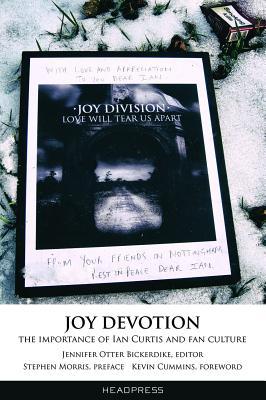
Joy Devotion: The Importance of Ian Curtis and fan culture explores the lasting legacy in the fan, post-punk and dot.com economy of Joy Division lead singer Ian Curtis, and what such dedication says about the larger issues facing us in a modern world. Essays on Curtis, exploring ideas of memory, death, technology, fandom and secular religion are complemented by photos taken at the Ian Curtis Memorial Stone. In this book, fans and artists contribute their personal insights, granting intimate access to the very people who Curtis continues to influence and inspire long past his untimely death in 1980. Foreword by Kevin Cummins. Preface by Stephen Morris.
This book is written by many people; fans, lecturers, etc., but is edited by Jennifer Otter Bickerdike. We hear tons of stories about how Joy Division has affected people's lives all around the world. Since several of the contributors are academics, their contributions are pretty much small essays, and can get dry to read. But there are some parts written in a very casual way as well, so be aware of that. You will find writings about how the scene in Manchester and around there was at the time, both musically and society in general, and why the scene pretty much died later on. There is lots of talk about Ian Curtis' grave, how it is treated, and the tourism in Macclesfield after his death. There are also interviews with some people who went to the legendary Joy Division concert on april 8th 1980! You'll read about a graphic novel and play about the band, a beer called Unknown Pleasures, the movies where Ian Curtis is revived, tribute bands and much more. It also includes a very in-depth discography, and an insert in the middle with tons of color photographs from Ian Curtis' grave. The book has lots of photos, but in black and white. Preface by Stephen Morris and foreword by Kevin Cummings, published in 2016 in various formats.
The book is barely over 100 pages, so it took me the duration of Unknown Pleasures (collector's edition) and Closer to finish it. I have to admit some of the parts in it were very dry. But I did enjoy most of it, reading about how the band has affected people and how the scene was at the time. But I still feel the book is missing something. I can't quite put my finger on it, whether it is the academic approach to some of the content, the multiple contributors writing very short texts each, or if it's something else. I'm not sure what I expected, but this wasn't quite it. I would only recommend it if you are a big fan of Joy Division, and definitely if you're the type who would write about them at university and likes that kind of reading material.
Such an interesting collection of writings about Joy Division and the myth and legend that Ian Curtis has become. A few of them were a bit boring and that would cause me to put the book down for a while but there are some, especially in the beginning, that really resonated. I wish there had been more about the details of the author's year of visiting Ian's grave, though.
This book truly gathered two of my passions, very unexpectedly: Ian Curtis and academia. I have never fulfilled the dream of writing a PhD, but to know someone out there wrote hers about Ian makes me really happy. I say it all the time, Ian is so interesting. Ian is someone I want to look at from every angle, so this book made it possible to look at him from the perspective of fandom.
I've been repeating constantly that listening to Joy Division has made me a better person, someone more understanding of the world around me, someone that tries to know why things happen. Ever since I read Deborah Curtis' book about her husband, so many things started to click that explained why people act the way they do, why there is stigma around mental illness and how to help those in need. I understood that Ian was just a young person, trapped in a time and place in which no-one was ready to understand what he went through. That he deserved so much better. That so many people still go through the same things, that much humanity is needed.
As I read in a fanzine about Joy Division some time ago, Ian won't be remembered as a brave artist. But he was, he really was. He expressed his suffering in ways nobody had ever before, he was a pioneer. As one of the writers in this book points out, the tragedy is that nobody sang to Ian the stuff he's sang to all of us. He had no way of knowing he wasn't the only one feeling that way. Because of his work, so many people feel less alone, and therefore more hopeful, more sane, more stable. So many people would deny that there's hope in Joy Division, but all the people writing these essays (and many of the readers) know there is. The energy in their music, the anger, the beauty of it lights a spark that can't be turned off.