

What do you think?

Human Prehistory and the First Civilizations
Where do we come from? How did our ancestors settle this planet? How did the great historic civilizations of the world develop? How does a past so shadowy that it has to be painstakingly reconstructed from fragmentary, largely unwritten records nonetheless make us who and what we are?
This course brings you the answers that the latest scientific and archaeological research and theorizing suggest about human origins, how populations developed, and the ways in which civilizations spread throughout the globe.
It is a narrative of the story of human origins and the many ties that still bind us deeply to the world before writing.
What Is "Prehistory"?
Prehistory—meaning human societies without writing or widespread written records—survived until Western culture and industrial society completed their globalization in the 20th century, making the topic of a course that begins with some very old fossils seem more current than you may think.
You learn about dozens of archaeological sites all over the world and learn about stone-tool making, mammoth hunting, and temple building as you explore man's earliest origins and the earliest civilizations.
Themes to Remember: Human Achievement
Woven through this narrative is a set of pervasive themes:
* Emerging human biological and cultural diversity (as well as our remarkable similarities across surprising expanses of time and space)
* The impact of human adaptations to climatic and environmental change
* The importance of seeing prehistory not merely as a chronicle of archaeological sites and artifacts, but of people behaving with the extraordinary intellectual, spiritual, and emotional dynamism that distinguish the human.
This is a world tour of prehistory with profound links to who we are and how we live today.
2.5 Million Years of History
This 36-lecture narrative covers human prehistory from our beginnings more than 2.5 million years ago up to and beyond the advent of the world's first preindustrial civilizations.
Due to the large spans of time and geography covered in this series, these lectures are divided into six sections:
Section I: Beginnings
This section surveys the archaic world of the first humans, you travel into the remote past, learning why the late Harvard biologist Stephen Jay Gould was probably right to observe that we all come from the same African twig on the bushy tree of human evolution.
You examine prehistory from Australopithecus africanus through Homo habilis (the first tool-making hominid), and Homo erectus (whose remains were first found on Java but whose origins lie in Africa) through the hardy Neanderthals who lived and hunted successfully in Europe despite the bitter grip of the last Ice Age 100,000 and more years ago. You focus on the first human settlement of Africa as early as 800,000 years ago.
Section II: Modern Humans
This section tells the story of the great diaspora of anatomically modern humans in the late Ice Age. Whether and how these modern humans spread from the African tropics into southwestern Asia and beyond remains one of the great controversies among scholars of prehistory.
You follow Homo sapiens sapiens north into Europe some 45,000 years ago. You meet the Cro-Magnons, among the first known artists as well as hunter-gatherers, who exhibited degrees of spiritual awareness, social interaction, and fluid intelligence.
You venture into the frigid open plains of the Ukraine and Eurasia, where big-game hunters flourished in spite of nine-month winters. Moving to the Americas, debate over the origins of the first human settlement continues.
Section III: Farmers and Herders
This section describes perhaps the most important development in all human prehistory: the beginnings of agriculture and animal domestication.
This defining chapter began about 12,000 years ago, when hunter-gatherers in the Near East broke from the long human tradition of intensely mobile foraging and turned to more settled ways of life built around cultivating cereal grains or tending animals.
Section IV: Eastern Mediterranean Civilizations
Professor Fagan describes early civilizations in an increasingly complex eastern Mediterranean world, discussing many theories accounting for the appearance of urban civilization and overall attributes of preindustrial civilizations.
You examine Sumerian civilization in Mesopotamia and the intricate patchwork of city-states between the Tigris and Euphrates Rivers. You explore ancient Egypt, the Minoan civilization of Crete, the Mycenaeans, and the Hittites.
You learn about the Uluburun shipwreck of southern Turkey, a sealed capsule of international trade from 3,000 years ago.
Section V: Africans and Asians
You analyze the beginnings of South Asian civilization and the mysterious Harappan civilization of the Indus, which traded with Mesopotamia. Professor Fagan resumes the story of South Asian civilization after the collapse of the Harappa...
This course brings you the answers that the latest scientific and archaeological research and theorizing suggest about human origins, how populations developed, and the ways in which civilizations spread throughout the globe.
It is a narrative of the story of human origins and the many ties that still bind us deeply to the world before writing.
What Is "Prehistory"?
Prehistory—meaning human societies without writing or widespread written records—survived until Western culture and industrial society completed their globalization in the 20th century, making the topic of a course that begins with some very old fossils seem more current than you may think.
You learn about dozens of archaeological sites all over the world and learn about stone-tool making, mammoth hunting, and temple building as you explore man's earliest origins and the earliest civilizations.
Themes to Remember: Human Achievement
Woven through this narrative is a set of pervasive themes:
* Emerging human biological and cultural diversity (as well as our remarkable similarities across surprising expanses of time and space)
* The impact of human adaptations to climatic and environmental change
* The importance of seeing prehistory not merely as a chronicle of archaeological sites and artifacts, but of people behaving with the extraordinary intellectual, spiritual, and emotional dynamism that distinguish the human.
This is a world tour of prehistory with profound links to who we are and how we live today.
2.5 Million Years of History
This 36-lecture narrative covers human prehistory from our beginnings more than 2.5 million years ago up to and beyond the advent of the world's first preindustrial civilizations.
Due to the large spans of time and geography covered in this series, these lectures are divided into six sections:
Section I: Beginnings
This section surveys the archaic world of the first humans, you travel into the remote past, learning why the late Harvard biologist Stephen Jay Gould was probably right to observe that we all come from the same African twig on the bushy tree of human evolution.
You examine prehistory from Australopithecus africanus through Homo habilis (the first tool-making hominid), and Homo erectus (whose remains were first found on Java but whose origins lie in Africa) through the hardy Neanderthals who lived and hunted successfully in Europe despite the bitter grip of the last Ice Age 100,000 and more years ago. You focus on the first human settlement of Africa as early as 800,000 years ago.
Section II: Modern Humans
This section tells the story of the great diaspora of anatomically modern humans in the late Ice Age. Whether and how these modern humans spread from the African tropics into southwestern Asia and beyond remains one of the great controversies among scholars of prehistory.
You follow Homo sapiens sapiens north into Europe some 45,000 years ago. You meet the Cro-Magnons, among the first known artists as well as hunter-gatherers, who exhibited degrees of spiritual awareness, social interaction, and fluid intelligence.
You venture into the frigid open plains of the Ukraine and Eurasia, where big-game hunters flourished in spite of nine-month winters. Moving to the Americas, debate over the origins of the first human settlement continues.
Section III: Farmers and Herders
This section describes perhaps the most important development in all human prehistory: the beginnings of agriculture and animal domestication.
This defining chapter began about 12,000 years ago, when hunter-gatherers in the Near East broke from the long human tradition of intensely mobile foraging and turned to more settled ways of life built around cultivating cereal grains or tending animals.
Section IV: Eastern Mediterranean Civilizations
Professor Fagan describes early civilizations in an increasingly complex eastern Mediterranean world, discussing many theories accounting for the appearance of urban civilization and overall attributes of preindustrial civilizations.
You examine Sumerian civilization in Mesopotamia and the intricate patchwork of city-states between the Tigris and Euphrates Rivers. You explore ancient Egypt, the Minoan civilization of Crete, the Mycenaeans, and the Hittites.
You learn about the Uluburun shipwreck of southern Turkey, a sealed capsule of international trade from 3,000 years ago.
Section V: Africans and Asians
You analyze the beginnings of South Asian civilization and the mysterious Harappan civilization of the Indus, which traded with Mesopotamia. Professor Fagan resumes the story of South Asian civilization after the collapse of the Harappa...
18 pages, Audible Audio
First published January 1, 2002
About the author
Brian M. Fagan
144 books284 followersBrian Murray Fagan was a British author of popular archaeology books and a professor emeritus of Anthropology at the University of California, Santa Barbara.
Ratings & Reviews
Friends & Following
Create a free account to discover what your friends think of this book!
Community Reviews
Displaying 1 - 30 of 66 reviews

April 11, 2024
The first bit of the lecture was the most interesting to me.
Fossil records and whatnot.
He did a good job giving an overview of the why, where, and how they think humanity got its kickstart.
But I think some of it might be outdated because he mentioned that it was biologically impossible for Neanderthals to breed with modern humans, and I'm pretty sure they've changed their minds on that one.
The middle had interesting parts but it was mostly a history of agriculture, animal domestication, and climate changes.
Less interesting, but I still learned quite a bit.
Toward the end, he gave a very broad look at all the major civilizations. And I hate to admit it, but I could feel myself zoning in and out on the regular.
It was too much and not enough.
Which was fair! He was trying to give an overview of the entire world.

One of the things I liked was the way he admitted how quickly our knowledge can change with new discoveries. One day we think one thing is what happened in the past, and then someone digs something up that upends everything and sheds a whole new light on it.
Now, to be completely honest, I'm not some sort of intellectual or scholarly smarty-pants. I'm just a middle-aged chick who is done raising kids and started listening to lectures because I'm interested in expanding my overall knowledge base. I can't be the only one!
So, if you're trying to find something to fill in the gaps and get an extremely condensed picture of prehistory, this should fit the bill nicely.
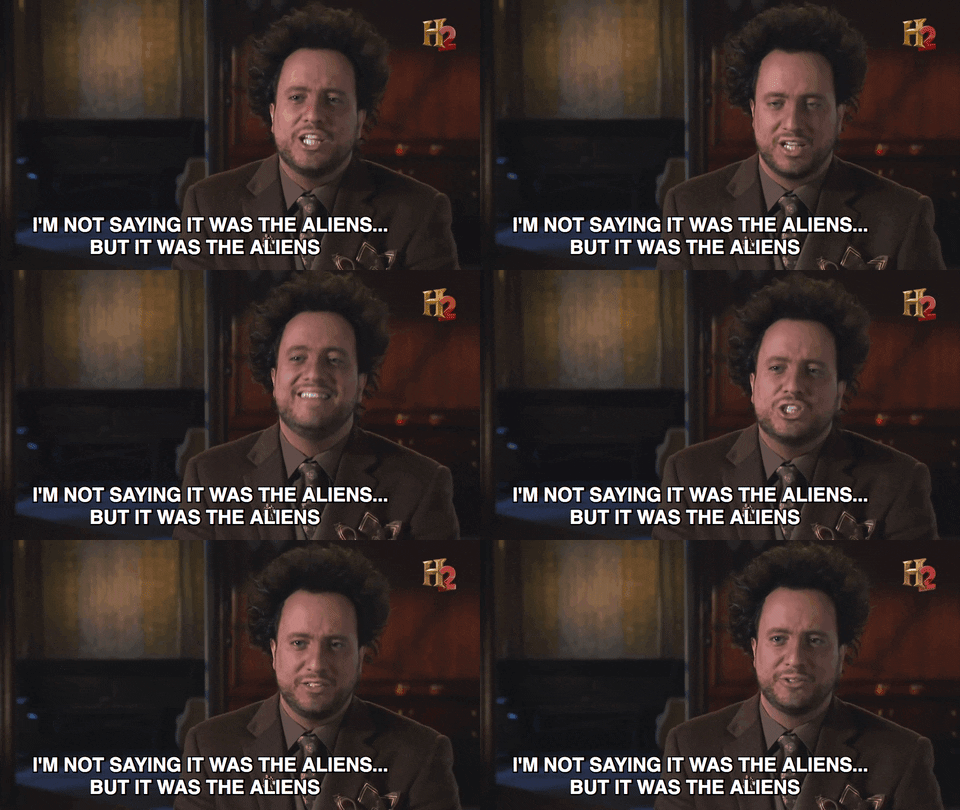
I also thought it was funny that at the start of the lecture, he said he was just going to be covering actual archaeological and scientific evidence and was not going to be catering to the theory of Ancient Aliens. That made me laugh and prompted me to grab Chariots of The Gods for shits and giggles.
Recommended.
Fossil records and whatnot.
He did a good job giving an overview of the why, where, and how they think humanity got its kickstart.
But I think some of it might be outdated because he mentioned that it was biologically impossible for Neanderthals to breed with modern humans, and I'm pretty sure they've changed their minds on that one.
The middle had interesting parts but it was mostly a history of agriculture, animal domestication, and climate changes.
Less interesting, but I still learned quite a bit.
Toward the end, he gave a very broad look at all the major civilizations. And I hate to admit it, but I could feel myself zoning in and out on the regular.
It was too much and not enough.
Which was fair! He was trying to give an overview of the entire world.
One of the things I liked was the way he admitted how quickly our knowledge can change with new discoveries. One day we think one thing is what happened in the past, and then someone digs something up that upends everything and sheds a whole new light on it.
Now, to be completely honest, I'm not some sort of intellectual or scholarly smarty-pants. I'm just a middle-aged chick who is done raising kids and started listening to lectures because I'm interested in expanding my overall knowledge base. I can't be the only one!
So, if you're trying to find something to fill in the gaps and get an extremely condensed picture of prehistory, this should fit the bill nicely.
I also thought it was funny that at the start of the lecture, he said he was just going to be covering actual archaeological and scientific evidence and was not going to be catering to the theory of Ancient Aliens. That made me laugh and prompted me to grab Chariots of The Gods for shits and giggles.
Recommended.

June 3, 2017
I noticed that several reviews knocked this down because it doesn't delve deeply into any period. It's an introductory, broad overview as you can see from the titles of the lectures I include at the end of this review. It is a bit much. I would have preferred 2 books & a better editor. I would have skipped the second book. I don't care for the way he covers later civilizations nearly as much as the way he covered early humans.
This is similar in many respects to Sapiens: A Brief History of Humankind & the early part shares a lot in common with Before the Dawn: Recovering the Lost History of Our Ancestors. This is almost 15 years old, but I was surprised by how current he is.
He has some weird ways of pronouncing some words such as 'controversy', a word he uses a lot. He also has a speech impediment that causes him to use a 'w' sound for 'r' most of the time. On top of that, he fumbles words fairly often, too. Not awful, but wearing. The most annoying thing he does is assume everyone has the video. He says, "The blade would have been about this long." Really? I can't hear that. Thankfully, it hasn't come up too often & several I already knew.
The lecture is divided into several parts, each beginning with a brief Professor Biography & Course Scope in the Study Guide. The first part ends with a Timeline, Glossary, & Maps. The last has a bibliography & maps. All 3 have an outline. The study guide is highly recommended, but the lecture uses more parts. He refers the listener to it fairly often & it contains some extra info that's handy such as explaining dating methods, although that was plain irritating. I looked up "Potassium-argon dating" only to be referred to "Dating Methods" which says "See box" which is on a separate page. It has a short paragraph on this method as well as the other 3 that are commonly used & why. This 'box' really should have been in the lecture itself. I'd suggest reading the entire glossary before listening to the lectures. It's not that long or complex & helped me a lot.
Dating Methods Four main chronological methods are used to date the human past:
• Historical Records (Present Day to 3,100 B.C. ) - Historical records can be used to date the past only as far back as the beginnings of writing and written records, which first appeared in Western Asia in about 3,100 B.C. , much later in many other parts of the world.
• Dendrochronology (Tree-ring dating) (Present Day to 8,000 B.C. ) - The annual growth rings of long-lived trees, such as sequoias, bristlecone pines, and European oaks, used for beams, posts, and other purposes by ancient people are an excellent way of dating archaeological sites in some areas, such as the American Southwest, the Mediterranean, and Western Europe. Tree rings are used to calibrate radiocarbon dates and to reconstruct drought cycles and other phenomena of short-term climate change.
• Radiocarbon Dating (c. A.D. 1500 to 40,000 years ago) - Radiocarbon dating is based on the measurement of the decay rates of 14C atoms in organic samples, such as charcoal, shell, wood, hair, and other materials. When combined with accelerator mass spectrometry (AMS), this method can produce dates from tiny samples, such as individual seeds. Radiocarbon dates from the past 8,000 years are calibrated, where possible, against tree rings to provide accurate dates in calendar years.
• Potassium Argon Dating (250,000 years ago to the origins of humankind) - A chronological method used to date early prehistory, which measures the decay rate of 40K atoms in volcanic rocks. Potassium argon dating is an excellent way of dating early East African hominid fossils, which are often found in volcanic layers.
These four methods provide the basic chronological framework for human prehistory. There are numerous other dating methods, often of limited application, such as thermoluminescence and obsidian hydration, which are used on occasion but need not concern us here.
Actually, he refers to thermoluminescence at least once, so it does concern us. They all do since otherwise I don't know how seriously to take the dates given.
Normally I'd do a thumbnail on each section, but there are too many - 36 each about 30 minutes long. One of the things I like best is how he points out that "We just don't know." on a fairly regular basis. It's amazing how much information we've gleaned from so few fossils, but also how many inferences I thought were facts. An interesting example is that my idea of a Neanderthal is based on a century old artist's depiction that turned out to be of one, old arthritic individual, so it's not very accurate. The species also varied a lot between the European & Mediterranean varieties.
As we get closer to the present, our knowledge becomes greater & dates are more certain. I find it difficult to keep amounts of time in proper perspective, especially with older versions of the genus Homo. Homo erectus is also known by several different species names which he mentions, but doesn't lend much emphasis to since there are so few examples. Instead he uses the overall name to highlight the little that we do know about them. It did help me understand the advances better.
Homo erectus (all) may have been around for a million years while Neanderthals were around for about 100,000 and overlapped with Homo sapiens for 5000 - 10,000 years. Modern humans have been around for about 100,000 years physically, but mentally only about half that or a little more. We just don't know & the date keeps changing since it's an indefinite line.
He strongly points out that our evolution is not a completely linear process, but more of a bush. Homo erectus left Africa about 1.8 million years ago, so there was a lot of parallel evolution going on while Homo sapiens developed in Africa about 100,000 years ago & then spread out again about the same time as our mental abilities developed. This makes the few & scattered old discoveries far more complex than was originally thought. While he doesn't mention it, there is some new evidence that speciation may not be quite as firmly distinct as we've thought or, possibly, hoped. That makes matters even more murky.
As he points out in several places, scientists are human. This can lead to prejudices, pride, & other reasons for misinterpreting or, more rarely, misrepresenting scanty data. He doesn't dwell on it, but offers it up as a reason that some opinions may be suspect.
What makes a modern human is interesting. His descriptions of early tool making & use slowly edge up to it before we hit the Cro-Magnon (The term Cro-Magnon has no formal taxonomic status, but is used commonly.) art in caves. I was rather surprised how he glossed over Neanderthal burials, though. He mentions them, but didn't give them quite the emphasis I would have expected.
Part I
Lecture One Introducing Human Prehistory
Lecture Two In the Beginning
Lecture Three Our Earliest Ancestors - 5-6 mya chimp/human split, 2.5 mya first tool making
Lecture Four The First Human Diaspora - 1.8 mya, also time of 1st fire
Lecture Five The First Europeans - 800 kya
Lecture Six The Neanderthals - 150 kya
Lecture Seven The Origins of Homo sapiens sapiens 100+ (150?) kya
Lecture Eight The Great Diaspora - lecture & other sources said about 50 kya, but SG says 75 kya for humans in SE Asia.
Lecture Nine The World of the Cro-Magnons
Lecture Ten Artists and Mammoth Hunters
Lecture Eleven The First Americans - 14 kya
Lecture Twelve The Paleo-Indians and Afterward - this section is notable for being repetitive. It could have been cut.
Up to this point it was a 4 or 4.5 star read.
Part II
Lecture Thirteen After the Ice Age
Lecture Fourteen The First Farmers
Lecture Fifteen Why Farming? Very little mention of livestock domestication, none at all of dogs. They hunted gazelle, but barely a mention of hunting sheep or goats. The number of tools is never given as a reason for settling down. Otherwise, environment (great harvests & then drought brought on by end of Ice Age) is well done. It's a good answer to a puzzling question since early farmers didn't live as well as hunter gatherers. Many didn't switch to farming until forced to by pop pressure & limited land.
Not in the timeline of the Study Guide, so as best I remember it.
- Ice age ends ~15K years ago, sea level 300' below current levels.
- Near/middle east & other places very fertile & wet. Near east living on a lot of tree nuts. Human population explodes.
- 10K years ago sea levels rise, coastal areas lost & many inland ones. NA ice lake dam breaks & covers Gulf stream causing bad droughts in Near east. Nut trees die off, impetuous for farming. Wheat grains stick better to stem in very short time (1 century?) due to harvesting.
- 5.5K years ago Black Sea formed, 500' lower than Med, earth dam breaks & suddenly fresh to brackish, hard push of people out.
Lecture Sixteen The First European Farmers
Lecture Seventeen Farming in Asia and Settling the Pacific
Lecture Eighteen The Story of Maize
From here on, his style is really wearing on me. I'm zoning out & occasionally skipping since he's so repetitive.
Lecture Nineteen The Origins of States and Civilization
Lecture Twenty Sumerian Civilization
Lecture Twenty-One Ancient Egyptian Civilization to the
Old Kingdom
- I'd forgotten how perfect a road the Nile was. Flows north, but winds from the north, so natural help in both directions.
Lecture Twenty-Two Ancient Egypt: Middle and New Kingdoms
Lecture Twenty-Three The Minoan Civilization of Crete
Lecture Twenty-Four The Eastern Mediterranean World
Cultural Terms and Archaeological Sites
Part III 7Jun2017 - taking a break for a bit. He isn't making the more modern eras particularly interesting. I'm having issues both with some of his observations & his weird way of speaking.
Lecture Twenty-Five The Harappan Civilization of South Asia
Lecture Twenty-Six South and Southeast Asia
Lecture Twenty-Seven Africa: A World of Interconnectedness
Lecture Twenty-Eight The Origins of Chinese Civilization
Lecture Twenty-Nine China: Zhou to the Han
Lecture Thirty Southeast Asian Civilizations
Lecture Thirty-One Pueblos and Moundbuilders in North America
Lecture Thirty-Two Ancient Maya Civilization
Lecture Thirty-Three Highland Mesoamerican Civilization
Lecture Thirty-Four The Origins of Andean Civilization
Lecture Thirty-Five The Inka and Their Predecessors
Lecture Thirty-Six Epilogue
I finished it, but skipped along sometimes. Reading the last section in the study guide would have been a better use of my time. I don't think it was all Fagan's fault.
This is similar in many respects to Sapiens: A Brief History of Humankind & the early part shares a lot in common with Before the Dawn: Recovering the Lost History of Our Ancestors. This is almost 15 years old, but I was surprised by how current he is.
He has some weird ways of pronouncing some words such as 'controversy', a word he uses a lot. He also has a speech impediment that causes him to use a 'w' sound for 'r' most of the time. On top of that, he fumbles words fairly often, too. Not awful, but wearing. The most annoying thing he does is assume everyone has the video. He says, "The blade would have been about this long." Really? I can't hear that. Thankfully, it hasn't come up too often & several I already knew.
The lecture is divided into several parts, each beginning with a brief Professor Biography & Course Scope in the Study Guide. The first part ends with a Timeline, Glossary, & Maps. The last has a bibliography & maps. All 3 have an outline. The study guide is highly recommended, but the lecture uses more parts. He refers the listener to it fairly often & it contains some extra info that's handy such as explaining dating methods, although that was plain irritating. I looked up "Potassium-argon dating" only to be referred to "Dating Methods" which says "See box" which is on a separate page. It has a short paragraph on this method as well as the other 3 that are commonly used & why. This 'box' really should have been in the lecture itself. I'd suggest reading the entire glossary before listening to the lectures. It's not that long or complex & helped me a lot.
Dating Methods Four main chronological methods are used to date the human past:
• Historical Records (Present Day to 3,100 B.C. ) - Historical records can be used to date the past only as far back as the beginnings of writing and written records, which first appeared in Western Asia in about 3,100 B.C. , much later in many other parts of the world.
• Dendrochronology (Tree-ring dating) (Present Day to 8,000 B.C. ) - The annual growth rings of long-lived trees, such as sequoias, bristlecone pines, and European oaks, used for beams, posts, and other purposes by ancient people are an excellent way of dating archaeological sites in some areas, such as the American Southwest, the Mediterranean, and Western Europe. Tree rings are used to calibrate radiocarbon dates and to reconstruct drought cycles and other phenomena of short-term climate change.
• Radiocarbon Dating (c. A.D. 1500 to 40,000 years ago) - Radiocarbon dating is based on the measurement of the decay rates of 14C atoms in organic samples, such as charcoal, shell, wood, hair, and other materials. When combined with accelerator mass spectrometry (AMS), this method can produce dates from tiny samples, such as individual seeds. Radiocarbon dates from the past 8,000 years are calibrated, where possible, against tree rings to provide accurate dates in calendar years.
• Potassium Argon Dating (250,000 years ago to the origins of humankind) - A chronological method used to date early prehistory, which measures the decay rate of 40K atoms in volcanic rocks. Potassium argon dating is an excellent way of dating early East African hominid fossils, which are often found in volcanic layers.
These four methods provide the basic chronological framework for human prehistory. There are numerous other dating methods, often of limited application, such as thermoluminescence and obsidian hydration, which are used on occasion but need not concern us here.
Actually, he refers to thermoluminescence at least once, so it does concern us. They all do since otherwise I don't know how seriously to take the dates given.
Normally I'd do a thumbnail on each section, but there are too many - 36 each about 30 minutes long. One of the things I like best is how he points out that "We just don't know." on a fairly regular basis. It's amazing how much information we've gleaned from so few fossils, but also how many inferences I thought were facts. An interesting example is that my idea of a Neanderthal is based on a century old artist's depiction that turned out to be of one, old arthritic individual, so it's not very accurate. The species also varied a lot between the European & Mediterranean varieties.
As we get closer to the present, our knowledge becomes greater & dates are more certain. I find it difficult to keep amounts of time in proper perspective, especially with older versions of the genus Homo. Homo erectus is also known by several different species names which he mentions, but doesn't lend much emphasis to since there are so few examples. Instead he uses the overall name to highlight the little that we do know about them. It did help me understand the advances better.
Homo erectus (all) may have been around for a million years while Neanderthals were around for about 100,000 and overlapped with Homo sapiens for 5000 - 10,000 years. Modern humans have been around for about 100,000 years physically, but mentally only about half that or a little more. We just don't know & the date keeps changing since it's an indefinite line.
He strongly points out that our evolution is not a completely linear process, but more of a bush. Homo erectus left Africa about 1.8 million years ago, so there was a lot of parallel evolution going on while Homo sapiens developed in Africa about 100,000 years ago & then spread out again about the same time as our mental abilities developed. This makes the few & scattered old discoveries far more complex than was originally thought. While he doesn't mention it, there is some new evidence that speciation may not be quite as firmly distinct as we've thought or, possibly, hoped. That makes matters even more murky.
As he points out in several places, scientists are human. This can lead to prejudices, pride, & other reasons for misinterpreting or, more rarely, misrepresenting scanty data. He doesn't dwell on it, but offers it up as a reason that some opinions may be suspect.
What makes a modern human is interesting. His descriptions of early tool making & use slowly edge up to it before we hit the Cro-Magnon (The term Cro-Magnon has no formal taxonomic status, but is used commonly.) art in caves. I was rather surprised how he glossed over Neanderthal burials, though. He mentions them, but didn't give them quite the emphasis I would have expected.
Part I
Lecture One Introducing Human Prehistory
Lecture Two In the Beginning
Lecture Three Our Earliest Ancestors - 5-6 mya chimp/human split, 2.5 mya first tool making
Lecture Four The First Human Diaspora - 1.8 mya, also time of 1st fire
Lecture Five The First Europeans - 800 kya
Lecture Six The Neanderthals - 150 kya
Lecture Seven The Origins of Homo sapiens sapiens 100+ (150?) kya
Lecture Eight The Great Diaspora - lecture & other sources said about 50 kya, but SG says 75 kya for humans in SE Asia.
Lecture Nine The World of the Cro-Magnons
Lecture Ten Artists and Mammoth Hunters
Lecture Eleven The First Americans - 14 kya
Lecture Twelve The Paleo-Indians and Afterward - this section is notable for being repetitive. It could have been cut.
Up to this point it was a 4 or 4.5 star read.
Part II
Lecture Thirteen After the Ice Age
Lecture Fourteen The First Farmers
Lecture Fifteen Why Farming? Very little mention of livestock domestication, none at all of dogs. They hunted gazelle, but barely a mention of hunting sheep or goats. The number of tools is never given as a reason for settling down. Otherwise, environment (great harvests & then drought brought on by end of Ice Age) is well done. It's a good answer to a puzzling question since early farmers didn't live as well as hunter gatherers. Many didn't switch to farming until forced to by pop pressure & limited land.
Not in the timeline of the Study Guide, so as best I remember it.
- Ice age ends ~15K years ago, sea level 300' below current levels.
- Near/middle east & other places very fertile & wet. Near east living on a lot of tree nuts. Human population explodes.
- 10K years ago sea levels rise, coastal areas lost & many inland ones. NA ice lake dam breaks & covers Gulf stream causing bad droughts in Near east. Nut trees die off, impetuous for farming. Wheat grains stick better to stem in very short time (1 century?) due to harvesting.
- 5.5K years ago Black Sea formed, 500' lower than Med, earth dam breaks & suddenly fresh to brackish, hard push of people out.
Lecture Sixteen The First European Farmers
Lecture Seventeen Farming in Asia and Settling the Pacific
Lecture Eighteen The Story of Maize
From here on, his style is really wearing on me. I'm zoning out & occasionally skipping since he's so repetitive.
Lecture Nineteen The Origins of States and Civilization
Lecture Twenty Sumerian Civilization
Lecture Twenty-One Ancient Egyptian Civilization to the
Old Kingdom
- I'd forgotten how perfect a road the Nile was. Flows north, but winds from the north, so natural help in both directions.
Lecture Twenty-Two Ancient Egypt: Middle and New Kingdoms
Lecture Twenty-Three The Minoan Civilization of Crete
Lecture Twenty-Four The Eastern Mediterranean World
Cultural Terms and Archaeological Sites
Part III 7Jun2017 - taking a break for a bit. He isn't making the more modern eras particularly interesting. I'm having issues both with some of his observations & his weird way of speaking.
Lecture Twenty-Five The Harappan Civilization of South Asia
Lecture Twenty-Six South and Southeast Asia
Lecture Twenty-Seven Africa: A World of Interconnectedness
Lecture Twenty-Eight The Origins of Chinese Civilization
Lecture Twenty-Nine China: Zhou to the Han
Lecture Thirty Southeast Asian Civilizations
Lecture Thirty-One Pueblos and Moundbuilders in North America
Lecture Thirty-Two Ancient Maya Civilization
Lecture Thirty-Three Highland Mesoamerican Civilization
Lecture Thirty-Four The Origins of Andean Civilization
Lecture Thirty-Five The Inka and Their Predecessors
Lecture Thirty-Six Epilogue
I finished it, but skipped along sometimes. Reading the last section in the study guide would have been a better use of my time. I don't think it was all Fagan's fault.

April 30, 2026
⭐ 4/5
This course was a very interesting and, for me, eye-opening experience. It presents a large amount of knowledge in a logical, well-structured way, following the flow of time rather than focusing on a single place. That makes it easier to understand how human society developed step by step.
Prehistory is usually only briefly covered in school, and rarely explored in fiction, so this course filled an important gap. It helped me see how much happened before written history and how those developments shaped everything that came later.
As Brian M. Fagan emphasizes, this is not just a story to listen to—it is something to observe. We are encouraged to look around us, visit sites, and think not only about what makes us unique, but also about what we share as human beings.
Overall, a strong and thoughtful course that builds a clear picture of our origins, even if at times it feels a bit slow.
This course was a very interesting and, for me, eye-opening experience. It presents a large amount of knowledge in a logical, well-structured way, following the flow of time rather than focusing on a single place. That makes it easier to understand how human society developed step by step.
Prehistory is usually only briefly covered in school, and rarely explored in fiction, so this course filled an important gap. It helped me see how much happened before written history and how those developments shaped everything that came later.
As Brian M. Fagan emphasizes, this is not just a story to listen to—it is something to observe. We are encouraged to look around us, visit sites, and think not only about what makes us unique, but also about what we share as human beings.
Overall, a strong and thoughtful course that builds a clear picture of our origins, even if at times it feels a bit slow.

September 3, 2025
Very in-depth and interesting synopsis of human prehistory. Professor Fagan does a wonderful job at touching bases of knowledge in each era while explaining what is known and what is supposed.
I liked the way he emphasized how much we don’t know and why and that we are discovering new history everyday as well as inventing new ways to research the information.
I also liked the way he rounded up each discussion with what was learned and what would be in the next lecture. It helped to have the recap during such a long course.
The apparent joy and excitement Professor Fagen has for his subject made this a wonderful class. His epilogue was uplifting and heartfelt.
I liked the way he emphasized how much we don’t know and why and that we are discovering new history everyday as well as inventing new ways to research the information.
I also liked the way he rounded up each discussion with what was learned and what would be in the next lecture. It helped to have the recap during such a long course.
The apparent joy and excitement Professor Fagen has for his subject made this a wonderful class. His epilogue was uplifting and heartfelt.

April 5, 2026
مدرس خیلی خوبی نداشت. اما موضوع تدریس اونقدر جذاب بود که سه ستاره بدم.

May 6, 2013
Professor Fagan provides an excellent introduction to the topic, covering in 36 lectures enormous stretch of time starting with appearance of first humanoids to the dawn of last pre-industrial civilizations. My relatively low 'score' is based in the fact that the definition of term 'prehistory' is very different for me and the professor. I expected a lot more time dedicated to what I consider prehistorical times, i.e. period of our evolutionary ancestors, such as Australopecus, Erectus, Neanderthals and Cro-Magnon. I expected a good explanation of appearance of different 'versions' of humans than 'they appeared sometime around...' or at least detailed walkthrough through theory of evolution of species. I wanted a much better coverage of archaeological finds regarding those early humans and discussion about their meaning.
Sure enough, all that is there, albeit in much smaller amounts than the 'prehistory' in the title indicates. About half of the lectures is dedicated to that earliest of times. The rest deals with evolution of human society from earliest time of hunters-gatherers to creation of major civilizations on different continents.
In other words, not enough focus on stuff I wanted to hear about. Maybe it's unfair to use my disapointed expectations as a one of the judgement criterias, but that's the way I feel.
Sure enough, all that is there, albeit in much smaller amounts than the 'prehistory' in the title indicates. About half of the lectures is dedicated to that earliest of times. The rest deals with evolution of human society from earliest time of hunters-gatherers to creation of major civilizations on different continents.
In other words, not enough focus on stuff I wanted to hear about. Maybe it's unfair to use my disapointed expectations as a one of the judgement criterias, but that's the way I feel.

July 5, 2014
A fairly light course/audiobook (if it's college-level as advertised, it's 1st year stuff at most).
This lightness is, as one might guess, due to the breadth of topics. Millions of years of prehistory and coverage of many early civilizations insures shallowness. Since buckets of ink have been spilt on books on various civilizations, I think a better strategy would have been to have omitted the early civilizations stuff and focused on the more rapidly advancing field of prehistory and human evolution.
Fagan lectures from an eurocentric point of view. Understandable perhaps, but it nonetheless is annoying at times. Frequent references, for example, to the 1st century CE to "the time of Christ" add nothing and are probably a turn off to some. Calling the Spaniards who decimated the civilizations of the Americas "adventurers", as if they were just some guys looking for fun times, left a bad taste in my mouth.
Finally, at 10 years old, some of the information is starting to show its age. Significant advances and discoveries in paleogenetics, archaeology, and historical linguistics have occurred in the decade since this course.
So, in the end, it's probably worth it as an introduction, modulo the datedness, but for serious information find something more specific and current.
This lightness is, as one might guess, due to the breadth of topics. Millions of years of prehistory and coverage of many early civilizations insures shallowness. Since buckets of ink have been spilt on books on various civilizations, I think a better strategy would have been to have omitted the early civilizations stuff and focused on the more rapidly advancing field of prehistory and human evolution.
Fagan lectures from an eurocentric point of view. Understandable perhaps, but it nonetheless is annoying at times. Frequent references, for example, to the 1st century CE to "the time of Christ" add nothing and are probably a turn off to some. Calling the Spaniards who decimated the civilizations of the Americas "adventurers", as if they were just some guys looking for fun times, left a bad taste in my mouth.
Finally, at 10 years old, some of the information is starting to show its age. Significant advances and discoveries in paleogenetics, archaeology, and historical linguistics have occurred in the decade since this course.
So, in the end, it's probably worth it as an introduction, modulo the datedness, but for serious information find something more specific and current.

Read
January 12, 2009I can not stand how this guy speaks!

June 27, 2023
Loved it, such interesting material and the lecturer has excellent pace and delivery, so it was endearing, interesting and captivating

April 19, 2023
I had high hopes for this lecture series, but it turns out that it didn't work for me. It was pretty boring. The first part about human prehistory was the reason I decided to get this course, my knowledge base was limited in this area. Unfortunately, Professor Fagan did not engage me with his lecture style. It was too generalized and vague. He ended up saying that there was a lack of evidence over and over. I appreciate his honesty and that he did not try to force facts where there was not hard evidence, but then he would often say it was probably a lot older than we think?
The section on first civilizations was a bit better, but because each civilization only got one or two lectures, there was not enough depth to satisfy my curiosity. This is the section of the course that I know better, having taught world history for many years in school, so the overview was not what I was looking for. Professor Fagan comes across as a really nice guy, and his English accent was easy to understand, even when he would trill his R's pretty noticeably, but this course just didn't gain my attention. I struggled through it and was glad when it was over.
The section on first civilizations was a bit better, but because each civilization only got one or two lectures, there was not enough depth to satisfy my curiosity. This is the section of the course that I know better, having taught world history for many years in school, so the overview was not what I was looking for. Professor Fagan comes across as a really nice guy, and his English accent was easy to understand, even when he would trill his R's pretty noticeably, but this course just didn't gain my attention. I struggled through it and was glad when it was over.

September 16, 2025
A basic and now dated survey. (Fagan’s delivery is inflated and ponderous: he stresses almost every word, even when uttering commonplaces.)

July 8, 2014
Audio download...36-30minute lectures
This is a very ambitious survey set of lectures that traces the origins of homo sapien sapien from Africa to the four corners of the world...a 2.5 my journey. Dr Fagan's presentation is extremely well-organized and delivered in a college lecture series style...describing what will be discussed, followed by the discussion and concluding with a summary. His style reminded me of David Attenborough's many nature productions that have been around for years.
The lecture material is organized around a summary of human anthropology (just enough to get you started) and moves to defining moments in human development (e.g. farming, art and commerce), culminating in the establishment of organized communities that morphed into what we call civilization.
Good course, well presented. Needs more graphics, of course...following the lectures on line with all the well-known resources can extend this 18 hour course into one that might take years to complete.
Recommended...on sale, with a coupon.
This is a very ambitious survey set of lectures that traces the origins of homo sapien sapien from Africa to the four corners of the world...a 2.5 my journey. Dr Fagan's presentation is extremely well-organized and delivered in a college lecture series style...describing what will be discussed, followed by the discussion and concluding with a summary. His style reminded me of David Attenborough's many nature productions that have been around for years.
The lecture material is organized around a summary of human anthropology (just enough to get you started) and moves to defining moments in human development (e.g. farming, art and commerce), culminating in the establishment of organized communities that morphed into what we call civilization.
Good course, well presented. Needs more graphics, of course...following the lectures on line with all the well-known resources can extend this 18 hour course into one that might take years to complete.
Recommended...on sale, with a coupon.

September 11, 2021
Outdated (from 2003) - Missing Denisovans. Neanderthals got some common DNA with us suggesting interbreeding or our same ancestor, "Neanderthal bun" as big occipital lobe could also be mentioned, their probably high pitch voice too.
The narration is the part where I seriously considered that I can't take it anymore. Besides the proffesors bad R letter pronunciation he has really bad rhytm. As I read in other comments, there are some people who love his style, so his speech is probably the typical love or hate case. I eventually settled on it, but with 1.4 increased speed, which is the highest I ever considered comfortable on Audible and in this case even ideal.
The rest of the facts and story is what I expected and why I buyed this course, so I am fine here. It wasn't that much thrillingly put although.
Those antient times are somewhat intriguing and romantic for me, so I feast on books like that.
The narration is the part where I seriously considered that I can't take it anymore. Besides the proffesors bad R letter pronunciation he has really bad rhytm. As I read in other comments, there are some people who love his style, so his speech is probably the typical love or hate case. I eventually settled on it, but with 1.4 increased speed, which is the highest I ever considered comfortable on Audible and in this case even ideal.
The rest of the facts and story is what I expected and why I buyed this course, so I am fine here. It wasn't that much thrillingly put although.
Those antient times are somewhat intriguing and romantic for me, so I feast on books like that.

May 27, 2020
The lecture series is so outdated... there is nothing about the Denisovans. it still claimed that Neanderthals were not genetically compatible w homosapiens that it was impossible for them to have mated...this lecture series is a joke. Great course should recall it so they won’t be misleading the innocent young minds and perpetuating the wrong “science” that has long been disputed by new DNA evidence...

October 4, 2016
Review: Recounted in a narrative style of lectures, outlined and told by Professor Brian Murray Fagan, this ambitious 6 part series of 36 half hour lectures, 18 Hours in total, is the most comprehensive work of compiled human prehistory that I have ever had the pleasure of reading and listening to. This lecture series takes a larger perspective, seeing the human prehistory forest for the trees -so to speak. This attempt is rather ambitious and some critics of the lectures are left disappointed as it doesn't touch on the more esoteric subjects they are interested in. I would think that they would realize that it would be rather impossible to go into that much detail on every subject without this turning into an encyclopedia of lectures.
It strikes me that Professor Fagan must be very experienced in his field as he continually reminds us throughout the lectures how this science is full of controversy and that one discovery could potentially fundamentally change our current understanding of our history as it has at times in the past. He also points out how researchers have made some of the discoveries and conclusions about our history and that there is still much that we just do not yet know about. He also delineates between facts, theories and speculations.
I appreciate these perspective and find it somewhat refreshing as many people of whom I've engaged in critical and/or speculative conversation with, seem to generally maintain an inflexible point view of history and science, assuming that which 'we know' cannot be questioned, explored or accounted for in any other manner. Ironically, they usually follow up with some remark about how ignorant and narrow minded I am. Often when I quiz them on what they know on the subject, it turns out to be very little and I find that I know more on the subject than they. Personally, I prefer to use my imagination, intuition, personal judgment, and keep an open mind to other possibilities.
Now back to the course; Professor Brian Murray Fagan takes us on an extensive journey covering 2.5 million years of human history and development. In it he covers the evolution of our species and technology as well as the migrations of humans to each continent and the development of their cultures. This is our story as a species.
In conclusion; I have taken other courses and read several other books on more specific topics that intersect with this series and I have to say that this wraps everything into a wonderful perspective without oversimplifying it too much. You should not expect to come away from these lectures knowing everything there is to know about the prehistory of humanity but you will gain a greater understanding of the big picture. If you're like me, it will only serve to whet your appetite for more specific subjects of human history. I highly recommend it for anyone who is intrigued by human evolution, ancient history, and early civilizations. I learned several things from this course and was reminded of others things that I have learned previously. Well worth the listening/watching and reading.
Outline of the Course:
Section 1, "Beginnings":
Professor Fagan begins his chronological narrative by telling of the roots of the theory of evolution as it relates to humanity and recounts what we know about man from 18 million to 2.5 million years, with humanity's ancestors the Australopithecus/Homo (controversial) Habilis, Homo Erectus, Neanderthals, and moves on through to until the emergence of anatomically modern human Homo Sapiens about 200-100 thousand years ago, ending the first section of lectures. Fagan points out how many have thought of human evolution very linearly, however it is more accurate to think of it as more resembling that of a bush or tree with only one branch leading to modern humans.
During the earlier period, human predecessors became more dependant on meat and many authorities have, controversially, linked this increased consumption of meat to an increase in brain size. Homo Habilis was the first of the tool makers and yet more ape-like than human and was more of a scavenger than a hunter. At about 1.8 million years ago Homo Ergaster, (Homo Erectus direct ancestor) tamed fire and began more sophisticated tool making. By the time Homo Erectus dominated in population there was a number of different races, like current humans. Homo Erectus
Section 2, "Modern Humans":
In this section, Fagan starts off with our genus of Homo Sapiens emerging, largely speculatively, out of Saharan Africa between 200-100 thousand years ago, the date again is speculative. We move on to the evolution of our species into the anatomically modern Homo Sapien Sapiens as they migrate across the globe for various reasons as described in the lecture, primarily for reasons of global warming and cooling and the following of animal migrations. Then we follow the development of the Cro-Magnom societies until the extinction of the Neanderthals and then on to the development of agriculture, both farming and livestock, arising sometime around 11,000 BCE.
Section 3, "Farmers and Herders":
In this section, Fagan describes perhaps the most important development in human history, agriculture. He discusses many theories of the changeover from hunter/gatherer to agriculture. He then covers the rapid environmental changes from global warming after the ice age. Then he touches on the earliest known farming settlements and moves on to the development of the world's staple foods such as wheat, rye, rice, roots like the potato etc. Finally, he elaborates more on the topic of migrations out of Africa and Europe of early peoples as well as the Pacific Islands and the Americas.
Section 4, "Eastern Mediterranean Civilizations",
Section 5, "Africa and Asia"
Section, 6 "Ancient Americas":
These Sections cover early human civilizations in the increasingly complex human world. First, Fagan covers Ancient Eastern Mediterranean Civilizations, Ancient Sumeria, Mesopotamia. Then Egypt, Minoan and Crete, Mycenaean and the Hittites. Then he moves on to South Asian civilizations and the Harappan and the Meroe and Aksum of East Africa. Then we move on into Ancient China recounting the Shang civilization and the three dynasties of the North, Xia, Shang, and Zhou and the unification of China to the Han dynasty. Then he covers the Khmer civilization. He ends this section with an examination of the Ancient Americas, first the Mesoamerican, Mayans, Aztecs, Andeans, Moche, Chimu and the Inkas. Then finally the Native American Tribes to the North.
It strikes me that Professor Fagan must be very experienced in his field as he continually reminds us throughout the lectures how this science is full of controversy and that one discovery could potentially fundamentally change our current understanding of our history as it has at times in the past. He also points out how researchers have made some of the discoveries and conclusions about our history and that there is still much that we just do not yet know about. He also delineates between facts, theories and speculations.
I appreciate these perspective and find it somewhat refreshing as many people of whom I've engaged in critical and/or speculative conversation with, seem to generally maintain an inflexible point view of history and science, assuming that which 'we know' cannot be questioned, explored or accounted for in any other manner. Ironically, they usually follow up with some remark about how ignorant and narrow minded I am. Often when I quiz them on what they know on the subject, it turns out to be very little and I find that I know more on the subject than they. Personally, I prefer to use my imagination, intuition, personal judgment, and keep an open mind to other possibilities.
Now back to the course; Professor Brian Murray Fagan takes us on an extensive journey covering 2.5 million years of human history and development. In it he covers the evolution of our species and technology as well as the migrations of humans to each continent and the development of their cultures. This is our story as a species.
In conclusion; I have taken other courses and read several other books on more specific topics that intersect with this series and I have to say that this wraps everything into a wonderful perspective without oversimplifying it too much. You should not expect to come away from these lectures knowing everything there is to know about the prehistory of humanity but you will gain a greater understanding of the big picture. If you're like me, it will only serve to whet your appetite for more specific subjects of human history. I highly recommend it for anyone who is intrigued by human evolution, ancient history, and early civilizations. I learned several things from this course and was reminded of others things that I have learned previously. Well worth the listening/watching and reading.
Outline of the Course:
Section 1, "Beginnings":
Professor Fagan begins his chronological narrative by telling of the roots of the theory of evolution as it relates to humanity and recounts what we know about man from 18 million to 2.5 million years, with humanity's ancestors the Australopithecus/Homo (controversial) Habilis, Homo Erectus, Neanderthals, and moves on through to until the emergence of anatomically modern human Homo Sapiens about 200-100 thousand years ago, ending the first section of lectures. Fagan points out how many have thought of human evolution very linearly, however it is more accurate to think of it as more resembling that of a bush or tree with only one branch leading to modern humans.
During the earlier period, human predecessors became more dependant on meat and many authorities have, controversially, linked this increased consumption of meat to an increase in brain size. Homo Habilis was the first of the tool makers and yet more ape-like than human and was more of a scavenger than a hunter. At about 1.8 million years ago Homo Ergaster, (Homo Erectus direct ancestor) tamed fire and began more sophisticated tool making. By the time Homo Erectus dominated in population there was a number of different races, like current humans. Homo Erectus
Section 2, "Modern Humans":
In this section, Fagan starts off with our genus of Homo Sapiens emerging, largely speculatively, out of Saharan Africa between 200-100 thousand years ago, the date again is speculative. We move on to the evolution of our species into the anatomically modern Homo Sapien Sapiens as they migrate across the globe for various reasons as described in the lecture, primarily for reasons of global warming and cooling and the following of animal migrations. Then we follow the development of the Cro-Magnom societies until the extinction of the Neanderthals and then on to the development of agriculture, both farming and livestock, arising sometime around 11,000 BCE.
Section 3, "Farmers and Herders":
In this section, Fagan describes perhaps the most important development in human history, agriculture. He discusses many theories of the changeover from hunter/gatherer to agriculture. He then covers the rapid environmental changes from global warming after the ice age. Then he touches on the earliest known farming settlements and moves on to the development of the world's staple foods such as wheat, rye, rice, roots like the potato etc. Finally, he elaborates more on the topic of migrations out of Africa and Europe of early peoples as well as the Pacific Islands and the Americas.
Section 4, "Eastern Mediterranean Civilizations",
Section 5, "Africa and Asia"
Section, 6 "Ancient Americas":
These Sections cover early human civilizations in the increasingly complex human world. First, Fagan covers Ancient Eastern Mediterranean Civilizations, Ancient Sumeria, Mesopotamia. Then Egypt, Minoan and Crete, Mycenaean and the Hittites. Then he moves on to South Asian civilizations and the Harappan and the Meroe and Aksum of East Africa. Then we move on into Ancient China recounting the Shang civilization and the three dynasties of the North, Xia, Shang, and Zhou and the unification of China to the Han dynasty. Then he covers the Khmer civilization. He ends this section with an examination of the Ancient Americas, first the Mesoamerican, Mayans, Aztecs, Andeans, Moche, Chimu and the Inkas. Then finally the Native American Tribes to the North.

April 8, 2025
The earlier part, on archaeology and early hominid anthropology, is more interesting, not surprising, as this is his area of expertise. The historical parts are shittier, and he would have probably done better to have cut it in half. He has two lectures on China, both of which are thoroughly misinformed. I assume the lectures on other civilizations are equally shitty, though I am not an expert on Meso American or African civilization.

October 10, 2018
A lecture series about the development of prehistoric humans and their transition in the the earliest civilizations. I really liked it when he would make a statement about something and then say, "How do we know this?" and then describe how the physical evidence is used to shed light on these peoples.

March 13, 2024
Brian M. Fagan [1936-], Professor of Anthropology at UCSB, has authored two widely-used textbooks: People of the Earth and In the Beginning. His other works include The Rape of the Nile, The Adventure of Archaeology, Time Detectives, and The Little Ice Age. He also edited The Oxford Companion to Archaeology.
At first impression, "human prehistory," defined as the story of human development before the advent of writing, might seem an oxymoron. While it is very difficult to deduce what went on before humans began recording events in writing, there is ample evidence that archaeologists can draw upon to make informed guesses. The fossil record is of course a big help.
In this course, we hear about the footprints of a pair of hominins who walked across a dry riverbed covered with volcanic ash, which preserved the footprints for modern scientists to examine. The footprints tell us not only about the foot size of the species, but also the gait and speed of movement of our ancestors some 4 million years ago, as they strived to adapt to life outside thick forests (change of diet, need for faster movement to hunt or to evade predators). It takes a lot of detective work to extract detailed info from a small collection of evidential material and it takes the skills of a persistent detective to put the puzzle pieces together, but it definitely qualifies as legitimate science.
The first ten lectures of this fascinating course deal with the origins and development of modern humans. The remaining 26 lectures introduce the development of agriculture & states, interaction of societies, and many of the most-significant early civilizations on all continents.
On the following Web page, you can find a detailed description of the course, including the titles of the 36 lectures. A short abstract of each lecture is available by clicking on its title.
https://www.thegreatcourses.com/cours...
At first impression, "human prehistory," defined as the story of human development before the advent of writing, might seem an oxymoron. While it is very difficult to deduce what went on before humans began recording events in writing, there is ample evidence that archaeologists can draw upon to make informed guesses. The fossil record is of course a big help.
In this course, we hear about the footprints of a pair of hominins who walked across a dry riverbed covered with volcanic ash, which preserved the footprints for modern scientists to examine. The footprints tell us not only about the foot size of the species, but also the gait and speed of movement of our ancestors some 4 million years ago, as they strived to adapt to life outside thick forests (change of diet, need for faster movement to hunt or to evade predators). It takes a lot of detective work to extract detailed info from a small collection of evidential material and it takes the skills of a persistent detective to put the puzzle pieces together, but it definitely qualifies as legitimate science.
The first ten lectures of this fascinating course deal with the origins and development of modern humans. The remaining 26 lectures introduce the development of agriculture & states, interaction of societies, and many of the most-significant early civilizations on all continents.
On the following Web page, you can find a detailed description of the course, including the titles of the 36 lectures. A short abstract of each lecture is available by clicking on its title.
https://www.thegreatcourses.com/cours...

January 7, 2020
This is a very good survey of prehistory. It includes several of the the first civilizations to leave some written records, but most of the content covers cultures who left behind only archaeological evidence. Unlike many such wide-ranging offerings, this one attempts to sample globally and contains examples from Asia, Africa, and the Americas . It presents a structure of human development and does not delve deeply into any one society, but it instead it provides valuable context for concentrated investigation into any of them.
In addition, Professor Fagan discusses how human societies across time and space have solved our common problems of survival in similar ways and also how they have significantly differed. He clearly states at the beginning of the series what he will address and comments at the end on some of the significant insights to be gleaned from this broad scope of early human development.
I find a good, well-organized survey very useful in better understanding more detailed and focused discussions of the specific events and people that preceded us. This lecture series did a fine job of providing that perspective.
In addition, Professor Fagan discusses how human societies across time and space have solved our common problems of survival in similar ways and also how they have significantly differed. He clearly states at the beginning of the series what he will address and comments at the end on some of the significant insights to be gleaned from this broad scope of early human development.
I find a good, well-organized survey very useful in better understanding more detailed and focused discussions of the specific events and people that preceded us. This lecture series did a fine job of providing that perspective.

September 23, 2022
One of my favorites
This series of college lectures covers from Australopithecus to the modern era. It is NOT eurocentric. This series doesn't denigrate anyone. Not the Neanderthals, not our early ancestors, not indigenous people, not couriering/ colonizing people, not the ones who got lucky, and not the ones who lost it all.
This series tries to tell the story of the all of humans around the world and set each civilization in a contexual time line with the rest of world events.
Professor Fagan drives home many points over and over, and those are:
Prehistory is the majority of human history. (the modern era hasn't been around for half the life of the Egyptian empire)
We are all interconnected. None of us have ever been able to go it alone.
The world changes constantly.
Climate Change has wrecked more civilizations than you thought.
A lot of this "modern" stuff started a long long time ago.
And... There is so much we don't know, and what we think we know could change overnight.
This series of college lectures covers from Australopithecus to the modern era. It is NOT eurocentric. This series doesn't denigrate anyone. Not the Neanderthals, not our early ancestors, not indigenous people, not couriering/ colonizing people, not the ones who got lucky, and not the ones who lost it all.
This series tries to tell the story of the all of humans around the world and set each civilization in a contexual time line with the rest of world events.
Professor Fagan drives home many points over and over, and those are:
Prehistory is the majority of human history. (the modern era hasn't been around for half the life of the Egyptian empire)
We are all interconnected. None of us have ever been able to go it alone.
The world changes constantly.
Climate Change has wrecked more civilizations than you thought.
A lot of this "modern" stuff started a long long time ago.
And... There is so much we don't know, and what we think we know could change overnight.

November 15, 2023
Dated and inaccurate. This is a very basic and pretty bad undergraduate course from 20 years ago. It wasn’t even up to date in 2003–I was in college the and a lot of the material presented was already being called into question. Yet the lecturer presents theories that were already being challenged as incontrovertible fact, which is an incredible disservice to students.
For example, he states definitively that Neanderthals couldn’t interbreed with humans. We now know with a high degree of certainty that they could and they did. DNA shows it fairly conclusively. Blithely foreclosing that possibility wouldn’t have been appropriate even in 2003.
If you already know some of this material, listening to these lectures is maddening. If you don’t, it’s wildly misleading. Pick a more recent course. I only started this lecture series because Audible is misrepresenting it as more recent than it really is. A lot has changed in the last two decades, and you really need a newer course to explore this subject.
For example, he states definitively that Neanderthals couldn’t interbreed with humans. We now know with a high degree of certainty that they could and they did. DNA shows it fairly conclusively. Blithely foreclosing that possibility wouldn’t have been appropriate even in 2003.
If you already know some of this material, listening to these lectures is maddening. If you don’t, it’s wildly misleading. Pick a more recent course. I only started this lecture series because Audible is misrepresenting it as more recent than it really is. A lot has changed in the last two decades, and you really need a newer course to explore this subject.

October 20, 2023
I really don't know how fair my rating is. The professor clearly knows a lot, and the subject is broad enough so I didn't expect it to be too detailed. Actually I only wanted something introductory level anyway since history has never been my best subject... I don't know if my general incapability of grasping complex historical ideas and facts was to blame or the style of Fagan but often times I found it really hard to follow his speech...
Although to anyone that says that some things are outdated: this was published 21 years ago (at the time I'm writing this...). Why did you expect it to have recent information?
Anyway. I guess people who are more keen on history than I am would find this easier to grasp and I'm sure that more things stuck to me while listening than dirt. Let's hope...
Although to anyone that says that some things are outdated: this was published 21 years ago (at the time I'm writing this...). Why did you expect it to have recent information?
Anyway. I guess people who are more keen on history than I am would find this easier to grasp and I'm sure that more things stuck to me while listening than dirt. Let's hope...

June 24, 2019
Jun 2019. The first three "sections" of this series (lectures 1 - 18) are much more organized than the final three (lectures 19 - 36). This was somewhat inevitable, since the subject matter balloons in both quantity and complexity as we advance from "prehistory" into a literate age. Even so, I think the "world tour" approach through a dozen or more ancient societies (one or two lectures apiece) was a miscalculation on the lecturer's part. I knew enough about Mediterranean antiquity to appreciate the fourth section (lectures 19-24), but if I listen to this series again, I'll stop before lecture 25.

January 1, 2024
Complex and enormously detailed and lengthy histories told with clarity and colour. A perfect introduction to the topic.
Frequently humble. 'We don't know' is said a lot, which is appropriate. He also frequently states that new information is constantly being found, and likely one or two things will be differently understood later. But that is the nature of all history. I'm not going to remember every last detail of this, so this works perfectly as a 'I got the gist of it' kind of information.
After this, I know what I want to go into more detail with. It's one of those kind of experiences.
Frequently humble. 'We don't know' is said a lot, which is appropriate. He also frequently states that new information is constantly being found, and likely one or two things will be differently understood later. But that is the nature of all history. I'm not going to remember every last detail of this, so this works perfectly as a 'I got the gist of it' kind of information.
After this, I know what I want to go into more detail with. It's one of those kind of experiences.

July 20, 2022
I thought it was ok, however it's from 2013 and there has been a lot of new discoveries since then there were some glaringly obvious things in the beginning that made me constantly wonder if the rest of what was presented was up to date or not. I'm thinking for instance of claiming that homo sapiens and neanderthals absolutely didn't mix when we now know from DNA that they most certainly did. I finished it mainly since it was going to be removed from audibles included catalogue at the end of July.

August 12, 2023
I loved the content. Masterfully combining generally known historical info with thought-provoking, lesser-known details, Brian makes everything come to life exquisitely.
He also has an exceedingly pleasant accent, though I cannot quite place my finger on it. Maybe a combination of English, Irish, and a dash of...(?)
Whatever it is, I am so grateful I listened, and finished, this course.
As a background accompaniment to banal activities which need doing (cleaning, washing dishes, doing laundry...), these became hours of my life that were truly well spent.
He also has an exceedingly pleasant accent, though I cannot quite place my finger on it. Maybe a combination of English, Irish, and a dash of...(?)
Whatever it is, I am so grateful I listened, and finished, this course.
As a background accompaniment to banal activities which need doing (cleaning, washing dishes, doing laundry...), these became hours of my life that were truly well spent.

May 4, 2024
The first half of this lecture series is excellent. From common ancestors to about the first true empire. And then it goes off the rails a bit. First the lecturer goes way too far in the historical Chronicles. You shouldn't be talking about the Romans or Han in a lecture series on first civilizations. I can understand the north American portion since they were the first civs of that region despite the date.
Recommend the first say 22 lectures after that only if you know nothing about world history.
Recommend the first say 22 lectures after that only if you know nothing about world history.

June 2, 2020
Fascinating overview of human history from our earliest origins to pre-industrial civilizations. Some dated information regarding Neanderthal interaction with modern humans, as is likely true of other topics due to constant scientific progress. Left me eager to learn more about Mesopotamia, the first Chinese empire (crazy!), the mystery of the sea peoples that arrived at the end of the bronze era and so many other human stories. And the Younger Dryas!

October 18, 2023
The strength of this course was also its weakness - its huge scope. I’m a big picture person and love an overview, and I was particularly pleased that this course wasn’t as Eurocentric as many history courses. However covering from distant millions of years ago right up to the arrival of Europeans in South America was a bit overwhelming. As others have stated it might be better split in two. More erudite reviewers than me have said that new discoveries mean that an update is needed.

January 1, 2018
3.5 stars. The beginning is intriguing, though it badly needs to be updated. But the discussions after food production drag and don't provide many memorable takeaways. This course would have been better if it focused on ancient humans and modern humans through food production. After that, there is simply too much to squeeze into such few lectures.
Displaying 1 - 30 of 66 reviews