Richard Horn wrote several notable books on design, including Fifties Style, Then And Now and Memphis, which introduced the Memphis design movement to the United States. With William Bergman, he wrote Recombinant Do-Re-Mi: Frontiers of the Rock Era, a book on contemporary music, and he contributed articles on New Wave design and contemporary culture to national publications.
He also wrote plays, including Attached, written in collaboration with Phil Kline and performed at P.S. 1. He was an associate editor of Victoria, a magazine devoted to the romantic spirit of the Victorian era.
An accomplished writer and design critic, Horn died when he was 34 years old at New York University Hospital from complications from tuberculosis. He had been living in Manhattan.
Memphis was a collective of young furniture and product designers based in Milan. Lead by Ettore Sottsass these designers created expensive oddball items that were more for art than utility. The Memphis collective produced from 1981 to 1985.
Memphis: Objects, Furniture & Patterns by Richard Horn was published the year after Memphis disbanded but it's written with an optimism of someone hoping they will come back together. Flipping through the book's colorful photography one can see the excesses of the 1980s.
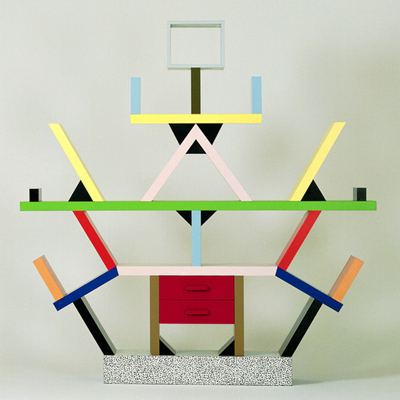
Horn divides the book up by the different types of objects Memphis designed: lamps, chairs, sofas, tables, storage, and so forth. All of the pieces are gaudy and oddly shaped with clashing choices of pastels and other ugly color combinations. Geometric shapes abound and the whole thing just screams 1980s. The Memphis style does not have the lasting post-modern appeal that Bauhaus does.
Not all the items included in Memphis were actually designed by the Memphis collective. Horn includes examples from competitors who began producing Memphis inspired knock-offs for the general public. They are just as gaudy but they are also functional. Anyone who has lived through the late 1980s and early 1990s will recognize the Memphis influence. My local video store's carpeting is vintage Memphis knock-off.
Despite all this, my children are fascinated with the book. They will fight each other for a chance to lie down on the floor flipping through the book as if it's the latest comic book. They compare favorites and argue the finer points of different things in the book. Among their favorites are the "Casablanca" sideboard (p. 70), the "Ginza" robot dresser/shelving unit (p. 72), and the "Ashoka" lamp (p. 32).
a book about the art movement/style known as Memphis and officially called Memphis Milano. a style that came to be in the 1980s. Made up and guided by the legendary Italian designer Ettore Sottsass. and its influence is still felt in the early 1990s and even further on. The book is from that era (published in 1986), and that makes it reporting on Memphis from the field, instead of it excavating old ruins and archives, if you will! indeed it makes a considerable difference in my opinion when the argument is of a philosophical nature to be from the horse’s mouth! The author gives his personal opinion on the style at the times of Memphis Milano, instead of one looking back on it or even worse (in a way), wasn’t even there to witness it! The pieces showcased here are authentic, whether from the official Memphis Milano catalogues or third party inspired ones. There is stuff today that while nice and “Memphisy”, does sway away slightly or dramatically from the soul of the original style and its definition. one can look at Memphis as Bauhaus on acid! or Bauhaus gone haywire! some of the pieces are fun, some happy, some wild and others are completely drunk! Memphis like any style is metaphorically never with sharp independent edges. instead, it has fuzzy edges that touches other previous styles. so you’ll find a bit of Bauhaus in Memphis. Also you can sense some 1950s pop style or Mid-Century Modern and maybe a sprinkle of 1950s diner style. But with Memphis contrary to Bauhaus, there is a tendency to drop symmetry from the design, to eliminate the predictable, the formulaic, almost to the point of being rebellious for the sake of it. Ettore Sottsass made it clear as he explains that “Memphis seeks not to forge a single coherent style, but to expand the visual vocabulary of contemporary design by introducing elements into it that are drawn from both today’s suburban vernacular and ancient and/or exotic ritualistic artifacts” The fuzzy nature of the structure of a design style as I see it is not surprising. Similarly to how the saying goes: no man is an island, I profess that no design style is an island! One can easily travel from one style to another by stepping on shared aspects. (and all styles in my personal opinion eventually leads to nature, the primordial source of inspiration for man’s creations). Sometimes art movements or manifestos act like a mirror of their time in the straight forward meaning, and sometimes the opposite, similar to how a mirror reverse things, thus the analogy suggests rebelling against their time. I personally have nostalgic feelings towards Memphis and an abstract admiration as well, I totally love this style. this is because Memphis’s influence leaked to all sort of things all the way into the early 1990s. Indeed, many think that it’s inspired abstract graphic design style a product of the 90s! Memphis influenced many styles in the 80s/early 90s including Rave and and New Wave. I personally owned some stuff way back as a child with some Memphis touches, including Crazee Wear and Bugle Boys clothing (who remembers these today?!), a skateboard also with such inspired style, slap bracelets (remember those?!), a pencil case, a Mickey Mouse fanny pack (rather useful, more so today with cumbersome smartphones, why aren’t they’re popular today?)…etc. And I also remember seeing photos of Memphis furniture and interiors, it was here and there. so that’s why it touches me nostalgically. but I also like it regardless of nostalgia.
🤔It’s rather interesting how one’s perception of things is partially affected by the inescapable exposure to stimulus over one’s life. Take Art Nouveau for instance. it was perceived by victorian traditionalists as outlandish, bizarre and even decadent! yet viewed by modern eyes today its looked upon as traditional, classical and even conservative! this fact reminds me of what I use to tell my younger brother: for anyone who’s looking at a square all his life, a circle is the next big thing, and vice versa!
💭things I wish to see done in Memphis style: a Memphis watch a Memphis game console! a Memphis car…maybe if you build the Voiture Minimum, Le Corbusier’s car and paint it like Andy Warhol’s BMW M1, it’ll be a Memphis car! what about a Memphis person? maybe Picasso’s crying woman painted by Roy Lichtenstein! here’s a Memphis “air”! : the Cassiopeia glass made by Marco Zanini has a sealed cavity, so the air trapped in it is from 1982, a Memphis air! anyway, enough silliness, nice book but I wish it did have more pictures, even though it does have a handful of, but you know me, I love pictures!
Memphis is a very funky, groovy, quirky, fun, out-there, colourful style that applies to anything functional in the home. Turning every thing into a piece of art, or objet d'art. Beautiful clean lines, curves and colourful stripes and patterns using a combination of materials that combine to look as though they are of one statement and personality.
I hate every single bed, table, chair, sofa, bookcase, textile, lighting fixture, and objet d'art in this book. I bought it because I love design and felt that Horn offered a great introduction to postmodernism in interior decorating. For example, one Memphis table mixes marble and plastic as a means to destabilize socioeconomic hierarchies in furniture. Still, the modernism to which Memphis was a reaction has since reasserted itself to the extent that some Apartment Therapy house tours feel like a '50-60s time warp, which indicates way more staying power to clean, uncluttered lines than Horn expected (this book being written at the height of Memphis's popularity). If anything, the current decluttering/Konmari/minimalist vogue turns poor Memphis upside down.
My first encounter with Memphis was during a 2011 visit to the High to see Modern by Design, which included Sottsass’s Carlton. Carlton had been placed on a podium in the middle of the gallery, creating quite an impression, dominating the room.
Reviving that memory, Dezeen ran an article back in April discussing the reappearance of Memphis in the design world. Since then my need to learn more about Memphis has been at the back of my mind.
While this book isn't definitive, it’s a very good introduction and overview of Memphis’s underpinnings, its most prominent designers and designs, its impact, and its utilization. It’s heavily illustrated with color photos, all of which are well described, making this book especially useful. My favorite feature is the photos Horn included showing Memphis pieces in interiors, some of which are entirely Memphis and some of which are eclectic.
I was going to give just 2 stars, because the photos aren't as good or as well reproduced as they could be, and the text isn't really very insightful, but it does include a great selection of Memphis pieces and one doesn't see a lot of that anymore. I used to hang out at the big Memphis dealer in Chicago before it burned down back in the '80s, and will always have a soft spot in my heart for this whimsical style.