Plutarch (46-120) - Greek biographer, historian, and philosopher, sometimes known as the encyclopaedist of antiquity. He is most renowned for his series of character studies, arranged mostly in pairs, known as “Plutarch’s Lives of the Noble Grecians and Romans” or “Parallel Lives.”
Marcus Brutus (75 AD) - A study of the life of Marcus Brutus, a Roman politician
Plutarch (later named, upon becoming a Roman citizen, Lucius Mestrius Plutarchus; AD 46–AD 120) was a Greek historian, biographer, and essayist, known primarily for his Parallel Lives and Moralia. He is classified as a Middle Platonist. Plutarch's surviving works were written in Greek, but intended for both Greek and Roman readers.
"Et tu, Brute?" The famous Shakespeare line from Julius Caesar is how most of us know Marcus Brutus. Well, the ancient biographer Plutarch wrote an entire life of Brutus. Turns out, Marcus Brutus was a remarkable man living in remarkable times. Here are several quotes from Plutarch's text along with my comments.
"Brutus having to the goodness of his disposition added the improvements of learning and the study of philosophy and having stirred up his natural parts, of themselves grave and gentle, by applying himself to business and public affairs, seems to have been of a temper exactly framed by virtue." ---------- What praise from Plutarch the philosopher - describing Brutus as a man good by nature and a lover of wisdom who is both serious and kind in the political sphere. The ideal Roman!
But bad time to be a Roman since it's civil war: Caesar vs. Pompey. We read: "Thinking it his duty to prefer the interest of the public to his own private feelings, and judging Pompey's to be the better cause . . . Brutus placed himself under Pompey's command." ---------- Years ago, Pompey had Brutus's father murdered, but Brutus was able to put aside his private feelings and, placing his country first, supported Pompey. And Plutarch writes how "Caesar had so great a regard for Brutus that he ordered his commanders by no means to kill him in the battle, but to spare him, if possible, and bring him safe to him." Now that speaks volumes of Brutus's character - even in a civil war, each leader wanted him on his side. And, to thicken the plot, Caesar knew Brutus was probably his son.
As we all know from our ancient history, Caesar wins and brings Brutus over to his side. But, alas, Brutus can see Caesar is an unjust tyrant and, along with his friend Cassius and other high-ranking Romans, Brutus make plans to assassinate Caesar. In his planning, Brutus consults an Epicurean. "Statilius the Epicurean held that, to bring himself into troubles and danger upon the account of evil or foolish men did not become a man that had any wisdom or discretion." ---------- Epicureans wanted little to do with the public life, especially if one has to deal with vicious fools. As it turned out, perhaps this was a bit of Epicurean wisdom worth heeding. (I had to throw this in since I am drawn personally to the philosophy of Epicurus).
Caesar is assassinated but Brutus and Cassius have Caesar's nephew to deal with, a 20 year old, also named Caesar. As per usual in the ancient world, this means war. After many battles all over the Roman empire, it all comes down to one big final clash. Now, as it turns out, the navy fighting on behalf of Brutus defeated Caesar's fleet. If Brutus knew about this critical navel success, he would have had no need to rush into the grand finale of a land battle. Plutarch writes: "But it seems, the state of Rome not enduring any longer to be governed by many, but necessarily requiring a monarchy, the divine power, that it might remove out of the way the only man that was able to resist him that could control the empire, cut off his good fortune from coming to the ears of Brutus. ---------- Ah, Plutarch was not only a biographer but a priest at Delphi. In Plutarch's worldview, no matter how virtuous and right-thinking a man may be, he will not succeed if the gods have other plans.
Surrounded by Caesar's army, Brutus does the honorable Roman thing - he has himself put to death. But before this, Brutus says: "He found an infinite satisfaction in this, that none of his friends had been false to him; that as for fortune, he was angry with that only for his country's sake; as for himself, he thought himself much more happy than they who had overcome, not only as he had been a little time ago, but even now in his present condition since he was leaving behind him such a reputation of his virtue as none of the conquerors with all their arms and riches should ever be able to acquire." ---------- Spoken like a true Greco-Roman philosopher! Brutus valued friendship and a reputation for personal virtue above all else. In this he joins Cicero, Seneca and the future great Roman emperor/philosopher Marcus Aurelius.
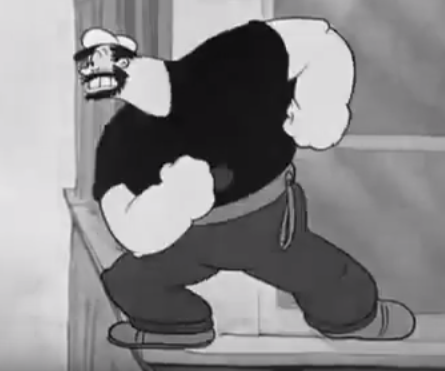
I just discovered that the bad guy from Popeye is actually named Bluto as opposed to Brutus, something that I had always thought otherwise. I guess you learn something everyday, not that it is going to have a profound effect on my life (unless of course, it is the difference between winning or losing a Trivia night, but then again you don’t get all that much for trivia nights – okay, maybe a dancing Jesus clock, but once again, a dancing Jesus clock isn’t going to have a profound effect on my life).
Still, whenever I come to Marcus Brutus, I still can’t get this image out of my head:
which is annoying because Marcus Brutus, despite being one of the people that decided that it would be a good idea to plunge a knife into the back of Julius Caeser, was not a thug. In fact, I get the impression that he was quite a sophisticate, and rather philosophical, individual, though these days the name is really only one that you would give to a dog, and a particularly big and vicious one at that.
Yeah, one has to sort of feel sorry for Brutus since he wasn’t the only person who was involved in Caeser’s death (Cassius for one), and there were some other pretty brutal Romans who also deserve our scorn (Mark Antony for one), but it seems as if Brutus gets all of the blame for the actions of many people. Maybe it has something to do with Brutus being Caeser’s friend and as such the act of stabbing him amounted to a betrayal (not as if one less stab would have made much of a difference). It wasn’t as if Caeser was lured into the Senate chamber by Brutus either – he came of his own accord, despite warnings not to. Oh and to top it all off, Brutus was on Pompey’s side in the Civil War.
I guess we can blame Shakespeare for all of that bad press, in the same way that we can blame Shakespeare for the fact that Richard III is remember as some disfigured tyrannical hunchback, not that he wasn’t the only English King to usurp the throne (Henry IV). I would probably mention King John as well, but then he does have a pretty bad reputation. We still name our children Richard and John, and even Julius rates a mention at times, but Brutus, no, that name is reserved solely for those guard dogs that roam the grounds of factories and warehouses at night.
The thing that many don’t seem to realise is that there was an enormous amount of pressure on Brutus to act. His ancestor had been instrumental in removing Tarquin from power back in the days when Rome had a king, and there were grave fears that Ceaser was heading in that direction. It is sort of like Jefferson’s idea that the tree of liberty must be refreshed from time to time with the blood of patriots and tyrants. However, the catch is how does one define a tyrant. Was Caeser a tyrant?
Well, it turned out that the conspirators’ actions backfired as it eventually leads Rome into the realm of Imperialism. However, one needs to look back and see that there was another person who had recently taken the title of dictator – Sulla. Back in those days, the title dictator was never meant to be permanent, and it was taken to bring the Republic out of a period of crisis (much in the same way that many Prime Ministers and such are ruling by decree during the age of Covid-19). However there is a big difference – you could say that Sulla supported the propertied classes whereas Caeser supported the working classes. In a way it is something that we are seeing being played out today in our political discourse, and it demonstrates that these struggles are nothing new.
For instance, here in Australia our leftwing leaders are routinely criticised by the mass media (of which 70% is owned by one man) for even the slightest hiccup, whereas the right-wing leaders are completely ignored, if not exonerated. I see a similar thing here – Sulla took the title of dictator and was not killed, Caeser took the title of dictator as was killed.
Then again, Sulla also used the opportunity to go around and kill all of his enemies – for the preservation of the republic of course – whereas Caeser refused to sink to that level. Well, we all know how that decision played out, don’t we? Then again, Augustus certainly didn’t make that mistake.
Anyway it seems as if I haven’t said all that much about Brutus, except that it is pretty clear that Shakespeare got a lot of information for his play from this book (as well as the one on Caeser). The other thing is that the lives of these two individuals are so inextricably linked that it is impossible to talk about one and not talk about the other. Still, I do feel that Brutus gets a pretty bad rap considering that there are plenty of other people out there that should be inhabitting that layer of hell as well.
It's fascinating to read history records that are so old they become history in themselves. At least in North's translation, it appears that Plutarch did not believe in paragraphs, so this reads like one giant paragraph, and the organization is a little tricky to follow, even though it's interesting subject matter. I read this specifically to study Shakespeare's portrayal of Brutus in Julius Caesar, and it appears that for the most part, the portrayal is accurate, though Shakespeare did condense the timeline and exaggerate Brutus's thought process, making him seem more reluctant to kill Caesar than it appears he actually was.
Caeser dies for a love of power; Brutus dies because of his distrust of this same power. Caesar is blinded by his hubirs; Brutus is too kind. Perhaps the stories of brutus and caesar illustrate a metaphor for virtue ethics.
' The fault, dear Brutus, is not in our stars but ourselves that we are underlings.' ( Julius Caesar, Scene 2)
Marcus Brutus will always be my Roman hero despite his tragic flaws. He has a wife of valour and a patriotic Roman. Such a warrior is she. Brutus loves her dearly.
Grayson loved this. It was our first Plutarch for school and I have to admit, it didn’t seem that hard for him. For me, there are aspects of the story, I’m pretty sure I didn’t quite get, but the parts I did were fascinating and feel I have a tiny bit more comprehension of the Roman Republic. We did read Anne E. White’s guide and I can’t thank her enough for the work she did for us to enjoy this more. I’ll review hers when I have finished the three lives.
"The state of Rome not enduring any longer to be governed by many, but necessarily requiring a monarchy, the divine power, that it might remove out of the way the only man that was able to resist him that could control the empire, cut off his good fortune."