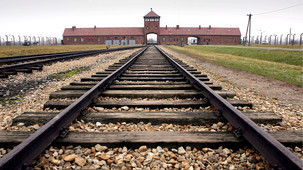
Part family biography, part European and Holocaust history, this book traces the life of violinist Alma Rosé, along with that of other members of her illustrious musical family, from her birth in 1906 in one of the world's foremost cultural capitals to her death in a Nazi extermination camp in 1944.
It will be particularly fascinating and wrenching to anyone with similar roots. Alma was the niece of the famous composer and conductor Gustav Mahler, at the time director of the Vienna Opera, and the daughter of Arnold Rosé, concertmaster of the Opera Orchestra and the Vienna Philharmonic and leader of his own renowned string quartet.
Her older brother Alfred became a noted pianist, conductor, composer, and teacher. Alma, named after her aunt and godmother, Alma Mahler, was taught by her father and, both inspired and intimidated by the family's musical tradition, she became a fairly successful violinist.
In 1930, she established a girls' orchestra called the Viennese Waltz-Girls, with which she toured throughout Europe as conductor and soloist, and which surprisingly had her austere father's blessing because of the high quality of the playing. Her marriage to the famous, dashing Czech violin virtuoso Vása Príhoda soon ended in heartbreak and divorce.
Disaster struck in 1938, when Hitler annexed Austria, whose population welcomed him enthusiastically; the country's always latent anti-Semitism erupted swiftly and violently. Though the Rosé family were completely assimilated and had even converted to Christianity, Arnold immediately lost his orchestra position and pension. His wife was ill and died that year, leaving him stranded financially and emotionally.
Alfred and his wife managed to flee to Holland, England, and eventually Canada, where he died in 1975; Alma mistakenly thought she was protected by the Czech passport gained through her marriage. With dauntless determination, and with the help of old friends, including the famous violinist Carl Flesch, she got her father and herself to England only months before the outbreak of World War II. The Rosé Quartet's cellist and former principal of the Vienna Philharmonic, Friedrich Buxbaum, had arrived there earlier; he later joined the re-formed quartet.
So far, Alma's story parallels my own. Born in Vienna 20 years later to musical parents who encouraged my violin studies, I grew up near enough the Rosé house to encounter the illustrious concertmaster not only on stage but on the streetcar. We witnessed Hitler's triumphant arrival, but our Czech passports enabled us to escape to Czechoslovakia. When Hitler caught up with us in 1939, we, too, managed with the help of friends to get to England just before the war. A few years later, I was thrilled to be the violinist in a trio with the venerable Buxbaum, who still played with the facility and tone of a man half his age. Here the resemblance ends. While we survived the war in England and ultimately came to America, Alma was tempted by performing opportunities to leave the comparative security of England for Holland, where her career flourished and she earned enough money to help her father.
She was still fulfilling engagements when the Germans overran Belgium and the Netherlands; her efforts to get back to England, or join her brother in America, failed. Staying with friends, she was almost picked up by the Nazis despite a hastily arranged marriage to an "Aryan" Dutchman, and in 1942 she went into hiding, tried to get into Switzerland, but was betrayed, arrested, and deported to Auschwitz-Birkenau.
From here on, the story takes on a surreal character. Shortly after her arrival at what has been called "a wound in the order of being," it was discovered that Alma was a violinist, and, in a grotesque replay of her past, she was asked to take over a poor, threadbare musical ensemble of women inmates. By sheer courage, fortitude, and determination, she turned this motley group into a viable orchestra, training and coaching the players; arranging music for its ill-matched instrumental makeup, from mandolins to sopranos; and driving herself and her musicians to exhaustion. Gaining unprecedented stature and exploiting some of the most brutal camp functionaries' love of music, she saved her musicians from the gas chambers and also obtained some favors and privileges for them. Forty years later, one of them said that there is not a day when she does not remember Alma and thank her. Alma herself succumbed to an undiagnosed illness, which deepened the mystery surrounding her.
Author Richard Newman made friends with Alfred Rosé and his wife in Canada in 1946. The impetus for writing this book was the publication of a memoir called 'Playing for Time' by Fania Fénelon, a singer with Alma's orchestra, which gives a very harsh portrayal of her. Newman's search for the "real" Alma lasted 22 years and took him around the world. His sources are family letters, interviews, and correspondence with family...
A meticulously researched biography of a truly outstanding woman. I read it for research purposes and the further I read, the more I began to admire Alma’s strong personality and boldness. Not only was she a true pioneer in conducting a highly-successful female orchestra when the music scene still mostly belonged to men but managed the impossible in a place where all hope was lost - create a new women’s orchestra out of nothing and thus save multiple lives (almost all members of her orchestra survived the camp). Mr. Newman did an outstanding job with his research. By the time I finished this remarkable biography, I felt like I knew this brilliant woman personally, and not only her, but her entire family and the girls she shared the last months of her life with. By providing historical documents and eyewitness accounts, the author creates a vivid and objective portrait of a woman who refused to bow down to the new world order and remained an artist and a rebel till the very end. A biography I’d highly recommend to everyone!
In this case the title doesn't really tell it all. Much of the story takes place in the years leading up to the Nazi take over of Vienna and the rest of Europe. People were constantly changing their lives to adapt to the new SS rules and regulations and to survive as they could. By the time the story comes to the concentration camps, the prisoners have spent the last few years of their lives trying to get the proper documents so they could leave or be safe where they were. None of their efforts were ever enough. It is amazing how much is known about the individuals lost in the camps. The amount of information is incredible.
Alma est une violoniste autrichienne, née dans une famille musicienne juive. Elle est déportée à bord du convoi n°57 à Auschwitz-Birkenau. Là-bas, elle est affectée au block n°10, le block des expériences médicales mais son talent va vite être remarqué et elle sera transférée au block des musiciennes. Elle va devenir la chef d’orchestre de cet ensemble médiocre, rôle qui lui offrira le statut de kapo. Alma Rosé va se montrer très exigeante avec celles qu’on appelle les filles de l’orchestre, et sera vivement critiquée pour cela. Cependant, ce besoin de s’évader dans la perfection les sauvera, autant en satisfaisant les SS par leurs progressions qu’en détournant leur attention des centres de mise à mort et des fours crématoires. L’extraordinaire travail de la violoniste sera reconnu : effectivement, son appellation par les SS passera du numéro qu’on lui a tatoué sur le bras, qui la déshumanise, 50 381, à Frau Alma, un titre honorifique. Les musiciennes et elles bénéficieront de nombreux privilèges grâce au talent et à la force de caractère d’Alma : avoir une double-portion de nourriture, des sous-vêtements, prendre des douches… En cela, Alma est une véritable figure d’humanité dans l’horreur de la déshumanisation.
Ce roman est une biographie d’Alma. Très factuel, je l’ai trouvé relativement difficile à lire et surtout TRÈS long. Il s’agit du livre sur lequel j’ai passé le plus de temps de tous les livre que j’ai lus dans ma vie. Chaque information sur Alma Rosé est exploitée. Nous découvrons des lettres entre Alma et sa famille. Cependant, il demeure une poésie incontestable. Découvrir la vie de la violoniste dans son intégralité nous permet de la comprendre. Nous découvrons son enfance, et toute sa vie, car sa déportation ne survient qu’aux trois quarts du livre. Alma est un exemple à suivre pour tous les lecteurs. Elle est sensible, humaine et honnête.
C’est un excellent support pour se documenter sur Alma Rosé, néanmoins ce n’est pas une lecture facile. Pour une lecture agréable, je vous orienterais plutôt vers “La violoniste d’Auschwitz” d’Ellie Midwood, un roman autobiographique. Mais cette biographique va beaucoup plus loin, ne contient que des informations vérifiées et reste bien plus complète en terme de documentation.
Yet another well researched book which covers Vienna just before and during the beginning of WWII, the musicians who made Vienna the music capital, the trials and tribulations of famous Jewish musicians, and the story of Alma Rose whose father was a famous musician. . This was a book recommended as being of interest to those who want to know more about the lives of people before and during WWII. I had never heard of Alma Rose; however, her story is worth knowing. The first half of the book is filled with names and dates in addition to learning about the lives and mores of the upper crust Viennese. The second half of the book deals primarily with Alma Rose after she left Vienna, the choices she made, and her contributions.
Absolutely phenomenal. A fascinating story which brings Alma Rose to life. An account of the Nazi regime and Auschwitz, very hard to read of the sheer barbarity and cruelty, while at the same time accounts of bravery and the strength of a women's' orchestra under the leadership of Alma Rose.
Alma Rose was a truly remarkable human being. Talented, troubled and sensitive. That she had the support of so very many friends from the musical world and beyond, says it all really.
While I didn't particularly care for Alma Rose, her story is interesting. The book tends to be more of a list of what music was played on what date, so it is a bit dry. I was surprised to hear that there was an orchestra in Auschwitz. Although this part isn't in the book, her brother and his wife ended up moving to London, Ontario.
From her romantic days in Vienna as violin royalty, to the days hiding out in Europe, to Auschwitz itself, this is a compelling and deeply moving tale. Meticulously researched. Even though there were so many things in Alma's story which were unimaginable, I found so much to relate to about her life and circumstances as well. Recommended, but not a light read.
I had never heard of Alma Rose before I picked this book up at a yard sale - which I did because of my interest in all things Holocaust. I never would have touched it had it not had the word "Auschwitz" on the cover.
There would always be a part of me that would know, deep down, I was deprived, not knowing this woman's story.
Alma Rose was an incredible person. Her story offers a beautiful picture of strength, endurance and remarkable clarity in the face of unending brutality. She was strong enough to save almost 50 women who would have died in the gas chambers had it not been for Alma.
Alma Rose was an incredible person.
Her story is one of inspiration. Her story needs to be known.
I think it is terrible that so many key Nazis escaped to lead ordinary lives in S. Americas. Mengeles became an illegal abortionist in Brazil for a time before (and after Adolf Eichmann was tracked down by Mossad) moving to Paraguay.
This entire review has been hidden because of spoilers.
THe first half of the narrative was quite dry and drawn out, with lots of bland listings of specific musical works played and practiced, and lots of name-dropping. Unfortunately, the result was that the characters came across as haughty, selfish and unsympathetic. By the second half of the book, which describes Alma's work as a musician in the camp, a bit more feeling came into the book. Certainly Alma was a brave woman under terrible conditions in the camps, but overall, I was surprised how relatively unemotional this book was in comparison to other Holocaust memoirs I've read.