"The Hipparchus or Hipparch (/hɪˈpɑrkəs/; Greek: Ἵππαρχος) is a dialogue attributed to the classical Greek philosopher and writer Plato. There is some debate as to the work's authenticity. Stylistically, the dialogue bears many similarities to the Minos. They are the only dialogues between Socrates and a single anonymous companion; they are the only dialogues where the titles bear the name of someone long-dead; and they are the only dialogues which begin with Socrates raising a "what is" question.
The primary aim of the dialogue is an attempt to define greed. A friend of Socrates argues that greed is a desire to profit from things of no value, but Socrates replies that no sensible man attempts to profit from worthless things, but inasfar as greed is a desire for profit, then it is a desire for the good, and thus everyone is greedy. The friend of Socrates thinks there is something wrong with Socrates' argument, but cannot say what is wrong with it.
In the dialogue Socrates discusses Hipparchus, a tyrant of the 6th century BC. Thus there is another theme in the dialogue concerning intellectual honesty and fairness in dialectical discussion."
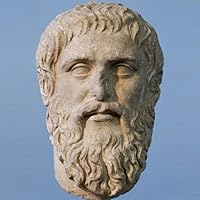
Plato (Greek: Πλάτων), born Aristocles (c. 427 – 348 BC), was an ancient Greek philosopher of the Classical period who is considered a foundational thinker in Western philosophy and an innovator of the written dialogue and dialectic forms. He raised problems for what became all the major areas of both theoretical philosophy and practical philosophy, and was the founder of the Platonic Academy, a philosophical school in Athens where Plato taught the doctrines that would later become known as Platonism. Plato's most famous contribution is the theory of forms (or ideas), which has been interpreted as advancing a solution to what is now known as the problem of universals. He was decisively influenced by the pre-Socratic thinkers Pythagoras, Heraclitus, and Parmenides, although much of what is known about them is derived from Plato himself. Along with his teacher Socrates, and Aristotle, his student, Plato is a central figure in the history of philosophy. Plato's entire body of work is believed to have survived intact for over 2,400 years—unlike that of nearly all of his contemporaries. Although their popularity has fluctuated, they have consistently been read and studied through the ages. Through Neoplatonism, he also greatly influenced both Christian and Islamic philosophy. In modern times, Alfred North Whitehead famously said: "the safest general characterization of the European philosophical tradition is that it consists of a series of footnotes to Plato."
In this Socratic dialogue about “lovers of gain,” Socrates and an unnamed friend debate whether pursuing gains can be wicked. Usually, the title of a dialogue is the name of Socrates’ philosophical sparring partner, but, herein, Hipparchus is a historical figure who Socrates cites as the reason he wouldn’t hornswoggle his friend, quoting “Walk with just intent” and “Deceive not a friend” as credos that he, Socrates, lives by.
The friend tries a number of approaches to argue the loathsomeness of lovers of gain. Recognizing the starting premise will be that a gain is a good, the friend argues that such people (presumably greedy / materialistic types) purse valueless gains. Socrates attacks that as an oxymoron. Next, the friend argues that lovers of gain seek gains that no honorable man would pursue. Again, Socrates argues that a gain is a good and all humans seek good. Since the friend doesn’t want to call the lovers of gain fools (i.e. unable to recognize a gain when they see it,) the friend is stuck. The third approach is to argue that a wicked gain could be considered a loss. This is also swiftly rebutted. The last tack is to argue that some gains are good, while some are evil, which runs afoul of the same argument.
This isn’t one of the best dialogues – in fact, many question whether it was written by Plato. That said, it brings up a few ideas that are worthy of consideration. It felt very much like a conversation I once heard in which a young woman argued, “No one should have that much more than they need.” Which drew the response, “You realize that 90% of the world would say you have tons more than you need?” Which resulted in the instigator walking off in a huff. If you want to engage in debates about the virtue (or vice) of wealth acquisition, this might be a good place to begin your reflection.
Possibly not written by Plato. Possibly satirical, in large part because Socrates discussion on Hipparchus seems, according to my edition of the text, to be revisionist (even for his time) and the clear indication of a lie somewhere--although the second interlocutor cannot find it.
What the dialogue is about, however, is the nature of greed. Put another way, it is about the nature of profit. We first ask whether greedy people know that thing they want has no value; it is suggested that, unless they are fools, they must at least think it has value. From that, we ask what it is that gain and loss are, and whether gain is good and loss bad; this is agreed to, viz., gain is good and loss is bad.
If, however, we are to say that profit/gain is good, then we must also say that to be greedy is to be after that which is good in excess--that is to say, we are very good; and, if we think that all people want the good, then we must also conclude all people are greedy.
Socrates' interlocutor thinks that there must be something wrong in this argument, so he attempts to distinguish between good and bad profit; however, he is unable to do so, precisely because profit has appended to itself the concept of 'value'. That is to say, we only profit by gaining something of value; we only lose when we lose something of value. So! so long as you are valuing the right stuff, profit will always be good; Socrates is vindicated, all people are greedy.
However, the lie is found precisely where he is not looking. One is greedy for lots of stuff, but isn't it possible to be jealous as well greedy? If that is the case, we can see that greed may have appended to itself a desire to have that which one cannot have. He is also quick to call someone foolish who values something wrongly; however, one can be perfectly intelligent in many other ways, and also value wrongly something--even value wrongly that thing to the extent of desiring it foremost. Money, when valued for itself merely, is precisely an example of this; profit for the sake of profit--when profit is defined as base acquisition of wealth, rather than good or valuable stuff--is worthless. It is worthwhile only so much as it can be used for useful stuff. It is a medium of value transference.
Much of Socrates' discussion on economics in this dialogue are not that enlightening. He seems to suggest that, by-and-large, those who want things want them for a reason. This is a fundamentally flawed premise, precisely because much of what people want is vague and obscured; even totally contradictory. The ability to hit upon some thread and to pull it, to make someone believe such-and-such is what they want (whether long term or short), is certainly more important. The wisdom of keeping to the crafts--to people acknowledged as skillful and desirous of tactile things, even if these things are webbed in a social milieu which may be, at bottom, questionable--allows for an easier throughline to his point: that we still really do want something we conceive as good.
Not a great dialogue---some controversy over whether it was written by Plato, and if I had to guess, I'd say no, though it's style is closer to his than the Alcibiades duo. Socrates and an unnamed friend set out to define what greed is, and by the end, the friend is annoyed because Socrates has shown him that everyone is greedy, since being greedy means wanting profit and all profit is good. Since everyone wants the good, we can't fault people for being greedy. The friend insists that Socrates is trolling him somehow, and I'd have to agree: for a man who talks such shit about sophists, Socrates, here, is certainly indulging in some sophistry of his own. It's mildly interesting as an exercise in ethics and value theory, but ultimately, not something I'd ever come back to again. It feels like it was written by a student of Plato who was pretty good at mimicking style but hadn't yet mastered the content, but who knows: maybe Plato was up against a deadline or had a book deal and just needed to get another one out of the chamber.
Rejects the idea that profit is necessarily evil as we all require mutually beneficial exchanges to exist within a society. I felt the moral aspect of what defines or constitutes an evil exchange could have been defined more clearly, that is if an evil exchange can exist. The Socratic idea that all men cannot knowingly choose to do what is evil seems absurd.
En pamplett där Platon inkarnerar Ayn Rand i ett passionerat och logiskt försvar av vinst och vinstintresse, genom att anknyta det till viljan till godhet och upplevelsen av godhet. Trevlig läsning, och knappast svår.
Jag rekommenderar denna för de liberaler som inte har tålamod att läsa ordentliga kulturellt grundade försvar för vår ideologi, men som ändå vill ha något att försvara sig med.
Un diálogo considerado casi unánimemente apócrifo que trata sobre la codicia, en el medio aparece una interpolación donde Sócrates habla de un tal Hiparco, que da el nombre al diálogo, el cual es bastante malo y de poco interés
Probably written by one of Plato’s followers in the Academy, the Hipparchus has Socrates reason that all men are greedy. Does he prefigure Nietzsche here?
Hipparchus is a lesser known work of Plato, probably due to it being so short as well as controversial in its authenticity.
Nonetheless, the work is a crucial piece of literature in understanding the morality of economic gain.
Hipparchus begins with Socrates asking his Comrade, "What is love of profit? What can it be, and who are the lovers of profit?"
In response, the Comrade asserts his main argument against the idea that profit can be moral by stating that economic gain relies on the selling of worthless commodities and breeds greed in all lovers of profit.
Socrates, immediately observing the absurdness of the argument, responds with a couple of examples to refute the first assertion: "...take a horseman who knows that he is providing worthless food for his horse; do you suppose he is unaware that he is destroying his horse?" or "take a navigator who has furnished his ship with worthless spars and ropes; do you think he is unaware that he will suffer for it, and will be in danger of being lost himself, and of losing the ship and all her cargo?"
A business owner is not incentivized to bring a worthless commodity to the market, for no sane individual will purchase the commodity.
The business owner will naturally act in a way that is beneficial to himself or the business, and to achieve that, he must appeal to the masses.
However, even the most absurd of commodities that might not seem appealing to one, are appealing to many.
Secondly, Socrates disagrees that all profit lovers are greedy by saying, "Now, of course lovers of profit must love profit... And by profit you mean the opposite of loss?... And is it a good thing for anyone to suffer loss?... So mankind are harmed by loss... Then loss is an evil... And profit is the opposite of loss... So that profit is a good."
Profit is synonymous with gain, and gain is not an evil.
- How does one alleviate themselves from poverty? Through gain. - How does one produce enough capital to purchase their needs? Through gain. - How does one exchange enough goods to send their children to a top-notch school? Through gain.
To assert that profit is an unequivocal evil is to disagree with the actions of the not only the working class but all groups of economic individuals in their goal of achieving prosperity.
If greed means to act towards betterment, then sure, profit lovers are greedy.
Hipparchus continues with the discussion of the primary characteristic of profit: is economic gain valuable?
"SOCRATES: Now, I am just going to ask you about that. Tell me, if one spends half a pound of gold and gets double that weight in silver, has one got profit or loss?
COMRADE: Loss, I presume, Socrates; for one's gold is reduced to twice, instead of twelve times, the value of silver.
SOCRATES: But you see, one has got more; or is double not more than half?
COMRADE: Not in worth, the one being silver and the other gold.
SOCRATES: So profit, it seems, must have this addition of worth. At least, you now say that silver, though more than gold, is not worth as much, and that gold, though less, is of equal worth."
The question of value is not answered simply, but Plato attempts to find a solution in which value is defined as the socially constructed worth of an item.
Since silver is much more abundant than gold, it is worth less to society. Through this, it is difficult to claim that the silver and the gold hold equal amounts of worthness.
Soon after the discussion of value, the discourse ends with Socrates stating, "Hence it is not right to reproach anybody with being a lover of profit: for he who makes this reproach is actually a lover of profit himself."
While first glance might alarm someone that Plato, through Hipparchus, is claiming that all means employed to achieve profit are moral, that is not true.
Plato is concerned with defining the true meaning of love of gain. It's not solely about acquiring profit, but about doing so in a way that aligns with reason and benefits you in the long run.
Socrates uses examples like the horse dealer harming the animal to show that illogical or harmful pursuits of gain aren't true love of gain. They might bring short-term profit, but ultimately lead to failure.
The dialogue seems to suggest that true love of gain involves using reason to achieve your goals. Fraud or manipulation might bring profit, but they wouldn't be sustainable and could lead to negative consequences.
Through the thought-provoking words of Plato, one is able to observe an enjoyable dialogue on profit not existing as an evil due to its ability to offer worthwhile commodities, alleviations of loss, and socially-compatible values.
Diyalog alışıldığın aksine ismini konuşanlardan veya üzerine tartışılan konudan değil, Platon diyalogları içerisinde başvurulan çeşitli tarihi kişiliklerden birinden almaktadır. Burada da, Sokrates’in “Dostunu kandırma” öğüdünü aldığını söylediği Hipparkhos, diyaloga ismini kazandırmıştır. Konu ise kazanç düşkünlüğünün, kazanma isteğinin ahlaki olarak nerede konumlandırılacağıdır. Kazanç burada maddi de olabilir, manevi de; ve kazanç bir değer problemi içermektedir, niteliği ve niceliği her zaman değişiklik gösterecek, kişiden kişiye göreli bir kavram olarak karşımıza çıkacaktır. Nihai sonuç olarak da Sokrates’e göre sonucu kimine göre iyi ya da kötü olsun, herkes bir şekilde kazanç peşindedir, bunu yadırgayacak kişi ancak kendinden bihaber olabilir.
Kleitophon
Platon’un en kısa diyalogu. Meneksenos gibi, bir diyalogdan ziyade monolog niteliği taşımakta, zira bu kısacık diyalogun neredeyse tamamı Kleitophon’un ağzından Sokrates’in düşünceleri ve onlara sunulan özlü bir antitezi içerir. Genelde Sokratik diyalogların sonuna tekabül eden Aporia diyalogun tamamında kendisini gösterdiği için bir kararsızlık hali vardır hep, Kleitophon diyalogun sonunda, Sokrates’i erdem öğrencileri için bir engel olarak gördüğünü söyleyene kadar da duruşu tam olarak belli değildir.
Rakipler / Rakip Aşıklar / Erasthai
Felsefe ile ilgilenmenin amaçları üzerine Sokrates ve bir gramer okulu önünde iki tartışmacı ile gerçekleşen diyalogdur. Form ve üslubu alıştığımız Platon diyaloglarından biraz farklı bir şekilde karşımıza çıkıyor burada. Sokrates, filozofun ve felsefe ile ilgilenmenin amacının, günlük yaşantıda pratik yararlar sağlayacak çeşitli sanatlar hakkında üstün bilgiye sahip olmadan uzak olduğunu, filozofun amacının kendini tanımaya ve bilgiye ölçü içeren bir metodla yaklaşmakta olduğunu savunacaktır.