You will hear a Nile Rodgers song today. It will make you happy.
Today’s pop music—genre-crossing, gender-bending, racially mixed, visually stylish, and dominated by dance music with global appeal—is the world that Nile Rodgers created. In the 1970s and 1980s, he wrote and produced the songs that defined that era and everything that came after: “Le Freak,” “Good Times,” “We Are Family,” “Like a Virgin,” “Modern Love,” “I’m Coming Out,” “The Reflex,” “Rapper’s Delight.” Aside from his own band, Chic, he worked with everyone from Diana Ross and Madonna to David Bowie and Duran Duran (not to mention Mick Jagger, Debbie Harry, Bob Dylan, Eric Clapton, Michael Jackson, Prince, Rod Stewart, Robert Plant, Depeche Mode, Paul Simon, Peter Gabriel, Grace Jones, Bryan Ferry, INXS, and the B-52’s), transforming their music, selling millions of records, and redefining what a pop song could be.
But before he reinvented pop music, Nile Rodgers invented himself. He was born into a mixed-race, bicoastal family of dope-fiend bohemians who taught him everything he needed to know about love, loss, fashion, art, music, and the subversive power of underground culture. The stars of the scene were his glamorous teenage mom and heroin-addicted Jewish stepfather, but there were also monkeys, voodoo orishas, jazz cats, and serial killers in the mix. By the time he was sixteen, Nile was on his own, busking through the sixties, half-hippie and half–Black Panther. He jammed with Jimi Hendrix, rocked out at Max’s Kansas City, toured with Big Bird on Sesame Street’s road show, and played in the legendary Apollo Theater house band behind history’s greatest soul singers. And then one night, he discovered disco.
During pop’s most glamorous and decadent age, Nile Rodgers wrote the biggest records and lived behind the velvet rope—whether he was holding court in the bathroom stalls at Studio 54, club hopping with Madonna, or scarfing down White Castle burgers with Diana Ross. Le Freak is the fascinating inside story of pop and its tangled roots, narrated by the man who absorbed everything in his topsy-turvy life—the pain and euphoria and fear and love—and turned it into some of the most sparklingly ebullient pop music ever recorded. Nile Rodgers is a brilliant storyteller who gives readers the surprising behind-the-scenes tales of the songs we all know, and lovingly re-creates the lost outsider subcultures—from the backstreets of 1950s Greenwich Village to the hills of 1960s Southern California to the demimonde of New York’s 1970s and 1980s discos and clubs—that live on in his music and in the throbbing, thriving world of pop he helped to set in motion.
Nile Rodgers' influence on modern pop music can barely be defined by his oeuvre of work as musician, producer and songwriter. A career that spans four decades and scores of hits, yet he has always been content being on the sidelines. Le Freak showcases a major portion of the career of Nile Rodgers. the Hitmaker.
The book starts off at Nile the little asthmatic kid whose childhood was spent with his junkie parents, watching TV and loitering around. After a difficult upbringing, which he details on particularly, he found his love for the guitar as a teenager and began a part hippie, homeless beatnik life panhandling and playing music for money. This early period has some interesting tales, like how he wound up in the same ER as a bloodied Andy Warhol after a bad hallucinogenic trip or his stint with the Black Panthers.
This is when his involvement in the music business as a guitarist had begun, and he would soon meet Bernard Edwards or Nard as he would call him. Together they formed the Big Apple Band and backed a group called NYC, touring extensively with them. After the disbanding of NYC, they'd soon become involved with Tony Thompson, and the Chic trio formed.
Nile and Nard in action
The book then details on the writing of their first hits and the conception of their image, their first inspirations and their sound. The book eventually details on the rise and fall of disco, the "disco sucks" movement, and their future success as producers writing for Sister Sledge and Diana Ross. Unfortunately, the two friends eventually drifted apart, but then David Bowie happened.
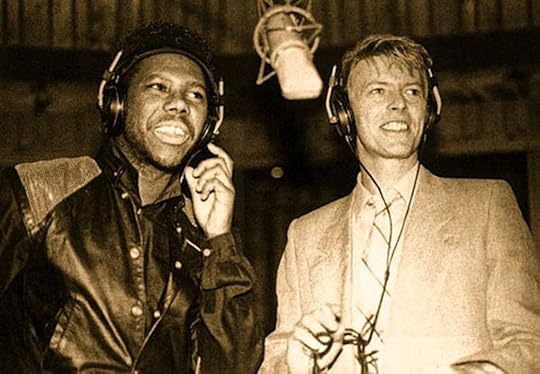
Nile Rodgers and David Bowie in studio
The book then details on the making of the Let's Dance album with Bowie and afterwards the Like a Virgin album with Madonna along with some other works with artists like Duran Duran. By this time, Nile had become independent of the Chic moniker and was suffering from severe alcoholism and drug problems. The book then details his breakdown from extensive drug use and the time when he almost quit the showbiz after rehab, only to be called back to action by Michael Jackson. Eventually it all moves onto the ill-fated Chic show at Budokan after which Bernard Edwards was found dead in his hotel room.
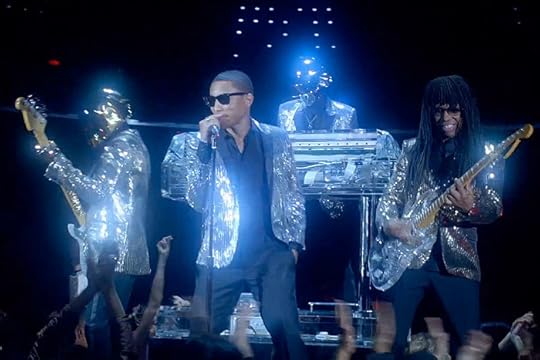
Nile Rodgers with Daft Punk and Pharrell Williams
What I most admired about this book is Nile's honesty. The man didn't take any credit away from the artists and gave credit where it was due. He also details on his junkie days and cleaning up his act. A must-read for the lovers of pop-culture and African-American music culture in America.
Note: If you're not familiar with Nile Rodger's body of work, here is a video interview of him playing a medley of some of his most important hits with his band Chic, in just sixty seconds.
This was great. Best muso's autobiography I have read since Art Pepper's Straight Life. Why so good? Because, amongst the inevitable famous namechecks and millions of units shifted, hits made and dollars traded for powder and tooted up the nose there's a great (self)portrait of a child -gifted to the point of serious strangeness- growing up independent, inventive and (yep!) charming and hard working in a world of junk, dysfunction, and the casual social destructiveness (rape, murder, incest, addiction, madness) that is sometimes concomitant with the more extreme and impoverished edges of bohemian cool.. The shifting times of his growing up and the strange mirror and fractured perspectives that bohemia can cast on the straight world provide a picture of USA and its changes -life, music, culture, politics, ambitions, dreams and disasters through fifties, sixties, seventies, eighties and onward that is as original, lively, honest and perceptive as his music is. He's dead interesting without being pretentious about disco arguing that -contrary to popular prejudice of the time- it was not decadent, self centred hedonism but an ecstatic celebration (decadent and hedonistic, admittedly) of something shared, even if it's only a dance floor... He's interesting too on how Chic were a deliberately fabricated construct like Kiss, like Roxy Music and -go on, admit it- one of the many incarnations of The Band or The Clash decked out in cobbled together Americana and rockers' pomp... His knowledge on how to work collaboratively, how to deconstruct and then reconstruct a song puts to shame all the simplistic bombast of the (generally white) Disco Sucks "authentic" music brigade... This quote might not be exact but it's close enough for me.. "The song's just an excuse for the hook and the hook's just an excuse to get you to the breakdown..." Could do with an accompanying CD or -as he promises somewhere- a list of all the REALLY FUNKY music that influenced Chic, not because the book is incomplete without them but because its spaces, like the spaces in the music, are structured in an open and welcoming way that helps fill them with memories, ghosts and surprises. Good times.
* * * * * Confession: I haven't read this book but am using it as a way to highlight something very interesting I saw about him. During these crazy times, I have indulged myself by finding things I wouldn't have the time for...like finding wonderful shows on YouTube not aired here in the States. One of them is Portrait Artist Of The Year 2020. It is a competition for artists where through a series of "Paint Offs", the final winner is commissioned to paint a portrait for the chosen subject to hang in the infamous Albert Hall. This year's subject is Nile Rodgers.
Now this "review" is two-fold. First, I can't think of anyone who loves music who wouldn't be interested in an interview/look at Nile and the little nuggets he talks about regarding his career, producing the likes of Diana Ross and Madonna. The episode presenting the end of the competition does just that.
BUT...Secondly, this series was fascinating as it showed the creative process of portraiture, something I would normally never think about.
The two best bits in most rock star autobiogs are a) when they start to break big and have hits and the world is their oyster and b) when they go mad on cocaine and become psychotic party animals. The worst bit is c) when they pretend to regret b), and repeat a load of rehab speak about how they're much happier now they stare at wind chimes and think about their recovery twelve hours a day.
This book has about 250 pages of a) and b) and about 50 pages of c), and that is a pretty good ratio.
Nile and ''Nard' (his name for Bernie Edwards, his partner in Chic) had a theory of trying to find the DHM, the Deep Hidden Meaning in all songs, what the DNA of them is, the key to making them a hit. Which sounds like it could be bollocks, but then you think of how many hits these dudes made, and there has to be something to it. The stuff I found the most interesting is when he becomes an in-demand producer, and the experiences working with David Bowie at the end of his Imperial Period and Madonna at the start of hers.
This is a man who had HITS. Who had FUN. Who was a DUDE. Who worked with EVERYONE. Rodgers comes across as a tremendous, benevolent, friendly guy who has taken a big, deep drink of life, loved his work, loved a whole load of fine women, and is welcome at my house or my disco anytime.
Le Freak: An Upside Down Story of Family, Disco, and Destiny is one of the most engaging, entertaining, profound, and relatable memoirs that I've yet read.
Nile Rodgers was someone in the music business I had been aware of since 1977, when I --- who had just crossed the threshold into adolescence --- first heard on the radio the song "Dance Dance Dance" from his group Chic, with whom he would enjoy a dizzying and intoxicating run of success over the next 2 years with hits like "Le Freak (C'est chic)", "Everybody Dance", "I Want Your Love", and "Good Times." Plus, along with his compadre and bassist extraordinaire from Chic, Bernard Edwards, he would write and produce songs for the group Sister Sledge -- e.g. "The Greatest Dancer", "Thinking of You", and We Are Family (which became an anthem for the 1979 World Series champions, the Pittsburgh Pirates).
Some of what I mentioned above about Nile Rodgers, I had already known to some degree. But as I read this book, I learned about his unconventional upbringing in both New York (where he was born in 1952) and Los Angeles, and the richness --- complete with highs and lows, and brushes with death --- of his life. I felt as if Nile Rodgers were in the room telling me his life. I have total respect for this man and am grateful for the music he has either made or produced (e.g for artists such as David Bowie, Diana Ross, Duran Duran, The Thompson Twins, INXS, Steve Winwood, Mick Jagger, Madonna, Blondie, Brittany Spears, and the B-52s), which is part of the soundtrack of my life.
For the reader of this review, I wish to leave him/her with some weighty words of wisdom from Nile Rodgers himself:
Yesterday's history Tomorrow's a mystery, today's a gift that's why they call it the present.
I recommend "Le Freak" for anyone who loves music and a compelling human interest story.
"History has reduced this glorious and complex period so badly that it's often dismissed as a one-line cinematic throwaway - the Saturday Night Fever or Studio 54 era - but it is much more than that, specially for me."
Amen Brother Nile! I LOVE music all kinds of music, rock, R&B, soul, blues, classical, you name it, my tastes are as eclectic as my taste in books. However, the disco years and Chic have a special place in my heart. Personally it reminds me of a happy time where the music was hot and everything was possible, and the memories of many nights dancing to Le Freak, Good Times, Everybody Dance, etc. always brings a smile to my face, as did this great autobiography. I knew quite a bit about Nile Rodgers the musical genius, but not a lot about his childhood growing up in a mixed race, very bohemian family, he tells the story of his early life and his storied career with self deprecating humor and plenty of wit.
It is hard to imagine popular music without the many contributions of Nile Rodgers. "You will hear a Nile Rodgers song today. It will make you happy."❤
Le Freak: An Upside Down Story of Family, Disco, and Destiny by Nile Rodgers swept me into the rhythm of one of pop music’s most dazzling lives, told with candor and delight by the man who helped shape disco and beyond. In this memoir, Rodgers shares his unorthodox upbringing in 1950s and 60s New York, his early musical explorations, the formation of Chic with Bernard Edwards, and the creation of enduring hits like “Le Freak” and “We Are Family.” He also walks readers through his work producing icons such as David Bowie, Diana Ross, and Madonna, offering vivid stories of Studio 54, musical breakthroughs, personal struggle with addiction, and creative triumphs. The book is as much about the culture of the era as it is about the man behind the music.
I felt Rodger's joy, his resilience, and his deep love for groove and groove makers everywhere. His storytelling is warm and informed, letting me see both the sparkle of nightclubs and the hard edges of life behind the scenes, creating a portrait of a creative life lived fully and honestly. The themes of belonging, reinvention, and the magic of collaboration stayed with me long after the final page.
Rating: 4 out of 5 An infectious memoir that made me feel the pulse of an unforgettable musical era.
I worked in the music industry during the ‘70s and have firsthand knowledge of Chic’s rise to fame. I was really looking forward to reading Rodgers’ autobiography and about his experiences working in the music industry particularly during that time.
The first portion of the book where he recounts his youth with drug addicted parents and constant turmoil was a page-turner. He writes in great detail about his own addictions, and from reading his account, one would presume the ability to be an amazing overachiever all by himself in spite of his addictions.
I’m sure he’s a fine music producer and songwriter, but I know there were important facts in Chic’s story that were missing, most importantly when it came to his reflections of Chic’s discovery and success. There is not one mention of Marc Kreiner, Tom Cossie or MK Productions. It made me wonder what other important parts of his story was either missing or fabricated. If you believe everything he writes, he was everywhere, knew everyone, and did an abundant amount of drugs but was still thoroughly functional. No doubt, he is a very talented guy, but he’s also an egomaniac, and to some degree delusional.
The first hundred pages of this are so cosmic that I would have happily read a book where Nile just talked about his wild life prior to Chic. Of course Rodgers was the coolest guy in any room: his parents, teenagers at the time of his birth, were the sort of beatnik junkies who sell Thelonius Monk a fur coat within the opening ten pages of the book. Rodgers had spent time in a convalescent home (he had asthma troubles), talked his naked father off a fire escape, taken acid with Timothy Leary, joined the Cub Scouts and the Black Panthers and had trouble with a contract killer before he was 16.
Of course, though, you want to read about Chic, Sister Sledge, Bowie, Madonna. You learn that Chic were influenced by Kiss and Roxy Music: who would have drawn that conclusion? When Bowie plays Iggy’s ‘China Girl’ - messy, no chorus - and tells Nile he thinks it could be a hit, Nile phones a mutual friend to check if Bowie is taking the piss. Madonna won’t work with him unless he loves all the songs she’s chosen (he doesn’t, but perseveres anyway and makes them work).
Rodgers’ writing is so vibrant and his gift for structuring a sentence with the punchline is so good that at one point I was wondering if the world’s best guitarist had, in fact, missed his calling in life. Unmissable.
This is one of the most uplifting books I have ever read.
Funny thing is, I don't believe it was written with a message in mind. It's the gripping biography of the unprivileged, skinny, asthmatic son of a 13 year old girl who left her husband-to-be at the altar because she wanted to live her own life. In the absence of his biological dad Nile Sr. (who drifts in an out of his son's life --and the book-- before succumbing to alcoholism) Nile Rodgers' father figure was a white junkie who worked in the garment district in New York. His mom dragged him to LA and back a couple times, had him sent off age 5 to a sanatorium for asthmatic children, left him a number of times with his two loving but not very vigilant grandmothers, did very little to prevent him from becoming a junkie himself and later in life became his largest supplier of drugs! She regardless emerges from this book as the true love of his life. Throughout this opus she remains the one constant.
That, and music. Because the boy had music. And brains. And a mission (shared with his musical partner Bernard) to discover the Deep Hidden Meaning.
And love for everybody he met.
Nile Rodgers has kind words for EVERYBODY in his autobiography. For his Chic partner Bernard Edwards with whom they traveled so far together, for Andy Warhol, with whom he shared an emergency room, for his grandmothers Goodie and Lenora, their boyfriends (one of whose was a convicted killer, while another gave him his biggest "high" ever when he tuned his first guitar), for his often not very well behaved siblings, for his mom Beverly, for her boyfriends and lovers, he even has good things to say for (yet another) convicted killer who raped his mother.
Aside from his mom, who gets it in spades, and his partner Bernard, adualtion is chiefly meted out to his idols like Diana Ross and David Bowie that he had the privilege to work for, but also to Michael Jackson, who sought his help at a difficult time, and Madonna, with whom he partied.
Ah, the partying. Must confess I don't exactly feel like my sense of partying and Nile Rodgers' have tons in common. He allegedly spent a few years of his life in a stall in the women's bathroom of Studio 54, meting out cocaine to all comers. But there's no denying that the guy did party hard.
The partying almost killed him, and you get the lowdown of how he battled his addiction and how he won, though that's not a big part of the book. This is chiefly a book about family and about music.
Lest we forget, Niles Rodgers gave us "Everybody Dance," "Le Freak," "Good Times," "We are Family," "He's the Greatest Dancer," "Upside Down," "I'm Coming Out," "Let's Dance," "China Girl," "Modern Love," "Wild Boys," "Notorious," "Like a Virgin," "Material Girl," "Love Shack," (I'll forgive him that one) and, of course, "Get Lucky."
There's nobody he hasn't worked with, basically.
Still, the thing I took away from this book, more than the music, more than the partying and more than the amazing story of what determination and talent can do for a young boy that grew up between two ghettos, was the endless optimism that has run through Nile Rodgers' life.
The last paragraph of the book tells us he's now fighting cancer. If anybody on earth can beat it, that will be Nile Rodgers!
You may not know Nile Rodgers' name, but you know his music. In addition to his band Chic, he's written songs for and produced records for a Who's Who of the music world, over the past 4 decades.
In this immensely readable autobiography, Rodgers tells of his chaotic childhood (parents doing and selling drugs, a murderer, several half brothers living with various parents and grandparents - it's all there), his career progression, and his own struggles with addiction. Happily for us, he avoids the boring/repetitive tell-all aspect that is so frequently part of the stories of the famous and addicted. He tells only one drug-related story which names names, and he notes that he did so with permission. That's not so say that he doesn't name-drop at all. It would likely be impossible for him to not mention the people he worked with, given the influence they've had on his career. After Chic he produced Madonna's "Like a Virgin," as she was just starting to become a household name. He then produced Diana Ross's 1980 album "Diana," her most successful studio album.
Rodgers comes across as dedicated to his music, honest about his addictions and struggles, and a survivor who is able to find joy in doing what he loves. More interesting, though, is that he doesn't come across as falsely modest. He mentions several times that he's basically filthy rich. And he's pretty frank about his drugging and sexcapades.
There's clearly stuff that's left out. I don't know enough of his story to know what, exactly, he skimmed over, but I definitely got the sense that he isn't telling us everything. The most obvious example is that he tells the story of his partner Bernard Edwards' death, but doesn't mention the cause of death. It's a pretty glaring omission, and it confirmed my sneaking suspicion that he was holding back.
I loved reading this book. Before I read the book I knew of Nile Rodgers, and was impressed with his musical involvement. But I had no idea of the extent to which he's been involved in the soundtrack of my life. I loved discovering, over and over again, that he was partially responsible for so many of the songs I've loved, and which continue to give me great joy.
If you've enjoyed disco, pop, or dance music in the past forty years, I recommend this book to you.
“A kite flies highest against the wind…” – Breathtaking!
I opened Nile Rodger’s memoir and honestly, had it not been for the Vine Program I would have missed out on enjoying one of the best books I’ve read this year.
His childhood was very hard to receive as cavalierly as he shared it, however when it came time to him sharing his music, there are three words that come instantly to mind. Oh – My – God!
The irony here is, once I was fully immersed and engaged into the technical philosophies of making music, was it when the DHM of his life, to include his young life, all came together like the many songs he helped bring up the charts. The language used I enjoyed most. The words and lines are not written, but composed. It’s the highest form of writing I know. So much so, at one point I questioned what I was reading. I mean, composing exceptional music is one art, but writing a book as influential as he was to music? …years later after the daily drug habit? But then, and ah ha, how could I have missed it? He is a musical genius.
Le Freak, a tremendous recording of musical influences inclusive, but not exclusive of classical, rock, pop and disco, incorporates so much by way of content that one review is far too little space to give it all the praise it deserves. His father, for one, touched me deeply. His brother and mother, hilarious. Too many times, one or the other was doing something that had me turned on my side laughing to tears. And Nard, oh man, what a compelling tribute. And still, the ‘metamorphosis of compressed and accelerated artistic talent’ brings out the significance of telling it all, none more important than the sharing of a phenomenal and inspirational musician living the dream in a time worth documenting. I am very moved, and indebted to have read a galvanizing musical icon.
Unbelievable.... in a good way. Niles upbringing is a jaw dropping, eye-popping, testimony of survival. The first quarter of this book has nothing to do with his future mega-celebrity and even then, every other page shocks and amazes. His mother was a thirteen year old student when she gave birth to Niles and he was adopted by an Albino woman living in the Bronx... his natural father is reintroduced several times through the book in various states of incredibly sad states: as a wino at the Port Authority, and later homeless sprawled out in a New York City toll booth. While this may sound a bit morbid, Niles narrative is nothing like that... it's infused with the charm of a curious, shy, precocious child who's ability of recall is astounding. His stories are like Grimm's fairy tales told from seedy Greenwich Village, the Bronx, and LA.... from the murderer who held him hostage at age 13 while holding his younger brother out the window - with out his knowledge he was ever a prisoner or there was anything wrong, to his teen hang session with Timothy Leary in the hills outside LA when some ragged friendlies on the beach ask him if he wants to go on "a trip". Niles first job in music was a guitarist with the Sesame Street show touring band! Susan, who every one knows from Sesame Street actually helps him land his next job at the Apollo Theater. His first gig there had me in tears laughing. I could not help throwing the Niles playlist on my stereo while reading about the artists he worked closely with starting with CHIC, David Bowie, Stevie Ray Vaughn, Diana Ross, and Madonna. Niles couldn't handle it all with out dangerous, rampant drug-use and the narrative comes across as if it's been therapeutic for him. It seems he's telling certain stories for the first time and his honesty is a pleasant surprise.
Really enjoyed the Rodger's autobiography. I liked the first part of the book best all the way through the Chic period. He talked more directly about music in this part and I find that the most interesting. The second half of this book focuses on his years as a big-deal producer in the 80s/90s and his drug problem and sobriety. This wasn't bad, but there was less focus on the specifics of his musical life. While I am not a big fan of many of those block-buster 80s records he produced, it would have been interesting to hear more about the process of producing some of them--specific challenges, the reasons for various decisions, etc. Still, though, throughout the book, Rodgers comes off as an engaging, humorous, warm-hearted sort and i enjoyed the read. I thought his defense of disco as a movement was great and his description of the death to disco period very interesting.
Highly entertaining, highly addictive read. Written with great charm and purpose, this is a book that will be of interest to anyone with a love of pop music of the 70s and 80s. Rodgers has worked with Madonna, Bowie, Diana Ross and scores of other legends, as well as making history with his own hits as part of Chic. The scandalous namedropping is kept to a tasteful minimum, but this book is still juicy and full of crazy tales. And at just under 300 pages, it's a whirlwind of a read.
An interesting romp that, however, left me unsatisfied. Once Chic's great early singles catapult him into the big money, he has almost NOTHING to say about their interesting later career, including their great album REAL PEOPLE. Also--not unusual with memoirs, but here it's so frequent it's annoying--he makes multiple errors of chronology, so many that the reader's tempted to call bullshit on him. Definitely overrated--but at least it reads quickly and it's got a bit of a roller coaster ride.
Nile Rodgers writes more joyfully about family chaos than any memoirist you've ever read; he not only survived an upbringing that would have killed most but somehow thrived, basically raising himself in New York and Los Angeles among junkies and musicians. Rodgers loves the mayhem but had the talent and discipline to emerge, in his early teens, as a real player on the music scene. He has a blast describing the birth and rise of Chic in detail, and offers genuine dismay at the sudden and harsh fall as "Disco sucks" took over the nation.
Rodgers has worked on hundreds of projects since then; he name-checks a bunch of them but gives real space to only a couple of highlights: David Bowie and Madonna. The rest go by in a blur, and the unfortunate—and genuinely bizarre—part is that he never actually discusses what he does as a producer apart from managing each project's calendar and budget. He has been enormously successful with a wide range of artists but never explains how or why, which is frustrating for any serious music fan—and they're the ones who would pick up Le Freak in the first place.
One reason, perhaps, is that Rodgers may not recall much about each project, since each was done on a sleepless cocaine jag. Indeed, at some point, his memoir becomes yet another drug addiction/rehab/recovery tale, though it's far less tiresome than most, partly because his voice on the page is so authentic and upbeat. Le Freak is a terrific read.
I lost like 3 lbs listening to this book because I was also listening to all the music mentioned - and I apparently can't listen to anything Nile Rodgers had his hands in without dancing.
Although I had a serious thing for Chic in elementary school, I had no idea he went on to produce and/or play on so many songs that I have loved since. So many of my "embarrass the kid" songs - the ones I can't help singing all the words to while I get my groove on no matter where we are or who is watching - are Nile's. So now the kid now knows who to blame...
This man's life inside and outside of music is kind of astonishing, and he shares an awful lot of it. I'm glad he survived. I'm glad he's here. I'm glad I read this book. My rating probably has more to do with my connection to the subject matter, but it was right book at the right time for me.
Nile has an incredible story, really. It's amazing what he has been through. I just wish the book had gone into a little more detail on some of the bands he worked with.
Fascinating life of drug, sex and making music that is just impossible NOT to dance to. Nile should not be here to tell his tale but he is - all part of the plan despite a pretty shocking chaotic childhood.
December 2018 still ranks as one of the best concerts I have attended. Thanks Nile
“You will hear a Nile Rodgers song today. It will make you happy…” I was aware of Nile Rodgers from his Chic days (although slightly too young to catch the disco explosion, I caught up on it), then through his connections with Debbie Harry (he co-produced her “Koo Koo” album), David Bowie (I loved “Let’s Dance”) and finally INXS, with “Original Sin”. These career highlights, which might be enough for most producers, barely scratch the surface of Nile Gregory Rodgers’ creative life. From his often harrowing beginnings - his 13-year-old Mum and stepfather were both bohemian junkies, he was asthmatic and shunted between relatives and institutions, often feeling unwanted and unloved - in the poorer neighbourhoods of New York (and later Los Angeles), with all that entailed, this doesn’t try to make sugar-coat anything and in leaving no stone unturned, it’s sometimes tough to read. His life was hard (the sequence with Bang Bang is particularly frightening) but a slowly developing love of music (fostered, ironically, by parents whose addictions took their abilities away from them) steered him from squalor (though he developed addictions early on), into hippie-dom, a stint in the Black Panthers and a gruelling circuit of gigging. About a third of the book details his childhood and teens (he has a very complicated family history) and then he meets Bernard Edwards, the two quickly becoming inseparable and incredibly supportive of each other. The Chic years (they take a while to make it) are dealt with much more briskly than I thought they would be, though with the bands story tied inextricably to the timeline of disco, Rodgers covers this time well (enjoying the excesses that were there, whilst being astonished that he was responsible for a significant part of it - the Rappers Delight business, for instance, is both amusing and surprising). Unfortunately, as his career took off, so did his substance abuse and he deals with it frankly - he was at the centre of a musical movement, part of the inner circle of Studio 54 in the 70s (being turned away from the 1979 New Years Eve party with Edwards inspired them to write “Le Freak”) and more into the 80s. In fact, he perfectly captures a sense of the exuberance and excess of the early 80s because he was living it - even as a full-blown addict, he was a high performing one, with Chic, Bowie and Madonna’s “Like A Virgin” all being produced during his period. Through all of this, his delight with show business - and the people he deals with - is almost palpable and he comes across as a genuinely nice bloke, secure enough in himself and his abilities to only take on work with people he likes and respects (whilst sharing partying and shopping adventures with them). Following his recovery (inspired, no less, by Keith Richards), the timeline fragments and the story effectively ends in 1996 (the book was published in 2011) with the death of Bernard Edwards, which is very touchingly dealt with. The epilogue jumps ahead fourteen years with a curt “it’s been a busy decade”, encompassing his work with his “We Are Family” foundation and the fundraising around 9/11 that I would have liked to have read in more detail. The same with the admission that he has cancer (he’s recently, as I write this, been given the all-clear), it seems like an odd place to leave a work that is, essentially, about hope and the triumph of his spirit. I really enjoyed this, an inspiring story of a natural performer who overcame the odds to make it big, re-invented his career after the ‘Disco Sucks’ debacle and lived life to the absolute full. Very much recommended.
A autobiografia de Nile Rodgers, escultor das principais feições da música pop dos anos 70 aos 2000 — e que encontrou novo fôlego em meados de 2010 — não haveria de não ser interessante. A forma desagradou-me um pouco — creio que o ghostwriter e/ou o editor se empenharam demais em imprimir à redação uma certa oralidade que, ainda que reflita o (auto)biografado, soa artificial. Isso, claro, pode ser um problema de tradução. Contudo, crédito deve ser dado à equipe por ter conseguido tornar legível a tão atribulada vida de Rodgers (especialmente as suas idas e vindas, mudanças de casa e de cidades, na infância e na adolescência) e de sua tresloucada família.
Como era de se esperar, a obra é um desfile de monstros sagrados do R&B, da disco, do jazz, do rock, do pop… Mais que isso: é o testemunho dos costumes e do espírito dos anos 70, 80, 90 etc. mas que, diferentemente de como se organizam em minha mente as imagens de cada uma dessas épocas, apresenta um continuum entre as décadas. Senti falta, contudo, de um aprofundamento maior sobre a história de diversos hits por ele compostos e/ou produzidos. Meu alento foi ver o cuidado com o qual foi tratada a história do Chic e a amizade e parceria musical de Rodgers com o antológico baixista (e meu grande ídolo) Bernard Edwards — uma relação tão forte que a morte de Edwards, ocorrida tragicamente em 1996, marca as últimas páginas do livro que se estende até 2011 (e que não inclui, portanto, seu trabalho com o Daft Punk).
Recomendo a qualquer um que se interesse por música — mesmo que não por disco music pois, como Rodgers deixa claro, nunca a viu separada do rock e do pop.
Nile Rodgers is currently experiencing a sort of late career renaissance, with his work with Daft Punk and that song with Pharrell, which I don't really care for, but I imagine might generate some interest in this book. The interesting thing about his career is that while his main career, as guitarist and songwriter for Chic, the thing he's known for to this day, was over for all intents and purposes almost as soon as it began, he's had this second career as a ridonkulously successful producer for artists like Diana Ross, David Bowie and Madonna. He pretty much dominated the pop charts in the 1980s, while remaining a more or less anonymous figure. This book covers everything, from his childhood, raised by junkies on the Lower East Side and in the Bronx, to his success with Chic and beyond, but honestly, I felt it kinda fell short in its analysis of why his early life was so difficult, and then he had this amazing success with Chic, and then all of a sudden the industry didn't want to have shit to do with him, but then he was still able to find such amazing success as a producer... but only with certain artists. There's a lot going on beneath the surface that's barely touched on here, probably because at the end of the day the guy's just made too much money to really tell it how it is.
Nile has lead a roller coaster of a life. He is a brilliant producer, songwriter, and musician. His influence on the Disco movement is revolutionary. The blending of different types and genres of music is what Nile does best. Chic is legendary.
He has worked with many of my favorite artists, but is like an honorary member of my all time favorite band Duran Duran. His influence in the music business is core.
He truly is a very kind and wonderful man. My son (age 11) and I met Nile a few years back when Chic was opening for Duran Duran. Nile was so amazing to my son. It was my son's first concert at age 10 and he is a big Chic and DD fan. On my son's birthday I tweeted asking Nile for a birthday shout out to my son. Nile did a birthday tweet to my son that just upped my son's hero status of Nile. My already respect and love for Nile grew tremendously. Nile is a genuine person. He has defied death and I am so glad that he has won.
Thank you Nile for writing this book!! Thank you for your music. Above all thank you for being real.
I was lucky enough to catch a question/answer session with Nile Rodgers earlier this year, and his fun, humble, and engrossing personality made me decide to read his book. Glad I did. For music fans, this is a must read. I'm not even that big of a fan of some of the areas of Pop Music that Nile has most worked in, but that almost doesn't matter at all. Nile's life is a great window in to the last half century of America. From 50's era nuclear family, through 60's counter-culture, social unrest, 70's excess, and 80's greed - this book describes it in a manner you'll rarely find. Plus Nile's writing style (it is an autobiography) is a whole lot of fun. He lived hard, and thankfully survived to tell us about it. His honesty and humility throughout make this a truly fun read, and I have to admit that it made me seek out and listen to a lot of music along the way. I usually give my books away after I've read them, but this one's a keeper.
I started reading this to gain more insight into the great producer's body of work, but was pleasantly surprised by an amazing memoir about growing up fast in NYC and dealing with the excesses of success. Rodgers, best known as the founder of Chic who went on to produce landmark albums for Madonna and David Bowie, was raised by downtown heroin junkies in the 1950s and ’60s, and it's fascinating to see how profoundly his worldview was shaped by the ups and downs of this experience. As his wandering childhood melds into his late 1970s music success, he gives us a glimpse inside the inner circle of Studio 54 and the ’80s party scene as he develops his 15 year cocaine addiction. Overall, I would have perhaps liked more emphasis on his studio techniques and creative revelations, but the unique personal narrative was more than impressive enough to carry the book.
Extremely well written and entertaining. This was difficult to put down and easy to get back into every time. I would have been happy to read this book if it was five times its length, and I have no doubt that Nile has the material to write such a book. As it is, he covers his tumultuous early childhood, his meteoric rise to success, some of his most famous collaborations such as David Bowie and Diana Ross, and his downward tumble into alcoholism and coke addiction. His recovery and life as a sober person are very quickly wrapped up, but not without one last emotional punch. All in all, a very humbled account of an extraordinary and extreme life.
an amazing journey - junkie / beatnik parents, childhood shuttling between New York and LA, early acid experiences with Timothy Leary, part of the Black Panthers ... serious drug abuse ... he came through it all and made some of the most uplifting music.