THE ADVENTURE OF THE SHOELACE STRANGLER
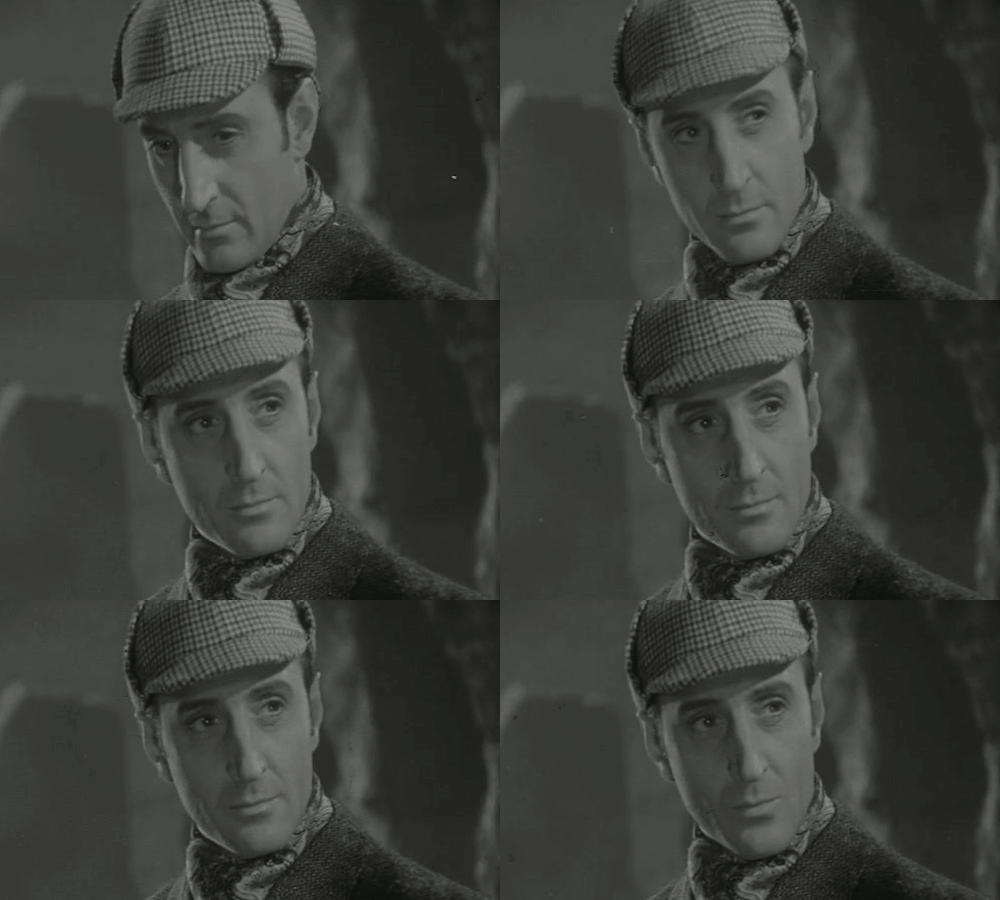
For several months, preoccupied with my recent marriage and my taking over the practice in Kensington, I had not the opportunity to see my friend Mr. Sherlock Holmes. One winter evening, after spending a largely idle day at my desk, I decided to lock up the door early and visit my old comrade. I did not relish the notion of enduring a lonely night at home --- Mary had gone away to visit her parents --- and I had with me something that I knew would amuse him. Soon enough, I found myself treading the familiar steps to 221b Baker Street. Holmes opened the door himself.
“Ah my dear Watson! What brings you here on this foggy and blustery evening?” said he. He was just about to put the violin on the desperately cluttered sideboard, long nervous fingers smoothing his mouse-coloured dressing gown.The tips of the fingers were stained with something purplish, and a faint ether-like odour lingered about his person. Judging from the remnants of the chemical experiments that I espied on the working table and the numerous copies of the Times that were strewn all over the sitting room, he had been holed up in Baker Street for quite a number of days. I surreptitiously stole a glance at his exposed wrist, and was secretly relieved to find it free of fresh puncture marks.
His slate-grey eyes followed my gaze, obviously aware of my apparently not-so-secret concern, and then swiftly turned to focus on me. “I’ve been keeping well, Watson. How are you? Mary away? Have been so for several days, I see. And quiet days at the office too. You have been somewhere in the vicinity of --- ah, perhaps Charing Cross Road earlier in the day. Browsing the book stalls, most likely. And am I correct to surmise that the parcel that you have under your arm is a new, hardbound book that you thought would be of interest to me?”
I cried in amazement, “How do you ---?”
“Elementary, my dear Watson. You know my methods.” He shrugged, took the parcel from me, and opened it.
“It’s a new novel by a young writer called Graham Moore about Arthur Conan Doyle ---“
“Your literary agent?”
“The very same. The publisher, aware of my own efforts to chronicle your adventures, asked me to read and comment on it.”
“A rather eye-catching cover. Although I actually tend to prefer smaller pipes than the Meerschaum. And I wish that you would cease referring to my cases as adventures, Watson. The aim of these little tales that you penned about me should be to instruct, not titillate. The public needs to be educated about the scientific method of crime detection, not being merely thrilled by the more sensational, wildly romanticized aspects of my cases.”
“But your cases are sensational, Holmes! That devil hound! That other hound that didn’t bark in the night! The Sussex Vampire! The Giant Rat of Sumatra!”
“Ah, never mind.” He began to leaf through the crisp, freshly bound pages. “So tell me, why do you think a piece of fiction about your literary agent should be of interest to me?”
“Because it’s also about you, and because I thought that it’s quite a neat bit of mystery.”
For the first time that evening, Holmes’ grey eyes twinkled. “A mystery!” He rubbed his hands together with exaggerated glee. “These last few days have been exceedingly dull, Watson. No crime worth mentioning whatsoever. The criminal classes of London seem to have hunkered down with the abominable weather. Even the agony columns are devoid of interest altogether. Humor me, my friend. Treat the novelistic mystery as if it is a real one and feed me the data. I am curious to see whether I am as good at devising solutions to artificial puzzles as I am in solving real life ones.”
“Well, if you insist.” I threw myself upon the familiar armchair that used to be mine when we roomed together. “The main character is a young chap called Harold White, 29 years of age, who had just been inducted into the Baker Street Irregulars.”
“Nothing to do with Billy and my other street Arabs, I assume?”
“No. Nothing to do with Billy at all”, I concurred. “The book is set in the future, the 21st century to be exact, and apparently in those far off days, your numerous admirers organize themselves into societies exclusively devoted to the study of you and your methods. The Baker Street Irregulars is one of the most prominent of those societies. One of its more senior members, a Mr. Alex Cale, claimed that he had found Doyle’s long lost diary, the one that he purportedly wrote during the time you were presumed dead at the hands of Moriarty. I must forewarn you that for the purposes of this story, your status has been relegated to a mere figment of Doyle’s imagination.”
Holmes’ thin lips twisted in a crooked smile. “How amusing. This sounds like a long, tall story indeed.” He reached for his pipe, filled it to the brim with pungent tobacco from the Persian slipper, lit it, and stretched his long frame on the armchair by the fire. “Pray continue.”
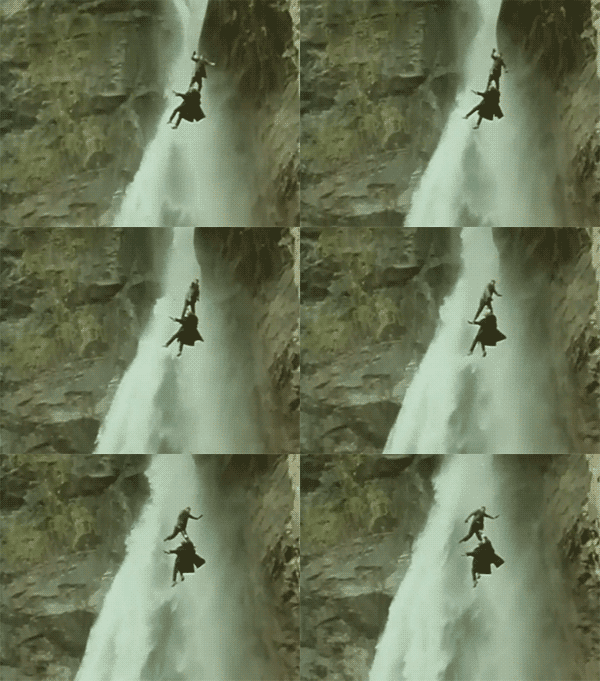
“As you might have surmised, the other strand of the story follows Mr. Doyle in our own times. He is a successful writer, having penned numerous stories about you in the Strand that brought him quite a degree of notoriety, as well as ample pecuniary rewards. You have became larger than life, an albatross around his serious author’s neck, and in a fit of pique, he killed you off at the Reichenbach Falls.”
“A fit of pique, eh?”
“You may pretend otherwise, Holmes, but I know that you derive quite a bit of satisfaction from my narrative.”
He puffed at his pipe, sending rings of aromatic smoke to the ceiling. “That I may be, my friend. After all, I have never been a larger than life fictional character before. I must admit that the novelty has not worn off. Proceed.”
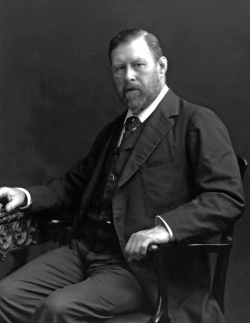
“The public vilified him for killing their beloved character. Doyle received mailed threats, and even a bomb, that mercifully, he was able to defuse. Exasperated by the Yard’s incompetence, Doyle decided to investigate the matter himself, aided by his friend, a certain Mr. Bram Stoker.”
“I get the impression that it is a name that I should have recognized. Who is he?
I looked at him in silent exasperation. He might be an unrivaled genius in his chosen profession, but of contemporary literature --- and God forbid --- popular culture, he had always been willfully ignorant.
“He is the author of Dracula, the sensation novel of the season.”
Holmes waved his hand dismissively, “another popular writer. Go on.”
“Meanwhile, in the 21st century, Cale was found to be murdered in his hotel room, strangled with a shoelace, the mysterious diary nowhere to be found. Harold, aided by Sarah Lindsay, a girl reporter --- “
“The gentler sex --- always excellent for providing motives for men’s actions, both in fiction and in real life.”
“ --- is hired by a Doyle heir to investigate the murder and find the diary. After a while, it transpires that the clues to the murder are to be found in certain tales of your cases.”
“That you so affectingly wrote,” he smiled. “Pray tell me all the pertinent details of the case, Watson.”
That I did, over a pipe of strong shag tobacco and even stronger glass of Scotch. Just after I finished my lengthy recitation, Holmes rose from his chair, took a random piece of paper from his desk, scribbled on it, and handed it to me with a soft chuckle.
“This is exactly right! How did you ---?” I cried, spilling the contents of my half empty tumbler.
“Isn’t it rather obvious, Watson? As your good self had so eloquently wrote in one of your tales --- when you have eliminated the impossible, whatever remains, however improbable, must be the truth?”
“I must confess that the mystery eluded me, up until the last chapters, that is.”
“But what of the literary merits, Watson? As a man of letters, what is your opinion of the story?”
“The mystery is actually quite intriguing, especially the one that occurs in the 21st century, and is presented in a linear, easy to follow manner. That said, I must say that there is certainly room for improvement in the writing department. The plot contains plenty of incidents that should be exciting, but are presented in such a way that fails to hold the reader’s interest. The effect is further amplified by the blandness of the central characters. But the author is a young fellow, and I am certain, is bound to improve with experience. And he is obviously a devotee of your methods and of crime fiction in general, so his heart is clearly in the right place. Why don’t you indulge yourself, and spend a few hours by the fire with the book? Judge for yourself.”
He looked at me and chuckled heartily. And for the briefest of moment I fancy that I saw something akin to affection in his eyes. “I prefer real crimes to fictional ones, Watson. You know that. What say you to supper at Simpson’s? The snow has stopped falling, and after solving two mysteries in one sitting, I’m a famished man.”