Making connections between images on a page and the real world is an important building block for your baby’s communication skills—and this charming introduction to ten baby animals, paired with a friendly text, and bold basic patterns, provide a great high-contrast experience for young developing eyes. The perfect follow up to Hello, Ocean Friends.
Great high contrast images. However "quack quack" duck makes no sense when all the other animals are saying "hi" and other greetings in various different ways in English and other languages. It's the cutest of the pictures but makes the reader ask a lot of questions. Do the ducks speak a language we should understand? Is quack quack in the vernacular somewhere? Or is it perceived that ducks aren't smart enough to pick up a language compared to all the other animals?
I loved the contrasting colors with the different ways to say hello to each animal. My mom says that the book is confusing with some animals being baby and some not, and the way to say hello not being consistent but I don’t notice
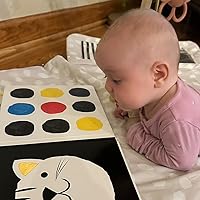
Simple but the high contrast images kept my little 3-month self engaged! I couldn’t stop staring at them (but I’m also partial to white images on a black background).
This is a great little board book for infants, who benefit from high-contrast images. The premise of the book is cute, but the text seems pretty lazy. Good thing the text isn’t important! The words means nothing to a one-month-old, but those pictures sure are fun for them to look at.
The illustrations are very cute with a lot of contrast for little ones. The text doesn't flow extremely well, but a variety of simple words are used. I wish the last page would have been a picture of a baby or a small mirror saying hello to baby.
Why does the duck get a "Quack Quack" greeting when all the other animals speak human languages like English, Spanish, or Mandarin? I expect more than nonsense like this from baby books.
This was one of the babe's first books. He seemed to enjoy looking at the black and white photos. We have used the book to fight the patriarchy by explaining that the greetings are never to be used for human women.
"Hello, baby bunny." No, only Ms. Bunny. "What's going on, zebra?" May have racial overtones. Best avoided. "What's up, chick?" NEVER "Hi, there, piggy." It doesn't matter how chubby someone is, Piggy is not an appropriate nickname. "Good to see you, baby elephant." Ditto here. "Quack, quack, baby duck." She will just think you are weird. "Ni hao, little panda!" Panda might not be Chinese. Don't make assumptions. "What's happening, pretty penguin?" I mean, just penguin would be weird, and the pretty makes it very condescending. Even if she is pretty, that's not the most important thing about her. "Hola, baby owl!" What? Is that because Hola and Hoo start with the same two letters? But they do not sound the same.
But all joking aside, this is a very cute book that we have enjoyed very much.
📖 Hello, Baby Animals: A High Contrast Book | By Duopress labs | Art by Julissa Mora
Mamá says: I realised only now that I have never read the actual words of this book to Eva. I simply use the black and white -and as the title suggests ‘high contrast’ images to read to her my own Spanish version. I make high pitch noises of what I think the animals sounds like (Does anyone know what a Panda sounds like?!) I’m sure the actual book is great though. Should we even be leaving this review though... - Eva says: This book is bold yet inconsistent. There’s a bit of english, chinese and spanish. Sometimes onomatopoeia (quack, quack) others just plain normal. Aside from the striking use of black and white, I’m really not learning that much.
So inconsistent it makes me crazy. Sometimes the baby animal name is used, sometimes the adult. Sometimes the animal sound is provided, sometimes not. Sometimes another language is used, sometimes not. If they were all baby animals and they each used a greeting in a different language, it'd be a 4 star book.
Sturdy pages and high contrast images make this book instantly suitable for the target audience. That the animals are baby animals makes being able to relate the animals to a very young child even easier (and I accept that this is larger, metanarrative point).
This one hands down my favorite book for the first 2-3 months of my life. I even tracked the pages when I was just a week or two old! I absolutely loved the last page with all the animals on it. I've leveled up to colourful books now so I don't read it too often.
Great contrast book that features a variety of animals. It even includes "ni hao" and "hola", which I think is great. My baby at 9 weeks enjoys this book.