

What do you think?

Lenny
"Lenny" is a science fiction short story by Isaac Asimov, originally published in the January 1958 issue of Infinity Science Fiction, and included in the collections The Rest of the Robots (1964), The Complete Robot (1982), and Robot Visions (1990).
16 pages, ebook
First published January 1, 1958
About the author
Isaac Asimov
4,430 books28.8k followersWorks of prolific Russian-American writer Isaac Asimov include popular explanations of scientific principles,
The Foundation Trilogy
(1951-1953), and other volumes of fiction.
Isaac Asimov, a professor of biochemistry, wrote as a highly successful author, best known for his books.
Asimov, professor, generally considered of all time, edited more than five hundred books and ninety thousand letters and postcards. He published in nine of the ten major categories of the Dewey decimal classification but lacked only an entry in the category of philosophy (100).
People widely considered Asimov, a master of the genre alongside Robert Anson Heinlein and Arthur Charles Clarke as the "big three" during his lifetime. He later tied Galactic Empire and the Robot into the same universe as his most famous series to create a unified "future history" for his stories much like those that Heinlein pioneered and Cordwainer Smith and Poul Anderson previously produced. He penned "Nightfall," voted in 1964 as the best short story of all time; many persons still honor this title. He also produced well mysteries, fantasy, and a great quantity of nonfiction. Asimov used Paul French, the pen name, for the Lucky Starr, series of juvenile novels.
Most books of Asimov in a historical way go as far back to a time with possible question or concept at its simplest stage. He often provides and mentions well nationalities, birth, and death dates for persons and etymologies and pronunciation guides for technical terms. Guide to Science, the tripartite set Understanding Physics, and Chronology of Science and Discovery exemplify these books.
Asimov, a long-time member, reluctantly served as vice president of Mensa international and described some members of that organization as "brain-proud and aggressive about their IQs." He took more pleasure as president of the humanist association. The asteroid 5020 Asimov, the magazine Asimov's Science Fiction, an elementary school in Brooklyn in New York, and two different awards honor his name.
http://en.wikipedia.org/wiki/Isaac_As...
Isaac Asimov, a professor of biochemistry, wrote as a highly successful author, best known for his books.
Asimov, professor, generally considered of all time, edited more than five hundred books and ninety thousand letters and postcards. He published in nine of the ten major categories of the Dewey decimal classification but lacked only an entry in the category of philosophy (100).
People widely considered Asimov, a master of the genre alongside Robert Anson Heinlein and Arthur Charles Clarke as the "big three" during his lifetime. He later tied Galactic Empire and the Robot into the same universe as his most famous series to create a unified "future history" for his stories much like those that Heinlein pioneered and Cordwainer Smith and Poul Anderson previously produced. He penned "Nightfall," voted in 1964 as the best short story of all time; many persons still honor this title. He also produced well mysteries, fantasy, and a great quantity of nonfiction. Asimov used Paul French, the pen name, for the Lucky Starr, series of juvenile novels.
Most books of Asimov in a historical way go as far back to a time with possible question or concept at its simplest stage. He often provides and mentions well nationalities, birth, and death dates for persons and etymologies and pronunciation guides for technical terms. Guide to Science, the tripartite set Understanding Physics, and Chronology of Science and Discovery exemplify these books.
Asimov, a long-time member, reluctantly served as vice president of Mensa international and described some members of that organization as "brain-proud and aggressive about their IQs." He took more pleasure as president of the humanist association. The asteroid 5020 Asimov, the magazine Asimov's Science Fiction, an elementary school in Brooklyn in New York, and two different awards honor his name.
http://en.wikipedia.org/wiki/Isaac_As...
Ratings & Reviews
Friends & Following
Create a free account to discover what your friends think of this book!
Community Reviews
Displaying 1 - 7 of 7 reviews
July 6, 2025
I do like the idea and overall the execution, yet I am left wanting more from the story in terms of depth

November 7, 2021
Collected in The Rest of the Robots, The Complete Robot and Robot Visions, this story can be read a here. A factory tourist accidentally reprograms the prototype LNE wiping its brain and making it the equivalent of a baby. After it is sent to Robopsychologist Susan Calvin for experimentation, she names it Lenny, discovering that Lenny's infantile robotic brain is capable of learning. All goes well until Lenny accidentally breaks the arm of a computer technician.
It is here that Susan goes into full blown mama bear mode, using her considerable intellect to "save" the closest thing to a child that she can ever have. It occurs to me that Asimov has quite a few short stories embodying parental (especially) maternal love - others in this vein include The Ugly Little Boy, First Law and The Deep. The most famous statement of this sentiment is this seminal line from Aliens.
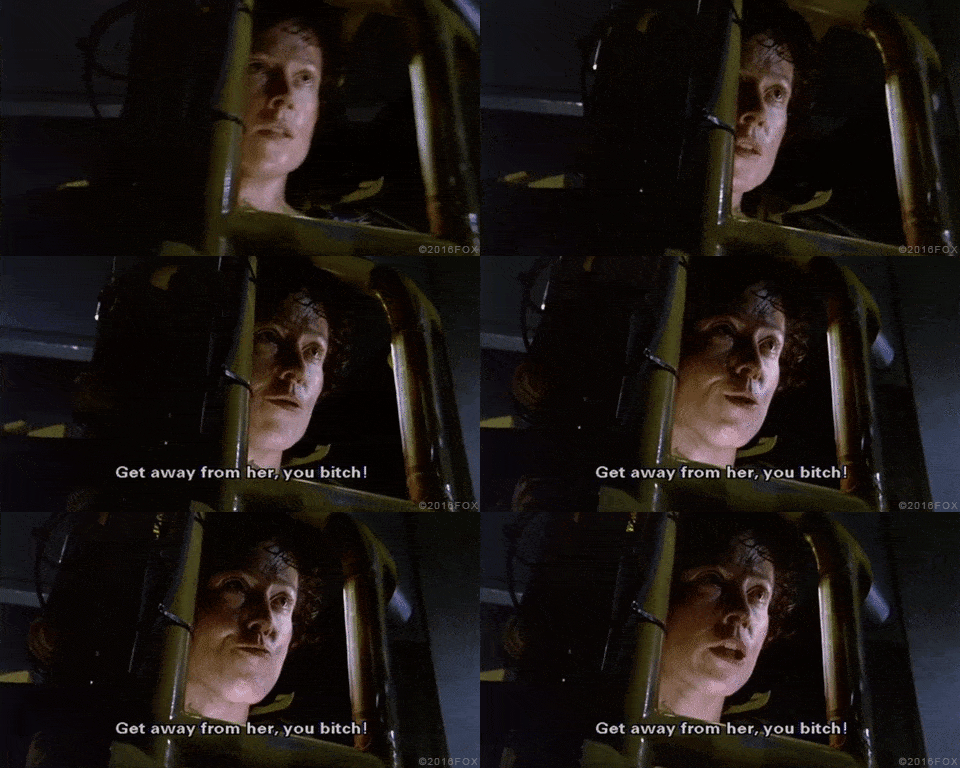
It is here that Susan goes into full blown mama bear mode, using her considerable intellect to "save" the closest thing to a child that she can ever have. It occurs to me that Asimov has quite a few short stories embodying parental (especially) maternal love - others in this vein include The Ugly Little Boy, First Law and The Deep. The most famous statement of this sentiment is this seminal line from Aliens.
This entire review has been hidden because of spoilers.

July 13, 2018
Lenny is one of the first stories that Asimov used to introduce the idea of machine learning. A robot that is literally turned into a baby that is practically adopted by a human psychologist, who decides to raise and teaches him like a she would a baby.
Now this whole plot is extremely fascinating, and it thickens towards then end in a very intersting way. However I do have one issue with it, and that is the fact that some random tourist was able to get ahold of the robot's main frame, wiping out its programming, and effectively turning it into a baby.
From the perspective of any software engineer, it's extremely unlikely that such a scenario is possible, especially given all the permissions needed to do just about anything on a computer.
Even a "rm -rf" requires a "sudo" leading to a password request.
Now this whole plot is extremely fascinating, and it thickens towards then end in a very intersting way. However I do have one issue with it, and that is the fact that some random tourist was able to get ahold of the robot's main frame, wiping out its programming, and effectively turning it into a baby.
From the perspective of any software engineer, it's extremely unlikely that such a scenario is possible, especially given all the permissions needed to do just about anything on a computer.
Even a "rm -rf" requires a "sudo" leading to a password request.

August 25, 2024
You can find this in
The Complete Robot
and
Robot Visions
.
Awwww . . .
. . . Susan Calvin becomes a mother.
Another good little story.
Next up is Galley Slave .
Awwww . . .
. . . Susan Calvin becomes a mother.
Another good little story.
Next up is Galley Slave .

June 23, 2019
Not too bad. There's surprisingly little actual conflict in this story. It kinda all just builds to a character moment for Susan Calvin. My favorite bit is before the end, when Susan gives her impassioned speech about "advertising the potential danger of working with robots".

November 17, 2025
4.5
An excellent
An excellent

August 27, 2022
Muy bonito cuento sobre un bebé robot quien una doctora psicóloga la única en la tierra se encarga de él.
Displaying 1 - 7 of 7 reviews