

What do you think?

Gossip from the Forest
A gripping reimagining of the drama, ego, intrigue, and madness at work during the World War I armistice negotiations
In November 1918, after four long years of murderous conflict, six men gather in a railroad car in a secluded forest outside Paris, France, to negotiate an end to World War I. A pacifist, left-leaning diplomat with no military knowledge or experience, Matthias Erzberger has been selected by the German high command to represent their surrendering nation, for reasons as baffling to him as to anyone. He is joined by France’s aging, vindictive Marshal Foch and Britain’s unbending Admiral Wemyss in an attempt to bring peace to a war-torn world. In these claustrophobic quarters the future is to be decided by men driven by ego, prejudice, fear, exhaustion, vengeance, delusion, and, in Erzberger’s case, conscience. But the well-meaning diplomat’s futile efforts to secure lenient surrender terms will have devastating consequences for Europe, the Fatherland, and Erzberger himself.
Renowned for his enthralling fictional accounts of historical events, award-winning author of Schindler’s List Thomas Keneally once again brings the heart-stopping human drama of history to life, as he brilliantly envisions the earth-shattering events that transpired in the forest of Compiègne, setting the stage for the Treaty of Versailles and the rise of the Third Reich.
In November 1918, after four long years of murderous conflict, six men gather in a railroad car in a secluded forest outside Paris, France, to negotiate an end to World War I. A pacifist, left-leaning diplomat with no military knowledge or experience, Matthias Erzberger has been selected by the German high command to represent their surrendering nation, for reasons as baffling to him as to anyone. He is joined by France’s aging, vindictive Marshal Foch and Britain’s unbending Admiral Wemyss in an attempt to bring peace to a war-torn world. In these claustrophobic quarters the future is to be decided by men driven by ego, prejudice, fear, exhaustion, vengeance, delusion, and, in Erzberger’s case, conscience. But the well-meaning diplomat’s futile efforts to secure lenient surrender terms will have devastating consequences for Europe, the Fatherland, and Erzberger himself.
Renowned for his enthralling fictional accounts of historical events, award-winning author of Schindler’s List Thomas Keneally once again brings the heart-stopping human drama of history to life, as he brilliantly envisions the earth-shattering events that transpired in the forest of Compiègne, setting the stage for the Treaty of Versailles and the rise of the Third Reich.
236 pages, Kindle Edition
First published January 1, 1975
About the author
Thomas Keneally
117 books1,376 followersThomas Michael Keneally, AO (born 7 October 1935) is an Australian novelist, playwright and author of non-fiction. He is best known for writing Schindler's Ark, the Booker Prize-winning novel of 1982, which was inspired by the efforts of Poldek Pfefferberg, a Holocaust survivor. The book would later be adapted to Steven Spielberg's Schindler's List (1993), which won the Academy Award for Best Picture.
Often published under the name Tom Keneally in Australia.
Life and Career:
Born in Sydney, Keneally was educated at St Patrick's College, Strathfield, where a writing prize was named after him. He entered St Patrick's Seminary, Manly to train as a Catholic priest but left before his ordination. He worked as a Sydney schoolteacher before his success as a novelist, and he was a lecturer at the University of New England (1968–70). He has also written screenplays, memoirs and non-fiction books.
Keneally was known as "Mick" until 1964 but began using the name Thomas when he started publishing, after advice from his publisher to use what was really his first name. He is most famous for his Schindler's Ark (1982) (later republished as Schindler's List), which won the Booker Prize and is the basis of the film Schindler's List (1993). Many of his novels are reworkings of historical material, although modern in their psychology and style.
Keneally has also acted in a handful of films. He had a small role in The Chant of Jimmie Blacksmith (based on his novel) and played Father Marshall in the Fred Schepisi movie, The Devil's Playground (1976) (not to be confused with a similarly-titled documentary by Lucy Walker about the Amish rite of passage called rumspringa).
In 1983, he was made an Officer of the Order of Australia (AO). He is an Australian Living Treasure.
He is a strong advocate of the Australian republic, meaning the severing of all ties with the British monarchy, and published a book on the subject in Our Republic (1993). Several of his Republican essays appear on the web site of the Australian Republican Movement.
Keneally is a keen supporter of rugby league football, in particular the Manly-Warringah Sea Eagles club of the NRL. He made an appearance in the rugby league drama film The Final Winter (2007).
In March 2009, the Prime Minister of Australia, Kevin Rudd, gave an autographed copy of Keneally's Lincoln biography to President Barack Obama as a state gift.
Most recently Thomas Keneally featured as a writer in the critically acclaimed Australian drama, Our Sunburnt Country.
Thomas Keneally's nephew Ben is married to the former NSW Premier, Kristina Keneally.
Often published under the name Tom Keneally in Australia.
Life and Career:
Born in Sydney, Keneally was educated at St Patrick's College, Strathfield, where a writing prize was named after him. He entered St Patrick's Seminary, Manly to train as a Catholic priest but left before his ordination. He worked as a Sydney schoolteacher before his success as a novelist, and he was a lecturer at the University of New England (1968–70). He has also written screenplays, memoirs and non-fiction books.
Keneally was known as "Mick" until 1964 but began using the name Thomas when he started publishing, after advice from his publisher to use what was really his first name. He is most famous for his Schindler's Ark (1982) (later republished as Schindler's List), which won the Booker Prize and is the basis of the film Schindler's List (1993). Many of his novels are reworkings of historical material, although modern in their psychology and style.
Keneally has also acted in a handful of films. He had a small role in The Chant of Jimmie Blacksmith (based on his novel) and played Father Marshall in the Fred Schepisi movie, The Devil's Playground (1976) (not to be confused with a similarly-titled documentary by Lucy Walker about the Amish rite of passage called rumspringa).
In 1983, he was made an Officer of the Order of Australia (AO). He is an Australian Living Treasure.
He is a strong advocate of the Australian republic, meaning the severing of all ties with the British monarchy, and published a book on the subject in Our Republic (1993). Several of his Republican essays appear on the web site of the Australian Republican Movement.
Keneally is a keen supporter of rugby league football, in particular the Manly-Warringah Sea Eagles club of the NRL. He made an appearance in the rugby league drama film The Final Winter (2007).
In March 2009, the Prime Minister of Australia, Kevin Rudd, gave an autographed copy of Keneally's Lincoln biography to President Barack Obama as a state gift.
Most recently Thomas Keneally featured as a writer in the critically acclaimed Australian drama, Our Sunburnt Country.
Thomas Keneally's nephew Ben is married to the former NSW Premier, Kristina Keneally.
Ratings & Reviews
Friends & Following
Create a free account to discover what your friends think of this book!
Community Reviews
Displaying 1 - 30 of 42 reviews

September 26, 2018
This book was shortlisted for the 1975 Booker prize and could be seen as a sort of companion piece or precursor for Keneally's Booker winner Schindler's Ark. Both are historical fiction in which the fiction serves mainly to fill in gaps in the historical record and to understand the motives of the protagonists.
The events in this book occurred almost exactly 100 years ago, so I have no doubt that we will hear much more about them over the next few days.
Its protagonists are the negotiators that signed the Armistice agreement that ended the Great War, and Keneally attempts to get inside their heads and describe the processes and understand the constraints that drove them.
The largely powerless chief German plenipotentiary Matthias Erzberger is the most convincingly realised character (much more three dimensional than the imposing Marshal Foch), and emerges as something of a tragic hero. The narrative switches between the various parties frequently and the chaotic nature of events particularly in Germany is powerfully portrayed.
It is impossible to read this book, particularly the details of the punitive demands on Germany, without the hindsight of knowing what came next.
The events in this book occurred almost exactly 100 years ago, so I have no doubt that we will hear much more about them over the next few days.
Its protagonists are the negotiators that signed the Armistice agreement that ended the Great War, and Keneally attempts to get inside their heads and describe the processes and understand the constraints that drove them.
The largely powerless chief German plenipotentiary Matthias Erzberger is the most convincingly realised character (much more three dimensional than the imposing Marshal Foch), and emerges as something of a tragic hero. The narrative switches between the various parties frequently and the chaotic nature of events particularly in Germany is powerfully portrayed.
It is impossible to read this book, particularly the details of the punitive demands on Germany, without the hindsight of knowing what came next.

December 14, 2018
I read this book as part of the 2019 Mookse Madness tournament.
The book is an imagined account of the signing of the Armisitice which ended the Great War on 11th November 1918. I have read many excellent books in 2014 on the events leading up to the outbreak of that war – not least Christopher Clark’s “The Sleepwalkers”, most of which – but have not found any books this year on the Armistice, so it was a pleasant surprise to come across this non-fictional treatment.
The book concentrates on a retelling of the signing itself – and those that signed the deal. Written in the third person there are really three main point of view protagonists, the main one being Matthias Erzberger, the whose civilian politician lead of the German delegation, under final instructions and authority from the newly appointed Social Democrat Chancellor Ebert, was shortly after distorted into the “stab-in-the back” idea that was tragically for human history the foundational myth of Nazi-ism.
The others are the British admiral Wemyss and the French General (and Allied Supreme Commander) Foch.
Erzberger struggles with the fore-knowledge that he will be blamed and hated for his role in the armistice (unpopular already with Conservative politicians due to his criticism of German colonial misdeeds in Africa. Ultimately he signs the terms while protesting at their unreasonableness and urging his government to push for urgent peace negotiations, with the crucial inclusion of the Americans and Wilson’s Fourteen Points.
Wemyss’s main determination is that the French will not concede Britain’s unequivocal naval terms. As the interactions progress he tries to understand if the Germans are bluffing over the threat of Bolshevism and starvation due to overly harsh terms.
Foch is presented unsympathetically as a rigid and unbending, Napoleonic character, sure of his Catholic faith, military doctrine and the justice of the terms – and of the weight of destiny behind the events: when both French politicians and the German delegates panic that the rapidly changing and deteriorating political circumstances in Germany mean that those delegates no longer have any authority, Foch is unwavering in his belief that the Armistice can and will be signed.
Both the English and French reject the, in their view, naïve level of balance in Wilson’s Fourteen Points, as being inappropriate to the devastation and death caused by the German hostilities and the reality of their military defeat. In one of my favourite lines:
At the mention of that remote platonist of the prairies, a film fell on the eyes of the French generals and British admirals. They looked like man who has been unexpectedly reminder that at the age of fourteen they had learned physics or history from a scholarly man of endearing naïvety.
I found this a powerful, enlightening and entertaining book – achieving a great synthesis of factual accuracy and fictional imagining.
Some closing comments:
One of my fellow Mookse and Gripes forum members has commented that everyone (authors as well as forum members who are champions of books) assume that their book/favourite was a narrow runner up in the Booker.
Interestingly this is the only book that can genuinely lay claim to the title of Booker runner-up, as it was part of the shortest every shortlist in Booker history.
I found it interesting that the events in this Book lead by a tragedy of history to those in the author’s more famous and Booker prize winning book.
Some criticisms: I also found the opening Epigraph a rather gratuitous dig at the French and a possible explanation of the apparent skew in the book against that nation; I found the opening of the book weak with too many portentous dreams.
The book is an imagined account of the signing of the Armisitice which ended the Great War on 11th November 1918. I have read many excellent books in 2014 on the events leading up to the outbreak of that war – not least Christopher Clark’s “The Sleepwalkers”, most of which – but have not found any books this year on the Armistice, so it was a pleasant surprise to come across this non-fictional treatment.
The book concentrates on a retelling of the signing itself – and those that signed the deal. Written in the third person there are really three main point of view protagonists, the main one being Matthias Erzberger, the whose civilian politician lead of the German delegation, under final instructions and authority from the newly appointed Social Democrat Chancellor Ebert, was shortly after distorted into the “stab-in-the back” idea that was tragically for human history the foundational myth of Nazi-ism.
The others are the British admiral Wemyss and the French General (and Allied Supreme Commander) Foch.
Erzberger struggles with the fore-knowledge that he will be blamed and hated for his role in the armistice (unpopular already with Conservative politicians due to his criticism of German colonial misdeeds in Africa. Ultimately he signs the terms while protesting at their unreasonableness and urging his government to push for urgent peace negotiations, with the crucial inclusion of the Americans and Wilson’s Fourteen Points.
Wemyss’s main determination is that the French will not concede Britain’s unequivocal naval terms. As the interactions progress he tries to understand if the Germans are bluffing over the threat of Bolshevism and starvation due to overly harsh terms.
Foch is presented unsympathetically as a rigid and unbending, Napoleonic character, sure of his Catholic faith, military doctrine and the justice of the terms – and of the weight of destiny behind the events: when both French politicians and the German delegates panic that the rapidly changing and deteriorating political circumstances in Germany mean that those delegates no longer have any authority, Foch is unwavering in his belief that the Armistice can and will be signed.
Both the English and French reject the, in their view, naïve level of balance in Wilson’s Fourteen Points, as being inappropriate to the devastation and death caused by the German hostilities and the reality of their military defeat. In one of my favourite lines:
At the mention of that remote platonist of the prairies, a film fell on the eyes of the French generals and British admirals. They looked like man who has been unexpectedly reminder that at the age of fourteen they had learned physics or history from a scholarly man of endearing naïvety.
I found this a powerful, enlightening and entertaining book – achieving a great synthesis of factual accuracy and fictional imagining.
Some closing comments:
One of my fellow Mookse and Gripes forum members has commented that everyone (authors as well as forum members who are champions of books) assume that their book/favourite was a narrow runner up in the Booker.
Interestingly this is the only book that can genuinely lay claim to the title of Booker runner-up, as it was part of the shortest every shortlist in Booker history.
I found it interesting that the events in this Book lead by a tragedy of history to those in the author’s more famous and Booker prize winning book.
Some criticisms: I also found the opening Epigraph a rather gratuitous dig at the French and a possible explanation of the apparent skew in the book against that nation; I found the opening of the book weak with too many portentous dreams.

December 12, 2015
A vivid re-imagining of the WW1 Armistice negotiations
I’ve not read “Shindler’s List”, but Keneally is one of those writers you feel you ought to read. I must admit I did find this difficult to get into with opening dream sequences, but once the book got going and you got used to Keneally’s style the book flows reasonably well.
The story is told via play-like dialogue as Keneally details the backgrounds of the main protagonists whilst examining their motives. The book is well researched and is an engaging work that provides albeit fictional insight into what the respective delegations were thinking in that railway siding at Compiegne.
Not a brilliant work, but fascinating nonetheless.
I received this book for free from the publisher in exchange for an honest review. This does not affect my opinion of the book or the content of my review.
I’ve not read “Shindler’s List”, but Keneally is one of those writers you feel you ought to read. I must admit I did find this difficult to get into with opening dream sequences, but once the book got going and you got used to Keneally’s style the book flows reasonably well.
The story is told via play-like dialogue as Keneally details the backgrounds of the main protagonists whilst examining their motives. The book is well researched and is an engaging work that provides albeit fictional insight into what the respective delegations were thinking in that railway siding at Compiegne.
Not a brilliant work, but fascinating nonetheless.
I received this book for free from the publisher in exchange for an honest review. This does not affect my opinion of the book or the content of my review.

April 30, 2020
"..though it took millions of men to fight a war, a few car-loads of delegates can end it"
In the momentousness of history, it is easy to forget that the people who are immortalized in it's annals are, just people. What would be the circumstances, beliefs, motivations, environment and emotions of these men who are negotiating peace and armistice? The depth to the proceeding is not a common aspect of war fiction.
The First world war is about to end and to begin the process, a group of delegates from the Allies and a group from Germany meet in a forest railway car in Nov 1918 to negotiate the terms of Armistice. Both sides are battle wearied and the changing political environment back in Germany (to the rise of Bolshevism and the Soviet block) causes confusion.
It is about the momentous journey, meeting and what happened since. Keneally is one of the best to handle this kind of stories which are human. And he makes it readable through short chapters, 'gossips' and episodes that exhibit more about the 6 men than the war. The entire negotiation in-fact is a max of 2 chapters (10 pages) of the entire book while the disillusionment runs pages. Till they arrive at the railway coach, their journey is a compelling understanding of the motives of the people.
On the one side, we see the friction between the French and the British on the same side of the table. The mannerisms of the Marshal Foch and his belief system stands out as the most powerful person in the room. As victors, the almost brutal terms spelled out are a lesson in negotiation.
On the other side is a bourgeois diplomat Erzberger along with a defeated army General and an almost unstable ex-Count who have been made into an ad-hoc team to sign up on the terms of the armistice. With no real power and a changing political environment back home - you feel for their predicament. A lot of question is asked on Erzberger's position to negotiate on behalf of the 'republic'. Armed with only personal decency and a sense of doom - the party has an uphill task of negotiating the harsher terms without even being sure they are still authorized to sign on behalf of their country.
A very palatable piece of history, which, gifted with hindsight, predicted what was to come.
In the momentousness of history, it is easy to forget that the people who are immortalized in it's annals are, just people. What would be the circumstances, beliefs, motivations, environment and emotions of these men who are negotiating peace and armistice? The depth to the proceeding is not a common aspect of war fiction.
The First world war is about to end and to begin the process, a group of delegates from the Allies and a group from Germany meet in a forest railway car in Nov 1918 to negotiate the terms of Armistice. Both sides are battle wearied and the changing political environment back in Germany (to the rise of Bolshevism and the Soviet block) causes confusion.
It is about the momentous journey, meeting and what happened since. Keneally is one of the best to handle this kind of stories which are human. And he makes it readable through short chapters, 'gossips' and episodes that exhibit more about the 6 men than the war. The entire negotiation in-fact is a max of 2 chapters (10 pages) of the entire book while the disillusionment runs pages. Till they arrive at the railway coach, their journey is a compelling understanding of the motives of the people.
On the one side, we see the friction between the French and the British on the same side of the table. The mannerisms of the Marshal Foch and his belief system stands out as the most powerful person in the room. As victors, the almost brutal terms spelled out are a lesson in negotiation.
On the other side is a bourgeois diplomat Erzberger along with a defeated army General and an almost unstable ex-Count who have been made into an ad-hoc team to sign up on the terms of the armistice. With no real power and a changing political environment back home - you feel for their predicament. A lot of question is asked on Erzberger's position to negotiate on behalf of the 'republic'. Armed with only personal decency and a sense of doom - the party has an uphill task of negotiating the harsher terms without even being sure they are still authorized to sign on behalf of their country.
A very palatable piece of history, which, gifted with hindsight, predicted what was to come.

June 20, 2017
The GR description of this book is excellent. At the beginning, there seemed to be a lot of conjecture - Keneally describes the dreams of two of the participants. But this is good historical fiction, based in fact. What true historical fiction usually does better than nonfiction is characterization. Because fiction can present the people with dialog, sometimes with thought processes, they become flesh and blood in a way that nonfiction does not often do.
This is the story of the negotiation of the Armistice rather than of the Peace. When I was a child, November 11 was called Armistice Day. I decided to go look to see when it was changed - Eisenhower changed it to Veterans' Day in 1954. Because the Armistice happened in the 11th hour of the 11th day of the 11th month, it seemed as if it was planned in advance. It was not. The Allies - French and English only - met with the Germans to present their demands on Nov 8, and gave the Germans 72 hours to accept or reject the proposal. As the Germans were delayed in arriving, the Armistice might well have happened on November 10. In that case, it surely would not have felt as if it had almost been pre-destined.
I knew a little of this story, but very little. As much as I've read of this war, I did not realize that the German people were headed for starvation, nor that the German army was in a state of revolt. Somehow I missed that it was in the middle the negotiations for the Armistice that the Kaiser abdicated, as did other kings and monarchs in the other countries of the Central Powers. Germany was crumbling from within. I do not know much about the aftermath in Germany, other than the terrible inflation. It isn't difficult to see how the end of the war left a vacuum of leadership which made an easy path for Hitler's rise to power.
Keneally is always good, so it's hard not to like this. Still, I think one has to have a compelling interest in all things about The Great War to take the time for it. I do. Despite my beginning skepticism, this became a strong 4-star read for me.
This is the story of the negotiation of the Armistice rather than of the Peace. When I was a child, November 11 was called Armistice Day. I decided to go look to see when it was changed - Eisenhower changed it to Veterans' Day in 1954. Because the Armistice happened in the 11th hour of the 11th day of the 11th month, it seemed as if it was planned in advance. It was not. The Allies - French and English only - met with the Germans to present their demands on Nov 8, and gave the Germans 72 hours to accept or reject the proposal. As the Germans were delayed in arriving, the Armistice might well have happened on November 10. In that case, it surely would not have felt as if it had almost been pre-destined.
I knew a little of this story, but very little. As much as I've read of this war, I did not realize that the German people were headed for starvation, nor that the German army was in a state of revolt. Somehow I missed that it was in the middle the negotiations for the Armistice that the Kaiser abdicated, as did other kings and monarchs in the other countries of the Central Powers. Germany was crumbling from within. I do not know much about the aftermath in Germany, other than the terrible inflation. It isn't difficult to see how the end of the war left a vacuum of leadership which made an easy path for Hitler's rise to power.
Keneally is always good, so it's hard not to like this. Still, I think one has to have a compelling interest in all things about The Great War to take the time for it. I do. Despite my beginning skepticism, this became a strong 4-star read for me.

December 6, 2015
Disclaimer: Arc via Netgalley.
Thomas Keneally is most famously known, at least outside of his homeland, for his novel Schindler’s List. This is re-issue by Open Road Media is a Keneally novel set in another World War I.
Keneally focuses Petain and Matthias Erzberger as they journey to history and the Treaty of Versailles. He reminds that not only are the men human but that perhaps history has been unfair to them. For if anything, Erzberger comes across as the better man.
The title of the book comes from the style, for the story is relayed in an almost chatty tone with little asides. The central characters themselves are more focused, in some cases, on their personal lives. There is an also a disturbing trend of how some of the characters think about war. The Second World War also hovers overheard, and nowhere is this more haunting than in Keneally’s portrayal of Petain – who comes across as almost dislikable.
Yet, there is something about the novel that is cold. It is an anti-war novel, an anti revenge novel, retreading in some degree the conclusion about the treaty. It is powerful, but slightly off putting.
Thomas Keneally is most famously known, at least outside of his homeland, for his novel Schindler’s List. This is re-issue by Open Road Media is a Keneally novel set in another World War I.
Keneally focuses Petain and Matthias Erzberger as they journey to history and the Treaty of Versailles. He reminds that not only are the men human but that perhaps history has been unfair to them. For if anything, Erzberger comes across as the better man.
The title of the book comes from the style, for the story is relayed in an almost chatty tone with little asides. The central characters themselves are more focused, in some cases, on their personal lives. There is an also a disturbing trend of how some of the characters think about war. The Second World War also hovers overheard, and nowhere is this more haunting than in Keneally’s portrayal of Petain – who comes across as almost dislikable.
Yet, there is something about the novel that is cold. It is an anti-war novel, an anti revenge novel, retreading in some degree the conclusion about the treaty. It is powerful, but slightly off putting.

December 3, 2016
An interesting idea for a work of fiction, Gossip from the Forest is a historical novel about the end of WWI's combat in November 1918. Thomas Keneally turns this narrow slice of time into a story without a great deal of elaboration, but clearly has fun along the way.
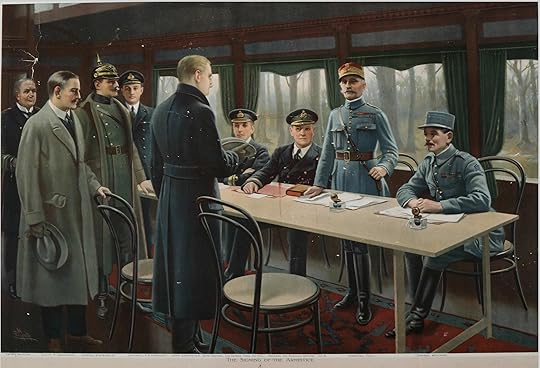
We follow two negotiating teams to a railway car in Compiègne. The Allies, dominated by French Generalissimo Foch, are in triumph, armed with ferocious terms for ending fighting. The Central Powers - well, Germany - are a rag-tag group including a politician, a self-hating naval officer, a continuously drunk count, and a useless general. Keneally probes each character through dialog, flashbacks, and dreams, bringing forth their unique natures and approaches to the Great War's finale. The first half of the book is about the teams assembling and traveling to the famous railroad car, while the second covers the negotiations there.
The delegations' leading members are probably the most interesting. Matthias Erzberger appears as both very competent and good at improvisation, while also being terrified and far out of his depth. He is frequently afraid of being shot, a fine premonition of his fate, after the novel's events. Ferdinand Foch begins the novel and broods over the negotiations, a man obsessed with concepts and sleep, utterly confident of his powers almost to the point of unreason.
Gossip from the Forest is fine fodder for students of WWI. We see the once-domineering German empire starting to crack, as workers form soviets, the Kaiser quits, and, most astonishing of all, soldiers question orders. We receive glimpses of the war's terrible costs, from German mass starvation to the ruin of northeastern France and the shell-shocked nature of the surviving troops. The German Revolution begins.
Alas, this doesn't work too well as a novel. Conflicts arise but, thanks to history, don't proceed very far. The Germans are defeated, long for honor, and are swiftly let down into the abyss without much chance of doing anything about it. It's a socially limited book, as don't engage with soldiers, keeping the novel largely to the top of society, and women barely appear. Too much of the book is nonfiction with a layer of dialog.
However, the dialog is fun, as are many of Keneally's pithy asides.
And this micro-story:
For WWI aficionados, a pleasant four stars. For the general reader, three by the end.
We follow two negotiating teams to a railway car in Compiègne. The Allies, dominated by French Generalissimo Foch, are in triumph, armed with ferocious terms for ending fighting. The Central Powers - well, Germany - are a rag-tag group including a politician, a self-hating naval officer, a continuously drunk count, and a useless general. Keneally probes each character through dialog, flashbacks, and dreams, bringing forth their unique natures and approaches to the Great War's finale. The first half of the book is about the teams assembling and traveling to the famous railroad car, while the second covers the negotiations there.
The delegations' leading members are probably the most interesting. Matthias Erzberger appears as both very competent and good at improvisation, while also being terrified and far out of his depth. He is frequently afraid of being shot, a fine premonition of his fate, after the novel's events. Ferdinand Foch begins the novel and broods over the negotiations, a man obsessed with concepts and sleep, utterly confident of his powers almost to the point of unreason.
Gossip from the Forest is fine fodder for students of WWI. We see the once-domineering German empire starting to crack, as workers form soviets, the Kaiser quits, and, most astonishing of all, soldiers question orders. We receive glimpses of the war's terrible costs, from German mass starvation to the ruin of northeastern France and the shell-shocked nature of the surviving troops. The German Revolution begins.
Alas, this doesn't work too well as a novel. Conflicts arise but, thanks to history, don't proceed very far. The Germans are defeated, long for honor, and are swiftly let down into the abyss without much chance of doing anything about it. It's a socially limited book, as don't engage with soldiers, keeping the novel largely to the top of society, and women barely appear. Too much of the book is nonfiction with a layer of dialog.
However, the dialog is fun, as are many of Keneally's pithy asides.
[I]t was insufferable to think that in such a little space, round a table no bigger than a family dinner table, with note paper and pencils, it was possible for eight men to weave a scab over that pit of corpses four years deep. (2704)
The Marshal stood still, his legs together, his precognitive passion all at once folded away as neatly as a beetle's wings. (1479)
The Kaiser, who a week ago had been an evocation of the sun, yet today was just a comic train traveler. (3249)
And this micro-story:
His name was Prince Max of Baden and his nickname was Max-Pax. Within three weeks he caught severe influenza, took too much sleeping draught and did not wake again until Turkey had surrendered and Austria sought an armistice. His ruinous reawakening made him prejudiced against sleep. (353)
For WWI aficionados, a pleasant four stars. For the general reader, three by the end.

July 12, 2010
It's a fictional presentation of the peace talks that took place in the forest of Compiègne in November 1918. It's written from the point of view of the German negotiator, Mattias Erzberger, a liberal pacifist. Keneally is managing so, to make us aware of the human face of war. The men involved in the peace talks were pitifully human.
Interesting true fact; In November 1918 the Engineer in charge of the North Region Railways: Arthur-Pierre Toubeau, was instructed to find a suitably discreet place which would accommodate two trains. By coincidence on the outskirts of Compiègne in the forest of Rethondes lay an artillery railway emplacement. Set deep within the wood and out of the view of the masses the location was ideal.
Early in the morning of the 8th November a train carrying Maréchal Ferdinand Foch, his staff and British officers arrived on the siding to the right, nearest the museum. The train formed a mobile headquarters for Foch, complete with a restaurant car and office.
At 0700 hours another train arrived on the left hand track. One of the carriages had been built for Napoleon III and still bore his coat of arms. Inside was a delegation from the German government seeking an armistice.
There were only a hundred metres between the two trains and the entire area was policed by gendarmes placed every 20 metres.
For three days the two parties discussed the terms of an armistice until at 0530 hours on the 11th November 1918, Matthias Erzberger the leader of the German delegation signed the Armistice document.
Within 6 hours the war would be over.
Initially the carriage (Wagon Lits Company car No. 2419D) used by Maréchal Foch was returned to its former duty as a restaurant car but was eventually placed in the courtyard of the Invalides in Paris.
there is a photograph of the carriage here;
http://www.flickr.com/photos/mark_vog...
Interesting true fact; In November 1918 the Engineer in charge of the North Region Railways: Arthur-Pierre Toubeau, was instructed to find a suitably discreet place which would accommodate two trains. By coincidence on the outskirts of Compiègne in the forest of Rethondes lay an artillery railway emplacement. Set deep within the wood and out of the view of the masses the location was ideal.
Early in the morning of the 8th November a train carrying Maréchal Ferdinand Foch, his staff and British officers arrived on the siding to the right, nearest the museum. The train formed a mobile headquarters for Foch, complete with a restaurant car and office.
At 0700 hours another train arrived on the left hand track. One of the carriages had been built for Napoleon III and still bore his coat of arms. Inside was a delegation from the German government seeking an armistice.
There were only a hundred metres between the two trains and the entire area was policed by gendarmes placed every 20 metres.
For three days the two parties discussed the terms of an armistice until at 0530 hours on the 11th November 1918, Matthias Erzberger the leader of the German delegation signed the Armistice document.
Within 6 hours the war would be over.
Initially the carriage (Wagon Lits Company car No. 2419D) used by Maréchal Foch was returned to its former duty as a restaurant car but was eventually placed in the courtyard of the Invalides in Paris.
there is a photograph of the carriage here;
http://www.flickr.com/photos/mark_vog...

February 24, 2019
Struggled to keep the characters straight between the vans, vons, etc. Sometimes they are referred to by their military post which made it even harder.
June 23, 2026
This was an interesting book to read in barely two sittings as I make my way through Proust: The Guermamtes Way. Thomas Keneally of course came to much attention as the author of the very moving Schindler’s List. Gossip from the Forrest is, relatively speaking much shorter and lighter, but deals with an aspect of the Armistice in November 1918 which I hadn’t considered before.
The main focus is the meeting of the deputies from the allies, including British Admiral Weymus and French Marshall Foch and those chosen by a chaotic, losing German side in the now famous railway siding in Compiegne Forest. The book is based on the actual events but with much imagined dialogue and some back history of the participants: ‘peasant’ politician Matthias Erzberger, who knows it’s a poisoned chalice, effete aristocratic cavalry office Count Maiberling, stern General von Winterfeldt and a weepy ineffectual sailor Captain Vanselow. The Germans had an impossible task, trying to limit the damage to civilians in the aftermath of steep war reparations which were demanded by the Allies, however they had no choice but to agree the terms of an immediate ceasefire and armistice ahead of peace negotiations. Unfortunately the agreement was derided by the Nazi party as they came to power in the 1920s and 30s and was used to stir up civilian agitation and subsequent remilitarisation of the country again citing the results of the meeting to have been unacceptably harsh and punitive.
Overall an imaginative and captivating book.
The main focus is the meeting of the deputies from the allies, including British Admiral Weymus and French Marshall Foch and those chosen by a chaotic, losing German side in the now famous railway siding in Compiegne Forest. The book is based on the actual events but with much imagined dialogue and some back history of the participants: ‘peasant’ politician Matthias Erzberger, who knows it’s a poisoned chalice, effete aristocratic cavalry office Count Maiberling, stern General von Winterfeldt and a weepy ineffectual sailor Captain Vanselow. The Germans had an impossible task, trying to limit the damage to civilians in the aftermath of steep war reparations which were demanded by the Allies, however they had no choice but to agree the terms of an immediate ceasefire and armistice ahead of peace negotiations. Unfortunately the agreement was derided by the Nazi party as they came to power in the 1920s and 30s and was used to stir up civilian agitation and subsequent remilitarisation of the country again citing the results of the meeting to have been unacceptably harsh and punitive.
Overall an imaginative and captivating book.
February 28, 2024
It was work to read this book: challenging vocabulary, dialogue in the form of a play script, character names and titles used interchangeably… but well worth the effort! Whatever Armistice Day meant to me before this book (and to most Americans living today), it was vastly under-valued and misunderstood.
I cried for those eight men who sat around the table in that forest, trying “to weave a scab over that pit of corpses four years deep”. And still the world goes on with war.
I cried for those eight men who sat around the table in that forest, trying “to weave a scab over that pit of corpses four years deep”. And still the world goes on with war.

December 18, 2024
i liked the historical focus, and did have to google quite a bit so wahoo for learning. i liked the dialogue format more in theory than in practice tho? as it turned out every character had quite a complex backstory, and i don’t really think it fully came out in the dialogue format

January 25, 2023
I am not, I have decided, a big fan of historical fiction, especially war related. That said, I like this author but found this a bit of a drag. Shortlist 1975.

March 23, 2013
This is a book - a faction or fictitious history if you will - about the group of men brought together to sign the Armistice at the end of the First World War, from two railway carriages parked in an artillery siding in the midst of a forest somewhere in northern France. Like all Keneally's books it is well researched. This one tells it's story by play-like dialogue. Keneally examines the motives behind the statecraft and the personal attitudes and behaviour of the delegates on both sides - from the arrogant Marshall Foch to the rapidly thrown together German delegates led by Erzeberger. Its basically Keneally's views on what amounted to a set of vituperative and the crippling terms put forth by the Allies to which Germany HAD to sign to gain the Armistice as Germany at home fell apart and the Kaiser was forced to abdicate changing the state from a sort-of monarchy to a republic with strong left wing leanings. Its written with a lot of short (sometimes very short) chapters which all haved to end with a little punch or quip (pathetic!) which is probbably meant to get us going "Ughh Ohhhhhhh!!" in expectation for the next chapter.
It's decently written in the usual Keneally manner. It does keep you turning the pages so his chapter-length trickery and tele-serial style would appear to work. But at the end of it I was left somewhat underwhelmed. Like going for a meal and getting served up a snack. There is also always this sense with his books that he set out to write an airport blockbuster - one of those gaudy coloured, always embossed-cover pieces of pulp trash that appear to be devoured by all, loved by publishers (hmmmmmmmm moneymoneymoney)and rapidly thrown away by many - but got sidetracked into wanting to write something half decent. I have read a couple of his books in quick succession (enough to know I don't really want to read another by him for a while). There is the sense of a populist trying to escape his intellectual pretensions. He always manages to get in some sordid little coitus somewhere throughout each of his books as if he expects his readers to be titillated by this. And then there is this feeling of always being short-changed by his books.
I think you can safely say that he can write a decent scene and a page-turner but don't expect to be intellectually challenged. In this one the starkest passage of writing is given by the Count telling Erzeberger about how his mad brother stabbed and murdered his sister in the nursery, and how his mother and father saw so little of them, as opposed to Erzeberger, the provincial politician and bourgeois growing up in the bosom of the familly. Even given how stark this small section is, it really is pretty lightweight and like someone shining a searchlight on emotion rather than the quality of writing that casts light but makes the reader make all the connections.
Contrast this - Keneally's writing and Booker nominations (gawd hasn't that prize been devalued) - with his fellow Australian and Nobel laureate Patrick White's descriptions of the interactions between Hurtle Duffield, his stepmother and his crippled stepsister in 'The Vivisector'. THAT , is pure writing.
OK maybe its just me - maybe I wanted too much. But I'll certainly give the rest of his oeuvre a rest though.
It's decently written in the usual Keneally manner. It does keep you turning the pages so his chapter-length trickery and tele-serial style would appear to work. But at the end of it I was left somewhat underwhelmed. Like going for a meal and getting served up a snack. There is also always this sense with his books that he set out to write an airport blockbuster - one of those gaudy coloured, always embossed-cover pieces of pulp trash that appear to be devoured by all, loved by publishers (hmmmmmmmm moneymoneymoney)and rapidly thrown away by many - but got sidetracked into wanting to write something half decent. I have read a couple of his books in quick succession (enough to know I don't really want to read another by him for a while). There is the sense of a populist trying to escape his intellectual pretensions. He always manages to get in some sordid little coitus somewhere throughout each of his books as if he expects his readers to be titillated by this. And then there is this feeling of always being short-changed by his books.
I think you can safely say that he can write a decent scene and a page-turner but don't expect to be intellectually challenged. In this one the starkest passage of writing is given by the Count telling Erzeberger about how his mad brother stabbed and murdered his sister in the nursery, and how his mother and father saw so little of them, as opposed to Erzeberger, the provincial politician and bourgeois growing up in the bosom of the familly. Even given how stark this small section is, it really is pretty lightweight and like someone shining a searchlight on emotion rather than the quality of writing that casts light but makes the reader make all the connections.
Contrast this - Keneally's writing and Booker nominations (gawd hasn't that prize been devalued) - with his fellow Australian and Nobel laureate Patrick White's descriptions of the interactions between Hurtle Duffield, his stepmother and his crippled stepsister in 'The Vivisector'. THAT , is pure writing.
OK maybe its just me - maybe I wanted too much. But I'll certainly give the rest of his oeuvre a rest though.

November 19, 2018
I enjoyed this historical novel of WWI. The armistice was signed exactly 100 years ago this month and this was an interesting way to learn about the representatives from different countries who met in a train car. Special emphasis was given to Marshal Foch from France and Erzberger from Germany, about whom I previously knew nothing. I have several more historical novels from that time period that I am looking forward to reading soon.

September 29, 2023
This mainly factual novel gives a very good insight into the signing of the Armistice at the end of World War 1.
The worries of the German signatories come through very strongly. So strongly that the novel almost makes me believe that Hitler could have been right about one thing – that Germany may not have been totally losing but was betrayed by certain of its leaders. Clearly the signatories were very worried that German troops might want to assassinate them if they realised what was happening. It also made even clearer to me how Germany was collapsing from within and so many German towns were becoming “soviets”. The novel makes clear that it was particularly the impact of the actions of the Communists (German, not Russian) that made German defeat inevitable, so that is why I have said it “almost” makes me believe Hitler could have been right, rather than that I do believe it to be so. Hitler did also claim that it was the Communists that caused the downfall of Germany at the end of the First World War, and this novel really emphasizes that point.
The cold-bloodedness of the Allied signatories, especially Marshall Fochs, really comes through too. They knew the conditions they were imposing would result in many innocent deaths through starvation, but when this was pointed out to them by the Germans their response was simply to point out that the Germans had been responsible for many innocent deaths and therefore had no right to complain. My reaction on reading all this detail was that two wrongs don’t make a right, and the Allies were completely immoral to push the terms in the way they did. We know now that the unfair treatment of the Germans at the ending of the First World War paved the way for the Second World War, but I had tended to focus on the “unfairness” rather than the far more important “cold-blooded callousness and indifference to civilian deaths”, which Keneally brings out in this novel.
I didn’t particularly enjoy the pace of the novel, which I think could have been much improved with more descriptive writing, and perhaps greater development of some of the characters, but I did enjoy the true historical elements and the way in which this novel has made me understand far better that enormously important historical event.
The worries of the German signatories come through very strongly. So strongly that the novel almost makes me believe that Hitler could have been right about one thing – that Germany may not have been totally losing but was betrayed by certain of its leaders. Clearly the signatories were very worried that German troops might want to assassinate them if they realised what was happening. It also made even clearer to me how Germany was collapsing from within and so many German towns were becoming “soviets”. The novel makes clear that it was particularly the impact of the actions of the Communists (German, not Russian) that made German defeat inevitable, so that is why I have said it “almost” makes me believe Hitler could have been right, rather than that I do believe it to be so. Hitler did also claim that it was the Communists that caused the downfall of Germany at the end of the First World War, and this novel really emphasizes that point.
The cold-bloodedness of the Allied signatories, especially Marshall Fochs, really comes through too. They knew the conditions they were imposing would result in many innocent deaths through starvation, but when this was pointed out to them by the Germans their response was simply to point out that the Germans had been responsible for many innocent deaths and therefore had no right to complain. My reaction on reading all this detail was that two wrongs don’t make a right, and the Allies were completely immoral to push the terms in the way they did. We know now that the unfair treatment of the Germans at the ending of the First World War paved the way for the Second World War, but I had tended to focus on the “unfairness” rather than the far more important “cold-blooded callousness and indifference to civilian deaths”, which Keneally brings out in this novel.
I didn’t particularly enjoy the pace of the novel, which I think could have been much improved with more descriptive writing, and perhaps greater development of some of the characters, but I did enjoy the true historical elements and the way in which this novel has made me understand far better that enormously important historical event.

December 25, 2018
Fascinating, gripping - exactly the sort of novel I love to read, fiction and non-fiction combined, and executed in great style by the author.
Keneally is best known for the later Schindler's Ark and this too combines history and imagination with the characters examined in the intense, pressured atmosphere of railway carriage 2417D in a French forest where they are drawing up the Armistice to end the fighting of the World War One.
It does not quite have the remarkable depth of detail of Schindler, winner of the 1982 Booker Prize, but the intensity of the situation similarly drives the plot and fractures the carapaces of these war-hardened veterans. One breaks open to reveal the terrible secret of the urbane aristocract Maiberling whereas there's a sad inevitability hanging over Matthias Erzberger.
The story, inevitably in the circumstances, is stronger than the depth of character portrayal, although one gets a sense of the French hauteur in Marshal Foch that discomfits our good old British chap, First Sea Lord Rosy Wemyss.
Not a great novel, therefore, but a greatly enjoyable one - one that because of a crusty old poet I might have missed in this long trawl through all the Booker Prize short-listed titles.
Susan Hill, one of the judges in 1975, wrote in The Guardian how her colleague on the panel, Roy Fuller, was rather crabby about the whole affair. He argued that the judges all preferred Ruth Prawer Jhabvala's Heat and Dust and refused at first to short-list any others, before reluctantly admitting just this one.
Looking back, some of the judges' decisions amaze me, including their preference for Jhabvala. What other more worthy winners were excluded in 1975?
Keneally is best known for the later Schindler's Ark and this too combines history and imagination with the characters examined in the intense, pressured atmosphere of railway carriage 2417D in a French forest where they are drawing up the Armistice to end the fighting of the World War One.
It does not quite have the remarkable depth of detail of Schindler, winner of the 1982 Booker Prize, but the intensity of the situation similarly drives the plot and fractures the carapaces of these war-hardened veterans. One breaks open to reveal the terrible secret of the urbane aristocract Maiberling whereas there's a sad inevitability hanging over Matthias Erzberger.
The story, inevitably in the circumstances, is stronger than the depth of character portrayal, although one gets a sense of the French hauteur in Marshal Foch that discomfits our good old British chap, First Sea Lord Rosy Wemyss.
Not a great novel, therefore, but a greatly enjoyable one - one that because of a crusty old poet I might have missed in this long trawl through all the Booker Prize short-listed titles.
Susan Hill, one of the judges in 1975, wrote in The Guardian how her colleague on the panel, Roy Fuller, was rather crabby about the whole affair. He argued that the judges all preferred Ruth Prawer Jhabvala's Heat and Dust and refused at first to short-list any others, before reluctantly admitting just this one.
Looking back, some of the judges' decisions amaze me, including their preference for Jhabvala. What other more worthy winners were excluded in 1975?

June 20, 2024
A historical fiction, character based novel of the armistice negotiations that took place in the Forest of Compiegne in November 1918, mainly about the highest ranking German negotiator, Matthias Erberger, a liberal pacifist. Erberger’s job is to mitigate the punishing terms offered by the Allies. Supporting Erberger is a defeated army General and an unstable ex-Count. Their position is further complicated with the fall of the Kaiser and being unsure whether they are still authorized to sign on behalf of the country.
On the other side are the French and British with Marshal Foch being the person with the strongest held views around the table.
An interesting novel about the personalities and the pressures of the time to reach an agreement in a railway carriage in the forest.
This book was shortlisted for the 1975 Booker Prize.
On the other side are the French and British with Marshal Foch being the person with the strongest held views around the table.
An interesting novel about the personalities and the pressures of the time to reach an agreement in a railway carriage in the forest.
This book was shortlisted for the 1975 Booker Prize.

September 7, 2023
Because I felt I'd read enough books about WWII I wanted to read one about WWI and because I liked Shindler's List I chose another book by Thomas Keneally. It took me two years to find it in a used book store so it's okay that it took me 2 years to start it and almost another year to finish it. That may be why it was hard for me to keep track of who represented which country.
The armistice was signed at 5am on 11/11/2018 to become active at 11am. Even after it was sent, and received, thousands more soldiers died.
Interesting quote: "It was insufferable to think that in such a little space, round a table no bigger than a family dinner table, with note paper and pencils, it was possible for eight men to weave a scab over that pit of corpses four years deep."
The armistice was signed at 5am on 11/11/2018 to become active at 11am. Even after it was sent, and received, thousands more soldiers died.
Interesting quote: "It was insufferable to think that in such a little space, round a table no bigger than a family dinner table, with note paper and pencils, it was possible for eight men to weave a scab over that pit of corpses four years deep."

February 4, 2024
This story about the signing of the armistice to end WWI gets into the heads of the men involved. While the author explores the mindsets of the French, English, and German participants, more attention is given to the German dignitaries and their struggle in wartime Germany. It is well written, but the story just did not keep me engaged. No enthrallment, and perhaps this should be expected when one side is dictating terms to the other side. Thus, there is not much to be engrossed with at the negotiating table. The struggle to show up and then communicate to a failing government becomes the more stimulating part of the story.
July 2, 2026
This was dry and hard to read. The first section read like a play missing stage direction. Although I was grateful for the play style of identifying who was talking to distinguish people it was simultaneously confusing since he identified people by first or last name or rank indescriminantly. Later we get some story and background of some of the people not really adding depth to the story but at least more engaging. Knowing the broad strokes of the history, the ending was the best part which provided interesting factual information that was interesting.
I didn't find this gripping at all and would not recommend it unless maybe to a history buff.
I didn't find this gripping at all and would not recommend it unless maybe to a history buff.
January 11, 2018
Perhaps the French got what they deserved in taking such a hard line in the 1918 armistice discussions? In not conceding the Germans any leeway, the seeds were sown for the next war in just twenty years time. The soon to end war is a background theme; the writer concentrates more on the individual prejudices each delegate brings to the discussions. Very readable.

July 13, 2020
A fictional history of the German surrender of World War I. Told, mostly, through the eyes of Matthias Erzberger a German representative who was given the duty to accept whatever terms the Allied imposed while hoping to negotiate some mercy from them. Although this was a fictional retelling by Keneally I believe it was actually very factual.

July 18, 2025
I’m baffled by Keanelly, I’ve seen him being interviewed on Australian TV, the man came across as a simpleton - he stated that mateship (friendship among males in Australia) is like no other in the World (I mean, really!?).
Glad to report that his writing reflects a beautiful intellectual range, this particular work deals with the signing of the ending of WW1, have to confess that my knowledge of the period is very sketchy. No problems Mr. Keanelly manages to set the background and context mastery.
I will definitely pick another novel by this simpleton complex writer 5/5
Glad to report that his writing reflects a beautiful intellectual range, this particular work deals with the signing of the ending of WW1, have to confess that my knowledge of the period is very sketchy. No problems Mr. Keanelly manages to set the background and context mastery.
I will definitely pick another novel by this simpleton complex writer 5/5
November 7, 2019
An informed, considered and well written book
I really enjoyed reading this novel. As always in Keneally's work the characters are very well drawn adding to the storyline. The atmosphere in the forest and in the train carriages reflects the mood of the events taking place.
I really enjoyed reading this novel. As always in Keneally's work the characters are very well drawn adding to the storyline. The atmosphere in the forest and in the train carriages reflects the mood of the events taking place.
June 26, 2026
Read this for a book club otherwise would never been on my radar. The first part of the book was very difficult read. It was difficult to keep track of the characters as the author interchangeably used their first name or last name or rank. There was an assumption that the reader has some basic understanding of history of WWI. Given that none of the names gave any hint to nationalities it was very hard. The story was terse and really just boring. I was not invested at all. The second half of the book was more interesting and gave back stories to the major players. The way the author would intermittently use the play format also was bothersome.

August 20, 2026
This is a really interesting look at the armistice agreement to end WW1. I was hooked
December 13, 2016
Disappointing. Slow and offered few real insights into the ending of the war
This entire review has been hidden because of spoilers.

July 30, 2021
An interesting idea for a historical novel, which joins the German WWI diplomatic mission immediately before ceasefire. This ragtag band feels under pressure from every direction, and the petty squabbling and mood swings take on special significance with the dramatic irony we hold as readers who know the fated results of the final outcome at Versailles.
Keneally delights in detail, and Gossip in the Forest foreshadows the wartime poignancy of his best-known work, Schindler's Ark. The atmosphere of the sodden November forests permeates this book and makes for a heavier read, but one that is deeply rooted in historical fact, and makes me want to forge deeper beyond the known landmarks of interwar history to understand the German experience, and wider international relations.
Keneally delights in detail, and Gossip in the Forest foreshadows the wartime poignancy of his best-known work, Schindler's Ark. The atmosphere of the sodden November forests permeates this book and makes for a heavier read, but one that is deeply rooted in historical fact, and makes me want to forge deeper beyond the known landmarks of interwar history to understand the German experience, and wider international relations.

April 22, 2014
Having seen Thomas 'Fenian' Keneally interviewed on TV many years ago,after the publication of a novel about Irish politics, & hearing his chippy Australian tones denigrating Great Britain & all who sail under her colours(me included!), I have avoided reading his controversial work - until now. This imaginative historical novel from 1975 is a masterpiece of a 'reconstruction' of the thoughts & feelings of the disparate men - no women, or nurses, here! - who came together in a railway carriage in the forest clearing near Compiegne in November 1918 to 'negotiate' an armistice (though, in reality, the beaten Germans had to accept a humiliating & justified 'diktat'). I visited this site in the 1990s to learn that the carriage itself had been burned by the Germans in 1940, on the orders of Hitler,having witnessed as its final act, the humiliating surrender of the French (again!)in the debacle of the summer of 1940, & Hitler's so-called dance of delight (he had a lovely smile!?).
Revenge indeed for the German national disaster of the First World War. Keneally features the doddery French Marshal Foch, the stiff British admiral Wemyss - no idealistic democratic American 'Johnny Come Latelys' here! - arrayed against the civilian 'powers' of Mathias Enzberger & his compatriot military & diplomatic non-entities, who are hastily delegated by an out-going government, with the onerous task of taking the Allied poison without complaint, with Germany in imminent danger of revolution & civil war!
Keneally handles the tensions & personality clashes with skill & artistry, throwing bright light into murky corners of our knowledge of the precarious shifting tides of the final days of the Great War.As a student of history, I found his insights & speculations both stimulating & informative.The reader is almost obliged to accept that such momentous events as the November Armistice are often,at the time, seen to be a walk in a forest of dark shadows & fleeting ghosts on a path leading to utter oblivion.The protagonists somehow muddle through to a resolution, leaving them rootless & without further purpose, happy to retire to the pages of History - where Keneally found them almost mummified by time.He gives them back their voices & their place in a moving story of peace bloodily won, a generation of young men lost for ever. Brilliant.
Revenge indeed for the German national disaster of the First World War. Keneally features the doddery French Marshal Foch, the stiff British admiral Wemyss - no idealistic democratic American 'Johnny Come Latelys' here! - arrayed against the civilian 'powers' of Mathias Enzberger & his compatriot military & diplomatic non-entities, who are hastily delegated by an out-going government, with the onerous task of taking the Allied poison without complaint, with Germany in imminent danger of revolution & civil war!
Keneally handles the tensions & personality clashes with skill & artistry, throwing bright light into murky corners of our knowledge of the precarious shifting tides of the final days of the Great War.As a student of history, I found his insights & speculations both stimulating & informative.The reader is almost obliged to accept that such momentous events as the November Armistice are often,at the time, seen to be a walk in a forest of dark shadows & fleeting ghosts on a path leading to utter oblivion.The protagonists somehow muddle through to a resolution, leaving them rootless & without further purpose, happy to retire to the pages of History - where Keneally found them almost mummified by time.He gives them back their voices & their place in a moving story of peace bloodily won, a generation of young men lost for ever. Brilliant.
Displaying 1 - 30 of 42 reviews