

What do you think?

Echoes From Afar
A powerful story of love and loss from internationally bestselling author Tamara McKinley.
So this is Paris, she thought in awe. Spread out before her beneath a clear blue sky, it was like a precious gift after the smog and filth of London. No wonder it was called the city of love . . .
After a spiteful rumour ruins her career in London, Annabelle Blake must travel to Paris to start afresh. There she makes the acquaintance of Etienne and Henri - one a poet, the other a painter - both charming, talented and handsome. They spend their days flirting and drinking with the city's artistes and Bohemians, and soon Annabelle too is swept up in the exotic and exhilarating world of 1930s Paris. But as ever more young people are drawn to the fight against Fascism in Spain, Annabelle must wake from the dream and confront the reality of war. A lifetime later, gifted artist Eugenie Ashton falls in love with Paris the moment she sets foot outside the Gare de Lyon. Like her mother Annabelle before her, the artistic delights of the city are a bright new world to her: but Eugenie will soon find that in its shadows are hidden the secrets of her family's past.
So this is Paris, she thought in awe. Spread out before her beneath a clear blue sky, it was like a precious gift after the smog and filth of London. No wonder it was called the city of love . . .
After a spiteful rumour ruins her career in London, Annabelle Blake must travel to Paris to start afresh. There she makes the acquaintance of Etienne and Henri - one a poet, the other a painter - both charming, talented and handsome. They spend their days flirting and drinking with the city's artistes and Bohemians, and soon Annabelle too is swept up in the exotic and exhilarating world of 1930s Paris. But as ever more young people are drawn to the fight against Fascism in Spain, Annabelle must wake from the dream and confront the reality of war. A lifetime later, gifted artist Eugenie Ashton falls in love with Paris the moment she sets foot outside the Gare de Lyon. Like her mother Annabelle before her, the artistic delights of the city are a bright new world to her: but Eugenie will soon find that in its shadows are hidden the secrets of her family's past.
450 pages, Paperback
First published September 3, 2015
About the author
Tamara McKinley
65 books138 followersTAMARA MCKINLEY was born in Launceston, Tasmania, and was forced to come to England with her grandmother to finish her education at an all girls’ boarding school in Sussex. Her childhood experiences and the enduring memories of her amazing grandmother and two extraordinary great-aunts, form the back-bone of her novels which are coloured with the red, green and gold of her beloved Australia.
Having raised her three children in the Eastbourne area she started to write psychological thrillers before returning to her roots in the form of Australian family sagas set against the backdrop of the outback pioneers. She is now household name in Germany where her books go straight into the bestsellers' list with each title selling around 4 million copies. Her books are also popular in Scandinavia, especially Sweden where her first saga, Matilda's Last Waltz was voted the booksellers novel of the year. In her homeland of Australia she is considered by many to be "Britain's Best Kept Secret".
Her eight Aussie sagas to date are published in at least 15 different languages and can be found worldwide.
Tamara now lives and writes on the south coast of England but travels to her homeland every year to promote her work, carry out research and visit her eldest son and her two grandsons.
Psychological Thrillers: Reap the Whirlwind and Queens Flight (Hodder & Stoughton)
Family Sagas: Matilda's Last Waltz (2000), Jacaranda Vines (2001), Windflowers (2002), Summer Lightning (2003), Undercurrents (2004) and Dreamscapes (2005) (Piatkus Books)
Lands Beyond the Sea, the first book of her Oceana trilogy, has been published in hardback and paperback by Hodder Stoughton. A Kingdom For The Brave, the second in the trilogy, was published in hardback in the UK on 6th March 2008.
Having raised her three children in the Eastbourne area she started to write psychological thrillers before returning to her roots in the form of Australian family sagas set against the backdrop of the outback pioneers. She is now household name in Germany where her books go straight into the bestsellers' list with each title selling around 4 million copies. Her books are also popular in Scandinavia, especially Sweden where her first saga, Matilda's Last Waltz was voted the booksellers novel of the year. In her homeland of Australia she is considered by many to be "Britain's Best Kept Secret".
Her eight Aussie sagas to date are published in at least 15 different languages and can be found worldwide.
Tamara now lives and writes on the south coast of England but travels to her homeland every year to promote her work, carry out research and visit her eldest son and her two grandsons.
Psychological Thrillers: Reap the Whirlwind and Queens Flight (Hodder & Stoughton)
Family Sagas: Matilda's Last Waltz (2000), Jacaranda Vines (2001), Windflowers (2002), Summer Lightning (2003), Undercurrents (2004) and Dreamscapes (2005) (Piatkus Books)
Lands Beyond the Sea, the first book of her Oceana trilogy, has been published in hardback and paperback by Hodder Stoughton. A Kingdom For The Brave, the second in the trilogy, was published in hardback in the UK on 6th March 2008.
Ratings & Reviews
Friends & Following
Create a free account to discover what your friends think of this book!
Community Reviews
Displaying 1 - 30 of 58 reviews

November 21, 2016
Matilda’s Last Waltz that I read back many, many years ago is still one of favourite books and one that I recommend to new readers of Tamara McKinley and since then Tamara is still an automatic read for me although for me, none of her following books have reached that height – in saying that I still enjoy her books. I loved the main character Annabellé story and the descriptions of The Spanish Civil War were compelling and atmospheric. The only thing that let the book down a star or two for me was how the story just fell into place and you could see that happening before you got there. People found each other easily along the way and the secrets that came out weren’t as shocking as you would expect them to be. But still a great read with captivating characters and a book that will go on my Tamara McKinley shelf for sure……

June 2, 2023
4,25 sterren- Nederlandse paperback
Quote: eenmaal weer in de trein gingen veel passagiers terug naar hun coupé, maar Annabelle was veel te opgewonden om nog te kunnen slapen. Ze wilde niets missen van dit bijzondere avontuur en wist in de lounge een plekje bij het raam te bemachtigen. Dikke rookwolken borden uit de pijp vsn de locomotief, de grote ijzeren wielen zetten zich in beweging en Annabelle kerk nieuwsgierig naar het Franse landschap dat aan haar voorbijtrok.
Quote: " Ik ben de Pyreneeën overgestoken, ik heb in een grot geslapen, ik heb voor het eerst van mijn leven op een paard gezeten en het laatste stuk heb ik afgelegd in een roestige oude vrachtwagen. Dus ik kan wel wat hebben. Uitrusten komt later wel."
Een heel goed, tijdslijnvast verhaal. Jammer dat er een stuk uitvalt in de verhaallijn, de tijd van Annabelle en George en Henri in de tweede wereldoorlog wat zeker mede oorzaak is van het einde van het verhaal. Dit is eigenlijk een trilogie, een géén een boek. Dit is de reden dat ik het geen vijf sterren heb gegeven terwijl het verhaal zelf wel 5 sterren verdiend.
Quote: eenmaal weer in de trein gingen veel passagiers terug naar hun coupé, maar Annabelle was veel te opgewonden om nog te kunnen slapen. Ze wilde niets missen van dit bijzondere avontuur en wist in de lounge een plekje bij het raam te bemachtigen. Dikke rookwolken borden uit de pijp vsn de locomotief, de grote ijzeren wielen zetten zich in beweging en Annabelle kerk nieuwsgierig naar het Franse landschap dat aan haar voorbijtrok.
Quote: " Ik ben de Pyreneeën overgestoken, ik heb in een grot geslapen, ik heb voor het eerst van mijn leven op een paard gezeten en het laatste stuk heb ik afgelegd in een roestige oude vrachtwagen. Dus ik kan wel wat hebben. Uitrusten komt later wel."
Een heel goed, tijdslijnvast verhaal. Jammer dat er een stuk uitvalt in de verhaallijn, de tijd van Annabelle en George en Henri in de tweede wereldoorlog wat zeker mede oorzaak is van het einde van het verhaal. Dit is eigenlijk een trilogie, een géén een boek. Dit is de reden dat ik het geen vijf sterren heb gegeven terwijl het verhaal zelf wel 5 sterren verdiend.

December 28, 2016
Kde inde sa zamilovať, ak nie v meste lásky - v Paríži? Presne v tomto romantickom meste, konkrétne na moste Pont Neuf, sa zamiloval Henri do Annabelle a Annabelle do Henriho.
Mladý, talentovaný Henri je maliar, ktorý spolu so svojim priateľom, začínajúcim úspešným básnikom Etiennom, žijú pravým bujarým životom v bohémskom meste Francúzska. Mladíci si užívajú život plnými dúškami, kým im cestu neskríži mladá, krásna Angličanka. Zvyšok recenzie je tu: http://kokina1.blogspot.sk/2016/12/mo...
Mladý, talentovaný Henri je maliar, ktorý spolu so svojim priateľom, začínajúcim úspešným básnikom Etiennom, žijú pravým bujarým životom v bohémskom meste Francúzska. Mladíci si užívajú život plnými dúškami, kým im cestu neskríži mladá, krásna Angličanka. Zvyšok recenzie je tu: http://kokina1.blogspot.sk/2016/12/mo...

September 28, 2016
SWEDISH REVIEW
Min kära mor och jag har haft en konversation angående denna bok. Det är så att hon gillade den och jag hade svårt för den. Saker som jag fann irriterade störde hon sig inte alls på. I vanliga fall brukar vi tycka väldigt lika när det gäller böcker, men denna bok är vi väldigt oeniga om. Nu är det även så att detta är den första Tamara McKinley bok jag har läst medan hon har läst flertalet och hon gillar dem skarpt. Jag är egentligen inte så mycket för historiska romantiska böcker, jag föredrar historiska romaner utan smäktande romantik (självklart finns det undantagsfall, jag älskar t.ex. Borta med Vinden och Törnfåglarna).
Nå, vad är det med denna denna som gjorde att jag hade svårt att finna den läsvärd? Jag hade hoppas på en intressant bok med två parallella handlingar men tyvärr var varken 1930 talets eller 50-talets berättelser speciellt intressant. Jag var även besviken att det spanska inbördeskriget hade en så liten del med handlingarna att göra och att så mycket hände i periferin som t.ex. Etienne och Henri umbäranden under andra världskriget. Jag var även en aning frustrerad över Annabelle som absolut inte hade tänkt sig åka till Spanien som sjuksköterska och sedan när hon blev kär (plus en motgång i arbetsfrågan) helt plötsligt beslutade sig för att det var en strålande idé. Kort sagt, boken handlingen var på tok för smäktande och sentimental för min smak. Krigen kändes blodlösa och kändes som en parentes i boken. Det värsta var nog hur förutsägbar handlingen var. det är som om författaren hade en mall med klicheer som hon utgick efter och prickade av längs vägen. På plussiden så var boken världigt snabbläst och jag klämde den på en dag.
Men, det här är mina åsikter, jag är oerhört svår när det gäller historiska romantiska romaner, jag föredrar när det är ett spännande mysterium med som t.ex. med Kate Mortons böcker. Men om du gillar smäktande böcker så är nog denna en bok helt i din smak!
Tack till Forum bokförlag för recensionsexemplaret!
ENGLISH REVIEW
My dear mother and I have had a conversation about this book. The thing is that she liked it and I could not see what was so great about it. Things that I found irritating disturbed her not at all. Normally, we tend to think very much alike when it comes to books, but this book, we are very divided about. Now it is also true that this is the first Tamara McKinley book I read while she has read most and she likes them a lot. I'm not so much for historical romantic books, I prefer historical novels without languishing romance (of course, there are exceptional circumstances, such as I love Gone with the Wind and The Thorn Birds).
Well, what is it about this that made it hard for me to find it worth reading? I was hoping for an interesting book with two parallel stories, but unfortunately, neither the 1930s or 50ths stories were especially interesting. I was also disappointed that the Spanish Civil War had such a small part in the book and that so much happened in the periphery, such as Etienne and Henri's hardships during World War II. I was also a little frustrated that Annabelle who absolutely did not intend to go to Spain as a nurse and then when she fell in love (plus had a job setback) suddenly decided that it was a brilliant idea. In short, the book was too languishing and sentimental for my taste. The Wars felt bloodless and like a parenthesis in the book. The worst was probably the predictability of the plot. It was as if the author had a list with clichés that she unchecked along the way. On the plus side was the book very easy to read and it only took me one day to finish it!
However, these are my opinions, I am extremely difficult when it comes to historical romance novels, I prefer when it's an exciting mystery with such Kate Morton's books. If you like languorous books is this probably a book entirely to your taste!
Thanks to Forum bokförlag for the review copy!
Min kära mor och jag har haft en konversation angående denna bok. Det är så att hon gillade den och jag hade svårt för den. Saker som jag fann irriterade störde hon sig inte alls på. I vanliga fall brukar vi tycka väldigt lika när det gäller böcker, men denna bok är vi väldigt oeniga om. Nu är det även så att detta är den första Tamara McKinley bok jag har läst medan hon har läst flertalet och hon gillar dem skarpt. Jag är egentligen inte så mycket för historiska romantiska böcker, jag föredrar historiska romaner utan smäktande romantik (självklart finns det undantagsfall, jag älskar t.ex. Borta med Vinden och Törnfåglarna).
Nå, vad är det med denna denna som gjorde att jag hade svårt att finna den läsvärd? Jag hade hoppas på en intressant bok med två parallella handlingar men tyvärr var varken 1930 talets eller 50-talets berättelser speciellt intressant. Jag var även besviken att det spanska inbördeskriget hade en så liten del med handlingarna att göra och att så mycket hände i periferin som t.ex. Etienne och Henri umbäranden under andra världskriget. Jag var även en aning frustrerad över Annabelle som absolut inte hade tänkt sig åka till Spanien som sjuksköterska och sedan när hon blev kär (plus en motgång i arbetsfrågan) helt plötsligt beslutade sig för att det var en strålande idé. Kort sagt, boken handlingen var på tok för smäktande och sentimental för min smak. Krigen kändes blodlösa och kändes som en parentes i boken. Det värsta var nog hur förutsägbar handlingen var. det är som om författaren hade en mall med klicheer som hon utgick efter och prickade av längs vägen. På plussiden så var boken världigt snabbläst och jag klämde den på en dag.
Men, det här är mina åsikter, jag är oerhört svår när det gäller historiska romantiska romaner, jag föredrar när det är ett spännande mysterium med som t.ex. med Kate Mortons böcker. Men om du gillar smäktande böcker så är nog denna en bok helt i din smak!
Tack till Forum bokförlag för recensionsexemplaret!
ENGLISH REVIEW
My dear mother and I have had a conversation about this book. The thing is that she liked it and I could not see what was so great about it. Things that I found irritating disturbed her not at all. Normally, we tend to think very much alike when it comes to books, but this book, we are very divided about. Now it is also true that this is the first Tamara McKinley book I read while she has read most and she likes them a lot. I'm not so much for historical romantic books, I prefer historical novels without languishing romance (of course, there are exceptional circumstances, such as I love Gone with the Wind and The Thorn Birds).
Well, what is it about this that made it hard for me to find it worth reading? I was hoping for an interesting book with two parallel stories, but unfortunately, neither the 1930s or 50ths stories were especially interesting. I was also disappointed that the Spanish Civil War had such a small part in the book and that so much happened in the periphery, such as Etienne and Henri's hardships during World War II. I was also a little frustrated that Annabelle who absolutely did not intend to go to Spain as a nurse and then when she fell in love (plus had a job setback) suddenly decided that it was a brilliant idea. In short, the book was too languishing and sentimental for my taste. The Wars felt bloodless and like a parenthesis in the book. The worst was probably the predictability of the plot. It was as if the author had a list with clichés that she unchecked along the way. On the plus side was the book very easy to read and it only took me one day to finish it!
However, these are my opinions, I am extremely difficult when it comes to historical romance novels, I prefer when it's an exciting mystery with such Kate Morton's books. If you like languorous books is this probably a book entirely to your taste!
Thanks to Forum bokförlag for the review copy!

January 18, 2016
This review was originally posted on [Between My Lines]1930s... Paris...a swoony looking cover. Hell yes, this blog tour for Echoes from Afar by Tamara McKinley was one I HAD to join! I came for the setting and delighted in the atmospheric writing and the engaging characters.
First Line of Echoes from Afar by Tamara McKinley:
My Thoughts on Echoes from Afar by Tamara McKinley:
Echoes from Afar has a romantic, bittersweet storyline. From the moment we meet Annabelle, we get the sense of just what a genuinely nice girl she is. She is hard working, wants to make a difference via her nursing work but is also realistically scared at what she might face in a war zone.
She drew the short straw when it comes to her father and thanks to his meddling, her nursing career is effectively finished in England. So she sets off to Paris to live with her aunt. I felt exactly like I was setting off on a scary adventure as I set sail with her. I felt all her anticipation and trepidation at what was ahead.
Her aunt Aline thankfully is a lot more caring and affection than her parents were. And I loved spending time with this artistic, loving and vivacious woman. And we also meet Henri. But knowing that the war is just ahead of them all, you know that there is going to be horror and confusion ahead and this story plays out in a poignant, unsettling way.
Definitely a book to get swept away in and I absolutely loved it. I soaked up the colour and energy of Paris, I trembled at the dangers in civil war Spain, my heart beat faster over the romance and ached for all they had to endure.
Who should read Echoes from Afar by Tamara McKinley?
I’d recommend this to you if you enjoy historical dramas, pre-war/war settings and a romance that you can’t stop thinking about.
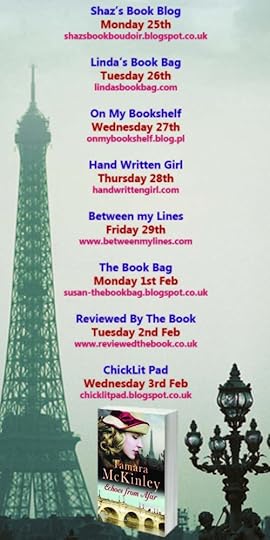
Thanks to Quercus books for giving me a copy of this book in exchange for an honest, unbiased review. And why not check out some of the other tour stops for this book, all are listed in the graphic below.
First Line of Echoes from Afar by Tamara McKinley:
“Despite the passing of the years, he’d hoped that by some miracle he would see her there once more, so that when she finally appeared, he wondered if it was the sheer force of his longing that had somehow conjured her up.”
My Thoughts on Echoes from Afar by Tamara McKinley:
Echoes from Afar has a romantic, bittersweet storyline. From the moment we meet Annabelle, we get the sense of just what a genuinely nice girl she is. She is hard working, wants to make a difference via her nursing work but is also realistically scared at what she might face in a war zone.
She drew the short straw when it comes to her father and thanks to his meddling, her nursing career is effectively finished in England. So she sets off to Paris to live with her aunt. I felt exactly like I was setting off on a scary adventure as I set sail with her. I felt all her anticipation and trepidation at what was ahead.
Her aunt Aline thankfully is a lot more caring and affection than her parents were. And I loved spending time with this artistic, loving and vivacious woman. And we also meet Henri. But knowing that the war is just ahead of them all, you know that there is going to be horror and confusion ahead and this story plays out in a poignant, unsettling way.
Definitely a book to get swept away in and I absolutely loved it. I soaked up the colour and energy of Paris, I trembled at the dangers in civil war Spain, my heart beat faster over the romance and ached for all they had to endure.
Who should read Echoes from Afar by Tamara McKinley?
I’d recommend this to you if you enjoy historical dramas, pre-war/war settings and a romance that you can’t stop thinking about.
Thanks to Quercus books for giving me a copy of this book in exchange for an honest, unbiased review. And why not check out some of the other tour stops for this book, all are listed in the graphic below.

January 16, 2016
Despite having written more than 12 novels Tamara McKinley is yet again another new author for me but when the press release says 'certainly on a par with Lesley Pearse' that has me sitting up and taking notice. Lesley, alongside Lucinda Riley, is my favourite author and I have devoured everything she has written so to say I had high expectations would be an understatement. I always love discovering a new historical fiction author and especially one who is in the same vein as an author whom you already love so much. So when Echoes from Afar came through the door I was more than excited.
For me the cover alone hit the nail on the head. There is an air of mystery about the woman and I was intrigued to learn more of her story in the exotic and exhilarating world of Paris in the 1930's. Also for once (not that I don't like this aspect featuring in books in this genre) the book wasn't set during World War Two so we are given a different viewpoint of the city of love before the horrors of war came knocking at the door for the Parisian citizens. Instead the Spanish Civil War does feature heavily for a section but these chapters were brilliantly written and tied in very well with the overall story line. This story focuses on two women a mother and daughter who find themselves in Paris twenty years apart. The daughter Eugenie has won a scholarship to study art for a year. But as she retraces her mother's footsteps is she about to uncover more than she bargained for or are secrets there to remain a mystery for the very reason they were created in the first place?
Echoes from Afar opens with a beguiling prologue of a man in Paris in 1956. He spots a woman on a bridge as he is gazing from his window. A woman he believes he recognises but can it really be who he thinks it is? Chapter one takes us back in time to London 1936, Anabelle Blake is at a crossroads in her life. She has been dismissed from the hospital she was nursing in and living in a run-down apartment with little money for food or clothes. Five years previously she had been banished from her home by her brute of a father and so has no one to turn to. That is until she meets her mother whom she hasn't had the best of relationships with. Her mother reveals a few surprising home truths and with a cash injection from Camille, Anabelle finds herself making her way to Paris to begin a new life with her art and culture loving Aunt Aline. Anabelle finds the city a contrast to everything she has known but soon falls in love with the cobbled streets, the sights, the sounds and the famous buildings and galleries. The house her Aline lives in is full of artists, poets, writers and musicians and is alive day and night. It is eclectic and homely, a sanctuary for all. Aline is a free spirit, serene and calm and she begins to rub off on Anabelle. But Anabelle is determined to work and continue on with her nursing. But will her lack of French hospital terminology let her down?
Henri and Etienne are friends since they were toddlers and come from the Basque region of France. They now live in Paris and are a struggling artist and a moderately successful poet. They encounter Anabelle upon a bridge and for Henri a connection is instantly established, one which will grow and develop and last for a long time. It was evident for the reader to see that Henri and Anabelle had this spark that ignited upon first sight. Their love, respect and passion for each other oozed from the pages. But you did wonder with the Spanish Civil War raging on could this love last as Henri and Etienne prepare to do battle and defend their heritage on the war front? Etienne seemed to me very jealous of his friend's deep love and happiness and I was worried he was going to be cruel, sneaky and underhand and maybe do something which would destroy Anabelle and Henri's happiness.
The parts of the book set in Paris were interesting and engaging but the action picks up even more when the two men leave to fight. Brave Anabelle decides nursing in Spain in the field hospitals is the way to go for her. She wants to give something back and be near Henri if at all possible. The action was non stop from here on in, full of twists and turns and lots that I didn't see coming and I did wonder how it would tie in with Eugenie and what secrets would be uncovered in the future?
Echoes from Afar is rich in detail in both the areas in which it is set - Paris and Spain - and of the events occurring at the time. At no point did it become bogged down in nitty, gritty detail of the war as in battles won and the reasons for occurrence. Instead just the right amount of description of Anabelle's time in the field hospital and the conditions she endured was used. I find if a book goes into too much detail I become confused and therefore lose interest and it can also detract from the main plot. Thankfully this wasn't the case here. Tamara nailed the descriptions of the setting showing the contrast between the bohemian lifestyle Anabelle, Aline, Henri and Etienne enjoyed and then that of the hot, stifling, difficult nursing conditions. The scenes with Henri and Etienne coming under fire were raw and fast paced and vivid.
When Henri and Anabelle return from their sojourn by the sea the next few pages were so real and intense that you could almost feel the vibrations of the planes over head as they charged towards the village. Tamara didn't hold back here. My heart was in my mouth as the buildings shook and battle commenced. By the end of this chapter my heart was torn in two. Another element which made this book so riveting was the fact that it wasn't all set in one place which made for a surprise read as you never knew what was around the corner. Moving the characters from their comfort zone allowed for a lot of development both of the characters and the plot. I feel if the setting had remained in Paris and the civil war aspect had not been introduced this would have been a very different book and not half as good as it was.
I absolutely loved Echoes from Afar and was totally engrossed from the very first chapter and really wanted the book to last for longer. Tamara McKinley has a way of sucking you in until you forget your surroundings and are actually really there with Anabelle be it on the streets of Paris or the battlefields of Spain . I loved the majority of the book but I do feel the last section when we jump forward twenty years to 1956 was the weakest aspect of the book, I fully understand why the author included it as it needed to be there to bring the story together but it seemed to have lost the flow of the rest of the book. I realise the sections are set over 18 years apart but it just seemed to stall what had up until that part been a completing mesmerising story. Yes there was that vital jaw dropping moment and I couldn't believe it could have happened yet was so glad it did. Even then the very end although very realistic was not quite the ending I wanted or maybe that's me just being very selfish. It felt as if we were rereading some of the same scenes from the very beginning of the book only with Eugenie's name inserted for Anabelle's as she discovers her Aunt Aline's house. Saying all that it didn't detract too much from what overall was a brilliant book.
So to come back to the comparison to my all time favourite author Lesley Pearse. Was it justified? Well I can absolutely see why this claim was made as Echoes from Afar is certainly as sweeping historical saga that keeps you hooked rapidly turning the pages. I enjoyed it so much I read it in two sittings. Truthfully though after reading only one book from Tamara McKinley I couldn't claim she is as good as Lesley (although she gave her a good run for her money). Personally I would have to read more by this author to come to that conclusion. But now I have a flavour of her writing style I am intent on searching out more of her books to see what other settings and themes she has used in her previous novels and whether the standard of writing is as high as it is here. Echoes from Afar is an exciting, enthralling read set against the backdrop of love,art and war. I wouldn't hesitate to recommend it. One not to be missed
For me the cover alone hit the nail on the head. There is an air of mystery about the woman and I was intrigued to learn more of her story in the exotic and exhilarating world of Paris in the 1930's. Also for once (not that I don't like this aspect featuring in books in this genre) the book wasn't set during World War Two so we are given a different viewpoint of the city of love before the horrors of war came knocking at the door for the Parisian citizens. Instead the Spanish Civil War does feature heavily for a section but these chapters were brilliantly written and tied in very well with the overall story line. This story focuses on two women a mother and daughter who find themselves in Paris twenty years apart. The daughter Eugenie has won a scholarship to study art for a year. But as she retraces her mother's footsteps is she about to uncover more than she bargained for or are secrets there to remain a mystery for the very reason they were created in the first place?
Echoes from Afar opens with a beguiling prologue of a man in Paris in 1956. He spots a woman on a bridge as he is gazing from his window. A woman he believes he recognises but can it really be who he thinks it is? Chapter one takes us back in time to London 1936, Anabelle Blake is at a crossroads in her life. She has been dismissed from the hospital she was nursing in and living in a run-down apartment with little money for food or clothes. Five years previously she had been banished from her home by her brute of a father and so has no one to turn to. That is until she meets her mother whom she hasn't had the best of relationships with. Her mother reveals a few surprising home truths and with a cash injection from Camille, Anabelle finds herself making her way to Paris to begin a new life with her art and culture loving Aunt Aline. Anabelle finds the city a contrast to everything she has known but soon falls in love with the cobbled streets, the sights, the sounds and the famous buildings and galleries. The house her Aline lives in is full of artists, poets, writers and musicians and is alive day and night. It is eclectic and homely, a sanctuary for all. Aline is a free spirit, serene and calm and she begins to rub off on Anabelle. But Anabelle is determined to work and continue on with her nursing. But will her lack of French hospital terminology let her down?
Henri and Etienne are friends since they were toddlers and come from the Basque region of France. They now live in Paris and are a struggling artist and a moderately successful poet. They encounter Anabelle upon a bridge and for Henri a connection is instantly established, one which will grow and develop and last for a long time. It was evident for the reader to see that Henri and Anabelle had this spark that ignited upon first sight. Their love, respect and passion for each other oozed from the pages. But you did wonder with the Spanish Civil War raging on could this love last as Henri and Etienne prepare to do battle and defend their heritage on the war front? Etienne seemed to me very jealous of his friend's deep love and happiness and I was worried he was going to be cruel, sneaky and underhand and maybe do something which would destroy Anabelle and Henri's happiness.
The parts of the book set in Paris were interesting and engaging but the action picks up even more when the two men leave to fight. Brave Anabelle decides nursing in Spain in the field hospitals is the way to go for her. She wants to give something back and be near Henri if at all possible. The action was non stop from here on in, full of twists and turns and lots that I didn't see coming and I did wonder how it would tie in with Eugenie and what secrets would be uncovered in the future?
Echoes from Afar is rich in detail in both the areas in which it is set - Paris and Spain - and of the events occurring at the time. At no point did it become bogged down in nitty, gritty detail of the war as in battles won and the reasons for occurrence. Instead just the right amount of description of Anabelle's time in the field hospital and the conditions she endured was used. I find if a book goes into too much detail I become confused and therefore lose interest and it can also detract from the main plot. Thankfully this wasn't the case here. Tamara nailed the descriptions of the setting showing the contrast between the bohemian lifestyle Anabelle, Aline, Henri and Etienne enjoyed and then that of the hot, stifling, difficult nursing conditions. The scenes with Henri and Etienne coming under fire were raw and fast paced and vivid.
When Henri and Anabelle return from their sojourn by the sea the next few pages were so real and intense that you could almost feel the vibrations of the planes over head as they charged towards the village. Tamara didn't hold back here. My heart was in my mouth as the buildings shook and battle commenced. By the end of this chapter my heart was torn in two. Another element which made this book so riveting was the fact that it wasn't all set in one place which made for a surprise read as you never knew what was around the corner. Moving the characters from their comfort zone allowed for a lot of development both of the characters and the plot. I feel if the setting had remained in Paris and the civil war aspect had not been introduced this would have been a very different book and not half as good as it was.
I absolutely loved Echoes from Afar and was totally engrossed from the very first chapter and really wanted the book to last for longer. Tamara McKinley has a way of sucking you in until you forget your surroundings and are actually really there with Anabelle be it on the streets of Paris or the battlefields of Spain . I loved the majority of the book but I do feel the last section when we jump forward twenty years to 1956 was the weakest aspect of the book, I fully understand why the author included it as it needed to be there to bring the story together but it seemed to have lost the flow of the rest of the book. I realise the sections are set over 18 years apart but it just seemed to stall what had up until that part been a completing mesmerising story. Yes there was that vital jaw dropping moment and I couldn't believe it could have happened yet was so glad it did. Even then the very end although very realistic was not quite the ending I wanted or maybe that's me just being very selfish. It felt as if we were rereading some of the same scenes from the very beginning of the book only with Eugenie's name inserted for Anabelle's as she discovers her Aunt Aline's house. Saying all that it didn't detract too much from what overall was a brilliant book.
So to come back to the comparison to my all time favourite author Lesley Pearse. Was it justified? Well I can absolutely see why this claim was made as Echoes from Afar is certainly as sweeping historical saga that keeps you hooked rapidly turning the pages. I enjoyed it so much I read it in two sittings. Truthfully though after reading only one book from Tamara McKinley I couldn't claim she is as good as Lesley (although she gave her a good run for her money). Personally I would have to read more by this author to come to that conclusion. But now I have a flavour of her writing style I am intent on searching out more of her books to see what other settings and themes she has used in her previous novels and whether the standard of writing is as high as it is here. Echoes from Afar is an exciting, enthralling read set against the backdrop of love,art and war. I wouldn't hesitate to recommend it. One not to be missed

November 16, 2021
Setting: London/Paris/Spain; 1936 & 1956. In 1936, nurse Annabelle Blake is forced out of her job unfairly and is persuaded by her mother to move to Paris to stay with her aunt, Aline. Aline runs an open house for artists and writers where Annabelle meets best friends, poet Etienne and artist Henri - and falls in love. But Etienne and Henri are of Basque descent and are determined to travel to Spain to help fight the fascists in the Civil War there - and having no success finding a nursing job in Paris, Annabelle decides to travel with them, where Etienne, Henri and Annabelle come face to face with the traumas of war which will change their lives forever. In 1956, Annabelle's daughter, Eugenie, travels to Paris to take up a place at a prestigious art school, where Eugenie discovers dark secrets from her mother's past....
I really enjoyed this tale although it is not my usual genre. Great characters and storylines although I felt that the the 1956 'prologue', which was repeated later in the book, somewhat gave the story away a bit unnecessarily! Really good read though - 8.5/10.
I really enjoyed this tale although it is not my usual genre. Great characters and storylines although I felt that the the 1956 'prologue', which was repeated later in the book, somewhat gave the story away a bit unnecessarily! Really good read though - 8.5/10.

August 25, 2018
Dit boek dus gelezen op aanraden van mijn oma. En inderdaad; het is een erg mooi boek. Het verhaal speelt zich in twee tijdzones af wat ik erg leuk vond. Het verhaal begon ik te lezen zonder te weten wat er op de flaptekst stond maar halverwege las ik deze toch per ongeluk en eigenlijk was dat heel jammer. Hierdoor spoilde ik mezelf een beetje en dat was jammer. Verder echt genoten van het boek op een aantal kleine details na maar die zal ik voor me houden voordat ik anderen spoil. Het is wel echt een aanrader als je het mij vraagt!

July 3, 2018
Poznáte ten pocit, keď si zamilujete mierne gýčovú knihu s neskutočne predvídateľným príbehom, no ktorá je v konečnom dôsledku taká krásna, že vám je to úplne fuk? Pri tejto som sa zaľúbila, prerevala pol dňa, poprechádzala som sa po Paríži... No čo viac si môžem od takej oddychovky priať?

December 2, 2023
La guerre d'Espagne sous un autre angle et j'ai aussi aimé le Paris des artistes. N'a-t-on pas un regret sur une histoire d'amour suite à une mauvaise décision ?

December 29, 2015
We get to meet young Annabelle, who after training as a nurse in 1930s London, is without a job and heads to Paris to stay with her aunt and get work there. A chance encounter with two young artists changes her plans, and Annabelle finds herself having to prove her skills and open her heart.
A good easy to read holiday book, that I enjoyed sitting on my deck in the summer sun with a cool drink over the Christmas break.
A good easy to read holiday book, that I enjoyed sitting on my deck in the summer sun with a cool drink over the Christmas break.

June 4, 2020
In 1936 after a spiteful rumour made by her cold, powerful, solicitor father, Edwin, Annabelle Blake finds her nursing career in London over. Her French mother, Camille, then advises her to seek a fresh start in Paris. When Annabelle arrives in Paris to stay with her maternal aunt and artist, Aline, she makes the acquaintance of two male friends named Etienne and Henri-a poet and an artist. The trio then spend their days flirting and socialising with the city's artistes and Bohemians, and swept up in the exhilarating world of 1930s Paris, which back then, was the home and meeting place of some of the world's most prominent painters, sculptors, composers, dancers, poets and writers. Paris offered numerous galleries, art dealers, and a network of wealthy patrons.Before the Great Depression hit Paris in 1931, the period Les annees folles or the crazy years, saw Paris re-established as a capital of art, music, literature and cinema. But the Spanish Civil War comes to their door and as more young people are drawn to the fight against Fascism in Spain, Annabelle must wake from the dream and confront the reality of war through her nursing skills. The Spanish Civil War was a civil war in Spain fought from 1936-1939. Due to the international political climate at the time, the war had many facets and was viewed as a class struggle, religious war, struggles between dictatorship and republican democracy, between revolution and counter-revolution and between fascism and communism. It has been frequently called the "dress rehearsal" to WWII, which came right after. 20 years later in 1956, gifted artist Eugenie Ashton falls in love with Paris at first sight. Like her mother Annabelle before her, the artistic delights of the city are a bright new world to her: but Eugenie will soon find that in its shadows lurk the secrets of her mother's past. The 1930s was known as the Twilight Years in Paris. For the artists and expatriates, the aristocrats and arrivistes, Paris lost none of its magical allure during that era. Social life continued on as normal until the fall of Paris and the Nazi occupation of France, and then resumed again after WWII.

July 9, 2018
📖
Annabelle tvingas lämna England och hamnar hos sin moster i Paris. Hon blir genast förälskad i den vackra staden och dess puls. Men då hon inte får något arbete väljer hon att följa med Henri och Etienne till inbördeskriget i Spanien för att jobba på ett fältsjukhus. Fransmännen kämpar på fältet ihop med motståndsrörelsen.
Kriget för med sig mycket elände, men till slut befinner sig Annabelle återigen i England. Men kan hon glömma allt? Kan hon gå vidare med sitt liv efter allt som hänt?
Ekon av längtan är en bok fylld med passion och kärlek. Fantastiska beskrivningar gör att man verkligen kan föreställa sig miljöerna.
Det var första boken av Tamara McKinley som jag läst, men det kommer att bli fler 👍🏼
Jag gillade den. 📘📗📙📕 av 5📚
#ekonavlängtan #tamaramckinley @manpocket #caritasläsning2018 @alskapocket @arvidsbokhandel
Annabelle tvingas lämna England och hamnar hos sin moster i Paris. Hon blir genast förälskad i den vackra staden och dess puls. Men då hon inte får något arbete väljer hon att följa med Henri och Etienne till inbördeskriget i Spanien för att jobba på ett fältsjukhus. Fransmännen kämpar på fältet ihop med motståndsrörelsen.
Kriget för med sig mycket elände, men till slut befinner sig Annabelle återigen i England. Men kan hon glömma allt? Kan hon gå vidare med sitt liv efter allt som hänt?
Ekon av längtan är en bok fylld med passion och kärlek. Fantastiska beskrivningar gör att man verkligen kan föreställa sig miljöerna.
Det var första boken av Tamara McKinley som jag läst, men det kommer att bli fler 👍🏼
Jag gillade den. 📘📗📙📕 av 5📚
#ekonavlängtan #tamaramckinley @manpocket #caritasläsning2018 @alskapocket @arvidsbokhandel

April 8, 2024
OMG l loved this book. Tamara Mckinley captures love and emotions like no other author. With her it is not all about raw lust but about the deep matters of the heart.
The story was so very sad for everyone. Time, events, circumstances and lack of knowledge interfered with a deep consuming love. Nobody really came out a winner except perhaps for young Eugenie - we hope. I don't know who I felt the most sorry for, George or Henri but both of them lost their hearts to Annabelle and a part of Annabelle's heart was lost to both of them. Then of course there was Annabelle's lovely aunt Aline who was inadvertently thrown into a very difficult situation as 'piggy in the middle'.
This novel is going to stay with me for a long time.
The story was so very sad for everyone. Time, events, circumstances and lack of knowledge interfered with a deep consuming love. Nobody really came out a winner except perhaps for young Eugenie - we hope. I don't know who I felt the most sorry for, George or Henri but both of them lost their hearts to Annabelle and a part of Annabelle's heart was lost to both of them. Then of course there was Annabelle's lovely aunt Aline who was inadvertently thrown into a very difficult situation as 'piggy in the middle'.
This novel is going to stay with me for a long time.

May 25, 2017
Can love endure? Can it survive the onslaught of war, lies and secrets?
Those are the questions facing Belle and Henri as their young love, ignited in Paris, is tested by the Spanish Civil War and its aftermath.
From the sublime descriptions of 1930s Paris to the heart breaking horrors of war, this is an elegantly written story, brought to life with memorable characters that sweep you along on an emotional ride filled with twists, surprises, and love that transcends tragedy.
Echoes From Afar is an epic tale, told with a confidence and mastery that engaged and surprised me from the first page to the last. Highly recommended.
Those are the questions facing Belle and Henri as their young love, ignited in Paris, is tested by the Spanish Civil War and its aftermath.
From the sublime descriptions of 1930s Paris to the heart breaking horrors of war, this is an elegantly written story, brought to life with memorable characters that sweep you along on an emotional ride filled with twists, surprises, and love that transcends tragedy.
Echoes From Afar is an epic tale, told with a confidence and mastery that engaged and surprised me from the first page to the last. Highly recommended.
August 28, 2017
een verhaal over oorlog, maar vooral over liefde.
Niet direct mijn eerste keuze van boek, maar het prikkelde toch genoeg om het boek eens echt te lezen.
Vooral het deel over de spaanse oorlog vond ik heel mooi geschreven. Oprecht en echt, de personages mooi uitgewerkt. Je ziet het zo voor je gebeuren.
En eigenlijk is heel dit boek zo geschreven. Je ziet bijna zoals in een film wat er gebeurd. Geen idee of dit de schrijfstijl van deze schrijfster is of dat het eerder ligt aan dit boek en de vele kunstenaars die er in voor komen.
Maar ik vond het zelf een heel mooi boek, waar ik mijn slaap voor gelaten heb.
Niet direct mijn eerste keuze van boek, maar het prikkelde toch genoeg om het boek eens echt te lezen.
Vooral het deel over de spaanse oorlog vond ik heel mooi geschreven. Oprecht en echt, de personages mooi uitgewerkt. Je ziet het zo voor je gebeuren.
En eigenlijk is heel dit boek zo geschreven. Je ziet bijna zoals in een film wat er gebeurd. Geen idee of dit de schrijfstijl van deze schrijfster is of dat het eerder ligt aan dit boek en de vele kunstenaars die er in voor komen.
Maar ik vond het zelf een heel mooi boek, waar ik mijn slaap voor gelaten heb.

June 21, 2020
RECENZE: https://malavelkaknihomolka.blogspot....
Měla jsem chuť na nějakou historickou romanci, a tak jsem v knihovně sáhla po této knize. Neměla jsem popravdě moc očekávání, což mi asi paradoxně pomohlo, protože jsem si tuto knihu nakonec velmi užila a přečetla ji vlastně skoro na jeden zátah. V rámci žánru je to určitě skvěle napsaný příběh. Melancholicky bolestivý, ale přitom krásný. Romantický, ale určitě ne přeplácaný kýčovitými hloupostmi. Nebo aspoň já ten pocit z toho neměla. Přišlo mi to tak akorát. Byť romantické příběhy nevyhledávám zas tak často, tak čas od času na ně dostanu chuť a tato kniha se mi trefila do noty a do momentálního rozpoložení. Dostala jsem od ní přesně to, co jsem chtěla - hodnotím tedy naplno. Je to strašně fajn pocit, když si v ten "správný okamžik" přečtete tu "správnou knihu".
Měla jsem chuť na nějakou historickou romanci, a tak jsem v knihovně sáhla po této knize. Neměla jsem popravdě moc očekávání, což mi asi paradoxně pomohlo, protože jsem si tuto knihu nakonec velmi užila a přečetla ji vlastně skoro na jeden zátah. V rámci žánru je to určitě skvěle napsaný příběh. Melancholicky bolestivý, ale přitom krásný. Romantický, ale určitě ne přeplácaný kýčovitými hloupostmi. Nebo aspoň já ten pocit z toho neměla. Přišlo mi to tak akorát. Byť romantické příběhy nevyhledávám zas tak často, tak čas od času na ně dostanu chuť a tato kniha se mi trefila do noty a do momentálního rozpoložení. Dostala jsem od ní přesně to, co jsem chtěla - hodnotím tedy naplno. Je to strašně fajn pocit, když si v ten "správný okamžik" přečtete tu "správnou knihu".

October 3, 2024
This is a beautiful story that holds the reader from beginning to end. It encompasses a tragic time in European history and tells the story of three young people who's destiny sends them into danger unimaginable to them from the start.
The storyline is based on extremely good research into real historical events that are interwoven with the lives of the three main characters. The three are well written and their interwoven lives brilliantly plotted to fit within the historical confines of the story.
To write more here within a review would give much away to prospective readers but I heartily recommend this book to everyone.
I own a softback copy of this book.
The storyline is based on extremely good research into real historical events that are interwoven with the lives of the three main characters. The three are well written and their interwoven lives brilliantly plotted to fit within the historical confines of the story.
To write more here within a review would give much away to prospective readers but I heartily recommend this book to everyone.
I own a softback copy of this book.

May 16, 2018
this book was romantic emotional and completely made you feel in love with true love. the love story woven within these pages was entirely believable and at times made you think that it was a real life true story.
I found the end a bit rushed unfortunately and would of loved for it to have played out more but I suppose thats the way the end always is rushed and over very quickly but the memories will always remain. Another book that I will recommend to the people I know
I found the end a bit rushed unfortunately and would of loved for it to have played out more but I suppose thats the way the end always is rushed and over very quickly but the memories will always remain. Another book that I will recommend to the people I know

October 20, 2019
I loved this story, set mainly in France in 1936 and 1956. Heartbreaking considering the first part of the book is set against the Spanish Civil war. Some very delightful scenes in 30s Paris...I do love to read a book set in Paris. This is my first book by Tamara Mckinley and I thoroughly recommend it.

August 21, 2018
Such a weird read. This book is really a 2 and 4 star rating. The language is something I could have written when I was younger.
At the same time the story is really fast paced and interesting.
One thing is for sure. I will not pick up another book by this author.
At the same time the story is really fast paced and interesting.
One thing is for sure. I will not pick up another book by this author.

September 23, 2019
A enjoyable read, it did take a while for me to become involved in the story. I must admit I did not enjoy the setting of France as much as Tamara's other books set in Australia. The story moves along at a good pace, although I was expecting a lot more drama to the end of the story.

November 22, 2019
Not really my type of book, but it was okay and easy to read. The story has potential, but us told a bit too shallowly to my taste. I would have preferred to dive deeper into the he thoughts and emotions of the characters as well as some of the events.
September 9, 2017
Great story line which I felt wasn't done justice in the way it was written.

October 11, 2017
Fijn geschreven roman wat zich afspeelt in Parijs.

October 24, 2017
Bra fina livsöden

December 18, 2017
Stundtals lite väl banal och romantisk. Det är kärlekshistorien som är själva grejen. Jag kapitulerar dock eftersom författaren skriver så medryckande.
June 23, 2018
2.5 stars
A set of not so great characters but with an interesting plot. The plot however, took too long to unfold.
A set of not so great characters but with an interesting plot. The plot however, took too long to unfold.
July 21, 2018
A lovely story that really draws you in.

March 12, 2020
Je to poměrně předvídatelné, jen konec mě překvapil. Příjemná oddechovka z Paříže.
Displaying 1 - 30 of 58 reviews