Чудна история за едно мъничко момченце, по-мъничко от листенце на цвете. То много обичало градината си и правило всичко по силите си, за да я съживи. Но било толкова уморено. И имало нужда от малко помощ.
Втората книжка на Емили Хюз след "Диво". Отново така артистична и прелестна! Адаптирана към българската публика – авторката изписа собственоръчно думичките от илюстрациите на родния ни език. ключови думи: За деца
Some nice artwork, I liked the dark background and the details on the plants. The pet worm for the tiny person was a nice touch but felt the story was very weak. There was so little text, many pages just three or four words I began to wonder if the book would have worked better with no text just told the story through the pictures.
A sweet story about a tiny gardener who finds the job of caring for a very large garden just a bit more than he can handle. The author's illustrations are the real star of the show here.
The cover of this beautiful book pulled me magnetically toward it, from... ok, three feet away. But I'm myopic, so that was the distance from which I first spied it. The children's New Release section of my local library is steps away from the New DVDs, and the books are always artfully displayed. So much so, that I rarely even make it to the DVDs. So very much temptation in those covers!
The Little Gardener is a sweet and gentle tale of a tiny fellow (perhaps a fantasy creature, such as an elf, but left open to our interpretation) struggling to care for his "oversized" garden, along with his cute pink worm buddy. We soon discover that he is of course living within a human's overgrown garden. This brief story depicts, rather than describes, the saving of the garden. It's likely to delight 3 to 5 year olds as a read-aloud, and slightly older kiddos who are able readers. As well as (cough!) "mature" retired teachers with a penchant for gorgeous children's books.
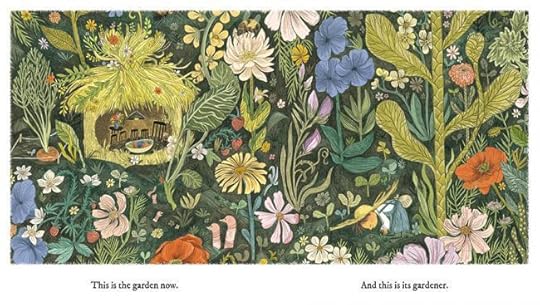
There is limited text, which still outlines the simple plot. The real treasures are the illustrations, done in a page-filling riot of plants, flowers, and garden denizens. The color pallette is warm, earthy, natural, and also bright. I was reminded a bit of the seventies earth-tones of my childhood, but the style is not nostalgic or outdated; more evocative.
There is peaceful respect for living things in these pages, and whimsy, and gentle humor. In my opinion, most small children will find something to like. This tale would be a nice addition to a classroom (or home) library for spring, Earth Day, or to celebrate starting a garden with a child.
I loved the pictures, the garden where this little gardener worked so hard. And I loved looking for his friend, that little pink worm. But the garden isn’t doing well, no matter how hard this little gardener works. Only one thing keeps him going, one lovely flower. That hope and a bit of help arriving later in the story rewards everyone in the end, including the reader. It feels like one big metaphor and I wonder how much young children will understand. I enjoyed its sweetness, but do think the plot is weak.
Very sweet. The story is really simple, but I like how, as in Wild, Emily Hughes' fantastic characters live in a wild world brimming with nature that is hidden in the unexplored/unnoticed pockets of our own world.
This is a lovely little story following a young boys dream of working hard to reach his goal and portraying the hope he has through planting a flower. The lovely illustrations of his face make him hard not to adore and empathise with as you follow his journey. As it is a quick read for lower KS1 it could be a great book to combine with science when looking at seeds/plants. Emily Hughes as an author has a range of similar picture books like this Wild, A Brave Bear - something to possibly suggest to children that enjoy this story.
I loved the illustrations which are rich with shapes and textures, and the use of color is extraordinary. The message which included perseverance, work ethic, hope, and patience was delivered in an interesting way also.
Чудесна история. Хареса ми много повече от "Диво", където лично за мен всичко беше твърде експлицитно, ясно и в този смисъл предсказуемо и познато. А тук образите на градината и градинарят са с богата, разклоняваща се коренова система, отвеждат те до различни мисли и идеи.
Изключително сладко попадение покрай книжния клуб на Ratio! Разлистих я (което си е прочит, понеже е основно величествени илюстрации и малко текст) с огромно удоволствие.
Small in stature but big in heart, the eponymous little gardener in this lovely picture-book works as hard as he can to sustain the garden that provides him with a home, sustenance, and joy. But although he does the best he can, his garden withers, save for one beautiful flower. Wishing on a star one night, the gardener goes to sleep, unaware that his flower also provides joy to a (big) little girl, who also works in the garden, inspiring her to do better as well...
Part fairy-tale, part exploration of the beauty and importance of the natural world around us, The Little Gardener is the second picture-book I have read from author/artist Emily Hughes, following upon her earlier Wild. I enjoyed the story here quite a bit more than I did with Wild, and I found the artwork (as is so often the case with Flying Eye Books) absolutely gorgeous. Children who enjoy stories about "little people" - fairy-tales like Thumbelina, The Borrowers series, the aptly named Littles series - will enjoy this story of a miniature gardener and his human-sized girl counterpart, and will appreciate seeing their garden blossom. I know I did! Recommended to all young gardeners and/or fairy-tale lovers.
The gardener loves his garden and he works hard in it, but he’s not that good at gardening. He feels often that he is too small for the job. He does manage to grow one tall red flower that gives him energy and hope. After working so hard, he knows that if something doesn’t change he will soon be out of food, out of a home, and no longer able to live in the garden he loves so much. He falls asleep, exhausted after making a wish that something will happen. Someone notices his flower in the garden and start to work. As the gardener sleeps, the people work on the garden, transforming it into flowers rather than weeds. The little gardener’s flower inspired them to make a change and in turn their work allowed him to live on as the gardener in the place he adores.
Told very simply, this picture book from the author of Wild is about a truly tiny gardener who is smaller than the weeds that he is battling. The writing is simple with a wonderful tone, very understated with the illustrations bringing the real truth to the reader. At the same time, there is a sense of wonder throughout the text that speaks to the power of wishes, the joy of being in just the right place for yourself, and the pleasure of a simple life.
Hughes’ illustrations are phenomenal. She captures the wildness of the weeds, the beauty of a single red flower rising above them, and then the bounty of a newly planted garden. She also captures the size of the little gardener, showing him to be almost fairy-like in his size, dwarfed and protected by the plants around him. That size allows Hughes to focus closely on the plants, creating a jungle out of the garden.
Beautifully illustrated and with a lovely look at a little life well lived, this picture book would be a great addition to gardening story times. Appropriate for ages 3-5.
Even before the last of the snow melts the daily ritual begins anew. It's a slow meander around the perimeter; frequently stopping to clear leaves, pull unwanted grass or weeds and observe the health of each individual growing thing. Everything in a garden flourishes under the careful eye and hard work of the gardener.
The vines extend, wrap and weave, bulbs burst and bloom, and the perennials push upward a little more each day. The Little Gardener (Flying Eye Books, June 1, 2015 UK, August 11, 2015 US) written and illustrated by Emily Hughes gives readers an entirely different view of the gardening world. We come to appreciate those things nearly too tiny or hidden for us to see.
This story taken at face value has little meaning. The gardener is not good at his job but has one beautiful flower that makes his failing efforts worthwhile. He gives up trying to keep the garden going by by falling asleep for a month after asking ( God?)for a little help. During his month long sleep someone else admires the flower and tends the garden successfully. The end. No point . But when viewed from the perspective of a child the book becomes the story faith and redemption. The child knows he can't manage the real world but appeals for help from anyone believing that there is someone anyone out there who cares will help. Surprise help comes and his garden is saved. For a child and for cynical adults this is much needed injection of hope into a world we cannot handle.
What a gorgeous book to teach children that there is meaning in hard work, not always because of what you accomplish but sometimes because of what you can give to and inspire in others.
What means everything to you? What gives you hope? Have you ever needed a little help or a little confidence? Have you ever made a wish?
This is a story about a little gardener who is struggling to look after his garden, for it is much bigger than him. Despite his size the little gardener manages to grow one wonderful flower and it is this that inspires someone else to discover the joy and wonder of gardening and set about helping to tend to the garden for it to reach its potential and bloom.
The flower gave hope, joy, passion and inspiration and this is what this story is about. Everyone is capable of inspiration and everyone capable of help.
The illustrations remind me of tapestries hanging in stately homes and are curiously dark, perhaps to accentuate the growing flowers and dark earth from which everything grows.
I think children would love to build the little gardener's home and plant a garden. I think too, the more I read this book, there's something rather magical in the 'wish' and the one wonderful flower...could it be magical....why did the garden grow.....was it just a matter of time and was the little gardener successful after all...he just didn't believe it?
This was a really lovely book. It had very little writing on each page but some beautiful language and pictures to match. The story follows a little gardener who tries very, very hard but his garden just won't grow, except one beautiful flower. He sends out a call for help but because he is so small, no one can hear him. However, one someone sees the beautiful flower. Exhausted from trying so hard all the time, the little gardener falls asleep for a month, when he finally awakes he finds his garden in full flourish. He's only little but to his garden he's everything.
Emily Hughes’ The Little Gardener is one of the latest books from Nobrow, Ltd., a publisher specializing in high-quality picture books. I’ve enjoyed every Nobrow book I’ve seen, but The Little Gardener stands out for the quality of its illustrations. The pages are bathed in the colors of the seasons: bright green and pink for spring, gold for summer, the oranges and deep greens of harvest, and the rich browns of soil throughout.
There are actually two little gardeners in this book: a very, very small boy, who lives in a straw hut under a clump of dandelions, and his earthworm companion. Together they labor in the garden, which is full size. The boy balances atop the earthworm’s head to water flowers. He uses a saw to take down weeds that tower over him like trees. At night, both the boy and the worm find themselves wishing for help: their garden is beautiful, but overwhelming.
That help comes in the form of a pair of human children who lovingly tend the garden. As each duo works unaware of the other, the garden thrives, producing food and beauty for all.
The text in this book is limited, making it a good read-aloud book for preschoolers or first-read book for early grade-schoolers. The text may be quick to read, but the illustrations will invite extended perusal—there is so much for little eyes (and big ones) to see on each page. If you need a book for bedtime reading or that a child can leaf through during quiet time, The Little Gardener will serve you well.
This kid's book made me cry too, though not as grandly as All Things Bright and Beautiful. It captures very well how overwhelming and all-consuming gardening can be, and how frustrating it can be when it's not working out. But when it bears fruit! Hooray! And it's such a mutually beneficial operation.. the garden needs the gardener! The gardener needs the garden! Perhaps these are grown-up concepts, but I know a lot of folks, like myself, dragging their kids out to garden, so it's nice to share that in a simply put way. The illustrations are pretty cool too, though they are very dark and a bit grand to the point of hipsterness. :) However, they are also reminiscent, to me of that great probably racist classic, The Funny Little Woman, by Arlene Mosel (where she goes under the earth and hangs out with goblins for a while, basically). Something about the tiny little dude in the dark expanse....it is very effective.
I love the message of this book. Many of the books from my generation's childhood teach that one can do anything one sets one's mind upon. Of course, many people in my generation have grown up to find that this is not necessarily true and have become frustrated, bewildered, disillusioned, or depressed when they fall short of their aspirations. In opposition to this trend, this book depicts a small gardener who is much too small to tend to his giant garden all on his own. Despite the dauting challenge, he does his very best with what he has, and is able to make one flower flourish. Exhausted, he falls to sleep, but his one flower serves as an inspiration to regular-sized people to help tending to the garden, and he awakes to find the entire garden put into order. This sends the message that, rather than trying to do everything ourselves, we can do the best with what we have, inspiring and calling upon others to aid us in making this better.
След като наскоро имах огромното удоволствие да ревюирам „Диво” от Емили Хюз, нямах търпение в ръцете ми да се озове и нейната втора книга, която издателство „Рибка” пуска у нас. Ако трябва да съм честна, не ми е нужно нищо повече освен да чуя „Емили Хюз” или „Рибка”, за да се втурна веднага към най-близката книжарница с „Диво” настървение! Издателството демонстрира такъв висок вкус в подбора на своя каталог, че имам безрезервно доверие на всичко, излизащо с тяхното лого на корицата! А всичко, което съм виждала от Емили Хюз до момента е достойно не само за рамка, но и за стените на световните галерии и музеи. С трепет разгръщам „Малкият градинар”… Прочетете ревюто на "Книжни Криле" - https://knijnikrile.wordpress.com/201...
Thanks to the publisher I got a chance to read this book with my girls before it was released.
I am a gardener at heart and my middle child loves to join me in the garden and planning what we are going to plant next.
This book ignited that desire this winter, with the beautiful illustrations and a cute story of a little gardener trying to grow his own garden. This hard work and determination inspires others to grow there own gardens.
Many thumbs up in my opinion.
I received this book from the publisher for this review. All opinions are my own.
A pleasant story with plenty of plants and a nice and small gardener. It wasn't enough deep for me and, even if the art was nice, it didn't really feel like a true or magical garden.