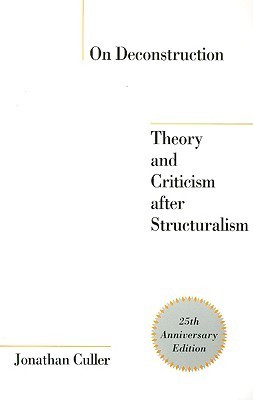
With an emphasis on readers and reading, Jonathan Culler considered deconstruction in terms of the questions raised by psychoanalytic, feminist, and reader-response criticism. On Deconstruction is both an authoritative synthesis of Derrida's thought and an analysis of the often-problematic relation between his philosophical writings and the work of literary critics. Culler's book is an indispensable guide for anyone interested in understanding modern critical thought. This edition marks the twenty-fifth anniversary of the first publication of this landmark work and includes a new preface by the author that surveys deconstruction's history since the 1980s and assesses its place within cultural theory today.
Culler's Structuralist Poetics: Structuralism, Linguistics and the Study of Literature won the James Russell Lowell Prize from the Modern Language Association of America in 1976 for an outstanding book of criticism. Structuralist Poetics was one of the first introductions to the French structuralist movement available in English.
Culler’s contribution to the Very Short Introductions series, Literary Theory: A Very Short Introduction, received praise for its innovative technique of organization. Instead of chapters to schools and their methods, the book's eight chapters address issues and problems of literary theory.
In The Literary in Theory (2007) Culler discusses the notion of Theory and literary history’s role in the larger realm of literary and cultural theory. He defines Theory as an interdisciplinary body of work including structuralist linguistics, anthropology, Marxism, semiotics, psychoanalysis, and literary criticism.
While I wish that this had gone deeper on the Heidegger connection if we were going to spend so much time on Derrida, I do enjoy this as an overview of the different schools of literary criticism that fall under the "deconstructionist" umbrella. I particularly appreciate Culler pointing out how fluid the boundaries between different camps has been over the last 70 years
This is a magisterial work. It combines Culler's clear explication and straightforward style with his expansive reading and comprehensive grasp of critical theory. He provides many summaries of the works of deconstructive theorists as well as many lengthy quotations followed by explications. The book's main aim seems to be a survey of the many aspects of deconstruction, although Culler often offers his own corrections and elucidations. This is a handbook that covers the main bases: Derrida, Hillis Miller, De Man, feminist deconstruction (although the approach is largely thematic, not by theorist). There is a wealth of great theoretical knowledge here. I was already convinced of the value (it feels wrong to say validity) of deconstruction, but this book gives a glimpse at the impressive depths and breadth of which deconstruction is capable and provides many refutations to those who are convinced that deconstruction is just a process of making everything mean nothing (or nothing mean everything). Culler even prepares for those purists who will suggest deconstruction is best when taken from the fount of Derrida himself by pointing out that his own "misreading" of Derrida is not in fact a derisive term when one recognizes that all readings are misreadings. Culler ends with a brief apologetic for setting out a methodology so steeped in contradiction and conflict in such clear, unequivocal terms, but I certainly appreciate his effort and feel all the wiser for having read it.
I read this after Culler's 'Structuralist Poetics' book, and it's more or less more of the same: excellent exposition of the theory in question, which reads like walking through knee deep oatmeal. What's odd is that you'd expect a book like this to be full of 60's French nonsense prose. Instead, it's clear but extraordinarily dull Anglo-academic prose. I doubt there's a better introduction, although I'm not sold on his claim that the post-structuralism/structuralism distinction is unhelpful.
Whew.....I finished this book. That's gotta say something right? I didn't understand a lot of it and I think it's due to my lack of knowledge in literary criticism and theory as well as my lack of knowledge in Deconstruction and Derrida in general. I was hoping for an intro that would elucidate deconstruction for me; I don't think this did it. There were definitely sections I was able to grasp and I have a more muddied and nuanced understanding of deconstruction, but I still feel like I'm pulling at strings or groping in the dark. I was thinking I'd just read some Derrida next. Any thoughts on good intro stuff to this kind of theory? By the end, my gut was telling me deconstruction was shit. I was reminded by another friend that sometimes our guts are able to tell more truth than we give them credit for. Thanks friend.
A blurb on the back cover begins "In the contentious field of literary criticism, deconstruction - often condemned as impenetrable, self-indulgent, mechanical, or nihilistic..." Alas, this book does little to change that perception and a lot to support it.
Divided into three sections or long chapters, the third is the clearest (least unclear) and most penetrable. The first two chapters suffer from many problems, and for the most part make you feel like you're coming late to a conversation that started years and books ago. At no point I can recall does the author offer a definition or starting point for deconstruction. These two chapters read like an endless string of pronouncements, without supporting information or discussion. Culler worsens "the read" by an almost complete lack of examples or basis for his declarations, and frequent use of obscure terminology.
The third chapter is a good deal more digestible and manages to discuss deconstruction with reference to examples, notably Melville's "Billy Budd" and a poem by Thoreau. Despite this, I could not tell whether and where Culler actually believes this stuff -- largely Derrida and de Man's writings. It certainly seems clear that their declarations that no text is readable leaves open the question of whether there is any practical use or value to deconstruction. The style throughout the book is rambling, and if Culler ever made it to a thesis, it eluded this reader.
Jonathan Culler gives here the clearest account of deconstruction as a method of reading. Why would one read as a deconstructionist? What do texts look like to a deconstructionist? How does one practice deconstructive criticism? Culler answers these questions in plain English, and in doing so makes deconstruction appear as plausible and attractive as is possible. I consider the first chapter on feminist criticism something of a bonus, the core of the book being in chapters two and three (“Deconstruction” and “Deconstructive Criticism”); but the first chapter does situate the later chapters so as to make clearer what is at stake there.
Of course, Jacques Derrida’s ideas receive a great deal of attention, but this is not a complete account of Derrida’s philosophy; Culler is focused only on what comes to inform a certain practice of reading and writing. To that end, Culler also discusses the works of Paul de Man, Shoshana Feldman, and Barbara Johnson, and this really gives one a well-rounded sense of what deconstructive criticism can be.
As others have noted in their reviews, Culler’s account is perhaps lighter on the philosophical background of deconstruction than it might have been, but I think this is forgivable, for a few reasons. First, the philosophical background of deconstruction is ably covered in other books: see, for instance, Christopher Norris’s Deconstruction: Theory and Practice and especially Rudolph Gasché’s The Tain of the Mirror: Derrida and the Philosophy of Reflection (which includes a chapter critiquing Culler). Second, Culler’s book is for students of literature, and it is meant to show them how to do something — how to read and write as a deconstructionist — not to provide a full historical account of how Derrida and others came by their ideas. This is a worthwhile task that would only have been hampered by additional references to the history of philosophy.
So it seems most discussions about Derrida composed after circa 1985 reference Culler almost as much as they do Derrida himself. Makes me suspect that contemporary opinion on the esoterica of Derrideism might in fact be misdiagnosed Culleranism. Which is fine by me, I think I prefer Culler to JD.
Ah, post-structuralism. I am glad I challenged myself to read such a book in the summer. Culler's humanistic approach to criticism challenged the older approach to literature, focusing on culture, linguistics AND literary meaning.
This book saved me, at least academically speaking. Great book for understanding deconstruction. Culler is great at explaining stuff, although deconstruction is not exactly easy to comprehend at first.
I love this book! If you want to understand poststructuralism (or just make impressive smalltalk at cocktail parties) this book makes it all seem lucid.