

What do you think?

Dianetics: The Evolution of a Science
From the author of the #1 New York Times bestseller Dianetics: The Modern Science of Mental Health, with over 20 million copies sold
The hidden source of your worries, upsets and insecurity REVEALED.
Written to coincide with the release of Dianetics: The Modern Science of Mental Health, this book was originally published as a book-length feature in a national magazine. The issue sold out within days, triggering thousands of letters and creating a storm of interest that grew into a worldwide phenomenon.
"The optimum computing machine is a subject which many of us have studied. It might be somewhat astonishing, at first, to conceive of such a computer. But the fact is, the machine is in existence. There are billions of them in use today and used in the past. In fact, you've got one. For we are dealing with the human mind."--L. Ron Hubbard
*Find out how the optimum computing machine the mind really works
*Learn how wrong answers enter into the mind and cause further wrong answers
*Discover your mind and how it works.
The hidden source of your worries, upsets and insecurity REVEALED.
Written to coincide with the release of Dianetics: The Modern Science of Mental Health, this book was originally published as a book-length feature in a national magazine. The issue sold out within days, triggering thousands of letters and creating a storm of interest that grew into a worldwide phenomenon.
"The optimum computing machine is a subject which many of us have studied. It might be somewhat astonishing, at first, to conceive of such a computer. But the fact is, the machine is in existence. There are billions of them in use today and used in the past. In fact, you've got one. For we are dealing with the human mind."--L. Ron Hubbard
*Find out how the optimum computing machine the mind really works
*Learn how wrong answers enter into the mind and cause further wrong answers
*Discover your mind and how it works.
214 pages, Hardcover
Published July 14, 2007
About the author
L. Ron Hubbard
2,037 books689 followersWith 19 New York Times bestsellers and more than 350 million copies of his works in circulation, L. Ron Hubbard is among the most enduring and widely read authors of our time. As a leading light of American Pulp Fiction through the 1930s and '40s, he is further among the most influential authors of the modern age. Indeed, from Ray Bradbury to Stephen King, there is scarcely a master of imaginative tales who has not paid tribute to L. Ron Hubbard. Then too, of course, there is all L. Ron Hubbard represents as the Founder of Dianetics and Scientology and thus the only major religion born in the 20th century.
source: Amazon
source: Amazon
Ratings & Reviews
Friends & Following
Create a free account to discover what your friends think of this book!
Community Reviews
Displaying 1 - 30 of 38 reviews

April 13, 2009
Like the famous Dianetics: the Modern Science of Mental Health, this book is absolute bullshit from beginning to end. That being said, it is fascinating to read! The way Hubbard can use scientific sounding language, passive voice and an overall tone of superiority to make his "research" sound valid is an impressive feat. Very enjoyable, but 100% UNbelievable...

September 20, 2010
I'm not a Scientologist but reading about the principles behind the religion is fascinating. From a scientific perspective, frankly, it's insane, but it's all a strange sort of logical. I'd suggest picking up a Dianetics book if you have an evening to waste and feel like reading something mind-screwy.

February 2, 2026
i picked up dianetics on audiobook for one dollar at a local thrift store, which honestly feels like the most appropriate price point. i listened to it while driving around town and i swear i was turning heads in the wrong way—like people could somehow sense i was blasting l. ron hubbard into the universe. windows down, traffic light red, hubbard confidently explaining the human mind with the authority of a man who absolutely should not be doing that. humbling. haunting. regrettable.
it’s fascinating in the same way a late-night documentary about scientology is fascinating—wide-eyed, jaw-dropped, wait-did-he-just-say-that kind of energy. the book insists it has cracked the code to literally everything (trauma! illness! memory! life itself!) and somehow manages to say all of it with zero evidence and maximum confidence. reading it after my recent deep dive into scientology made me sad more than anything. you can almost see the moment where curiosity tips into control, where “self-help” starts wearing a trench coat and whispering promises it can’t keep.
anyway. bogus book. fascinating artifact. deeply kooky group of people. would recommend only if you enjoy anthropological curiosity, light despair, and the thrill of knowing you spent less on this than a gas station coffee.
it’s fascinating in the same way a late-night documentary about scientology is fascinating—wide-eyed, jaw-dropped, wait-did-he-just-say-that kind of energy. the book insists it has cracked the code to literally everything (trauma! illness! memory! life itself!) and somehow manages to say all of it with zero evidence and maximum confidence. reading it after my recent deep dive into scientology made me sad more than anything. you can almost see the moment where curiosity tips into control, where “self-help” starts wearing a trench coat and whispering promises it can’t keep.
anyway. bogus book. fascinating artifact. deeply kooky group of people. would recommend only if you enjoy anthropological curiosity, light despair, and the thrill of knowing you spent less on this than a gas station coffee.

September 9, 2007
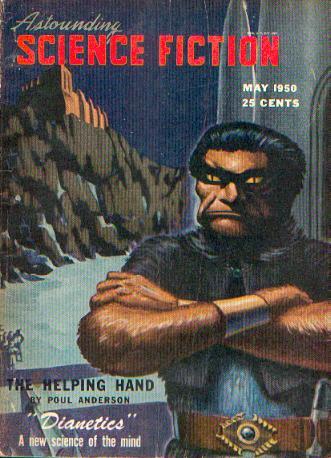
This reprints the original article introducing the 'science' of Dianetics, which appeared in Astounding Science Fiction, May 1950. There's a lot of hand-waving and "this was obviously right" and 'science' arrived at by just thinking that it's probably so or through research that is never expanded on. It's hilarious. Dianetics advances "non-germ disease theory", in that nearly everything wrong with people is psychosomatic, like the common cold and arthritis. Oh, and pre-natal memory, from the moment of conception (and even before).
Oh, and I wish there was a zero-star option. (edit - there is, you just clear the star rating)
Oh, and I wish there was a zero-star option. (edit - there is, you just clear the star rating)

January 2, 2019
This book seems like an essay that is a stream of consciousness by L. Ron Hubbard. He discusses the "science" of Dianetics, but for all of his discussion about research, he provides absolutely no evidence for any of his findings. We are simply supposed to believe it because he said he saw it happen. This was originally published in 1950, but there have been many revisions where specific details of Hubbard's research could have been included. Because it is not there, I must assume that it does not exist. He creates new words and new ideas, and he discards previous research (which has been recorded with actual evidence) by psychologists and scientists before him. Further, he contends that we have "engrams" all the way back to four days after we were conceived, but again, provides absolutely no evidence (except for his word) that this is true. In fact, a note was added in later editions that says: "Validating this work, medical authorities have since released much data on the phenomena discovered by Hubbard concerning both birth and prenatal engrams..." (92). Again, no evidence is provided, aside from references to being published in "such magazines as Time, Reader's Digest, and the Ladies Home Journal." Hubbard claims that we can go clear and be cured of all of our human ills if we can clear our engrams. No evidence as to how this can be (or has been) done except for his statement that he did it. I am reminded that this author does not have any credentials that would support his work in this field. He did two years at George Washington University in engineering, but apparently he flunked out. He also served in the Navy, doing administrative work. No psychology degrees. And yet, he spends an awful long time discussing the brain, memories, and his "Research" to support Dianetics. This book was poorly written and contained no evidence whatsoever for the claims which it contains.

August 22, 2011
In this short volume (110 pages, the rest consists of glossaries and descriptions of other LRH books), Hubbard describes how he allegedly discovered the "reactive mind" and the "engrams" that cause all sorts of "aberrations". He mentions lots of experiments that were allegedly made and claims that Dianetics has been shown to work in every single case. But he provides no evidence, so despite his claims that Dianetics is a science, there's no way for the reader to verify any of his claims, only take his word for it. There have been no independent studies that have shown Dianetis to have any merits at all. This book is recommended only to those who want to understand what Dianetics is all about without having to read the much longer Dianetics: The Modern Science of Mental Health.
(Review from July 2012)
(Review from July 2012)
Read
May 1, 2009Interesting but flawed proposal of man's "reactive" mind. A lot of what it purports to have "discovered" is already well documented. Although it professes to be a scientific book it skilfully avoids any scientific methodology or presentation in its execution. There are many parts of it that are written in a naive fashion and it comes across as if the writer was trying to impress the reader with his use of language and corny humor.
February 5, 2015
Meh. I still think the Scientology thing is a lil whacko. But this book gives me a little more insight into the groundwork for it. The most infuriating times in this book come when the author just simply states "does (blah blah) work? It does!" That's not scientific proof! That's just ramblings. It is a bit rambley at times but again like most religions has so basic roots in good and truth. I'd be willing to look into the next book.

September 3, 2012
Dianetics gives an overview of the "science" of dianetics. Not worse than many self-help books in its mix of common-sense, "insight" and wild extrapolations of scientific knowledge (a per mid-20th century). However, more influential, which was my reason for reading.

March 11, 2015
Great book once you understand it. I find Dianetics: The Modern Science of Mental Health much easier to understand as it lays out Mr Hubbards discoveries clearer and give good examples. I recommend reading that one first.


September 12, 2014
Not science. I don't know whether to be amused or horrified by this.

Read
November 7, 2017Utter garbage.

March 25, 2018
This book is fascinating for one reason and one reason only: SOMEHOW people believe this is anything but pure bullshit, through and through.
December 14, 2019
An absolute crock of shit. Rambling and nonsensical with circular arguments. But what did you expect, really?

July 1, 2026
A reissue of the original article from Astounding Science Fiction*
2.5/5
Having just read Hubbard’s first work on dianetics (The Original Thesis) it is both fun and interesting seeing the complete shift in tone from cold academic to the folksy citizen scientist with the full flare of his pulp writing abilities.
As for the article itself its energetic but meandering and while it doesn’t really prove or demonstrate much you can certainly see why it generated such interest in his main book. Similarly it is interesting seeing how it tapped into the the growing post war culture shift – where religion was still central but science was starting to grow in social importance and where the value of psychology is growing while the dominance of Freud starting to crumble.
Overall a book that would be a bit of fun for contemporary Scientologists but not much more.
*The original cover
2.5/5
Having just read Hubbard’s first work on dianetics (The Original Thesis) it is both fun and interesting seeing the complete shift in tone from cold academic to the folksy citizen scientist with the full flare of his pulp writing abilities.
As for the article itself its energetic but meandering and while it doesn’t really prove or demonstrate much you can certainly see why it generated such interest in his main book. Similarly it is interesting seeing how it tapped into the the growing post war culture shift – where religion was still central but science was starting to grow in social importance and where the value of psychology is growing while the dominance of Freud starting to crumble.
Overall a book that would be a bit of fun for contemporary Scientologists but not much more.
*The original cover

March 4, 2020
Wat een klinkklare onzin. Zogenaamd wetenschappelijk, maar nergens wordt verwezen naar bewijzen, gepubliceerde onderzoeken, etc. Maagzweren krijg je omdat tijdens de zwangerschap je moeder een poging tot abortus heeft gedaan... really? Ik dacht het dus niet.
Alle klachten zijn volgens Hubbard psychosomatisch en kunnen door het herhaaldelijk vertellen erover onder stimulans van caffeïne zo worden veranderd in het brein, dat overigens wordt vergeleken met een computer en een rekenmachine, dat je een "clear" bereikt. Wat dat inhoud wordt totaal niet uitgelegd. Ook niet door mensen die lid zijn van de Scientology beweging. "Dat is gewoon wat je voelt" werd er letterlijk gezegd.
Niet de moeite waard.
Alle klachten zijn volgens Hubbard psychosomatisch en kunnen door het herhaaldelijk vertellen erover onder stimulans van caffeïne zo worden veranderd in het brein, dat overigens wordt vergeleken met een computer en een rekenmachine, dat je een "clear" bereikt. Wat dat inhoud wordt totaal niet uitgelegd. Ook niet door mensen die lid zijn van de Scientology beweging. "Dat is gewoon wat je voelt" werd er letterlijk gezegd.
Niet de moeite waard.
June 9, 2026
The book gives a comprehensive understanding about the principles of Dianetics and the mind. Worth reading.It is interesting how L. Ron Hubbard knew so much about the mind in the late 1940ies. Psychology and Psychiatry came stron around this time and were certainly not supportive of the idea what one could get rid of unwanted emotions, psychosomatics and more, and so Dianetics was attacked from the very start, after this book here got released. For me that was enough reason to get curious and read it.
March 9, 2025
I liked it. It is shorter than Dianetics but it has all the basic elements of why Dianetics works. Good first book to read by L. Ron Hubbard.
If you want to know about Dianetics don’t listen to what people have to say. Read a book and decide for yourself.
If you want to know about Dianetics don’t listen to what people have to say. Read a book and decide for yourself.

April 18, 2023
Good introduction to Dianetics: The Modern Science of Mental Health.

December 24, 2024
If nothing else, this book is a master-class in how to write utter bullshit and market it as well founded science.
I give it a point for being so incredulous as to make me laugh out loud.
I give it a point for being so incredulous as to make me laugh out loud.

December 29, 2024
It’s a no from me dawg
March 8, 2025
Great Read!
This book gave me so much clarity on how the mind works. It’s clear, engaging, and really makes you think. Highly recommend!
This book gave me so much clarity on how the mind works. It’s clear, engaging, and really makes you think. Highly recommend!
September 6, 2025
Read this last year. Fantastic book
October 1, 2025
This book is a must read to u derstand the barriers that are holding a person back from their best life. Very easy read. This book empowers a person to learn more. Highly recommended!!!

October 13, 2025
Didn’t finish reading. Not interested

November 13, 2025
Total nonsense. I was hoping to find some entertainment value but was disappointed with even that.

Read
June 3, 2014first off, I don't know much about the cult Scientology has presumably become, years after Hubbard began churning out his theoretical-psychological books. Despite my awareness that there ARE sketchy details, I was delighted to find that this book, perhaps unique for Hubbard(?), was a relatively simple treatise that hardly maintained anything ridiculous. There was 1 point I cringed when a non germ-theory of disease was proposed, but I insist that the claim is less arrogant than it sounds. In my own language (taking influence from Timothy Leary's work & Ken Wilber's model), Hubbard says that the potentially integrated, healthy, advanced human personality is inhibited/prevented by what he calls "engrams". Engrams are what Leary would call imprints on the lower circuits of consciousness. Unconscious behaviour habits, robotic emotional responses, SLEEP. Lower chakras that are in major tension, energy not circulating upwards. In Wilber's terms, these are the prepersonal pathologies that prevent healthy integration of the personality (preventing higher development to vision-logic or 2nd tier; this is what I think Hubbard refers to as the Optimum). Dianetics is then his claim of a science capable of healing these pathologies, allowing development, energizing the expansion of moral-cognitive development. In theory, this is a profound work for the 50s. He confirms what Grof would later see in over a thousand psychedelic sessions: pre-natal, perinatal experiences. He acknowledges the unity of mind & body, hence the causal efficacy of the mind ON the body (this is perhaps the arrogant over emphasis in the work; that strong engrams are the ONLY factor needed to treat disease). This book shows no actual evidence, just testimony. All in all, from this book I gain a respect for Hubbard's passion for healing the psychic damage humanity harbours, deep in the "subconscious". Hubbard discovered a way to crack this so called "unconscious" open and examine what came pouring out. For that, surely a pioneer researcher. The inflexible conclusions are the irksome aspect: perhaps Scientology's pathology is the inability to think beyond Hubbard.

August 15, 2012
Amazing book. L Ron Hubbard reviews his own thoughts and tests conducted in discovery and remedy for the Reactive Mind. It took some doing to put the pieces together but is not overly complex and a sort of personal journey in tone as well as fairly succinct to read.
Mr Hubbard's reluctance to enter the field of religion is expressed, as he is on the discovery trail of the reactive mind, but in later books on Scientology he found the existence of the individual as a spiritual being irrepressible and yet led to more.
This book is an excellent formative landscape of initial discoveries and how conclusions were made.
Tight.
Mr Hubbard's reluctance to enter the field of religion is expressed, as he is on the discovery trail of the reactive mind, but in later books on Scientology he found the existence of the individual as a spiritual being irrepressible and yet led to more.
This book is an excellent formative landscape of initial discoveries and how conclusions were made.
Tight.
January 21, 2016
If you interested in Dianetics, start with this book before reading Dianetics Modern Science of Mental Health. This explains how LRH came up with the science of Dianetics. It is a short read and lays out the basic ideas expounded upon in DMSMH.Dianetics: The Evolution of a Science
Displaying 1 - 30 of 38 reviews