Jump to ratings and reviews
Rate this book

Kay Harker #1

The Midnight Folk

Rate this book
‘Don’t you have any fear, Kay. We’re the guards, we are. We hear that the house has gone all to sixes and sevens since we left it, but that’s going to be remedied now’

Young Kay Harker lives in an old house in the country, filled with portraits of his ancestors. His only companions are his unpleasant guardian Sir Theopompus and his governess Sylvia Daisy Pouncer (who, Kay suspects, has stolen all his toys). Life is lonely and dull, until one night Kay’s great-grandpapa Harker, a sea captain, steps out of his portrait to tell him about a stolen treasure that belongs to Kay’s family. The evil Abner Brown is searching for it too, but Kay is helped by the midnight folk: creatures like Nibbins the cat and Rollicum Bitem Lightfoot the fox, and even his lost toys, who will join him on his dangerous quest.

The Midnight Folk is a feast of imaginative story-telling, a glorious cornucopia of pirates and witches, lost treasure and talking animals. Although it was published in 1927, it evokes an older world: houses are lit by oil lamps, and travel is by horse, carriage – or broomstick. Masefield perfectly captures a child’s perspective, from the terrors of tigers under the bed to the horrors of declining a Latin adjective. Yet there is also plenty of humour that adults will appreciate, from Miss Piney Trigger, who swigs champagne in bed and prides herself on having backed a host of Derby winners, to Kay’s lessons: ‘Divinity was easy, as it was about Noah’s Ark. French was fairly easy, as it was about the cats of the daughter of the gardener.’ This mingling of past and present, reality and fantasy, has made this one of the most rewarding and influential children’s books ever written.

238 pages, Paperback

First published January 1, 1927

116 people are currently reading
2942 people want to read

About the author

John Masefield

711 books100 followers
Masefield was born in Ledbury, a rural area in England to George Masefield, a solicitor and Caroline. His mother died giving birth to his sister when Masefield was only 6 and he went to live with his aunt. His father died soon after. After an unhappy education at the King's School in Warwick (now known as Warwick School), where he was a boarder between 1888 and 1891, he left to board the HMS Conway, both to train for a life at sea, and to break his addiction to reading, of which his Aunt thought little. He spent several years aboard this ship and found that he could spend much of his time reading and writing. It was aboard the Conway that Masefield’s love for story-telling grew.

In 1894, Masefield boarded the Gilcruix, destined for Chile. He recorded his experiences while sailing through the extreme weather. Upon reaching Chile, Masefield suffered from sunstroke and was hospitalized. He eventually returned home to England as a passenger aboard a steam ship.

In 1895, Masefield returned to sea on a windjammer destined for New York City. However, the urge to become a writer and the hopelessness of life as a sailor overtook him, and in New York, he deserted ship. He lived as a vagrant for several months, before returning to New York City, where he was able to find work as an assistant to a bar keeper.

For the next two years, Masefield was employed in a carpet factory, where long hours were expected and conditions were far from ideal. He purchased up to 20 books a week, and devoured both modern and classical literature. His interests at this time were diverse and his reading included works by Trilby, Dumas, Thomas Browne, Hazlitt, Dickens, Kipling, and R. L. Stevenson. Chaucer also became very important to him during this time, as well as poetry by Keats and Shelley.

When Masefield was 23, he met his future wife, Constance Crommelin, who was 35. Educated in classics and English Literature, and a mathematics teacher, Constance was a perfect match for Masefield despite the difference in age. The couple had two children (Judith, born in 1904, and Lewis, in 1910).

In 1930, due to the death of Robert Bridges, a new Poet Laureate was needed. King George V appointed Masefield, who remained in office until his death in 1967. Masefield took his appointment seriously and produced a large quantity of verse. Poems composed in his official capacity were sent to The Times. Masefield’s humility was shown by his inclusion of a stamped envelope with each submission so that his composition could be returned if it were found unacceptable for publication.

On 12 May 1967, John Masefield died, after having suffered through a spread of gangrene up his leg. According to his wishes, he was cremated and his ashes placed in Poets’ Corner in Westminster Abbey. Later, the following verse was discovered, written by Masefield, addressed to his ‘Heirs, Administrators, and Assigns’:

Let no religious rite be done or read
In any place for me when I am dead,
But burn my body into ash, and scatter
The ash in secret into running water,
Or on the windy down, and let none see;
And then thank God that there’s an end of me.

Ratings & Reviews

What do you think?
Rate this book

Friends & Following

Create a free account to discover what your friends think of this book!

Community Reviews

5 stars
417 (29%)
4 stars
416 (29%)
3 stars
413 (29%)
2 stars
130 (9%)
1 star
35 (2%)
Displaying 1 - 30 of 199 reviews
Profile Image for Petra X.
2,455 reviews35.7k followers
June 1, 2015
This was one of my favourite books when I was a child. It was creepy and real, I suspected. Parents may deny it but things are different in the dark and the goings-on at midnight in the book might be real, only a child knows for certain and only in the dark.

It's kind of the antithesis of Disney. Dark with horror and fear. Parents, themselves grown up on more than a spoonful of sugar themselves, love the cheeky chappies and happy, sparkly endings of Disney with all the bosom-y almost pre-teen princesses. But children really love that little shiver of fear that a book with supernatural horror and terrors engenders.

Perfect reading for a winter's night tucked up with a child snuggling deeper under the covers. Perfect rereading for an adult who will get the sly little jokes about gambling and drinking that Masefield slipped in. (Yes, two more reasons your Disneyfied child shouldn't read this book).


Read 1/1/93ish, review rewritten 14/4/2015
Profile Image for mark monday.
1,877 reviews6,304 followers
May 9, 2020
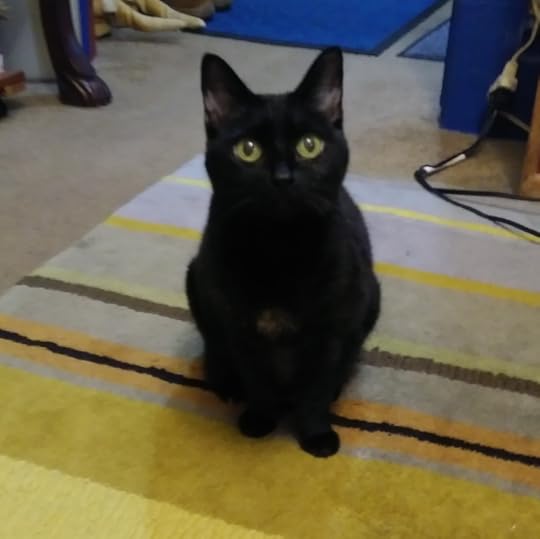
Funny little cat takes funny little boy on all sorts of funny adventures. This is a funny dream of book. And this is a funny, dreamy cat named Digsy:

Digsy_with_Nanny_Yukiko_(1)

She doesn't look very dreamy there. But I promise you that she's spends most of her life dreaming!

OK THANKS FOR YOUR PATIENCE

This book has a great cat character named Nibbins, a little black cat who reminded me of my own. Nibbins introduces our protagonist Kay to adventures that begin at the stroke of midnight. The book features a huge manor house with many secret places, flying, invisibility, ghosts, visiting the lively world undersea (my favorite part), a great fox character, two villainous cats named Blackmalkin & Greymalkin (and Blackmalkin is really the worst, such a suck-up), a profane and delightful old lady who shouldn't drink so much champagne while boasting about her hoodwinkin' piratin' past doing all sorts of unseemly things. Most of all, it is about a treasure hunt! And also righting some old wrongs and outwitting some dastardly witches & wizards.

Masefield doesn't put any distance between Kay, his surreal adventures, and the reader. They just happen, don't question it. Don't overthink it either: channel your Inner Rich Orphan and indulge in some dream logic. There aren't even any chapters to break it all up, so when you're in, you're in.

The prose for this middle grade book is surprisingly sophisticated, the humor rather sneaky, and the dialogue ironic and strange. I loved it! But I wonder if many middle graders would actually love it.
Profile Image for Hilary .
2,294 reviews491 followers
December 8, 2017
A really great childrens book. I can see that some readers might find this inaccessible. It's a book that requires attention to be paid and some parts of conversation, just like the box of delights could be fairly described as going on a bit. But if you persevere you are rewarded with a very special and important story. I am in no doubt this story had lots that inspired J.K.Rowling, and if anyone has read both this and the voyage of the dawn treador they will know that inspiration is far too polite a way of putting it but vast chunks of the storyline have been taken and used by C.S.Lewis, in places it feels almost word for word. This story has all the ingredients of the perfect childrens book, cats that can speak, animal costumes that you can slip on and become the animal, secret passages, codes, witches, paintings that come alive, buried treasure, evil guardians, mermaids, pirates, talking otters and foxes and toys that are alive and can come to your aid. We loved the characters of Nibbins and Bitem. If you're reading this book aloud it will be fun doing all the different characters voices although I found Nibbin's voice hurt after a while ( high pitched cattish voice ) Beautiful illustrations too.
Profile Image for Neil R. Coulter.
1,300 reviews150 followers
December 7, 2022
The Midnight Folk is another in a long list of “How have I never read this before?” books. It’s exactly the kind of book that I love. Tell me a cat leads a boy into a magical world, and I'm there. Published in 1927, it references earlier works (Shakespeare in obvious ways, but also, if I’m reading it correctly, Dickens, Wind in the Willows, and perhaps even The Wonderful Wizard of Oz), and it seems to be an influence in numerous other works that followed in the twentieth century. I can’t recall having heard of a connection between John Masefield and C. S. Lewis (I’m sure they knew of each other, at least), but it’s hard to believe Lewis wasn’t influenced by Masefield in certain key images of The Voyage of the Dawn Treader.

In The Midnight Folk, Masefield includes no chapter breaks at all, which gives the narrative an unbroken, dreamlike feeling. The separation between one day and night and the next is tenuous, and as I read, I sensed time moving differently. Strange, unsettling things happen throughout the book, all of which are received very evenly and calmly by Kay Harker, the young protagonist. The tone of the writing lures me in to accept everything just as Kay does, with the result that the book is illogical but perfect. I love the way Masefield brings together tropes from mythology, fairy tale, Arthurian legend, pirate adventure, and the search for lost treasure. Having pieces of the past revealed to Kay little by little really drew me into the story. And the way the characters across several generations share the same names was fantastic. Madeleine L’Engle wrote the afterword in the edition I read, and that makes perfect sense to me, since she took that idea of names across generations for her novel A Swiftly Tilting Planet.

I really enjoyed this book, and I’m eager to continue on to The Box of Delights.
Profile Image for Nigel.
Author 12 books68 followers
October 31, 2014
An amazing dream of a book that unfolds with surreal logic as cats talk, witches fly, foxes plot against gamekeepers, model ships sail away with a water-rat captains and a hundred other odd and wonderful things, while Kay tries to discover the fate of his great-grandfather's lost treasure. The voices and the language are as magical as the various miraculous and mysterious occurrences. It utterly refuses to make any sense of things or offer explanations or justifications. It's pretty much its own justification, that's what.
Profile Image for James Lark.
Author 1 book22 followers
January 9, 2017
What a frustrating muddle of a book. I picked it up with the excited interest of one reared on the lauded BBC adaptation of 'The Box of Delights', and many of the same elements are here - magical journeys and dips into the past, a gang of villains and talking animals, a dreamlike fantasy woven into a quaint world of governesses and gamekeepers. What it doesn't have is any hint of a structure: in fact, Masefield takes his cue from the dreamlike feel of the episodes and gives us an exhausting stream of consciousness, eschewing chapter headings and running one event into another, introducing ideas and characters as they occur to him then dropping them as quickly. We're vaguely on the quest of some buried treasure, but such clues as young Kay Harker stumbles upon are both repetitive and inconsistent, and somewhere along the line Masefield must have got bored of that treasure because a man comes along (that's right, just 'a man') and casually mentions to young Kay there's another load of treasure knocking about in the vicinity and maybe he'd like to have a go at finding that? It's as if he's making it up as he's going along.

Don't expect Kay to act on any of the information he gathers with any urgency, either, because he has schoolwork to attend to, and won't he just catch it if he's not back in time for breakfast! Two of his friends are trapped in a cave, but oh dear it's nearly sunrise, you'd better be off home! Oh, and don't hold your breath about Kay playing any part in the happy denouement either, when a deus ex machina will do the job just as well.

I know 'The Box of Delights' is equally bonkers and arguably just as much a series of episodes strung together, but surely it has more of a sense of plot? I haven't read it: perhaps the BBC adaptation is more of a rescue job that it is given credit for. I can see the potential for adaptation in this one, with its imaginative and visual sensibility and many a vivid character to enjoy (though the fact that several of them speak with an idiom as incoherent as the overall storyline doesn't help). What I can't imagine is reading this to a child, less still a child reading it for themselves.

I notice that 'The Box of Delights' has chapter headings, which is something to look forward to at least. But when I eventually summon enough patience to embark on reading it, it will be with a great deal of trepidation.
Profile Image for Judith Johnson.
Author 1 book100 followers
October 30, 2020
Stunning! There’s a quote on the cover from The Times describing this and The Box of Delights, its sequel, as ‘two of the greatest children’s books ever written’. I have to agree! It’s full of wonderful magical things to enchant young readers (and old!) but in my opinion has the advantage over many other stories (see JK Rowling’s Harry Potter series!) of deeply poetic writing and fantastic characterisation, no surprise there I guess, coming from John Masefield.

One wee complaint about the Egremont Classics edition I have: there’s no credit for the illustrations, though I managed to read the tiny signature and learn that they are by Rowland Hilder, who incidentally did the beautiful watercolour illustrations for the Ladybird book of British Wildflowers. As the mother of an artist, I really object to the modern trend of not crediting art (though, fair play, the cover art is here credited).
Profile Image for Alice-Elizabeth (Prolific Reader Alice).
1,163 reviews166 followers
May 28, 2020
Published first in the 1920s, The Midnight Folk is a middle grade book and the first in the Kay Harker series featuring Kay who is on a mission to locate the missing treasure left behind by his great grandfather and to stop the bad characters from finding it first. It is magical-esque at times and as one reviewer has already written here on goodreads, it is reminiscent of another popular children's classic called Alice In Wonderland. I liked the fantasy and talking animals side of the story, just not the slow pacing or parts of the writing style. I think Masefield's poetry would suit me better personally as a reader to his works!
Profile Image for Felicity.
Author 10 books47 followers
November 4, 2007
I'm being a little silly in characterizing this book as magical realism, but it does seem to fit it best. Like Alice in Wonderland, it depicts fluid physical laws. Unlike Alice, it draws no really meaningful lines between the world where the rules apply and that where they do not. The magical happenings that befall Kay Harker partake both of the logic of the dream world and the concerns of the waking one.

Kay is a young boy living in his familial country house, but overseen by unrelated and seemingly uncaring adults. He begins to find out the world is stranger than he had thought when he begins to dig into the mystery surrounding his great-grandfather, a sea captain who lost or stole a great treasure. The other characters include cats Blackmalkin and Graymalkin, otters, foxes, witches....
Profile Image for Tweedledum .
859 reviews67 followers
October 30, 2016
I remember my mum reading some of this to me when I was about 8 or 9 and being mightily confused and not overly impressed. I presume I finished reading it for myself, being an insatiable bookworm who kept a torch under the pillow for emergency reading sessions. Having sampled the delights of E. Nesbit and C.S.Lewis who wrote so beautifully for children I am afraid I found Masefield's prose very contrived and convoluted. Mum, however, being a great fan of the Laureate's poetry followed this up with The Box Of Delights which I found almost as impenetrable until the delightful BBC serialisation came out in time to entrance my own children. I therefore reserved my judgement and continued to honour my old puffin paperback with a place on my bookshelves until it literally fell apart.

Re-reading The Midnight Folk on kindle as an adult I was finally able to decode the arcane references to the classics and Latin grammar early on in the story but still feel I am somehow missing the point. The weird dislocations of the story, which constantly jumps between reality/ dreamworld/ nightmare/ magic / past and present etc , just don't make sense to me any more now, than as a child. I mean to say... I can follow them.... But I don't like the confusing jumble. Of course that is the whole point of magic....it doesn't make sense and transcends the real world, but personally I prefer more structure and less confusion in my stories. Many times Masefield tells the reader through Kay... Oh it must have been a dream.... To account for the confusion ... But then after all it's not a dream....

Ok I was never that keen on Alice either as a child....

However the way in which Kay is suddenly able to be transformed into a being who can swim with the otters, fly with the bats, listen in on foxes conversations etc is genuinely delightful and I can see how this story will have inspired many other authors.

In today's world where everything shared publically with children must be subjected to the PC censorship rules one might think twice or thrice about sharing Masefield's extra-ordinary tale at all in which a presumably benevolent dictator is suddenly invoked and rewarded at the end of the story with a great treasure trove.... though Kay is arguably an abused child living parentless under the awful tyranny of a governess who turns out to be a witch. So that's ok then....


Profile Image for Beauty is a Necessity .
38 reviews1 follower
March 4, 2021
I truly wished to love this book, however after only several pages I was hoping to at least like it since I had a nice, unabridged first edition sitting in my hands. However the outcome of positively loathing this story couldn’t have become a more stark contrast. I couldn’t handle it after 78 pages, as I felt I was wasting life on this balderdash. Frank Raymond mentioned this book in his own book, Sweet Dreams and Terror Cells, so I wanted my hands on a copy. The beginning chapters are herky-jerky and not at all intended to usher you into the story in an all captivating way. There are also tedious, unnecessary details included. I hate to say it however the prose is subpar, wreaking of poor writing. I cannot even fathom this story keeping the attention of a child. If I’m not engrossed into the story by 78 pages in, it’s time to abort. Another 1 Star reviewer mentioned cardboard characters, well I couldn’t agree more, they were unlikeable and emotionally barren. This book is another fizzle as was my experience reading the literary lemons, The Last Unicorn,
The Snow Goose, and unbelievably
The Wind in the Willows all of which people unbelievably rave over. Good grief, especially since I just finished reading The Little White Horse by Elizabeth Goudge which is a bookcraft gem of gems!
Profile Image for Rinske.
130 reviews10 followers
Read
October 25, 2025
My boyfriend read this to me before going to bed over several months. I thoroughly enjoyed it but fell asleep most nights after a few pages of reading so I probably missed about 40% of the book lol
Profile Image for Andrew.
2,539 reviews
July 14, 2013
I know that it is all to easy to say a book is dated - it can be many things- from references to actually events, technology - all the way to words and phrases. But this book just feels old - it shows it in the mannerism and attitudes of the characters, it shows itself in many subtle and small ways. And it all adds to he charm of the book, you see the whole book has quite a simple plot to it - its the many characters and adventures that kay has along his way that is the real story. At times it can be a little tricky to follow what is going on - and the lack of chapters and even dialogue breaks can be a challenge but once you are in tune with the story it all starts to flow and seems less of an issue.
Ironically I originally came looking for the second book - the box of delights - but it seems disrespectful jumping books simply to feed your curiosity.
62 reviews
September 25, 2011
I admired the writing, but didn't much enjoy reading this. Masefield builds the characters almost solely through dialogue and throws you right into the action (admirable!), but there are so many characters operating in obscurely devious ways, the plot becomes hard to follow. The story is imaginative, but lacks warmth. I never felt like I broke through the periphery of eavesdropping.
Profile Image for Ashley Lambert-Maberly.
1,794 reviews24 followers
July 29, 2023
A disappointment (so why 3 stars rather than 2? Bumped up for historical importance and author's literary qualities ... but for sheer pleasure it gave me, it's really a 2). Even Madeleine L'Engle, who wrote an afterword for it, damned it with faint praise (paraphrasing, but basically "it's over-complicated and confusing but kids ought to be able to figure it out nonetheless).

Too many characters, too many shifts in time and place, too many dreams, or dreams which turn out not to be dreams, and despite almost constant movement from our protagonist, no sense that any of it is really directed or intentional, the plot seemed to happen all around him, despite him. Lots of scenes of people telling other people what other people had done, were doing, or were going to do.

I thought it was interesting, but as a historical artifact, "fancy, that used to be the sort of book one would give a child and expect them to enjoy it!"

Will still try the next book (Box of Delights) which is apparently more of a classic and perhaps the author learned lessons from book one and applied them to book two. Fingers crossed!

(Note: 5 stars = amazing, wonderful, 4 = very good book, 3 = decent read, 2 = disappointing, 1 = awful, just awful. I'm fairly good at picking for myself so end up with a lot of 4s).
Profile Image for Ivan.
801 reviews15 followers
May 3, 2016
Absolute classic. I place this (and its sequel The Box of Delights) right beside The Chronicles of Narnia and The Children of Green Knowe series. The imagination at work here is that of a genius storyteller. The imagery, the prose and the phrasing create an unforgettable adventure story full of magic and fantasy and lost treasure. There are witches and talking animals and toys that come to life. I guess you can tell that I thoroughly enjoyed this.
Profile Image for Alex Sarll.
7,058 reviews363 followers
Read
December 5, 2014
With the annual rewatch of The Box of Delights tomorrow, it was time to get around to Kay Harker's earlier adventures. Though I've seen the BBC adaptation plenty of times, I don't think I ever read either of Masefield's books when young - and though this is charming, I'm glad the BBC version of the Box stands alone. For if Kay has already had all these adventures, these tangles with Abner Brown and Pouncer, then the Box itself comes to seem a little less wonderful, less of a numinous intrusion into the everyday world. The dream-logic here, too, feels less convincing (because easier?) than that enacted on screen through the miracles of eighties special effects.
Profile Image for George Collingwood.
Author 4 books1 follower
November 21, 2012
This reads as if Masefield wrote it in one go and that's why it’s a bit rough around the edges - and also why it's full of amazing events and episodes that just couldn’t have been planned. If you want the one you have to put up with the other. I particularly like the bit where Kay is taken down to the guard-room and finds out that the toys that he thought he’d had taken from him are all alive and well and secretly looking after him still. I also like the way that animals and people change sizes without anyone (Masefield included) thinking it's odd or in need of an explanation.
Profile Image for Laura.
397 reviews20 followers
January 6, 2016
Not as charming as its sequel, The Box of Delights, but necessary to understand the characters and plot of it. The Midnight Folk moves at a rapid pace, and isn't a book for slow, lingering reading. It must be read as quickly as possible, so as to keep up with all the characters and settings and action.
Profile Image for Daniel Polansky.
Author 35 books1,249 followers
Read
August 15, 2018
Lavie Tidhar wouldn’t stop ranting on about this, which after I got from the library turned out to be a cutesie y/a book from the 1920’s about a typical plucky everyboy protagonist-orphan pursuing a lost treasure in the face of his evil governess who is also a witch. I liked its indifference to making any sense, which is an aspect of y/a literature that’s largely been lost these days, and it went by pretty quick. Obviously I’m not the target audience. Then again, neither is Lavie?
Profile Image for Louise Culmer.
1,188 reviews49 followers
December 5, 2024
Kay Harker is an orphan who lives in his family home with his disagreeable governess, and kindly Jane, the cook, and Ellen, the maid. Kay wants to find the Santa Barbara treasure which his great grandfather, Captain Harker, was transporting from Santa Barbara during the Napoleonic Wars. The treasure disappeared, and although Captain Harker swore he was innocent, some have always suspected that he stole the treasure himself. Kay is assisted in his search by a surprising variety of characters, including some of his ancestors who talk to him from the family portraits. There are many talking animals, and Kay also gets assistance from mermaids, King Arthur’s knights, and a mysterious lady on a flying horse. He flies on a broomstick and drinks an invisibility potion. But Kay is not the only person searching for the treasure, there are others who are up to no good, and Kay must outwit them. One astonishing episode follows another, you scarcely have time to catch your breath. One of my favourite characters is the outrageous old lady,Piney Trigger (or Susan Pricker) whose father was involved in the disappearance of the Santa Barbara treasure: “Deuce take these Lily-liveried times! I’ll have a devilled bone to my breakfast as long as I’ve a gum in my mouth. Cheer up, my lads, there’s shot in the locker still”. I am also very fond of the loquacious old rat with a fondness for haggis: “of all the foods that’s good as tart, there’s none like pretty Nagy”. And the description of his underwater adventures with the mermaids is glorious. An enchanting book full of wonder and surprises.
Profile Image for Capn.
1,355 reviews
November 6, 2021
It pains me to rate this a 3 (it deserves more!), but it is so old and dated now that it almost requires footnotes. There were parts here that I was sure JK Rowling lifted, err, was strongly influenced by (although not quite so much as what she must have borrowed-without-credit-or-leave from the late and great Jill Murphy!! For shame! And it really cheeses me that Rowling's a successful female author - I would very much like to be supportive of her, but she didn't even have the GRACE to ACKNOWLEDGE even 'similarities' to The Worst Witch series! As a modern feminist, I can very much accept that there are rotters in both sexes, as much as I wish it weren't so. But I digress!).
Very much looking forward to reading The Box of Delights now, having only seen the (then old and now positively ancient) BBC television series as a young child.
This is a tale absolutely packed to the gills with adventure and magical fantasy. I believe I liked the descriptions of the unspoiled, pristine countryside and crystal-clear oceans and their native denizens the best. I was wistful for a time before all this pollution....
Worth a read if you will be undaunted by (British) 1920s jargon, cultural and historical references, and can wade through olden "eye dialect" or phonetic accents. And you have to like fantasy. And be a child at heart, if you aren't still one chronologically.
Profile Image for Mira Taylor.
6 reviews1 follower
November 24, 2016
I cherish this book. I still have my early 60's Puffin paperback edition with the 1930's b/w spot illustrations on the cover washed over by psychedelic swatches of (midnight) blue and purple. My parents listened to a broadcast version on BBC radio c1960, and soon after bought the book--eventually read (and avidly re-read) by my sister and me. The story grabs you from the very beginning and doesn't let go. Sheer magic. Contains some of the finest descriptive prose I've ever read in a children's book. The section where Kay, the little orphan boy hero, has to don the disguise of a witch and ride a broomstick is better than any Harry Potter moment, IMHO. Quite a complex plot involving lost treasure, it unravels like an old seaman's yarn but enthralls all the way through. Masterly story-telling. There is a delightful undertow of ironic menace, too. This is not a sugary book at all. I simply adore the poignant tale of Benjamin the Highwayman, btw, and it pulls no punches, either. Can't recommend this book highly enough and the original illustrations by Rowland Hilder are simply wonderful.
Profile Image for Mel.
3,519 reviews213 followers
April 29, 2013
I read this because I really enjoyed the Box of delights and this is the first book he wrote about Kay. I heard that it wasn't as good, it's definitely not as good as the sequel, the story is far less cohesive, but it was still enjoyable. This is one that I think children would really enjoy, it is just full of imagination. Animals all have their own personalities, paintings offer up doorways to different places and times, there are witches and pirates and hidden treasure. It's never quite obvious where Kay is dreaming and when he is actually having a magical adventure. Reading this now I felt I was too old to enjoy it properly but I think I would have really loved it when I was around 7 or 8.
10 reviews
March 10, 2022
Disappointed. I had read box of delights first after watching the BBC adaptation and enjoyed that. This however is poorly written, hard to follow, has no chapters and being the first book written about Kay I expected it to be more of an introduction into the characters and Kay’s first venture with talking animals yet it jumps straight in, he doesn’t seem at all confused about a talking cat leading him away into the night or travelling through time. Considering the villains in this are the same as in box of delights I would have thought they too would be better explained. But no. This very much feels like a first attempt at an idea of a story where box of delights is a better second draft. If anything this should have been the sequel.
Profile Image for Chris.
946 reviews115 followers
November 26, 2019
"You must be the master in your own house. Don't let a witch take the charge of Seekings. This is a house where upright people have lived. Let's have no Endorings nor Jezebellings in Seekings." -- Grandmamma Harker's message to Kay.

In 1885 orphan Kay Harker finds himself under the guardianship of the distant Sir Theopompous and the stern tutelage of an unnamed governess. His former companions, a collection of stuffed toys, have evidently been removed, their place taken by the declension of Latin adjectives for 'sharp', and by exercises in French, Divinity and the like.

When freed from lessons he explores and investigates the surroundings of his ancestral home of Seekings, uncovering a nefarious plot to steal some long-lost treasure, thus following up family traditions and living up to the family name. The Harker shield displays three oreilles couped proper (that is, three disembodied flesh-coloured ears) and so, true to form, Kay eavesdrops, harkening to conversations and learning from what he overhears.

Young Kay (whom we may imagine as around seven) inhabits a magic realist world midway between dreams, imagination and daily life, one inhabited by a combination of guardians and governesses, servants and smugglers, wild animals and witches, knights and toys, ancestors and archvillains.

The impetus to investigate and solve mysteries while avoiding perilous situations drives the reader forward as much as it does the protagonist, in a chapter-free tale full of incidents and wonder. The joy of this narrative is that one can quickly and easily shrug off scruples about implausibilities and engage fully in the ebb and flow of story.

Part of my own ease comes from remembering myself at the same age, with the same sense of life being a dreamscape where reality was of one substance with imaginings. Maybe a lot of the novel's strange-yet-familiar quality comes from the author's own remembered past being a kind of foreign country, where "they do things differently".

As has been pointed out to me, at times The Midnight Folk feels like a mash-up between Treasure Island and Halloween, what with ecclesiastical gold and South American settings and a clandestine witches' coven meeting at at dead of night. But it is much more complex than that: the three ears of the Harker arms underscore several trios of themes.

There are three treasures (smuggled goods, a highwayman's plunder, and the aforementioned Spanish gold), three principal hidey holes (caves, the highwayman's lair, and under a hearthstone), three prime locations (Seekings, Trigger Hall in the North of England and Santa Barbara in South America), not forgetting three groups of friends for Kay (his old toys, the animals at Seekings, and Arthur's knights); there are even three generations of the truly sinister villain, each one called Abner Brown.

The Midnight Folk is a novel to immerse and lose yourself in, a story in which to go with the ebb and flow. Yet for all its fantastic elements it has a tell-tale authenticity at its heart. There is much of Masefield's own childhood here, epitomised by his own drawings of Kay's toys, with their significant names, which interrupt the text. There are also snatches of folksongs and nursery rhymes here -- all with new words, one for example evidently modelled on A Frog he would a-wooing go -- which must've formed a nostalgic background to the author's early years.

Masefield's mother Caroline Louisa died in 1885, followed by his paternal grandparents and then his unhappy father George in 1891. An unsympathetic aunt and uncle became the guardians of the five Masefield children, perhaps providing the templates for the wicked governess and overbearing guardian Sir Theopompous. Are we surprised that Kay's proposed replacement guardian bears his mother's name?

His teenage experiences as a naval cadet and then in the merchant navy provided the seafaring subplot in the novel, though his maiden voyage in 1894 to Chile, when he was not yet 16, was ruinous to his health. Nevertheless, on his return home to recuperate his authoritarian aunt insisted on him pursuing this career, to his dismay.

In early 1895 he jumped ship in New York, where he took odd jobs and read voraciously: here he acquired and retained the first volume of Malory's Morte Darthur, aspects of which work emerge in this novel in the scenes at the earthwork known as King Arthur's Round Table. Sites associated with Arthurian legends, such as the Dorstone and Old Oswestry, abound in Herefordshire and Shropshire so it was only natural that the famed monarch's court should appear in the narrative.

The Midnight Folk alludes to Kay's companions whom he meets around and after the witching hour, but there is much more to enjoy here than talking animals: there are some fine descriptions of the delights of nature, of the fun to be had cataloguing objects, of the slow realisation of who exactly the chief witch Sister Pouncer is, of the truly dastardly character of Abner Brown -- all three of them.

This is a truly magical tale, "the best book of its kind that has appeared since Mrs Hubert Bland died," declared the reviewer in The Illustrated London News in the week before Christmas in 1927. Mrs Bland is of course better known as children's author Edith Nesbit, who'd died in 1924, so high praise indeed.
Profile Image for Elinor  Loredan.
661 reviews29 followers
January 7, 2023
There are aspects I love--secrets in old houses, talking cats, governesses who are actually witches. But I would read a page and realize that I had no idea what I just read. I followed the plot in a very vague, general way, but for the most part I was lost and did not want to expend the effort to make more sense of what was happening. There is a plethora of characters but I did not feel like I got acquainted with any of them. The first few pages in the Kindle sample were so promising, but overall I was very disappointed.
92 reviews1 follower
March 3, 2015
I'm rereading this (to my son) and am as happy as the first time. Everything unfolds perfectly from a child's perspective. Infused with wonder, with its own dreamlike logic, offering no simple answers, there's nothing cute or overly nice about the story or characters. Put this on the same shelf as Alice In Wonderland and The Phantom Tollbooth.
Profile Image for Louise.
41 reviews
August 25, 2012
I absolutely adored this book as a child. Everything about it resonated with me, far more so than any of his other works. Perhaps it was the cats. I do, and always have, had a 'thing' for cats. But it was also the elements of magic and mystery, and the wonderful names of the animals. Just superb.
Displaying 1 - 30 of 199 reviews

Can't find what you're looking for?

Get help and learn more about the design.