

What do you think?
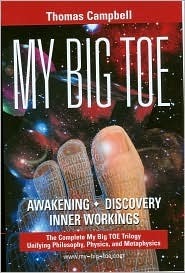
My Big TOE Trilogy #1-3
My Big TOE - Awakening, Discovey, Inner Workings : The Complete Trilogy Unifying Philosophy, Physics, and Metaphysics
My Big TOE, written by a nuclear physicist in the language of contemporary Western culture, unifies science and philosophy, physics and metaphysics, mind and matter, purpose and meaning, the normal and the paranormal. The entirety of human experience (mind, body, and spirit) including both our objective and subjective worlds, are brought together under one seamless scientific understanding.
If you have a logical, open, and inquisitive mind - an attitude of scientific pragmatism that appreciates the elegance of fundamental truth and the thrill of breakthrough - you will enjoy this journey of personal and scientific discovery.
Based upon careful scientific research and logical deduction, this is a book for all who have an interest in the nature of the reality in which they exist. My Big TOE is not only about scientific theory, function, process, and discovery - but also speaks to each individual reader about their innate capabilities. Readers will learn to appreciate that their human potential stretches far beyond the limitations of the physical universe.
This trilogy delivers the next major scientific conceptual breakthrough since relativity and quantum mechanics raised scientific eyebrows in the first half of the twentieth century. No catch, no megalomania, no hypothetical wackiness, no goofy beliefs, no unusual assumptions - just straightforward science that better describes the totality of our experience and provides a wealth of practical results and new understanding that can be applied personally and professionally by scientists and nonscientists alike. This is the real thing.
My Big TOE is about life, purpose, personal significance, physics, evolution, and the reason why. The acronym "TOE" is a standard term in the physics community that stands for "Theory Of Everything" Such a theory has been the "Holy Grail" of physicists for more than fifty years. My Big TOE delivers the solution to that scientific quest at the layman's level with precision and clarity. This book is an adventure into the overlapping worlds of science, philosophy, and metaphysics. It is tightly analytical and logical as all good works of science and philosophy should be, while at the same time down to earth, easily understandable, and full of good humor. No leaps of faith or beliefs of any sort are required to get to where these books will take you.
Campbell did not put the "My" in My Big TOE to flaunt pride of authorship. Nor does the "My" indicate any lack of generality or applicability to others. The "My" was added to be a constant reminder to you that this reality model cannot serve as your personal Big TOE until it is based upon your personal experience. On the other hand, personal or subjective experience is only one piece of the reality puzzle. In the objective physical world of traditional science, My Big TOE delivers a comprehensive model of reality that subsumes modern science, describes our objective material reality, and is universally applicable. Contemporary physics is shown to be a special case of a more general set of basic principles.
If you have a logical, open, and inquisitive mind - an attitude of scientific pragmatism that appreciates the elegance of fundamental truth and the thrill of breakthrough - you will enjoy this journey of personal and scientific discovery.
Based upon careful scientific research and logical deduction, this is a book for all who have an interest in the nature of the reality in which they exist. My Big TOE is not only about scientific theory, function, process, and discovery - but also speaks to each individual reader about their innate capabilities. Readers will learn to appreciate that their human potential stretches far beyond the limitations of the physical universe.
This trilogy delivers the next major scientific conceptual breakthrough since relativity and quantum mechanics raised scientific eyebrows in the first half of the twentieth century. No catch, no megalomania, no hypothetical wackiness, no goofy beliefs, no unusual assumptions - just straightforward science that better describes the totality of our experience and provides a wealth of practical results and new understanding that can be applied personally and professionally by scientists and nonscientists alike. This is the real thing.
My Big TOE is about life, purpose, personal significance, physics, evolution, and the reason why. The acronym "TOE" is a standard term in the physics community that stands for "Theory Of Everything" Such a theory has been the "Holy Grail" of physicists for more than fifty years. My Big TOE delivers the solution to that scientific quest at the layman's level with precision and clarity. This book is an adventure into the overlapping worlds of science, philosophy, and metaphysics. It is tightly analytical and logical as all good works of science and philosophy should be, while at the same time down to earth, easily understandable, and full of good humor. No leaps of faith or beliefs of any sort are required to get to where these books will take you.
Campbell did not put the "My" in My Big TOE to flaunt pride of authorship. Nor does the "My" indicate any lack of generality or applicability to others. The "My" was added to be a constant reminder to you that this reality model cannot serve as your personal Big TOE until it is based upon your personal experience. On the other hand, personal or subjective experience is only one piece of the reality puzzle. In the objective physical world of traditional science, My Big TOE delivers a comprehensive model of reality that subsumes modern science, describes our objective material reality, and is universally applicable. Contemporary physics is shown to be a special case of a more general set of basic principles.
828 pages, Paperback
First published December 1, 2007
About the author
Thomas Campbell
7 books122 followersPhysicist; author of "My Big TOE." TOE is an acronym for Theory of Everything.
Ratings & Reviews
Friends & Following
Create a free account to discover what your friends think of this book!
Community Reviews
Displaying 1 - 30 of 80 reviews

August 17, 2014
I had to devote 3x as many man hours to read this, as I did to read War and Peace. It took 3 months, or more ominously 1/4 of a year. And it was worth it. Even though sometimes I wanted to fling this fantastically heavy thing at my dog, door or disengaged friends, I always managed to keep it in my hand. Then the next day I would pick it up again and start where I left off.
What I got from this book, is that I'll need just about a lifetime to discern whether what is said in My Big TOE is hogwash, or stuff that is actually true but so marginalized by our scientific society, that it stands no chance on a fair playing field. I'm not even going to get into what Campbell talks about about. I'm sure other reviewers have.
I will, however, say that regardless of your thoughts on the subject, it is worth reading it. There is more knowledge in there than could be packed into five hundred hours of television. Or five thousand, or any finite amount (Depending on the program, of course).
And even if you don't like any of the far out stuff, you will still most likely appreciate the way Campbell scientifically attacks questions. And the way he encourages you as a reader to scientifically attack his writing and theories. He says "This is what I think. Now, you think about this, go out and test it in the real world. And see if you think I'm full of it, or if what I say is the truth." Very interesting, very fulfilling.
Best of all! When you done with it, you can use it as a doorstop. Or maybe to break a window and loot a shop, the possibilities are endless.
What I got from this book, is that I'll need just about a lifetime to discern whether what is said in My Big TOE is hogwash, or stuff that is actually true but so marginalized by our scientific society, that it stands no chance on a fair playing field. I'm not even going to get into what Campbell talks about about. I'm sure other reviewers have.
I will, however, say that regardless of your thoughts on the subject, it is worth reading it. There is more knowledge in there than could be packed into five hundred hours of television. Or five thousand, or any finite amount (Depending on the program, of course).
And even if you don't like any of the far out stuff, you will still most likely appreciate the way Campbell scientifically attacks questions. And the way he encourages you as a reader to scientifically attack his writing and theories. He says "This is what I think. Now, you think about this, go out and test it in the real world. And see if you think I'm full of it, or if what I say is the truth." Very interesting, very fulfilling.
Best of all! When you done with it, you can use it as a doorstop. Or maybe to break a window and loot a shop, the possibilities are endless.

Read
August 10, 2011There have probably been many books claiming to be promulgate a 'Theory Of Everything'. which is a subject that holds fascination for scientists, philosophers and sophists alike.
This one submits a model of reality that is expressed in a language of western rationality in general, and computer science/ digital physics in particular.
Being someone of that ilk/ pre-disposition, I would rate this as one of the most important books I have read, to date.
Among many other things, the book has helped me define the core 'Objective function' for myself - the continuous improvement of the quality of consciousness. The simplicity and clarity of that objective function is highly liberating, and almost heralds the beginning of a new chapter.
The ToE is constructed through a few meta-themes, which are:
1) Beliefs and self-imposed limitations
2) Ideas from the edge
3) Education , learning and personal growth
4) Wisdom (distinguished from knowledge)
5) Fear, ego and delusion
6) Truth, science and logic
Most fundamentally, the author contends that the path has to be walked, not just read or intellectualized on.
This one submits a model of reality that is expressed in a language of western rationality in general, and computer science/ digital physics in particular.
Being someone of that ilk/ pre-disposition, I would rate this as one of the most important books I have read, to date.
Among many other things, the book has helped me define the core 'Objective function' for myself - the continuous improvement of the quality of consciousness. The simplicity and clarity of that objective function is highly liberating, and almost heralds the beginning of a new chapter.
The ToE is constructed through a few meta-themes, which are:
1) Beliefs and self-imposed limitations
2) Ideas from the edge
3) Education , learning and personal growth
4) Wisdom (distinguished from knowledge)
5) Fear, ego and delusion
6) Truth, science and logic
Most fundamentally, the author contends that the path has to be walked, not just read or intellectualized on.

December 12, 2012
Where does one begin to descibe this reading experience? "The Theory of Everything" (T.O.E.) is based not only on science, but also on para-psychology. There is no way to decant this author's huge oeuvre here. He fuses Philosophy 101 to both The Science Channge and The History Channel. There is reality, but there is also this mirror/jello-mold area where myths become truths, and where our soul's essence can travel. He studied and was affected greatly by Robert Monroe. Both authors were cited by my boss in work. As a result, I am more involved in awareness and more content to explore the greater mysteries of life because of that recommendation.
Iteration is the medium where AI will grow. That is a basic computer law, known to programmers. But, Campbell applies this to the universe and then to "digital awareness" (i.e., the importance to become part of the digital world.) Look for the fractals: look for the patterns because these were the building blocks of the past, and will be the building blocks of the future. BE AWARE!!!
Iteration is the medium where AI will grow. That is a basic computer law, known to programmers. But, Campbell applies this to the universe and then to "digital awareness" (i.e., the importance to become part of the digital world.) Look for the fractals: look for the patterns because these were the building blocks of the past, and will be the building blocks of the future. BE AWARE!!!

October 28, 2014
As a past life / in-between life regressionist, energetic healer and consciousness development teacher, I wanted to add a little review of this book.
I am well read and I consider the information and scientific based theories within this book to be very sound, based upon my practical experiences, which includes but not limited to astral projection, my 'knowing' and my knowledge from many sources out there.
Tom has set a precedent here that should last a very long time and this book should become a resource that can be used for a greater understanding about the foundations of existence and the primary reasons that individual souls keep having experiences.
But when saying all that, My Big Toe is a very hard book to read because Tom has chosen to write it without putting in much of his actual experiences, which in my opinion is a mistake. He explains at the end why he did that, and I respect and understand his choice there. But this does limit his audience a great deal. For example, I have referred this book to many people and most of them have found it very, very hard to get into and I have had to provide a lot of encouragement to keep them going. Part of Tom's reason for making this choice is because he wants people to find their own truths, so if he tells them how it is... they are not doing that.
The book would have been a lot easier to read if it had some more entertainment value, it would have flowed much better if he had included examples and excerpts from his astral diary and actual experiences.
I think the best piece of information that I picked up was his explanation around belief and belief traps, how they can hold us back, based on us getting stuck in a belief and not expanding or letting other info in because of that.
I enjoyed the diagram and information surrounding the various realms/dimensions and how they all interact.
I think people need guidance, but they also need to jump in there when they feel ready and seek out the answers directly, and to be ready, they may need certain information and reach a certain stage of their own development and understandings. But then some people don't need that guidance, they can just jump in strait away. It all depends on their current level of consciousness development.
Based on my own consciousness development I no longer need scientific evidence, and I don't need to read about scientific theories because of such reasons, but I still very much enjoyed this book and I know it is very important for some people to read and to be used to support many out there. I do give this book five stars as I believe he accomplished exactly what he was meaning to and he did it very well, based upon his expectations and intent.
I am well read and I consider the information and scientific based theories within this book to be very sound, based upon my practical experiences, which includes but not limited to astral projection, my 'knowing' and my knowledge from many sources out there.
Tom has set a precedent here that should last a very long time and this book should become a resource that can be used for a greater understanding about the foundations of existence and the primary reasons that individual souls keep having experiences.
But when saying all that, My Big Toe is a very hard book to read because Tom has chosen to write it without putting in much of his actual experiences, which in my opinion is a mistake. He explains at the end why he did that, and I respect and understand his choice there. But this does limit his audience a great deal. For example, I have referred this book to many people and most of them have found it very, very hard to get into and I have had to provide a lot of encouragement to keep them going. Part of Tom's reason for making this choice is because he wants people to find their own truths, so if he tells them how it is... they are not doing that.
The book would have been a lot easier to read if it had some more entertainment value, it would have flowed much better if he had included examples and excerpts from his astral diary and actual experiences.
I think the best piece of information that I picked up was his explanation around belief and belief traps, how they can hold us back, based on us getting stuck in a belief and not expanding or letting other info in because of that.
I enjoyed the diagram and information surrounding the various realms/dimensions and how they all interact.
I think people need guidance, but they also need to jump in there when they feel ready and seek out the answers directly, and to be ready, they may need certain information and reach a certain stage of their own development and understandings. But then some people don't need that guidance, they can just jump in strait away. It all depends on their current level of consciousness development.
Based on my own consciousness development I no longer need scientific evidence, and I don't need to read about scientific theories because of such reasons, but I still very much enjoyed this book and I know it is very important for some people to read and to be used to support many out there. I do give this book five stars as I believe he accomplished exactly what he was meaning to and he did it very well, based upon his expectations and intent.

April 12, 2021
It's not an easy read. It doesn't spoonfeed. It's not written by someone who took a writing course so that the contents are pleasing to the masses. It will repeat certain key concepts over and over again until we can leap over our existing paradigms and ingrained belief systems. It's for those willing to push through while maintaining an open-minded scepticism to explore an alternative theory of existence beyond what science, religion and philosophy says. It requires us to go beyond what we are taught to believe in and what our fears and ego blind us to. It doesn't claim to be true - it just provides a fresh starting point for us to discover our personal truth, and not the one we are taught to accept and believe.
What a read. What a difficult read. But as they say, nothing good nor worthwhile comes easy. This can be a life-changing book for some (as it is for me), even as it may be a waste of paper for others, as Thomas Campbell says so himself.
I'm so glad I read and completed the trilogy. Phew.
What a read. What a difficult read. But as they say, nothing good nor worthwhile comes easy. This can be a life-changing book for some (as it is for me), even as it may be a waste of paper for others, as Thomas Campbell says so himself.
I'm so glad I read and completed the trilogy. Phew.
July 30, 2011
This book has changed my life. It's like taking the red pill in the movie 'The Matrix'. You'll realise how deep the rabbit-hole goes.
The only downside to the book is the unnecessary verbosity and repetitions, which may put off some people. Hopefully Tom would come up with a concise edition. Still it's no exaggeration to say that this book is worth it's weight in gold.
Hopefully the core concepts of this work would enter into mainstream science and education in the decades to come.
The only downside to the book is the unnecessary verbosity and repetitions, which may put off some people. Hopefully Tom would come up with a concise edition. Still it's no exaggeration to say that this book is worth it's weight in gold.
Hopefully the core concepts of this work would enter into mainstream science and education in the decades to come.

December 19, 2013
Mr. Campbell spends the first 100 pages of the book trying to convince the reader that he is a serious academic mind that approaches new experience through the prism of science and experimentation. It only takes him another hundred pages to betray himself.
Out of body experiences, clairvoyance, fortune telling, intelligent beings from another dimension, etc, etc. After 200 pages I had to put down this book.
I wouldn't be that offended by the author's accounts if this was a work of subjective selfreflection, but he repeatedly claims that "THIS STUFF IS REAL!" (emphasis his) . I don't doubt the author believes what he writes, but his loose logic and bad science crossed the line for me.
How did I end up reading this book? Oh, well...
Out of body experiences, clairvoyance, fortune telling, intelligent beings from another dimension, etc, etc. After 200 pages I had to put down this book.
I wouldn't be that offended by the author's accounts if this was a work of subjective selfreflection, but he repeatedly claims that "THIS STUFF IS REAL!" (emphasis his) . I don't doubt the author believes what he writes, but his loose logic and bad science crossed the line for me.
How did I end up reading this book? Oh, well...

February 8, 2021
On the intersection of metaphysics, ontology, epistemology, science, and spirituality one will find the Big TOE. Some people have small Toes, and they walk on small grounds, but Thomas Campbell has packed into the bigger worlds and has a very Big TOE.
His Theory of Everything(TOE) starts and is grounded on his own experiences, and is constructed in a way that makes sense to a western materialistic oriented mind. His metaphors go beyond the words and try to explain that which is unexplainable. The writing style is novel and witty, and you get the feeling that your weird uncle is telling you stories from his previous lives.
The text is very engaging, requires extreme open-mindedness and I think should be read after encountering some mystical experiences. (Otherwise, it would not make much sense)
In summary, The Book proposes that there is Absolute Unbounded Oneness(AUO) that creates an Absolute Unbounded Manifold(AUM), which further crates NPMR sets and PMR sets. We live in one of such Physical Material Reality sets and our main goal is to decrease our disorder(entropy) while evolving our awareness. Space-time was created when the concept of change(delta) was introduced to awareness itself, out of which space was then created. Space is created through the interaction of light with itself, and in our reality, the speed of light is one of the many rule-set constraints that create and constrain our reality. Other NPMR and PMR have their own constraints and rulesets that enable the evolution of the One (AUM).
Our PMR interacts with other NPMR, and as such is a subset of NPMR, but NPMR is a subset of other NPRMs. Each smaller subset has its own internal clock which ticks slower than the clock of the superset. All Subjects(humans) in PMR have free will contained by the rule-set of PMR, but the actions are probabilistically calculated and estimated in higher less-dense realities.
His Theory of Everything(TOE) starts and is grounded on his own experiences, and is constructed in a way that makes sense to a western materialistic oriented mind. His metaphors go beyond the words and try to explain that which is unexplainable. The writing style is novel and witty, and you get the feeling that your weird uncle is telling you stories from his previous lives.
The text is very engaging, requires extreme open-mindedness and I think should be read after encountering some mystical experiences. (Otherwise, it would not make much sense)
In summary, The Book proposes that there is Absolute Unbounded Oneness(AUO) that creates an Absolute Unbounded Manifold(AUM), which further crates NPMR sets and PMR sets. We live in one of such Physical Material Reality sets and our main goal is to decrease our disorder(entropy) while evolving our awareness. Space-time was created when the concept of change(delta) was introduced to awareness itself, out of which space was then created. Space is created through the interaction of light with itself, and in our reality, the speed of light is one of the many rule-set constraints that create and constrain our reality. Other NPMR and PMR have their own constraints and rulesets that enable the evolution of the One (AUM).
Our PMR interacts with other NPMR, and as such is a subset of NPMR, but NPMR is a subset of other NPRMs. Each smaller subset has its own internal clock which ticks slower than the clock of the superset. All Subjects(humans) in PMR have free will contained by the rule-set of PMR, but the actions are probabilistically calculated and estimated in higher less-dense realities.

January 5, 2020
Finished it just and spent time on the forums. I dunno. I know nothing. I know everything. I gained clarity and yet and more confused than ever.
I thank the person who recommended it, and hate him for telling me about this book.
I need to let it sit for a bit. It’s a remarkable collection of ideas for sure - so much to digest. I have no idea what, if anything to do next with this information.
I’ve been studying philosophy, Buddhism and stocisim for a few years, this fits in well and yet is also entirely new.
As Uncle Tom says pretty clearly, each of us must develop our own big toe - his is just his.
Or, maybe i’ll Just get high and rewatch The Matrix and look for more clues.
I thank the person who recommended it, and hate him for telling me about this book.
I need to let it sit for a bit. It’s a remarkable collection of ideas for sure - so much to digest. I have no idea what, if anything to do next with this information.
I’ve been studying philosophy, Buddhism and stocisim for a few years, this fits in well and yet is also entirely new.
As Uncle Tom says pretty clearly, each of us must develop our own big toe - his is just his.
Or, maybe i’ll Just get high and rewatch The Matrix and look for more clues.

March 9, 2011
Not only are these books amazing, the community surrounding them rises up to meet the books in a beautiful way.
If you haven't yet, check out the community on the MBT website - Tom has created a network of support and conversation with plenty of personal touches from the author himself!
If you haven't yet, check out the community on the MBT website - Tom has created a network of support and conversation with plenty of personal touches from the author himself!

June 21, 2014
This book is a huge mess. I was annoyed most of the time because the whole thing is horribly amateurish. Even the cover is a disaster. My wife made me keep the book upside down because no one wants to look at someone's ugly toes.
I am very familiar with Thomas Campbell and find his ideas intriguing, even profound. I've heard him speak in person, listened to many podcasts, and watched hours of him speaking on YouTube. I like him a lot as a speaker.
But this book is poorly edited and written, and Campbell comes across as an immature sexist jerk. His attempts at humor are lame and sound more like twelve-year old boy than a middle-aged physicist. Furthermore, the book is highly repetitive and features some of the most unreadable writing I've ever read--and I spent years in academia. Reading it literally made my head hurt.
Save yourself. The book is too frustrating to read. Find the podcasts and YouTube videos. In those, Campbell is likable and explains his ideas much more clearly. You may not agree with everything he says (I don't), but his theory is worth a listen.
I am very familiar with Thomas Campbell and find his ideas intriguing, even profound. I've heard him speak in person, listened to many podcasts, and watched hours of him speaking on YouTube. I like him a lot as a speaker.
But this book is poorly edited and written, and Campbell comes across as an immature sexist jerk. His attempts at humor are lame and sound more like twelve-year old boy than a middle-aged physicist. Furthermore, the book is highly repetitive and features some of the most unreadable writing I've ever read--and I spent years in academia. Reading it literally made my head hurt.
Save yourself. The book is too frustrating to read. Find the podcasts and YouTube videos. In those, Campbell is likable and explains his ideas much more clearly. You may not agree with everything he says (I don't), but his theory is worth a listen.
September 2, 2017
I cannot believe am typing this, but I've finished My Big TOE!!!
"Hail, Hearty Readers, Thou Hast Completed Nonphysical Mechanics 101"
Tom's humour and my curiosity for his Big Theory of Everything is what kept me going through a trilogy that got me questioning everything about myself and my motives for continuing with the book numerous times.
At times it felt like I was going through a midlife crisis. Other times, I started questioning my own intelligence because surely he cannot be iterating the importance to keep an open-mind and a healthy dose of skepticism, AGAIN!
Now, that I have finished the book, don't ask me for details about the TOE, nor for instructions on where to start if you want to improve the quality of your consciousness. The latter is a completely individual and personal process and as for the former: I feel like I need to start all over again, after giving myself some time to digest a small portion of the material first.
Nevertheless, I reckon despite all the eye-rolling, frustration and moments of near-giving up, the fact that I want to read the book again in the future says a lot.
Finally, I hope I get to meet uncle Tom in this life time. It would be a great honour.
"Hail, Hearty Readers, Thou Hast Completed Nonphysical Mechanics 101"
Tom's humour and my curiosity for his Big Theory of Everything is what kept me going through a trilogy that got me questioning everything about myself and my motives for continuing with the book numerous times.
At times it felt like I was going through a midlife crisis. Other times, I started questioning my own intelligence because surely he cannot be iterating the importance to keep an open-mind and a healthy dose of skepticism, AGAIN!
Now, that I have finished the book, don't ask me for details about the TOE, nor for instructions on where to start if you want to improve the quality of your consciousness. The latter is a completely individual and personal process and as for the former: I feel like I need to start all over again, after giving myself some time to digest a small portion of the material first.
Nevertheless, I reckon despite all the eye-rolling, frustration and moments of near-giving up, the fact that I want to read the book again in the future says a lot.
Finally, I hope I get to meet uncle Tom in this life time. It would be a great honour.

December 28, 2021
There should be some negative stars. Maybe xxx s or skulls 💀 ☠ ... for horrible books. This one is another pseudoscience gobblydook!
Use some scientific words, put some people's names, give some vague experiments, jump from facts to analogies and hocus pocus.
Not even readable for the sake of reading
Use some scientific words, put some people's names, give some vague experiments, jump from facts to analogies and hocus pocus.
Not even readable for the sake of reading
March 4, 2019
I wish this book had less entropy. I'm mad at myself for sticking through the same-shit-on-repeat for so many hours.
The author's ideas might have been edgy in 2003, but now the whole simulation theory, complete with various ideas about multiple realities is pretty common place discussion in quantum physics. The only difference is "Uncle Tom" (as the author calls himself) is saying we can transcend the constraints of our reality by lowering the entropy of our consciousness - achieved by becoming more loving. That sounds nice, I just don't see what love has to do with entropy.
The low-entropy "Big Cheese" entity the author described that is using our reality as a Petri dish to grow it's own consciousness doesn't seem real loving. Anyone who would setup a torture chamber like Earth is pure evil.
And why do we need lower entropy anyway? How about the purpose of life be fun and love! That sounds way better. Uncle Tom, you need to imagine something better. You're the one stuck in a "belief trap".
The author's ideas might have been edgy in 2003, but now the whole simulation theory, complete with various ideas about multiple realities is pretty common place discussion in quantum physics. The only difference is "Uncle Tom" (as the author calls himself) is saying we can transcend the constraints of our reality by lowering the entropy of our consciousness - achieved by becoming more loving. That sounds nice, I just don't see what love has to do with entropy.
The low-entropy "Big Cheese" entity the author described that is using our reality as a Petri dish to grow it's own consciousness doesn't seem real loving. Anyone who would setup a torture chamber like Earth is pure evil.
And why do we need lower entropy anyway? How about the purpose of life be fun and love! That sounds way better. Uncle Tom, you need to imagine something better. You're the one stuck in a "belief trap".
January 11, 2013
If you really want things explained on many different levels regarding the different levels of reality this is a must read. It does become technical at times but is easy to follow if this is one of your interests. It is a good read and I go back to it many times. Beware this could broaden your outlook and shake some pretty ingrained beliefs structures so if you are not willing to become open minded don't embark on this journey.

January 29, 2022
Despite the sense of humor being kind of overindulgent. I enjoyed reading it. I appreciate and agree with the idea - the theory of everything that is suggested to the reader. I think it helps give readers a primer and guidance for metaphysical/scientific/philosophy theory of what and how reality and consciousness exist. I think that I would return to this book, with a future appreciation as I pursue a lower entropy consciousness.

January 3, 2023
“The smaller your reality, the more convinced you are that you know everything.”
“To live in the hearts we leave behind, is not to die”
“Fear is like mind-cancer; it is a disease of consciousness, a dysfunctional condition of ignorance trapped within a little picture.”
“Big Truth, once understood and assimilated, always modifies your intent, and invariably leads to personal change.”

December 17, 2012
It's not that I don't 'like' this book - it's okay - but for some reason I just cannot seem to get through it. Perhaps because I (personally) feel it to be a bit too long-winded, in contrary to his videos - which are more 'to the point'.

April 30, 2019
This is one of the most important books on earth.
January 12, 2020
We are a doomed species. Our most brilliant mind figured it all out, but accidentally turned it into a complete hogwash.

Want to Read
April 20, 2026Ok, i really want to read this because i love hearing Thomas Campbell speak, but can we all please take a moment to marvel at what a silly cover this book has? I have rarely seen such cringe and i am *chronically* online 😂
May 27, 2025
This thing blew my mind but I'll probably need to read through it about 3 more times before I grasp it all. Only rating four stars because of all the tangents he goes on making this book wayyyy too big.
April 27, 2018
To paraphrase something Steve Kaufman once told me, "When you're looking for gems, you can either see the gems, or the mud and rock they're stuck in." I've learned to see the gems, thanks in large part to Steve and Tom.
Tom Campbell is nothing if not an original thinker. So when, halfway through this trilogy, Uncle Tom made a quick shoutout to Kaufman and his Unified Reality Theory, I heeded the call. Which left me with not one but two worldview-disintegrating tomes to read, which left me elated and enlightened.
Here's the gem (not a spoiler):
Love is the answer.
You may have heard this elsewhere. Hopefully it stuck. I am shocked at how many times I heard it before it sank in. Campbell makes it astonishingly clear that there's profundity here. To paraphrase, the consciousness we all share generates the reality we experience as it evolves. Our purpose as benefactors and agents of consciousness is to evolve toward higher quality, and lower entropy. Love is the optimal strategy for elevating the quality of the consciousness we share.
This gem was lodged in 824 pages of remarkably consistent deductive reasoning from two clearly stated premises. Uncle Tom, being a physicist and such, leans heavily on his Western materialist vocabulary when expounding on the ineffable. But the truth isn't fragile, as Tom says. It holds together and shines through.
Beyond the delightfully soul-shaking content of this book, Uncle Tom has plenty to teach us about theory and practice of science, and reasoning and logic more generally. You'll come away well-versed in optimistic skepticism. It is a cozy, lengthy experience, this Big TOE, but one crafted with heaps of the very same love it preaches.
Tom Campbell is nothing if not an original thinker. So when, halfway through this trilogy, Uncle Tom made a quick shoutout to Kaufman and his Unified Reality Theory, I heeded the call. Which left me with not one but two worldview-disintegrating tomes to read, which left me elated and enlightened.
Here's the gem (not a spoiler):
Love is the answer.
You may have heard this elsewhere. Hopefully it stuck. I am shocked at how many times I heard it before it sank in. Campbell makes it astonishingly clear that there's profundity here. To paraphrase, the consciousness we all share generates the reality we experience as it evolves. Our purpose as benefactors and agents of consciousness is to evolve toward higher quality, and lower entropy. Love is the optimal strategy for elevating the quality of the consciousness we share.
This gem was lodged in 824 pages of remarkably consistent deductive reasoning from two clearly stated premises. Uncle Tom, being a physicist and such, leans heavily on his Western materialist vocabulary when expounding on the ineffable. But the truth isn't fragile, as Tom says. It holds together and shines through.
Beyond the delightfully soul-shaking content of this book, Uncle Tom has plenty to teach us about theory and practice of science, and reasoning and logic more generally. You'll come away well-versed in optimistic skepticism. It is a cozy, lengthy experience, this Big TOE, but one crafted with heaps of the very same love it preaches.

June 21, 2025
This book could have been an email.
The central topic here is clearly panpsychism, yet the author never uses the word. Nor does he engage with any of the scholars or traditions currently exploring the subject. In fact, after a lot of waffling, he finally states in Section 6 that he won’t do that; claiming that it will simply "confuse" the reader.
And yet, confusion is all he offers. Only one or two sections contain genuinely useful material. The rest is filled with repetition, bad jokes, and patronising questions like, “Are you following me?” The truth is, anyone not able to follow along would likely give up early; and those who can follow the ideas will be put off by all the condescension!
What frustrated me most is that the author claims he’s writing from “direct experience,” but never explains what that experience actually entailed, beyond a vague mention of meditation and a personal mantra. He refers to beings such as “The Big Cheese” with no exploration of their role or meaning, leaving everything feeling shallow and underdeveloped.
I kept reading in the hope the ideas would deepen; but they never did. If you're curious, read until Section 3. After that, you're better off saving your time.
The central topic here is clearly panpsychism, yet the author never uses the word. Nor does he engage with any of the scholars or traditions currently exploring the subject. In fact, after a lot of waffling, he finally states in Section 6 that he won’t do that; claiming that it will simply "confuse" the reader.
And yet, confusion is all he offers. Only one or two sections contain genuinely useful material. The rest is filled with repetition, bad jokes, and patronising questions like, “Are you following me?” The truth is, anyone not able to follow along would likely give up early; and those who can follow the ideas will be put off by all the condescension!
What frustrated me most is that the author claims he’s writing from “direct experience,” but never explains what that experience actually entailed, beyond a vague mention of meditation and a personal mantra. He refers to beings such as “The Big Cheese” with no exploration of their role or meaning, leaving everything feeling shallow and underdeveloped.
I kept reading in the hope the ideas would deepen; but they never did. If you're curious, read until Section 3. After that, you're better off saving your time.

April 4, 2014
Tom Campbell is one of the best consciousness explorers around. This book is his explanation of reality based on extensive research both in our reality system (called PMR=PhysicalMatterReality) and other realities (called NPMR=NonPhysicalMatterReality). The book is especially written for left brained people who need logical answers to be able to reason and in a non-persuasive manner which encourages you to be sceptical to what he says but have an open mind.
He gives you a no-nonsense overview of his big theory of everything which explains natural phenomena like Quantum Mechanics but also meta-physical stuff like remote viewing and Reincarnation.
He also offers advice on how to evolve your consciousness and become a consciousness explorer yourself.
If you want to have an idea of what our next big fundamental paradigm might look like you should definitely read this book!
He gives you a no-nonsense overview of his big theory of everything which explains natural phenomena like Quantum Mechanics but also meta-physical stuff like remote viewing and Reincarnation.
He also offers advice on how to evolve your consciousness and become a consciousness explorer yourself.
If you want to have an idea of what our next big fundamental paradigm might look like you should definitely read this book!
September 23, 2020
Campbell describes our subconscious thought mechanisms and the foundations of consciousness with a precise and scientific syntax. He has logically defined and classified the mesh network of unifying principals within our physical matter reality as well as the identification of how sequences of binary patterns have created supersymmetry between the manifolds of cosmic creation. This axiom reveals the driving factors of evolution within all forms of physical and nonphysical entities. Consciousness is a direct response of an organisms ability to compute, compound, and organize binary datasets.
November 7, 2022
"Truth can never be told so as to be understood, and not be believed."
- William Blake
This is the quote Tom uses to finish off.
In hindsight, this could have been 1/3rd its length, but just like the ancient monasteries where knowledge is not handed out until you prove yourself worthy, it's only 200 pages in where he starts. I don't have a science background so not sure of some of the claims of his model of reality already spoken about/proved in bits and pieces. Overall, I enjoyed this very much,oddly will not recommend anyone to slog through this.
- William Blake
This is the quote Tom uses to finish off.
In hindsight, this could have been 1/3rd its length, but just like the ancient monasteries where knowledge is not handed out until you prove yourself worthy, it's only 200 pages in where he starts. I don't have a science background so not sure of some of the claims of his model of reality already spoken about/proved in bits and pieces. Overall, I enjoyed this very much,oddly will not recommend anyone to slog through this.

October 5, 2021
Thomas Campbell is a very interesting person. This book teaches you how to see life from a whole new perspective. He teaches you not to get hung up on minor details but to understand the bigger picture for example (small spoiler): he interacted with beings from a different dimension and he didnt waste time on understanding who or what they are instead he focused on the message that they conveyed to him.
This book is tough but you have the will and patience it's rewarding.
This book is tough but you have the will and patience it's rewarding.
January 5, 2010
this sounds like a nice book but a nasty one too because look at the title my big toe n toes n feets or nasty but i cnt judge this book because i didnt read it yet.it loooks like a gud book to read so i would recconment this book to all people to read because it seems like an enjoyable book that would make you laugh.

February 28, 2018
first if you're not a psychic already it s going to be a 'tough long long stretching' exercise for your mind... I was going crazy trying to find a scientific approach to explain my paranormal experiences, this book is my holy grail, no other new age book tops My big TOE for me till this present moment!
Displaying 1 - 30 of 80 reviews