

What do you think?
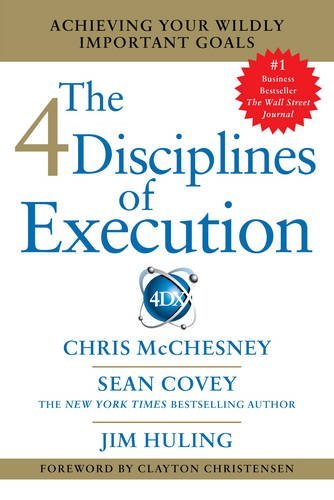
4 Disciplines of Execution
The Four Disciplines of Execution is about a simple, proven formula for reaching the goals you want to reach as a business or individual. In Covey's experience, the thing that most undermines the ability to execute goals is what he calls the Whirlwind: those urgent tasks that must be done simply to keep an organization alive. As Covey shows, the only way to execute new, important goals is to separate those goals from the Whirlwind. The Four Disciplines allow leaders to create a strategy that requires a change in behaviour, since only by ensuring that everyone on the team understands the goal, knows what to do to reach it and knows whether progress is being made, will a leader produce consistent breakthrough results while sustaining the urgent work of the Whirlwind. The Four Disciplines of Execution are:1. Focus on the Wildly Important; 2. Act on the Lead Measures; 3. Keep a Compelling Scoreboard; 4. Create a Cadence of Accountability. For more than a decade FranklinCovey has been studying what it takes to achieve important goals, and in this book they share success stories from a wide range of companies that have implemented the Four Disciplines to result in greater profits, increased market share and improved customer satisfaction. This way of thinking is essential to any company that wants to not only weather, but thrive in this economy.
352 pages, Paperback
Published January 1, 2015
About the author
Sean Covey
142 books543 followersSean Covey was the starting quarterback for Brigham Young University during the 1987 and 1988 seasons. He was benched due to an ankle sprain. Following his college football career wrote a book called The 7 Habits of Highly Effective Teens. It is a book based on the principles of The Seven Habits of Highly Effective People, which was written by his father, Stephen R. Covey, but directed towards the life of a teen. A more recent book he has written is The 6 Most Important Decisions You Will Ever Make. The book directs the six big choices teenagers will make in their teenage years. The six decisions are: School, Friends, Parents, Dating and Sex, Addictions, and Self Worth.
Ratings & Reviews
Friends & Following
Create a free account to discover what your friends think of this book!
Community Reviews
Displaying 1 - 30 of 820 reviews

February 2, 2015
“It is the job of thinking people not to be on the side of the executioners.”
- Albert Camus

Probably somewhere between 2.5 and 3 stars. First, full disclosure: I went to a private school in Provo, UT with several of Stephen R. Covey's kids. Not Sean Covey. He was older, but one or two of his younger brothers. My wife also worked for the Covey Leadership Center (and later FranklinCovey after the merger) while I was finishing college. I am very familiar with the FranklinCovey business model (could probably vomit on demand each of the 7-habits) and business strategy approach. In many ways I'm biased by my own agnosticism towards Franklin Covey. I think Stephen R. Covey was brilliant at building a consultant business that structured time-management, strategy, and execution ideas into highly marketable programs (notice I don't say books) that could be sold in several formats and applied in multiple industries. The ideas were common sense, but the packaging and marketing WERE brilliant. Stephen R. Covey died a couple years ago from a mountain bike accident in Rock Canyon (oh the stories I could regale you with about the dangers of Rock Canyon). Anyway, the Covey mantle has evidently been passed.
This book is the management/leadership book equivalent of the novelization and franchising of a successful movie (see Star Wars, etc). 4DX was developed by FranklinCovey as an additional piece of their large consulting and content-delivery arsenal. IT was almost the reverse process that works with other leadership coaching/books. First you birth the book, than you try to exploit the success of the book into a bunch of CDs, webinars, videos, consultant workshops, certifications, yaddas and yaddas.
Anyway, I think the 4DX approach is just fine (see my agnosticism line above). But like Mark Twain once wrote when reviewing The Book of Mormon, "Whenever he [Joseph Smith] found his speech growing too modern—which was about every sentence or two—he ladled in a few such Scriptural phrases as “exceeding sore,” “and it came to pass,” etc., and made things satisfactory again. “And it came to pass” was his pet. If he had left that out, his Bible would have been only a pamphlet." The team that wrote the 4 Disciplines of Execution didn't include "and it came to pass" once, but if you removed all the hyping of 4DX, the internal and external reviews of how much it helped "Business A" or "Organization X", all the subtle and not-so-subtle references to 4DX CDs, certifications, consultants, etc., it might not be a book, it might only have been a pamphlet (and you can't pimp a pamphlet for $30 to the State of Georgia). But seriously, every time someone brings up WIGs at work without irony, I start to cringe and look for a quick exit or hidden bottle of whiskey.
So, why do I give this 3-stars while I gave a recent (and rare) read of a business management book only two-stars (Executive Toughness? Well, the simple answer is: polish. At least the development team of writers, consultants, VPs, staff, and family at the FranklinCovey Organization know how to write and edit. When I read this I didn't laugh or gag once, and that is (I guess) at least worth one additional star.
- Albert Camus
Probably somewhere between 2.5 and 3 stars. First, full disclosure: I went to a private school in Provo, UT with several of Stephen R. Covey's kids. Not Sean Covey. He was older, but one or two of his younger brothers. My wife also worked for the Covey Leadership Center (and later FranklinCovey after the merger) while I was finishing college. I am very familiar with the FranklinCovey business model (could probably vomit on demand each of the 7-habits) and business strategy approach. In many ways I'm biased by my own agnosticism towards Franklin Covey. I think Stephen R. Covey was brilliant at building a consultant business that structured time-management, strategy, and execution ideas into highly marketable programs (notice I don't say books) that could be sold in several formats and applied in multiple industries. The ideas were common sense, but the packaging and marketing WERE brilliant. Stephen R. Covey died a couple years ago from a mountain bike accident in Rock Canyon (oh the stories I could regale you with about the dangers of Rock Canyon). Anyway, the Covey mantle has evidently been passed.
This book is the management/leadership book equivalent of the novelization and franchising of a successful movie (see Star Wars, etc). 4DX was developed by FranklinCovey as an additional piece of their large consulting and content-delivery arsenal. IT was almost the reverse process that works with other leadership coaching/books. First you birth the book, than you try to exploit the success of the book into a bunch of CDs, webinars, videos, consultant workshops, certifications, yaddas and yaddas.
Anyway, I think the 4DX approach is just fine (see my agnosticism line above). But like Mark Twain once wrote when reviewing The Book of Mormon, "Whenever he [Joseph Smith] found his speech growing too modern—which was about every sentence or two—he ladled in a few such Scriptural phrases as “exceeding sore,” “and it came to pass,” etc., and made things satisfactory again. “And it came to pass” was his pet. If he had left that out, his Bible would have been only a pamphlet." The team that wrote the 4 Disciplines of Execution didn't include "and it came to pass" once, but if you removed all the hyping of 4DX, the internal and external reviews of how much it helped "Business A" or "Organization X", all the subtle and not-so-subtle references to 4DX CDs, certifications, consultants, etc., it might not be a book, it might only have been a pamphlet (and you can't pimp a pamphlet for $30 to the State of Georgia). But seriously, every time someone brings up WIGs at work without irony, I start to cringe and look for a quick exit or hidden bottle of whiskey.
So, why do I give this 3-stars while I gave a recent (and rare) read of a business management book only two-stars (Executive Toughness? Well, the simple answer is: polish. At least the development team of writers, consultants, VPs, staff, and family at the FranklinCovey Organization know how to write and edit. When I read this I didn't laugh or gag once, and that is (I guess) at least worth one additional star.

August 21, 2012
I picked this book up at just the right time. I was just starting to try Elance to get freelance projects, and I noticed that whenever I was feeling apathetic or low, instead of getting on Facebook or whatever, I'd find myself writing proposals! Why??? It took me a while to figure out, but I realized that the number and dollar amount of proposals I'd submitted each week was the only thing I was tracking visibly and giving myself credit for doing. That observation primed me to embrace everything in this book--I'd already stumbled a tiny version of it myself.
Overall, I'd say this book is frickin' fantastic. I've been self-employed for over a year, and I've spent most of that time flailing and not feeling like I'm getting anywhere. Since I started using 4DX, I've felt much more in control of my life, I can see the progress I'm making and what I need to do to make even more, and I'm finally making money! For the first time, I'm actually ahead of my targets. Winning the game feels great. I love it.
Notes:
Face the fact that the everyday stuff that keeps your business alive now (the whirlwind) will take 80% of your effort. Use this book to maximize the impact of the other 20%.
The 4 disciplines are:
- focus on the wildly important (1 or 2 goals at most to throw yourself at, preferably one at a time)
- act on the lead measures (measure yourself on things you can control now that will lead to success, not the after-the-fact success stuff. ex. hours of exercise and calories eaten vs. pounds lost)
- keep a compelling scoreboard (this is what i'm trying to do with my visual progress bars and level nonsense)
- create a cadence of accountability (Jonathan's idea of the Monday HLA, daily MIT, and Friday week in review is a perfect example of this)
Discipline 1: Choose a Wildly Important Goal
How to choose: What one thing in your business would have the highest impact if it changed?
Rules:
- No more than 1 or 2 WIGs at a time per team. Preferably 1.
- Choose the battles (as few as possible) that will win the war. What will ensure the success of the WIG? Do that.
- Senior leaders can veto but not dictate.
- All WIGs have a finish line in the form of "from X to Y by when." Otherwise there's no way to tell if you've achieved it. (p. 37)
Discipline 2: Lead measures
Lead Measures - predictive (measure something that leads to the goal) and influenceable (we can impact this immediately)
The key is choosing the lead measures that will give you leverage to move the giant rock that is your WIG, and measuring them. Examples: % of shifts with full crews, % compliance with preventive maintenance, number of shoes shown, number of charge account invitations extended to customers, getting on base (instead of number of runs for lag measure of won baseball games), compliance with 8 key safety standards, number of out-of-stock items.
Discipline 3: Compelling Scoreboard
People play much harder when they're keeping score. The scoreboard must:
- be simple. Show the lead measures and whether the team is winning; don't muddle it up with a lot of complex data.
- be easily visible.
- show lead and lag measures. This way, the team can see what they're doing (lead measures) and what they're getting out of it (lag measure changes) <--key
- show at a glance whether the team is winning or losing.
p. 75 "...results drive engagement. This is particularly true when the team can see the direct impact their actions have on the results. In our experience, nothing affects morale and engagement more powerfully than when a person feels he or she is winning."
Discipline 4: Cadence of Accountability
p. 92 3 reasons people disengage from work:
- Anonymity: don't feel like leaders know or care what you do
- Irrelevance: don't see the point of what they're doing
- Immeasurement: can't see or measure impact of what they do
Update the scoreboard and do quick status reports every week, no matter what. Otherwise, the effort will fall by the wayside. Schedule WIG commitments into your week and remember they'll only be about 10-20% of what you do--the rest is whirlwind.
p. 140 To choose lead measure, brainstorm possible lead measures. Then rank them by impact on the WIG. Before you adopt a measure, make sure it's predictive, influenceable, ongoing, measurable, worth measuring, and a team game, not a leader's game.
Overall, I'd say this book is frickin' fantastic. I've been self-employed for over a year, and I've spent most of that time flailing and not feeling like I'm getting anywhere. Since I started using 4DX, I've felt much more in control of my life, I can see the progress I'm making and what I need to do to make even more, and I'm finally making money! For the first time, I'm actually ahead of my targets. Winning the game feels great. I love it.
Notes:
Face the fact that the everyday stuff that keeps your business alive now (the whirlwind) will take 80% of your effort. Use this book to maximize the impact of the other 20%.
The 4 disciplines are:
- focus on the wildly important (1 or 2 goals at most to throw yourself at, preferably one at a time)
- act on the lead measures (measure yourself on things you can control now that will lead to success, not the after-the-fact success stuff. ex. hours of exercise and calories eaten vs. pounds lost)
- keep a compelling scoreboard (this is what i'm trying to do with my visual progress bars and level nonsense)
- create a cadence of accountability (Jonathan's idea of the Monday HLA, daily MIT, and Friday week in review is a perfect example of this)
Discipline 1: Choose a Wildly Important Goal
How to choose: What one thing in your business would have the highest impact if it changed?
Rules:
- No more than 1 or 2 WIGs at a time per team. Preferably 1.
- Choose the battles (as few as possible) that will win the war. What will ensure the success of the WIG? Do that.
- Senior leaders can veto but not dictate.
- All WIGs have a finish line in the form of "from X to Y by when." Otherwise there's no way to tell if you've achieved it. (p. 37)
Discipline 2: Lead measures
Lead Measures - predictive (measure something that leads to the goal) and influenceable (we can impact this immediately)
The key is choosing the lead measures that will give you leverage to move the giant rock that is your WIG, and measuring them. Examples: % of shifts with full crews, % compliance with preventive maintenance, number of shoes shown, number of charge account invitations extended to customers, getting on base (instead of number of runs for lag measure of won baseball games), compliance with 8 key safety standards, number of out-of-stock items.
Discipline 3: Compelling Scoreboard
People play much harder when they're keeping score. The scoreboard must:
- be simple. Show the lead measures and whether the team is winning; don't muddle it up with a lot of complex data.
- be easily visible.
- show lead and lag measures. This way, the team can see what they're doing (lead measures) and what they're getting out of it (lag measure changes) <--key
- show at a glance whether the team is winning or losing.
p. 75 "...results drive engagement. This is particularly true when the team can see the direct impact their actions have on the results. In our experience, nothing affects morale and engagement more powerfully than when a person feels he or she is winning."
Discipline 4: Cadence of Accountability
p. 92 3 reasons people disengage from work:
- Anonymity: don't feel like leaders know or care what you do
- Irrelevance: don't see the point of what they're doing
- Immeasurement: can't see or measure impact of what they do
Update the scoreboard and do quick status reports every week, no matter what. Otherwise, the effort will fall by the wayside. Schedule WIG commitments into your week and remember they'll only be about 10-20% of what you do--the rest is whirlwind.
p. 140 To choose lead measure, brainstorm possible lead measures. Then rank them by impact on the WIG. Before you adopt a measure, make sure it's predictive, influenceable, ongoing, measurable, worth measuring, and a team game, not a leader's game.

August 30, 2012
Update 2025: I got the new 2nd edition to motivate me to read it again. I had forgotten many of the details. Was worth it for the refresh.
Update 2017: I have used this approach in real life and it worked. I presented the issue, other team members proposed solutions, we agreed on measurable leading indicators, tallied our progress visually, and that focused our actions, making a huge difference in helping us achieve our goal. So I am bumping this up to 5*.
Original review 2012: The 4DX approach makes sense in the context of general principles of behavior change, because it gets groups of people working step by step toward meaningful objective goals with frequent feedback. These tactics are based on the authors' trial-and-error experience consulting with thousands of employees. They don't offer any outside scientific evaluation of their technique but they do offer testimonials from companies that piloted the approach in some locations and not others, with the result that 4DX sites did way better.
I haven't tried to implement this yet as a manager, but I think this will be very helpful and the colleagues I've talked to so far agree. At one level, there is nothing new in here: have "SMART" goals, etc. The plus-value is getting into the nitty-gritty of how to do it. The authors give examples of the specific wording to use when asking questions, talk about how often to have meetings and for how long and with how many people, etc. Their lessons seem plausible. People aren't robots, so you can't just say "let's increase performance!" but it is not obvious what you can say that will work to change behavior in the right direction. This book gives very clear and reasonable advice on what to do.
Update 2017: I have used this approach in real life and it worked. I presented the issue, other team members proposed solutions, we agreed on measurable leading indicators, tallied our progress visually, and that focused our actions, making a huge difference in helping us achieve our goal. So I am bumping this up to 5*.
Original review 2012: The 4DX approach makes sense in the context of general principles of behavior change, because it gets groups of people working step by step toward meaningful objective goals with frequent feedback. These tactics are based on the authors' trial-and-error experience consulting with thousands of employees. They don't offer any outside scientific evaluation of their technique but they do offer testimonials from companies that piloted the approach in some locations and not others, with the result that 4DX sites did way better.
I haven't tried to implement this yet as a manager, but I think this will be very helpful and the colleagues I've talked to so far agree. At one level, there is nothing new in here: have "SMART" goals, etc. The plus-value is getting into the nitty-gritty of how to do it. The authors give examples of the specific wording to use when asking questions, talk about how often to have meetings and for how long and with how many people, etc. Their lessons seem plausible. People aren't robots, so you can't just say "let's increase performance!" but it is not obvious what you can say that will work to change behavior in the right direction. This book gives very clear and reasonable advice on what to do.

Read
August 13, 2012WILDLY IMPORTANT GOALS! "We must all suffer from one of two pains: the pain of discipline or the pain of regret" Jim Rohn as quoted in this short video synopsis of 4DX: http://www.4dxbook.com/?utm_source=QR...
Gets technical toward the end, but for the most part it was an interesting read and I see its potential for improving many different environments: at work, or in a non-profit organization, or even in family, and individual lives.
Gets technical toward the end, but for the most part it was an interesting read and I see its potential for improving many different environments: at work, or in a non-profit organization, or even in family, and individual lives.
September 17, 2013
4DX is better than YABR (Yet Another Business Religion) books that I've read. The approach is simple enough to actually be usable in an organization and it directly addresses what I think is the problem with all YABRs, follow through. I like that the authors discuss the "whirlwind" or daily business tasks that consume us all and indicate upfront that unless the managers (me and my boss) are willing to block out time to deal with our WIGs (Wildly Important Goals) the whole things will fall apart. If you really want to address getting things done and are willing to dedicate resources and time, this is a good approach.
Over one year later...
The whirlwind wins and virtually nothing learned in this book was applied at work. Like all of the "business religions" there are a lot of good ideas, but you have to actually make time to do things differently. Do the same thing you've always done, and you'll get the same results.
Over one year later...
The whirlwind wins and virtually nothing learned in this book was applied at work. Like all of the "business religions" there are a lot of good ideas, but you have to actually make time to do things differently. Do the same thing you've always done, and you'll get the same results.

November 8, 2015
As sales pitches go, The 4 Disciplines of Execution ain’t bad. McChesney, Covey, and Huling – the deputized writing arms of the FranklinCovey hivemind – put together a lucid, readable plan that’s sensible enough to seem practical while being acronym-stuffed and slick enough to appeal to upper management looking for the Next Big Thing in organizational fads.
If I seem cynical, it’s more from having spent more than a decade in management having my cheese moved and my teams de-dysfunctioned than from any inherent fault of this particular flavor-of-the-month (well, aside from the fact this book is very clearly all a sales pitch for FranklinCovey’s consulting services). 4DX, like many other management tomes, offers a few simple guidelines to improve performance – focus on what’s wildly important, act on predictive (lead) measures rather than responding to outcomes, track performance in a compelling way, and hold everyone accountable – which are pretty standard. What’s surprising, and much more helpful, is the amount of specific, practical advice included in the chapters after the ones outlining these broad strokes, which cover the before/during/after stages of implementation of each of their four disciplines. It almost sounds silly when the authors direct organizations attempting to settle on a wildly important goal to start with a verb (“Cut costs” as opposed to “In order to drive increased value…”), but it’s at that level of nitty-gritty that implementations of this kind of sweeping management strategies usually fail. Fully two-thirds of the book focuses more on the how than the what, which sets 4DX a bit apart from its brethren and makes its pitch both compelling and attractive. If only reading it didn’t make me feel as if I were being nibbled to death by smartly-dressed FranklinCovey salesmen with white teeth and perfectly coifed hair.
If I seem cynical, it’s more from having spent more than a decade in management having my cheese moved and my teams de-dysfunctioned than from any inherent fault of this particular flavor-of-the-month (well, aside from the fact this book is very clearly all a sales pitch for FranklinCovey’s consulting services). 4DX, like many other management tomes, offers a few simple guidelines to improve performance – focus on what’s wildly important, act on predictive (lead) measures rather than responding to outcomes, track performance in a compelling way, and hold everyone accountable – which are pretty standard. What’s surprising, and much more helpful, is the amount of specific, practical advice included in the chapters after the ones outlining these broad strokes, which cover the before/during/after stages of implementation of each of their four disciplines. It almost sounds silly when the authors direct organizations attempting to settle on a wildly important goal to start with a verb (“Cut costs” as opposed to “In order to drive increased value…”), but it’s at that level of nitty-gritty that implementations of this kind of sweeping management strategies usually fail. Fully two-thirds of the book focuses more on the how than the what, which sets 4DX a bit apart from its brethren and makes its pitch both compelling and attractive. If only reading it didn’t make me feel as if I were being nibbled to death by smartly-dressed FranklinCovey salesmen with white teeth and perfectly coifed hair.

December 12, 2019
This is the best book on goal planning and execution I've ever read. It takes time to decide what is most important to focus on (and it's often not what you'd expect). I sometimes have to work in teams and collectively that can lead to distraction and important deadlines falling through the cracks. The work required to achieve what they call a WIG (wildly important goal) takes regular focus, a scorecard and weekly accountability check-ins.
You know when people say, "That book changed my life" but they don't really mean it changed how they live? Well, this book changed my (work) life for the better. Who knew? I was dreading reading it (assigned reading is still never fun) and now I can't stop recommending it to anyone who works on projects with others and wants to get things done faster and with better focus.
You know when people say, "That book changed my life" but they don't really mean it changed how they live? Well, this book changed my (work) life for the better. Who knew? I was dreading reading it (assigned reading is still never fun) and now I can't stop recommending it to anyone who works on projects with others and wants to get things done faster and with better focus.

July 23, 2012
I will need to re-read this in more depth and follow through on the links to case studies and other resources found embedded in this ebook. I read through it at lightning speed so I could at least intelligently discuss the concepts with my upper management where I work.
I gave it four stars, but really would probably hone that in to 3.5 stars. That may change as I put these disciplines into play.
I gave it four stars, but really would probably hone that in to 3.5 stars. That may change as I put these disciplines into play.

June 6, 2020
“The 4 disciplines of execution” is a process for achieving your most “wildly important goals” (WIGs) by applying four disciplines;
Discipline 1 is about setting the target
Discipline 2 is about identifying activities which most efficiently pursue the Wildly Important Goal. This is divided between “lead measures” and “lag measures”;
- Lead measures are the actions which affect the goal
- Lag measures is the measurements of the outcome
A key message of the book is that we need to focus more on lead measures. The lead measures tell us what we need to do to achieve our target/goal. Also, once we have the lag measures, it is too late to do anything about it.
Discipline 3 is about making it visible how we are performing. This should be achieved through ”keeping a compelling scoreboard”. The requirements for the scoreboard is that it has to be:
- Simple
- Visible
- Show lag and lead measures
- Show clearly of we are succeed or failing
Discipline 4 dictates weekly meetings called WIG sessions. A key goal of these weekly meetings is ensuring a cadence of accountability.
The “whirlwind”
Continuously through the book, they discuss a key challenge in order to execute: Not getting all caught up in the daily operation which they call the “whirlwind”. Their claim is not that the whirlwind is not necessary nor important. It is that the urgent get in the way of the important.
All of the above is fine…
The book lacks recommendations on how to execute the disciplines in a setting where people are working in several teams with each their WIG’s – even if these WIG’s end up in the same overall WIG’s. Take for example Sales or Consultant teams where team members are working on multiple teams for multiple customers. This does not subtract from their recommendations. Maybe it makes them even more critical. It is just more complicated and you’ll we need to look elsewhere, or invent it yourself, if these scenarios is your reality.
Another thing is how the book fails to mention the many places from where they were hopefully inspired. Fx., while they are using a different vocabulary, their recommendations really is very much in family with fx SCRUM and Agile.
Discipline 1 is about setting the target
Discipline 2 is about identifying activities which most efficiently pursue the Wildly Important Goal. This is divided between “lead measures” and “lag measures”;
- Lead measures are the actions which affect the goal
- Lag measures is the measurements of the outcome
A key message of the book is that we need to focus more on lead measures. The lead measures tell us what we need to do to achieve our target/goal. Also, once we have the lag measures, it is too late to do anything about it.
Discipline 3 is about making it visible how we are performing. This should be achieved through ”keeping a compelling scoreboard”. The requirements for the scoreboard is that it has to be:
- Simple
- Visible
- Show lag and lead measures
- Show clearly of we are succeed or failing
Discipline 4 dictates weekly meetings called WIG sessions. A key goal of these weekly meetings is ensuring a cadence of accountability.
The “whirlwind”
Continuously through the book, they discuss a key challenge in order to execute: Not getting all caught up in the daily operation which they call the “whirlwind”. Their claim is not that the whirlwind is not necessary nor important. It is that the urgent get in the way of the important.
All of the above is fine…
The book lacks recommendations on how to execute the disciplines in a setting where people are working in several teams with each their WIG’s – even if these WIG’s end up in the same overall WIG’s. Take for example Sales or Consultant teams where team members are working on multiple teams for multiple customers. This does not subtract from their recommendations. Maybe it makes them even more critical. It is just more complicated and you’ll we need to look elsewhere, or invent it yourself, if these scenarios is your reality.
Another thing is how the book fails to mention the many places from where they were hopefully inspired. Fx., while they are using a different vocabulary, their recommendations really is very much in family with fx SCRUM and Agile.

July 28, 2021
"To achieve a goal you've never achieved before you must start doing things you have never done before." Jim Stewart's observation meets time-tested principles of execution in The 4 Disciplines of Execution: Achieving Your Wildly Important Goals 2nd Edition: Revised and Updated.
I read The 4 Disciplines of Execution in 2016 when I was serving as Senior Pastor of Spanish River Church in Boca Raton, Florida. Scott Thele, a contributor of the book and friend of mine, was also a member of our church. The 4DX model proved incredibly valuable in our efforts at Spanish River. Since that time, I have utilized the approach generally, but assuming the presidential role at Lancaster Bible College | Capital Seminary and Graduate School gave impetus for a re-read.
I packed my copy with my summer reading stash only to discover the revised and expanded second edition had made its way to the shelves. I jumped on it, purchasing both the Audible version and a hard copy of the new book. I am so glad I did!
The authors contend the biggest organizational struggle is not creating a strategy, but executing ones strategy in the whirlwind. The whirlwind is our "day job," the important day-to-day matters of operational initiatives, strategic plans, KPIs, and the never-ending mound of work awaiting us. The whirlwind is not a bad thing, but it is a distracting thing and contributes to lack of organizational clarity, commitment, and accountability. This is where the 4 Disciplines of Execution (4DX) comes into play.
4DX is not designed to manage the whirlwind, but to help teams accomplish breakthrough results when it comes to their organization's single most critical objective. This all-important focus is what the authors call the "Wildly Important Goal" or WIG. Here's a snapshot of the four disciplines:
1. Ouch! "Attempting to spread ...limited capacity across multiple goals is the most common cause for failure in execution." This was an "oucher" for me because it is so true of me. Whether it comes to my car hobby, writing projects, or LBC | Capital objectives, I think I can operate more broadly than I can. 4DX is once again helping me narrow focus.
2. It's about the long haul! "As a leader, how you launch 4DX with your team is not as important as how you run 4DX with your team" (23). I have really appreciated this approach. 4DX isolates one aspect of the whirlwind, improves it and then sends it back in the whirlwind, all the while improving how the team operates because they have embedded new disciplines in their culture.
3. The battle between LAG and LEAD measures. Okay, it's not a battle, more of a tension. Most organizations thrive on lag measures (outcome measures), which are important, but also in some ways like looking in the rear view mirror. Lead measures are predictive and influenceable. Since they move the LAG, they deserve our attention. 4DX equips you to leverage LEAD to accomplish the LAG.
4. Jack's words are worth repeating. The authors quote Jack Welch on goal clarity: "Goals cannot sound noble but vague. Targets cannot be so blurry they can't be hit. Your direction has to be so vivid that if you randomly woke one of your employees in the middle of the night and asked, 'Where are we doing?' you could still get an answer in a half-asleep stupor" (97). What I love about 4DX, is that it helps teams get to what Welch promotes. Discipline 4: Create a cadence of accountability, is so impactful.
5. Tim's words are changing me! I have a son and son-in-law who are Chick-fil-A operators. When the authors quote CFA President and COO, Tim Tassopoulos, I take notice. Tim said, "The first thing I want to know when I am talking to a leader is, where has that leader chosen to spend disproportionate energy?" (117). Game changer!
6. A new maxim for my collection. "People have to have their say, but they don't have to have their way." I love this. People need to be heard, for if they are they will feel respected. If respected, they will more likely move with a decision even if it is not their "first choice." Because those at the top have taken the time to listen, they have built a trust worth following.
7. 4DX is both model and field guide. This book is full of real-life examples, years of wisdom, helpful exercises, and practical tools. The 4DX app is an additional value-added tool. The book is organized in a way that provides an overview followed by guidelines for leaders of leaders as well as the front-line leaders whose role, because different from leaders of leaders, requires specific insight.
8. Well, is it "Top-Down" or "Bottom-up"? Do WIGs come from the leader or team? I appreciate the way the authors navigate this tension. The answer is "Both." As they note, "Only the leader can clarify what matters most. The leader is ultimately responsible... but should actively engage team members in the process" (214). I appreciate 4DX because the authors share how the "should" gets done.
9. A question I want to ask again and again: When it comes to 4DX, and particularly lead measures, they ask, "Is this a leader's game or a team game?" (233). "If only the leader (or one individual) can move the lead measure, the team will quickly lose interest in the game" (233).
10. It takes more than 4DX to win! The book ends by highlighting "The Missing Ingredient," that is, "that without which execution never reaches its highest level: the personal characteristics of the leaders themselves" (279). They highlight humility, determination, courage, and most importantly, love. They conclude: "But in the end, we believe love will be the greatest determiner of your success. And that's a legacy that can't be measured" (284). Hmm, seems I've heard that focus somewhere before (1 Corinthians 13).
The 4 Disciplines of Execution: Achieving Your Wildly Important Goals is -- in my opinion -- the organizational equivalent of Covey's The Seven Habits of Highly Effective People. It is a game changer, an organizational changer, a life changer.
BTW... as I noted, I have this book in Audible and Hardcover, but apparently the ISBN is the same as the 2012 edition since Goodreads has no separate link for the revised and expanded hardcover edition.
I read The 4 Disciplines of Execution in 2016 when I was serving as Senior Pastor of Spanish River Church in Boca Raton, Florida. Scott Thele, a contributor of the book and friend of mine, was also a member of our church. The 4DX model proved incredibly valuable in our efforts at Spanish River. Since that time, I have utilized the approach generally, but assuming the presidential role at Lancaster Bible College | Capital Seminary and Graduate School gave impetus for a re-read.
I packed my copy with my summer reading stash only to discover the revised and expanded second edition had made its way to the shelves. I jumped on it, purchasing both the Audible version and a hard copy of the new book. I am so glad I did!
The authors contend the biggest organizational struggle is not creating a strategy, but executing ones strategy in the whirlwind. The whirlwind is our "day job," the important day-to-day matters of operational initiatives, strategic plans, KPIs, and the never-ending mound of work awaiting us. The whirlwind is not a bad thing, but it is a distracting thing and contributes to lack of organizational clarity, commitment, and accountability. This is where the 4 Disciplines of Execution (4DX) comes into play.
4DX is not designed to manage the whirlwind, but to help teams accomplish breakthrough results when it comes to their organization's single most critical objective. This all-important focus is what the authors call the "Wildly Important Goal" or WIG. Here's a snapshot of the four disciplines:
Discipline 1: Focus on the Wildly Important: The key question: “If everything stayed the same, where do we need to see the most improvement?” The authors note: “Attempting to spread limited capacity across multiple goals is the most common cause for failure in execution” (19).
Discipline 2: Act on the Lead Measures: Lead measures focus on each team’s most impactful actions/behaviors. They are predictive of achieving the goal and can be influenced by team members.
Discipline 3: Keep a Compelling Scoreboard: People play differently when they keep score.
Discipline 4: Create a Cadence of Accountability: The cadence of accountability is a rhythm of brief, regular, and consistent meetings to (1) report on action taken, (2) review the scoreboard, (3) identify specific action steps (commitments) to act on lead measures.My takeaways:
1. Ouch! "Attempting to spread ...limited capacity across multiple goals is the most common cause for failure in execution." This was an "oucher" for me because it is so true of me. Whether it comes to my car hobby, writing projects, or LBC | Capital objectives, I think I can operate more broadly than I can. 4DX is once again helping me narrow focus.
2. It's about the long haul! "As a leader, how you launch 4DX with your team is not as important as how you run 4DX with your team" (23). I have really appreciated this approach. 4DX isolates one aspect of the whirlwind, improves it and then sends it back in the whirlwind, all the while improving how the team operates because they have embedded new disciplines in their culture.
3. The battle between LAG and LEAD measures. Okay, it's not a battle, more of a tension. Most organizations thrive on lag measures (outcome measures), which are important, but also in some ways like looking in the rear view mirror. Lead measures are predictive and influenceable. Since they move the LAG, they deserve our attention. 4DX equips you to leverage LEAD to accomplish the LAG.
4. Jack's words are worth repeating. The authors quote Jack Welch on goal clarity: "Goals cannot sound noble but vague. Targets cannot be so blurry they can't be hit. Your direction has to be so vivid that if you randomly woke one of your employees in the middle of the night and asked, 'Where are we doing?' you could still get an answer in a half-asleep stupor" (97). What I love about 4DX, is that it helps teams get to what Welch promotes. Discipline 4: Create a cadence of accountability, is so impactful.
5. Tim's words are changing me! I have a son and son-in-law who are Chick-fil-A operators. When the authors quote CFA President and COO, Tim Tassopoulos, I take notice. Tim said, "The first thing I want to know when I am talking to a leader is, where has that leader chosen to spend disproportionate energy?" (117). Game changer!
6. A new maxim for my collection. "People have to have their say, but they don't have to have their way." I love this. People need to be heard, for if they are they will feel respected. If respected, they will more likely move with a decision even if it is not their "first choice." Because those at the top have taken the time to listen, they have built a trust worth following.
7. 4DX is both model and field guide. This book is full of real-life examples, years of wisdom, helpful exercises, and practical tools. The 4DX app is an additional value-added tool. The book is organized in a way that provides an overview followed by guidelines for leaders of leaders as well as the front-line leaders whose role, because different from leaders of leaders, requires specific insight.
8. Well, is it "Top-Down" or "Bottom-up"? Do WIGs come from the leader or team? I appreciate the way the authors navigate this tension. The answer is "Both." As they note, "Only the leader can clarify what matters most. The leader is ultimately responsible... but should actively engage team members in the process" (214). I appreciate 4DX because the authors share how the "should" gets done.
9. A question I want to ask again and again: When it comes to 4DX, and particularly lead measures, they ask, "Is this a leader's game or a team game?" (233). "If only the leader (or one individual) can move the lead measure, the team will quickly lose interest in the game" (233).
10. It takes more than 4DX to win! The book ends by highlighting "The Missing Ingredient," that is, "that without which execution never reaches its highest level: the personal characteristics of the leaders themselves" (279). They highlight humility, determination, courage, and most importantly, love. They conclude: "But in the end, we believe love will be the greatest determiner of your success. And that's a legacy that can't be measured" (284). Hmm, seems I've heard that focus somewhere before (1 Corinthians 13).
The 4 Disciplines of Execution: Achieving Your Wildly Important Goals is -- in my opinion -- the organizational equivalent of Covey's The Seven Habits of Highly Effective People. It is a game changer, an organizational changer, a life changer.
BTW... as I noted, I have this book in Audible and Hardcover, but apparently the ISBN is the same as the 2012 edition since Goodreads has no separate link for the revised and expanded hardcover edition.

May 27, 2014
I'll start off by saying I am probably not the target audience for this book. It was a goodreads recommendation based on business books I have read in the past. It was an odd recommendation, because most business books I read have a focus on people and building great corporate culture (i.e. Conscious Capitalism, The Decoded Company). This was more directed to strictly numbers/results/profit-oriented types. I would say this is most valuable for people who are in the higher echelons of their companies (i.e. decision makers who set policy). If you are in project management or on a special committee, you may find the system the authors are selling to be helpful. For the rest of the workforce, much of this may not be relevant or useful. One note on the style/format of the book: I really disliked the use of QR codes for videos and extra content mid-page. I find it disruptive and inconvenient to have to stop in my reading to dig out a smartphone and scan things.

November 22, 2021
A very clear and actionable disciplines to drive execution:
1. Select and focus on a wildly important goal (WIG), which would be a breakthrough. Authors appreciate the pressure from operational activities (whirlwind) and highlight importance to ring-fence a WIG.
2. While Lag indicators is what we need (like revenues or lead time), lead indicators is what the team could really focus on. It's required to define good lead indicators and focus on them.
3. Develop and use visual scoreboard (like the one in soccer game). A team needs to quickly see the current state and coordinate the efforts and focus on result. Such scoreboard is not the same as coach scoreboard, which is usually much more detailed.
4. Implement the cadence of accountability - regular (weekly) meetings where leader and all team members hold each other accountable on their commitments on driving the goal. Authors gives tailored instructions for leaders of leaders and leaders of the front line teams.
1. Select and focus on a wildly important goal (WIG), which would be a breakthrough. Authors appreciate the pressure from operational activities (whirlwind) and highlight importance to ring-fence a WIG.
2. While Lag indicators is what we need (like revenues or lead time), lead indicators is what the team could really focus on. It's required to define good lead indicators and focus on them.
3. Develop and use visual scoreboard (like the one in soccer game). A team needs to quickly see the current state and coordinate the efforts and focus on result. Such scoreboard is not the same as coach scoreboard, which is usually much more detailed.
4. Implement the cadence of accountability - regular (weekly) meetings where leader and all team members hold each other accountable on their commitments on driving the goal. Authors gives tailored instructions for leaders of leaders and leaders of the front line teams.
September 28, 2014
4DX (as it is known by the hip and cool) is one of the best books on managing execution that i have ever read. we are spared the history, philosophy, and emotions of management and shown a method that the authors have demonstrated to work in many companies around the world. the book is a simple, but powerful, read. many of the points in the book are so obvious that i thought to myself, "Well, i know that already"...but i also had to acknowledge that i am not doing anything with the knowledge if i have it. 4DX is highly motivational and is a method of execution management that i look forward to using for the rest of my career. as the authors point out, 4DX can also be used by individuals to make big changes in their personal lives, so the book is not only for managers of executives, but for anyone who wants to achieve a big and challenging goal.

December 31, 2016
Great book.
We leverage OKRs a lot, so much of this we already have working really well in our teams.
However I did find the Lag vs Lead measures to be really great! Something I'm reflecting a lot about how for the next quarters of goal setting.
Basically, we must understand what "leads" to success in a goal, and not what "showed" success (lag measure).
If you're already using OKRs a lot, I'd greatly advice reading the chapter in this book on Lead Measures. Great insight and incredibly useful for guiding teams towards realizing goals and having a meaningful feeling of progress every day.
We leverage OKRs a lot, so much of this we already have working really well in our teams.
However I did find the Lag vs Lead measures to be really great! Something I'm reflecting a lot about how for the next quarters of goal setting.
Basically, we must understand what "leads" to success in a goal, and not what "showed" success (lag measure).
If you're already using OKRs a lot, I'd greatly advice reading the chapter in this book on Lead Measures. Great insight and incredibly useful for guiding teams towards realizing goals and having a meaningful feeling of progress every day.

July 27, 2014
I enjoyed the reading. I was easy and quick, and I had lots of insights.
Interesting many of the ideias presented in the book are aligned with what we already do in Agile Software Development.
I've also prepared a talk to my team about this book, here is the slides (in portuguese) http://pt.slideshare.net/andrefaria/a...
Interesting many of the ideias presented in the book are aligned with what we already do in Agile Software Development.
I've also prepared a talk to my team about this book, here is the slides (in portuguese) http://pt.slideshare.net/andrefaria/a...

October 29, 2021
I stumbled over references to this book in Jesper Boegs book on applying Toyota Kata in an agile context.
At the core 4DX and Toyota Kata are remarkably similar:
- In TK you’ve got the Challenge, in 4DX there‘s the Widely Important Goal (WIG).
- Both put emphasis on making the goal really concrete (by quantifying the goal and also giving it a time horizon).
- Both recommend continuous tracking and visualization of progress.
- Both continuously review and introspect progress.
Where they differ is emphasis .
Toyota Kata with its acknowledgment of complexity, „not knowing the solution in advance“ and moving forward through scientific thinking and experiments seems to be geared more towards learning and discovering solutions on first sight. Also on challenging our mental model. Similarly the coaching aspect and personal growth seems more important here.
4DX on the other hand is much more a playbook of execution and how to introduce the whole process into an organization. It seems to be less focused on improving the individual thinking patterns and more about execution and especially accountabilities.
So why should you read this, if you‘re familiar with Toyota Kata?
1. It introduces you to lag and lead measures. Understanding the difference for me is key to be successful on the path of becoming a data informed team or even organization
2. It provides a lot of guidance and tests for discovering and prioritizing WIGs, lag & lead measures.
3. It also provides quite a few strategies for introducing such a way of working into an environment.
4. I perceived it a bit more applicable to the knowledge worker domain
I totally dig why Jesper Boeg referenced this. To me this feels very complementary. It helps to get a more complete picture when you‘re facing the big task of trying to induce a behavioral change into a human system in a systematic fashion.
-1 star, because while the book is great, Toyota Kata in terms of attitude to me acknowledges more the fact that our environment is inherently complex and unpredictable and that we often need to tinker our way forward towards the solution. It’s not only about executing. That resonates with me
Worth a read!
At the core 4DX and Toyota Kata are remarkably similar:
- In TK you’ve got the Challenge, in 4DX there‘s the Widely Important Goal (WIG).
- Both put emphasis on making the goal really concrete (by quantifying the goal and also giving it a time horizon).
- Both recommend continuous tracking and visualization of progress.
- Both continuously review and introspect progress.
Where they differ is emphasis .
Toyota Kata with its acknowledgment of complexity, „not knowing the solution in advance“ and moving forward through scientific thinking and experiments seems to be geared more towards learning and discovering solutions on first sight. Also on challenging our mental model. Similarly the coaching aspect and personal growth seems more important here.
4DX on the other hand is much more a playbook of execution and how to introduce the whole process into an organization. It seems to be less focused on improving the individual thinking patterns and more about execution and especially accountabilities.
So why should you read this, if you‘re familiar with Toyota Kata?
1. It introduces you to lag and lead measures. Understanding the difference for me is key to be successful on the path of becoming a data informed team or even organization
2. It provides a lot of guidance and tests for discovering and prioritizing WIGs, lag & lead measures.
3. It also provides quite a few strategies for introducing such a way of working into an environment.
4. I perceived it a bit more applicable to the knowledge worker domain
I totally dig why Jesper Boeg referenced this. To me this feels very complementary. It helps to get a more complete picture when you‘re facing the big task of trying to induce a behavioral change into a human system in a systematic fashion.
-1 star, because while the book is great, Toyota Kata in terms of attitude to me acknowledges more the fact that our environment is inherently complex and unpredictable and that we often need to tinker our way forward towards the solution. It’s not only about executing. That resonates with me
Worth a read!

June 3, 2025
Discipline 1: Focus on the Wildly Important
Discipline 2: Act on the Lead Measures
Discipline 3: Keep a Compelling Scoreboard
Discipline 4: Create a Cadence of Accountability
I came to this on the recommendation of a successful serial entrepreneur in tech driven PE-backed businesses, who is using the approach to drive success, building on the OKR approach in a below-the-radar but highly successful growth business in the (tech-enabled) holdiay business.
4DX is certainly an interesting concept, not least in how it is both 'obvious' and yet counterintuitive, and would be a powerful framework if implemented organisation wide. The case studies used throughout felt real and illuminating. As downsides to the book, it is an overall framework, indeed discipline in following it is key to the approach, so gives less in terms of takeaways for piecemeal adoption; and the book is a little repetitive in that section 2 and 3 largely say the same thing again, from the perspective of a leader-of-leaders or leader of a frontline team respectively.
Discipline 2: Act on the Lead Measures
Discipline 3: Keep a Compelling Scoreboard
Discipline 4: Create a Cadence of Accountability
I came to this on the recommendation of a successful serial entrepreneur in tech driven PE-backed businesses, who is using the approach to drive success, building on the OKR approach in a below-the-radar but highly successful growth business in the (tech-enabled) holdiay business.
4DX is certainly an interesting concept, not least in how it is both 'obvious' and yet counterintuitive, and would be a powerful framework if implemented organisation wide. The case studies used throughout felt real and illuminating. As downsides to the book, it is an overall framework, indeed discipline in following it is key to the approach, so gives less in terms of takeaways for piecemeal adoption; and the book is a little repetitive in that section 2 and 3 largely say the same thing again, from the perspective of a leader-of-leaders or leader of a frontline team respectively.

October 26, 2023
Very excited to actually try implementing this with a Missionary Team - very easy to see the powerful impact it can have, excited to see how difficult implementation can be but the great morale builder it can be for a team that has built the discipline to push through anyway

February 10, 2022
Clear, precise, and uplifting.
September 6, 2018
Practical, realistic, intellectually simple and yet grueling to make it happen.. as most endeavors in the corporate world seems to me.

September 21, 2023
so boring but could be helpful if i’m a manager eventually. kyle said i could stop reading it now thank god

December 24, 2018
I was first introduced to Chris McChesney two years ago at the Global Leadership Summit. His talk on The 4 Disciplines of Execution whet my appetite for the book he and his colleagues Covey and Huling wrote. The book does not disappoint. They promise that these four executions will improve the performance of any individual or team. The disciplines are focus, leverage, engagement, and accountability. While none of these disciplines will strike the reader as novel, it is zeroing in on these specific disciplines relentlessly that is the key.
Discipline 1 is to focus on wildly important goals. Similar to essentialist doctrines, the most important part of this discipline is the determination of what is, in fact, wildly important for oneself. The authors aver, “You might find it hard to let go of a lot of good goals until you start serving a greater goal.” They say that the research proves that, surprisingly, “only one employee in seven could name even one of their organization’s most important goals.” Our organizations are not naturally places that diffuse goals, they do not naturally zero in on a goal. “Many teams have multiple goals—sometimes dozens, all of which are priority one. Of course, that means that nothing is priority one.”
Discipline 2 is to leverage your lead measures. Much research has shown that focusing on lead, instead of lag measures nets significantly better results. For instance, focusing on the lead measures of caloric intake and exercise will net much better health results than the lag measure of weight loss.
Discipline 3 is have employees keep score in order to boost engagement. The authors say that a simple, visible scoreboard with essentials has a dramatic effect in results. “The only reason you fight a battle is to win the war.” The authors tell us that, “A staggering 81 percent of the people surveyed said they were not held accountable for regular progress”
Discipline 4 is accountability. None of the other disciplines is worth much without systems and structures of individual and team accountability. “The secret to Discipline 4, in addition to the repeated cadence,” the authors share, “is that team members create their own commitments.”
If the book was a description of the disciplines, it wouldn’t be nearly as valuable as it is. Every discipline, taken by itself, has been written about elsewhere. But the book is about how to use those four disciplines as a system. When you use them together, you get a positive synergy. Any one of the four will improve your results. Using the four all together will improve your results dramatically.
I’ve begun to try to implement the system to varying degrees of success. I’ve done significant work in the past on discipline 1 (focusing on wildly important goals) and discipline 4 (accountability). The book helped me be more thoughtful about discipline 2 (leveraging my lead measures), but I’ve done little in the realm of keeping score.
I’m hopeful to go through the book again with our Executive Leadership Team in the coming year—doing so I think will both challenge and improve my own disciplines and help us to implement those disciplines collectively.
What is most difficult in The 4 Disciplines of Execution is not the concept, but the implementation. I know I have many bad habits that are a detriment to myself and my teams and returning to this book more than once I’m sure will be necessary. “While every one of the disciplines has value, their real power is in how they work together in sequence.”
Like so many things, what is easy is not what is best. Discipline is difficult, but ultimately rewarding. We are, after all, to be disciples of Jesus himself. May all of my life: personal, physical, spiritual, and vocational, be improved by the practices of disciplines.
Discipline 1 is to focus on wildly important goals. Similar to essentialist doctrines, the most important part of this discipline is the determination of what is, in fact, wildly important for oneself. The authors aver, “You might find it hard to let go of a lot of good goals until you start serving a greater goal.” They say that the research proves that, surprisingly, “only one employee in seven could name even one of their organization’s most important goals.” Our organizations are not naturally places that diffuse goals, they do not naturally zero in on a goal. “Many teams have multiple goals—sometimes dozens, all of which are priority one. Of course, that means that nothing is priority one.”
Discipline 2 is to leverage your lead measures. Much research has shown that focusing on lead, instead of lag measures nets significantly better results. For instance, focusing on the lead measures of caloric intake and exercise will net much better health results than the lag measure of weight loss.
Discipline 3 is have employees keep score in order to boost engagement. The authors say that a simple, visible scoreboard with essentials has a dramatic effect in results. “The only reason you fight a battle is to win the war.” The authors tell us that, “A staggering 81 percent of the people surveyed said they were not held accountable for regular progress”
Discipline 4 is accountability. None of the other disciplines is worth much without systems and structures of individual and team accountability. “The secret to Discipline 4, in addition to the repeated cadence,” the authors share, “is that team members create their own commitments.”
If the book was a description of the disciplines, it wouldn’t be nearly as valuable as it is. Every discipline, taken by itself, has been written about elsewhere. But the book is about how to use those four disciplines as a system. When you use them together, you get a positive synergy. Any one of the four will improve your results. Using the four all together will improve your results dramatically.
I’ve begun to try to implement the system to varying degrees of success. I’ve done significant work in the past on discipline 1 (focusing on wildly important goals) and discipline 4 (accountability). The book helped me be more thoughtful about discipline 2 (leveraging my lead measures), but I’ve done little in the realm of keeping score.
I’m hopeful to go through the book again with our Executive Leadership Team in the coming year—doing so I think will both challenge and improve my own disciplines and help us to implement those disciplines collectively.
What is most difficult in The 4 Disciplines of Execution is not the concept, but the implementation. I know I have many bad habits that are a detriment to myself and my teams and returning to this book more than once I’m sure will be necessary. “While every one of the disciplines has value, their real power is in how they work together in sequence.”
Like so many things, what is easy is not what is best. Discipline is difficult, but ultimately rewarding. We are, after all, to be disciples of Jesus himself. May all of my life: personal, physical, spiritual, and vocational, be improved by the practices of disciplines.

August 5, 2025
Good to gain a better understanding of the foundation of our company’s processes.

May 30, 2012
Developed and promoted by FranklinCovey, The 4 Disciplines of Execution (4DX) provides hands-on, practical tools to help a company drive its primary goals even in the middle of the daily "whirlwind" of work. All too often, leadership training follows a strategic course, with little to no practical application. You have all of these great ideas to improve your business—but how do you actually put them to work? This book is FranklinCovey's response and answer. The Four Disciplines are:
• Focusing on the Wildly Important Goal (WIG)
• Acting on Lead Measures
• Keeping a Compelling Scoreboard
• Creating a Cadence of Accountability
Although the book was written for the commercial market, 4DX is easily ported to other sectors, including non-profit groups, volunteer organizations, even families or individuals starting or rejuvenating their own personal pursuits . . . essentially any effort that involves a creative enterprise with a goal. Rather than scattering many ideas into the marketplace and hoping one or two will catch on, 4DX encourages teams to focus on a specific WIG, then implement proven tools (leading measures, the active scoreboard, group accountability) to achieve that specific goal. The result is an upbeat, inspiring 3-CD set that both motivates and provides hands-on, practical tools to propel groups towards achieving their goals, rather than losing sight of their goals in the daily whirlwind of must-do activities. To emphasize the importance of the WIG, the authors present compelling, real-world examples, including the Apple iPhone story.
The CD narrators are also the authors (Chris McChesney, Sean Covey, and Jim Huling). As is almost always the case when authors read their own works, the quality of the narration varies, but the narration is certainly clearly presented and expertly produced. As a bonus, the first CD includes a professionally-designed booklet of worksheets and examples in Portable Document Format (PDF) format. The worksheets help jump-start the Four Disciplines, offering helpful tips not included on the audio portion. Overall, The 4 Disciplines of Execution is a comprehensive, useful addition to the canon of leadership training tools. Recommended.
• Focusing on the Wildly Important Goal (WIG)
• Acting on Lead Measures
• Keeping a Compelling Scoreboard
• Creating a Cadence of Accountability
Although the book was written for the commercial market, 4DX is easily ported to other sectors, including non-profit groups, volunteer organizations, even families or individuals starting or rejuvenating their own personal pursuits . . . essentially any effort that involves a creative enterprise with a goal. Rather than scattering many ideas into the marketplace and hoping one or two will catch on, 4DX encourages teams to focus on a specific WIG, then implement proven tools (leading measures, the active scoreboard, group accountability) to achieve that specific goal. The result is an upbeat, inspiring 3-CD set that both motivates and provides hands-on, practical tools to propel groups towards achieving their goals, rather than losing sight of their goals in the daily whirlwind of must-do activities. To emphasize the importance of the WIG, the authors present compelling, real-world examples, including the Apple iPhone story.
The CD narrators are also the authors (Chris McChesney, Sean Covey, and Jim Huling). As is almost always the case when authors read their own works, the quality of the narration varies, but the narration is certainly clearly presented and expertly produced. As a bonus, the first CD includes a professionally-designed booklet of worksheets and examples in Portable Document Format (PDF) format. The worksheets help jump-start the Four Disciplines, offering helpful tips not included on the audio portion. Overall, The 4 Disciplines of Execution is a comprehensive, useful addition to the canon of leadership training tools. Recommended.

Read
April 10, 2016I'm not sure why I didn't read this book sooner. It's been referenced so often recently I felt like there must be a reason, so I finally read it. The Covey organization used The 4 Disciplines of Execution (4DX) with their own clients for years, refining their approach and collecting anecdotes and success stories along the way. I always feel better when there are real life businesses being cited.
The majority of key concepts make sense, like:
* Teams, even work teams, like to win.
* Business initiatives fail because behavior change is hard.
* It's important for leaders who aren't on the front line to let go of setting goals for individuals on the front line, aka STOP MICROMANAGING.
I had a handful of questions and concerns on topics that seemed to get short shrift, like whether any of Covey's clients experienced entire departments opting out of 4DX, or what it was like to have individuals just sort of fizzle out and recede to the wallpaper... how to build consensus and confidence that the right lead measures have been chosen, and whether any of their clients have gotten their lead measures wrong, and how long it took them to reassess and select new lead measures, or maybe they just fired the Covey org and dismissed 4DX entirely... and a couple more that I don't remember offhand.
But I like the idea of focusing on execution and implementation, and I'm optimistic that this works. My plan is to chat with the couple of folks I know who have used 4DX in their own organizations, and maybe some of the front line folks who were involved in those initiatives. And if I'm lucky, a 4DX devotee on Goodreads will leave me a comment with their own perspective on what 4DX takes to work, and how it went, really, for really real.
The majority of key concepts make sense, like:
* Teams, even work teams, like to win.
* Business initiatives fail because behavior change is hard.
* It's important for leaders who aren't on the front line to let go of setting goals for individuals on the front line, aka STOP MICROMANAGING.
I had a handful of questions and concerns on topics that seemed to get short shrift, like whether any of Covey's clients experienced entire departments opting out of 4DX, or what it was like to have individuals just sort of fizzle out and recede to the wallpaper... how to build consensus and confidence that the right lead measures have been chosen, and whether any of their clients have gotten their lead measures wrong, and how long it took them to reassess and select new lead measures, or maybe they just fired the Covey org and dismissed 4DX entirely... and a couple more that I don't remember offhand.
But I like the idea of focusing on execution and implementation, and I'm optimistic that this works. My plan is to chat with the couple of folks I know who have used 4DX in their own organizations, and maybe some of the front line folks who were involved in those initiatives. And if I'm lucky, a 4DX devotee on Goodreads will leave me a comment with their own perspective on what 4DX takes to work, and how it went, really, for really real.

June 19, 2012
Goals cannot be set and forget, to achieve them you need to get the right things done. Goals are the "what", but what stops many from being achieved is the "how." Sean Covey's latest book teaches the "how."
The 4 Disciplines, when described seem simple. And to understand them is simple, but they are not simplistic. Discipline 1 is Focus on the Wildly Important. Discipline 2 is Act on the Lead Measures. Discipline 3 is Keep a Compelling Scoreboard. Discipline 4 is Create a Cadence of Accountability.
Of these, my favourite is Discipline 2. Too often we have the focus on the end result when we can't influence that directly. Lead measures are things you can do that, if done consistently, will change the end result.
As a connoisseur of the Covey family's work, I'm willing to declare this as the best work from Covey since "The 7 Habits of Highly Effective People" and I recommend for use in your business and personal lives.
The 4 Disciplines, when described seem simple. And to understand them is simple, but they are not simplistic. Discipline 1 is Focus on the Wildly Important. Discipline 2 is Act on the Lead Measures. Discipline 3 is Keep a Compelling Scoreboard. Discipline 4 is Create a Cadence of Accountability.
Of these, my favourite is Discipline 2. Too often we have the focus on the end result when we can't influence that directly. Lead measures are things you can do that, if done consistently, will change the end result.
As a connoisseur of the Covey family's work, I'm willing to declare this as the best work from Covey since "The 7 Habits of Highly Effective People" and I recommend for use in your business and personal lives.

May 1, 2020
Comprehensive, well-written, and theoretically easy to take into execution. Why the 3-stars rating? Simply because it's the same as every other organizational development book: stories of others who successfully put the instructions to work and became great, simplified examples from a rosy "real life" scenario, and then a seemingly logical conclusion to every problem that arose; it was fixed by following so and so steps.
This is not to discount the methodology, it seems to be workable and useful, yet it really is a marketing book for Stephen Covey's consultancy (great people and nothing against their work).
Probably one of the last organizational development books that I will read, the genre itself is becoming too repulsive and useless for my taste, so take this review with a grain of salt.
This is not to discount the methodology, it seems to be workable and useful, yet it really is a marketing book for Stephen Covey's consultancy (great people and nothing against their work).
Probably one of the last organizational development books that I will read, the genre itself is becoming too repulsive and useless for my taste, so take this review with a grain of salt.

October 20, 2012
كتاب رائع يتحدث عن خطوات أربعة مبسطة للتنفيذ
وهي خطوات جميلة عملية تساعد في تنفيذ الأعمال بشكل أكثر سلوسة.
فالخطوات باختصار هي:
١- حدد الهدف الرئيسي الذي تريد تنفيذه بوضوح
٢- حدد مقياس قابلة للقياس وتحت سيطرك لتقيس تقدمك وتوزع إنجازها على الفريق
٣- اكتب نتيجة الأداء وتقدمه في مكان واضح للجميع، واختر المعايير الأساسية فقط لتكتبها
٤- خذ التزاما من الفريق بقيامهم بتنفيذ المهمة الخاصة بهم. ويتم ذلك بعقد اجتماع أبو ٢٠ دقيقة في الأسبوع يقوم فيها كل فرد بذكر ماذا قدم في الأسبوع الماضي ليزيد من المقياس الأداء، وماذا سيقدم الأسبوع القادم لذلك
وهي خطوات جميلة عملية تساعد في تنفيذ الأعمال بشكل أكثر سلوسة.
فالخطوات باختصار هي:
١- حدد الهدف الرئيسي الذي تريد تنفيذه بوضوح
٢- حدد مقياس قابلة للقياس وتحت سيطرك لتقيس تقدمك وتوزع إنجازها على الفريق
٣- اكتب نتيجة الأداء وتقدمه في مكان واضح للجميع، واختر المعايير الأساسية فقط لتكتبها
٤- خذ التزاما من الفريق بقيامهم بتنفيذ المهمة الخاصة بهم. ويتم ذلك بعقد اجتماع أبو ٢٠ دقيقة في الأسبوع يقوم فيها كل فرد بذكر ماذا قدم في الأسبوع الماضي ليزيد من المقياس الأداء، وماذا سيقدم الأسبوع القادم لذلك
April 23, 2013
I am currently reading this book. Originally, it was recommended to me by our CFO and leader of our department. It is a wonderful resource for members of a team to use to help identify and then work towards achieving those "wildly important goals." Although I began reading this as a "work-related" book, I can definitely see goal setting/achieving techniques that can be applied to my personal and home life goals. It's a keeper on the bookshelf; something to refer to again and again when the whirlwinds of life get in the way of achieving your goals.

August 17, 2015
Overall this was a very insightful book. I think most business people will readily identify with the concept of the "whirlwind" and the associated frustration of not being able to focus on the activities that you know will move your business forward. While I'm sure undertaking a full implementation of 4DX would lead to good results, business leaders would be wise to at least grab a hold of the concept of "less is more" when it comes to executing on your goals.
I highly recommend this book for anyone in management or strategy execution
I highly recommend this book for anyone in management or strategy execution
Displaying 1 - 30 of 820 reviews