In an unprecedented series of studies, Harvard Medical School has followed 824 subjects -- men and women, some rich, some poor -- from their teens to old age. Harvard's George Vaillant now uses these studies -- the most complete ever done anywhere in the world -- and the subjects' individual histories to illustrate the factors involved in reaching a happy, healthy old age.
He explains precisely why some people turn out to be more resilient than others, the complicated effects of marriage and divorce, negative personality changes, and how to live a more fulfilling, satisfying and rewarding life in the later years. He shows why a person's background has less to do with their eventual happiness than the specific lifestyle choices they make. And he offers step-by-step advice about how each of us can change our lifestyles and age successfully. Sure to be debated on talk shows and in living rooms, Vaillant's definitive and inspiring book is the new classic account of how we live and how we can live better. It will receive massive media attention, and with good reason: we have never seen anything like it, and what it has to tell us will make all the difference in the world.
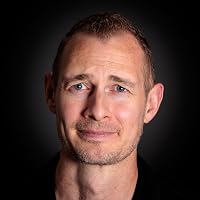
George Eman Vaillant, M.D., born 1934, is an American psychiatrist and Professor at Harvard Medical School and Director of Research for the Department of Psychiatry, Brigham and Women's Hospital.
Vaillant has spent his research career charting adult development and the recovery process of schizophrenia, heroin addiction, alcoholism, and personality disorder. Through 2003, he spent 30 years as Director of the Study of Adult Development at the Harvard University Health Service. The study has prospectively charted the lives of 824 men and women for over 60 years.
A major focus of his work in the past has been to develop ways of studying defense mechanisms empirically; more recently, he has been interested in successful aging and human happiness.
Villant has received the Foundations Fund Prize for Research in Psychiatry from the American Psychiatric Association, the Strecker Award from The Pennsylvania Hospital, the Burlingame Award from The Institute for Living, and the Jellinek Award for research on alcoholism. In 1995 he received the research prize of the International Psychogeriatric Society.
Reporters love to interview old people and ask how they reached such an advanced age. In theory this should be helpful, but the elder person is either spinning the story or forgetting the details, so their advice is fanciful, at best. Plus, we sometimes change our view of history to be able to live with ourselves.
But in Aging Well, Dr. George Vaillant reports on the analysis of three longevity studies spanning, in some cases, almost eighty years. During this time, the researchers interviewed individuals from childhood through old age and recorded their observations. The three studies written about here are so important because they track the participants' early responses and continue tracking them right into elderhood. So when they reach old age, you can see what they're spinning, whether deliberately or inadvertently.
For example, some of the elders in the study who were beaten and starved during childhood reached a place of forgiveness in old age, and now viewed their parents as tough but loving. Some of the brilliant women, who were denied careers and high wages due to discrimination and the sexism of the time, adopted a sunnier retrospective on this injustice. These coping mechanisms were discovered because the researchers had recorded what actually happened and what was actually said, back when study participants were kids, young adults, middle-aged, older, and old.
The two examples given are representative of the tactic of sublimation.
Sublimation is the art of putting the best spin on something you can’t fix, and really being okay with that. This is a capability that’s beyond the reach of younger people. In Dr. Vaillant’s words, “Such maturation requires emotional development, years of experience…and the continued biologic evolution of our brains, whose connecting pathways–especially those integrating desire and reason–continue to mature past age 40.”
As one elderly member of the study put it, "Contrary to all expectations, I seem to grow happier as I grow older. I think that America has been sold on the theory that youth is marvelous but old age is a terror. On the contrary, it’s taken me sixty years to learn how to live reasonably well, to do my work, and cope with my inadequacies."
The other three main coping strategies that we develop with maturity are:
1. humor (the ability to laugh at what can’t be changed, and while laughing, not cause others to suffer) 2. altruism (getting pleasure from giving to others what we would like to receive) 3. suppression (in my words, this is the ability to stifle yourself in unpleasant circumstances, and still be happy. It’s not denial; it involves being fully aware of the cause and outcome, but it’s done for the greater good. Think of keeping your mouth shut when the drama kicks in at, say, a holiday dinner.)
One of the most surprising things I learned was that an unhappy childhood is probably the least important predictor of happiness in old age. Per Dr. V., “…unhappy childhoods became less important with time…a bleak childhood did not condemn (them) to misery.” When a study subject reached his/her seventies, the difficult childhoods (and I mean difficult even to the point of malnutrition and abandonment) did not correlate with poor mental or physical health.
Women Overlooked: The Flaw in the Studies
As with most studies, sociological or biological, the male experience was the only one studied, and from that, it was assumed women's experience could be extrapolated. For example, here is one description of healthy aging from an elderly male participant:
"Old age is knowing what I’m doing, the respect of others, a relatively sane financial base, a loving wife, and the realization that what I can’t beat I can endure."
But what about the “loving wife”? What was her secret recipe for aging well? We’ll never know. Dr. Vaillant apologizes for that, and tried to balance things out by including data from female participants of the The Terman Study.
I picture a man being interviewed about his views on aging, and saying he had a great wife who he was crazy about. And I’d imagine the woman smiling and gritting her teeth through the interview, and wished I could ask her, what was it like giving up your dreams to help this man be successful? How are you now? How did your experience of aging alongside this happy man compare to his?
Women learn suppression early and deeply, and it helps the men, but what if it isn’t good for them? And do women stop doing it as much as they age and gain confidence? We can't know from these studies.
Still, there is so much in Aging Well to learn from and marvel over. It's a fascinating book, and I recommend it.
Aging Well by George E. Vaillant, MD. (New York: Little, Brown and Company, 2002).
I am very impressed by this book. The findings from Aging Well are based on a longitudinal study of the lives of three different groups of elderly men and women. One group is 268 male Harvard University sophomores selected between 1939 and 1942, most of who continued to participate in this study for nearly 60 years (or until their death). The second group is a sample of 456 disadvantages Inner City men born in 1930 studied for 70 years. The third group, a sample of 90 middle-class gifted women participating in the Terman Study conducted at Stanford University in 1922, were studied for almost 80 years. The male groups had periodic physical exams to evaluate their health. All groups completed periodic written surveys as well as participated in personal interviews to evaluate their mental health over the 60-80 year period.
With a background as a manager of marketing research, you can imagine why I would be so impressed with this qualitative and quantitative study. It is unprecedented to track respondents over a 60-80 year time period. The book is very clear and well-written. I don’t want to be a spoiler, so I will let you read the book. This book extensively uses the adult development process conceptualized by Erik Erickson. I was impressed by the importance of social and emotional maturation to adult well-being and healthy aging.
I might have given this book two stars. It was readable but I thought me and the author had a personality clash.
Some of the Harvard men led such remarkably good lives that I felt had not much relationship to mine or many "ordinary" people.
Also I know many people who have enoyed their retirement so seeing what made people enjoy retirement was not an issue for me.
The author stresses the importatance of family and children in sucessful aging. While I am married(which he also said was important), I don't have children or siblings so I could not relate/found disturbing about the importance of siblings and children when aging.
A lot of anecdotes, but they are useful in demonstrating the author's ideas. A summary chapter would have been useful.
It is a hopeful book, in that Vaillant writes that your childhood has diminishing influence on your mental and physical health as you get older.
Having a large social circle that you care about is definitely good for maintaining a long life of health. Of course, you read about the usual suspects: don't smoke, don't abuse booze, have a great marriage, guide the young. So much of what he wrote agrees with what I read in Thirty Lessons for Living. I recommend you read both.
Lots of useful insights here. Some takeaways that I had better put to use unless I want to be an old man many years before I should:
Find good people to be with and add to your life. At all ages.
Don’t complain.
Don’t preach, don’t offer unsolicited advice, don’t bitch about “kids these days” or how the younger generation is a bunch of idiots…
Don’t be the kind of person other people won’t want to hang out with.
Ask yourself “How do you make a life that you’ll be glad you made?”
Develop appropriate and useful coping mechanisms.
Don’t “choke on anger.” It will kill you.
Graceful aging involves being open to new ideas, remaining curious and continuing to learn from the next generations, helping others, staying social by maintaining intimate contact with old friends, making new friends, caring about others, and remembering that “biology flows downhill”... you help those behind you, rather than expect them to care for you.
Also maintain a cheerful tolerance of the indignities of old age. Maintain a sense of humor and a capacity for play. But also insist on “sensible autonomy”--doing for yourself what is reasonable. Be the type of patient that a doctor will enjoy caring for.
Finally, be a “gardener” both literally and metaphorically in the sense of cultivating relationships, friendships, skills, finding people to help, etc.
I undertook this book after reading a favorable review of its recently-published sequel, Triumphs of Experience, in the WSJ. For over 40 years, Dr. Vaillant has led a Harvard study extending across the entire lives of a large (250+) group of Harvard graduates. Those subjects who are still alive are now in their late eighties or older. In this book, published in 2002, Dr. Vaillant reports on his findings as to what factors influence how lives (mostly men's, but a few women's as well) turn out. The book is full, perhaps overly full, of extended case studies of individuals. The meat of his arguments could have been served much more concisely and, for me at least, more effectively if the book had been less ad hominem. But then it wouldn't have been long enough to be a book, would it? Another concern was my perception that Dr. Vaillant, who has spent most of his adult life on this project, seemed so deeply involved with the study and its subjects that it raised a question about his objectivity. All in all, some interesting points, but not what I had hoped.
A masterpiece, a special blend of empirical research and wisdom from the humanities; it's firmly among the greatest in my pantheon of great books. Vaillant writes with grace, and this book is even better than his landmark Adaptation to Life. The vignettes are revealing, joyous, sad, moving, and beautifully perceptive. It is a book I'll be rereading and giving as a gift many times throughout my life. VERY highly recommended!
Adult development, what an interesting idea! Fun to read about people in their 80s whose lives were followed in one of three studies, all brought together in this book. Some had very difficult childhoods; others began their lives with every advantage. We learn--Meeting up with good people can improve your life; alcohol and cigarette abuse are really bad for you; it's good to make new friends as the old leave or die; helping others can be really good for you. I read this at a good age. I was telling my mom about it; I think she could have written it. It has lots of good nuggets. Here's an example: Stuart Little listed 3 important rules: (1) Be a true friend. (2) Do the right thing. (3) Enjoy the glory of everything.
I read this book about 10 years ago when it first came out and I thought it was really good, so I wanted to re-read it now that I'm closer to being old. I didn't get as much out of it this time. I think I had already absorbed most of its lessons 10 years ago and am living them. Still, some of the bios were interesting, and it did re-affirm NOT to get stale as I age, and especially not to allow my social circle to shrink, which I imagine is pretty hard when everybody you knew starts dying. Also encouraging to hear that many people are happiest after 60, still satisfied with their marriages and, if healthy, many people are even still happy with their sex lives. Woo hoo!
Skimmed thru it pretty fast but fascinating stories of people. One can respond by feeling bad about yourself - for not being a self-actualized person - one can be inspired by the lives of others and appreciate what the research shows about aging well. Being creative, active, learning new things, being social...
This entire review has been hidden because of spoilers.
This is a must-read for anyone dealing with aging or friends/family who are aging. Inspirational and surprising, this longitudinal case study is a fascinating read for anyone with an interest in psychology, aging, and what makes us happy as humans.
I had to stop reading this book after plowing through about a third. The stories of Harvard elites, brilliant women and even the inner city cohort left me sad and feeling inadequate. And, generally, I am not either. The book, at least the first third, is filled with the observations made by a reviewing panel of psychiatrists, mostly from the Freudian psychotherapy school, using an Eric Ericson framework. The poor subjects are judged over and over again as they age and we are to draw conclusions from their changes and success or lack thereof. My mother was always comparing me unfavorably to my peers, and I rarely felt appreciation from her about my own successes - darn that Freud, it is always the mother's fault. If you follow my reviews, I don't read biographies very often. Maybe hearing other people's stories forces me to reflect unhappily on my own in comparison, and, again, I think I compare well. I can't explain it. I just found it tedious and not rewarding, so, I quit reading it, and now I feel guilty about that.
As I reach 65 and give serious consideration to retirement I greatly appreciate George Valiant’s discussion and advice on the subject of “Aging Well”. I believe the time spent to read this was very worthwhile and expect that I will refer to it again and again as I enter a new exciting chapter of my life.
Amazing longitudinal study and a rare glimpse into many interesting lives. It was hard to reconcile the variations in people’s stories with the author’s struggle to tie it all together into an academic paper. But a good book to have in the shelf as we grow old.
Aging Well surprising guideposts to a happier life.. is the ~50-year follow-up (published in 2002) of the Harvard Study of Adult Development, which was first reported in the 1977 publication by the same George Vaillant, MD, of Adaptation to Life. This report provides the continued longitudinal study of the Harvard College cohort which was first enrolled in the late 1930s. This book tries to tackle the subject of positive, or successful, aging. The author defines and then examines life satisfaction; social relationships; and physical health. With regard to life satisfaction, he opines, “…whenever I write pedantically of successful aging – think joy. The heart speaks with more vitality than the head…there will be many paths…there will never be a right way. But the goal is straightforward; How can we make the trip to three-score-and-twenty a journey that we will be glad we made?” When he begins to discuss relationships with others as a component of positive aging, he further defines: “…successful aging means giving to others joyfully whenever one is able to, receiving from others gratefully whenever one needs it, and being greedy enough to develop one’s self in between.” Ultimately, it was necessary to consider physical health, disability, and death as they applied to healthy aging. The author considered both objective and subjective components of physical and emotional health. Among the most important findings reported in this book, for me, were: 1. All of the subjects continued to change over the course of their adulthood, as they had in their youths. Put another way, change, including many changes for the better, did not stop at some arbitrary age, like 50. As long as they lived, the subjects continued to change. 2. Repression, or forgetting, continues throughout our lives. Memories change, as do our interpretations of the things we remember. In the author’s words, “Maturation makes liars of us all.” The author described himself as a psychiatrist who had previously studied schizophrenia, alcoholism, heroin addiction, and personality disorder, and then took up the comparison of healthy and not-so-healthy, aging. He reported that for him the most important findings from this chapter of the longitudinal study were: • Good people in our lives help us cope with the bad things that happen. • Healing relationships are facilitated by gratitude and forgiveness. These two concepts seem much more important and feasible for mature, translated older, than younger people. • A good marriage at age 50 predicts a good marriage at 80. Besides surviving to age 80, it is important to note that for many of the vignettes, the marriage at 50 was not necessarily the first marriage. • Alcoholism was associated with unhealthy aging, and the author surmised that this was largely due to the erosion of social supports. In other words, we are talking of substance abuse sufficiently severe to lead to the dissolution of personal relationships and families. • The most important observations regarding retirement as described below. • Physical and mental health have subjective and objective components. Beyond simple survival, the author felt a subjective sense of wellness and/ or functionality were more important than many objective measures. From a medical perspective, I was intrigued by the factors which did and did not appear to be associated with longevity. With regard to predicting a long survival were; no heavy smoking; no alcohol abuse; stable marriage (importantly in many cases, a second marriage); exercise; not being overweight; and the use of mature psychological defenses, which the author repeatedly refers to as ‘the ability to make lemonade from lemons’. As reported in Adaptation to Life, the most mature coping methods were altruism, sublimation, suppression, and humor. Conversely, as Dr. Vaillant wrote, “Surprisingly, by age 70 parental social class, stability of parental marriage, parental death in childhood, family cohesion, and IQ – variables important to young adulthood – were no longer predictive of outcome.” Another useful compilation from this book is the four basic activities that appeared to make retirement rewarding; • Making new friends, particularly after the deaths of parents, and other loved ones • Learning how to play or do things primarily for fun not compensation. Admittedly, this is what my wife and best friend, calls 'a high-priced headache', namely it is an option only for those who have saved enough to cover, food, shelter, and healthcare! • Exercising creativity, which necessitates having the time to do so. • Lifelong learning.
The author defined social and emotional maturity in terms of sequential mastery of life’s tasks. A contribution of this study is to contrast the sequential tasks of childhood and young adulthood as listed by Erik Erickson, with a comparable sequence for older subjects. I found the definition of the 6 sequential tasks that this book posited for older people, to be particularly helpful: 1. Identity: who am I? What do I value? 2. Intimacy: interdependent, reciprocal, committed, and contented relationship 3. Career consolidation: Having established a career with which one feels contentment, having received adequate compensation, a sense of competence, and commitment 4. Generativity: being a part of something which lives on after we are gone; guiding the next generation 5. Keeper of the meaning: contributing to the continuation of values and a sense of justice 6. Integrity: the acceptance of one’s one and only lifecycle as something that had to be and accepts no substitutions. I highly recommend this book to thoughtful and curious, elderly readers.
Great statistics and great anecdotes, both working together to give a general picture of healthy aging. Made me both hopeful and apprehensive (still) about the topic of aging and eventually passing on. You could some it up, more or less, into six basic statements: don't be an alcoholic, don't smoke, be very generous with what you have, develop social connections at every step of life, continually play regardless of your age, and love deeply and freely. Always good advice.
As with most non-fiction, I feel like a good essay would have done the job. What made this better was that the anecdotes were really entertaining and interesting.
I learned from this book that aging well relies on more that just the physical care of the body. Relationships are another key aspect of living a healthy life, and this book reminded me that I do not want to get to the end of my life and not have had good friendships in it. I was also surprised to learn in this Harvard study that level of education played a role in aging well. I am a committed life-long learner.
This book made me very upset. Alright, it was an experiment and I assume some of the data were useful/interesting. But the whole narrative is just stupid. The author marks all introvert people and especially the ones that aren't hyped about his little study as failures. You must have a wife and preferably still work 40 hours a week at the age 78 to be deemed successful. One model fits all, oh yea...
I skimmed a lot of this and skipped one or two chapters entirely. I read it for a book group and would never have chosen it to read it on my own. Some of the stories of people's lives were interesting. However,I am very suspicious of studies like this when they try to draw conclusions about people in general. And the longitudinal studies used as the basis for this book had a very narrow base.
George Vaillant is one of my thought-heros. A leading academic, researcher and writer, he does not seek the spotlight but earns complete trust. The findings in this book have stood up to a decade of active research in numerous disciplines. If you want to age well, and who doesn't, read it for yourself and be creative in finding ways to share these essential findings with those you love.
The author teaches at Harvard, so the explanations of the research methods and analysis were, at times, a little over my head. But overall, the text was accessible, I found the discoveries fascinating...and what a great topic!
George E Vaillant is a medical doctor who followed a longintudinal study of three cohorts or individuals as they aged. It is full of inspiration albeit, a tad dry of a read.
The author and his team studied three separate cohorts for more than 50 years and this Study of Adult Development has some great advice on what you need to age well and live a happier life post retirement. The cohorts were Harvard men, middle class women and low income men. All caucasians who were followed with questionnaires and interviews for over 50 years.
Positive aging means to love, to work, to learn something new, enjoy the remaining precious moments with loved ones.
Erik Erikson, the 1930s psychoanalyst lays the foundation for adult development and identifies 6 adult life tasks: Identity-a sense of one's own self separate from parents; Intimacy-living with another in a committed relationship; Career Consolidation-expanding personal identity to assume a social identity within the world of work; Generativity-demonstrate a clear capacity to unselfishly guide the next generation (mentor, guide, coach, consultant); Keeper of the Meaning-the wise judge, preserving the culture; and Integrity-wisdom as a virtue.
Emotional Maturation is important as are sublimation, humor, altruism, and suppression. The author uses real examples of men and women from the study to illustrate the concepts.
Chapter 3 talks about the past and how much it matters. If you had a great childhood, you're in good shape, but an unhappy childhood becomes less important over time. The 6 adult life tasks have devoted chapters. Chapter 4 on generativity, claims that taking care of the next generation (a virtue), is a key to successful aging. Biology flows downhill but first we must develop ourselves. For a good marriage - you need commitment, tolerance, and humor. We learn from our children-they inspire us.
Chapter 5 is Keeper of the Meaning, and the virtue is justice-being a judge. Chapter 6 is Integrity-task is to accept the end of life and disease. Chapter 7 is healthy aging-a second pass. Predictors of healthy aging before 50 include ancestral longevity, cholesterol, stress, parental characteristics, childhood temperament, and general ease with social relationships. So, by age 70 these don't predict much, but do somewhat before 50. By age 70,7 factors that predict healthy aging are: not smoking, having an adaptive coping style and using mature defenses, not abusing alcohol, healthy weight, stable marriage, some exercise, and years of education-the more the better up to a point. Self care and perseverance, not IQ and parental income are better predictors. You need 4 or more of the 7.
Chapter 8 is about what's needed in retirement. Play and creativity, new social networks, lifelong learning, letting go of self-importance, flow helps. Play, create, learn new things, and make new friends.
Chapter 9 is about wisdom. Does it increase with age? The answer is not necessarily. Chapter 10 talks about religion and spirituality. Hope and love are more important. It's unclear. Chapter 11 asks do people really change over time. Character is not set in plaster. People do change and having a good marriage and social contacts makes a huge difference.
Finally, we need forgiveness, gratitude, and joy in our lives. So, stay away from booze, find a loving mate, find a hobby, volunteer, find meaning and purpose and you'll be happier in your older years.
Initially I was going to give this five stars because the author has distilled the research into a very readable book.
However, the subtitle "surprising guideposts to a happier life" was misleading. The likelihood of falling into the happy-well group was based upon things like having a warm childhood, stable marriage, close relationships (ie able to let people in), higher social class, making healthy lifestyle choices (not smoking or abusing alcohol, maintaining a healthy weight and exercising). People who are lucky enough to have all of that are extremely blessed. The fact that they're in the most happy/healthy group isn't all that surprising...?
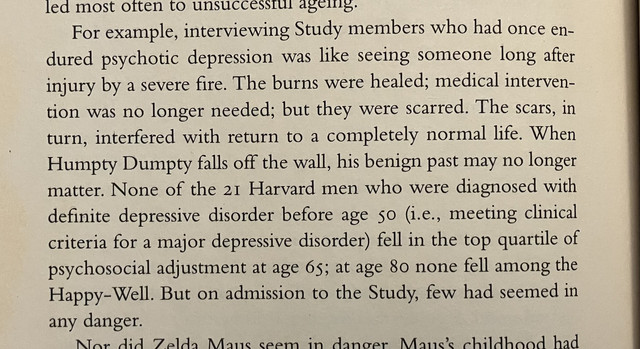
The one thing that did surprise me was that if you have ever had a diagnosis of major depressive disorder, you can rule yourself out of being in the happy/healthy group EVER. It's not going to happen:
So that was kind of deflating but perhaps forewarned is forearmed? If you have a history of depression you need to manage your expectations and strive to stay out of the 'prematurely dead' or 'sad/sick' groups. (Or if you're feeling ambitious you could aim to be in the intermediate group, which would be an achievement against great odds!)
Oh! Also there were quotes but no actual case studies here, all the examples were composites of the study participants, with names like "Gwendoline Havisham" or "Anna Love". They were almost like stock characters.
It was noticable that there were no examples of people who lived non-conformist lifestyles who turned out okay. (For example, the skater slo-mo is quite clearly in the top group but according to this study he shouldn't be as he's divorced and has a history of depression). A discussion of outliers like him would have rounded out this book but apparently there weren't any (???)
Overall it was a good read, maybe 4 stars. There's not a lot of actionable steps you can take after reading it though. If anything by the end it was like, you're got bad factors, surprise! Studies have shown that things will only get worse! By the end of this book I felt like, "hang on, wait. I want to be an outlier, where are the outliers?"
If you're interested in knowing more, this book is based on three cohorts. A summary of one of the cohorts is here, it's very similar to this book - https://en.wikipedia.org/wiki/Grant_Study