From the New York Times bestselling author of When Elephants Weep and Dogs Never Lie About Love comes a personal tribute to 100 fascinating animals. B&W photos throughout. Full-color insert.
He has written several books books critical of psychoanalysis, psychotherapy and psychiatry as well as books on animals, their emotions and their rights.
He currently lives in New Zealand with his wife, two sons, three cats and three rats.
Until reading this book, I had no idea that there were Westerners who so closely followed the tenets of Jainism as this author, Jeffrey Masson Moussaieff. Jainism is an ancient religion that originated in India, and its adherents have a strict policy of nonviolence towards all living things. And when they say “all,” they mean all. This obviously means they're vegetarians, but it also means things like no killing bugs, not even gnats. In fact, Jains traditionally sweep the floor in front of them as they walk so that they remove any insects from their path, lest they be crushed. This is serious hardcore stuff. Although the author of Altruistic Armadillos, Zenlike Zebras doesn't identify himself as a Jain, he fits this description better than anyone I've ever met, or heard of.
But let me back up a bit. This book is divided into 100 chapters, with each chapter giving an overview of one of the author's favorite animals, including prosaic animals like the armadillos and zebras from the book's title, as well as more obscure animals like bower birds and cochineal insects (which achieved their 15 minutes of notoriety recently when customers found out that Starbucks uses ground-up cochineal insects to color their strawberry Frappuccinos...but as you will learn in this book, almost anything that's red and not found growing in nature is only red because of the guts of innumerable little cochineal insects). Each chapter of the book includes little-known facts about the animal, including any of its weird or amazing features, but especially a list of all the ways that humans have mistreated it throughout history.
This is where my beef (pun definitely intended) with the author comes in. Ok, man, we get it. You're a vegan. You think animals have emotions just as powerful and real and valid as human emotions...even starfish. But by turning each chapter into a relentless litany of the endangered species list, Moussaieff alienates nearly his entire audience by implying that anyone who benefits from animals in any way is a murdering, immoral stain upon humanity.
And it's not just food. His veganism isn't just about not consuming animal products (which is already quite extreme – no honey, even). Moussaieff takes it a step further by refraining from even using any animal products in any way. But not just obvious things like no leather or no furs (which I can sort of support even though I eat meat). This guy won't even wear silk clothing because doing so is stealing the labor of hundreds of thousands of silkworms. I can take some of his beliefs seriously – no killing elephants for ivory, no killing tigers for sport, etc. seems like common sense and simple ethics. But not wearing silk because it amounts to profiting from the slavery of silkworms? I just have a hard time not finding that ridiculous.
This book really is chock-full of tons of interesting facts about a wide variety of animals, but unfortunately I found the preachy tone and schoolmarmish finger-wagging to greatly outweigh any enjoyment the book could have provided.
The title is a screamer for me and quickly caught my attention while the author quickly points out that his hope for the book was that it would be like a conversation between him and the reader on some of his favorite animals. If the concept could have been pulled off then it would most definitely have made this book one of the most interesting that I had ever read but instead he flops and in the worst case instead of building a personal bond with the reader emphasizes the fact that there is a separate standing line between the author and the reader.
Meanwhile the book does a great job in exploring various animals with some of them being iconic and well-known species while others don't have much of a fan base, which really made me lean towards the author himself. Furthermore I was glad that he did include quite a bunch of domesticated animals thus working on helping to dispel some of the darkness and bias that many are led to know about these particular animals, mostly from a lot earlier age.
Unfortunately the picture at the front of each animal chapter was a black-and-white with some of them being quite easily found if you were to Google Image the animal itself. All in all I would have hoped for a work like this that there would have been used for the photos at least more interesting photos displaying some of the animals true selves in their natural habitat and color would have been nice but I am not sure if it would have been totally feasible.
At the same the entries weren't consistent with some a few pages long and others just a bit longer as some explored a single species and others a whole group thus scientific names appeared for some while others didn't have. And the fact that out of the 5 rhino groups he only chose the two African species that are better known didn't escape from my attention. Keeping, though, to this inconsistency led the entries to be either somewhat educational, full of self-questioning about a purpose of an animal, the telling of the exploits of the author focused around that animal, the rants against human activities involving the said creature and/or an array of other information.
For those who definitely enjoy reading about animals there may be a new nugget or two you could possibly find but most of the information has probably been read before in other sources while some of the author's questions don't make sense since it would seem science has already answered them to the extent that they are able to.
Again all in all a decent book and possibly a good starter for those who may be interested in the topic although depending upon your reader personality one that may need to be read in short rounds. Otherwise again if you are into reading about animals in your spare time it may be one you may want to leave laying on a shelf if found in a used bookstore.
Jeffrey Moussaieff Masson is one hell of an interesting character, if not exactly for the better. But I'm not hear to pick on him for being one of Freud's disciples; no, I'm here to pick on him for being a hypocrite who anthropomorphizes animals beyond the confines of good-faith do-gooding who can still manage to write an entertaining field guide to his favorite 100 types-of/species-of animals. I picked this book up at a library sale as I was getting back into reading zoological nonfiction, and I'm glad I got this out of the way sooner than later, because if you're really into zoology... this isn't exactly going to do much for you.
*Altruistic Armadillos, Zenlike Zebras* (a name which betrays how Masson colors the animal kingdom rather aptly) consists of 100 disconnected 2-5 page essays on different kinds of animals. These kinds can be individual species like the New Zealand Longfin Eel or groupings of similar species like jellyfish or honeybees. The entries can be relatively continuous recounting of Masson's own experience with said animals that explains why he admires them or succinct explanations of their social structures and groupings while potential being rather herky-jerky explorations of topics ranging from said social structure to evolutionary history to biological quirks and everything in between. It's not very uniform and therefore not a great reference book, but the entries are snappy to read and written in a pleasing way. The entries do get rather repetitive and borderline-oppressive when they get dreary and castigate humanity for our sins against the covered species, as almost all of these entries do, and that uniformity - whether it's deserved or not - does eventually make this book a bit of a tedious read. Still, in a vacuum, a lot of these writings are good and engaging. Masson should get some credit for that.
With all that said, Masson shouldn't get credit for scientific accuracy or understanding zoological emotions. I cannot say it better than some of my fellow Goodreads reviewers, but basically, Masson is making emotional pleas on the worth of each animal without digging into the science to back up his claims. A particularly ridiculous example is where he chastises those who believe that female praying mantises eat their mates' heads during reproduction, insisting that this ridiculous notion springs solely from a singular paper in 1886 and that the big bad collective consciousness is being oppressive by perpetuating this myth... he even seemed to imply that male mantises only get their heads eaten because they're rape-y or... something like that. Now it's true that a lot of mantis species don't do this, but I can't find any evidence against praying mantises doing this, and this lack of respect for observational science is common throughout Masson's work. He spends a lot of time telling us how this or that behavior suggests that a rather un-humanlike altruism is present in different animal species, and he insists that certain things that humans do make animals sad, and that makes us the bad guys.
For example, Masson spends some time talking about how wearing silk means one is supporting the slaving of silk worms, and at other points he insists that because brain size doesn't equate the brain intelligence it's foolish of us humans to assume the intelligence of any other animal. And then, in the next entry, he'll make a scientifically baseless claim about how some animal's behavior showcases joy or sadness or love or selflessness - anthropomorphizing to the extreme, even though he talks about how attributing human emotions to animals only hurts them in the long run... I don't want to beat up on his personal belief system (rooted in veganism and hating all instances of zoos and the like, rather unsurprisingly), but I don't believe that shoving one's head up their own butt when writing makes for a sound reading experience for the reader. I do wonder if I'm being too harsh and if I should take it easier on Masson and give his beliefs more thought - after all, it was mostly after the fact that I took issues with the constant dour and skewered tone of this book - but I think that holding authors to a level of credibility is reasonable in the reviewing line of work. And when rating nonfiction, how important is it to balance how credible you feel a book is to how much you enjoyed reading it? Those are two different metrics - I'd probably give this book a 5/5.5 or a 7/7.5 respectively - but I can't give a book two different ratings at the end of the day.
So to balance it out, I'll give this book 6/10. I wish I could've walked away from it with more (or at least, more that I didn't have to question), but I still enjoyed my time with it and think that most of the people who will read it simply will walk away with a pleasant experience under their belt. I just don't know how deeply you can look into it. And this definitely isn't a book for the experienced zoologist - even without its factual gaffs, its information isn't really exclusive; it's the kind of stuff that you'll know if you've been around the animal block a few times, and even I - a relative amateur - knew a not-insignificant amount of the facts presented. Anyways, I'm looking forward to a study-based book called *A Pride of Lions* later this spring, and whatever animalistic books I'll be reading in the future. Thanks for reading, and good luck out there among our furry, scaled, and feathered friends, no matter what emotions you think they feel.
One hundred very brief essays on one hundred very fascinating animals. However, I think other reviewers had the right idea when they gave themselves a year to finish this book. Reading it for long stretches just got tedious, not because the individual entries were encyclopedic (which most people equate with "boring"), but because Masson is just plain repetitive and, to me, grating. What I wanted was to be convinced why I should appreciate these 100 species as individuals. What I usually ended up getting was a long history of how humans had exploited or been affected by these species, and how very sad and terrible and just plain awful that was. For someone who throws around the word "anthropocentric" so much, Masson doesn't seem to realize that that's just what he's guilty of most of the time. As for anthropomorphism, Masson scoffs when humans attribute "evil" traits to animals, but is just fine with ascribing the good ones. Overall this was a nice book and I did learn to look at some of the included species in a new and more appreciative way; but be prepared that this book is more autobiographical -- admittedly it presents itself as such from the very beginning -- than scientific. If you don't like some of Masson's views (which I didn't), you're going to get annoyed or bored with this book. It would be better in small doses for people who don't take it too seriously, and who don't mind a little unfounded whimsy in their science.
I've read and own a number of the author's other books, but this one fell short for me. I read the first 100 or so pages, in addition to several other selections. There are a few pages on each of the 100 animals (species or larger groups) featured, which means there isn't much chance to cover any of them. Animal lovers may not learn much new.
In this book in particular, Moussaieff Masson does a lot of outright ignoring or dismissing of science. A common theme is "I wonder why animals do X, maybe it's because Y" when in fact ABC is something that is well studied and understood by science (even when the finding is that the reason is indeed Y, the author presents it as if these notions are his own casual musings). At other times he'll present things like "scientists say animals do X, but I think Y is actually true." As both a scientist and an animal lover, I lost all respect for the work. Claiming female praying mantises don't ever kill males during mating was the final straw that sent this book to the donate pile.
This book is supposedly about the animals, but in fact, it is about the author's pro-animal agenda. Nobody really enjoy soapbox books, and I don't agree with the author's messages in general, but I was hoping to at least enjoy from fascinating facts about those animals. First, I think the structure of the book leaves much to be desired. With only two or three pages per animal, one feels like many of them deserve a few more pages. I think half the animals and double the information would have made more sense. Second, I already mentioned the agenda thing. It was repetitive and tiresome. Finally, I was disappointed with the large number of inaccuracies. The Hebrew edition has comments from a scientific editor who points out dozens of them. I think the very least should have been a scientific verification of correct fact. Two stars out of five.
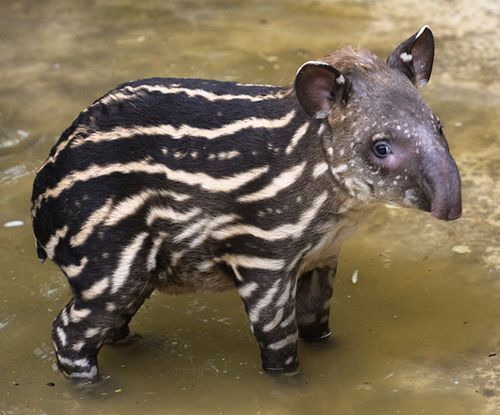
Here's a fascinating look at dozens of mammals, sea creatures, and birds - some endangered, some threatened, all worthy of a look. Particularly interesting are the less studied animals like tapirs, "living fossils" who've been on this planet in some form or other for 20 million years:
They live in the depths of the forests and near water, in which they love to swim. They are preyed upon by jaguars, but can escape by submerging with the jaguar on their back, forcing the predator to swim away. They can walk on the bottom of ponds and rivers.
AND . . .their babies look like watermelons with legs!
I picked up this book in the hopes of a light-hearted read filled with fun facts and anecdotes about interesting animals. Instead, I was bombarded with depressing statistics about animal abuse and conservation threats, and a plethora of anthropomorphic speculations from the author. I think it's safe to say that anyone who picks up a book with this title is already interested in the well-being of animals, and does not need to be constantly reminded of the depressing state of our natural world. This book needs to be marketed more appropriately.
I'm not sure how to rank this book. I really enjoyed reading it, although I'm not as passionate about wildlife as the author is. It is clear that he loves every single animal he writes about. And he brings up many interesting and enlightening facts about each one. I find this book has given me a greater appreciation for many kinds of animals. That said, sometimes his writing is just a bit off. Odd phrases. Non-sequiturs. A bit preachy at times. Nevertheless, I would gladly recommend this book to anyone who has any interest in the fascinating animals with whom we share this world.
I have read many of this author's other books and this is one of my least favorites. It is like he is trying to combine an encyclopedia with some of his books on animal emotions. This could be some of my own personal bias but I don't like that so many personal remarks are added in. I am a scientist, I like facts. I also like his books on animal emotion. But I don't like it when the two are combined. He could write some really interesting things about little known animals but there is too many personal remarks and too much emotion in a book that is seeking to educate. He projects way too much his own thoughts on what the animals are thinking rather than sticking to the facts. He also has many facts wrong or he states things as fact that are only a matter of theory or conjecture. Really annoying to a scientist. Definitely plays favorites with cute/cuddly/innocent. Predators not so highly thought of in all cases (see chapter on lions). He also seems to gloss over the "darker" side of animal behavior. In the chapter on Whooping Cranes everything seems to be sunshine and roses for the 2 chicks that hatch. He fails to mention that siblicide is the norm. Teh chick that hatches first always kills the second unless there is a super huge amount of food. Also he states theories as fact or denounces scientific thoughts as impossible based on his opinion, not based on real evidence. See the chapter on zebras and the theories about the purpose of thier stripes. He shoots down all theories except his own unsubstantiated ideas. Pisses me off as a scientist who follows stict guidlines for these things.
Altruistic Armadillos, Zenlike Zebras by Jeffrey Moussaieff Masson provides a short description of some 100 animals throughout the world. Masson is an excellent writer whose briefs about these animals are entertaining, humorous and informative but infused with the author's point of view.
His choice of animals includes most domesticated animals including, the cat, dog, sheep, pig, cow and goat but omits the horse. Of wild animals, the elephant, tiger, panda, kangaroo, giraffe, are all included. He relies heavily on animals from Australia and New Zealand which is perhaps understandable as Masson, currently resides in New Zealand. Nor has he forgotten invertebrates or fish. He has however forgotten the deer. I am sure that everyone who reads the book is like me and wonders "Well he has included the Yeti, pinnipeds, silk worms, rats, cochineal, but how could he forget...."
Still it is a fascinating book and will be a great resource and reference book for me.
Jeffrey Moussaieff Masson is well-known for his books regarding animals; I read his book Raising the Peaceable Kingdom and enjoyed it very much. Altruistic Armadillos, Zenlike Zebras is another fun read: Masson chose 100 of his favorite animals and researched them. The resulting short essays are included here. He picked animals from all over the spectrum, from domestic cats to lions, oysters to sharks, bats to kookaburras.
I learned lots of fun information from Altruistic Armadillos and certainly interrupted my husband’s work many times to tell him my latest discovery. So, read this book if animals fascinate you: just make sure you have someone around to inform of what you learn.
I really loved this book! It was a delightful collection of various animals that are beloved by people around the world. It was just full of fascinating facts (such as one of my favorites, dolphins are just as fascinated by dogs as people are!) and a full bibliography is available online, and a selected bibliography is easily available at the end of the book, making it a nice reference to lead to more in depth knowledge of certain animals that strike your fancy. Though there are black and white photographs, I found myself frequently on Google Images for color pictures... a nice coffee table edition should be made with large, color photographs!
When I finished this book, I dragged my dad to the New York Aquarium just so we could see the octopus. This reminded me of when you walk into an eight-year-old's room and he wants to show you all his toys and what they do. Jeffrey Masson is not a biologist but he is simply truly passionate about animals. Not everyone will like the predictable moralizing at the end of each chapter (he is a vegan and against all forms of animal exploitation), but I found he was winning me over with his emotional appeals.
In this book you'll find out that anyting you ever thought about animals was not nearly as sophisticated enough. For example, rats are highly empathic creatures, crows are way more intelligent than you would ever think, and prairie dogs have different sounds to identify "man" and "man with gun." The book is written so that each chapter is about one animal and only about two or three pages long. One of my all-time favorite books!
Jesus should get the most credit for this of course. But I also thought the book was well-written. Animals are so interesting! And beautiful. While reading, I often got the sense that PETA hired somebody to write a book, and occasionally - maybe twice that I can think of - the author says something utterly ridiculous. But I gained an even stronger appreciation for God's creation and the scientists who strive to understand how our planet works. Amazing!
This was a fun read -- the author gives us a couple of pages of fun facts and philosophical ponderings on each of 100 of his favorite animals. He emphasizes how little we know about many species -- he includes the Yeti, for one. Clearly comes out in favor of veganism, conservation and cruelty-free study and observation. I have to say, though, that this author (or his copyeditor) needs to work much, much harder on subject-verb agreement.
This book is a love-letter to the animal kingdom, wonderfully written in a near-gushing tone, especially when it comes to animals I'd never even considered especially fascinating nor wonderous--the stick bug chapter comes to mind.
Although I may not share the author's fascination with certain animals, I still appreciate learning more about all the creatures he discusses in his book.
Book is basically short essays on different animals. If you are a lover of nature, it should be enjoyable to the average reader. You will learn many nifty nuggets about manatees, koalas, etc. But if you have done extensive study on the animal kingdom, as in college courses, you may be a little disappointed in it.
This book was interesting and the author must have done formidable research.His list of 100 animals gave me information I did not know and was very reader friendly.It also recommends authors and books that sounded interesting.Another thing I liked was his up to date reporting on the new information that is being uncovered about animals and their feelings.Lovely read!
The author anthropomorphizes animals so much that it drives me crazy! The idea that his gut feeling is more important than the scientific research that has been done should of course also be ignored while reading this book. Picked up a couple of interesting facts but please don't take the rest of the book to seriously.
From a-z, gives 3-5 pages on various animals. Great tidbits of information. Like there are currently 35 species of sea horse & they are still finding more. There's all the animals you love & then some. Like the tuatara & the yeti. : > An easy read.
Ok, I really didn't read every single page of this book. It is quite interesting, but I wanted to know more. Each animal gets about 2-5 pages. Sometimes that is enough information. Once in a while too much. But, more often, not enough.