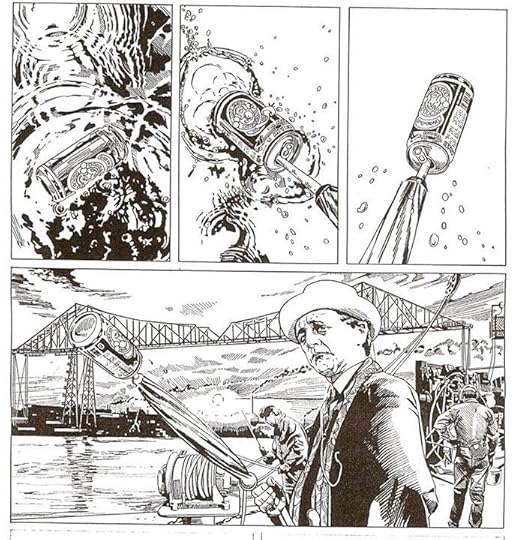
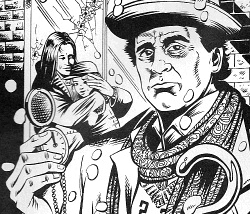
Evening's Empire, a Doctor Who comic strip from the 1990s written by Andrew Cartmel, was never completed in the pages of Doctor Who Magazine. Although a version was printed subsequently, this new collection contains the first publication of the full story as originally intended, with brand-new artwork from the original artist, Richard Piers Rayner.
The golden age of the DWM strip, when it interlocked with the New Adventures, the Cartmel masterplan was in full effect, and the Seventh Doctor would happily take steps that'd make the War Doctor blanche, whether that be bringing a ronin forward from feudal Japan to fuck up a near future street gang, or telling a grubby little Gor fan's mum exactly what he's been up to in the shed. As ever, any John Ridgway art is a particular treat; Richard Piers Rayner does some great work on the title story, though it's a little disjointed on account of occasional pages being redrawn in a totally different style decades later.
Overall, this is the best Seventh Doctor volume to date, with some great writing by Andrew Cartmel and more hints of a connection to Virgin's New Adventures series.
Evening's Empire (180+). Andrew Cartmel tells a story that could have fit right into the last season of Doctor Who, with its realms of fantasy and its questions about what's real. But, he goes beyond that and tells his story in any interesting way that keeps the readers guessing. It's one of the most sophisticated comics in DWM to date, and beautifully illustrated [5/5].
The Grief (185-187). Doctor Who v. Aliens. More or less. A shallow story that has all the strengths of Aliens, meaning exciting action and sudden violent death. As Abnett notes in his author's notes, it does a great job of portraying the darkness of the later Seven [4/5].
Ravens (188-190). Another nice piece by Cartmel, this one heavy on mood. It presents a very miveanipulat Doctor, which nicely links to his darkening in the New Adventures, and we even get a New Adventures reference, with the House on Allen Street ... but overall, this is a good story, and once again it's told in an interesting way [5/5].
Memorial (191). Scott Gray's first work is impressively good! It's a quiet little story, but with its focus on war and peace, it really goes to the essence of the Doctor [5/5].
Cat Litter (192). The last Doctor comic in this volume. It's great that they're starting to really tie into the New Adventures, with this supposedly a coda for Cat's Cradle: Time's Crucible, and there's some nice artwork, but there's not much to the story [3/5].
Conflict of Interests (183). This fill-in about the Sontarans is almost entirely uninteresting. Maybe if we got into their heads it'd be interesting, but instead it's a Dan Abnett Space Marines episode [2/5].
Living in the Past (162). Another Seven and Ace short story. It's almost totally non-interesting. I really couldn't do more than skim it [-/5].
A collection of Doctor Who comic strips from the early 1990s, an odd time for the franchise when fandom and tie-in media were kicking their heels in the vague hope of a new season being announced (they'd have a long time to wait).
Andrew Cartmel, the final script editor of the show's original run and the man generally credited with leading its late rejuvenation, contributes two stories (including the title one) and continues the good work he did on the show.
The influences on the stories collected in Evening's Empire are totemic of the period and worn openly – Aliens, cyberpunk, The Punisher – but that's fine; they at least show an awareness of the franchise's wider cultural context. As late as 1987 Doctor Who was still acting as if the competition was Blake's 7 rather than Predator.
Occasionally the attempts to push the tone in new directions are misjudged, but failure is an important step towards success. Look at the strip "Ravens", for example, in which the Doctor takes a bereaved samurai from feudal Japan to a near-future service station so he may save a different mother and daughter from a murderous gang of yoofs.
The violence and idea of the Doctor commissioning direct slaughter don't feel appropriate for either the brand or character, but the story is a terrific exploration of the show's concept. The Doctor walks between times; actions and consequences, problems and solutions can be five hundred years and 6,000 miles apart for us, but clearly connected for him. The TARDIS isn't just a protagonist delivery system.
'Success' is a difficult and absolute term. A casual reader might be confused by this collection (by both the tone and the stories' increasingly complex relationship with the contemporary New Adventures tie-in novels) but for the die hards interested in the evolution of Doctor Who, this is a fascinating little source text.
This collection really feels like it is being written as part of the VNA continuity proper, rather than the retroactive conclusion the previous collection is given. And it shows in the tone and themes:
Evening's Empire: 2.5 Stars The commentary in the back chronicles the issues they had with getting this story completed. Whilst it is an interesting concept I feel it needed sharper writing and a much clearer art style to convey it properly.
The grief: 2 stars Basically an Alien rip-off. The Doctor meets up with some soldiers trying to find ancient superweapons and encounter some creatures that look suspiciously like Xenomorphs. 1 extra star is for good character work between Ace and The Doctor
Ravens: 1.5 stars Interesting for them to do a story set within one of the VNA books, however the end result is quite dull and most off it just looks like standard pages from a 90s image comic
Memorial: 3 stars A lovely quiet little story after all the violent ones before, much better choice
Cat Litter: 2 stars An experimental story with a bit of foreshadowing but lacks any any depth
Conflict of Interests: 3 stars I liked the clever little twist, still very 90s
Living in the past: 3 stars Ace riding a dinosaur, 'nuff said
The title story is worthy of five stars but only accounts for about 40% of this book. I got this one to fill a gap as that story was never fully published in the original Doctor Who Magazine, for reasons finally explained in the commentary section at the back of this book. The replacement art for the 'lost pages' is beautiful but in a completely different style to the original, which is slightly jarring.
The other stories are not quite as good but still interesting examples of the 'dark seventh Doctor' era, 'Ravens' and 'Cat Litter' in particular. The final text story, 'Living in the Past' feels out of place - shouldn't it have been included in the previous volume? We should have had the more contemporaneous 'Heliotrope Bouquet' included instead...
Another fun trip down memory lane. The Doctor Who comic strip tried to stay current with the Virgin New Adventures books; which were just starting up when these strips were first featured in Doctor Who Magazine. It's fun to look back at where the writing for the strip was going back then. There is an attempt at writing a darker tone to the adventures featured here, but Cat Litter is just fun for the visuals. Ravens and Grief are somewhat dark and for more mature readers. Still it was an enjoyable reading experience.
an excellent compilation of Black and White comics run in Doctor Who Magazine published during the dark time between the show's hiatus in 1989 and its reboot in 2005. the artwork ranges from fantastic to very good and the writing is stellar throughout Cartmel and Co do a marvelous job of bringing Sylvester McCoy to life
If this had been just the overly ambitious (and beautifully illustrated) Evening's Empire story I might have given this 5-stars. But some of the other material wasn't nearly as powerful. Over all this was still one of the better collections of the Doctor Who Magazine comic strips.
comics from Doctor Who magazine featuring The 7th Doctor and Ace. great collection of stories and incredible black and white artwork. these stories came out in the early 90s, after the original run and over a decade till the new series. fantastic
I got this on a whim as part of a three for two offer, being a fan of Doctor Who since the 2005 series but only having seen bits and pieces of the older show and not much in the way of expanded universe material. I enjoyed it. The title story is by far the most substantial, trying to be a condemnation of the misogyny of a lot of sci fi adventure fiction but making the female cast suffer by way of demonstration. Emblematic of the approach is when Ace is told to put on a gold (presumably; the comic is in black and white) bikini, to which her response is to kick a guard square in the chest, steal his sword, and escape, only to quickly fall back into peril and be forced into the slave attire anyway. Much worse things happen to women in the story from there.
The art is impressive enough at times but often falls into uncanny and offputting in ways that extremely realistic styles do. It’s feels like making a comic out of stills taken from the show paused at unfortunate moments mid sentence that make the characters look as bad as possible. Included in this version are some redone pages that might be argued to look better than the originals in isolation, but in practise massively contrast with what’s either side of them in a terribly jarring manner. In the originals you have strict black and white with clear lines and contrast with the redrawn ones done entirely in digital brushes with no sharp lines and a million shades of grey. The contrasting styles could, maybe, have been used to dilettante the reality of Earth with the imaginary construction of the titular empire but that is not how they are used at all. In fact when I saw how the soldiers in fatigues looked in the painted pages I thought it made them look like plastic figurines, which I thought might tie into how Ace describes the empire of stinking of polystyrene cement, but those were the real UNIT troops, not part of Alex’s mindscape.
The second largest part of the book is The Grief which is a fairly middling riff on Aliens in which the Doctor guilt trips a guy into doing a big heroic sacrifice and then leaves him to die, followed by him in The Raven picking up a samurai to bring to the future so that he can murder a bunch of gangsters. I know these stories are trying to be part of an era of constructing the Doctor as a darker, more ambiguous, schemer but it just comes across as petty and mean.
Memorial tries to put this scheming to a better, more touching use, but the backstory being a highly advanced purely good lovely alien species being wiped out by another purely evil alien species seems very unimaginative, especially coming just off The Grief which had the same thing. Cat Litter is kind of fun with the chutes and ladders spread but I felt like I was missing some context reading it, which the commentary at the back of the volume confirmed and I have nothing much to say about Conflict of Interests or Living in the Past.
This entire review has been hidden because of spoilers.
As of the time of writing this review - early July 2025 - my experience with the Virgin New Adventures has been minimal to an extent. Most of it has come via the Novel Adaptations line from Big Finish which is one of the best series they’ve ever put out in their 25+ year history, but in terms of actually reading them it’s just Nightshade, Human Nature and Shakedown (the last two being republished by the BBC in the early 2010s). I will rectify that via a big read-through of them from next year onwards though…
Much like post-2005, the DWM strip tied itself with the continuity of the ‘official’ run of Who, in this case the VNAs, and there’s noticeably a different tone that veers from the ‘season 25/26’ energy into a grimmer, edgier push into the 1990s, beginning with Andrew Cartmel’s ‘lost’ strip Evening’s Empire*, a dark masterpiece dealing with subject matter like misogyny and male-focused objectification through the lens of a surreal Vertigo comic and coated with lyrical prose in a way not seen in the strip before and continuing with Dan Abnett’s The Grief where it continues on said writer’s obsession with Sawardian macho-action finesse by having his UNIT-like squad fight Xenomorph like aliens (which merely highlights them as being more like the Colonial Marines from Aliens than UNIT, despite the Doctorless one-parter Conflicts of Interests trying to convince you otherwise via them going up against Sontarans). I don’t like Ravens very much (much as the core story of the Doctor helping a samurai heal his grief is a good one, having him essentially hire this guy as a mercenary to kill off his enemies doesn’t sit right with me and Cartmel’s writing is shockingly pretentious this time around) but we close things out on two sweet and effective one-handers; Memorial, the first strip to be penned by future comic-strip genius Scott ‘Warwick’ Gray which works just as well as a moving story about war trauma, and Marc Platt’s quirky TARDIS-bound romp Cat Litter which has shades of Steve Parkhouse’s surrealistic fantasy amongst its quiet foreshadowing of Ace’s departure in Paul Cornell’s novel Love and War…
*obviously the version I read was the 2016 graphic novel one where a couple of pages were redone since the original artwork was unable to be recovered, and the new stuff looks beautifully reminiscent of the works of Alex Ross, but it’s very jarring to go from the watercolour-like artwork to the line-drawn one as originally done in the early 90s. If you want me to be honest I’d have preferred it if the entire thing was redone (and even in the intended multi-part format instead of the eventual omnibus format it was published in for Doctor Who Classic Comics, like a ‘what it should’ve been’ way) and the original art was featured at the back end of the book.
Let’s talk for a moment about photo references for art. It’s an incredibly helpful tool to ensure that your artwork actually matches the human figure in motion or even at rest, because we can’t all rely on life models and those little wooden doll things with the moving arms and legs. The best photo reference art is quite subtle, such as John Ridgway’s two stories here: as he did during the Colin Baker era, every now and then there is a moment which is obviously based on an image from the show itself and it’s nice to see them, but mainly as a sort of side pleasure to seeing a master artist at work (and for my money Ridgway is a genius, effortlessly evoking his Voyager era art for Cat Litter and a little bit of Luke Kirby with Memorial). When it goes wrong… it’s Evening’s Empire
Because while Richard Piers Rayner is clearly a tremendously gifted artist, almost every image is clearly a photo reference which gives you the effect of seeing those terrible photo stories comics dabbled with in the seventies and eighties, but copied in excellent pen and ink. It makes an already pretty dodgy story - Ives is particularly undercooked, as are the slave girls which suggests Cartmel enjoyed a bit too much of the worst excesses of the Gor books he mentions in his afterword - absolutely static. Everything is inert and weird looking, the high/ lowlight being a use of one of McCoy’s more histrionic moments in Ghostlight for just a bit of in Tardis chit chat with Ace. It’s very strange
Abnett is definitely in his journeyman era here, but some of his ideas are already bubbling into something special. It’s just a shame that the stories feel a bit undercooked and the final moment of The Grief, with McCoy’s Doctor having a bit of a cry, is a bit like that bit in the video for Pavement’s Cut Your Hair where Malkmus tears up for comic effect. It’s unfortunately very funny. The Ridgway stories are great, although the Scott Gray one is wildly undermined by the Doctor going on about how much he hates war and violence after a couple of stories by Cartmel where he deliberately leaves one character catatonic and another where he decides to get a time unstuck samurai who’s suffering from PTSD to murder some cultists because OBVIOUSLY that’s the only available way to achieve that. These stories are terribly edited with no sense of cohesion at all
The seventh Doctor's era on television was marked by some very intriguing and ambitious writing and characterization, but let down by particularly bad production values (even for Doctor Who). It is interesting to note that this collection of comics stories suffers from exactly the same problem: great ideas and some pretty good writing, but with some miserably bad artwork, apart from one story illustrated by the always excellent John Ridgway.
The first four stories in this Seventh Doctor collection are moody and dark; objectively they're fairly good, but they also aren't very fun (especially the title story and "Ravens"). The last three stories are somewhat lighter but also less substantive (with "Cat Litter" being my top pick). If nothing else, this collection is a good example of what Doctor Who looked like in the lead-up to the New Adventures novels... (B)
I’m a child of the 80’s and Ace will always be my favorite companion. I’m glad they have taken these old Doctor Who Magazine comics strips and put them into graphic books. The art is a lot more realistic than we get these days in the comics and I enjoyed that.