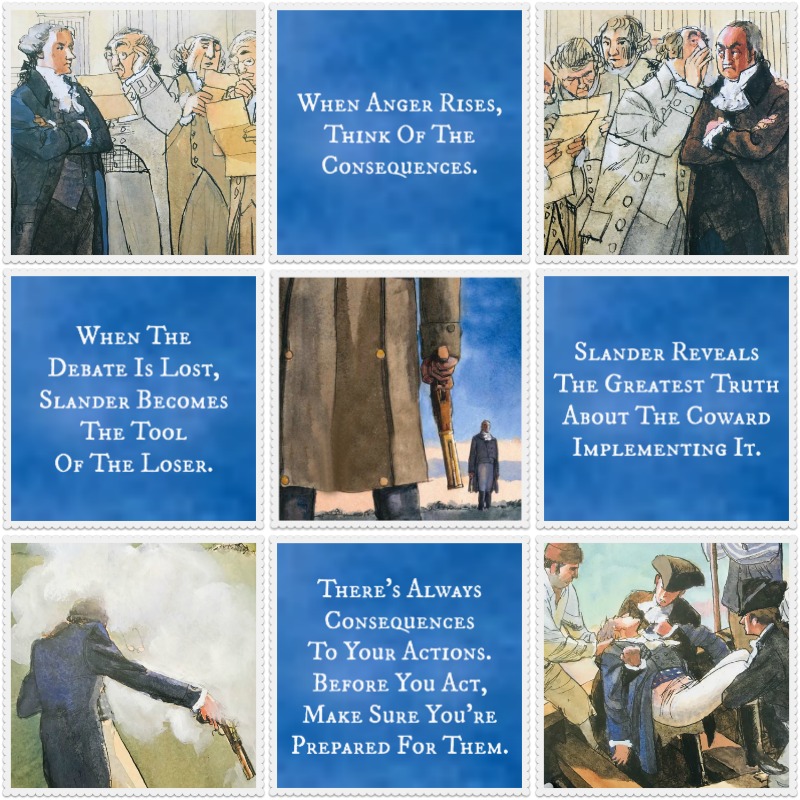
In the early morning hours of July 11, 1804, two men stood facing each other on a New Jersey cliff side. One was the U.S. vice president, Aaron Burr, and the other was Alexander Hamilton, the secretary of the treasury. They were ready to fight to the death for honor.
These Founding Fathers, once friends and colleagues, had become the bitterest of enemies. After years of escalating tension, Burr had finally challenged Hamilton to a duel. In the end, only one man survived, but their infamous rivalry lives on.
The award-winning author of nearly 300 non-fiction books for children and young adults, Dennis Fradin is known for his meticulous research, attention to detail and smooth, graceful writing.
Fradin attributes his success in part to years of teaching in the Chicago Public Schools. In order to hold his second graders’ attention at the end of the day, he would spin stories about crayons in distress and birds with broken wings. One such story caught the attention of an editor who asked him to write a series of books about the United States. The Sea to Shining Sea series (Children's Press), launched Dennis's career as a full-time author.
Dennis Fradin has written children's books on topics as varied as astronomy, colonial history, the Underground Railroad, slave escapes and scientific discoveries. He has written biographies of Thomas Jefferson, Samuel Adams, Jane Addams and Louis Braille, among others. Bound for the North Star is his riveting collection of true slave escape stories. The Power of One: Daisy Bates and the Little Rock Nine, co-authored with his wife Judy, was a Golden Kite Honor Book.
Dennis has collaborated with Larry Day on two picture books, Let It Begin Here! and Duel! with Walker Books. He's completed two dozen Turning Points books for Marshall Cavendish. Along with his wife Judy, Dennis wrote Five Thousand Miles to Freedom for National Geographic Children's Books, followed by their Witness to Disaster series.
For all those of my fellow citizens, young or old, who think that the political life of our republic is a little too divisive these days, I invite you to consider the July 11, 1804 duel between Alexander Hamilton - soldier in the Continental Army during the Revolution, signatory to the Constitution, and former Secretary of the Treasury - and then Vice President Aaron Burr, which was prompted by a bitter (and public) political rivalry, and ended with the death of one participant. Clearly, political divisiveness is nothing new in this country!
All in all, this book offers a fascinating glimpse into our past for young readers (I'd say upper elementary school), highlighting one of the most dramatic incidents in the history of the early republic. I know I would have loved it, as a girl!
Fradin seemed to have set out to "right" a history text wrong, so the young readers will know that both Burr and Hamilton were at fault for the famous Duel. But, instead, this reads as if 90% of the rivalry was caused by Hamilton -- making him a highly despicable character, without demonstrating the reasons for his historical and political significance. For very young readers (since this is a picture book history text) this lack of context might be misleading. I also had issue with the first two pages where Fradin tried to illustrate how these "two enemies had much in common, starting with difficult childhoods." But the only example he could come up with was the both boys were orphaned. And there are more differences in these two childhoods: one was born in The Caribbean, the other in Newark, NJ; one was obviously supported by friends and family while the other was whipped by an uncle. When "Aaron" (first name) graduated from Princeton College, "Hamilton" (last name) came to Elizebeth, NJ. <-- this was posed as a "similarity" -- a bit of a stretch, no? Then, their political paths did cross quite a bit. But, if they hadn't had those paths crossed, they wouldn't have had all the rivalry and the final fatal feud. So, it almost seems superfluous to find parallels in their lives.
It's also somewhat odd that the narrative of the duel is presented in italicized text. This created confusion for the reader, especially when the leading sentence of the italicized text follows directly after these words: "On the even of the duel, Burr wrote a parting letter to his daughter Theo." One expects that the next sentence is text of his note, but then one reads, Early the next morning, oarsmen row Hamilton and Burr across the Hudson from New York City to Weehawken in separate boats."
The illustrations are done well enough with drama and the cover is very enticing, but over all, not the most exciting offering.
As anyone who remembers that famous "Got Milk?" commercial from the last decade knows, Aaron Burr shot Alexander Hamilton in their famous duel. What many people may not know is why the duel took place at all.
Here's a picture book introduction to the longstanding political rivalry (and all-out feud) that destroyed two great men. Hamilton was physically destroyed in that he was killed by Burr's bullet, yet his name rose to fame and he is regarded as one of the great men in American History (even gracing us on the $10, which is fitting as he was the first U.S. Secretary of the Treasury). Though he survived the duel, Burr's reputation was destroyed even though he had finally silenced the man so bent on soiling his name and ruining his chances in public office (amazing he was almost the president of the United States!)
The book is a decent introduction to this subject but for some reason it didn't exactly wow me. The illustrations were just so-so for me and the storytelling was a bit disjointed in places and never really gave me a clear feeling of knowing either character. Or perhaps the subject of mudslinging that ended in a deadly duel was just so distasteful I couldn't really enjoy the book! Ah, how little has changed though at least our current politicians don't engage in a duel to settle their disputes...
(I found it very interesting how prominent dueling was, even though it was technically illegal, up to the early 1900s. Even Abraham Lincoln almost engaged in a duel!)
All my life I've heard that Aaron Burr killed Alexander Hamilton in a duel. Among the gazillion things in this story that I'd never heard were:
1] Hamilton and Burr had a long-standing hatred for each other.
2] Thomas Jefferson and Aaron Burr had tied in the election for President, and Hamilton "lobbied" for Jefferson by spreading ugly statements about Burr (which really ticked Burr off, by the way).
3] Dueling was illegal at the time, so immediately after he shot Hamilton, Burr--the Vice President of the United States, participating in an illegal duel--was whisked away so as to avoid prosecution. He was charged anyway, but never brought to trial, and he even got to finish out his term as VP. Along with Hamilton, Burr had also shot any chance he had at continued political success, however.
4] They were both stubborn coots, apparently. And they both paid a price....
5] I have trouble typing the word "Burr". I am constantly typing the word "butt" instead. I know this has nothing to do with the book, but I found it interesting.
I liked this one better than Aaron & Alexander. There are limited words here, so you could probably read it with younger kids than Brown's book. Fradin really allows the art to shine here and help tell the story. I love the art in this one, too.
An unusual subject for a picture book but Fradin handles it very well. Choosing vignettes from the lives of Burr and Hamilton that relate to contemporary politics, Fradin shows students that history and modern events still have much in common. Interesting perspectives in the illustrations help make this a visually intriguing book as well.
Last year a local public library brought a sculpture of Burr and Hamilton and traveling exhibit of this famous duel to town. This picture book does a fine job of introducing the men and the event and has stunning artwork.
22 November 2008 DUEL! BURR AND HAMILTON'S DEADLY WAR OF WORDS , by Dennis Brindell Fradin and Larry Day (ill.), Walker, June 2008, 40p., ISBN: 9780802795830
"The best of America is in these small towns that we get to visit, and in these wonderful little pockets of what I call real America, being here with all of you hard working very patriotic, um, very, um, pro-America areas of this great nation." -- Sarah Palin, vice presidential candidate, Greensboro NC
"Sing a song for America Once she was a young girl with her heart on fire Born in the dust of the magic of history It all goes on yeah the dream goes on." -- Paul Kantner Jefferson Airplane co-founder, San Francisco CA
My own northern California-based small town of Sebastopol is full of hard working Americans who have read and studied our country's living, sacred documents. I have lots of friends in this small town who are always up for thoughtful discussions about the hopes and ideals of America and how in the Twenty-first century we can continue to put to good use the Eighteenth century words and principles upon which our country was founded in order to make this a more perfect union. And we are not shy about participating in our democracy, including sometimes standing on our street corners downtown, holding signs that express our sentiments about a candidate or a position.
I love my country and I love to engage in such debates and demonstrations of sentiment.
"After the American Revolution began in 1775, Burr and Hamilton both fought heroically for independence."
Decades ago, back in the mid-Seventies, I was succeeding well enough in my classes at the University of Connecticut as I diligently pursued the business administration degree that my mother had instructed me to earn. (Just as she predicted, I have repeatedly put that business degree to good use.) But I was not particularly impassioned about anything going on in those lecture halls until I enrolled in my first Business Law class. This was a course where we frequently immersed ourselves in the legal precedents that have led logically to how and why business is conducted today under a particular system of laws. Such a course of study brought me right back to the fascination, enjoyment, and reverence for American history I have always held, going way back to when, as an emergent reader, my grandfather Rex Partington sat me down for a few days with a compilation of writings that was half my own weight and had me take notes on the Autobiography of Thomas Jefferson. (Today this particular autobiography is easily accessed online.)
"During the war, both men served as aides to George Washington. Because he was foreign born, Hamilton felt that others saw him as an outsider. He had a chip on his shoulder and quarreled with many people, including Washington. Even so, Washington was very fond of Hamilton and named him his chief aide. Burr was envious that Washington favored Hamilton. Washington thought Burr was a troublemaker and soon dismissed him from his staff."
Having sought out the advice from my Business Law professor, I enrolled at his suggestion in Constitutional History classes. And so it was that, while I had learned a little bit about the Federalist papers back in high school, I came to fully immerse myself in the words of Alexander Hamilton who, along with James Madison and John Jay, had in 1787 and 1788 penned the series of writings that provided the philosophical and motivational arguments for adoption of the proposed Constitution of the United States of America.
"Partly due to Hamilton's attacks, Burr was defeated. Jefferson was elected president, and Burr had to settle for becoming Vice President. When Burr found out about Hamilton's slurs against him, their secret fight became public."
To me, it has always been those who dealt with words and ideas -- such as Jefferson and Franklin and Hamilton -- who are so much fun to study and who are so central to gaining an understanding of what America is really all about. That Alexander Hamilton's life ended during his forties was clearly tragic for the nation in that it forever deprived us of the continued wisdom and perspective of one of the great minds behind the founding of America. Even back before I became familiar with Hamilton's writings, it just seemed so terrible that his life had ended in a duel. (Just think about how much more civilized life is in the Twenty-first century: Today he and Burr would have been dissing each other on competing cable talk shows and blogging scurrilous tidbits about one another online.)
"The next day Burr lost the election for governor. He was furious that Hamilton's name-calling had again played a major role in his defeat. "Burr could have written a newspaper article blasting Hamilton or asked to meet with him to iron out their differences. Instead Burr sent Hamilton notes demanding that he apologize for his remarks -- or fight a duel. "Hamilton could have apologized or arranged to meet with Burr to make peace. Instead he accepted Burr's challenge."
One of the benefits of great, nonfiction picture books for older readers is that they can turn us on to new topics and catch our interest without our having to invest more than a few minutes. The book should sell itself with its eye-catching cover featuring the extreme close-up perspective of being just behind Hamilton's coat and gun, as he faces Aaron Burr.
While we may not have an interest in reading at length about Alexander Hamilton or Aaron Burr before learning about their deadly altercation in DUEL! BURR AND HAMILTON'S DEADLY WAR OF WORDS, there will certainly be a few readers who are enticed to go on to learn all about the philosophy and writings of Alexander Hamilton thanks to Dennis Fradin and Larry Day's storytelling.
"Then they hear, 'Present!' -- the signal that they can aim and fire."
Or, perhaps, in a few years, a reader of DUEL! will be doing research for a project in American history and say to himself, "Oh yeah, that Vice President who shot his buddy while they were out hunting."
Err...whoops...no...That's a different Vice President-with-a-gun story...
This book popped up on the Missing List at the library tonight during my volunteer shift. I found it and then I took it to the workroom, checked it in, and read it. It's the story of Burr & Hamilton's rivalry. It starts with their similarities--each lost his parents at an early age, each fought in the American Revolution and worked under Washington, each became a lawyer after the war, and each was drawn to politics and power. But they butted heads often, which lead to an argument neither could back down from. This escalated into a duel and a fateful shooting.
This is depicted in the book through plain storytelling and lovely art. The representations of people aren't as detailed as I would have liked, but that brought even more ambiguity to the tale than it already had, considering that versions of the story differ. We'll never know for sure how the shots were fired or what Hamilton was aiming at, but it was interesting to see this author's take on it.
From the title, I was expecting more about the heated letters the two men exchanged that led up to their duel, but they were barely mentioned. The book left no doubt as to the factors, though. And the reality of the consequences was also clearly depicted. I liked, at the end, the historical notes about duels and our other political leaders who participated in them or very nearly did (I don't remember hearing that about Lincoln!).
This was a short but beautiful book that depicted history and tragedy.
Another unique topic for a picture book, but one that sets a historical story into context and adds details to an event that contains a good deal of myth. I would not recommend this story to be read to a very young audience. It is very good for upper elementary and middle school students. It is also part of New Jersey "lore" and fits an audience in that regard as well. History and many other texts and history books had told us that both men were long-lasting political and personal rivals - and that Burr's career was destroyed even though he lived and of course, the promising life and career of Hamilton ended with the duel, yet his popularity and fame increased with his tragic end. What we learn here from the story brings to light that it was Hamilton who was more of the antagonist in the heated relationship, and even had the opportunity to make peace with Burr, but he declined. Dennis Brindell Fradin does a good job in describing the actual duel in simple, yet dramatic text. The idea of a duel to settle a score is antiquated and illegal - and Fradin makes that point clear - in addition, there are details of other "famous" duelists in the endnotes. The illustrations by Larry Day add to the drama and historical period of the story as well.
This is a well written and illustrated children's picture book about the fatal due of Alexander Hamilton and Aaron Burr on July 11, 1804 and what led up to it. I love picture books that make you feel like you were there! This one does that and also lets us know that Duels were a misguided way to settle angry feelings. I believe the author represented this historical account in a non-biased way. Neither one comes out looking worse then the other although he mentions in the end Burr living a long life but with a ruined reputation and Hamilton's life having been cut short but ended up on the 10 dollar bill. But both were at fault for trying to solve their disagreements and anger through a duel.
The author carefully shows the parallels in these two guys' early life and then describes how Hamilton's opposition to Burr angered the vice president more and more. The duel itself drops into italics. The conclusion is that Burr won the duel (since Hamilton died) but Hamilton won history, since he's now honored and no one knows Burr. But the text says both men were at fault. Nowadays we have the musical, so kids may have an extra interest in the book.
I thought it was a fine read, but not something I wish I had a handy kid so I could read it with him.
This is a fantastic non-fiction tale of two founding fathers that couldn’t get along peacefully, instead backstabbing and gossiping endless again and again to vilify the other. The result of their childish actions leading to the most famous duel of all time. Duel!: Burr and Hamilton's Deadly War of Words is a perfect way to introduce elementary age students to this ridiculous event in American History.
This was a GREAT picture book for children based on the duel or Aaron Burr and Alexander Hamilton. Perfect story and format to point out to my kids what hate, jealously and greed can do to a mans heart and soul.
Hamilton fever has struck at the local library! This is a very brief history of Burr, Hamilton, and their feud, and includes a quick rundown of dueling's decline.
This was an interesting read. It had an uncommon unbiased perspective of the duel between Burr and Hamilton, blaming them both for the tragedy. I like how the author added the background history of Burr and Hamilton, as well as the life of Burr after Hamilton's death.
Nonfiction (historical) Grades 2-6 As a huge fan of "Hamilton" and an American History buff, I knew I had to read this. There was a lot of content in this book that I had not known previously! I would definitely recommend this as a resource for research for older elementary students. The illustrations are so well done, they really enhanced the book! It is a fairly short read and I recommend it to anyone who might be interested in American History or the musical!
This picture book is a great little compare and contrast between Hamilton and Burr. It briefly explains their roles in American government and their duel which ended in the Hamilton's death. My fifth graders enjoyed it and asked a few questions later. My favorite comment was that there's a great episode of Studio C with a an Old West Duel in it. I get a lot of tips for watching Studio C when we discuss history in my class. Whatever builds the network in their brains, right?
Fradin, Dennis Brindell. 2008. Duel: Burr and Hamilton's Deadly War of Words. Illustrated by Larry Day.
I honestly never thought I'd see a picture book about the duel between Alexander Hamilton and Aaron Burr. When I first read about the duel back in school--eighth or ninth grade--or whatever, I must admit it was one of the more intriguing, more interesting aspects of American history. Made even more *fun* (if fun is the proper word) by this Got Milk commercial which was brand new and oh-so-much-fun.
So on to the book review. I liked it. It was clear. It was straight-forward. It was interesting. It was informative. I can't say that I loved, loved, loved the illustrations. But they were nice enough. (Just because I like a slightly different style of illustration doesn't mean these aren't good.) Perhaps if I hadn't just read (and reviewed) Lady Liberty by Doreen Rappaport with illustrations by the incredible Matt Tavares, then I wouldn't have felt they were lacking a little something.
Just because I'm reviewing it here doesn't mean it's a picture book for young readers however. This one is not really a picture story book for young ones. It's for those in mid to upper elementary school perhaps. The reader needs to have some grasp of history in order to enjoy this one. (As opposed to first graders who don't really "get" that George Washington and Abraham Lincoln and Martin Luther King Jr. all lived at different times. These are the folks that most often than not will either answer Lincoln or Washington when asked who the president is.)
I've always been fascinated by Aaron Burr's daughter, Theodosia, so I like to read anything to do with Aaron Burr. It's a pity that he and Alexander Hamilton couldn't have been friends, as they came from such similar backgrounds. To think that two men who came from such hard and humble backgrounds, one of them not even in this country, could have risen to such high political office. Fradin seems to think that both men are partly to blame for the tragedy that took Hamilton's life. If Hamilton had only left Burr alone... Whoever came up with the idea of dueling as a way to solve problems anyway? A note at the back of the book said that dueling did not die out until around 1900, which I wasn't aware of. Not one of society's smarter inventions. One thing the text didn't mention, and which I would like to know is, how far apart were Hamilton and Burr when they fired their weapons? I guess I'll have to read another book to find out, and Fradin provides a list of further reading at the end of the book. I loved Larry Day's illustrations, which reminded me of those of Robert Andrew Parker. I recommend this introduction to two influential American fathers.
A fascinating story with an engaging first paragraph:
"As the sun rises on a July morning in 1804, two men stand ten paces apart on a New Jersey cliffside. One is Alexander Hamilton, a signer of the Constitution. The other is Aaron Burr, the vice president of the United States. They are risking arrest - and their lives - to fight an illegal pistol duel."
The duel is written in the present tense, which builds excitement and anticipation. The back story (middle portion of the book) gives the important facts, but seems a bit dry. I found the statements about how Burr and Hamilton could have worked out their differences to be a bit obvious and didactic, but I did appreciate the final comments about the differences in each man's reputation following the duel despite their common fault in the matter.
A nonfiction picture book about Burr and Hamilton. I thought this was great in the beginning and did a really good job of summarizing high points at a kid-friendly level: Both Burr and Hamilton had difficult childhoods; Hamilton felt like an outsider because of his West Indies heritage and was prone to mouthing off; both served as aides to Washington and Washington adored Hamilton and fired Burr. Burr blamed Hamilton for his political failings and called him out. There was a duel; Hamilton was killed and Burr escaped criminal charges but lived out his days as a disgrace. There's a small end note appended about other well-known figures who were involved in pistol duels and how it finally was outlawed. The only thing really strange here was a very jarring shift in narrative when it comes to the duel itself that detracted from my enjoyment of the book.
One of my students checked this out at the library for me because she knows how much I love all things related to Hamilton. (Bless you Lin-Manuel Miranda.)
I recently finished Rob Chernow's masterful biography on Hamilton so this was just a little dollop in the history. I wasn't wildly impressed. I kind of got the impression that the author had a bone to pick with Alexander Hamilton. I'm not saying that A. Ham was perfect, but he was pretty darn impressive. The author sort of put off this air of "poor wittle burr" and "damn you Alexander!" He didn't mention anything about how Alexander might have fired into the sky during the duel, a fact that I find extremely vital to the story.
The illustrations were cool, but it needed better text.
This is a concise well illustrated title about one occurrence in history, the duel between Alexander Hamilton and Aaron Burr. While this event occurred in 1804 apparently it was the same type of politics as we have today in the 21st century. Neither man had good thoughts about the other. Two facts that I learned were Burr was vice-president of the US under Jefferson at the time and that Burr lived till he was 80 years of age. I feel as if this limited information will be valuable as I read further about Hamilton and Burr.