At midday on May 4, 1970, after three days of protests, several thousand students and the Ohio National Guard faced off at opposite ends of the grassy campus Commons at Kent State University. At noon, the Guard moved out. Twenty-four minutes later, Guardsmen launched a 13-second, 67-shot barrage that left four students dead and nine wounded, one paralyzed for life. The story doesn't end there, though. A horror of far greater proportions was narrowly averted minutes later when the Guard and students reassembled on the Commons.The Kent State shootings were both unavoidable and unavoidable in that all the discordant forces of a turbulent decade flowed together on May 4, 1970, on one Ohio campus; preventable in that every party to the tragedy made the wrong choices at the wrong time in the wrong place.Using the university's recently available oral-history collection supplemented by extensive new interviewing, Means tells the story of this iconic American moment through the eyes and memories of those who were there, and skillfully situates it in the context of a tumultuous era.
May 4, 1970 marked the 50th anniversary of the Kent State University shootings, which left four dead and nine wounded. I have read through other reviews and notice the same generation gap that Means refers to throughout this book. Other reviewers had been high school or college students in 1970 and perhaps wanted to bring much needed closure to this event and era of their youth. In 1970, I would not be alive for an entire decade and joined in this buddy read to read about a historical event, not one I lived through. In my United States history class, all events post World War II were glossed over in a mishmash at the end of the school year. Kent State might have gotten two sentences of text, and, according to Means’ thesis, deserve more than what history books tell their readers. I live in Ohio today and have borrowed books from Kent State through interlibrary loan. I also know the school because one of my favorite football players attended it. I guess I joined in the buddy read to shed light on what happened on May 4, 1970.
At 12:24 on May 4, 1970, Ohio National Guard members open fire against a mob of students, killing four and wounding nine others. The shooting was a culmination of a weekend of protesting at Kent State and other college campuses throughout the nation. On the Thursday evening prior to the shootings, President Nixon has announced to the nation the installation of U.S. troops in Cambodia. The President believed that additional troops’ presence would allow the South Vietnamese to become self-sufficient within a year, allowing for the United States to leave Vietnam during that time. Students who had already experienced the draft lottery had had enough and took to the streets to protest. Much like events of the past few weeks, Means argues that the protesting was a culmination of a decade of frustration that saw the assassination of leaders, race riots, Woodstock, and a hippie culture that countered their parents’ greatest generation. Many male students were in college at the time simply to get a draft deferment as a student. Not all the students took school or classes seriously for this reason. The left leaning students joined organizations like Students for a Democratic Society and participated in peace demonstrations. The protests in May of 1970 were in response to four years of pent up frustration, yet, Means believes also signified the end of an era of hippie culture.
With Kent State President Robert White in Iowa for the weekend and Ohio governor Jim Rhodes campaigning for a senate spot with a primary election days away, Kent State represented a chance for Rhodes to earn much needed votes. Today’s argument is that Rhodes could declare martial law and call in the national guard to Kent State because it is a smaller school in the state system, tucked away in the northeast corner of the state near Akron and Cleveland. Had students rioted similarly at Ohio State in Columbus, these events might not have occurred. They would have been too visible and alienated potential Rhodes voters. With eighteen year olds allowed to drink in Ohio and the school president out of town, the student body was in chaos in the days leading up to the shootings. A curfew was declared for 1 am then changed to 9 pm and finally decided on 11 pm. Even Rhodes, who attempted to control the escalating situation, could not calm down frustrated students. The majority of the students might have been peaceful, save for a group of fifty who were alumni of the Students for a Democratic Society. The group was deemed to radical by the school’s administration and kicked off campus six months earlier. Perhaps the organization’s presence would have allowed for a more orderly protest; without visible leadership, the student body was in chaos. Rhodes believed by Saturday night, with protests and “mobs” escalating that he had no choice but to send in the national guard.
Means notes that during the Vietnam years, governor Rhodes utilized the national guard more than any other state. Most of the enlisted members were the same age of the students and joined the guard in hopes of not going to Vietnam. Means noted that of the casualties, the national guard represented .0002 percent, so becoming a national guard member meant staying stateside. Other members were weekend warriors, active duty members fulfilling their monthly and yearly obligation, teachers, and factory workers. The companies were in almost as much chaos as the student protests that the guard attempted to quell. Guard leadership was just as sketchy as university leadership at the time. When asked who was in charge of the guard, Colonel Robert Canterbury, clearly the leader in the chain of command, claimed that he was not in charge. The result was that the young guard members in need of leadership did not have a clear go to person, and some may have fired one of the 67 shots on May 4, 1970 due to poor leadership decisions. With the guard field reports taken by the FBI, fifty years later the public still does not have a clear answer as to who was in charge, who was to blame, and which side was at fault. Means wrote a lot of what ifs and speculation, leading readers to formulate their own hypotheses as to who was the most culpable.
Fifty years after the Kent State shootings, the university still holds memorial services and has even honored the dead with a May 4 memorial center on campus. Means did not have enough information to write an entire book on this event, so the final third was a lot of what ifs and court cases that lasted almost ten more years. His hypothesis is that after Kent State, students saw the light go out of their ideology and gave up, leading the United States to become an insular nation. This hypothesis was one sided as he shifted the blame away from the students onto government officials. One event that humanized the generation gap for me was President Nixon’s nighttime jaunt to meet with students and hear their grievances on a personal level. Yet, even President Nixon’s presidency could not survive Kent State as Means speculated that these events are what lead to the Watergate scandals. Not to take away from the students who lost their lives on May 4, 1970, but perhaps what I am looking for is a comprehensive book on the Nixon presidency and his role in changing society away from the mythical generation gap and toward life with hippies as adults and future leaders of society. Means did allow me to learn more about the Kent State shootings and I did from history books but left me feeling unfulfilled.
67 shots were fired on May 4, 1970 on the campus of Kent State University in Ohio.
4 students were killed, and 9 others were wounded, including a man who would spend the rest of his life in a wheelchair.
I’ve been a college student and I’ve also been a National Guardsman and soldier. I was a student named Lyn and when I wore my uniform it had my name sewn onto it. Many of the Guardsmen on duty that day were also students. Many students present that day also had military duty. All of the students, faculty, and guardsmen there had names, voices, family and friends. The labels used – liberal or conservative, patriotic or protestor – are secondary to each individual.
What author Howard Means does very well in this 2016 publication is to focus on the individual participants in that time and to minimize the effects of labels and oversimplifications of US and THEM.
Some of the polarizing rhetoric from that time indicated that there were thousands of radical students fighting with the guardsmen. Means, in a well-researched and objective account, notes that while there were hundreds of people observing the events leading up to the shootings, the actual protesters were a minority. Only two of those killed were directly involved in the protests, a third was there between classes to watch and the fourth had nothing to do with the protests at all, she was literally in the wrong place at the wrong time.
Taken from hundreds of interviews and quotes from witnesses, Means describes a pressure cooker of fear, tension and anger, simmering into a boil in the days leading up to May 4th. A middle-class college and a blue-collar town were caught up in the angry times as the Vietnam war raged across the world and in the media of the day. Conservative homeowners were apprehensive and wary of the long-haired students at the university, and of the out-of-town organizers who came to stir up trouble. When the national guard was called in to quell violence, the guardsmen were minimally trained and overworked, many having only had a few hours’ sleep prior to the tragic skirmish.
While guardsmen were the targets of rock throwing and other projectiles, there is no evidence of snipers or other hazards as were immediately reported. While the riots of the days before, including arson at the ROTC building, later investigators could find no clear organization that led the protests and riots.
Whose idea it was to arm the guardsmen with live ammo and whether there was an actual order to fire remains a mystery. Means describes the event as well as the days leading up to the shootings in an attempt to understand how it happened. The fact that 13 people were shot is combined with less material facts, circumstantial evidence of the hows and whys.
Means also looks at the political environment of the time, examining Nixon’s policies and there is a poignant scene between Spiro Agnew and David Frost that casts blame on the guard, the mayor, the university president, but also to the rioters themselves. Several student leaders were later charged with inciting a riot.
In his book, Howard Means chronicles the Kent State Massacre in a way that does not contribute anything valuable to the existing scholarship on the topic. There is nothing much to say about his account except that it has two main drawbacks.
The first thing that casts Means's analysis in a negative light is that he attempts to compare the Kent State shootings with the deaths of American soldiers in Vietnam on the same day, May 4, 1970. He sees the students as almost deserving of their fate because they were vandals who harassed the Ohio National Guardsmen. He also seems to have wanted to make the reader feel guilty for being sorry for these students because he underscores that the soldiers had died committing "small acts of bravery," while the students had taunted the Guardsmen.
There are a lot of things wrong with this point of view. First, it turns out that according to the author some human lives are more valuable than others. Second, he ignores the fact that the students of Kent State University were unarmed civilians. There can be no excuse for armed guardsmen to shoot at protesters who do not carry weapons. On the other hand, the American soldiers who died in Vietnam that day were armed and fighting. This fact does not make their deaths any less tragic. However, the comparison between them and the students is unnecessary. It seems like a cheap propaganda technique.
My second problem is that the author treats the statements of anonymous witnesses of what happened at Kent State as if their veracity has been confirmed. For instance, he cites Ellen Mann, a resident of Kent who worked on campus at the time: "Just killing for white students, for white kids, was enough to stop the whole antiwar movement." This is not correct. For from stopping the protest movement, the Kent State Massacre ignited it all over again. The shootings were followed by a wave of student protests.
The author does a good job narrating the events surrounding the Kent State shootings. His tone gives away the fact that he was biased against the protest movement, though. When he depicts how the Guardsmen dispersed a demonstration on Kent University's campus with tear gas, he does not mention that several students were bayoneted in the process.
67 SHOTS is not worth the read if one has read other accounts of the Kent State Massacre. This book is sensationalist and unconvincing.
On May 4th, 1970, 28 people died in actions related to the war in Vietnam; 24 on the actual battlefield, and 4 on the campus of Kent State University. My memories of that day are quite clear as I was a student at Pace University in New York City. A day or two later I joined a demonstration against the war as Mayor John Lindsay ordered the flag at City Hall Park to be flown at half-staff in remembrance of the 4 student who died at Kent State. Almost immediately construction workers who were working on the World Trade Center site marched up Broadway beating anyone who seemed to be against the war, while New York City’s finest did nothing to stop them. The next day my US Army Reserve unit was activated on the St. John’s University campus in Queens to deal with demonstrations. My experience reflects the split in American society at the time and the total deterioration that existed between generations, and the attitude of many toward the Nixon administration. Howard Means’ new book 67 SHOTS: KENT STATE AND THE END OF AMERICAN INNOCENCE captures that time period as he reevaluates events leading up to the shootings, the actual shootings themselves, and how people reacted and moved forward following the resulting casualties.
The climate at Kent State was heated long before President Richard Nixon went on television on April 30, 1970 to announce the American “incursion” into Cambodia to root out North Vietnamese sanctuaries that were used to attack American troops. This announcement exacerbated tensions between the administration and the anti-war movement that was labeled as “bums” by Nixon and his Vice President Spiro T. Agnew. Means was able to reconstruct events at Kent State through numerous interviews of many of the actual participants as well as conducting research at Kent State’s archive. This allowed Means to weave his narrative encompassing the actions of students and members of the National Guard and try and determine whether the Guardsmen were under enough of a threat to open fire on the students, or did the climate that existed on campus from May 1-4 make the tragedy inevitable.
Tension on campus was brought to a head when students burned down the ROTC building on May 2nd, and later that day the National Guard was summoned by Governor James Rhodes and deployed on campus. One of the most important questions that Means explores was why was the Guard was called upon when it lacked the training in crowd control, and the use of M1 rifles, when the Ohio Highway Patrol was trained and ready to intervene. Means places a great deal of the blame for events on Governor James Rhodes who was running for the US Senate against Congressman Robert Taft, Jr. and wanted to strike a tough persona to enhance his election bid as he stated on the morning of 5/3 when things seemed to be calming down, that he “would eradicate the disease of student unrest, not merely treat the symptoms.”
The inevitability of a crisis at Kent State resulted from disparate forces-the high spirits of the student body (about 4,000 of 21,000 students who participated in the demonstrations), the spring like weather, the war in Vietnam, Nixon’s Cambodia speech, campus radicalism (about 300 students), the exhortations of Jerry Rubin, local anxiety, the generational divide, and growing tensions between the town and the university. Means argues effectively that outside agitators were not responsible for May 4th, as events were fostered by Kent State’s student body. Supporters of the National Guard argue that SDS was responsible for organizing students which was not true. Means presents a frame by frame picture of May 4th and concludes that the shootings did not have to take place. The National Guard spokespersons argued that there was a snipper who threatened the soldiers, but there was no evidence that one existed. Further, the students did not rush the soldiers who claimed their lives were in danger. The problem throughout the crisis was the lack of communication and coordination between the National Guard, the university, and town officials. Means based his conclusions on evaluating the statements of the main participants and the interviews he conducted over many years. For Means it is clear that the National Guard was not protecting itself from “imminent danger, instead, there seems to have been a strange mix of intentionality, horrific judgement, terrible luck, preventability and inevitability.” The generation gap, the Age of Aquarius, all came together on May 4, 1970.
Means describes the moods of students and guardsmen and the shock and outrage that followed the shootings. He points to the heroes, like Major Don Manley of the Ohio Highway Patrol who convinced the National Guard commander, General Robert Canterbury to allow faculty marshals additional time to convince students to disperse, before further damage could be done. Other heroes include Geology professor Glenn Frank, a former marine who convinced students to leave when the National Guard reformed and were getting ready to fire again. However, most townspeople and guardsmen felt that the students brought the shootings on themselves and they got what they deserved. It is amazing that the actual firing took 13 seconds to unleash 67 bullets!
Means does an excellent job describing the actions and statements of the Nixon administration as well as taking the reader into the White House. He argues that Nixon became unmoored by events at Kent State that led to his famous 2:00am visit to the Lincoln Memorial to engage young people. Means also examines the culpability of all the major players in this drama; from university president, Robert White; Kent mayor, Leroy Satron; Governor James Rhodes, and National Guard Commander Robert Canterbury and his officers. Means explores the legal actions that followed and the Scranton Commission that investigated the shootings. What emerges is that the death of 4 students and 9 wounded should not have occurred. It was due to poor training, a lack of communication, and a political climate that was on edge. Means has written a well-documented account of events and for anyone interested in one of the most iconic tragedies of the Vietnam era, this book is well worth consulting.
On May 4, 1970 the Ohio National Guard and student protesters engaged in a conflict that resulted in four students dead and nine wounded. It was the culmination of days of increased emotional conflict that began when President Nixon announced that American troops were going into Cambodia to cut off supplies to the Viet Cong. He thought it would help end the war. Students at Kent State University did not see it that way.
Fueled by 3.2 beer, the fine spring weather, high emotions, and a culture of idealism, students began protesting. They burned down the campus ROTC building. The Ohio governor called in the National Guard and the campus was put under a military take-over. Students protested the military presence, attacking the Guard with curses, throwing stones and bricks and bags of human feces and urine. And at some point the Guard felt vulnerable, and either were instructed or emotionally reacted with use of force. And 67 shots from military grade rifles splattered the crowds--the innocent and the threatening, and those walking to class and the merely curious.
In May of 1970 I was a senior in high school and the heady last weeks of school activities and parties betrayed my inner life, my deep sense of loneliness, self doubt, and a longing for connection. My diary pages are filled with everyone I talked to, joked with, every event I attended, poetry, dreams, mentions of books I read. But the greater world is not present.
I was aware of the cultural and political climate, but I resented the confusing conflicts of the world; I was a girl still trying to figure myself out. The body counts, protests, generational war, violence, hate, distrust, drugs--these were scary. While the events of May 4, 1970 at Kent State University occurred I was avoiding television news and hoping someone, any one, would ask me to the senior prom. It was as big a problem as I could handle. I was seventeen years old.
I have never had any illusions about the 1960s being the 'best of times' to grow up. For years I avoided thinking about those days. Starting with the Cuban Missile Crisis to The Ballad of the Green Berets, the War on Poverty to Hell No, We Won't Go, and sit-ins and Hippies and Earth Day-- it seemed I grew up in one long arc of culture and political wars. There were the assassinations and the brutal response to Civil Rights workers. We went from the bubble gum silliness of I Want To Hold Your Hand to Hey! Look! What's that Sound! and the drop out idealism of The Age of Aquarius. On May 6 anti-war protesters at Memorial Park in my home town of Royal Oak, MI marched to the local draft board; it turned into a melee. In August the park was the scene of riots between thousands of youth and the police. The national discord had come to my hometown.
I requested 67 Shots: Kent State and the End of American Innocence by Howard Means because, nearly fifty years later, it was past time I dealt with those days and understood what had happened. It was a painful trip, like witnessing a horrible accident you can't look away from.
Howard Means' book is thorough and detailed, including newly available oral histories. He recreates the events that escalated fear and high emotions, politicizing students who reacted in visceral hate against the overwhelming military presence on the campus: 1,317 Guardsmen with bayonets on their powerful M1 rifles, hundreds of trucks including armored personnel carriers, mortar launchers, and helicopters. Rumors spread fear. Town residents boarded up businesses and family men kept armed watch over their homes.
Human beings, young men and women in their late teens and early twenties, lost their identity and became bums, pigs, commies, traitors, hoodlums, hippies. The students were no longer 'our children', they were the enemy. Rational thought was lost. Compassion was dead. The opposing forces were just a bunch of kids, really, scared armed boys and angry kids yet to understand the deadly earnestness of this escalating local war.
After the shootings the students could have easily been sucked into the moment, charging the Guardsmen, resulting in more deaths. Thankfully, four men stepped in. A highway patrolman, Major Don Manley, convinced General Canterbury of the National Guards to give students time to disperse before further action. Graduate student Steven Sharoff meet with Gen. Canterbury and was told to move the students off. Sharoff told the students to sit down and popular geology professor Glenn Frank, an ex-Marine with a flat-top haircut, addressed the students with anguished voice and in tears, pleading for them to disperse before there was a slaughter. He convinced them, saving lives. The Guard who had surrounded the students made exits and the students slowly left.
The aftershock rocked the country. Protests and student strikes rocked the country. People tried to understand what had happened and how it had happened, who was to blame. The President for taking the war into Cambodia? The Ohio governor for sending in the National Guard? The Kent State leadership for it's 'appeasement' when the students burned down the ROTC? The protesting students who threatened and cajoled the Guardsmen? The Guard for ordering fire? Guardsmen who were scared and reacted viscerally in self-protection?
Here's the kicker. There is no resolution. No PI, detective, policeman, rounds up the usual suspects, details the series of events, and IDs the murderer. No court case judge found a guilty party. We do not know exactly how the National Guards came to shoot at the protesters.
The great divisions in America have changed but survive. The dehumanization of people who do not fit our world view or philosophy is rampant. I see comments on social media from individuals who have no compunction in announcing they hate so-and-so. When will we learn to talk and listen? To seek common ground? To build bridges and not walls?
Means ends the book with a quote stating that without forgiveness there is no healing and "the murder goes on forever." That does not mean to forget what had happened; the deaths of the four students must serve as a reminder and lesson.
I received a free ARC through NetGalley in exchange for a fair and unbiased review.
"Using the university's recently available oral history collection, Howard means delivers a book that tracks events still shrouded in misunderstanding, positions them in the context of a tumultuous era in American History, and shows how the shootings reverberate still in our national life."
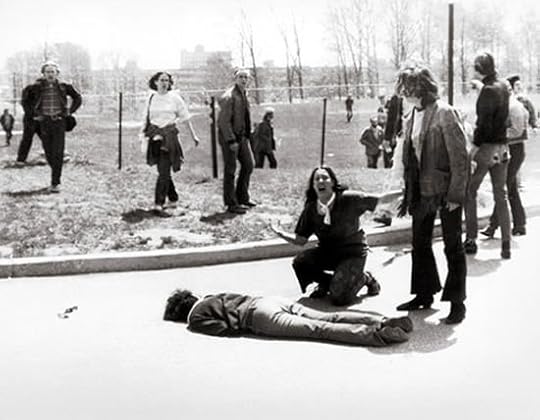
Reading the first few pages of "67 Shots" plunged me back into the 60's Vietnam protest. "67 Shots" leads us through the horrifying domestic incident of those fearful days. The murder of four university students, some who were engaged in protesting and some who were in the wrong place at the wrong time. The most iconic photo of the the Kent State shootings, Mary Ann Vecchio, a fourteen year old Florida runaway can be seen screaming as she kneels by the body of a slain student, reminded the author of "Edvard Munch's famous painting The Scream. Both are silent images that nonetheless shriek in pain."(p.84) That original Pulitzer Prize photo over-time has come under scrutiny as being altered which I didn't know. "In the early 1970s, an anonymous technician removed the fencepost above Mary Ann Vecchio’s head using darkroom techniques. The altered photo was then used in numerous publications, including TIME, People and LIFE." http://www.alteredimagesbdc.org/filo Fencepost or no fencepost, this single picture at the time was taken by John Paul Filo summed up the story of this incident. It has left a lasting impression on the minds of those who lived in that era.
Despite the substantial literature which exist in the Kent State shootings Means book is the most balanced, detailed and compelling written account of this incident. He reveals that the tragedy resulted from egregious leadership failures by all parties, student protestors, incompetent university officials, clueless local and state politicians and tragically inexperienced National Guardsman. "67 Shots" is a fine book which adds another, often fresh account of a sad but significant episode in modern American history.
As the 50th anniversary of this tragedy is marked, I wanted to find a complete book on this event and this book did the trick. It pointed out the mistakes and fallacies of some theories about why this happened but unlike other articles I have read on Kent State, this paints a fair and balanced picture, not completely blaming the students or the National Guard. Recommended for readers who want the complete story.
This rating is really 2.5 stars, rounded up. The author gave an impression that students, including those who were killed or wounded on May 4, 1970, somehow share blame with the National Guard, Kent State University administration and the Ohio state government. That "every party to the tragedy made the wrong choices at the wrong time in the wrong place."
He discusses at length the destructive behavior of young people (not necessarily students) on and off campus during the days prior to May 4. Why. I hope it isn't because he believes it is relevant to the murders. There is absolutely no justification whatsoever for the random shooting and maiming by the National Guard at Kent State that day. None. The book provides no reasonable explanation about why the shootings were appropriate, and I wanted the author to be more fervent in his discussion about responsibility and lack of accountability.
The book covers an important event and raises awareness of what can happen. This tragedy should not be forgotten. It feels like it was just yesterday, and it also feels like it could happen today given the polarization and animosity at play in our country.
Anyone that was alive in 1970 and remembers this incident should read this book and clear all the rumors, hearsay and incorrect reports that occurred days, weeks, years after it took place. I was a senior in high school, one month from graduation, when this horrible "accident" broke into all news reports that day. It shocked me then, and haunted me ever since. As I read this book, which I'm pleased has finally been written, I still cannot believe how some people who were there justify the action of shooting and killing unarmed college students. "They were throwing rocks." Okay, then arrest them; throw tear gas, DON'T SHOOT THEM. "They should have shot more." Unbelievable to me even to this day. At the time, I grew up in a mid-sized, east coast, college town. That college today is huge, but not so much in 1970. As 18 year old HS seniors about to graduate, we thought it was our right to hang out on this college campus on weekends. Attend parties, dances, athletic events, and see our old friends who graduated the previous year and now attended this college. I don't know why, but most of their anti-war protests went peacefully. We were all shocked when we heard what happened at Kent State. I don't remember hearing any adults say what some said from the local area surrounding Kent State, ("they should've shot more") but that doesn't mean it wasn't said. The late 60's and early 70's was a tough time with the Vietnam war, the Kennedy and King assassinations, then Watergate and ultimately Nixon's resignation. Our parents, many who had fought in WWII and the Korean war couldn't understand this lack of patriotism, no questions asked; or protesting. Still, we couldn't understand shooting at college students on their own campus, unarmed, protesting a war. Everyone should read this book.
I'm glad this book exists. I was a student at Kent State in the mid 2000's, and studied architecture in Taylor Hall, the building shown on the cover of the book, walking past the graves in the Prentice Hall parking lot everyday on my way to & from class. With our own fair share of anti-war protests against GWB's invasion of Iraq during my time at Kent, the May 4th shootings felt especially poignant to many, but I admit I only knew the generalities of the events leading up to the shootings and almost nothing about the aftermath. Thankfully, this book has corrected that. A very detailed, well-researched & accessible account, that tries to be fairly unbiased, or perhaps to fairly apportion both blame & compassion where it is due. Since the book was published so recently it was great to hear about developments & research from as recent as the 2010s, while also placing the shootings into a more present day historical context. I found this book especially timely & thought-provoking, finishing it weeks after the Parklands school shooting & 1 day after the March for our Lives - noticing the many similarities between the (incredibly disheartening) attitudes of the media towards student victims & survivors of gun violence, the government's failure to do much of anything to remedy the situation, and the intense division between conservatives & liberals that was also present during the Vietnam war. As they say, 'Those who forget history...
On May 4, 1970, four college students at Kent State University were killed by the Ohio National Guard after several days of protest about the Vietnam War. This book by Howard Means gives the background of the shooting, tells us about the people who were shot and the aftermath of the shooting. I had just finished college when the Kent State shootings occurred and thought that I understood all about them but I learned so much in this book that I either didn't know or had forgotten. But even if you weren't alive in 1970, this book is one that you should read - it gives a clear picture of the state that the country was in at this time, the way the town's people felt about the college students and the way the college students felt about the war. The author does a fantastic job of giving the facts but also humanizing the story to make it very readable and interesting. It was a sad time in American history and shouldn't be forgotten. (I received this book from NetGalley for an impartial review)
Living, as we do, in a world where the President openly pines for the days when protesters were taken away in handcuffs and on stretchers, and where a Republican party official says we should have "another Kent State", it's worth reviewing what went down in Ohio one spring day in 1970.
* After a bout of late night rowdiness on Friday night, the governor of Ohio locked down the Kent State campus and sent the National Guard in to impose order. The soldiers were equipped with M1 rifles, a limited supply of tear gas, and no other riot gear.
* When students protested the occupation of their campus, the soldiers, most likely acting in a premeditated manner, opened fire, murdering four students and injuring still more. Most of those shot were hit in the back or side, and were not even in the group closest to the National Guardsmen.
* Afterwards, the soldiers lied about what happened, claiming that the students had been much closer to their position than they actually were, and that one of the protesters opened fire first. There is not one shred of evidence for this.
* In the aftermath, many Americans -- particularly the sort Nixon termed the "Silent Majority," who are the forerunners of modern Trump supporters -- came out in favor National Guard's actions. There are numerous accounts of people saying they wished the Guard had killed more dirty hippies.
Rather than a story of a country outraged at an obvious atrocity, Kent State is a tale of societal complicity of a sort that threatens to overtake us again.
Audio When this took place I had been out of the US Army for 2 years and had just started my lower div studies in a Silicon Valley community. This story oscillates from who and what was responsible for the event. He did this well considering we have a national empathy for student expression. Two things that were greatly explored which I will judge are: 1--public protest.......my opinion this must limited to legal order 2--use of National Guard.....my opinion is that the NG is currently, and has never been, trained for such civil police force. My first 6 months of my army training was done with NG and enlisted reserves. Unless they went to military police school, they had no business being at the assembly until after violence superceeded what police could handle.
Since I was in Kent on May 4, 1970, I knew much of what was described in this book. But it brought back memories that I hadn't thought about in a long time. I now recall the helicopters with searchlights that flew over the town that weekend, and how frightening this was. I had forgotten how divisive the shootings were. I knew people who said that the National Guard "should have shot them [students] all". We still have protests today, but the participants and flavor (as well as the object of the protests) are different. Someone in the book said that the sixties ended on May 4th. I always truly believed that.
In May of 1970 I would have been eleven and a half years of age, and lived about half an hour's road time from the campus of Kent State University. For me, this is an exercise in interrogating myself as to what I actually remember of the events of May 4.
Be that as it may, I think that Howard Means did a good job of trying to tease out the decision points of why events played out as they did. Or is that non-decision points, as people on both sides of the firing line were just barreling along, acting out their personal standard operating procedures, without seriously considering the likely consequences of their actions.
That's the thing, for all the paranoia about a cadre of Communist insurrectionists, directing events on campus, there is just no good evidence that these people existed. Certainly the Students for a Democratic Society were no longer a presence on the campus, and likely would have been much more organized. The most one can imagine is a remnant of SDS enthusiasts who decided to engage in a little guerrilla theater, and the glorified shack that was the ROTC building was too tempting a target.
However, by the time the ROTC building was burned, there was a sense of general insurrection in the community, as the real flash point was a rowdy Saturday night that got out of hand, leading to the trashing of the business district, and Kent's mayor asking for help from the government of the state of Ohio. Governor James Rhodes saw this is a golden opportunity for a display of performative authority, and sent in the Ohio National Guard, with orders to keep Kent State open. It would seem most sensible people would have shut down the school for a week until tempers cooled, but no one seemed to be using common sense, and I read nothing that suggests that I should temper my continuing lack of respect for Rhodes.
Here's the thing, while the Kent State community keeps ever-green the memory of May 4, the reality is that no one was really talking about these events within a few years; certainly not after the Paris Accords, Watergate, and the fall of Saigon.
What haunts me is confrontations between students and parents where students witnessed the incompetence of government in action, and some parents ranted about how they wished their own children had been shot. Means has no after-the-fact testimony from the "Silent Majority" folks about their second thoughts, if any, though he has enough remembrance from the rank-and-file Guardsmen put in a bad situation, who felt let down by their supposed leadership.
As for myself, I don't recall my parents being particularly vocal about this disaster, though they were certainly appalled. Keep in mind that they were the children of coal miners, and were under no illusions about the good will of political authority, and their parents had been subjects of the Austrian Empire. They would have appreciated that if you see men in uniform with weapons on your street, you should make yourself scarce. Innocence amongst the Kent student body had a lot to do with the course of events, but there was a lot of innocence all around about the consequences of playing with fire to score political points. Maybe that was a lesson learned, and hopefully it stays learned; with the current administration in Washington one has to wonder.
The best way to describe this book by Howard Means is riveting. Once I started reading it, I couldn't put it down, and I couldn't stop talking about it.
Prodigiously researched, expertly written, and packed with facts and figures I never knew before, this is arguably the definitive guide to what happened not only on that tragic day of May 4, 1970 at 12:24 p.m. on the campus of Kent State University in Kent, Ohio when Ohio National Guardsman killed four students and injured nine more, but also the events leading up to it and the investigations that continued for years after.
The parts of the book that I found most elucidating and fascinating: • Why so many students were assembled on the commons at noon on May 4 and what they were really doing there;
• What the residents of the town of Kent thought about what happened;
• What individual members of the Ohio National Guard were thinking as events unfolded;
• The actions (or lack thereof) of the Kent State University president and his administration;
• The crazy and ludicrous rumors that were rampant after the shootings;
• The deeply hurtful letters so many of the victims and their families received in the aftermath;
• The bizarre reaction of President Nixon, whose speech on April 30 about the expansion of the Vietnam War into Cambodia was the trigger for the student demonstrations;
• The domino effect of national events that happened over the next five years because of Kent State.
The true strength of this book is the way Howard Means has told the story, weaving the various pieces and parts into an understandable whole. And while the book is written with great compassion, the events are recounted with the utmost of journalistic integrity.
Although the book is probably most relevant for anyone who was in college in the late '60s and early '70s, this is also an important history lesson that is valuable for all people—no matter their age.
And I leave you with this: This is an expensive book, especially by Kindle standards. $17.99 was the price I paid and the price charged as this review is published. Was it worth it? Unequivocally, YES.
Howard Means makes an argument by selectively choosing well-supported claims, essentially facts, and mildly abridged quotations to tell a story. I like this style of history because it somewhat limits the author—though anyone who has watched a director’s cut knows two editors can make wildly different works out of the same footage. Here are some of the claims that stood out to me.
In April 1969 Kent State University pulled its Students for a Democratic Society chapter’s charter.
On April 30th, 1970 Richard Nixon announced the extension of the Vietnam war into Cambodia.
On Friday May 1st, 1970 anti-war students congregated in downtown Kent. They were forcibly removed from bars by local police.
At 12:30 a.m. Saturday, Kent Mayor LeRoy Satrom declared a state of emergency. At 5:00 p.m. Satrom formally requested relief from the National Guard. Throughout the afternoon, protestors burned the campus ROTC building.
On May 3rd through May 4th 1970, Kent and Kent State were occupied. 1,317 guardsman arrived on campus. Eighty-six half-ton trucks, nineteen three-quarter-ton trucks, eleven five ton trucks, seven APC M113s and an additional mortar-modified M113, three M106s, five armored-command vehicles, five OH-13 helicopters, three OH-23 helicopters, four UH-19 Chickasaw helicopters, one UH-34 Choctaw helicopter, two Cessna 01-A planes, and two De Havilland U6A planes were deployed. Protestors threw bricks, rocks, urine, and feces at guardsman. Protestors put cut flowers in the barrels of guardsmans’ M1 rifles.
At 12:24 p.m. May 4th, 1970 guardsmen fired 67 shots at unarmed students in a parking lot near the commons. Protestors Jeffrey G. Miller and Allison B. Krause were killed. Students William K. Schroeder and Sandra L. Scheur were killed. Nine were wounded including Dean Kahler, a student, who was paralyzed. A few protestors painted red letter X’s on themselves and approached the guardsmen. Students and protestors dispersed under threat of further violence under the Ohio Riot Act.
Throughout the course of May 4th, 1970, twenty-four American servicemen died in South Vietnam.
On June 8, 1970 Brigadier General Robert Canterbury filled out a report describing the actions of the National Guard. Heading: “Problem areas and Lessons Learned” Response: “None.” Heading: “Recommendations” Response: “None.”
Good book that helped me learn more about the shootings at Kent State in May 1970. Never knew much about that event, nor the prelude activity and aftermath. I was unaware of how many ROTC buildings were burned to the ground in the late 60s/early 70s on college campuses across the nation. As a former ROTC unit leader, I can't imagine the challenges those leaders faced back then. I was surprised that few were found guilty in the courts over the shootings/events of that weekend in 1970; very surprised that the OHARNG basically escaped any repercussions except probably in their recruiting efforts. In my opinion, the OHARNG rushed into the situation without sufficient preparation for their change of mission from guarding civilian trucking convoys to campus security; makes me better understand why the Guard is sometimes a few days in deploying to such incidents.
I was obviously generally familiar with what went down here, but didn’t know many of the details. I can’t even imagine being on this (or most any) college campus at this time. It was a helpful reminder that the national guard combatants were generally young, as well, and that much of the blame should be placed on the decision makers that put them in that position to begin with. Really sad how a lot of the public at the time blamed/attacked the college students who had done nothing near anything that should have resulted in being shot at, but not surprising, as that’s what would happen again today.
I have read an almost-embarrassing number of May 4 books. This one is head and shoulders above the rest; it has the best historical account (of a non-academic variety). I didn't find any obvious errors and the selected interviews and oral histories were incredibly insightful. It would have benefitted from a map/aerial shot of campus but otherwise it was outstanding. If you only read one book on what happened, make it this one.
Very informative account of the 1970 Kent State shootings, including events that preceded and followed the shootings. I was aware of this point in history, but never really knew what had actually happened. Means did a great job of remaining objective during the book, although he did seem to side with the students. I would side with the students as well- but there was certainly more to this event than I originally thought
Well-researched and compelling account of the Kent State shooting. The author includes some quotations from anti-protesters but is clearly on the side of the protesters here. He believes that Kent State was an important factor in causing young people to turn away from politics and toward their own pleasures, finances, needs, etc. I can see his point--not only were protesters killed or paralyzed, but also many ordinary people said things like, "They should have shot more of them."
I wish the author had said more about the Jackson State shootings, which were not widely reported or analyzed because the news media was unsurprised by and uninterested in the fact that young black people died. You can read more about Jackson State here: http://www.npr.org/templates/story/st...
67 Shots was such an illuminating and informative book. I learned so much not only about the shooting, but about the turbulent times and entities also around during this time. Howard Means did a fantastic job setting the stage for the events starting with those that died in the Vietnam War that day. I was honestly surprised by how people responded to the "long hairs" and anti-war protesters because I think my only viewpoint of the 70s is what I've seen in saccharine movies and tv shows. It was so interesting to see how vitriolic people were to the students and the families of those that died on May 4. It's also evident the the military/armed forces and police forces have a deeply ingrained attitude that is not new and continues to play out in present day with cases like Alton Sterling, Tamir Rice (and etc unfortunately.) Means does a fantastic job of looking at the situation from many viewpoints - the students, faculty/staff of the university, residents of Kent, National Guard members, the Nixon administration, parents of students - and sharing those points to offer a well-rounded view of what actually happened. Also, his detailed description of the weapons used, which were "relics" of the time due to all the new weapons being used in combat in Vietnam, truly frightened me because the M-1 that the NG used on campus sound absolutely terrifying so imagining the force and power of the ones that followed and are currently in use (M-11, M-16 etc) gave me chills. I found this book to be incredibly well-researched and truly enlightening to me because it taught me so much about the times and how people felt during those times and has allowed me to understand and draw parallels about how people are reacting/responding to the current state of affairs in the US concerning things like BLM, the Tea Party, police brutality, the wars in the Middle East, radical right-wing politics and the like. I would recommend this book to anyone who lived through that time or those who, like me, have a very narrow view and understanding of the late 60s/70s and what led up to the outbreak on Kent State and similar events on other campuses and in cities across the nation.
I was 10 years old and lived 40 miles away from Kent State University when the campus shootings happened on May 4, 1970. I clearly remember seeing the iconic picture of the grieving young woman in the paper the next morning. But I never really understood what happened. The author of this book did a good job of presenting balanced viewpoints and plausible explanations for the actions of the students and the National Guard and others associated with the tragedy. Even after 46 years there are contradictions in testimony that render a definitive understanding impossible. It does seem clear that these deaths further eroded support for the war and hastened the withdrawal of troops from Vietnam. And it also seems clear that it is almost miraculous that more people did not die or get injured in the powder keg that erupted that day. It is worthwhile to revisit this sad event so that we can take lessons from what happened for the future.
This is a straightforward, strongly-written and human retelling of the 1970 event, still painful even retold 45 years on. While a detailed account of that day and the campus unrest that preceded it, it also explores the origins -- the invasion of Cambodia and the general protests that followed on that fateful week -- and the social implications afterward. The book does, as perspective, to contrast Kent State with other school shootings, from the University of Texas in 1966 to the Virginia Tech and Sandy Hook tragedies in our time, but also places Kent State in the context of its times. It was one of the pivotal moments in the Vietnam War -- and it happened in middle America.
It was a turning point in American society and this work discusses it, the politics, the social hostilities, as well as the various inquests that would follow. Above all, it humanizes, and illuminates, the people caught in this event and is well worth pondering. Highly recommend.
An excellent story of a very tragic, and avoidable day in American history. The author shows how mistakes and miscalculation multiplied upon themselves to lead to the deaths of four students and the wounding of nine others by National Guard soldiers. The author interviewed many of the participants and observers to put a human face on this sad day. On a personal note, I was attending the Salem branch of Kent State at that time. That fall, I went to the main campus to continue my studies and remember having to evacuate the building I was in more than once because of bomb threats. I felt anger at the time, towards people in authority and towards politicians. Reading this book all these years later, I feel a great deal of sadness about the events, and most especially for the four students who were killed and for the ones wounded. I found myself thinking, "If only....." many times.