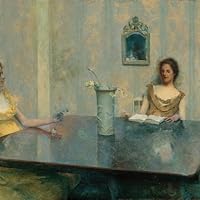
Мир романа «Духи земли» не выдуман, Катрин Колом описывала то, что видела. Вероятно, она обладала особым зрением, фасеточными глазами с десятками тысяч линз, улавливающими то, что недоступно обычному человеческому глазу: тайное, потустороннее. Колом буднично рассказывает о мертвеце, летающем вдоль коридоров по своим прозрачным делам, о юных покойницах, спускающихся по лестнице за последним стаканом воды, о тринадцатилетнем мальчике с проломленной грудью, сопровождающем гробы на погост. Неуклюжие девственницы спотыкаются на садовых тропинках о единорогов, которых невозможно не заметить. По вечерам за окнами с тройными рамами плавают странные космические рыбы. В комнатах слышится тоскливое журчание воды, под репсовыми скатертями задыхаются и плачут древесные нимфы. Ангелы смотрят из-за синих ставень на маленькую швейцарскую деревню, кружат над цветущими вишнями, разговаривают на двух языках и хватают красивых девушек за золотистый локон. С башни Фредега легко можно разглядеть воздушный столп, соединяющий каждое живое существо с его небесным двойником, но деревенские жители слепы, самонадеянны и заняты семейными дрязгами.
Catherine Colomb (1892–1965) has long been considered one of the most original francophone novelists of the twentieth century in Switzerland. Using penname Catherine Tissot, she published her first novel, Pile ou Face (Heads or Tails), in 1934. Adopting the name Catherine Colomb, she wrote a second novel, Châteaux en enfance (Castles in Childhood, 1945), which drew attention to her work. Colomb’s next novel, Les Esprits de la terre (The Spirits of the Earth, 1953), was a critical success. Except for stays in Weimar, Potsdam, Berlin, Paris, and London (where she met members of the Bloomsbury Circle, including Lloyd George, Bertrand Russell, Lytton Strachey, and Vaslav Nijinksy—but not the Woolfs), Colomb spent her entire life in the canton of Vaud. It is known that she read Balzac, Hölderlin, Jean Paul, and especially Proust, as well as, late in life, Virginia Woolf; but, above all, she fashioned her exceptional style and formally innovative fictions in relative isolation.
This is wonderful--inventive and interesting. The Virginia Woolf/Proust analogies are quite misleading; this is much closer to Josef Winkler and Ivy Compton-Burnett (all indirection and repetition), but I guess those names are even less likely to generate sales. I very much hope John Taylor translates Colomb's other novels, which would be far too much for me in the original.
Anyway, you have to pay attention, but it rewards that attention. It's a real shame that so few seem to be reading this book!
Propelled by misanthropy, this book is a bit of a stylistic tour de force. In a deliberately jumbled way, it tells the story of 4 siblings who lost their mother while still children. César, the eldest and his mother's favorite, was hit hardest, and never really recovered. Eugène and especially Adolphe couldn't care less. Zoé is the least developed character. Eugène and Adolphe marry early in a successful effort to squeeze César out of his inheritance. Eugène marries Madame, a tight-fisted snob who believes she made a poor bargain with Eugène, whose vineyards are not as prosperous as she imagined. Adolphe marries Mélanie, who gets attracted to César the minute she meets him. César himself is too dreamy and indecisive to ask for his childhood sweetheart's hand in time. Eventually, tired of being played by his brothers, he marries Blanche, at random. To Madame's great satisfaction, Blanche dies in a accident during her honeymoon. Zoé never marries and pretends to be mad in order to escape from further persecutions from Madame. The novel starts dramatically with yet another failed attempt by César to take revenge on Madame by pushing her son Abraham, his own nephew, to his death. The novel then throws light on this aborted infanticide by highlighting the pettiness and cruelty of Madame through a series of grotesque vignettes alternating with lyrical descriptions of the countryside to which César has a strong connection. Like Colomb's first book "Pile ou Face", this is powerful stuff somewhat marred by a relentlessly gloomy view of mankind.