

What do you think?
The Shadow #1
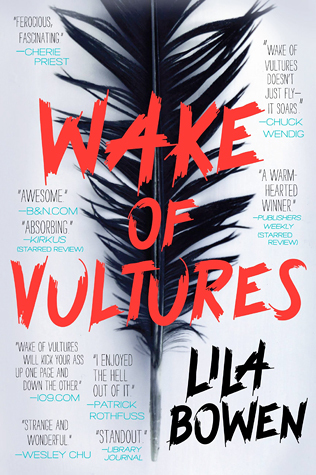
Wake of Vultures
“Wake of Vultures will kick your a** up one page and down the other.” —io9
Nettie Lonesome dreams of a greater life than toiling as a slave in the sandy desert. But when a stranger attacks her, Nettie wins more than the fight.
Now she’s got friends, a good horse, and a better gun. But if she can’t kill the thing haunting her nightmares and stealing children across the prairie, she’ll lose it all—and never find out what happened to her real family.
Wake of Vultures is the first novel of the Shadow series featuring the fearless Nettie Lonesome.
Nettie Lonesome dreams of a greater life than toiling as a slave in the sandy desert. But when a stranger attacks her, Nettie wins more than the fight.
Now she’s got friends, a good horse, and a better gun. But if she can’t kill the thing haunting her nightmares and stealing children across the prairie, she’ll lose it all—and never find out what happened to her real family.
Wake of Vultures is the first novel of the Shadow series featuring the fearless Nettie Lonesome.
384 pages, Paperback
First published October 27, 2015
About the author
Lila Bowen
11 books287 followersLila Bowen is the writer of Wake of Vultures and its sequel, Horde of Crows. As Delilah S. Dawson, she writes the Blud series, the Hit series, Servants of the Storm, and a variety of short stories and comics.
Ratings & Reviews
Friends & Following
Create a free account to discover what your friends think of this book!
Community Reviews
Displaying 1 - 30 of 935 reviews

October 31, 2015
This is a tricky book for me to give this a star rating to.
Don't get me wrong, I liked it. I liked it a whole lot. I read the whole thing in two sittings.
But that's not the end-all be-all when it comes to rating a book. (Or at least it isn't for me.) When I rate a book publicly, one of the things I take into consideration is how much you would enjoy the book. (And by "you" I mean the average person who reads my reviews.)
Here are the things that complicate rating this book for me:
First and foremost, I don't read a lot of Westerns. And whether or not you consider this a western, it's obviously western-inspired and influenced. Since I don't have a lot of context for the story, it's hard for me to tell how it measures up to other works in that area.
Another element is the main character: a black woman written realistically into a historical setting where it was not a great time to be black or a woman, let along both.
I think the character was handled well. Very well. And that doesn't happen easily or by accident. The character isn't not a blushing violet, and neither is she a crusader and a firebrand. The book isn't about her fighting gender oppression or anything like that. But it's a part of her life, and so it's a part of the book. And writing that sort of thing is *hard* to do well. That means the story is doing something very different and very hard right out of the gate...
So, did I enjoy this book as much as I enjoy, say, reading a Pratchett novel? (Books which generally get five stars from me?) No. I didn't.
But honestly, that's an unfair comparison, given that Pratchett's one of my favorite authors. And honestly? The first books in Discworld weren't really 5-star books....
Instead, let me say this.
The world: I thought it was cool and unique. Loved the western setting.
The supernatural element: Also cool and unique. Well integrated. Never seen anything like it before.
The character: Also unique. And that's a rare thing for me to say. But it's true, I've never seen a character like this. I liked her.
Ultimately it comes down to two questions:
Did I like it? Yeah. I enjoyed the hell out of it.
Is it worth your time? Well, that depends....
If you hate being exposed to new things. This isn't probably going to be the book for you. For example, if 90% of anything you read is in the same narrow slice of genre (Like D&D novels or Star Wars books) then this isn't probably going to be for you.
But if one of the things you enjoy about reading fantasy is getting to see different worlds, strange magics, and unique characters, and... well... just generally having new experiences in general. Then yeah. Then you owe it to yourself to read this. Because I'm willing to bet, just like me, you've never seen anything like it before....
Don't get me wrong, I liked it. I liked it a whole lot. I read the whole thing in two sittings.
But that's not the end-all be-all when it comes to rating a book. (Or at least it isn't for me.) When I rate a book publicly, one of the things I take into consideration is how much you would enjoy the book. (And by "you" I mean the average person who reads my reviews.)
Here are the things that complicate rating this book for me:
First and foremost, I don't read a lot of Westerns. And whether or not you consider this a western, it's obviously western-inspired and influenced. Since I don't have a lot of context for the story, it's hard for me to tell how it measures up to other works in that area.
Another element is the main character: a black woman written realistically into a historical setting where it was not a great time to be black or a woman, let along both.
I think the character was handled well. Very well. And that doesn't happen easily or by accident. The character isn't not a blushing violet, and neither is she a crusader and a firebrand. The book isn't about her fighting gender oppression or anything like that. But it's a part of her life, and so it's a part of the book. And writing that sort of thing is *hard* to do well. That means the story is doing something very different and very hard right out of the gate...
So, did I enjoy this book as much as I enjoy, say, reading a Pratchett novel? (Books which generally get five stars from me?) No. I didn't.
But honestly, that's an unfair comparison, given that Pratchett's one of my favorite authors. And honestly? The first books in Discworld weren't really 5-star books....
Instead, let me say this.
The world: I thought it was cool and unique. Loved the western setting.
The supernatural element: Also cool and unique. Well integrated. Never seen anything like it before.
The character: Also unique. And that's a rare thing for me to say. But it's true, I've never seen a character like this. I liked her.
Ultimately it comes down to two questions:
Did I like it? Yeah. I enjoyed the hell out of it.
Is it worth your time? Well, that depends....
If you hate being exposed to new things. This isn't probably going to be the book for you. For example, if 90% of anything you read is in the same narrow slice of genre (Like D&D novels or Star Wars books) then this isn't probably going to be for you.
But if one of the things you enjoy about reading fantasy is getting to see different worlds, strange magics, and unique characters, and... well... just generally having new experiences in general. Then yeah. Then you owe it to yourself to read this. Because I'm willing to bet, just like me, you've never seen anything like it before....

January 22, 2018
Sometimes, it's all in the spin. If you has said to me, "here, read this YA book with trigger scenes, set in the Old-Timey West with phrases like, "Poor critter was parched and gaunt as a crow's skeleton," I would have insincerely said, 'sure,' and immediately made plans to deep-six it down the nearest prairie well. But had you said, "here, I have this great book about a brown, mixed race, Native gender-bender girl who learns to see monsters after she kills one and is given a ghost-quest to take down the biggest, scariest, baby-stealing monster of all, but perhaps she'll have help from some other legends," I would have been intrigued, especially if you mentioned birds.
So, I'm cleaning out the TBR, and I have this in the library stack, and I have far, far too much of a headache for Miéville's wordy tricks and politics, so I pick this up, and you can switch me twice with a porcupine's tail if I didn't finish it the very same night. Even though--and this is a very big even though--it's spoken in gawd-awful cowboy talk: "Stunned, she nearly swallowed a fly; in ten years as Monty's shadow, this was her first invitation to join the wranglers for grub at the ranch house." With more spitting than a llama convention. But it begins quickly, throwing the hero/ine Nettie right into trouble when a fancily dressed stranger tries to corner her inside the barn of her adopted parents' tiny farmstead. I might've hung it up then and there if Bowden's writing weren't so durn good, and the sickle in the stranger's eye didn't seem to deter him from carrying on, until Nettie stabs him in the heart with a piece of wood and he turns to sand.
This becomes a watershed moment for her where she becomes brave enough to sneak away from her clearly drunk and abusive Ma and Pa and venture over to the next ranch to seek a job. She adopts a male personality and is starting to fit in when she discovers all sorts of beasties in the night, particularly the red-eyed, fanged ones at the local whorehouse. Soon after, the ranch hands discover a half-dead ancient Native woman who keeps repeating, "Pia Mupitsi," and from there, Net's destiny or curse is clear.
It is truly an intriguing and well written book. Net/Nat is annoying, as all teenagers, refusing to communicate when she finally has a learning opportunity and saying, "ain't" every time she does. But it's all made plausible by her horrible upbringing that didn't give her the skills to puzzle out a world in shades of grey, and Bowden stays faithful to that set-up until the end, exposing Net in bits and pieces to the idea that not everything is one thing or another. In the setting of the Special Orphan Trope, she at least commits to the very gradual awakening of the ignorant and stubborn orphan.
But here's what no doubt caught Past-carol's attention: there's some intriguing stuff running through here about gender and sexuality, and as Nettie has to navigate a man's world by becoming Nat, she starts to learn identity is broader than what she learned from Ma and Pa. I was curious to see if Bowden was going to establish Netti as transgender, but by the end, I don't think she did. I think Net is uncomfortable with definitions of femaleness and wants the freedom and roles of the male world, but I can see where future books might have her just be a 'tomboy' girl--who is, admittedly, attracted to both male and female. At any rate, a fascinating exploration of the topic as Net meets more people and develops relationships.
In some ways the quest is a McGuffin; though she's forced into it, her journey isn't really about learning about what she's after. Rather, the goal is to learn potential skills that could help and engaging in adventures along the way, although, as is typical, part of the strategy seems to be relying on her own Specialness. The landscaped developed is both rich and sparse, and has the dry, arid feeling of the Texas desert, ghost towns and isolated farms included.
There's a prolonged non-significant side incident on the way that was deeply disturbing and even more triggering than the initial farmyard scene. Seriously, I'm left wondering at the authorial choice; it's the kind of thing that most definitely means I'd suggest it for the mid-teen crown not an advanced-reader younger one. Bowden is probably trying to make some kind of complex metaphor about sexuality in this book, but it is often contextualized in a bloody, violent framework. Had I been Nettie, I might have chosen, 'none of the above.' Which will be interesting to see how gender and sexuality is negotiated, if Bowden continues to remain roughly faithful to her chosen timeline of 1870s.
And while there's a resolution, it is not an entirely clear one, so negative point for that. Still, the writing was very good, the landscape and atmosphere solidly developed and the Native myths intriguing. I'm sure I'll pick up the next.
Three and a half cowpokes
So, I'm cleaning out the TBR, and I have this in the library stack, and I have far, far too much of a headache for Miéville's wordy tricks and politics, so I pick this up, and you can switch me twice with a porcupine's tail if I didn't finish it the very same night. Even though--and this is a very big even though--it's spoken in gawd-awful cowboy talk: "Stunned, she nearly swallowed a fly; in ten years as Monty's shadow, this was her first invitation to join the wranglers for grub at the ranch house." With more spitting than a llama convention. But it begins quickly, throwing the hero/ine Nettie right into trouble when a fancily dressed stranger tries to corner her inside the barn of her adopted parents' tiny farmstead. I might've hung it up then and there if Bowden's writing weren't so durn good, and the sickle in the stranger's eye didn't seem to deter him from carrying on, until Nettie stabs him in the heart with a piece of wood and he turns to sand.
This becomes a watershed moment for her where she becomes brave enough to sneak away from her clearly drunk and abusive Ma and Pa and venture over to the next ranch to seek a job. She adopts a male personality and is starting to fit in when she discovers all sorts of beasties in the night, particularly the red-eyed, fanged ones at the local whorehouse. Soon after, the ranch hands discover a half-dead ancient Native woman who keeps repeating, "Pia Mupitsi," and from there, Net's destiny or curse is clear.
It is truly an intriguing and well written book. Net/Nat is annoying, as all teenagers, refusing to communicate when she finally has a learning opportunity and saying, "ain't" every time she does. But it's all made plausible by her horrible upbringing that didn't give her the skills to puzzle out a world in shades of grey, and Bowden stays faithful to that set-up until the end, exposing Net in bits and pieces to the idea that not everything is one thing or another. In the setting of the Special Orphan Trope, she at least commits to the very gradual awakening of the ignorant and stubborn orphan.
But here's what no doubt caught Past-carol's attention: there's some intriguing stuff running through here about gender and sexuality, and as Nettie has to navigate a man's world by becoming Nat, she starts to learn identity is broader than what she learned from Ma and Pa. I was curious to see if Bowden was going to establish Netti as transgender, but by the end, I don't think she did. I think Net is uncomfortable with definitions of femaleness and wants the freedom and roles of the male world, but I can see where future books might have her just be a 'tomboy' girl--who is, admittedly, attracted to both male and female. At any rate, a fascinating exploration of the topic as Net meets more people and develops relationships.
In some ways the quest is a McGuffin; though she's forced into it, her journey isn't really about learning about what she's after. Rather, the goal is to learn potential skills that could help and engaging in adventures along the way, although, as is typical, part of the strategy seems to be relying on her own Specialness. The landscaped developed is both rich and sparse, and has the dry, arid feeling of the Texas desert, ghost towns and isolated farms included.
There's a prolonged non-significant side incident on the way that was deeply disturbing and even more triggering than the initial farmyard scene. Seriously, I'm left wondering at the authorial choice; it's the kind of thing that most definitely means I'd suggest it for the mid-teen crown not an advanced-reader younger one. Bowden is probably trying to make some kind of complex metaphor about sexuality in this book, but it is often contextualized in a bloody, violent framework. Had I been Nettie, I might have chosen, 'none of the above.' Which will be interesting to see how gender and sexuality is negotiated, if Bowden continues to remain roughly faithful to her chosen timeline of 1870s.
And while there's a resolution, it is not an entirely clear one, so negative point for that. Still, the writing was very good, the landscape and atmosphere solidly developed and the Native myths intriguing. I'm sure I'll pick up the next.
Three and a half cowpokes

November 16, 2016
I stinkin' loved this book. Clearly, as I gave it five stars, so that's obvious. And normally my reviews don't get all analytical or deep, but because this book tackles so much and does it really, really well, I feel like it deserves some praise and a little bit deeper of a review.
This book is set in the past - the late 1800s Southwest, to be exact -- but its message includes some highly relevant subjects. Sure it's a fantasy take on the famous western "Cowboy and Indian" tales and games we used to play as kids, down to the small desert towns, saloons, and badged rangers, but it's so much more than that.
Okay, yeah, a lot of this "more" is because it's got magic mixed in, which is honestly one of the only reasons I'd give a western book a chance -- not a big fan of the genre in general -- but the biggest "more" of Bowen's work is the intense level of diversity she has included. Her main character is not the typical "cowboy hero" or "native who has a heart for all people." She's dark, gritty, and a loner by nature. But then the "modern" issues enter the picture (I use quotes there because, well, these issues have long been a part of the human experience, but archaic thinking and religion and most cultures have tamped down things that are different for as long as the world has memory) - gender identity, self-acceptance, race (mixed, even!), and sexuality all play a vital role in the development of our heroine/hero. Nettie Lonesome is a half-black, half-Comanche badass. She just doesn't know how badass she is at first. She starts the book virtually as a slave to the couple that "adopted" her, not knowing her past, and getting by, unhappy. She's not comfortable in her womanhood, and feels more comfortable in her own skin by living as a man. So as time goes by, her choices lead her to join the Rangers (who fight monsters of the actual variety) as Rhett, not as Nettie, and the story leads us to a final conclusion against a brutal, vicious monster AND through a journey of not only self-discovery, but of a deeper understanding of a world she thought she understood, but barely knew.
I struggle with knowing the correct pronoun to use, because the author herself uses "she" but Nettie's compatriots think she is (and therefore refer to her as) a man. So I'll just put my little apology here, and end with the following plea:
If you're comfortable with all those "today topics," give this book a shot.
If you're NOT comfortable with all those "today topics," give this book a shot.
If you want a good historical urban fantasy, give this book a shot.
JUST GIVE THIS BOOK A SHOT.
Can't wait for book two.
(Thanks to Netgalley and the publisher for providing me with an ARC in exchange for an honest review.)
This book is set in the past - the late 1800s Southwest, to be exact -- but its message includes some highly relevant subjects. Sure it's a fantasy take on the famous western "Cowboy and Indian" tales and games we used to play as kids, down to the small desert towns, saloons, and badged rangers, but it's so much more than that.
Okay, yeah, a lot of this "more" is because it's got magic mixed in, which is honestly one of the only reasons I'd give a western book a chance -- not a big fan of the genre in general -- but the biggest "more" of Bowen's work is the intense level of diversity she has included. Her main character is not the typical "cowboy hero" or "native who has a heart for all people." She's dark, gritty, and a loner by nature. But then the "modern" issues enter the picture (I use quotes there because, well, these issues have long been a part of the human experience, but archaic thinking and religion and most cultures have tamped down things that are different for as long as the world has memory) - gender identity, self-acceptance, race (mixed, even!), and sexuality all play a vital role in the development of our heroine/hero. Nettie Lonesome is a half-black, half-Comanche badass. She just doesn't know how badass she is at first. She starts the book virtually as a slave to the couple that "adopted" her, not knowing her past, and getting by, unhappy. She's not comfortable in her womanhood, and feels more comfortable in her own skin by living as a man. So as time goes by, her choices lead her to join the Rangers (who fight monsters of the actual variety) as Rhett, not as Nettie, and the story leads us to a final conclusion against a brutal, vicious monster AND through a journey of not only self-discovery, but of a deeper understanding of a world she thought she understood, but barely knew.
I struggle with knowing the correct pronoun to use, because the author herself uses "she" but Nettie's compatriots think she is (and therefore refer to her as) a man. So I'll just put my little apology here, and end with the following plea:
If you're comfortable with all those "today topics," give this book a shot.
If you're NOT comfortable with all those "today topics," give this book a shot.
If you want a good historical urban fantasy, give this book a shot.
JUST GIVE THIS BOOK A SHOT.
Can't wait for book two.
(Thanks to Netgalley and the publisher for providing me with an ARC in exchange for an honest review.)

March 2, 2015
4 of 5 stars at The BiblioSanctum http://bibliosanctum.com/2015/12/24/b...
Wake of Vultures has all the qualities of a great book. First, it features a standout protagonist, an undaunted misfit heroine who against all odds rises to meet the biggest challenge of her life. Second, we have an action-filled plot full of wildly imaginative ideas and exciting new twists–in other words, a genuinely entertaining story. Third, I enjoyed its poignant messages of self-discovery and independence, of seizing control of one’s destiny by fighting back against society’s expectations. None of these points would be enough by themselves, but this new coming-of-age tale by Lila Bowen (AKA Delilah S. Dawson) exemplifies all three.
Meet Nettie Lonesome, a mixed-race young woman who was found orphaned as a child and raised by a couple who treated her more like a slave. She has never felt accepted anywhere, though she has found some measure of belonging at a nearby ranch where she trains horses and does other odd jobs while disguised as a man. It’s the only life she’s ever known, until one day, a stranger shows up at her house and attacks her. When Nettie stakes him through the chest with a sharp piece of wood, he disintegrates into a pile of sand. Just like that, her life is turned completely upside down.
Nettie soon learns that the world is full of monsters. Real monsters, like blood drinkers, shapeshifters, harpies, and sirens and chupacabras and more. And now she can see them everywhere. At first, she tries to flee, donning her male disguise to join up with a team of cattle drivers. But Nettie doesn’t realize that she has been marked for a destiny, one she cannot escape until she fulfills the task set for her by forces ancient and unknowable.
First, I know I’ve made it known before how much I love western-fantasy settings. I also am a sucker for the good old girl-disguised-as-a-boy trope. Earlier this year, I read another coming-of-age novel with similar aspects, the fantastic Walk on Earth a Stranger by Rae Carson, but the two books are very different in their approaches. For one thing, Wake of Vultures is less traditionally Young Adult, leaning towards darker and more mature themes. Nettie’s home is also a grittier, fantastical setting inspired by the Old West, albeit steeped with real-world Native American folklore and mythology. On top of that, Bowen has created a very unique and special world where historical elements combine with the paranormal, so that we get to see some really cool things—like a reimagining of the legendary Rangers as a band of rough living and tough talking monsters hunters, for instance.
It’s also worth picking up Wake of Vultures just to read about Nettie, the most spirited, determined and unforgettable protagonist you’ll ever meet. A half-black, half-Native American woman, nothing in life has ever been easy for her, and yet even when constrained by societal expectations, she has the guts and gumption to do anything to get what she wants. Her gender keeping her from getting her dream job? No problem, chop off her hair and pretend to be one of the guys. And monsters beware, Nettie’s not one to lie down and be easy prey. After discovering her gift, she even tries her darndest to escape her fate, until her pragmatism and kindheartedness makes her realize she would be doing a lot more good by standing her ground against evil.
Furthermore, for someone who lives in disguise and who goes by so many different names, Nettie is surprisingly comfortable in her own skin. Whether she calls herself Nettie Lonesome, Nat Lonesome, or Rhett Hennessy, all those are simply different aspects of her true self; no matter which identity she takes on, her race, gender and sexuality are all things she embraces, even when she’s still learning what it all means, and I love how extraordinarily genuine and down-to-earth she is.
From the moment I heard about this book and its western setting, I knew I had to read it. And in the end, it turned out to be even more than I bargained for. Wake of Vultures did not disappoint, giving me what I wanted and then some. Bold and original, this weird west fantasy novel is a masterfully written tale full of thrilling adventure and heart. Give me book two now!
Wake of Vultures has all the qualities of a great book. First, it features a standout protagonist, an undaunted misfit heroine who against all odds rises to meet the biggest challenge of her life. Second, we have an action-filled plot full of wildly imaginative ideas and exciting new twists–in other words, a genuinely entertaining story. Third, I enjoyed its poignant messages of self-discovery and independence, of seizing control of one’s destiny by fighting back against society’s expectations. None of these points would be enough by themselves, but this new coming-of-age tale by Lila Bowen (AKA Delilah S. Dawson) exemplifies all three.
Meet Nettie Lonesome, a mixed-race young woman who was found orphaned as a child and raised by a couple who treated her more like a slave. She has never felt accepted anywhere, though she has found some measure of belonging at a nearby ranch where she trains horses and does other odd jobs while disguised as a man. It’s the only life she’s ever known, until one day, a stranger shows up at her house and attacks her. When Nettie stakes him through the chest with a sharp piece of wood, he disintegrates into a pile of sand. Just like that, her life is turned completely upside down.
Nettie soon learns that the world is full of monsters. Real monsters, like blood drinkers, shapeshifters, harpies, and sirens and chupacabras and more. And now she can see them everywhere. At first, she tries to flee, donning her male disguise to join up with a team of cattle drivers. But Nettie doesn’t realize that she has been marked for a destiny, one she cannot escape until she fulfills the task set for her by forces ancient and unknowable.
First, I know I’ve made it known before how much I love western-fantasy settings. I also am a sucker for the good old girl-disguised-as-a-boy trope. Earlier this year, I read another coming-of-age novel with similar aspects, the fantastic Walk on Earth a Stranger by Rae Carson, but the two books are very different in their approaches. For one thing, Wake of Vultures is less traditionally Young Adult, leaning towards darker and more mature themes. Nettie’s home is also a grittier, fantastical setting inspired by the Old West, albeit steeped with real-world Native American folklore and mythology. On top of that, Bowen has created a very unique and special world where historical elements combine with the paranormal, so that we get to see some really cool things—like a reimagining of the legendary Rangers as a band of rough living and tough talking monsters hunters, for instance.
It’s also worth picking up Wake of Vultures just to read about Nettie, the most spirited, determined and unforgettable protagonist you’ll ever meet. A half-black, half-Native American woman, nothing in life has ever been easy for her, and yet even when constrained by societal expectations, she has the guts and gumption to do anything to get what she wants. Her gender keeping her from getting her dream job? No problem, chop off her hair and pretend to be one of the guys. And monsters beware, Nettie’s not one to lie down and be easy prey. After discovering her gift, she even tries her darndest to escape her fate, until her pragmatism and kindheartedness makes her realize she would be doing a lot more good by standing her ground against evil.
Furthermore, for someone who lives in disguise and who goes by so many different names, Nettie is surprisingly comfortable in her own skin. Whether she calls herself Nettie Lonesome, Nat Lonesome, or Rhett Hennessy, all those are simply different aspects of her true self; no matter which identity she takes on, her race, gender and sexuality are all things she embraces, even when she’s still learning what it all means, and I love how extraordinarily genuine and down-to-earth she is.
From the moment I heard about this book and its western setting, I knew I had to read it. And in the end, it turned out to be even more than I bargained for. Wake of Vultures did not disappoint, giving me what I wanted and then some. Bold and original, this weird west fantasy novel is a masterfully written tale full of thrilling adventure and heart. Give me book two now!

Read
May 17, 2017DNF at 55%
I don't DNF often and it isn't that this is a bad book. It isn't at all I'm just really struggling to stay interested in it.
Lila hasn't been really likable for me so far and I'm not sure if it is just that this has a setting like a Western or that there was a lot of stuff with Horses that disinterested me.
I did like it when the shapeshifting Coyote showed up though.
I've tried to get back to it a few times and I'm just really more interested in a lot of other books right now and this being YA isn't CALLING to me to finish it.
I might try to re-pick it up at a future date.
I don't DNF often and it isn't that this is a bad book. It isn't at all I'm just really struggling to stay interested in it.
Lila hasn't been really likable for me so far and I'm not sure if it is just that this has a setting like a Western or that there was a lot of stuff with Horses that disinterested me.
I did like it when the shapeshifting Coyote showed up though.
I've tried to get back to it a few times and I'm just really more interested in a lot of other books right now and this being YA isn't CALLING to me to finish it.
I might try to re-pick it up at a future date.

August 4, 2015
This was both a joyful and inspiring read. With a fabulously frantic fast pace, the action-packed adventure to find and conquer the Cannibal Owl sucked me in and carried me along. The variety of monsters that are encountered all along the way totally tickled my adoration of fantasy, while the main character, Nettie Lonesome grounded me and filled me with hope and pride.
Nettie’s spunk, whole-hearted courage and unconditional admiration and adoration of all animals are delightfully demonstrated by her actions and blunt dialogue. Her rough edges are only a thin disguise for her compassion and empathy, making her into the quintessential heroine, in my eyes.
“What if it was a good monster having a bad day?”
Already a huge fan of Delilah Dawson (aka Lila Bowen), I was nevertheless blown away by her clever capability of tackling serious social issues with subtle undertones in this captivating, compelling story. I think Chuck Wendig summed it up best when he said, “WAKE OF VULTURES doesn’t just fly—it soars.”
“I ain’t white, and that’s all that seems to matter to folks.”
“Suicide was a pleasure she couldn’t afford.”
If you are looking for something completely different yet comfortable and familiar, this is the author for you. Enjoy.
***** ****** ***** ***** ***** ***** ***** *****
Stupidly, I decided to start this book last night before going to sleep. So, yeah. I went to sleep a solid hour later than planned, but man....I am loving Nettie Lonesome and her kind, compassionate, gentle ways with the wild horses. Pretty sure I'm going to "busy" until I've finished this compelling tome!
Nettie’s spunk, whole-hearted courage and unconditional admiration and adoration of all animals are delightfully demonstrated by her actions and blunt dialogue. Her rough edges are only a thin disguise for her compassion and empathy, making her into the quintessential heroine, in my eyes.
“What if it was a good monster having a bad day?”
Already a huge fan of Delilah Dawson (aka Lila Bowen), I was nevertheless blown away by her clever capability of tackling serious social issues with subtle undertones in this captivating, compelling story. I think Chuck Wendig summed it up best when he said, “WAKE OF VULTURES doesn’t just fly—it soars.”
“I ain’t white, and that’s all that seems to matter to folks.”
“Suicide was a pleasure she couldn’t afford.”
If you are looking for something completely different yet comfortable and familiar, this is the author for you. Enjoy.
***** ****** ***** ***** ***** ***** ***** *****
Stupidly, I decided to start this book last night before going to sleep. So, yeah. I went to sleep a solid hour later than planned, but man....I am loving Nettie Lonesome and her kind, compassionate, gentle ways with the wild horses. Pretty sure I'm going to "busy" until I've finished this compelling tome!

March 20, 2024
Wake of Vultures
By Lila Bowen
This part horror, part thriller, and all fantastic fantasy! This follows Nettie, part black and part native American, during an alternative Western world. Characters include vampires, unicorns, harpies, and other monsters. Terrific world building. Really loved this. Ready to read book 2!
By Lila Bowen
This part horror, part thriller, and all fantastic fantasy! This follows Nettie, part black and part native American, during an alternative Western world. Characters include vampires, unicorns, harpies, and other monsters. Terrific world building. Really loved this. Ready to read book 2!

October 14, 2015
WELCOME TO THE WILD WEST!

Get ready for a tale about the pull of destiny and the search of one's identity, carrying a distinctly feminist undertone (not that guys won't love it too ... it's a western, duh).
“Nettie Lonesome had two things in the world that were worth a sweet goddamn: her old boots and her one-eyed mule, Blue. Neither item actually belonged to her. But then again, nothing did.”
...and just like that, after the first two lines, I knew I would love it.
Set in an alternate version of 1800s Texas , Wake of Vultures is a fantastic YA novel featuring a pretty unique heroine. With the smell of gun smoke and horse corrals blowing our way, and the scorching sun leaving us parched in true western style, there is also a hefty sprinkle of Native American folklore (skin-walkers and the Big Owl) with a generous dose of classic fantasy monsters like vampires (no, not the sparkling kind) and werewolves (no, not the hot, possessive ones), a handful of less frequent ones like harpies (buzzard-looking ones), the siren (no, not the half fish kind), the water horse and even an urban legend like the chupacabra. A weird mix for sure. It could have gone wrong very easily, it's a debut novel after all ... and somehow it worked out.
“The last fourteen years of Nettie’s life had passed in a shriveled corner of Durango territory under the leaking roof of this wind-chapped lean-to with Pap and Mam, not quite a slave and nowhere close to something like a daughter. Their faces, white and wobbling as new butter under a smear of prairie dirt, held no kindness.”

Nettie Lonesome is a half-breed teenage girl, trying to get on with life day by day working like a slave (she is not one on paper but they sure treat her so) on a run down ranch owned by her abusive adoptive parents. It is a rough enough world for an adopted half-breed, it doesn't help being a girl on top. Nettie dresses and pretends to be a boy. Besides her "parents" only her friend on the neighboring big ranch knows her secret. It is easier that way. Boys can do what girls aren't allowed, and go wherever they want. Plus, posing as a boy, no man will look at her the way her Pap does for some time now.
“Despite the drenching Durango heat, she’d taken to dressing like a bandito’s grandmother with one of Pap’s old, faded shirts over her bound chest, baggy pants held up by a rope, and a moth-gnawed serape over that. The less the folks of Gloomy Bluebird could see she was a girl, the less trouble they gave her.”
One night a stranger corners Nettie and she kills him in self-defense ...
“She expected the stick to break against his shirt like the time she’d seen a buggy bash apart against the general store during a twister. But the twig sunk right in like a hot knife in butter. ...
He wasn’t breathing, and Pap wasn’t coming, and Nettie’s finger reached out as if it had a mind of its own and flicked one big, shiny, curved tooth. The goddamn thing fell back into the dead man’s gaping throat. Nettie jumped away, skitty as the black filly, and her boot toe brushed the dead man’s shoulder, and his entire body collapsed in on itself like a puffball, thousands of sparkly motes piling up in the place he’d occupied and spilling out through his empty clothes....
It was sand. Nothing but sand.”
... and now Nettie can see ... all that is hidden to the human eye ... the endless source of the desert sand ... and nothing will be the same, there's no way back.
“Did you know a group of vultures is called a wake? As if they waited for a funeral instead of causing one. A normal person walking past would see only useful scavengers waiting to pick off the weak and old or to feast after a battle.”
But Nettie saw cruel, blue-eyed bird-women with hanging dugs, sharpening their beaks against the bark and preening. As the sun topped the rise, their razor-sharp feathers shone like blades and screeched like steel as they shifted and stretched.
Like they were getting ready for war.
Like they were hungry.”

First and foremost, I loved the writing....
“Gloomy Bluebird was a stupid name for a town, especially considering Old Ollie Hampstead had shot the only bluebird they had back in 1822, right outside what passed as a general store. The damn thing had been stuffed and posed with little skill and now sat proudly on the storekeeper’s counter as a reminder of what looking cheerful and bright would get you in a town as dusty as an old maid’s britches.”
Next, Nettie....
Nettie is not your out-of-a-mold YA heroine. When I think I've met them all, here comes a half black, half native american orphaned girl, who doesn't want to dress or act like one. She is fast with the guns (often shoots before thinking),
“There was a hole in the middle of his forehead, and he fell on his face looking most surprised.
Jumping Jesus on a jackrabbit”
She's an I-won't-take-shit-from-anyone-again-so-help-me-god-I'll-shoot-you-if-you-if-you-call-me-slave-or-try-something type, she distrusts men in general (if even half of them are like her Pap, the world is a scary up place), loves working with horses, taming the wild broncs ... and she hasn't decided if she likes boys or girls or both. She will get to work as a wrangler, to ride with the infamous Rangers, to kill monsters left and right searching for her past and trying to find her own identity.

As I said, this could have been a mess, but somehow Lila Bowen makes it work... the book was a joy to read. It has passed with flying colors this year's often disastrous Read it Alongside the Malazan the Book of the Fallen Test, and that says a lot (Erikson has been the end to more than one book this year).
“Your heart is not a rock that stands unchanging. It’s like water. It flows, it moves, it allows neither boulders nor canyons to stand in its way. It hardens and softens and expands to fill new spaces. You are still becoming yourself. And you have a lot to learn.”

Don't get me wrong, it wasn't perfect. At one point, after some "tingling, and heart flipping feelings" caused by the proximity of a certain young blue-eyed Durango Ranger, I was worried this was going to be one of those books that at half point take a sharp turn into angsty teen love. fortunately we dodged that metaphorical bullet, and thankfully just skimmed the dangerous territory. I don't mind romance ... though I love to keep it low profile and slow in this kind of story. It's no good when a perfectly kick-ass character starts mooning about. thinking mainly of love and sweet lips and blue smiling eyes, through half the novel. Please, please ... give us romance in smaller doses.
“The only breathing thing she could find was the buzzard that kept spiraling hopefully overhead. When she launched a rock straight up with her best throw, the thing screeched something that sounded a little like “Bitch,” and Nettie decided she’d best sip from the water skin before the tumbleweeds started talking back”
Rating 4.5

P.S.
Loved Ragdoll, Nettie's horse and the wet black mare...
“No matter how many times Pap drove the filly away with poorly thrown bottles, stones, and bullets, the critter crept back under cover of night to ruin the water by dancing a jig in the trough, which meant another blistering trip to the creek with a leaky bucket for Nettie.
Splash, splash. Whinny.
Could a horse laugh? Nettie figured this one could.”
...loved the skin-walker siblings, Coyote Dan and Winifred, although I hope we don't get some weird love triangle featuring them and Nettie in the next book.
“Eternity was a wake of vultures, a harem of harpies, a brigade of bragging bitch-buzzards carrying her through the night, flying her toward the gaping mouth of a cave at the top of a mountain that nothing on two legs could ever reach.”
Get ready for a tale about the pull of destiny and the search of one's identity, carrying a distinctly feminist undertone (not that guys won't love it too ... it's a western, duh).
“Nettie Lonesome had two things in the world that were worth a sweet goddamn: her old boots and her one-eyed mule, Blue. Neither item actually belonged to her. But then again, nothing did.”
...and just like that, after the first two lines, I knew I would love it.
Set in an alternate version of 1800s Texas , Wake of Vultures is a fantastic YA novel featuring a pretty unique heroine. With the smell of gun smoke and horse corrals blowing our way, and the scorching sun leaving us parched in true western style, there is also a hefty sprinkle of Native American folklore (skin-walkers and the Big Owl) with a generous dose of classic fantasy monsters like vampires (no, not the sparkling kind) and werewolves (no, not the hot, possessive ones), a handful of less frequent ones like harpies (buzzard-looking ones), the siren (no, not the half fish kind), the water horse and even an urban legend like the chupacabra. A weird mix for sure. It could have gone wrong very easily, it's a debut novel after all ... and somehow it worked out.
“The last fourteen years of Nettie’s life had passed in a shriveled corner of Durango territory under the leaking roof of this wind-chapped lean-to with Pap and Mam, not quite a slave and nowhere close to something like a daughter. Their faces, white and wobbling as new butter under a smear of prairie dirt, held no kindness.”
Nettie Lonesome is a half-breed teenage girl, trying to get on with life day by day working like a slave (she is not one on paper but they sure treat her so) on a run down ranch owned by her abusive adoptive parents. It is a rough enough world for an adopted half-breed, it doesn't help being a girl on top. Nettie dresses and pretends to be a boy. Besides her "parents" only her friend on the neighboring big ranch knows her secret. It is easier that way. Boys can do what girls aren't allowed, and go wherever they want. Plus, posing as a boy, no man will look at her the way her Pap does for some time now.
“Despite the drenching Durango heat, she’d taken to dressing like a bandito’s grandmother with one of Pap’s old, faded shirts over her bound chest, baggy pants held up by a rope, and a moth-gnawed serape over that. The less the folks of Gloomy Bluebird could see she was a girl, the less trouble they gave her.”
One night a stranger corners Nettie and she kills him in self-defense ...
“She expected the stick to break against his shirt like the time she’d seen a buggy bash apart against the general store during a twister. But the twig sunk right in like a hot knife in butter. ...
He wasn’t breathing, and Pap wasn’t coming, and Nettie’s finger reached out as if it had a mind of its own and flicked one big, shiny, curved tooth. The goddamn thing fell back into the dead man’s gaping throat. Nettie jumped away, skitty as the black filly, and her boot toe brushed the dead man’s shoulder, and his entire body collapsed in on itself like a puffball, thousands of sparkly motes piling up in the place he’d occupied and spilling out through his empty clothes....
It was sand. Nothing but sand.”
... and now Nettie can see ... all that is hidden to the human eye ... the endless source of the desert sand ... and nothing will be the same, there's no way back.
“Did you know a group of vultures is called a wake? As if they waited for a funeral instead of causing one. A normal person walking past would see only useful scavengers waiting to pick off the weak and old or to feast after a battle.”
But Nettie saw cruel, blue-eyed bird-women with hanging dugs, sharpening their beaks against the bark and preening. As the sun topped the rise, their razor-sharp feathers shone like blades and screeched like steel as they shifted and stretched.
Like they were getting ready for war.
Like they were hungry.”
First and foremost, I loved the writing....
“Gloomy Bluebird was a stupid name for a town, especially considering Old Ollie Hampstead had shot the only bluebird they had back in 1822, right outside what passed as a general store. The damn thing had been stuffed and posed with little skill and now sat proudly on the storekeeper’s counter as a reminder of what looking cheerful and bright would get you in a town as dusty as an old maid’s britches.”
Next, Nettie....
Nettie is not your out-of-a-mold YA heroine. When I think I've met them all, here comes a half black, half native american orphaned girl, who doesn't want to dress or act like one. She is fast with the guns (often shoots before thinking),
“There was a hole in the middle of his forehead, and he fell on his face looking most surprised.
Jumping Jesus on a jackrabbit”
She's an I-won't-take-shit-from-anyone-again-so-help-me-god-I'll-shoot-you-if-you-if-you-call-me-slave-or-try-something type, she distrusts men in general (if even half of them are like her Pap, the world is a scary up place), loves working with horses, taming the wild broncs ... and she hasn't decided if she likes boys or girls or both. She will get to work as a wrangler, to ride with the infamous Rangers, to kill monsters left and right searching for her past and trying to find her own identity.
As I said, this could have been a mess, but somehow Lila Bowen makes it work... the book was a joy to read. It has passed with flying colors this year's often disastrous Read it Alongside the Malazan the Book of the Fallen Test, and that says a lot (Erikson has been the end to more than one book this year).
“Your heart is not a rock that stands unchanging. It’s like water. It flows, it moves, it allows neither boulders nor canyons to stand in its way. It hardens and softens and expands to fill new spaces. You are still becoming yourself. And you have a lot to learn.”
Don't get me wrong, it wasn't perfect. At one point, after some "tingling, and heart flipping feelings" caused by the proximity of a certain young blue-eyed Durango Ranger, I was worried this was going to be one of those books that at half point take a sharp turn into angsty teen love. fortunately we dodged that metaphorical bullet, and thankfully just skimmed the dangerous territory. I don't mind romance ... though I love to keep it low profile and slow in this kind of story. It's no good when a perfectly kick-ass character starts mooning about. thinking mainly of love and sweet lips and blue smiling eyes, through half the novel. Please, please ... give us romance in smaller doses.
“The only breathing thing she could find was the buzzard that kept spiraling hopefully overhead. When she launched a rock straight up with her best throw, the thing screeched something that sounded a little like “Bitch,” and Nettie decided she’d best sip from the water skin before the tumbleweeds started talking back”
Rating 4.5
P.S.
Loved Ragdoll, Nettie's horse and the wet black mare...
“No matter how many times Pap drove the filly away with poorly thrown bottles, stones, and bullets, the critter crept back under cover of night to ruin the water by dancing a jig in the trough, which meant another blistering trip to the creek with a leaky bucket for Nettie.
Splash, splash. Whinny.
Could a horse laugh? Nettie figured this one could.”
...loved the skin-walker siblings, Coyote Dan and Winifred, although I hope we don't get some weird love triangle featuring them and Nettie in the next book.
“Eternity was a wake of vultures, a harem of harpies, a brigade of bragging bitch-buzzards carrying her through the night, flying her toward the gaping mouth of a cave at the top of a mountain that nothing on two legs could ever reach.”

June 7, 2018
2.5 stars
I’ll begin with a disclaimer: this isn’t my type of book, though from its marketing I thought it might be. First, because while it has a fantasy plotline, the setting and tone are more horror-tinged paranormal, full of monsters and gruesomeness. Second, because it really is a young-adult novel, in the sense of being an easy-to-read, action-oriented adventure populated by simplified characters and featuring a 16-year-old Chosen One who is unrealistically functional for her age and life experience, with a heavy emphasis on People Are Different and That’s Okay. Adding a couple of sexual assault scenes doesn’t make an adult novel of something not written in an adult register; it just means your YA is dark and risqué.
At any rate, this book follows a standard fantasy plotline: Nettie, a mistreated orphan of mysterious parentage who is shunned in her town, discovers supernatural powers, loses her mentor, learns she is the Chosen One, and goes on a quest to defeat an evil villain. The setting is interesting – an alternate version of the Old West, specifically Texas around the 1870s – and the author tries hard to make the book diverse: Nettie is part-black, part-native, bisexual, and genderqueer. This effort is in my view only moderately successful: the characterization overall is not particularly deep or complex; Nettie doesn’t have any consensual sexual encounters or a relationship; and Nettie’s racial heritage functions mostly just as the reason people are occasionally mean to her. She was raised by white people and the only other important non-white characters in the book are two native siblings who, in the traditional role of irritating fantasy allies, are much more knowledgeable, skilled and committed than the protagonist but inexplicably pop in and out of the story rather than sticking around long enough to be helpful, presumably because if they simply took over the quest there wouldn’t be much action left for the clueless young protagonist. But this is better than including no diversity at all.
It’s an action/adventure type of book, with a cliffhanger at the end of every chapter and even a literal one at the end of the novel (I read the preview of the sequel online to satisfy my curiosity, which does not extend to reading another book). The narrative is full of “cowboy” talk: “The Rangers were doing their level best to give off an air of relaxation and ease, but any feller with sense could see that underneath the calm they were jittery as junebugs at a jaybird party.” At least the author has committed to her setting.
Overall, this isn’t a book that did much for me; I’d have appreciated more interesting characters or a plot that contained more than a quest to kill a monster, with something or other attacking our heroes every chapter. But if you like dark paranormal YA with a dash of horror and don’t mind the standard fantasy plot, this book may well be for you.
I’ll begin with a disclaimer: this isn’t my type of book, though from its marketing I thought it might be. First, because while it has a fantasy plotline, the setting and tone are more horror-tinged paranormal, full of monsters and gruesomeness. Second, because it really is a young-adult novel, in the sense of being an easy-to-read, action-oriented adventure populated by simplified characters and featuring a 16-year-old Chosen One who is unrealistically functional for her age and life experience, with a heavy emphasis on People Are Different and That’s Okay. Adding a couple of sexual assault scenes doesn’t make an adult novel of something not written in an adult register; it just means your YA is dark and risqué.
At any rate, this book follows a standard fantasy plotline: Nettie, a mistreated orphan of mysterious parentage who is shunned in her town, discovers supernatural powers, loses her mentor, learns she is the Chosen One, and goes on a quest to defeat an evil villain. The setting is interesting – an alternate version of the Old West, specifically Texas around the 1870s – and the author tries hard to make the book diverse: Nettie is part-black, part-native, bisexual, and genderqueer. This effort is in my view only moderately successful: the characterization overall is not particularly deep or complex; Nettie doesn’t have any consensual sexual encounters or a relationship; and Nettie’s racial heritage functions mostly just as the reason people are occasionally mean to her. She was raised by white people and the only other important non-white characters in the book are two native siblings who, in the traditional role of irritating fantasy allies, are much more knowledgeable, skilled and committed than the protagonist but inexplicably pop in and out of the story rather than sticking around long enough to be helpful, presumably because if they simply took over the quest there wouldn’t be much action left for the clueless young protagonist. But this is better than including no diversity at all.
It’s an action/adventure type of book, with a cliffhanger at the end of every chapter and even a literal one at the end of the novel (I read the preview of the sequel online to satisfy my curiosity, which does not extend to reading another book). The narrative is full of “cowboy” talk: “The Rangers were doing their level best to give off an air of relaxation and ease, but any feller with sense could see that underneath the calm they were jittery as junebugs at a jaybird party.” At least the author has committed to her setting.
Overall, this isn’t a book that did much for me; I’d have appreciated more interesting characters or a plot that contained more than a quest to kill a monster, with something or other attacking our heroes every chapter. But if you like dark paranormal YA with a dash of horror and don’t mind the standard fantasy plot, this book may well be for you.

July 17, 2018
Because a shadow was a thing that defined itself, and Nettie didn’t have to fit anyone else’s shape.
It is a story of finding yourself and self determination.
" It doesn’t matter what tribe you came from. You can make your own.”
This was a fantastic weird western with ALL the things
Chupacabra, werewolves, harpies, minotaurs, vampire covens, a Cannibal Owl
gorgons , rabbits with fangs, butterflies with skulls for heads and huge stingers, Cockatrices, Death’s Head moths, pixies, dwarves, ski walkers, were wolves.
Nettie was a fantastic character and she surrounds herself with colourful characters. Great story. Looking forward to the rest of the series.
It is a story of finding yourself and self determination.
" It doesn’t matter what tribe you came from. You can make your own.”
This was a fantastic weird western with ALL the things
Chupacabra, werewolves, harpies, minotaurs, vampire covens, a Cannibal Owl
gorgons , rabbits with fangs, butterflies with skulls for heads and huge stingers, Cockatrices, Death’s Head moths, pixies, dwarves, ski walkers, were wolves.
Nettie was a fantastic character and she surrounds herself with colourful characters. Great story. Looking forward to the rest of the series.

March 26, 2016
This is the most fun I have had with a book in awhile. I didn't really know much about this one going in. There is a bit of everything. There's a girl who wants to be a boy and isn't sure if she likes boys or girls. There are wranglers and vampires and coyotes who are really people and there is one mean ass owl. See fun! The audio narration is also excellent.

December 22, 2016
Lately I have found myself being drawn to YA Westerns and when I saw this book, I was intrigued. Western adventure, Native American/Black protagonist and magic, magic, magic! Dream come true.
I had a lot of fun reading this, even though there is some darkness woven throughout the story. This is one of those books where the journey is the story more than the destination. As such at times the long road to the monster felt a tad tedious, and the ending was abrupt in comparison.
However I did enjoy this book overall and the characters were interesting, even if at times it felt that the author was trying to cram as much diversity as possible into this story. Still, I can't wait to check out the next book in the series and see if it is written in a more focused viewpoint.
Buy, Borrow or Bin Verdict: Borrow
Check out more of my reviews here
Note: I received this book for free in exchange for an honest review.

April 4, 2019
Dnf-ed 80 pages in.
It wasn't grabbing my attention, so I decided to just stop forcing myself to read it.
It wasn't grabbing my attention, so I decided to just stop forcing myself to read it.

April 27, 2021
This was fantastic, admittedly when grabbing this from the library I thought this was something different and had no idea it was a western
or a series.

I am consistently unaware I am reading a series until at least halfway through a story, at least I started with the first book this time.
Nettie is a young native/black girl growing up in the old west she is being raised as a slave by a horrible couple on a delipidated farm, who everyday tell her not only how worthless she is but how the world works, that she will never receive kindness from another soul because of the colour of her skin. Everything changes when a strangers comes to the barn looking to assault her and Nettie kills the rapist, who turns out to also be a vampire that considerately turns to dust immediately.

She makes a quick decision to take all the vampire's belongings and start a new life as boy and work on a ranch. Nettie has never wanted to be a girl due the current climate for that gender and deals with much confusion mostly due to the fact that I think Nettie is most definitely Bi, I would not say she is transgendered even though for a bit of the book it seems that way, I don't think that's where she will land. Every step of the book Nettie learns something about herself, about society and also the fact that there is a supernatural world and it is terrifying.
In this world once you kill a supernatural creature you can then see them and they are every where! We get the aforementioned vampires, Chupacabra, Sirens, shapeshifters and werewolves. This is an exciting ride in the wild west with a strong I hesitate to say female lead as Nettie does not want to be called female but she also wants to be a boy due to her experience and teachings from the farm from hell so who know where the next book will take us on Nettie's journey but I will be along for the ride.
or a series.
I am consistently unaware I am reading a series until at least halfway through a story, at least I started with the first book this time.
Nettie is a young native/black girl growing up in the old west she is being raised as a slave by a horrible couple on a delipidated farm, who everyday tell her not only how worthless she is but how the world works, that she will never receive kindness from another soul because of the colour of her skin. Everything changes when a strangers comes to the barn looking to assault her and Nettie kills the rapist, who turns out to also be a vampire that considerately turns to dust immediately.
She makes a quick decision to take all the vampire's belongings and start a new life as boy and work on a ranch. Nettie has never wanted to be a girl due the current climate for that gender and deals with much confusion mostly due to the fact that I think Nettie is most definitely Bi, I would not say she is transgendered even though for a bit of the book it seems that way, I don't think that's where she will land. Every step of the book Nettie learns something about herself, about society and also the fact that there is a supernatural world and it is terrifying.
In this world once you kill a supernatural creature you can then see them and they are every where! We get the aforementioned vampires, Chupacabra, Sirens, shapeshifters and werewolves. This is an exciting ride in the wild west with a strong I hesitate to say female lead as Nettie does not want to be called female but she also wants to be a boy due to her experience and teachings from the farm from hell so who know where the next book will take us on Nettie's journey but I will be along for the ride.

November 18, 2016
I don't think I've ever read a Western, but considering how much I'm enjoying Westworld right now, I think I read this book at the right time.
I loved the setting and I loved the characters. The writing was great and the plot was intriguing. What left me a little confused in this book is the trans content.
POTENTIAL SPOILERS AHEAD... Now, according to the info at the back of the book, the author considers Nettie, the MC, to be trans. While I absolutely appreciate the difficult nature of showing what being trans means in this olden day era full of prejudice, I was a little confused by some of the choices the author made regarding the use of pronouns. Even after the MC has quite clearly chosen to be identified as a boy, asks people to stop referring to them as 'girl' and takes on masculine identity and physical appearance, the narration continues to refer to Rhett as Nettie using female pronouns. This didn't sit well with me. I was hoping and waiting for the moment when the narrative would switch from Nettie and she/her to Rhett and he/him, but it never happened :( Perhaps this means the MC hadn't yet settled on a gender identity, but from the story it seemed pretty clear to me that the MC identified as male.
I loved the setting and I loved the characters. The writing was great and the plot was intriguing. What left me a little confused in this book is the trans content.
POTENTIAL SPOILERS AHEAD... Now, according to the info at the back of the book, the author considers Nettie, the MC, to be trans. While I absolutely appreciate the difficult nature of showing what being trans means in this olden day era full of prejudice, I was a little confused by some of the choices the author made regarding the use of pronouns. Even after the MC has quite clearly chosen to be identified as a boy, asks people to stop referring to them as 'girl' and takes on masculine identity and physical appearance, the narration continues to refer to Rhett as Nettie using female pronouns. This didn't sit well with me. I was hoping and waiting for the moment when the narrative would switch from Nettie and she/her to Rhett and he/him, but it never happened :( Perhaps this means the MC hadn't yet settled on a gender identity, but from the story it seemed pretty clear to me that the MC identified as male.

September 10, 2015
BAM... great... weird... and different! I loved it. Full review to come.

June 18, 2020
Wake of Vultures (The Shadow #1) by Lila Bowen (aka Delilah S. Dawson) was exactly the kind of historical western fantasy that I was looking for. Historical fantasy is one of my favorite genres, and this was delightful. Once I got started I couldn't put it down. I enjoyed that this series doesn't follow the character you usually expect to see leading a western. Nettie challenges expectations at every turn and she's always going to be herself no matter what that means. I can't wait to see more of Nettie in book two, Conspiracy of Ravens, especially after that ending!

December 2, 2015
Pen name of Delilah S. Dawson, Wake of Vultures sets up to be a book tailor made for the likes of me. Diverse cast, Old West vibe, and a quick pace are all present. And for the most part it was a hit for me. I flew through it, the protagonists’ place in the story and the overall vibe. A nice big disclaimer warns the reader that this is based on a U.S. Old West that never was; a very smart move to keep us history majors from trying to dissect the exact time frame.
The story starts with Nettie, a girl of mixed blood living with her white adopted ‘parents’ and doing all the failing farms work. A short setup lets us know that she is great with horses, treated like dirt, and convinced that as bad as things are on the farm they would only be worse in the wider world due to her skin color. But a night time run-in with a human not entirely human opens her eyes to a supernatural world that she will never be able to escape from. Suddenly she can see past the mundane, and a drowned woman is going to force her on a geas whether she wants one or not.
The author makes no bones about the purpose of the book, bring up the #WeNeedDiverseBooks hashtag and giving us a heroine of mixed blood and confused sexual and gender identity (as in confused due to cultural conditioning, Nettie knows just what she is) in a world where neither is exactly accepted. Wake of Vultures was designed to give a presence to the oft forgotten in fantasy; people of color, LGBT characters, and oppressed natives. How well this works will never be my domain, I admit that seeing the only natives present having supernatural powers while most of the whites don’t is a bit of a flag. Still, I am a believer that natural screen time is better than writing entire groups out of the story through omission. And throughout this is a book with an agenda that manages to stand on its own through quality writing and a (mostly) tight story; it is not a story of style without substance.
Only a few issues, none of which are deal breakers. As much as I love this new wave of Old West fantasy this particular outing had a strong feel of urban fantasy. Specifically the middle of the book bogged down in the overload of myths and fantasy creatures being introduced page after page that felt more like filler than anything crucial to the plot. And I would like to make a new rule for everyone to follow. Once a character discovers that the supernatural is real they are not allowed to still be surprised when they find yet another example of the supernatural in their world. The existence of vampires should leave the mind open that there also may be werewolves, sirens, or anything else that crawls out of the woodwork.
I would recommend the book almost without reservation for the entertainment value but I am not sure I saw much to make it memorable. Overall? Pretty solid.
The story starts with Nettie, a girl of mixed blood living with her white adopted ‘parents’ and doing all the failing farms work. A short setup lets us know that she is great with horses, treated like dirt, and convinced that as bad as things are on the farm they would only be worse in the wider world due to her skin color. But a night time run-in with a human not entirely human opens her eyes to a supernatural world that she will never be able to escape from. Suddenly she can see past the mundane, and a drowned woman is going to force her on a geas whether she wants one or not.
The author makes no bones about the purpose of the book, bring up the #WeNeedDiverseBooks hashtag and giving us a heroine of mixed blood and confused sexual and gender identity (as in confused due to cultural conditioning, Nettie knows just what she is) in a world where neither is exactly accepted. Wake of Vultures was designed to give a presence to the oft forgotten in fantasy; people of color, LGBT characters, and oppressed natives. How well this works will never be my domain, I admit that seeing the only natives present having supernatural powers while most of the whites don’t is a bit of a flag. Still, I am a believer that natural screen time is better than writing entire groups out of the story through omission. And throughout this is a book with an agenda that manages to stand on its own through quality writing and a (mostly) tight story; it is not a story of style without substance.
Only a few issues, none of which are deal breakers. As much as I love this new wave of Old West fantasy this particular outing had a strong feel of urban fantasy. Specifically the middle of the book bogged down in the overload of myths and fantasy creatures being introduced page after page that felt more like filler than anything crucial to the plot. And I would like to make a new rule for everyone to follow. Once a character discovers that the supernatural is real they are not allowed to still be surprised when they find yet another example of the supernatural in their world. The existence of vampires should leave the mind open that there also may be werewolves, sirens, or anything else that crawls out of the woodwork.
I would recommend the book almost without reservation for the entertainment value but I am not sure I saw much to make it memorable. Overall? Pretty solid.

May 26, 2015
Full review at The Speculative Herald: http://www.speculativeherald.com/2015...
4.5/5 stars
Wake of Vultures is a western fantasy doused with folklore, and complete with vampires, werewolves and shape-shifters. Just don’t go into this expecting the sparkling variety of vampires or the happy, hunky type of werewolves. This is a darker book that left me mesmerized by the world and characters.
Nettie has an incredibly hard life. She is the only non-white person around and was raised by a couple who told her that when no one else would have her, they showed her mercy by taking her in as a baby. But they show her no love, give her no support, and they certainly never took any steps to try and educate her. She may call them Pap and Mam as if they were her parents, but they treat her as a servant, without the pay. It really is a loveless and thankless life she has been living.
Nettie Lonesome doesn’t ask for much. Just a chance to work hard in a way that makes her happy. Even as her world is thrown upside down, she still keeps looking for a way to live a life that will make her happy. What happens as a result of her pursuit of this is a wonderful, if not always happy, tale that ended on a note that left me craving the next book immediately.
4.5/5 stars
Wake of Vultures is a western fantasy doused with folklore, and complete with vampires, werewolves and shape-shifters. Just don’t go into this expecting the sparkling variety of vampires or the happy, hunky type of werewolves. This is a darker book that left me mesmerized by the world and characters.
Nettie has an incredibly hard life. She is the only non-white person around and was raised by a couple who told her that when no one else would have her, they showed her mercy by taking her in as a baby. But they show her no love, give her no support, and they certainly never took any steps to try and educate her. She may call them Pap and Mam as if they were her parents, but they treat her as a servant, without the pay. It really is a loveless and thankless life she has been living.
Nettie Lonesome doesn’t ask for much. Just a chance to work hard in a way that makes her happy. Even as her world is thrown upside down, she still keeps looking for a way to live a life that will make her happy. What happens as a result of her pursuit of this is a wonderful, if not always happy, tale that ended on a note that left me craving the next book immediately.

November 17, 2015
This is an entertaining fantasy Western that takes a diverse set of myths and spins them together. Anchored by a hero learning her own worth, this is a really interesting story.

November 28, 2016
The Short Version: GO BUY THIS BOOK!
The Long Version: https://nicholaseames.com/2016/11/27/...
The Long Version: https://nicholaseames.com/2016/11/27/...
November 8, 2016
Wake of Vultures is Fantasy meets the Wild West, which is just as adventurous and exciting as it sounds. It's also a tale with a moral story. Struggle and strength often go hand and hand, and that's readily apparent in the form of Nettie Lonesome. Not only is she in a battle for survival, but she's also in a battle to understand who she is, what she is, and how to embrace her true identity. Nettie's struggles often deal with both sexual and gender identity. As a girl masquerading as a boy, she knows both sides. There's comfort in being thought of as male, there's less comfort in embracing her femininity, but ultimately there's fear at being discovered and ostracized for showing who she truly is. Not that a girl named Nettie Lonesome is unaccustomed to lonely, mind you.
There's been quite a bit of talk lately in the YA book world about the need for diverse books, and not just in terms of incorporating more people of color. That's excellent, yes, a step in the right direction. But what they really mean is they need diversity in terms of heroes and heroines who are dealing with the same issues that so many young people are dealing with - identity and gender issues, misconceptions based on race and sex, people of color being misrepresented, both in real life and fiction. Lila Bowen took these issues, handled them like a pro, and produced a book that takes these very important issues and doesn't handle the difficult subject matter with kid gloves. There's a lot of diversity happening in this book, and Bowen masterfully shows readers that the most important battle of all is accepting yourself for what you are, and being proud enough to stand up and let the world see the real you.
Aside from tackling some very important and relevant topics, Bowen created a rich and wonderfully imagined version of 1800's Texas in a fantasy version of Cowboys and Indians, only in this case, they're mostly on the same side. With the exception of the tribes that are werewolves, of course. I've never gravitated towards western tales in general, but throw in some supernatural creatures and a whole bunch of magic, and westerns become...well, magical in my eyes. And a whole lot of fun :)
Bottom line - Bowen delivered such an exciting and richly imagined tale in this first installment of The Shadow series. Not only was the story phenomenal, but her inclusion of diversity and relevant topics was such a huge bonus, and she tackled them beautifully, without misrepresentation. Highly recommended, and I will most certainly be following this series for as long as it runs.
*eARC received via NetGalley in exchange for my honest opinion.
There's been quite a bit of talk lately in the YA book world about the need for diverse books, and not just in terms of incorporating more people of color. That's excellent, yes, a step in the right direction. But what they really mean is they need diversity in terms of heroes and heroines who are dealing with the same issues that so many young people are dealing with - identity and gender issues, misconceptions based on race and sex, people of color being misrepresented, both in real life and fiction. Lila Bowen took these issues, handled them like a pro, and produced a book that takes these very important issues and doesn't handle the difficult subject matter with kid gloves. There's a lot of diversity happening in this book, and Bowen masterfully shows readers that the most important battle of all is accepting yourself for what you are, and being proud enough to stand up and let the world see the real you.
Aside from tackling some very important and relevant topics, Bowen created a rich and wonderfully imagined version of 1800's Texas in a fantasy version of Cowboys and Indians, only in this case, they're mostly on the same side. With the exception of the tribes that are werewolves, of course. I've never gravitated towards western tales in general, but throw in some supernatural creatures and a whole bunch of magic, and westerns become...well, magical in my eyes. And a whole lot of fun :)
Bottom line - Bowen delivered such an exciting and richly imagined tale in this first installment of The Shadow series. Not only was the story phenomenal, but her inclusion of diversity and relevant topics was such a huge bonus, and she tackled them beautifully, without misrepresentation. Highly recommended, and I will most certainly be following this series for as long as it runs.
*eARC received via NetGalley in exchange for my honest opinion.

June 26, 2017
I think this book probably had two strikes against it (me-wise) going in. I'm not a big fan of westerns and I'm not a big fan of YA. That's not to say that I can't enjoy both of those types of books, but if I do the book's got to wow me in some way. That didn't happen here.
Nettie Lonesome is a slave on a broken down farm in the middle of dusty nowhere. After being accosted by a stranger-than-strange stranger in the barn, she discovers that through killing him she's tapped into the ability to see the supernatural. She also gets up the gumption to flee the farm and find work as a bronc-tamer on a neighboring ranch, where she goes under the name of Nat and passes as a boy.
This book does a lot of good work representing those who often go un-represented in fantasy. Nettie is most likely half-black and half-Indian, although it's hard to tell exactly since she doesn't remember much of anything about her family. I'm using these terms because America as we know it doesn't really exist in the novel. Nettie also isn't sure whether she fits best as a girl or a boy. She knows that men have it much easier, that's for sure.
Although all Nat really wants is to be a ranch hand and be left alone, things just don't go that way for him and he ends up on the run and then ends up getting even more involved with the supernatural.
You might find this book really good fun. I found the trope of "just leave me alone, I don't want to be special" (when clearly this is never going to happen or there wouldn't be a book) rather annoying this time. It takes so loooooong for Nettie/Nat to finish Refusing the Call to the Hero's Journey! And she seems really uncurious about anything, doesn't seem to care about learning much either. The sassy YA protagonist who is the Chosen One but just doesn't want to be wasn't what I was in the mood to read yet again.
With regard to the Western flavor of the book, I'm not sure how well the author knows horses, so that's a big minus for me in a book that makes them so important. The "aw shucks", hat-wearing, spur-jingling trappings of the book did not enchant me. I didn't feel like losing myself in this dusty harsh world.
So, not for me. You might read this entire review and be convinced otherwise- that's cool!
Nettie Lonesome is a slave on a broken down farm in the middle of dusty nowhere. After being accosted by a stranger-than-strange stranger in the barn, she discovers that through killing him she's tapped into the ability to see the supernatural. She also gets up the gumption to flee the farm and find work as a bronc-tamer on a neighboring ranch, where she goes under the name of Nat and passes as a boy.
This book does a lot of good work representing those who often go un-represented in fantasy. Nettie is most likely half-black and half-Indian, although it's hard to tell exactly since she doesn't remember much of anything about her family. I'm using these terms because America as we know it doesn't really exist in the novel. Nettie also isn't sure whether she fits best as a girl or a boy. She knows that men have it much easier, that's for sure.
Although all Nat really wants is to be a ranch hand and be left alone, things just don't go that way for him and he ends up on the run and then ends up getting even more involved with the supernatural.
You might find this book really good fun. I found the trope of "just leave me alone, I don't want to be special" (when clearly this is never going to happen or there wouldn't be a book) rather annoying this time. It takes so loooooong for Nettie/Nat to finish Refusing the Call to the Hero's Journey! And she seems really uncurious about anything, doesn't seem to care about learning much either. The sassy YA protagonist who is the Chosen One but just doesn't want to be wasn't what I was in the mood to read yet again.
With regard to the Western flavor of the book, I'm not sure how well the author knows horses, so that's a big minus for me in a book that makes them so important. The "aw shucks", hat-wearing, spur-jingling trappings of the book did not enchant me. I didn't feel like losing myself in this dusty harsh world.
So, not for me. You might read this entire review and be convinced otherwise- that's cool!

January 4, 2019
Want to see me talk about books? Check out my Youtube Channel: Bexnbookx
Wake of Vultures is a western novel with a fantasy twist. It was an entertaining story with monsters weaved throughout and a strong main character, but the writing style dragged for me and the language and slang used was jarring.
Wake of Vultures follows Nettie Lonesome, who dreams of a life far greater than being a slave in the middle of the desert. When a stranger attacks her, she fights back until he turns into dust, and she gains something more than just her life.
Nettie has now been tasked to find and kill the Pia Mupitsi who has been taking children across the prairie, but killing something that nobody has ever seen isn't going to be the only challenge she will face in a world surrounded by dessert and monsters.
The is the Quarterly Book Club book pick for Winter, and I hadn't heard anything about Wake of Vultures before going into it. All I knew was that it was about a girl who finds out there is more to her world than meets the eye. With a lot more supernatural elements than I expected, I was intrigued throughout the novel although it was a struggle to read at times.
The writing style was in third person POV specific to our main character Nettie, and although this is a short novel, I found the reading experience really drag for me and it wasn't an easy read. I found this stem from the extreme overuse of western/cowboy language, and specific phrases used constantly. It was cringy at time, and was similar to when people think, all Australian's say in sentances is 'gidday and fair dinkum'... It's not the actual case and felt very forced.
I felt like the plot of this book was action-packed, and fast paced. It weaved Native American mythology throughout the story which I was really intrigued with reading, however I do think at one point it became too much. The focus was taken away from the plot, and put on all the different creatures that were included, unfortunately I found that the plot and world building suffered.
Moving onto our characters, I think Nettie as a character was fantastic. As a leading character they were strong, but also trying to work out who they were as a person and where they fit in. I liked that Nettie was complex and learning who they were, and due to that the character development was really nice and well written. I do think the chosen one trope was overused in this novel, there was so much going on that it didn't need to continue to be thrown at us how special and different Nettie was. As a character they stood on their own, and I believe it was a bit unnecessary.
The representation in this book was done well, we have LGBT characters, and a main character that chooses what they want to be which I think is under-represented in YA/NA novels. I cannot speak to whether the representation is accurate as I do not identify with the main character, however it was refreshing to see.
Overall, this book had a lot of important topics and a main character that was strong and independent. However, the writing style and excess supernatural elements detracted from the book.
Rating: 3/5
Purchase Wake of Vulture by Lila Bowen from Book Depository and receive FREE SHIPPING: https://www.bookdepository.com/Wake-o...
Wake of Vultures is a western novel with a fantasy twist. It was an entertaining story with monsters weaved throughout and a strong main character, but the writing style dragged for me and the language and slang used was jarring.
Wake of Vultures follows Nettie Lonesome, who dreams of a life far greater than being a slave in the middle of the desert. When a stranger attacks her, she fights back until he turns into dust, and she gains something more than just her life.
Nettie has now been tasked to find and kill the Pia Mupitsi who has been taking children across the prairie, but killing something that nobody has ever seen isn't going to be the only challenge she will face in a world surrounded by dessert and monsters.
The is the Quarterly Book Club book pick for Winter, and I hadn't heard anything about Wake of Vultures before going into it. All I knew was that it was about a girl who finds out there is more to her world than meets the eye. With a lot more supernatural elements than I expected, I was intrigued throughout the novel although it was a struggle to read at times.
The writing style was in third person POV specific to our main character Nettie, and although this is a short novel, I found the reading experience really drag for me and it wasn't an easy read. I found this stem from the extreme overuse of western/cowboy language, and specific phrases used constantly. It was cringy at time, and was similar to when people think, all Australian's say in sentances is 'gidday and fair dinkum'... It's not the actual case and felt very forced.
I felt like the plot of this book was action-packed, and fast paced. It weaved Native American mythology throughout the story which I was really intrigued with reading, however I do think at one point it became too much. The focus was taken away from the plot, and put on all the different creatures that were included, unfortunately I found that the plot and world building suffered.
Moving onto our characters, I think Nettie as a character was fantastic. As a leading character they were strong, but also trying to work out who they were as a person and where they fit in. I liked that Nettie was complex and learning who they were, and due to that the character development was really nice and well written. I do think the chosen one trope was overused in this novel, there was so much going on that it didn't need to continue to be thrown at us how special and different Nettie was. As a character they stood on their own, and I believe it was a bit unnecessary.
The representation in this book was done well, we have LGBT characters, and a main character that chooses what they want to be which I think is under-represented in YA/NA novels. I cannot speak to whether the representation is accurate as I do not identify with the main character, however it was refreshing to see.
Overall, this book had a lot of important topics and a main character that was strong and independent. However, the writing style and excess supernatural elements detracted from the book.
Rating: 3/5
Purchase Wake of Vulture by Lila Bowen from Book Depository and receive FREE SHIPPING: https://www.bookdepository.com/Wake-o...

January 12, 2016
A half-breed black/Indian girl comes of age in a fantasy version of the old west, complete with vampires, werewolves, ghosts, chupacabras and all sorts of other monsters.
Nettie Lonesome is the adopted child of a terrible couple who treat her poorly, but she's hard-working and talented with horses, so she has a promising future given that she can pass as a boy in most places. Unfortunately an accidental encounter with the supernatural leaves her able to see monsters, and monsters are attracted to people who can see them, leaving her in a difficult situation. But it's not all bad; not all monsters are evil and Nettie gets help from unexpected places and finds a place for herself.
This is great. Nettie cross-dresses out of necessity, but in terms of gender she clearly doesn't think of herself as a girl (or a boy for that matter), and her sexual desires are no clearer either. So right up front we have a protagonist that's agender who's conforming to male and is pansexual besides ... all without even the vocabulary to talk about homosexuals let alone the gender-studies level stuff she's trying to puzzle through. It all forms a large part of the overall problem of Nettie's identity which the fantastic elements play into as well.
There's also the issue of where Nettie belongs. She doesn't know what tribe her mother was from, and that's important to her. She doesn't want to belong with her adopted parents, and once she can see monsters, she doesn't belong with the ranch that she was hoping to work at either.
And Lila Bowen being a synonym for Delilah S. Dawson, of course we get a cameo of bloodbunnies :)
Nettie Lonesome is the adopted child of a terrible couple who treat her poorly, but she's hard-working and talented with horses, so she has a promising future given that she can pass as a boy in most places. Unfortunately an accidental encounter with the supernatural leaves her able to see monsters, and monsters are attracted to people who can see them, leaving her in a difficult situation. But it's not all bad; not all monsters are evil and Nettie gets help from unexpected places and finds a place for herself.
This is great. Nettie cross-dresses out of necessity, but in terms of gender she clearly doesn't think of herself as a girl (or a boy for that matter), and her sexual desires are no clearer either. So right up front we have a protagonist that's agender who's conforming to male and is pansexual besides ... all without even the vocabulary to talk about homosexuals let alone the gender-studies level stuff she's trying to puzzle through. It all forms a large part of the overall problem of Nettie's identity which the fantastic elements play into as well.
There's also the issue of where Nettie belongs. She doesn't know what tribe her mother was from, and that's important to her. She doesn't want to belong with her adopted parents, and once she can see monsters, she doesn't belong with the ranch that she was hoping to work at either.
And Lila Bowen being a synonym for Delilah S. Dawson, of course we get a cameo of bloodbunnies :)

March 22, 2018
I LOVED this story! It's going on my 10* favorites shelf. I think you absolutely have to listen to the audio to get the full experience of Nettie Lonesome aka Nat aka Rhett.
On the surface it's a dark and gritty, western fantasy but down deep it's a whole lot more then that. The author touches on quite a few serious topics-gender identity; sexual orientation, racism, cultural identity, slavery etc.
The entire story was just so well written too. If you haven't read it, you should definitely addit the audio to your 'TBR-Now' pile.
On the surface it's a dark and gritty, western fantasy but down deep it's a whole lot more then that. The author touches on quite a few serious topics-gender identity; sexual orientation, racism, cultural identity, slavery etc.
The entire story was just so well written too. If you haven't read it, you should definitely add

October 28, 2016
This story started off really promising with the introduction of the heroine Sixteen-year old Nettie Lonesome. She was a biracial girl living on a ranch with a couple she called Pap and Mam. According to Pap and Mam, no one including her biological family wanted this half black, half native American girl, so they took her in and tolerated her.
One day, a visiting man attacked Nettie at the ranch and when Nettie stabbed him, the man turned into ash. This opened her eyes to a whole other world of lurking monsters such as vampires, chupacabras, skinwalkers (shapeshifters) etc and altered Nettie’s understanding of her world.
Nettie runs away from the ranch and joins a new Ranch, the Double TK, but lives there as a man named Rhett. After a series of events sends her running away, Nettie begins her true destiny hunting monsters, most specifically the Pia Mupitsi (the Big Cannibal Owl) rumored to steal babies and turn them into monsters too.
I am not sure how I feel about this book. In the beginning, I thought I would be taking a journey with a girl who lived as a man because she didn’t like what women had to do to survive if you were poor like her. Those women worked in saloons, or were basically subservient to mean drunken men like Pap. Nettie knew she never wanted to be treated with so little regard, so she chose to live as a man. But soon after she arrived at the Double TK, the story shifted to a paranormal story with Nettie as the chosen hunter or the special one. So, it became less about Nettie, the teenage girl trying to figure herself out in her community, to Nettie the one prophesied to destroy an evil monster, the Pia Mupitsi.
The subplot that I was most interested in pertaining to Nettie’s gender identity issues as well as her establishing her own way as a rancher breaking horses. That plot took a backseat to the search for the supernatural monsters. The story just veered off for me and I didn’t have the same enthusiasm as with the first part of the story.
I was never able to decide if Nettie was truly transgendered or was she living as a man because in that time period, women were at the mercy of men. The audiobook was enjoyable and the reader was treated to the history of Nettie which made her current mindset more understandable.
I wish the author had split these into two books, letting us know Nettie as a girl first. She was smart, resourceful and suspicious of everyone. Definitely an interesting western and how far someone women went to protect their virtue or even. There were many themes in this book so perhaps it’s a situation of treating the reader on too much.
I just don’t know how I feel about the paranormal aspect about this book either. It’s definitely not the traditional PNR. I thought there was excellent writing and the author put forth a lot of research. It was clever, creative and imaginative. The second half just didn’t click with me right now .
*Special Thanks to Orbit Books via Netgalley for the ebook given in exchange for an honest review
One day, a visiting man attacked Nettie at the ranch and when Nettie stabbed him, the man turned into ash. This opened her eyes to a whole other world of lurking monsters such as vampires, chupacabras, skinwalkers (shapeshifters) etc and altered Nettie’s understanding of her world.
Nettie runs away from the ranch and joins a new Ranch, the Double TK, but lives there as a man named Rhett. After a series of events sends her running away, Nettie begins her true destiny hunting monsters, most specifically the Pia Mupitsi (the Big Cannibal Owl) rumored to steal babies and turn them into monsters too.
I am not sure how I feel about this book. In the beginning, I thought I would be taking a journey with a girl who lived as a man because she didn’t like what women had to do to survive if you were poor like her. Those women worked in saloons, or were basically subservient to mean drunken men like Pap. Nettie knew she never wanted to be treated with so little regard, so she chose to live as a man. But soon after she arrived at the Double TK, the story shifted to a paranormal story with Nettie as the chosen hunter or the special one. So, it became less about Nettie, the teenage girl trying to figure herself out in her community, to Nettie the one prophesied to destroy an evil monster, the Pia Mupitsi.
The subplot that I was most interested in pertaining to Nettie’s gender identity issues as well as her establishing her own way as a rancher breaking horses. That plot took a backseat to the search for the supernatural monsters. The story just veered off for me and I didn’t have the same enthusiasm as with the first part of the story.
I was never able to decide if Nettie was truly transgendered or was she living as a man because in that time period, women were at the mercy of men. The audiobook was enjoyable and the reader was treated to the history of Nettie which made her current mindset more understandable.
I wish the author had split these into two books, letting us know Nettie as a girl first. She was smart, resourceful and suspicious of everyone. Definitely an interesting western and how far someone women went to protect their virtue or even. There were many themes in this book so perhaps it’s a situation of treating the reader on too much.
I just don’t know how I feel about the paranormal aspect about this book either. It’s definitely not the traditional PNR. I thought there was excellent writing and the author put forth a lot of research. It was clever, creative and imaginative. The second half just didn’t click with me right now .
*Special Thanks to Orbit Books via Netgalley for the ebook given in exchange for an honest review
August 16, 2017
“People fear monsters. Monsters fear the Cannibal Owl.” Nettie”
Wow. This was really bad. This is probably a very unpopular opinion, but there was not a single thing I liked about this book. Characters lacked any depth, dialogues were stupid, it was full of clichés and plot was just silly.
The premise of this book really intrigued me - vampire western. I haven´t read any western yet (and now I am not so keen on reading any more), but I love Westworld, so I thought I might like it. Boy I was wrong.
The main character, Nettie,lives under the stair with hateful relatives is a slave of hateful relatives and one day she *accidentally* manages to kill a vampire, who attacked her. I know. Weird. She just randomly grabbed a wooden stick and impaled him right through the heart. And she hadn´t even heard of vampires before, so it wasn´t like she got any clue. Then she steals and wears his clothes. Ew.
But what I hate the most in books is that she is *DRUMROLL PLEASE* super special snowflake, who is the only one that can kill this super scary monster. The monster that wants her dead. Why? I´m glad you asked. Because it killed her whole village and all the infants in it, except it couldn´t kill her. Sounds familiar?
Also, there was nothing I could relate to, because I didin´t even get to know who Nettie really is. She was just random character for me, doing random things, finding herself in random situations. There was no depth. And other characters were no exceptions. I felt like I was reading bad fanfiction with stupid dialogues, where all the characters talked about food (or any irrelevant topic).
There were also these mythical creatures, which was really overdone. Almost everyone was something, which was always revealed as this big thing, but I justhad to roll my eyes. Vampires were just portrayed very sadly, they were uninteresting and weak, which is honestly frustrating. Then of course, there were shapeshifters, werewolves, harpies, sirens... and even chupacabra. You can only imagine. And our main character was the most special of them all.
Our villian, this so called "Cannibal Owl" was supposed to be scary, but I just found it riddiculous. Its descriptions, name and actions were either full on cliché or felt like something made up by first grader.
I would not advise to read this book, but based on so many positive reviews, you should probably make your opinion. If you like it, good for you! It just wasn´t for me. That´s all.
1/5*
Wow. This was really bad. This is probably a very unpopular opinion, but there was not a single thing I liked about this book. Characters lacked any depth, dialogues were stupid, it was full of clichés and plot was just silly.
The premise of this book really intrigued me - vampire western. I haven´t read any western yet (and now I am not so keen on reading any more), but I love Westworld, so I thought I might like it. Boy I was wrong.
The main character, Nettie,
But what I hate the most in books is that she is *DRUMROLL PLEASE* super special snowflake, who is the only one that can kill this super scary monster. The monster that wants her dead. Why? I´m glad you asked. Because it killed her whole village and all the infants in it, except it couldn´t kill her. Sounds familiar?
Also, there was nothing I could relate to, because I didin´t even get to know who Nettie really is. She was just random character for me, doing random things, finding herself in random situations. There was no depth. And other characters were no exceptions. I felt like I was reading bad fanfiction with stupid dialogues, where all the characters talked about food (or any irrelevant topic).
There were also these mythical creatures, which was really overdone. Almost everyone was something, which was always revealed as this big thing, but I justhad to roll my eyes. Vampires were just portrayed very sadly, they were uninteresting and weak, which is honestly frustrating. Then of course, there were shapeshifters, werewolves, harpies, sirens... and even chupacabra. You can only imagine. And our main character was the most special of them all.
Our villian, this so called "Cannibal Owl" was supposed to be scary, but I just found it riddiculous. Its descriptions, name and actions were either full on cliché or felt like something made up by first grader.
I would not advise to read this book, but based on so many positive reviews, you should probably make your opinion. If you like it, good for you! It just wasn´t for me. That´s all.
1/5*

July 16, 2017
4.0 Stars
This western fantasy novel felt incredibly fresh for the genre. The inclusion of Native American folklore and myths created a fascinating and unique story.
This novel included some excellent elements of the diversity, with a biracial main character grappling with her gender identity. Not the typical kick-butt female character, Nettie was instead quite timid and even submissive, which made her very sympathetic and relatable.
As the story progressed, she developed as a character, gaining more confidence in herself.
While the main character is younger, the story should be considered adult fiction, not young adult. There were many mature and graphic scenes in this story, including some quite dark and gruesome scenes involving the fantastical beasts. The book also includes some serious, possibly triggering subject matter, addressing issues including abuse and assault.
The narrative was fairly slow paced and not entirely immersive. Yet, I still appreciated the author's attention to detail. The dialog and setting lent itself perfectly to the western flavour of the novel. Personally, I loved the sections related to taming horses.
I would recommend this one to readers looking for a different kind of fantasy book that features diverse characters and underrepresented folklore traditions.
This western fantasy novel felt incredibly fresh for the genre. The inclusion of Native American folklore and myths created a fascinating and unique story.
This novel included some excellent elements of the diversity, with a biracial main character grappling with her gender identity. Not the typical kick-butt female character, Nettie was instead quite timid and even submissive, which made her very sympathetic and relatable.
As the story progressed, she developed as a character, gaining more confidence in herself.
While the main character is younger, the story should be considered adult fiction, not young adult. There were many mature and graphic scenes in this story, including some quite dark and gruesome scenes involving the fantastical beasts. The book also includes some serious, possibly triggering subject matter, addressing issues including abuse and assault.
The narrative was fairly slow paced and not entirely immersive. Yet, I still appreciated the author's attention to detail. The dialog and setting lent itself perfectly to the western flavour of the novel. Personally, I loved the sections related to taming horses.
I would recommend this one to readers looking for a different kind of fantasy book that features diverse characters and underrepresented folklore traditions.

May 12, 2016
Reread: July 2019
Nettie has had a harsh life. She's mixed race, raised by people who treated her like a slave and AFAB in a world that doesn't look kindly upon women. When she kills a vampire who tried to assault her and develops powers, it seems like a chance to escape somewhere better...but things only got worse.
I loved the prose (gives a really nice sense of atmosphere!), the worldbuiling, and the fact that it at least touches upon themes of race and gender and identity.
What I forgot was just how damn much sexual violence is in this book. A minor character is heavily implied to have been raped by her husband on the regular. And Nettie...Nettie has every bad thing imaginable happen to her fully on screen. It's graphic and it's unpleasant - I'm not too sensitive to it and I had to stop reading at a few points.
Recommended to: those who want a western where the issues of race and gender are not ignored, grimdark fans, those looking for a protagonist who's PoC/trans/bi
Not recommended to: massive content warning for abuse and all forms of sexual violence (including rape)
More reviews on my blog, To Other Worlds.
Nettie has had a harsh life. She's mixed race, raised by people who treated her like a slave and AFAB in a world that doesn't look kindly upon women. When she kills a vampire who tried to assault her and develops powers, it seems like a chance to escape somewhere better...but things only got worse.
I loved the prose (gives a really nice sense of atmosphere!), the worldbuiling, and the fact that it at least touches upon themes of race and gender and identity.
What I forgot was just how damn much sexual violence is in this book. A minor character is heavily implied to have been raped by her husband on the regular. And Nettie...Nettie has every bad thing imaginable happen to her fully on screen. It's graphic and it's unpleasant - I'm not too sensitive to it and I had to stop reading at a few points.
Recommended to: those who want a western where the issues of race and gender are not ignored, grimdark fans, those looking for a protagonist who's PoC/trans/bi
Not recommended to: massive content warning for abuse and all forms of sexual violence (including rape)
More reviews on my blog, To Other Worlds.
Displaying 1 - 30 of 935 reviews