

What do you think?
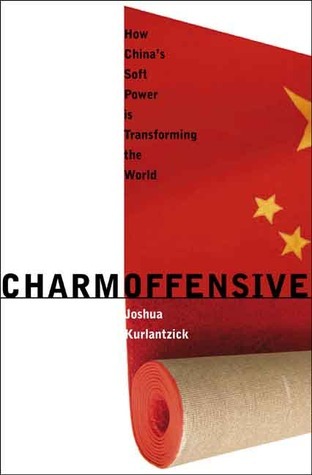
Charm Offensive: How China's Soft Power Is Transforming the World
At the beginning of the twenty-first century, China is poised to become a major global power. And though much has been written of China’s rise, a crucial aspect of this transformation has gone largely the way that China is using soft power to appeal to its neighbors and to distant countries alike.
This book is the first to examine the significance of China’s recent reliance on soft power—diplomacy, trade incentives, cultural and educational exchange opportunities, and other techniques—to project a benign national image, position itself as a model of social and economic success, and develop stronger international alliances. Drawing on years of experience tracking China’s policies in Southeast Asia, Latin America, and Africa, Joshua Kurlantzick reveals how China has wooed the world with a "charm offensive" that has largely escaped the attention of American policy makers.
Beijing’s new diplomacy has altered the political landscape in Southeast Asia and far beyond, changing the dynamics of China’s relationships with other countries. China also has worked to take advantage of American policy mistakes, Kurlantzick contends. In a provocative conclusion, he considers a future in which China may be the first nation since the Soviet Union to rival the United States in international influence.
This book is the first to examine the significance of China’s recent reliance on soft power—diplomacy, trade incentives, cultural and educational exchange opportunities, and other techniques—to project a benign national image, position itself as a model of social and economic success, and develop stronger international alliances. Drawing on years of experience tracking China’s policies in Southeast Asia, Latin America, and Africa, Joshua Kurlantzick reveals how China has wooed the world with a "charm offensive" that has largely escaped the attention of American policy makers.
Beijing’s new diplomacy has altered the political landscape in Southeast Asia and far beyond, changing the dynamics of China’s relationships with other countries. China also has worked to take advantage of American policy mistakes, Kurlantzick contends. In a provocative conclusion, he considers a future in which China may be the first nation since the Soviet Union to rival the United States in international influence.
320 pages, Hardcover
First published April 1, 2007
Ratings & Reviews
Friends & Following
Create a free account to discover what your friends think of this book!
Community Reviews
Displaying 1 - 18 of 18 reviews
December 5, 2022
It is interesting to read this book 15 years after it was published to look back with additional perspective on China’s ‘charm offensive’ and how it’s continued and where it’s been successful (for me, I mostly look at it from an Africa perspective). It was written at an interesting time, when America’s international relations were very poor (though perhaps not as poor as the 16-20 timeframe?) and China was on the rise, throwing increasing amounts of money and influence around. I would be interested in this author’s perspective now.
Anyway, the book was interesting and had a lot of good stuff, but sometimes it felt like a laundry list of things China was doing without a lot of overarching ‘so what’ to draw it together. Not always, but enough times to just give it 3 instead of 4.
Overall though, a decent book that I enjoyed reading to get more perspective on China’s activities up until 2007.
Anyway, the book was interesting and had a lot of good stuff, but sometimes it felt like a laundry list of things China was doing without a lot of overarching ‘so what’ to draw it together. Not always, but enough times to just give it 3 instead of 4.
Overall though, a decent book that I enjoyed reading to get more perspective on China’s activities up until 2007.

September 2, 2007
Kurlantzick has taken what should be a fairly interesting topic---China's purportedly increased "soft power" around the world---and made it simply a laundry list of places where the PRC did something or another popular, contrasted against the obvious fact that America is unpopular just about anywhere but Albania and, perhaps, Poland.
So what? Well, it is menacing, says the author. Why? Because China is alleged to WANT to see its model of authoritarianism replicated abroad. There is no real proof of this, as far as I can see. Just proof that China doesn't care much about its allies' internal politics. Beijing seems equally ready to get along with democratic South Korea as authoritarian North Korea, Indonesia and East Timor, and, truth be told, the United States and Russia.
One chapter, which contrasts China's success in fighting drugs and human trafficking in its bordering countries with its environmental and labor policy failures abroad, digs a little deeper. The interviews can be pretty good, too. In general, though, this feels like a wasted opportunity.
Kurlantzick seems to be everywhere these days talking about "China's soft power"(I saw him pop up on China Digital Times at least a couple of times). There is something there in what he says, but it may take a couple more tries before Kurlantzick gets it.
So what? Well, it is menacing, says the author. Why? Because China is alleged to WANT to see its model of authoritarianism replicated abroad. There is no real proof of this, as far as I can see. Just proof that China doesn't care much about its allies' internal politics. Beijing seems equally ready to get along with democratic South Korea as authoritarian North Korea, Indonesia and East Timor, and, truth be told, the United States and Russia.
One chapter, which contrasts China's success in fighting drugs and human trafficking in its bordering countries with its environmental and labor policy failures abroad, digs a little deeper. The interviews can be pretty good, too. In general, though, this feels like a wasted opportunity.
Kurlantzick seems to be everywhere these days talking about "China's soft power"(I saw him pop up on China Digital Times at least a couple of times). There is something there in what he says, but it may take a couple more tries before Kurlantzick gets it.

July 6, 2008
Useful, thoughtful discussion of an important development in world affairs. JK looks from a number of directions at how China's low-key realism and self-interest is increasing its influence in key parts of the developing world, while Washington's combination of finger-pointing and idealism has weakened American clout.
Reads, as another reviewer pointed out, like a long Kurlantzick magazine article; more vibrant journalistic color might have livened the story up a bit, but it's worth having a look at. JK's policy prescriptions sometimes seem shaped by his own persepctive as an affluent, liberal Westerner (he suggests that there's only a small, limited audience in the developing world for trading rapid economic growth for political liberties -- hmm) but anybody interested in foreign policy should check this book out.
Reads, as another reviewer pointed out, like a long Kurlantzick magazine article; more vibrant journalistic color might have livened the story up a bit, but it's worth having a look at. JK's policy prescriptions sometimes seem shaped by his own persepctive as an affluent, liberal Westerner (he suggests that there's only a small, limited audience in the developing world for trading rapid economic growth for political liberties -- hmm) but anybody interested in foreign policy should check this book out.
December 28, 2025
Joshua Kurlantzick’s Charm Offensive is devoted to an analysis of the profound transformations that took place in China’s foreign policy strategy at the beginning of the twenty-first century. In this book, the author seeks to demonstrate that China’s growing global influence has been shaped not only by economic growth or military capabilities, but also by a complex policy of “soft power” aimed at influencing perceptions, ideas, and public attitudes.
By the early twenty-first century, China had developed a new foreign policy approach based on the combination of attraction and interest. The author illustrates China’s soft power through diplomatic activism, trade and investment initiatives, cultural exchanges, educational programs, and pragmatic cooperation with developing countries. According to Kurlantzick, this approach has enabled China to present itself as a stable, reliable partner and as an alternative to the Western political model.
The book examines China’s activities in Southeast Asia, Africa, and Latin America through concrete case studies. It explores how China’s “charm diplomacy” has been received in these regions, identifying circumstances in which it has generated positive responses as well as situations where it has provoked caution or resistance. In this regard, the work aims to reveal the practical mechanisms through which the concept of soft power operates.
Importantly, the author does not idealize China’s soft power policy. Instead, he evaluates it as a foreign policy technology serving clearly defined national interests. He also notes that inconsistencies in Western foreign policy—particularly on the part of the United States—and a broader crisis of credibility have created favorable conditions for China’s expanding influence. Thus, China’s success is presented as the result not only of its own initiatives, but also of the strategic missteps of its competitors.
At the same time, the book contains several debatable points. The author adopts a broad interpretation of soft power by including trade and financial incentives within its scope, a position that is theoretically contentious. In certain cases, economic instruments may function less as tools of attraction and more as mechanisms of indirect pressure. Moreover, because the book primarily focuses on developments in the early twenty-first century, it does not fully reflect the intensified geopolitical rivalry and the emergence of new communication instruments that have characterized more recent years.
Nevertheless, the book provides valuable insight into the foundational concepts of China’s foreign policy, its global image-building strategy, and the ways in which soft power can be transformed into tangible political influence.
In conclusion, this work offers a rigorous and well-structured analysis of China’s soft power policy, examining it not at the level of slogans or declarations, but through concrete mechanisms, regional case studies, and real political practice.
By the early twenty-first century, China had developed a new foreign policy approach based on the combination of attraction and interest. The author illustrates China’s soft power through diplomatic activism, trade and investment initiatives, cultural exchanges, educational programs, and pragmatic cooperation with developing countries. According to Kurlantzick, this approach has enabled China to present itself as a stable, reliable partner and as an alternative to the Western political model.
The book examines China’s activities in Southeast Asia, Africa, and Latin America through concrete case studies. It explores how China’s “charm diplomacy” has been received in these regions, identifying circumstances in which it has generated positive responses as well as situations where it has provoked caution or resistance. In this regard, the work aims to reveal the practical mechanisms through which the concept of soft power operates.
Importantly, the author does not idealize China’s soft power policy. Instead, he evaluates it as a foreign policy technology serving clearly defined national interests. He also notes that inconsistencies in Western foreign policy—particularly on the part of the United States—and a broader crisis of credibility have created favorable conditions for China’s expanding influence. Thus, China’s success is presented as the result not only of its own initiatives, but also of the strategic missteps of its competitors.
At the same time, the book contains several debatable points. The author adopts a broad interpretation of soft power by including trade and financial incentives within its scope, a position that is theoretically contentious. In certain cases, economic instruments may function less as tools of attraction and more as mechanisms of indirect pressure. Moreover, because the book primarily focuses on developments in the early twenty-first century, it does not fully reflect the intensified geopolitical rivalry and the emergence of new communication instruments that have characterized more recent years.
Nevertheless, the book provides valuable insight into the foundational concepts of China’s foreign policy, its global image-building strategy, and the ways in which soft power can be transformed into tangible political influence.
In conclusion, this work offers a rigorous and well-structured analysis of China’s soft power policy, examining it not at the level of slogans or declarations, but through concrete mechanisms, regional case studies, and real political practice.

November 16, 2018
This book brought something back to my mind that I haven considered as a formal concept since 2006: Soft Power. In the context of the GWOT, attempting to use US soft power has been laughable. Trying to say that exporting McDonald’s or putting money to middle eastern countries hoping their populations would support US objectives was completely wrong. What we got instead were fighters with western haircuts and shorts in English shooting at our forces and throwing rocks.
Now, regarding great power competition it has caused me to reconsider the concept as a whole and I have realized that “peddling influence” is no different when it comes to why China, and to a lesser extent Russia, has been so successful at degrading western influence across the world.
This book does a great job showing the evolution of China’s diplomatic and economic engagements to better meet its national interests, at the expense of our own.
They have learned from our mistakes and have take advantage of historical lows in US popularity to almost steal preferential treatment by other countries and propping itself as an alternative to western “strings attached” aid.
Additionally, China has certainly latched onto taking advantage f every opportunity to tout its investment and minimal aid to other countries to establish political clout, even if it is relatively minuscule to the US and Japanese aid.
Great book that has made some pretty sound assessments, some even coming true now. This is a great launchpoint for anyone who wishes to start somewhere.
Now, regarding great power competition it has caused me to reconsider the concept as a whole and I have realized that “peddling influence” is no different when it comes to why China, and to a lesser extent Russia, has been so successful at degrading western influence across the world.
This book does a great job showing the evolution of China’s diplomatic and economic engagements to better meet its national interests, at the expense of our own.
They have learned from our mistakes and have take advantage of historical lows in US popularity to almost steal preferential treatment by other countries and propping itself as an alternative to western “strings attached” aid.
Additionally, China has certainly latched onto taking advantage f every opportunity to tout its investment and minimal aid to other countries to establish political clout, even if it is relatively minuscule to the US and Japanese aid.
Great book that has made some pretty sound assessments, some even coming true now. This is a great launchpoint for anyone who wishes to start somewhere.
May 24, 2021
A good analysis (as of 2007) on China's soft influence on the developing world. The author goes into deep detail on China's economic, financial, business, diplomatic, and cultural power. He also discusses how China exploited the gaps in world power and opinion created by US cuts to diplomatic diplomacy, foreign policy missteps, domestic issues, and isolationism. I found his final chapters on the implications of Chinese foreign strategy for the US, as well as Chinese weaknesses and how the US can respond and regain its soft power most important. Reading this 14 years later, I'd love to see an update. This is a must-read for any Americans involved in international business, foreign policy, diplomacy, and defense.
August 6, 2026
Pretty good, definitely got a lot of predictions correct. Hard to believe that this book from nearly 20 years ago can explain so much about China’s soft power. In some cases, China’s aggression has driven southeast Asian nations to ally with the U.S. In other cases its noninterventionism has led it to support infamous dictators like in Myanmar and Zimbabwe. Still, many countries simply want economic investment from
China, even if they do not want to emulate its single party political system. This book does a good job of showing how small nations react positively or negatively to China’s diplomatic overtures, without resorting to jingoism or hysteria.
China, even if they do not want to emulate its single party political system. This book does a good job of showing how small nations react positively or negatively to China’s diplomatic overtures, without resorting to jingoism or hysteria.

July 23, 2017
Worthwhile read.

August 4, 2023
I don’t usually read geopolitical books, but this was fascinating and kept me well engaged.

April 29, 2011
Eye-opening look at China's role in shaping global relations over the past decade. Using the theme of soft power - a nation's ability to shape other nation's preferences or branding your influence on another country in relation to popular and elite culture, public diplomacy, value, ideals and norms. - Kurlantizick argues that China has dramtically increased its strength globally while the United States has seen its soft power diminish.
My thought as I was reading the book is that I hope American leaders have read these words and pay attention to its lessons. The only negative for me is the question about whether it's already outdated (even though it just came out four years ago. That's the one drawback of writing a book about current affairs, I guess.
My thought as I was reading the book is that I hope American leaders have read these words and pay attention to its lessons. The only negative for me is the question about whether it's already outdated (even though it just came out four years ago. That's the one drawback of writing a book about current affairs, I guess.

May 10, 2008
Thanks Natalie:
A good book, and although it took me a while to finish it, I found it quite interesting. I do think however that the author could have explored the theme of how the US could combat China's growing soft influence; seems to me that he skimmed this subject and he could have developed this theme a bit more. In the end he seem to back off from his overall theme in that he states that China still has a long way to go.
Overall however a good read especially if you are interested in poly sci and international relations.
thanks for letting me borrow your book Nat.
A good book, and although it took me a while to finish it, I found it quite interesting. I do think however that the author could have explored the theme of how the US could combat China's growing soft influence; seems to me that he skimmed this subject and he could have developed this theme a bit more. In the end he seem to back off from his overall theme in that he states that China still has a long way to go.
Overall however a good read especially if you are interested in poly sci and international relations.
thanks for letting me borrow your book Nat.

November 27, 2007
The problem with this book for a bureaucrat like yours truly is that it summarizes the outputs of Chinese soft power but gives me no sense of how China builds its diplomatic corps and the ties of that group to activities like its Chinese teaching efforts. That's what I went in hoping to find ... uh, not that I do this for a living or anything.

April 18, 2008
Well this book has been really interesting so far. it is very scary how a nation with so many internal problems and a history of human rights violations to its own people can not only appear to the public as successful and trustworthy but also cary so much weight and influence in the world wide scope of things. so far i would recommend it but, we shall see.

December 28, 2007
This book definately puts people on the right track as to what is actuall happening in the world, and allows us to see the truth which is: China is worse than the U.S., please let Americans see the value and urgency of weighing the scale accurately!

February 22, 2010
The only good thing I got out of this book was that Kurlantcick introduces some important ideas. If he had then discussed these ideas more deeply, it could have been a good book. Instead, it feels more like a Cold War panic tale.

August 13, 2007
So far, it's like reading a long Kurlantzick article.

January 3, 2008
American's soft power deficit vs China's new tool of soft power may push countries to choose between the two.
June 21, 2009
I didnt like the writing. it was eye-opening in terms on how politics happens
Displaying 1 - 18 of 18 reviews