This award-winning true Holocaust story, newly updated, connects generations through one woman’s quest to find the truth behind a mysterious suitcase. In March 2000, Fumiko Ishioka, the curator of a small Holocaust education center in Tokyo, received an empty suitcase from the museum at Auschwitz. On the outside, in white paint, were the words “Hana Brady, May 16, 1931, Orphan.”
Fumiko and the children at the center were determined to find out who Hana was and what happened to her all those years ago, leading them to a startling and emotional discovery.
The dual narrative intertwines Fumiko’s international journey to find the truth about Hana Brady’s fate with Hana’s own compelling story of her life in a quiet Czech town, which is shattered by the arrival of the Nazis, tearing apart the family she loves. This suspense-filled work of investigative nonfiction draws in young readers and makes them active participants in the search for Hana’s identity.
Praise for Hana’s Suitcase • “Hana wanted to become a teacher, and surely through this little book her dream is being realized.” —Archbishop Desmond Tutu, from his new foreword to Hana’s Suitcase • “The account . . . is part history, part suspenseful mystery . . . with an incredible climactic revelation.” —Booklist
Karen Levine is a prizewinning producer with CBC Radio. She worked for many years on CBC programs including As It Happens, The Sunday Edition and This Morning as producer of the “First Person Singular” series. Karen has won awards for her radio work, including two Peabody Awards(the Oscars of radio). Levine originally produced Hana’s Suitcase as a radio documentary and later made it into a book. Though she travels widely (most recently to Australia and Japan) to talk about the book, she makes her home in Toronto with her partner and her son.
✡️Well, I tried my friends, I tried to hold it together, we are familiar with these Holocaust stories, aren’t we? But by the end of the book an overwhelming sense of loss crushed me and the tears came. Is the world any safer, any better, any more peaceful, are children any more protected? How many thousands have been killed in Yemen and Ukraine? Why do humans keep on doing these things to the innocent and helpless over and over again? Why is there so much hate from generation to generation?
🧳 There are two parallel stories here. One is of Hana Brady, a girl from what is now the Czech Republic 🇨🇿 being sent to Auschwitz, her suitcase in her hand. The other is of the suitcase winding up with a small Holocaust museum in Japan run by schoolchildren and their teacher. They make every effort possible to find out who Hana Brady was, if there were photographs of her, if her brother had survived. That was a difficult journey but they persisted. And those two stories combine to make a painful but beautiful book.
5★ “My son — Gabriel Zev Enright Levine — is six years old now, too young to know Hana's story. But when he is old enough, I'll read it to him. I hope he will be as drawn to Hana, George and Fumiko as I was. I also hope he will learn from the story that history matters, and that despite the most unspeakable evil, good people and good deeds can make a difference.”[In author’s acknowledgements]
Here you can see the cover of the book a little more clearly. Cover photo of Hana
This wonderful project began because an anonymous Japanese donor felt it was important for Japanese kids to understand history and work towards world peace. Many young people in Japan, may not realise that during World War Two, Japan was allied with Germany. They doubtless know about the atom bombs dropped on Nagasaki and Hiroshima but may not be aware of what Hitler was actually doing. In this book, he is wiping out Czechoslovakian Jews.
Fumiko Ishioka is the young director of the Tokyo Holocaust Education Resource Center, and school groups tour often. She had contacted other museums and begged for a few objects belonging to children to show people, to make the experience more real. She finally received a few items and an empty suitcase – Hana’s suitcase, with her name spelled the German way (double N) and her date of birth. Hana’s suitcase. “Waisenkind” means orphan.
A group of students formed the Small Wings Club, writing newsletters and sharing whatever information they could find about Hana Brady. They pressured they young director to find out more! Ishioka persisted and finally tracked down some drawings Hana had done at home in her childhood, many of which are reproduced in the book. The Small Wings
And here’s how the Small Wings are carrying out their “assignment” from the anonymous donor. Small Wings members hold signs saying “Let’s Learn, Think and Act (to create peace) for the 21st century.”
The book itself alternates between Ishioka’s hunt for information and Hana’s own biography, written from details discovered later. This is perseverance which I imagine few people are capable of. [Yes, you CAN end a sentence in a preposition, no matter what the Grammar Police say. But I digress.]
Ishioka flew to Europe more than once, convinced other museums, directors, (everyone she could find!) to trace as much as they could. The biography tells us this:
“Lists. Everywhere there were lists. The Nazis were systematic record keepers, and they wanted all their prisoners to know it. Through the constant counting and listing of people, the Nazis reminded the inmates who was in charge. Everyone knew that being counted, being noticed, could mean a transport and another separation from family and friends.”
And lists mean names and birthdates and destinations. Ishioka followed every small trail until she tracked down a surprising amount of detail. The book is full of photographs, some from Hana’s own past and some from various locations. I’ll include a few here, since they won’t spoil the book. It’s been published in many countries.
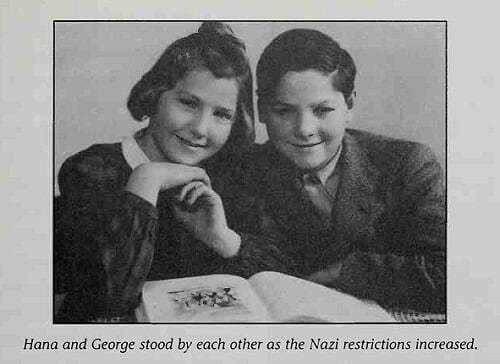
The one small disappointment is that the suitcase itself is a replica created by the Auschwitz Museum when the original was destroyed in a fire, but nobody remembered to tell Ishioka. The replacement was discovered when comparing old photographs. But never mind - the story itself is fascinating and true. Here are a few photos of the very real people involved. There are many many more!
I don’t know how many schools in which countries use this book in classes, but I reckon that all children everywhere should study it. These kids, these happy, well-dressed, much-loved kids, could have been any of us if we’d been in the wrong place at the wrong time.
One of my favourite sayings is that there's no limit to what you can achieve if you don't care who gets the credit. What a great thing that anonymous donor started.
Barb's comment below pointed me to the Paper Clip Project. Have a look - wonderful idea to help children (and adults!) understand the enormity of this tragedy. http://www.oneclipatatime.org/paper-c...
Sometimes I tend to go round the bend and end up doing things that I'v made myself promise not to do. Reading about Holocaust is one of those BIG NOs for me. Not because I don't want to know about the horrors that transpired in the name of ethnic cleansing but rather, I'v read SO MUCH about it, that the stories will last me a lifetime or rather a few hundred to say the least.
It was one of those days, when I broke my own vow and picked up this innocuous book with an intriguing title, Hana's Suitcase. As the introduction to the book itself mentions
"...story of terrible sadness and great joy, a reminder of the brutality of the past and a hope for the future"
I read the last 25% of this poignant little true story all blurry eyed...
I am still wondering how the stories of the innumerable children and people were lost and still getting lost due to the senseless acts of people in the name of power race, religion, state, caste or creed. And when if ever will we learn from our past.
This is a book designed for children, but really it is for all of us. It is timeless. It’s tremendously touching and so sad.
A very motivated Japanese woman, Fumiko Ishioka, has set up a Holocaust Education Center in Tokyo to educate young Japanese children about the Holocaust (something many in Japan are not aware of) and by this try to get them to accept the diversity of human-kind and avoid repeating what happened in Europe during World War II.
Fumiko, in order to personalize her center, writes to and receives various artifacts of the Holocaust from across Europe. Among others is a suitcase from Auschwitz with the birth-date year of 1931 and the name “Hana Brady” written on it. This places the owner of the suitcase, at the time of her murder, in the same age group of many of the students in Fumiko’s class.
Fumiko digs up more information on Hana and is able to trace her tragic pathway to Auschwitz. She determines that Hana was born in what was then Czechoslovakia. She also finds that Hana spent time at the Theresienstadt camp and from a list comes across the name “George Brady” . Fumiko is a very persistent sleuth and finds out that George was Hana’s older brother. Not only that, but she finds out he is still alive and living in Toronto, Canada. She writes to him a carefully worded letter and hopes that she is not infringing upon scarring memories.
Here is an excerpt from her letter:
I was wondering if you would kindly be able to tell us about you and Hana’s story, the time you spent with Hana before sent to the camp, things that you talked with her, you and her dreams, and anything that would help children here feel close to you and Hana to understand what prejudice, intolerance and hatred did to young Jewish children.
This is an emotionally charged book. George was more than willing to help Fumiko, and told the story of his tragically murdered sister. He went to Japan and provided many family pictures that were kept at a relative’s house when the deportations started.
From George’s story and pictures we can see that Hana was an aspiring and spirited young girl, whose life was shattered with the German annexation of Czechoslovakia in March, 1939. Her parents were removed from their home, after which the two children went to live with a relative (one was non-Jewish) – and then the two were extradited to Theresienstadt in 1942. Because George was three years older he was “selected” for work duty, and Hana at the age of 12 for Auschwitz. Only because she was Jewish.
This book (like the Holocaust Center in Tokyo) succeeds in putting a real person before us who was taken out of her normal childhood existence and put to death like millions of others.
This well-written, surprisingly enjoyable book starts in Czechoslovakia in the early 1900's where a little girl named Hana is born and grows up in a loving family with her older brother. Then it switches- for the next chapter- to modern-day Japan where a young lady is putting together a museum for children on the Holocaust. She writes to several places in Germany asking for things to go in her museum and receives a small suitcase with the name "Hanna" and the German word for orphan painted on the outside and polka-dot paper on the inside. Then back to Czechoslovakia where Hana starts school and enjoys her friends and family despite news on the family radio of Hitler's rise. Then back to Japan, where the young lady wonders who Hanna is and decides to investigate. The two stories converge eventually at Auchwitz.
This book hooked me. I expected to do a quick read, getting the info-- and although the whole thing took me only about an hour-- I became lost in Hana's world and rooting for the Japanese young woman. I highly recommend it. =)
While reading this true story about an 13 year old holocaust victim ,written for children , I couldn't help but be reminded of The Diary of a Young Girl and how in spite of the horrendous circumstances of both Anne and Hana our spirits can be uplifted. Fumiko Ishioka , Director of the Tokyo Holocaust Museum lovingly devoted herself to insuring that Japanese children would learn what happened to six million Jews , of which one and a half million were children. Through her persistence and the telling of Hana's story by Levine in this book, children world over can learn about what happened.
It was especially moving that the group of children called "Small Wings " were so captivated by Hana and that by discovering what Hana’s life was like before the Nazis, they could relate to this young girl and thus begin to understand how great the loss. What better way could you teach children about the Holocaust than through another child? The beautiful drawings and pictures made Hana come to life again. The touching scene when Hana’s brother, George meets the children is really beyond any words other than what Levine has written.
I was also reminded of a novel I read recently, The Street Sweeper, in which the heart of the novel is the profound message of “tell then what happened here.”
From a poem read at the end of the book:
“We Small Wings, will tell every child in Japan what happened to Hana.
We Small Wings, will never forget what happened to one-and-a-half-million Jewish children.
We children can make a difference in building peace in the world – so that the Holocaust will never happen again.”
I did not realize, at first, that the novel was predominantly for children thus I felt a little let down but only a very little. Hana's Suitcase taught me about a part of the Holocaust which was previously not known to me. The story saddened me immeasurably; a suitcase usually signifies a holiday, a trip, the expectation of something new and good; not so for little Hana and children like her. I'd love for Levine, or someone, to write an lengthier version catering to adults; I am sure there are many older readers who would like the option of reading about this subject. Thank you to Brenda in Aussie Readers for bringing this book to my notice; much appreciated. For Levine's brilliance in opening kid's and the occasional adult's eyes, 4★
Hana’s Suitcase is a deeply moving and heartbreaking story that stayed with me long after I finished it. I found myself emotionally drawn to Hana Brady, a vibrant, warm and beautiful young child whose personality comes through so strongly in the photographs and memories shared throughout the book.
Seeing her life represented in such a human way makes the loss even more difficult to comprehend. It is genuinely hard to understand how anyone could harm such an innocent child, and the story forces the reader to confront that painful reality.
What makes the book even more powerful is the way it connects Hana’s individual story to the wider history of the Holocaust. It is a reminder of how prejudice and hatred can escalate into unimaginable tragedy. In today’s world, where antisemitism is still present in different places, the book also feels sadly relevant. It encourages reflection on where hatred can lead if it is not challenged.
Overall, this is not just a story about the past—it is a warning, a memory, and a call to empathy and understanding.
Wow! What an amazing story. I read this in about one hour. I loved the juxtaposition of the two stories told together. Hana was a young Jewish girl who did not survive the Holocaust. The book is a tale of Hana, her family and their many obstacles during a very difficult time in history. This book is also the tale of a Japanese woman named, Fumiko Ishioka, who is a museum director in Japan. Fumiko started teaching her students (who named themselves "Little Wings") about the Holocaust and by the end her simple social studies unit grew into something much bigger. She hunted down information and artifacts that would help her better teach her students about the Holocaust and, more importantly, about the trials and tribulations of the young Jewish children during that time. Finally, Fumiko learned that Hana's brother, George, was still alive. They got in contact and eventually met. This book is truly an inspiration for me because it reminded me how important history is and that we, as teachers, might need to rethink how we instruct young children about various historic events. This book could be read by students ranging from grade 5 to grade 12. I found it to be full of information and heart yet so easy to read and understand. I think many students would be forever changed by this book. I also found the Brady family website which was so much fun to look at. Check it out if you are interested!
Title: Hana's Suitcase Type: Standalone Author: Karen Levine First Published On: Jan 1, 2002 Rating: 5 stars
''Hana Brady, thirteen years old, was the owner of this suitcase. Fifty-five years ago, May 18, 1942 — two days after Hana’s eleventh birthday — she was taken to Terezin in Czechoslovakia. October 23, 1944, crowded into the freight train, she was sent to Auschwitz. She was taken to the gas chamber right after. People were allowed to take only one suitcase with them. I wonder what Hana put in her suitcase. Hana would have been sixty-nine years old today, but her life stopped when she was thirteen. I wonder what kind of girl she was. A few drawings she made at Terezin — these are the only things she left for us. What do these drawings tell us? What do these drawings tell us? Happy memories of her family? Dreams and hopes for the future? Why was she killed? There was one reason. She was born Jewish.''
''Hana's Suitcase" tells the story of a Czech girl, Hana Brady, and how her tragic fate in the Second World War came to touch the hearts of children on the other side of the globe and over half a century later. There have been many books written about the Holocaust, but this story is different. This story begins with a happy family in Czechoslovakia whose life was changed forever and turned upside down when the Holocaust began. The book switches from the perspective of from Hana and her family to a woman, named Fumiko Ishioka, in Tokyo, Japan 70 years later. Fumiko Ishioka is the director of Holocaust museum in Tokyo.Fumiko wanted young people in Japan to learn from the Holocaust.She decided the best way to start would be through physical objects that the children could see and touch. She wrote to Jewish and Holocaust museums all over the world asking for a loan of artifacts that had belonged to children.From Auschwitz she got a pair of socks, a sweater, a canister of gas and a suitcase.
From the day the suitcase arrived in Tokyo, Fumiko and the children were drawn to it. Fumiko Ishioka was eager to find out about Hana because she has a suitcase from the Holocaust with the name Hana Brady in her museum. Fumiko Ishioka then travells to Czech Republic to find the story of Hana Brady. This book is so inspiring, and so touching the book shows all the hardships Hana and George had to go through during the holocaust.It also shows the determination of Fumiko Ishioka in finding the story of Hana. It was well illustrated, showing original pictures of the Brady family, Fumiko, her museum, the conditions of the Holocaust and much more. It broke my heart how this loving family was separated .Its' a wonderful story about a young girl who didn't survive the Holocaust but who is brought to life by the perseverance and determination by a Japanese teacher who wants to spread the story of this period to her pupils in a memorable way.The whole thing could be read in two hours and bring tears to your eyes,an excellent book to introduce kids to the holocaust.5 million stars to ''Hana's Suitcase’’
This entire review has been hidden because of spoilers.
Hana's Suitcase is a surprisingly well written and entertaining story, despite the tragic tone contained in the book.
This isn't a simple story about the Holocaust. This is the tale of a young child who is too innocent to face the horrors she had to endure, and also of a girl willing to do anything to prevent such horrors from occurring again.
One of the notable elements of the plot is the juxtaposition of three different stories, located in different places with characters easily recognizable.
With a simple and delicate tone, Hana's Suitcase can transpose indescribable feelings. The book possessed few pages, which did not diminish its ability of touching the reader and entertaining people of all ages and tastes.
Often we look at the Holocaust and lose track of the number of innocents who lost their lives. Books like this show us that every one of those people had desires, people they loved and many dreams, all interrupted by the simplicity of human ignorance.
SENTENCE: A simple and easy read ensures the interest of many students and young readers. With only 112 pages, this is one of the books that everyone should read at least once in the course of their lives.
If you are interested in more details about the life of Hana, this is the website of the Brady family: http://www.hanassuitcase.ca/
Hana's Suitcase: A True Story tells the story of Hana Brady, a Jewish girl who died, like so many, in the gas chambers of Auschwitz. It is she whose photo we see on the cover. Her parents were taken, then she and her brother George were taken to the Theresienstadt Ghetto, where they were held until 1944. Hana was put on the train to Auschwitz, where she died the day of her arrival. As the book reminds us repeatedly, a million and a half children were among the Jews killed.
It is all too common a story. But Hana is special in one important way. Most of the millions who died vanished with barely a trace. Hana's story was told, mostly through the efforts of an extraordinary educator and researcher, Fumiko Ishioka.
The problem with writing a children's book about the Holocaust is that, in the words of Aragorn, "it is sad, as are all the tales of Middle-earth". There are no happy stories of the Holocaust. But we need to remember it.
Karen Levine accomplishes the job of telling a Holocaust story with a happy ending by a trick. As the title tells you, Hana's Suitcase is not just the story of Hana -- it is also the story of her suitcase. Boring, right?
Fumiko Ishioka is the director of the Tokyo Holocaust Education Resources Center (??????????????). In 1998 when Fumiko Ishioka took on the job of coordinator of the Center, she visited the Auschwitz Museum and persuaded an assistant director to loan her some physical artifacts. Among these was a suitcase with the name "Hanna Brady", her date of birth 16-May-1931, and the word "WaisenKind" (orphan).
Ishioka, who is clearly a Force To Be Reckoned With, bent her efforts to finding out more about Hana. She learned that before Auschwitz Hana had lived in the Model Ghetto at Theresienstadt for several years. And she struck gold -- Hana's older brother George had been with her in Theresienstadt, and although he was also sent to Auschwitz, he survived. Ishioka tracked him down -- he was in 2000 a successful plumber (a trade he learned in Theresienstadt) in Toronto. She wrote to him. And There Was Great Joy!
George was able to tell Ishioka (and Levine) Hana's story up to the day on which he boarded the train to Auschwitz, after which he never saw Hana again. We have him to thank for the photos and Hana's story. (Levine continues the story past that point -- this part of the book is lightly fictionalized, in that she tells us of conversations of Hana's from which no witness or participant survived past that day. This reminded me of the similarly mostly true Carry On, Mr. Bowditch.)
Levine, a radio producer, read the story in a Jewish newspaper and produced a radio documentary, which friends persuaded her to turn into a book. It's short -- I read it in about an hour -- and there are plenty of pictures. In her acknowledgements, she gives away the trick, "First and foremost, my thanks go to George Brady and Fumiko Ishioka. This is their story." All the tales of the Holocaust are sad, but this is not exclusively a tale of the Holocaust. For Fumiko and George there is a happy ending, of a sort.
WOW!! An incredible story that will leave you speechless. In the year of 2000 a suitcase arrives at a children’s Holocaust education centre in Tokyo, Japan marked Hana Brady, May 16 1931, so begins the search for clues about this girl and her family.
This is only a small book, but it’s an incredible heart wrenching story that will leave you speechless. Highly recommended.
The suitcase had painted on it “Hanna Brady (German spelling of Hana) 625 d.o.b. 16th May 1931 – Waisenkind (German for orphan)”…
Fumiko Ishioka began her job in 1998 at the Holocaust Education Resource Centre in Tokyo, Japan – she was determined to teach the younger generation in Japan about the atrocities of the holocaust during the war, so when the Museum received the suitcase along with a few other items from the Auschwitz Museum, she decided they (the children and her) would try to discover Hana’s story.
Her search took her all across Europe and eventually to Canada and encompassed seventy years of history.
This is an incredibly sad story, as we all know the holocaust to be. But the wonder of Fumiko and her amazing search, the results she achieved – she was one person who kept looking even when the odds were against her. This story deserves the same recognition as Anne Frank; and of course all the other untold stories out there. At only 112 pages, this poignant and totally true story is one which everyone should read.
I don't know how anyone could read this and walk away with dry eyes. I'm 53 years old and what this little girl had to do would break me. I'm so glad someone gave this little girl a voice and found out who she was and what happened to her. I'd say this should be required reading in school, but I'm sure a bunch of Holocaust deniers would freak the fuck out and claim we were trying to indoctrinate their kids into some sort of cult or some bullshit like that.
This is the true story of how a little girl's suitcase inspired a museum curator to travel half way around the world to uncover a story that has touched the hearts of thousands of Japanese children.
Hana Brady was a young Jewish girl who lived in Czechoslovakia in the 1930's. She and her family became victims of the Third Reich and the Nazi extermination of the Jews. During WWII Japan was one of the Axis powers, and since the end of the war, very little has been publicized in Japan concerning the Holocaust. Now there is the "Tokyo Holocaust Education Resource Center" dedicated to teaching the Japanese people about the horrors of the Holocaust. Through the efforts of one woman, Fumico Ishioka, the education center was able to acquire a few artifacts form Auschwitz to serve as visual reminders. One of the artifacts was a suitcase with the name "Hana Brady" painted on it with a birthdate. From this, children that visited the center became fascinated with Hana and wanted to learn more about her. The curator, Fumico Ishioka, left no stone unturned to uncover the story of this one small girl. Through her efforts, the story of Hana has now been told, and is used to educate the visitors to the center in the value of tolerance, respect, and compassion.
This is juvenile non-fiction and I can highly recommend it to anyone who is interested in sharing this important message with children. This would be an excellent choice for shared classroom reading.
Hana's Suitcase is a surprisingly well written and entertaining story, despite the tragic tone contained in the book.
This isn't a simple story about the Holocaust. This is the tale of a young child who is too innocent to face the horrors she had to endure, and also of a girl willing to do anything to prevent such horrors from occurring again.
One of the notable elements of the plot is the juxtaposition of three different stories, located in different places with characters easily recognizable.
With a simple and delicate tone, Hana's Suitcase can transpose indescribable feelings. The book possessed few pages, which did not diminish its ability of touching the reader and entertaining people of all ages and tastes.
Often we look at the Holocaust and lose track of the number of innocents who lost their lives. Books like this show us that every one of those people had desires, people they loved and many dreams, all interrupted by the simplicity of human ignorance.
SENTENCE: A simple and easy read ensures the interest of many students and young readers. With only 112 pages, this is one of the books that everyone should read at least once in the course of their lives.
This book goes to show that quality is more important than quantity. It’s very brief, you’ll easily finish it in one session, but it sure packs a punch and is very moving. I was choking up near the end. Around the year 2000, a very persistent curator, Fumiko Ishioka, sets up a Holocaust Education Centre in Tokyo in the belief that Japanese children don’t know or learn much about this aspect of WWII. She writes to various museums around the world pleading for artefacts that will make the centre more meaningful and receives a suitcase that belonged to Hana Brady from Czechoslovakia. Fumiko goes on a mission to find out Hana’s story and remarkably is able to trace her older brother George who survived the war and emigrated to Canada. The book’s power lies in telling the story of a real person, thirteen-year-old Hana, who tragically met her fate like millions of others at Auschwitz, but whose individual story will live on forever thanks to the dedicated work of Fumiko.
A mala de Hana é um livro bem fininho mas muito muito poderoso.
Conta a história de Hana uma garotinha judia nascida em 1931 na antiga Tchecoslováquia, que com a invasão de Hitler na Europa, teve sua vida, junto com a do seu irmão George , dilacerada pelo nazismo e foi parar no campo de concentração de Auschwitz .
Hana perde tudo, pois seus pais são levados para outros campos de concentração e depois ela perde a companhia do irmão George que foi levado para um campo de concentração diferente do dela.
Paralelo a isso o livro conta a história de Fumiko Ishioka uma professora e tradutora japonesa que afim de que seus alunos melhor entendessem o nazismo e não podendo levá-los ao museus da Europa,escreve a vários museus do holocausto para conseguir alguma coisa para mostrar às crianças. Depois de 7 tentativas ela recebe pelo correio a mala de Hana usada por ela para levar umas poucas coisas quando partiu para o campo de concentração. Fumiko Ishioka então consegue através dessa mala ensinar os horrores do holocausto ao seus alunos e também trazer ao mundo, depois de viagens a terra natal de hana e depois de muita investigação , contar a história emocionante de Hana Brady.
A autora do livro depois de ler no Canadian Jewish News, a história Fumiko Ishioka e seu esforço em mostrar Hana ao mundo, resolve escrever um livro contando a história da garotinha.
A beautiful, warm search for one child lost to us all. Hanna Brady died in Auschwitz and was forgotten until Fumiko Ishioka brought her back. Today, Hanna lives through her suitcase and Fumiko's search. The lovely story of bringing Hanna's story to the world for the purpose of peace and understanding is beautiful. Hanna's story is a tribute to a child, a life and a history. The last third of this Anniversary edition shows the growth of the movement of Hana's Suitcase. The project has grown from a small Japanese Children's Community Centre project to a Worldwide Discovery of Peace and Remembrance. There are quilts, pictures, poems, tributes and more.....all to a little girl who pulls people together in unity. As her brother George said, Hanna did become a teacher, as she always wanted to be.
This is a beautiful story and this edition of it is a wonderful tribute to Hanna, her family, Fumiko and the Hanna's Suitcase movement around the World.
I read the book and I watched a DVD of the story. The DVD would be a powerful tool to use after students read the book, "Hana's Suitcase." It is a one hour presentation given at the Skokie Public Library in November of 2003. The author of the book, Karen Levine, tells her story and what journey toward writing this book. She retells much of the story and shows slides of many of the photographs used in the book. Then Fumiko Ishioka, from the Tokyo Holocaust Education Resource Center and George Brady, Hana's brother, speak. It brought me to tears to see and hear the real people who are so central to this story. I think that using the book and the DVD would have a powerful impact on middle school or high school students studying the Holocaust.
A very short, but fascinating book! I watched the Prime Video “Inside Hana’s Suitcase” first. I highly recommend it! To see the people, such as Hana’s brother, and hear him tell about his little sister during the real nightmare that was The Holocaust brought me to tears. I’ve read a lot of Holocaust memoirs over the last year and a half and feared I was becoming more immune to the true stories of suffering. Thankfully, this story proved I was wrong. I will remember this book and when my young granddaughters are old enough to understand, I will share Hana’s life story with them.
What a beautiful, little book this turned out to be. I loved the two stories and following Hana and Fumiko's journeys. As for the epilogue, what a powerful ending to a poignant story.
What a beautiful tribute to Hana Brady, a young Jewish girl during the Holocaust, and Fumiko Ishioka who was/is the director of the Tokyo Holocaust Center. This story was told in alternating chapters between Hana's story in the 1930s and 1940s and Rumiko's attempts to find out more about Hana in the 2000s. The story centers around Hana's suitcase that was sent to the Tokyo Holocaust Center as an educational tool to help children there learn more about the horrors of the Holocaust. They desperately want to find out more about Hana. Her life is revealed to us amidst this search for answers. Beautifully told, deeply emotional, and the pictures really capture the essence of her life. Highly recommended for anyone!
Es la historia real de una niña judía en la segunda guerra mundial, pero contada para niños a partir de 10 años. Me ha encantado la manera de llevar la historia, de forma muy sencilla y connmovedora para los niños. En alemán se lee muy fácil. Lo recomiendo.
This is a sensitively written children's book about a little girl called Hana Brady. A true story about Hana and her family, who lived in Czechoslovakia in the 1930's and what happened to them. The story begins when Fumiko Ishioka the director of a small museum in Tokyo starts to investigate one of the exhibits, a small suitcase with the name Hana Brady written on it. The suitcase came from the Holocaust Museum at Auschwitz concentration camp. Fumiko embarks on a long journey to find out what happened to Hana and we learn, along with her, about this beautiful little girl, her hopes, dreams and fears. The face looking out of the photograph of Hana is one of a very pretty, blond haired, blue eyed girl, she was full of fun and life, a talented skier and skater, loved drawing and playing with her school friends and her brother George. The only thing that was to cause Hana such pain and grief was the fact that she was born a Jew! It didn't matter to the Nazis how beautiful and bright she was, they lived their lives filled with hatred and bigotry and cared nothing for the plight of anyone who stood in their path. Being able to put a face to the name on that suitcase is so touching and in a way makes it easier to visualise the faces of the 6 million other people, all wonderful in their own way who were simply wiped out by Hitler and his evil regime. This book is a great way for children to learn about the Holocaust, it is succinct, informative and very moving.
The suitcase had painted on it “Hanna Brady (German spelling of Hana) 625 d.o.b. 16th May 1931 – Waisenkind (German for orphan)”…
Fumiko Ishioka began her job in 1998 at the Holocaust Education Resource Centre in Tokyo, Japan – she was determined to teach the younger generation in Japan about the atrocities of the holocaust during the war, so when the Museum received the suitcase along with a few other items from the Auschwitz Museum, she decided they (the children and her) would try to discover Hana’s story.
Her search took her all across Europe and eventually to Canada and encompassed seventy years of history.
This is an incredibly sad story, as we all know the holocaust to be. But the wonder of Fumiko and her amazing search, the results she achieved – she was one person who kept looking even when the odds were against her. This story deserves the same recognition as Anne Frank; and of course all the other untold stories out there. At only 112 pages, this poignant and totally true story is one which everyone should read.
The interweaving tales of Fumiko Ishioka, a Japanese curator, and Hana Brady, the young Czechoslovakian girl whose life she is trying to track down. Both tales are based on historically true stories but written in an imaginative, almost novelised way, which is a style I always find quite disconcerting.
It's surprisingly touching at the end, despite it avoiding any of the more grisly truths of these events in order to be suitable for its younger audience. In fact, the shadowy, ominous aura it leaves around Auschwitz, the place it is unwilling to write about in any detail, begins perhaps to communicate a sense of the vague dread the place must have had at the time. I found its looming spectre in the book genuinely quite upsetting.