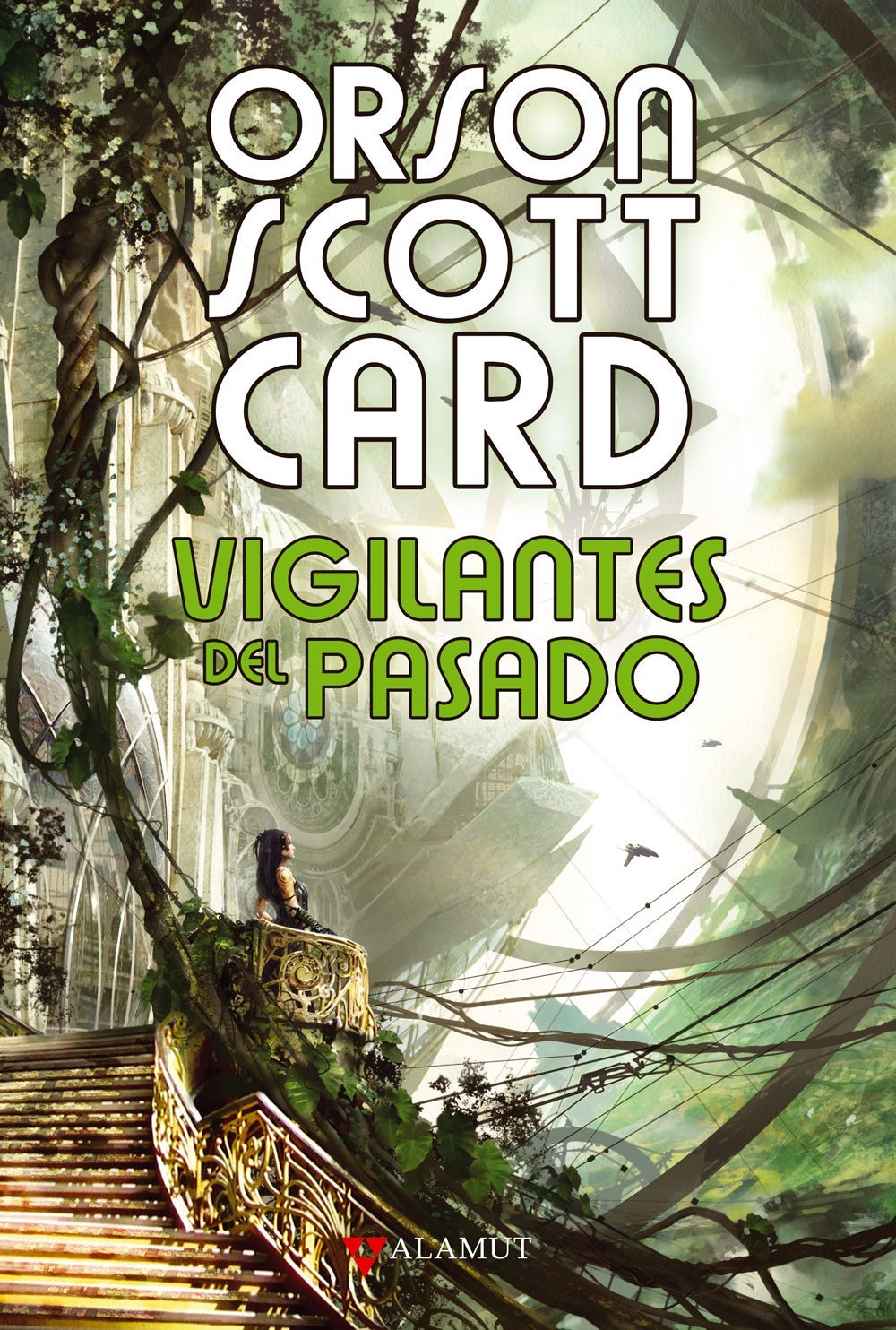
La llamaron “la era de deshacer”. Tras las catástrofes de los siglos precedentes, el mundo entró en una época de recuperación y curación. Pero sanar los estragos del presente no era suficiente. Con poderosos instrumentos, las personas de esta era más compasiva indagaron en el pasado para resolver misterios históricos y dar voz a los olvidados por el implacable avance de la civilización. Y también, quizá, para cambiar el curso de la historia.
Éste es el relato de Cristóbal Colón, el hombre más grande de su época. De cómo su ambición le llevó a concebir un descabellado plan de conquista. ¿Las Indias Occidentales? No: su afán era liberar Constantinopla de las hordas turcas, y fue redirigido por misteriosas fuerzas hacia el descubrimiento de América. Pero lo que pudo cambiarse una vez... puede cambiarse de nuevo.
Y es el relato de Kemal, que desveló el enigma de la Atlántida, de Diko, que juró acabar con la institución de la esclavitud, de Hunahpu, que teorizó la conquista americana de Europa, y de tantos otros hombres y mujeres de Vigilancia del Pasado que emprendieron la aventura definitiva: alterar la historia para construir un mundo mejor, aun a costa de sus vidas.
Orson Scott Card is an American writer known best for his science fiction works. He is (as of 2023) the only person to have won a Hugo Award and a Nebula Award in consecutive years, winning both awards for his novel Ender's Game (1985) and its sequel Speaker for the Dead (1986). A feature film adaptation of Ender's Game, which Card co-produced, was released in 2013. Card also wrote the Locus Fantasy Award-winning series The Tales of Alvin Maker (1987–2003). Card's fiction often features characters with exceptional gifts who make difficult choices with high stakes. Card has also written political, religious, and social commentary in his columns and other writing; his opposition to homosexuality has provoked public criticism. Card, who is a great-great-grandson of Brigham Young, was born in Richland, Washington, and grew up in Utah and California. While he was a student at Brigham Young University (BYU), his plays were performed on stage. He served in Brazil as a missionary for the Church of Jesus Christ of Latter-day Saints (LDS Church) and headed a community theater for two summers. Card had 27 short stories published between 1978 and 1979, and he won the John W. Campbell Award for best new writer in 1978. He earned a master's degree in English from the University of Utah in 1981 and wrote novels in science fiction, fantasy, non-fiction, and historical fiction genres starting in 1979. Card continued to write prolifically, and he has published over 50 novels and 45 short stories. Card teaches English at Southern Virginia University; he has written two books on creative writing and serves as a judge in the Writers of the Future contest. He has taught many successful writers at his "literary boot camps". He remains a practicing member of the LDS Church and Mormon fiction writers Stephenie Meyer, Brandon Sanderson, and Dave Wolverton have cited his works as a major influence.
Orson Scott Card’s very entertaining 1996 novel Pastwatch: The Redemption of Christopher Columbus is a time travel book and so much more.
Many great science fiction / fantasy writers have had fun and great success with time travel as an extension of their speculative vision. Heinlein, Poul Anderson, Bradbury, de Camp, H.G. Wells, Vonnegut, Twain, and Piers Anthony to name just a few. There seems to be as many approaches to the time travel conundrum as there are writers, but generally falling into one of two camps. There is the classic paradox scenario where a time traveller actually goes back in time and is a part of the action and so perhaps changes his own destiny. There is also the time traveller as voyeur, where the agent can only view and report.
This is a little of both.
Setting up a time travel process whereby scientists can “see” into the past, the sightseers make an astonishing discovery that perhaps they can be seen and influence those in the past. From here comes the next step of travel, and so Card is off.
The subject is good ole Christopher Columbus and his world-changing voyage. Should he have gone east instead of west to influence the Crusades? What would that be like? Could travellers making influential changes create a worse result? Card asks and answers many of these questions and creates a fecundity of time travel paradoxical theorizing.
Columbus is more than just a time traveller’s target, Card spends plenty of time getting to know the Genoese and this history seems well researched and deftly produced.
The reader is thus entranced and entertained, spell bound by Card’s exceptional storytelling and invited to consider a myriad of time travel what ifs.
No one can begrudge Card for using Sci-Fi as a field for propaganda: the medium itself (world-creation/world-defining) by nature almost requires it.
But unless you're rather fond of the idea that mormon "family values" are somehow universal, and extend throughout the whole history of humanity, than you might not go for this book.
I didn't.
If you're the sort who watches the history channel and finds it profound, somehow missing the propaganda within a narrative of human actions throughout recorded time which asserts a long succession of wars to be an adequate measure of the passage of human activity, than perhaps you'll have no problem with Card's proposed defense for european colonialism (his thesis: it could have been worse--we could have let the natives handle things!).
The next stop in my time travel marathon was Pastwatch: The Redemption of Christopher Columbus, the 1996 novel by Orson Scott Card. This was my introduction to Card, one of the more prolific science fiction authors working; his Ender saga alone equals the flex of most writers out there. Pastwatch was rumored to be the beginning of a series, and with the attention to both character and history, as well as dedication to a rousing good tale, I couldn't be more excited to visit this world again.
Pastwatch begins at the dawn of the 23rd century. Mankind has stepped back from the brink of destruction to unite in the restoration of the earth's resources. Agriculture has eliminated hunger. Education has uplifted the minds and futures of the youth. Science has given the world the Tempoview, a machine that permits the members of Pastwatch to observe history. Pastwatch has no ability to alter the past, only to view it, study it, document lives that will prevent mankind from making the same mistakes over and over again.
Tagiri is a historian who has used to Tempoview to trace her ancestors back seven generations to a mountainous village in Africa. Tagiri begins to follow the lives of the village's women in reverse, from death to birth, a method that takes her from the misery of one of her subjects to its cause: the abduction of the woman's son by a slaver. Tagiri later makes an even more alarming discovery when one of her subjects relates a dream of being watched by a dark woman seven generations in the future. This indicates that Pastwatch might not be as neutral as believed.
It is Tagiri's theory that the genocide of the New World began with the return of Christopher Columbus to Spain, where he made extravagant promises of gold and spices he had not actually found on his maiden voyage. Tagiri's colleague Hassan is promoted to what becomes known as The Columbus Project, a study to determine what exactly led Columbus to cross the Atlantic in the first place and whether his discovery might be stopped. Tagiri and Hassan marry and have a daughter, Diko, who grows up observing scenes of Columbus' life so often she comes to regard him as an uncle.
The novel forks off to trace the rise of Columbus, son of a Genovese weaver, born without wealth or title. He watches his tradesman father disrespected by the gentleman class and becomes obsessed with the procurement of gold to alter his family's fortunes. Learning everything he can about marine travel, charts and navigation, Columbus achieves some notoriety for exhibiting bravery and surviving a pirate attack on a convoy to Flanders. He improves his social standing by taking as wife the daughter of the late governor of Porto Santo, the homely Felipa Moniz. Columbus neglects her and their son to focus on his true passion: achieving his destiny by crossing the Atlantic.
Diko becomes so skilled at using the latest in Pastwatch technology, the TruSite II, that she locates the moment in history Columbus decided to cross the Atlantic. After being shipwrecked by the pirates, he experiences a prophetic vision in the form of the Holy Trinity. The spirit speaks to Columbus, instructing him to sail westward. "There are great kingdoms there, rich in gold and powerful in armies. They have never heard the name of my Only Begotten, and they die unbaptized. It is my will that you carry salvation to them, and bring back the wealth of these lands."
With Diko's alarming discovery, two additional researchers join the Columbus Project. Kemal is a Turkish meteorologist who used the Tempoview to study historic sea level rise; this led him to the Red Sea, where Kemal traced the origins of both the Noah myth and the legend of Atlantis. He begins studying the rise of civilization in Mesoamerica when he learns of Tagiri's research into stopping slavery. Hunahpu is a Mayan historian whose thesis that a great civilization was on the rise in the Caribbean -- until the arrival of Columbus -- proves unpopular with his colleagues, except for Diko.
She believes that Columbus' prophetic vision and his obsession with sailing west was hardly divine but the work of some alternate version of Pastwatch, which reached back in time and tampered with history, perhaps to avert the conquest of Europe by the bloodthirsty tribes of Mesoamerica. While this might have spared war in Europe, the alternate history enslaved the indigenous people of the New World, a historical evil that The Columbus Project seeks to atone for. While Columbus campaigns the court of Queen Isabella for a charter across the Atlantic, Diko, Hunahpu and Kemal volunteer to be sent back to stop him from succeeding, at least, succeeding as history recorded it. As a result, they will destroy the present and everyone left behind in it.
Pastwatch is science fiction first and foremost, historical fiction second and maybe thriller much, much further down the line. In spite of this, I was enthralled by the novel and once the time travelers meet Columbus and begin alternating history, our history, I couldn't flip the pages fast enough.
The novel started off fuzzy for me. I found it difficult to get a handle on exactly what was happening in the 23rd century, who all these characters with the strange names were. Even the conceit of Pastwatch -- with monitors that "see" into the past -- seemed sketchy to me.
What makes the novel so spellbinding are the characters. Card does an outstanding job of populating his future trek with compelling human beings, scientists cut with passion and intelligence that I was able to relate to throughout. It was refreshing to find two African women and a Mayan and Turk featured so prominently -- there's nary a white man around. I was also surprised by how compelling the historical scenes were. Without the benefit of tech and with the outcome already known by history, Card devotes just as much energy to the launch of the Nina, the Pinta and the Santa Maria, a mission of discovery that parallels the efforts of Pastwatch 700 years in the future.
I felt that the mechanisms for time travel might've been explained better and that it took too long for the time travelers to physically arrive in the past, but I did enjoy the cutting back and forth between science and historical fiction. Rather than blasting off into the Delta Quadrant, the drama is intertwined in the genocide and injustices of the past. And the speculation that Card gives in to late to build a history where the "discovery" of the New World turned it much differently, and much more beneficial, for all interested parties, was a pleasure to read.
4.0 to 4.5 stars. Another superb novel by OSC. Apart from Empire which I did not like, I have found Card's novels to be consistently excellent and both Speaker for the Dead and Hart's Hope are on my list of "All Time Favorites" (with Ender's Game not far behind.
I was surprised to see that this novel was not among the list of nominees for any of the SF awards during its year of eligibility. It was certainly worthy of being recognized as one of the best of 1996. RECOMMENDED!!
This is an idea book, not a character book. In this book, Card is exploring the idea that a group of people would deliberately go back in time to alter events in such a way that human history would work out "better." The height of hubris, definitely, for any group of mortals to think they could predict future events accurately enough to know what to "improve." I think that Card is right that humanity would have to be in the brink of extinction before they would permit such an experiment.
There are lots of ideas in this book...global warming, geopolitics, time travel, the complicated and interrelated history of European and ancient American peoples....it's also an exploration of the life of Christopher Columbus, which is very interesting. Columbus himself is the only fully fleshed-out character in the novel. The rest of the characters exist solely as props to keep the plot moving...they have just enough detail to add a little bit of human interest to the very complicated story.
I thought the book was fascinating. But don't read it if you have to have a character you love in order to really enjoy a novel. You won't find that here.
Before I start this, I just have to say I have this kind of funny reaction to Card's books. I may like or love a book/series but when I find one that I hate, I want to tear the heavens apart and demand Card pay for my mental illness that was caused by reading it.
I mean, I hate-hate-hate-hate with a passion that borders on religious fervor. There is no meh or disappointed or even mild hatred or annoyance.
This is because Card is a very good story teller. He's made a huge name for himself and this is why his bad books are terrible. He believes since he's a highly respected author that it's okay to break every god damn rule of writing (no, I don't me the grey area of rules or even a blending of good or bad to balance out.)
It's like he makes a list of all the worst things a writer can do in a story and then goes at it.
This book, Pastwatch, is perhaps the worst book I've EVER read.
First off, this book is about a group of scientists from the future that make a kind of devise that allows them to look into the past. They can't change it but they'll research it and such.
So, as they go along, one of the scientists is looking back through her genealogy (which is supposed not allowed? I'm not sure. I think my mind blocked it.) In this lab is a man who is researching the past too.
Eventually, they find a way to actually go back in time. Their attempt was to stop the the massacres that followed Christopher Columbus's journey. They did and find out that a huge massacre happens in Europe. The blood thirsty savages totally made mountains of sacrificed people. So they change it back.
The only good parts of this book is the stories from the past. That's the only time he's telling a story.
Every where else you'll find the book to be a huge soapbox for his fake science. I mean, people literally have a ten or twenty page discussion on Card's whimsy science then the two will part. One will leave the lab and down the hall, that person will find another to bump into and thus have another ten or twenty page discussion on his science. This bumping into each other thing just be a good 90%. It goes ON and ON and ON and OOOOOOOOOOOOON!
95% of this book is just info dumping. Dumping isn't the right word. Info vomiting is more like it. Card, I don't care about your personal science! You're obviously proud and, hey, more power to you! But spare the rest of us!
And those two in the lab I mention? Yeah, even though they rarely interacted and barely spoke to each other (and there is absolutely NO expression of even mild romantic interest or friendship), one day you find they've gotten married and have retired, and now their two GROWN children (also a girl and a boy) are doing the same exact research and starting at the exact same place that the newly wed/ newly formed family/ newly empty nesters/ newly retired never to appear again scientists were at before they went poof! This is like an instant thing. It's baffling. I'm like WHAT? Did they speak two sentences to each other?
The Christopher Columbus this is also incredibly racist. His supposition is that if Columbus hadn't got their and killed all the brown people, they would've come to Europe in a couple years (as he says the people were almost at the same point in their ship building -- just give it a couple years type thing) to kill all the white folk. He says this while completely ignoring the fact that Columbus totally wiped them out. A couple years? Really? So how then, if these natives were so terrifying, did Columbus massacre them?
It was like the worst apologetic argument supporting the wide spread genocide the Europeans wrought on the new world. And using the innocent white folk as sacrifices? He didn't even bother researching that. They didn't just pick someone up off the street. They had special wars and such to get the sacrifices (eg, the Flower Wars.)
If anyone else tried to submit this book for publication, they would've been blacklisted.
I like Card. However, I don't search out his books anymore. This book and a handful of his other books have taught me how foolish to seek him out.
3.8- i rank this lower because im so conflicted based on what i know about the author vs what i read in this book.
I hear OSC is a homophobe and actively works for his extremist views—- but NONE of that comes thru in his writing to date. And frankly I’m impressed with the heavy themes of tolerance and equality that is heavy in this book. I dont know what to make of it 🤔
This story follows multiple characters from future who can watch the past for study but are unable to change anything. Of course, our main character focuses on her specific past and gradually believes that slavery is the root of her family’s generational sadness and bad luck. With help of other collegues, it is determined that to change history of slavery, it all come down to christopher columbus and first contact in the americas.
We alternate POV with Columbus himself as he waits for years trying to convince Isabela to give him the ships to go. There is alot of religious furvor in this perspective which might turn some people off but it is this furvor that is eventually used to try to change this most crucial voyage.
There is alot of telling rather than showing, as in lots of character monologues that are required to explain things since the story itself isnt strong enough to ride by itself. It is in essence a “what if” and thought experiment that reached some interesting conclusions including that teaching tolerance and equality is the secret to human greatness…. (See above for my confusion on this topic)
This is an interesting book but based entirely on a white supremacist view of history. The basic premise is that Native Americans from the future interfered in history to send Columbus to America because the future they created was so horrible. This book seeks to correct some of Columbus's more horrible actions but pretends that he was a religious man when he was a scammer and a liar. It's offensive as fuck. On every level. White folks create genocide on every continent they inhabit, create mass slavery, destroy the environment, are the creators of sexism, racism, homophobia, transphobia, pretty much all modern bias and bigotry but somehow they are the saviors?????? This is the equivalent of saying Hitler was advised by Jewish folks from the future to create the Holocaust because if not Jewish folks would've created something far, far worse. Sigh. Card is a hardened racist. It's such a waste.
This is a well-written work of science fiction, as are all of Card's works. Like his Rachel and Leah, however, the characters of this book who pretend to be historical are not very accurate. I enjoy good fiction and exciting narratives. I dislike fiction masquerading as history or a work such as this blurring the lines between history and fiction so thoroughly that it is impossible to see where the imagination ends and facts begin. The idea that the voyage of Columbus changed the entire face of the earth forever, bringing on Western civilization as we know it, is debatable. Pedro Cabral accidentally landed in Brazil a short time later. Who can say absolutely that Cabot, Cartier and the other exporers would NEVER have ventured into the Atlantic without Columbus' tales of a land of plenty? Secondly, it is highly far-fetched for any to suppose that a final crusade to retake Constantinople was in the offing in 1492. The Great Schism was 400 years old and the Greek Orthodox people were not considered Christians. Even more dubious is Card's contention that the Native Americans were on the road to huge technological discoveries and massive, centralized empires worthy of competing with European powers in ship-building and exploration. Columbus' voyage and the succeeding colonizings by European countries stopped this enormous Central-American empire from taking shape. I put the book down as soon as Card began expounding that Malthus was right: Western culture will lead us in the year 2100 to the total destruction of the Amazon rainforest, all the topsoil in the world, and the total destruction of all arable land in the world. The apocalyptic future in which massive wars have killed 90% of the world's people, but the world is still unable to feed itself is beyond ludicrous. Thomas Malthus could have written this book. A fanciful history and a Malthusian future build the setting of Pastwatch on false foundations. I give it two stars because it is at least well-written.
A really interesting book with a really dissapointing last third.
I loved how half of this is the story of Christopher Columbus, portrayed as a not that likable but determined man, working towards a mission for years, and the other half is about researchers from the future studying him and the possibility of interfering with him. The researchers knowledge, theories and goals kept evolving and I much prefered that approach to having the same mission from the start. This really is a book about studying the past and the potential implications of messing with it. The characters felt like real, living people, too, but I never really grew attached to them. Still, I enjoyed a lot how the book fully committed to its premise.
Then there was a twist that took a lot of agency from the characters and everything after this was just less interesting and parts of it a bit weird. Some of the nuance of the novel didn't survive through this and so it just didn't have an ending that satisfied me.
I was really excited about this book. Most of Card's works are brilliant. An alt-history-sci-fi tale centered around Christopher Columbus what could go wrong? Well a lot.
The characters are emotionless, devoid of any characteristics. Columbus is turned into this demi-sex god who women can't resist. All of this could be forgiven with a decent story, instead we get a heavy handed preaching sermon of the authors beliefs. Nevermind the gaping plot holes with Pastwatch since there is little oversight. This reads more like a college thesis than a novel.
7/10 en 2014. He encontrado lo que escribí en su día:
Yo he visto 3 partes : moralina (hasta el 12%) + presentación y "ved qué bien me he documentado" (hasta el 72% más o menos) + lo interesante.
Decir que me ha gustado pero con un 7/10, no más. Y ese 7 por la parte de interés ese que digo y, como no, porque este hombre da cuerpo a los personajes de una forma que los vives con interés.
Y ahora meto spoiler, que si no no hay forma de hablar de este libro sin mataros a los que estáis con ello.
[SPOILER=LEER SOLO AL ACABARLE] La presentación con moralina y la que va soltando por todo el libro qué queréis que os diga, que me cansa bastante. Que malos somos con el planeta, la frasecita esa de no follemos si nos casamos antes, sed buenos con todas las razas, todos somos iguales, igualdad hombres mujeres ... que sí, que todo es cierto (salvo lo de follar, claro) y con todo estoy de acuerdo pero no leo un libro para que me adoctrinen humanísticamente. Y el final de "fueron felices y comieron perdices" pues un poco pasteloso.
La presentación de personajes, antiguos y modernos, pesadita. Preparatoria para el momento del viaje, donde realmente pasan las cosas que quieres leer y que intuyes desde el comienzo de la novela.
Desde que viajan al pasado es donde he disfrutado, pues al menos pasan cosas originales. Eso, unido a como crea personajes Card es lo que me ha gustado de la novela. [/SPOILER]
También decir que me cansé de este hombre hace ya años e igual eso ha influido en que no valore más el libro. Me ha gustado, pero sin tirar cohetes.
No entro a valorar la bondad o maldad de las actuaciones de los españoles/europeos de la época, pues siempre he creído que no es lícito juzgar unos tiempos pasados desde la óptica del presente. Para juzgar se debiera uno haber empapado hasta la saciedad de las motivaciones/moral/costumbres/religiones/luchas de poder de la época a juzgar. Y casi ni aún así.
Eso sí, entro al trapo de cada comentario que queráis hacer sobre los mil y un aspectos morales que nos encontramos en cualquier obra -y en esta, claro- de Card. Total, para eso comentamos, para sacar un poco de jugo al libro, ¿no?.
Je, je, je, sabroso el comentario del traductor sobre los vascos-vizcaínos. Ahí se le escapó el contexto a Card.
This book is 280 pages of people talking about doing things and only 60 pages of people actually doing those things that they already spent 280 pages talking about doing. Characters are introduced and then never really utilized. Characters that are utilized frequently defer to and reference characters that barely made an impression at the beginning of the book. In general, it's just not a well written story.
As far as the philosophy behind it, it's a pedantic story with the ending message, "Christopher Columbus, slaver/rapist/murderer, had his heart in the right place. He was just a victim of his own time and circumstance." A weird moral that belongs next to theories like, "Could Hitler have been a great artist instead?" in the big book of, "Things we don't need to waste our time thinking about." Some times people do good things, some times people do bad things. And when people do really really bad things, I don't think we need to waste our time thinking, "But what if more people would've just helped them do more good things?" Don't waste your time reading the false redemption of one of history's villains, find a book praising one of history's many unsung heroes.
Great, great book. I've mentioned recently in reviews that I've read some time travel books people have recommended as "as good as Connie Willis" and they never turn out to be; this is the only other book I can think of that I put on the same level as Doomsday Book and To Say Nothing of the Dog (though I read it first, so really, it was more like reading Doomsday Book and thinking it was as good as Pastwatch). Highly recommended.
"Who am I, she thought, if I dare to answer prayers intended for the gods?
Pastwatch es una organización en un futuro post-apocaliptico que se dedica a observar mediante máquinas el pasado de la raza humana. Hay diferentes personas siguiendo diversos proyectos, y la novela se centra en un principio en Tagiri que empieza a estudiar las raices de su familia en África y termina interesada en la esclavitud y la convierte en su 'cruzada'. Y dejenme decirles que hay muchos fanáticos'cruzados' en este libro. Pero es su hija, Diko, quien más tarde descubre varias cosas que vienen a cambiar el curso de sus investigaciones y se convierte todo en una obsesión acerca de cómo cambió Colón la historia de Europa y América, y quizás más.
Después se pasa a convertir en una especulación de si es válido cambiar la Historia, en que dan ganas de citarles hasta al dr. Malcom: What you study, you change.
Este libro fue un sube y baja, si no fuera por ese final precipitado y varias cosas que no me convencieron del final (y la supermegaenredada mumblejumble seudo explicación del matemático) le hubiera puesto un 4.5 de 5 . Sí, así de bueno. Claro, si te gusta una novelización de la historia de Cristobal Colón (que conforma gran parte del libro) y eres un geek de Historia como yo y te encuentras con esa cosas refrescante de que alguien por lo menos hizo algo de investigación real en el tema. Si no, seguro te aburre. Y también me gustó la especulación acerca de los cambios que influyen en la Historia, todos esos 'qué pasaria si' que encontré interesantes.
“Who is to say that the change these people made didn't end up with a worse result than the events they tried to avoid?” Kemal grinned at them wickedly. “The arrogance of those who wish to play God. And that's exactly what they did, isn't it? They played God.
--
How dare I? How dare we? Even if we got the unanimous consent of all the people of our own time, how will we poll the dead?
-- “Which just goes to show,” said Tagiri, “that one can always find language to make the most terrible things sound noble and beautiful, so you can live with doing them.”
--
Todo bien, hasta que viene de la nada la revelación tan /ironia/ conveniente que viene a terminar con todas las vacilaciones.
Me gustó la parte mesoamericana y lo del Popol Vuh y los dioses (y Hunahpu, a eso sí que lo llamo 'apostar') ; aunque me sacaba de onda eso de que seguian hablando de "Indie" ¿? Y encontré tremendamente descabellada esa idea de que el paso siguiente para el imperio fuera ir al mar ... ¿en serio? ¿Qué pasa con expandirse a norteamerica y sudamerica? ¿y qué hicieron con el imperio del Tawantinsuyu que no los mencionaron en ninguna parte?
Pero mi mayor WTF fue con Kemal
¿Será válido creer que tan pocas personas pueden cambiar el mundo?. Ruleta rusa es lo que fue. Seria una historia diferente, pero no puedo creer que en realidad vaya a cambiar como ellos quieren que cambie.
Lo bueno: personajes africanos, mayas y hasta un turco son grandes protagonistas. Y las mujeres tienen gran relevancia: Tagiri, Diko. Hasta las mujeres tainos. Además de introducir la idea de igualdad de los sexos.
Libro interesante, ideas acerca del autor aparte.
Y a ver si no se cumple lo que ya sabemos, de la destrucción ecologica que se viene.
“First we try to preserve ourselves,” said Manjam, “until we see that we can't. Then we try to preserve our children, until we see that we can't. Then we act to preserve our kin, and then our village or tribe, and when we see that we can't preserve even them, then we act in order to preserve our memory. And if we can't do that, what is left? We finally have the perspective of trying to act for the good of humanity as a whole.”
This was recommended to me by a friend. It is an alternative history book rather than what I'd call a sci-fi book and I'm not really an alternative history fan. Pastwatch is an organization that does what it says. Via special machines Pastwatch personnel are able to tap into the past and watch history. One day one of the workers discovers that it may be possible to interact with the past and thus change the past (and everything in the future that follows from that change). It is later discovered that the past has been changed. Eventually, it is decided to change the past and destroy the present in order to make the world better by altering the outcome of Columbus' voyage to the New World. The reason it is decided to change the past is it is clear that in the present mankind has ruined the world and is headed for extinction. Interspersed with the chapters about Pastwatch are chapters concerning Columbus' attempts to obtain ships for a voyage West. These chapters are really an historical novel. They are quite fanciful but very well done and in many ways are the best part of the book. Two thirds of the way through the book the attempt to change the past is undertaken. The plot is quite interesting and cleverly done, but all in all it struck me as naive (both as to whether or not history would change as planned and whether that plan is actually any good to begin with). Let me put it this way without giving anything away. You learn at the end of the book that Columbus has fathered nine children. No matter how things have improved in other respects, that doesn't strike me as a strategy for avoiding the ruination of the planet in the future. All in all this book held my interest, but that is about it. There was nothing really profound about it and no great speculations put forth.
“I guess every writer who considers writing fiction occasionally has the experience of running across a book whose plot is one he was working on himself, thinking it an original idea.
I have had an idea for a SF novel very much along the lines of Pastwatch for at least 10 years. I never had the drive to bring the idea to life, just some sketches and development ideas. So I was shocked when I read Pastwatch. I realized how much of what we think is our own idea is just floating out there in the Zeitgeist for any of us to pick up.
That issue aside I found Pastwatch fascinating. Like a lot of SF, I thought it was stronger on ideas than on psychology, I found the characters thin on the whole, but the ideas were well thought out and the history, very well thought out. Alternative history, especially the time travel variant, is very difficult to pull off well. "Guns of the South" and the "Axis of Time" trilogy are the two most interesting full length novels of this genre I've read in the last ten years and Pastwatch is at least as good.
There is one issue that Pastwatch didn't take up that is central to my treatment and that is ...
I think I'll keep that a secret in case I ever write my book.
(2011) Turns out Arthur C. Clarke wrote a book that was EXACTLY the idea I thought was mine.
Recommended by Jocelyn and Joje. It's a science-fiction, utopian novel as well as a thoughtful and well-researched reflection on History and its twists, a moral tale filled with lovely, compassionate and clever characters. At some point in my reading, I thought that the story was lacking a major villain (there is a minor one) to make the plot even more exciting and a little less heavy on the politically correct, but this may have been my wicked mind speaking. In the end, I came to realize that a villain was not really needed and would probably have made things more difficult for Card, who chose to stay close to the historical facts. Whether the change that the characters are plotting will succeed or not provides enough suspense, even though it does not make for a truly compulsive reading. In any case, it's an intriguing book and definitely worth reading if you enjoy historical novels or science fiction. It's the first time that I approach O.S. Card's work but certainly not the last.
I enjoyed this book very much. It is one of the best fiction books I have read in months. It is an engaging time travel story with an ending that I found to be very uplifting. I read a few of the other reviews on Goodreads that are at the top of the list, some of which are very negative. I have this to say: You will not like this book if you think that Orson Scott Card is an evil person. You will not like this book if you believe that things like fidelity in marriage and treating others with respect are ridiculous.
The book caused me to introspect and think about the ideas it discusses, and I feel that I am a little bit better for having read it.
4.5 stars! I ended up really loving this book. It is a favorite of people I love and trust but who have very different reading styles than I do, so it took some discipline for me to start it and pursue to the end. I would say about halfway in I was hooked, not only by the plan to alter the past, but also by the intimate look into Christopher Columbus’ world and the unquestioned assumptions that drove the people of his time. It is clear that Card immersed himself deeply in the history and culture and world of Columbus’ voyage before (and while) writing this book and the ideas he puts forth and questions he poses are intriguing. I love reading a book like this that has so much creative thinking in it that it spills over into other things I am thinking about and gives me a fresh perspective on many things beyond the scope of the book itself. Excellent!
This was a very interesting read- not your typical time-travel sci-fi book. It had a really cool view of history and the book really makes you think. Welker-sensei, I think you'd probably enjoy this one!
A lot of my thoughts on this are spoilery, but here’s the tl;dr version: I loved this book. Its driving force is ideas, which is right up my alley. It was the perfect blend of being grounded in historical detail but full of idealism and hypotheticals (what science fiction is for). It had a fascinating world-building (both historical and in the far future), characters I cared about, and ethical dilemmas. Now for more in-depth thoughts and critiques of other people’s critiques …
Another reviewer said this is an ideas book rather than a character book. I agree that the ideas are the main propellers (which is personally right up my alley, although I completely understand that it isn't for everyone) but the characters also felt very real and sympathetic to me. Card did an admirable job making each of them unique and fleshed-out despite relatively small screen time (due to the multi-generational nature of the story, as well as the emphasis on ideas) .
Because the ideas are the main point, the ending wasn't as overdone as it otherwise would have felt. In a pure novel, it would have felt preachy It is the culmination of the idea, a thought experiment. This whole book is a thought experiment, and a lot of the negative reviews I read stemmed from the fact that people either didn't understand or like that. It’s fine if you don't enjoy that kind of book, but don't complain that it isn't historically accurate (duh—it’s a what-might-have-been) or an info dump (it’s science fiction!).
I love all the ethical dilemmas this book made me wrestle with . I love the interesting take on time travel and the fact that I could actually understand it. I love how it exposed me to cultures and a time period (central America and the Caribbean during the time of Columbus) that I know next to nothing about. Card’s list of resources at the end is impressive, how he did a lot of research to write this science fiction book (again! It's science-fiction! It's not historical fiction. It's just supposed to be grounded enough in what happened to provide a possible basis for another outcome).
Last thing: I'm a Christian. Of course I don't agree with the way Christianity has often been used historically, . But I appreciate that Card highlighted the importance that religion plays in creating societies, unifying (and dividing) cultures, and inspiring people unlike anything else can. It's something our modern culture often overlooks. And Christianity really is the best source for hope and healing (although it looks rather the opposite of how it's used in this book: not as a political pawn but as a transformation of individuals).
Fascinating, too, the thought that the Central Americans were more Christian than the Europeans. I absolutely agree that they acted far more Christian than many Europeans (Card did a good job balancing that view with a condom nation of human sacrifice). My only caveat to that is that true Christianity is about far more than our actions—you can act like a good person and still be far from a relationship with God.
All that to say, this book really made me think, for which I love it.
Also Card's writing style really reminds me of Brandon Sanderson's, which is quite an endorsement.
Pastwatch is a really interesting alternate history by Orson Scott Card.
It is really hard to give a summary of this book without giving away any spoilers. Normally I'd give a short summary and then go into my opinions, but I don't feel comfortable giving a summary here because one of the most important plot points isn't something you discover until half way through the book, and I'm not going to ruin that for you guys.
One of the most interesting parts of this book is that it takes place during two different time periods, and neither of them is ours. One is far off into the future. The other is during the time of Christopher Columbus.
Card interweaves these two times and his many different characters masterfully. My favorite parts took place in the future. I likes those characters more than the characters in the time of Columbus. Card creates many sympathetic characters, but its pretty obvious that the real star of the story is the story itself, not any of the people in his story.
Without spoilers, I'd like to say that the ending was pretty satisfying, a little too neat, and very bittersweet (for me at least).
This book was impressive to read. Card brought together piece after piece after piece and somehow assembled them all into a pretty fascinating tale.
The story is a bit dry at times, and, towards the end, Card's obvious belief in the good and importance of Christianity definitely annoyed me, but it was worth the read. This is one of those books that leaves you thinking, "What if . . . ?"
I was wavering between three and four stars, but because I'm sure I'll be pondering over Card's ideas for months to come, I decided on four stars.
This isn't one of my favorite novels by Orson Scott Card, but I daresay it is one of his best. This novel, set simultaneously in the near-future and the 15th century is a major feat of narrative gymnastics. Card switches back and forth between Columbus' historical world and the science fiction futuristic world of our time-traveling scientists. The scientists' quest to change history and wipe out slavery forever makes for very compelling story. Deep thinkers will find all sorts of ways that the paradox would end the universe, but Card does a pretty good job of explaining that away as well.
This novel is full of deep characters, the most prominent of which is Columbus himself. Card's major gift is writing about ridiculously brilliant and charismatic people and he doesn't depart from that in this novel. Whatever your view of Columbus is in these modern times, this novel is still worth a read. I'm pretty sure it will surprise you. It definitely surprised me.
Loved it!!! I LOVE time-travel/historical fiction/alternate reality stories. I am also in love with books that can broaden my horizons, tell a compelling story, and have great writing. This definitely fit the bill. It is well written, had a great plot, the characters were interesting, and it was thought provoking.
My love of this genre started for me with "the Magic Tunnel" where children travel back to 1664, when New York was New Amsterdam. I also loved "The Devil's Arithmetic" where 12 year old Hannah travels back to Poland in the 1940's and experiences the time of the Holocaust. If you know of any other good ones, please comment!
Pastwatch was one of those books that got better and better as I read. The concept of being able to change history is incredibly fascinating, both from a physics time-travel point of view, and from a historical/philosophical context. The concept of "Pastwatch" - being able to scroll through history as if watching it on film (or microfilm, as it were, which is how I pictured it in the book) is both well-constructed and well-executed in the book. Definitely a recommended read for history buffs, sci-fi nerds, philosophers, and humanitarians.
I love books about time travel. I love the idea of historians going back in time (Connie Willis stories are great). I thought the plot twist of considering changing the past just to notice someone already did it was awesome. I also enjoyed the reasoning and conversation about not changing the past. My caveats about the book are at the end of the story where the historians do change things and religion is all powerful. The fact that the Caribbeans ask Spain for priests made me vomit a little. But in general I enjoyed the book. Scott Card is problematic but alas! I enjoy his writing !!
This entire review has been hidden because of spoilers.