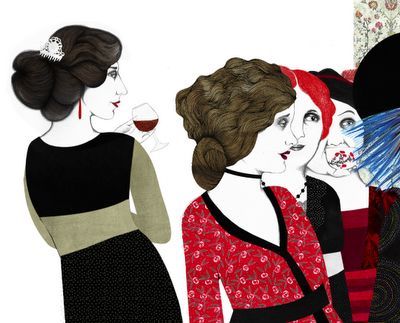
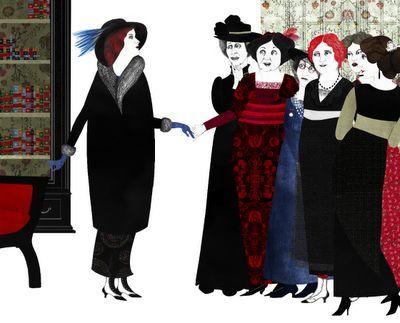
Las señoras Ballinger, Plinth, Leveret y Roby y las señoritas Van Vluyck y Glyde son las integrantes del Club del Almuerzo, en cuyas reuniones se dedican a debatir sobre libros y los más variados temas culturales. Un día, Osric Dane, una famosa escritora, visita la ciudad, y el Club le cursa una invitación para que asista a una de sus reuniones. Las integrantes del club ven el encuentro con la escritora como una excelente oportunidad para lucir sus mejores galas intelectuales. Sin embargo, la reunión se desarrollará de manera muy diferente a como habían previsto.
Edith Wharton emerged as one of America’s most insightful novelists, deftly exposing the tensions between societal expectation and personal desire through her vivid portrayals of upper-class life. Drawing from her deep familiarity with New York’s privileged “aristocracy,” she offered readers a keenly observed and piercingly honest vision of Gilded Age society.
Her work reached a milestone when she became the first woman to receive the Pulitzer Prize for Fiction, awarded for The Age of Innocence. This novel highlights the constraining rituals of 1870s New York society and remains a defining portrait of elegance laced with regret.
Wharton’s literary achievements span a wide canvas. The House of Mirth presents a tragic, vividly drawn character study of Lily Bart, navigating social expectations and the perils of genteel poverty in 1890s New York. In Ethan Frome, she explores rural hardship and emotional repression, contrasting sharply with her urban social dramas.
Her novella collection Old New York revisits the moral terrain of upper-class society, spanning decades and combining character studies with social commentary. Through these stories, she inevitably points back to themes and settings familiar from The Age of Innocence. Continuing her exploration of class and desire, The Glimpses of the Moon addresses marriage and social mobility in early 20th-century America. And in Summer, Wharton challenges societal norms with its rural setting and themes of sexual awakening and social inequality.
Beyond fiction, Wharton contributed compelling nonfiction and travel writing. The Decoration of Houses reflects her eye for design and architecture; Fighting France: From Dunkerque to Belfort presents a compelling account of her wartime observations. As editor of The Book of the Homeless, she curated a moving, international collaboration in support of war refugees.
Wharton’s influence extended beyond writing. She designed her own country estate, The Mount, a testament to her architectural sensibility and aesthetic vision. The Mount now stands as an educational museum celebrating her legacy.
Throughout her career, Wharton maintained friendships and artistic exchanges with luminaries such as Henry James, Sinclair Lewis, Jean Cocteau, André Gide, and Theodore Roosevelt—reflecting her status as a respected and connected cultural figure. Her literary legacy also includes multiple Nobel Prize nominations, underscoring her international recognition. She was nominated for the Nobel Prize in Literature more than once.
In sum, Edith Wharton remains celebrated for her unflinching, elegant prose, her psychological acuity, and her capacity to illuminate the unspoken constraints of society—from the glittering ballrooms of New York to quieter, more remote settings. Her wide-ranging work—novels, novellas, short stories, poetry, travel writing, essays—offers cultural insight, enduring emotional depth, and a piercing critique of the customs she both inhabited and dissected.
Reading Kalliope’s gorgeous, tempting review of Edith Wharton’s The Age of Innocence, coming accidently across this short story by her, like my daughter stealthily sticking her finger into a whipped cream topping, I hadn’t the patience to wait until I would find the time to embark on the novel – too keen to get an impression of the taste of Wharton’s prose. The 1916 short story Xingu turned out somewhat more spicy and far less sweet than whipped cream toppings– which for me is fine, as I have no penchant for sweet - a cleverly crafted, amusing satirical story on a club of pseudo-intellectual women ‘indomitable huntresses for erudition’, a clumsy would-be literary conversation salon which is swayed by the fear to put up a poor showing when it honoured by the visit of famous author – generously sparked by vivid dialogue like in a play.
The way these unsympathetic, snobbish women are outfoxed by the one club member they actually see as ‘unfit’ for the club is hilarious and I laughed out loud at lines like She has a mind like an hotel where facts came and went like transient lodgers, without leaving their address behind, and frequently without paying for their board. And yet. In a sense reading Xingu left me feeling somewhat similarly duplicitous as when reading some of the stories in Weird Things Customers Say in Bookshops – initial laughing shifting slowly into discomfort with the preposterous pleasure the author displays by exposing people’s ignorance.
Bearing in mind the 18 previous books of women authors I have been reading so far this year, Wharton’s was the first female voice I encountered that chose to mock only women – admittedly also scoffing at snooty, vacant, literary criticism and pedantry and only women of a certain class - but anyway exclusively women – which made me wonder why this story felt so much more barbed than it did at first sight and why it kept me brooding on what I sensed as its implicit message.
Satire as well as an astute analysis of human psychology, Xingu maybe could be perceived from a feminist viewpoint – look, this kind of silly behaviour is what a society keeping women bigoted by denying them education can expect - however I was struck by tasting in this story what I sensed a puzzling approval or at least continuation of a tradition making a laughing stock out of women because they – unsuccessfully and clumsily - seem to reach for the stars instead of the broom and refuse to ‘know their place’ and willingly accept their empty-headiness and the barren wasteland of their uneducatable, dilettante brain too barren to root a deeper understanding of things as a fact.
‘True knowledge’ and valuable books (Marx, Bergson, Saint Augustine, a work on Mendel) come out of the dressing-room of the husband and will not be found in the wife’s silly ‘fashionable’ ladies’ library, which suggests almost a disbelief in the sheer possibility that women could have an equally genuine love of knowledge and curiosity for the world like men – for the bunch of ladies debating books and various fields of knowledge is just a fashionable way of passing time, laughable as they come no further than venting platitudes in an attempt to show off.
Maybe it is just me (or I might just be suffering from PMS these days), failing to put this in the context of time and not seeing a male counterpart of this genre, oversensitive to anything reminding me of Molière’s Les femmes savantes or sneering at bluestockings in general. However it may take on a different form than male misogyny, this story illustrated for me women don’t seem immune to misogynist thought either, such attitude not uncommon in a patriarchal society – a deeply internalized attitude that isn’t a recent phenomenon and which seems much more complex than what it often derisively minimized as a simple catfight.
As Xingu was thought-provoking as well as written delightfully eloquent and witty, I look forward to explore Wharton’s novels and some more of her stories.
Set in the early 1900’s, Xingu features a group of ladies who are members of a Lunch Club. During their meeting they discuss many topics, and as they’re about to have a visit from a famous guest author, they look forward to some interesting discussions, but things don’t go as planned!
They’re a pretentious lot and the following is just an example….. "And what do you think of 'The Wings of Death'?" Mrs. Roby abruptly asked her (Mrs. Plinth). It was the kind of question that might be termed out of order, and the ladies glanced at each other as though disclaiming any share in such a breach of discipline. They all knew that there was nothing Mrs. Plinth so much disliked as being asked her opinion of a book. Books were written to read; if one read them what more could be expected? To be questioned in detail regarding the contents of a volume seemed to her as great an outrage as being searched for smuggled laces at the Custom House. The club had always respected this idiosyncrasy of Mrs. Plinth's. Such opinions as she had were imposing and substantial: her mind, like her house, was furnished with monumental "pieces" that were not meant to be suddenly disarranged; and it was one of the unwritten rules of the Lunch Club that, within her own province, each member's habits of thought should be respected. The meeting therefore closed with an increased sense, on the part of the other ladies, of Mrs. Roby's hopeless unfitness to be one of them.
"Her mind was an hotel where facts came and went like transient lodgers, without leaving their address behind, and frequently without paying for their board."
This short story by Edith Wharton is priceless! I spent an entertaining morning alternately reading, drinking coffee, and discussing bits and pieces of this with my own ‘breakfast club’ on-line. In this book, Wharton introduces us to the ‘Lunch Club’. Any member of a book club will most definitely appreciate this one! I’m sure you will recognize a person or two and find yourself chuckling throughout. It may perhaps be best to hold one’s tongue rather than feign intelligence in an attempt to grandstand one’s peers. Poking fun at literary snobbery doesn’t get much better than this! I always love Wharton’s wit and she succeeds here once again. This is a great introduction to her work, if you want a quick sample of her writing.
I read Edith Wharton's Xingu with a group of women who call themselves the Enchanted readers breakfast club. We have decided to discuss short stories over coffee. Having never been exposed to Edith Wharton before and desiring a variety of women authors for my women's history month lineup, I decided to join them.
In thirty two short pages, Wharton offers a social commentary on the education and social awareness of upper class society women. During this era, as in Wharton's case, the sole purpose of women was to marry. As a result, they were not abreast of the key issues of their day, yet at a time when women's suffrage was gaining steam, women desired to know more. At the time of Xingu, society women may have read a book or thought of the day, but they for the most part did not know much beyond the walls of their upper crust homes.
The story takes place at a book club meeting at the home of Mrs Ballinger. The women, it so appears, meet for lunch once or twice a month to discuss current novels. During this meeting, the women have invited one of their favorite novelists named Osric Dane to join them in discussion. The only issue is that none of the women have much to discuss, and seem to meet at these clubs to socialize as much to discuss the books. As a result, they are at a loss as to what to speak about so as not to embarrass themselves in front of the author.
Having not read Wharton before, I thought this story was a decent introduction to her writing. She writes of social commentary at a key juncture of American history when a wave of women's rights began to emerge. Xingu pokes fun at the upper classes while silently addressing women's place in society. I look forward to reading Wharton's novels in the future in the hope that they address a woman's place in society on a larger scale.
Late last night, I was scratching around for something quick to read before sleeping and I am so glad I stumbled across this marvellous short story, it was already tucked away in my Kindle library. It seems I bought myself a present sometime ago and it turned out to be a wonderful surprise. The advantage of having a dull memory. Anyway, this is my first Wharton, and it won’t be my last, oh boy it was smart and funny.
It was only the fact of having a dull sister who thought her clever that saved her from a sense of hopeless inferiority
We go back to Edwardian times (not sure if it's set in England or America to be honest) and meet up with a bunch of ‘well to do’ ladies who regularly catch up to discuss topics of the day including discussions on any interesting books The Lunch Club. Well, we catch up with them in one of their homes and an invited author comes along to discuss a book she recently wrote.
What ensues is a quiet riot of sarcasm, stuffiness, snobbery, pretentiousness, and satire. But beware, it’s not the type of humour that smacks you between the eyes. The sniping is quite subtle, well mannered even. The invited author is a hoot too – she comes in with an attitude the size of a house.
There’s a total misunderstanding here about Xingu, which turns into a tangle of confusion, bluffing and uncertain groupthink, as everyone ducks for cover to try and make sure they don’t come across as the fool. This is a LOT OF FUN.
Her mind was a hotel where facts came and went like transient lodgers, without leaving their address behind, and frequently without paying for their board
Oh, there is a bonus in the edition I surprisingly purchased for myself, it’s one of Wharton’s essays titled The Vice of Reading, that was illuminating.
Hello Edith!!
4 Stars.
Oh BTW - If you haven’t read this wee gem, don’t try and find out what Xingu is :)
A fun satirical short story about group of pretentious women and their book club. Their discussion of Xingu kind of reminds me of when I read the Goodreads reviews of a novel and everyone has written multiple paragraphs about its literary merit and symbolism and characters' motives and relevancy in the publishing world. And then I go to write my review and it pretty much boils down to “The book was good and I liked it” and I'm trying to think up super smart-sounding things to say so that everyone won't think I'm a complete nitwit. Maybe from now on I'll just say that it's “saturated with Xingu” and see how that goes.
So, yeah, this is an entertaining and quick read that's, um … saturated with Xingu. Four stars.
When a group of ladies who lunch receive the honor of hosting Osric Dane, the celebrated author, their excitement and trepidation concerning the visit stirs a fluff amongst the members.
As the event draws near, each woman reveals their upper-crust considerations, save one: Mrs. Roby. She is, as they say, the odd one out with this crowd. But perhaps they shouldn't be so hasty to dismiss someone deemed an ill fit? Will she be their salvation or their downfall?
Awash with beautiful prose and subtle comedy, I urge you to read this delightful short story and find out how 'lunch is served.'
A big thank you to Antoinette for directing me to this fabulous short story. Antoinette's review
Here are a few quotes I adored: “Mrs. Ballinger is one of the ladies who pursue Culture in bands, as though it were dangerous to meet alone.”
“Miss Van Vluyck adjusted her spectacles as though they were the black cap of condemnation.”
“Her mind was a hotel where facts came and went like transient lodgers, without leaving their address behind, and frequently without paying for their board.”
“Osric Dane received the homage of the smile as a matter of course; but the accompanying question obviously embarrassed her, and it became clear to her observers that she was not quick at shifting her facial scenery.”
A satirical short story focussing on the pretentious attitude of a group of women in an elite club.
‘The Lunch Club’ was founded by a few “huntresses of erudition” to pursue culture as a group. After a few successful years, they now host distinguished strangers to further their quest for knowledge. The only thorn in the side of this all-women group is Mrs. Roby, whose membership had been accepted on recommendation of an erudite professor, but who was now proving to be a hurdle in the club’s intellectual pursuits. When noted author Osric Dane visits the club as an esteemed guest, the visit turns out quite the opposite of what was expected as Dane too turns out to be a cultural snob. Somehow, the topic of ‘Xingu’ comes up for discussion. Each woman is now determined to prove that she is familiar with the offbeat topic. So what is Xingu? Read and find out.
The writing starts off slowly, but Wharton does a splendid job of providing the detailed background, such that when Osric Dane’s visit starts in the second section, we can understand and even predict the manner of thinking of the six club members. The tempo builds up slowly and steadily. The ending, while somewhat foreseeable, is fun!
This little story was first published in 1916, but it looks like some of its members’ snooty attitudes are prevalent even now. Their game of one-upmanship (or perhaps I should say, one-upwomanship) is so common even nowadays with a few book club members who consider themselves superior to others for having read “serious books” or nonfiction.
Definitely recommended to classic fiction lovers and satire fans. Keep your patience at the start of this short tale, and the ending will prove your effort worthwhile.
4 stars.
My thanks to my Goodreads friend Bob whose review put this lovely story on my radar.
Thank you, @Maureen for the short story link!! I loved seeing the lunch ladies get played by a woman who was just living her life and having real experiences... and that the guest is in on it, too! Gold!
This entire review has been hidden because of spoilers.
Published in 1916, Xingu is a brilliant satire by Edith Wharton. I had so much fun reading it. Thank you, Mark Porton, for lighting the way to this entertaining story.
Five ladies who belong to a Lunch Club meet regularly to discuss art, literature, philanthropy, psychology, statistics, sociology, and a host of topics that are supposed to showcase how cultured they are.
The ladies claim to be readers, too; the latest book for discussion is Osric Dane’s latest book, ‘The Wings of Death.’ Ah, a book club of sorts. I was thrilled. This was until I discovered that not being able to offer a comment that sits well with the club members can bring shame and disdain. Mrs Roby who has not read the book finds herself on precarious ground. It does not help that their guest writer turns out, in Mrs Roby’s words, to be a brute.
Hear what Mrs Ballinger, the club president, has to say: “For my part, when there are so many books one has to read; I wonder how anyone can find time for those that are merely amusing.” Good grief! This is just one example of the snobbery and haughty talk in the Lunch Club. Imagine the stress of thinking about the next clever thing to say that will impress the club members or making sure that their ignorance is concealed.
This story is very well written. I could hear Wharton mocking her characters. I enjoyed her acerbic humor. Wharton laid bare their arrogance, hypocrisy, self-delusion, and need for self-preservation.
Somehow, ‘Xingu’ made me think of an exotic Chinese mushroom. No. You will have to find out what it is for yourself. I had such a jolly time reading this story that I retraced my steps when it ended just to be entertained once more by the ‘surprising reconstruction’ of the banter around Xingu.
At the beginning, I thought Wharton's writing pretentious. But as I proceeded with this short story I saw how the writing style complemented her theme. And by the end I was smiling broadly. Wharton has portrayed her characters eloquently and in the end, it was they who were pretentious.
My favorite quote: ' Her mind was an hotel where facts came and went like transient lodgers, without leaving their addresses behind, and frequently without paying their board.'
5★ What an absolute treat of a short story! Anyone who’s ever felt like an awkward peasant among self-proclaimed literati will love this Mad Hatter’s Tea Party of a book club.
"Mrs Ballinger is one of the ladies who pursue Culture in bands, as though it were dangerous to meet alone. To this end she founded the Lunch Club, an association composed of herself and several other huntresses of erudition."
The ladies are meeting in one of the 'lesser' homes, awaiting the author of their current book discussion. Some of them carry a handy helper called "Appropriate Allusions" to ensure they can sound erudite and well-read when mixing with people who might use words like “erudite” or “literati” in everyday conversation.
Their names remind me of Dickens. Mrs Leveret (a young rabbit), Mrs Plinth (a solid block of stone at the base of a column), and Mrs Roby, whom I imagine draped in something long and loose. I can see there are authorised dramatisations of this, but I can’t help imagining it all in wonderful cartoon form, too.
Mrs Plinth (a pillar of society?) has a footman, while poor Mrs Ballinger is one “whose obligations to society were bounded by the narrow scope of two parlour-maids”. Perish the thought that one should sink so low! How generous of the others to include her in their group.
I will include a couple of quotes for fun. You can read or download the story at Gutenberg.org. (See below.)
“It was as through her countenance had so long been set in an expression of unchallenged superiority that the muscles had stiffened, and refused to obey her orders.” . . . “Miss Van Vluyck’s face took on a nauseated expression, and Mrs. Plinth looked as is she were passing someone she did not care to bow to.” . . . “The author departed, “seizing the hands of the disconcerted members, she administered a series of farewell pressures with the mechanical haste of a railway-conductor punching tickets.”
I haven’t read Edith Wharton before, yet another glaring gap in my literary pursuits. I must go find some more!
Not quite a novella and yet more than a short story, Xingu is a witty and humorous look at pomposity, snobbery, and the inclination to derive worth from someone other than self. It was a bundle of satirical fun that made me laugh, while shaking my head and protesting to myself that "I have met these people."
If you have ever met someone who throws around big words in an effort to appear intellectual, but never bothers to know the ACTUAL meaning of them, thus betraying themselves, you cannot help enjoying this story. And, finally, it served for me as a reminder not to take myself too seriously...you never know when someone might identify you as a member of the "club".
Thank you so much to the Enchanted Readers' Breakfast Club for sharing this lovely read, and especially to Lori who suggested that we do it in the first place. I am so happy to be a member of this group!
Thank you to Mark Porton for bringing this story to my attention.
“ Amusement is hardly what I look for in my choice of books,” states one of the members of a woman’s lunch club. I guess Edith Wharton showed her cause this story is a total hoot.
This woman’s group prides themselves on having intellectual, informative discussions on topics that are chosen by the members. At this meeting an author of a book they have read is attending. Her name is Osric Dane. Not exactly a pleasant woman! The meeting is not going well till Mrs. Roby brings up the topic of Xingu. Just go with the flow and see what transpires after this.
Edith Wharton was poking fun at women in this story- the snobby women who think they are a cut above. Such an amusing, delightful read.
OK, so I read this, and it certainly did make me smile. What makes it special is that it criticizes social snobbery and intellectualism through humor.
The story is short. It will not take you an hour to read. It is about a group of women who in the late 1800s meet to discuss books, quite an appropriate topic for those of us here at GR. You will surely recognize particular "individual types" common to both the story and GR.
Here is one section on page five that made me smile. It offers a taste of the humor and the characters you will meet:
"And what do you think of 'The Wings of Death'?" Mrs. Roby abruptly asked her (Mrs. Plinth). It was the kind of question that might be termed out of order, and the ladies glanced at each other as though disclaiming any share in such a breach of discipline. They all knew that there was nothing Mrs. Plinth so much disliked as being asked her opinion of a book. Books were written to read; if one read them what more could be expected? To be questioned in detail regarding the contents of a volume seemed to her as great an outrage as being searched for smuggled laces at the Custom House. The club had always respected this idiosyncrasy of Mrs. Plinth's. Such opinions as she had were imposing and substantial: her mind, like her house, was furnished with monumental "pieces" that were not meant to be suddenly disarranged; and it was one of the unwritten rules of the Lunch Club that, within her own province, each member's habits of thought should be respected. The meeting therefore closed with an increased sense, on the part of the other ladies, of Mrs. Roby's hopeless unfitness to be one of them.
So far this is my favorite by Edith Wharton. Having enjoyed it, I will be reading more.
Xingu is my first experience reading Edith Wharton. True to what I have heard of her, her work involves a strong social commentary of her time.
Wharton has picked a lunch club formed by some upper-society ladies for her stories, so that it could serve as an abstract platform to expose the level of education and ignorance of the women of her time. There is satire throughout the story on the pretentious display of intellect by these high-society ladies, thus exposing their poor education and general ignorance. Edith herself was never happy with the education she received. She craved for more. Her personal experience must have induced her to write this satirical piece to build a voice in standardizing education for women.
Having not read her works before, I'm glad to how begun with this short work. I feel it is a good introduction to her thinking and writing. I only chose this work to complete a challenge, as it was a short read, and it was recommended to me. But I'm glad I took on it, because I found an interesting author to explore.
The Lunch club is expecting a guest for their next meeting, a famous author! Everyone is all atwitter over the prospect, except perhaps newest member Mrs. Roby.
"I can understand that, with all your other pursuits, you should not find much time for reading; but I should have thought you might at least have got up 'The Wings of Death' before Osric Dane's arrival." Mrs. Roby took this rebuke good-humouredly. She had meant, she owned, to glance through the book; but she had been so absorbed in a novel of Trollope's that— "No one reads Trollope now," Mrs. Ballinger interrupted. Mrs. Roby looked pained. "I'm only just beginning," she confessed. "And does he interest you?" Mrs. Plinth enquired. "He amuses me." "Amusement," said Mrs. Plinth, "is hardly what I look for in my choice of books."
Now if I was Mrs. Roby I am afraid I might have done some something quite foolish at this point, like smack both women upside the head and stomp out of the house, perhaps. But Mrs. Roby has class. She has style. And she is very clever. So she waits until the Big Day, and then she makes her rebuttal and drenches the 'ladies who lunch' in their own pretensions.
Like many other readers, I added this title to an A-Z Challenge list a year or two ago. I did not know at the time what the story was about, I just wanted to be able to fill in that 'X' space. I was familiar with Wharton's name, but other than one ancient (and failed) attempt at Ethan Frome, I had never read any of her work. Even comments from fellow GR members in various groups did not convince me to plunge into her novels. But after this little dip of my toe in Wharton's style, I know I will be hip deep in rivers of her work Someday.
Wharton is masterful with titles. They bait me every time. Lured to read, I am soon hooked and reeled in though I kick and protest all the while. I have a love/hate feeling towards this story. The skill is admirable. Yet I hate to be played. It reminds me of a trick P. T. Barnum did at his circus. He put up a sign which read "EGRESS." People followed it to what they thought was another attraction. They found out it meant "exit" in Latin.
"Xingu" promises something exotic, somewhere that gongs pound, mountains spear clouds, and nuns go mad with lust. Nope. None of that, though the women in this story do become heated at times.
Xingu is actually the word for - . No, I can't. That would spoil it. Find out for yourself.
What a wicked little satire! Wharton portrays a ladies' literary meeting with tongue firmly in cheek as the ladies welcome a popular author whose work intimidates them. They wish to seem educated and up-to-date, but they haven't read the author's books. Mrs. Dane, the popular author, sits down to her coffee and asks the ladies what their opinion of Xingu is. But—what is Xingu?
Huge thanks to my friend Kimber for bringing this short classic story to my attention and providing a link to it.
I could hardly contain my laughter has I read through the Lunch Club’s meeting with their distinguished guest. Edith Wharton paints a perfect picture of these six women of upper crust haughtiness and their self-absorbed opinions of their literary and cultural prowess.
This classic will become one of my all time favourite reads, and I only wish it could have been a whole series of their luncheon meetings as it is not only highly entertaining but also an exquisite example of literary prose.
I think I’ll hold “High Tea” for my bookclub to discuss this… but of course the tea pot would be filled with a lovely Cabernet Sauvignon! Wear your hat and gloves!
This is an excellent short story about a pompous group of lunching ladies who have dedicated themselves to culture and literature and the like. It's humorous because the women pretend they know more than they do and will have entire conversations professing opinions on topics they know nothing about. This story has cemented Edith Wharton as one of my favorite American writers.
How fun it was to watch the ladies’ Lunch Club in action, and enjoy the unraveling of this clever plot! The best part was Edith Wharton’s trademark descriptive similes peppered throughout, which may have stood out more in this short story than they do in her novels.
Just a few of my favorites: “ … whose manner of putting forth an opinion was like that of an obliging salesman with a variety of other styles to submit if his first selection does not suit.” “Mrs. Leveret felt like a passenger on an ocean steamer who is told that there is no immediate danger, but that she had better put on her lifebelt.” “ … she had a way of looking at you that made you feel as if there was something wrong with your hat.”
This is why I love short stories (and bonus point for being free for Kindle on Amazon). When you read this on Kindle you can look up Xingu immediately and get in on the joke.
You know how you wish you could say something smart to someone pretentious but the words never come? This is how you do it! (And for those looking for something educational *and* pretentious, that phrase is "L'esprit de l'escalier" or the wit of the staircase...when the perfect comeback comes as you're on your way out and it's too late.)
Edith Wharton wrote this story at the turn of the 20th century about bourgeois women from the backwater of Hillbridge; however, it’s sentiment is true for any age and for any but the largest American metropolises. A case study in snobbery with the most satisfying ending.
Timeless satire on the pretentiousness of humans. A 1900's book club has invited a celebrated author into their midst to discuss her literary offering. Caught up in their one upmanship, they make fools of themselves. As they attempt to discuss a topic(Xingu) of which they have no clue, hilarity ensues. A previous reviewer likens this group to the high school cliques we all are so familiar with. And I cannot think of a better description. Edith Wharton nailed it! This is part of a collection of her work that has languished on my tablet for too long. Time to renew my acquaintance with the classics!