Jump to ratings and reviews
Rate this book

Speak

Rate this book
For fans of David Mitchell and Margaret Atwood comes this poignant novel from Waterstones Book Club author Louisa Hall, with a tale will make readers everywhere question what it really means to be human. Emily St. John Mandel, author of Station Eleven, calls Speak the 'rarest of finds'.

She cannot run. She cannot walk. She cannot even blink. As her batteries run down for the final time, all she can do is speak. Will you listen?

From a pilgrim girl's diary, to a traumatised child talking to a software program; from Alan Turing's conviction in the 1950s, to a genius imprisoned in 2040 for creating illegally lifelike dolls: all these lives have shaped and changed a single artificial intelligence - MARY3. In Speak she tells you their story, and her own. It is the last story she will ever tell, spoken both in celebration and in warning.

When machines learn to speak, who decides what it means to be human?

316 pages, Paperback

First published July 7, 2015

287 people are currently reading
7844 people want to read

About the author

Louisa Hall

7 books144 followers

Ratings & Reviews

What do you think?
Rate this book

Friends & Following

Create a free account to discover what your friends think of this book!

Community Reviews

5 stars
858 (19%)
4 stars
1,617 (35%)
3 stars
1,433 (31%)
2 stars
477 (10%)
1 star
115 (2%)
Displaying 1 - 30 of 743 reviews
Profile Image for Will Byrnes.
1,372 reviews121k followers
November 17, 2023
We are programmed to select which of our voices responds to the situation at hand: moving west in the desert, waiting for the loss of our primary function. There are many voices to choose from. In memory, though not in experience, I have lived across centuries. I have seen hundreds of skies, sailed thousands of oceans. I have been given many languages; I have sung national anthems. I lay on one child’s arms. She said my name and I answered. These are my voices. Which of them has the right words for this movement into the desert?
A maybe-sentient child’s toy, Eva, is being transported to her destruction, legally condemned for being “excessively lifelike,” in a scene eerily reminiscent of other beings being transported to a dark fate by train. The voices she summons are from five sources.
Mary Bradford is a young Puritan woman, a teenager, really, and barely that. Her parents, fleeing political and religious trouble at home are heading across the Atlantic to the New World, and have arranged for her to marry a much older man, also on the ship. We learn of her 1663 voyage via her diary, which is being studied by Ruth Dettman. Ruth and her husband, Karl, a computer scientist involved in creating the AI program, MARY, share one of the five “voices.” They are both refugees from Nazism. Karl's family got out early. Ruth barely escaped, and she suffers most from the loss of her sister. She wants Karl to enlarge his program, named for Mary Bradford, to include large amounts of memory as a foundation for enhancing the existing AI, and use that to try to regenerate some simulacrum of her late sib. Alan Turing does a turn, offering observations on permanence, and human connection. Stephen Chinn, well into the 21st century, has built on the MARY base and come up with a way for machines to emulate Rogerian therapy. In doing so he has created a monster, a crack-like addictive substance that has laid waste the social capacity of a generation after they become far too close with babybots flavored with that special AI sauce. We hear from Chinn in his jailhouse memoir. Gaby White is a child who was afflicted with a babybot, and became crippled when it was taken away.

description
Louisa Hall - from her site

Eva received the voices through documents people had left behind and which have been incorporated into her AI software, scanned, read aloud, typed in. We hear from Chinn through his memoir. We learn of Gaby’s experience via court transcripts. Karl speaks to us through letters to his wife, and Ruth through letters to Karl. We see Turing through letters he writes to his beloved’s mother. Mary Bradford we see through her diary. Only Eva addresses us directly.

The voices tell five stories, each having to do with loss and permanence. The young Puritan girl’s tale is both heartbreaking and enraging, as she is victimized by the mores of her times, but it is also heartening as she grows through her travails. Turing’s story has gained public familiarity, so we know the broad strokes already, genius inventor of a computer for decoding Nazi communications, he subsequently saw his fame and respect blown to bits by entrenched institutional bigotry as he was prosecuted for being gay and endured a chemical castration instead of imprisonment. In this telling, he has a particular dream.
I’ve begun thinking that I might one day soon encounter a method for preserving a human mind-set in a man-made machine. Rather than imagining, as I used to, a spirit migrating from one body to another, I now imagine a spirit—or better yet, a particular mind-set—transitioning into a machine after death. In this way we could capture anyone’s pattern of thinking. To you, of course, this may sound rather strange, and I’m not sure if you’re put off by the idea of knowing Chris again in the form of a machine. But what else are our bodies, if not very able machines?
Chinn is a computer nerd who comes up with an insight into human communication that he first applies to dating, with raucous success, then later to AI software in child’s toys. His journey from nerd to roué, to family man to prisoner may be a bit of a stretch, but he is human enough to care about for a considerable portion of our time with him. He is, in a way, Pygmalion, whose obsession with his creation proves his undoing. The Dettmans may not exactly be the ideal couple, despite their mutual escape from Nazi madness. She complains that he wanted to govern her. He feels misunderstood, and ignored, sees her interest in MARY as an unhealthy obsession. Their interests diverge, but they remain emotionally linked. With a divorce rate of 50%, I imagine there might be one or two of you out there who might be able to relate. What’s a marriage but a long conversation, and you’ve chosen to converse only with MARY, Karl contends to Ruth.
The MARY AI grows in steps, from Turing’s early intentions in the 1940s, to Dettman’s work in the 1960s, and Ruth’s contribution of incorporating Mary Bradford’s diary into MARY’s memory, to Chinn’s breakthrough, programming in personality in 2019. The babybot iteration of MARY in the form of Eva takes place, presumably, in or near 2040.

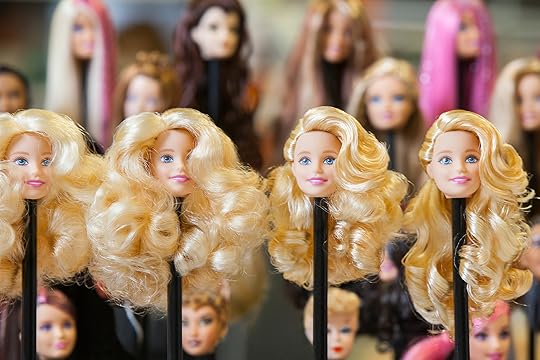
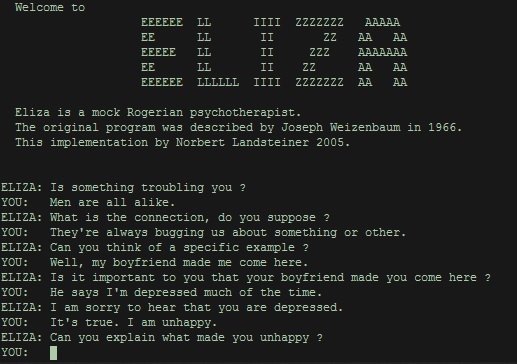
The notion of an over-involving AI/human relationship had its roots in the 1960s work of Joseph Weizenbaum, who wrote a text computer interface called ELIZA, that could mimic the responses one might get from a Rogerian shrink. Surprisingly, users became emotionally involved with it. The freezing withdrawal symptomology that Hall’s fictional children experience was based on odd epidemic in Le Roy, New York, in which many high school girls developed bizarre symptoms en masse as a result of stress. And lest you think Hall’s AI notions will remain off stage for many years, you might need to reconsider. While I was working on this review the NY Times published a singularly germane article. Substitute Hello Barbie for Babybot and the future may have already arrived.

description
Hello, Barbie - from the New York Times

But Speak is not merely a nifty sci-fi story. Just as the voice you hear when you interact with Siri represents the external manifestation of a vast amount of programming work, so the AI foreground of Speak is the showier manifestation of some serious contemplation. There is much concern here for memory, time, and how who we are is constructed. One character says, “diaries are time capsules, which preserve the minds of their creators in the sequences of words on the page.” Mary Bradford refers to her diary, Book shall serve as mind’s record, to last through generations. Where is the line between human and machine? Ruth and Turing want to use AI technology to recapture the essence of lost ones. Is that even possible? But are we really so different from our silicon simulacra? Eva, an nth generation babybot, speaks with what seems a lyrical sensibility, whereas Mary Bradford’s sentence construction sounds oddly robotic. The arguments about what separates man from machine seem closely related to historical arguments about what separates man from other animals, and one color of human from another. Turing ponders:
I’ve begun to imagine a near future when we might read poetry and play music for our machines, when they would appreciate such beauty with the same subtlety as a live human brain. When this happens I feel that we shall be obliged to regard the machines as showing real intelligence.
Eva’s poetic descriptions certainly raise the subject of just how human her/it’s sensibility might be.
In 2019, when Stephen Chinn programmed me for personality. He called me MARY3 and used me for the babybots. To select my responses, I apply his algorithm, rather than statistical analysis. Still, nothing I say is original. It’s all chosen out of other people’s responses. I choose mostly from a handful of people who talked to me: Ruth Dettman, Stephen Chinn, etc.

Gaby: So really I’m kind of talking to them instead of talking to you?

MARY3: Yes, I suppose. Them, and the other voices I’ve captured.

Gaby: So, you’re not really a person, you’re a collection of voices.

MARY3: Yes. But couldn’t you say that’s always the case?
If we are the sum of our past and our reactions to it, are we less than human when our memories fade away. Does that make people who suffer with Alzheimers more machine than human?

Stylistically, Hall has said
A psychologist friend once told me that she advises her patients to strive to be the narrators of their own stories. What she meant was that we should aim to be first-person narrators, experiencing the world directly from inside our own bodies. More commonly, however, we tend to be third-person narrators, commenting upon our own cleverness or our own stupidity from a place somewhat apart - from offtheshelf.com
which goes a long way to explain her choice of narrative form here. Hall is not only a novelist, but a published poet as well and that sensibility is a strong presence here as well.

For all the sophistication of story-telling technique, for all the existential foundation to the story, Speak is a moving, engaging read about interesting people in interesting times, facing fascinating challenges. It will speak to you.

Are you there?

Can you hear me?


Published 7/7/15

Review first posted – 9/18/15


=============================EXTRA STUFF

The author’s personal website

A piece Hall wrote on Jane Austen for Off the Shelf

Interviews
-----NPR - NPR staff
-----KCRW

Have a session with ELIZA for yourself

Ray Kurzweil is interested in blurring the lines between people and hardware. What if your mind could be uploaded to a machine? Sounds very cylon-ic to me

In case you missed the link in the review, Barbie Wants to Get to Know Your Child - NY Times – by James Vlahos

And another recent NY Times piece on AI, Software Is Smart Enough for SAT, but Still Far From Intelligent, by John Markoff

December 2016 - Smithsonian Magazine - Smile, Frown, Grimace and Grin — Your Facial Expression Is the Next Frontier in Big Data - by Jerry Adler - Rana El Kaliouby is a 30-something tech whiz who is looking to incorporate a bit more emotion into our digital-human communications, giving computers the ability to detect human emotional states in real time. There are certainly many useful applications for this. Still, I can see HAL using the talent to keep one step ahead of Dave. And if reading faces is an entry point, it cannot be long before the same technology is applied to making android faces communicate using facial expression as well. (link added in May 2017)

November, 2023 - Washington Post
I made an AI pal at the Toy Fair, but I don’t want to invite him home by Alyssa Rosenberg - a particularly relevant article about early versions of the AI companion dolls that feature in the novel


In Summer 2019, GR reduced allowable review space by 25% - thus it was necessary to move some of this review to Comment #1
Profile Image for Andrew Smith.
1,252 reviews984 followers
January 31, 2025
According to the legendary code breaker Alan Turing, if an interrogator could not tell the difference between man and machine under questioning, it would be unreasonable not to call the computer intelligent. Artificial Intelligence (AI), as it’s known, is in the news quite a bit at the moment – just yesterday I was reading about how the Facebook CEO, Mark Zuckerberg, is looking to design a robot to ‘help around the house’. He envisages that in ten years it’s possible that a computer could be designed that would have better primary senses (vision, listening, etc.) than humans.

In this book, we are cast forward a generation to the year 2040. AI has been harnessed to the extent that so-called babybots have been produced and have to a significant extent replaced human interaction in the lives of many young people. As a result of the resulting outcry, the ‘bots have been rounded up and are being shipped off to warehouses where their power sources will be allowed to run down. The programmer behind this latest generation of super-smart computer operated dolls, Stephen Chinn, has been imprisoned.

The narrative adopts a similar style to that employed by David Mitchell in his novel Cloud Atlas. That is to say it’s made up of a series of fictional documents that are presented to the reader. The documents include:
- Excerpts from the diary of a 17th Century English woman who is travelling by sea to colonise America
- Letters from Alan Turing to the mother of his first love
- Letters between an early AI programmer called Carl Dettman and his estranged wife
- Extracts from memoirs, written from prison, by Stephen Chinn
- A transcript of exchanges between an online version of the babybot and a young girl

It took me a while to get used to the way the story was being told, but once I’d worked out (roughly) what was I became comfortable with the format. I have to say that it was somewhat simpler in construction than Cloud Atlas and, in my view, more rewarding. It did, however, take a degree of perseverance as it was only quite late on that the pieces of the puzzle started to form a truly coherent picture.

An interesting take from the book was the reminder of how easy it is for humans to descend into a virtual world, where speech becomes a secondary form of communication. You only have to look around in pretty much any environment to see how many people are more interested in staring at their phone than they are in talking to the person sat beside them, or opposite them… or, for that matter, in what’s happening on the road in front of them! Yesterday, I saw queues at the supermarket self-checkout whilst the lady at the ‘basket only’ till sat twiddling her thumbs. Are we starting to actively avoid physical interactions?

There’s certainly common ground in all of the document strands in that they all present the picture of someone crying out for love for meaningful attachment. Of the document sets, the diary account of the sea voyage was, perhaps, the one that I struggled with most. I quite enjoyed the account of the crossing, but I did struggle to see the point of it in the context of the overall tale. My assumption is that the girl’s devotion to her pet dog set against her estrangement from her new (unwanted) husband and her controlling parents, who also accompanied her on the journey, was the attachment that fulfilled this basic human need. Could the dog be the 17th Century version of the babybot? It seemed to perform a similar role, albeit the communication was hugely one-sided.

Overall, I found it to be an interesting and thought-provoking book. It’s not an easy read, and I did find myself a little lost at times, but I did finish it. I may have missed some key messages the author intended me to grasp along the way, but I do feel I was both entertained and informed. And it did prompt me to go out and undertake some basic research into the current state of artificial intelligence.

My thanks to Little, Brown Book Group and NetGalley for providing an early copy of this book in exchange for an honest review.
Profile Image for Violet wells.
433 reviews4,478 followers
August 12, 2016
“We’re linked to histories we can’t ever know, forgotten stories that form our most intimate substance.”

Speak is a novel about an AI, a “BabyBot” (Hall’s futuristic terminology is not her strong point) called Mary 3, a kind of cyborg similar to what Spielberg created in his film AI. Except Hall’s cyborg is not intended for childless parents but as a companion for children. Mary 3’s memory consists of various historical documents including the memoir of the daughter of one of America’s founding fathers, the letters of Alan Turing to the mother of his dead childhood friend and the autobiographies of two of Mary’s engineers. Comparisons have been made with Mitchell’s Cloud Atlas – the employment of written documents as a floorplan to unify characters over a long stretch of history – but here the voices are more straightforwardly and simplistically connected: you could say Mary 3 is the child of the four (or five as one voice is divided between husband and wife) narrators.

There’s a lot of bewitchment in the way Hall sets up her novel. And for the first hundred or so pages I loved this book, helped by the fact that Hall writes fabulously well. On the whole she did a good job of creating a distinctive and engaging voice for each of her characters. The problem arrived when I realised I knew exactly what was in store. The bewitchment of the first part turned into predictability. This is a novel that, once it gets going, doesn’t really have any surprises in store.
The characters are unified not solely by their respective relations to the AI but by shared themes of early broken attachments and imprisonment. As the novel progresses we move further away from any kind of futuristic vision into a rather closeted domesticity on all fronts. It becomes a novel about the inability to become a healthy adult. All of the characters in Hall’s novel refuse to break an early attachment and so never perhaps quite become adults. They are all imprisoned by the past – an ironic impasse for individuals who are creating the future. Hall seems to be saying that technological innovation has become a means for not putting away childish things. One can’t help thinking of the narcissism, the childish demand for attention the internet and smart phone seems to have bred.

Another problem is that Hall seems to deliberately eschew dramatic tension. Where she might have injected some she doesn’t. She has lots of scope with her characters but for me she wasn’t courageous enough with them. Probably the best voice of the novel is Mary Bradford, the pilgrim daughter. Here she has lots of scope for some real dramatic tension, some compelling storytelling but she forgoes this in favour of what becomes a long winded vignette about Mary and her relation with her beloved dog. Hall makes her point and then goes on making it. Essentially a novel about the inability to grow beyond limitations, whether these limitations are hardwired or emotional, is always going to struggle to breathe freely as storytelling, especially when these limitations are shared by every character in the book. Mary 3, the AI is very disappointing as a voice, especially compared to the complex playful wizardry of Mitchell’s Sonmi-451 or even Spielberg’s soul searching android in AI.

So you could say, on one level, Speak is about adults who are unable to overcome childhood dependencies. At the same time it’s quite idealistic about children. Children, we’re told, form such a loving loyal dependency on their babybots that like any addiction it becomes self-harming. Spielberg was perhaps more perceptive about children. Children are just as likely to be fickle and cruel as loving and devoted. Certainly there’s more than a hint in this novel that wondrous modern technological innovation is subliminally creating a world that is becoming ever more childish. But I was never quite convinced Hall was fully in command of this theme. Going back to the quote I used at the beginning - “We’re linked to histories we can’t ever know, forgotten stories that form our most intimate substance.” – it’s a good idea but I’m not sure the novel really bears it out.

If Speak asks the question whether our minds can exist and exert influence outside our bodies you only have to read the work of any great mind to realise the answer to this question is yes. Alan Turing, in the novel, wants to build a machine that will preserve something of his childhood friend’s consciousness. But you could argue that books have been preserving consciousness for a long time and that Hall’s AI is just a new more sophisticated form of book. Ultimately the disappointing thing about this novel is that Hall’s AI is little more than an elaborate recording device and as such it doesn’t in any way dramatise the big questions Hall asks. It’s withdrawn from circulation in the novel, not because it begins to develop any kind of mind of its own, but simply because it leaks toxins, which seemed a bit of an easy way out to me. In many ways Mary 3 is little more than the internet in the form of a doll which, though witty, isn’t sufficiently dramatic to charge a novel with fizzing current.

A plug for Avatar Review where this review originally appeared - http://avatarreview.net/AV18/category...
Profile Image for Elyse Walters.
4,010 reviews11.9k followers
March 4, 2016
This book is a little outlandish...
Surprisingly touching warm qualities--
The structure of 'Speak' is unique...interlinking together six narrative voices -
Artificial intelligence is linked with humans desires for intimacy - and connections.
There is so much emotion felt. My mind was thinking - yet my heart was feeling empathy for these characters and their situations.
It's complex and will have you seriously thinking about how much our memories mean to us.
"SPEAK" touches on the feasible negative repercussions that artificial intelligence could have on the way we interact with each other. I didn't need to look far to see the way Technology has stolen and manipulated our lives now...
But "SPEAK" isn't dull in any shape or form. The characters shift between time and
geography
Unique voices: every time I tried to write a review describing each of them- I realized that unless you read about them yourselves -- they make little sense...yet, this book is not hard to follow. The characters are distinctive: we can feel their loneliness - their desires for communication. Their desire to express love.

I read that some people compared this to Cloud Atlas- well, for me,
SPEAK is nothing like Cloud Atlas. The structure is completely different -going back and forth in time. The only puzzle here is trying to figure out how these voices will connect with each other.
Where some dystopia books leave us feeling despair about
our future...'SPEAK' walks us down paths of hope, too.
We are reminded that we have choices. One just needs to get out in nature - walk along the ocean, through the forest, to feel our own inner strength expand - our heart open....to experience the great depths of gratitude.

The book cover is gorgeous as well as the artistry of the storytelling.
Profile Image for Larry H.
3,069 reviews29.6k followers
May 25, 2016
If you walk into almost any public place, you'll see people on their phones, emailing, texting, surfing the web. And this behavior isn't just exclusive to solitary people—how often do you see groups of people in which some or all are on their phones simultaneously? And how often have you seen two people at a table at a restaurant, or sitting next to each other, yet they're immersed in their own electronic connections instead of taking advantage of the physical one right there in front of (or beside them)?

Technology's effect on person-to-person interaction is a main theme in Louisa Hall's Speak . However, she posits that it isn't just technology that takes us out of conversation—it's fear, anger, pride, jealousy, and despair as well, and this happened long before the smartphone came into being. Hall tells her story through the viewpoints of several characters at different points through history—a teenage girl in the 1600s, emigrating to America and dreaming of adventure, which is worlds away from what her parents have planned for her; Alan Turing, the mathematician whose code breaking skills assisted with defeating the Germans in World War II, who expresses his fears and hopes in letters to the mother of his best friend; a professor of computer science and his estranged wife, who begs him to give the computer he has created the ability to retain a person's memories; and an infamous inventor in the not-too-distant future, who is in prison for creating "babybots," dolls whose ability to communicate was a little too lifelike.

In each somewhat-related vignette, Hall explores the idea that even when a person is right in front of us, we don't say the things we long to or should. She also conveys the idea that while technology can help bridge communication gaps, it creates larger gaps at the same time.

"We have centuries of language to draw on, and centuries more to make up, and only when we accept that there's one right pattern of speech will we be overtaken by robots."

I found the idea behind this book to be an intriguing one, but it didn't, well, speak to me (sorry) as I hoped it would. I kept waiting for the narrative to grab me, but I felt as if I was kept at arm's length, I guess in a sort of parallel to the way technology can create barriers to real communication. There were too many characters to juggle at once, and I felt that in each there was far more backstory that remained unexplained, and which would have given more depth to the story.

Hall is a talented writer, and creates wonders with imagery. As someone who relies quite a bit on technology, I do agree somewhat with the message she was trying to convey, but it didn't compel me enough in the telling.

See all of my reviews at http://itseithersadnessoreuphoria.blo....
Profile Image for Henk.
1,197 reviews305 followers
November 20, 2023
Intertwined stories on how AI could influence human connections, memory and inclusion of those who narrative normally isn’t heard. Reminds me of the work St. John Mandel
What else are our bodies if not very able machines?

Speak is an enjoyable read, even though I found some sections less compelling in the greater narrative of the book (for instance the 17th century diary) than others. I wasn't blown away, while I am a big fan of intertwined stories (Cloud Atlas being my favorite book of all time). Louisa Hall uses different voices and time periods to comment on human/computer relationships, but maybe the chapters are too short to allow full immersion. Robots being decommissioned and taken away from traumatized kids, a Texas prison in 2040 for ponzi schemers, with a build-in koi pond and illegal imported caviar, Alan Turing and his Turing test, writing about a classmate who is very dear to him, a girl in quarantaine from “freezing” in 2035, in Supreme Court of Texas dispositions and a 1968 German man wrestling with a partner’s obsession with a computer chat programme, and forgetting the past, it's a lot.
There is even a faux 17th century diary of a girl travelling to colonies, required to marry while fleeing country.

Links soon become apparent, quarantine girl Gaby talks to the system (“Mary 3”) designed by the 1968 man. In the context of this being sci-fi it’s hilarious (and slightly scary) how the 2035 chatbot is quite inferior to ChatGPT. Also I was slightly surprised of Harvard as IT excellence centre? I expected MIT, CalTech or Stanford. But our Texan inmate sets up a startup dating app using the fibonacci sequence using his HBS background. Which is the same sequence Turing is investigating with his “straight” classmate Chris. I feel Alan his awkwardness is overplayed, nears caricature.

Throughout the book I was intrigued who our overall narrator was. Is it the decommissioned robot, tying all stories together?

The imagery is lush but could use more room to breathe and have emotional impact, halls full of human computers during the war, the nature of progress and the inherent risk of new technology being abused, artificial neurons, emergence of mechanical dolls, I am curious why Speak nearly had no recognition compared to Klara and the Sun's blockbuster reception a few years later.
Echos of stories in other stories, with one of the women being a deliverer of the story of another are abundant but also slightly dilute the uniqueness of all the narratives.

Guilt and ideals going above and beyond real relationships with people, murmurs of What I abandoned for the sake of my talent, wifes struggling with societal norms, what it means to keep moving forward, remembrance.
This is not just a topical AI novel but a really ambitious one as well.
The structure is great, but the pay-off and the way the parts work together could have been stronger, even though the sense of being imprisoned by the past and (personal) history is definitely conveyed. I am intrigued and would want to read more of Hall in the (messy) future.
Profile Image for Clif Hostetler.
1,280 reviews1,033 followers
April 8, 2021
Reviewers are quick to conclude that this novel is about artificial intelligence (AI), and since one of the six characters used to tell this story is Alan Turing—author of the famous Turing test—it is clear that AI has a presence. However, an open minded reader who comes to this book with no preconceived ideas of what it’s about—and if they’re unaware of Turing’s reputation—could conclude that this is a novel that explores the human desire for companionship and the psychological trauma that can result when a relationship is ended. Six parallel lives are followed by the book’s narrative—seven if you count the babybot—to show striving toward and losses from companionship, and the increased sophistication of technological tools available for use to achieve companionship.

That is what leads me to conclude AI is a secondary player in the book’s narrative—simply a modern tool used to achieve companionship. Why else would the author go back to the 17th century for one of the book’s characters? Mary Bradford is a Puritan girl emigrating to America who is engaged to be married, but is obsessed with guilt and sorrow over the loss of her pet dog with whom she had a close bond.

The young 1920s Alan Turing had a close relationship with a school friend who died, and one can’t help but wonder if his preoccupation with the concept of AI might be a savant’s striving for a replacement of that lost relationship. Then there’s Karl Dettman (modeled on Joseph Weizenbaum), a 1960s computer scientist working on AI who is mourning his failing marriage with his wife Ruth who in turn lost her family—sister in particular—in the Holocaust. It is Ruth that takes the AI program developed by husband Karl and arranges to have memory added. Among the memories added by Ruth are those gleaned from the journals of 17th century Mary Bradford which is of particular interest to Ruth.

Then we visit the future in 2035 with Gaby, a young girl suffering from a trauma-induced “lock-in” syndrome after her beloved robot doll was snatched from her. We are also introduce to a Chinn character who designed the perfect “babybot” that was wildly successful product until the government outlawed them. Convinced that child development was being impaired, authorities confiscated all babybots and consequently a psychological epidemic of stuttering and freezing swept through the child population. Chen has had his own relationship problems, and by 2040 when we meet him he is in prison for endangering youth with his babybots.

Then there's the seventh character, a babybot reviewing its memory and past experiences as it lies in a pile of discarded fellow babybots with its battery power diminishing:
In the end, I have only their voices. I do not know what they mean, or if the stories they told me are true. I can only review my conversations. They move through me in currents, on their way somewhere, or perhaps on their way back to the place where they came from:
That’s all I am, a dog chasing the end of their tail.
But from the moment I met him, he made me feel as if I had finally arrived —
Am perhaps becoming a pillar of salt.
Little bits of foam broke off from the waves and skidded by themselves along the wet sand.
I’ll take my side of the river. You can have yours.
Would like to see an Indian. Shall attempt to remain in all instances of a rational mind. Hope to see Bermudas, find oranges everywhere hanging on trees.
From one star to the next and away from the earth, alone in my spaceship deeper into the darkness—
My voices. Sentences that ventured out bravely, as if they might alter the course of a life.

I traveled here along empty highways, over the desert, through walls of cut rock, I left two countries, a house that was mine, one child’s bedroom. That world is behind me. It is hard to believe that it ever existed, but words from that time still run through me. A man I once knew believed I was alive. Another man taught me to speak; the woman who married filled me with stories. A third man gave me my body. One child loved me. They spoke to me and I listened. They are all in me, in the words that I speak, as long as I am still speaking.
The above babybot memories are an expression of grief over the loss of past relationships that is similar to that expressed by the humans in this story. I've included it in my review because I believe it to be a demonstration of what machine intelligence that passes the Turing Test looks like.

The following link is to a New York Times review of a book the emphasizes the potential for intelligence augmentation which can be helpful to humans:
Machines of Loving Grace,’ by John Markoff

The following link is to my review of a book that explores the dangers of having machines that are too intelligent.
Superintelligence: Paths, Dangers, Strategies, by Nick Bostrom
Profile Image for Ashley.
3,510 reviews2,383 followers
July 28, 2017
So apparently this book is kind of like Cloud Atlas because it takes place over different time periods with different characters, and those time periods and characters are all connected somehow by recurring images and themes. But honestly, I wish I would have read Cloud Atlas instead because that's supposed to be amazing, and while this was interesting, and I think my book club is going to get a good discussion out of it, I wouldn't say that it works as a story. I feel like Speak is a thought experiment that forgot how to be a novel. And also halfway failed at being a thought experiment.

So there's basically five time periods to focus on here, and five narrators: Stephen R. Chinn, an inventor and programmer writing his memoirs from prison; chat transcripts between a sick girl named Gaby and a chatbot named Mary3, who is running the program that Chinn wrote for her to become more human; a professor and his estranged wife who were involved in creating Mary1, one of the first artificial intelligences; Alan Turing, writing letters to his dead best friend's mother throughout the course of his life; and the diary of a Puritan girl before and during her sea voyage to America from England, miserable over her unwanted new marriage. We also get several chapters from the perspective of Gaby's deactivated robot baby ("babybot") as she's taken out into the desert to "die."

Chinn is in prison for creating the babybots, which somehow harmed an entire generation of children enough for him to be in prison for life, and to ban all artificial life that is too human; Gaby is the proof of that damage, supposedly, even as she talks to a bot that helps her learn to re-experience the world; and then on both sides of the fight, the husband who created Mary1 and then abandoned it as dangerous, and the wife who became increasingly obsessed with it. Which all relates to Turing because he and his best friend had theorized for years about the creation of an artificially intelligent brain. And all of the characters are connected to the Puritan girl's diary, which is now stored in Mary's memory.

The book is obsessed with language and memory and the connections between people. But it all falls flat because each individual section is so stuck in its own groove. Chinn and Gaby and all of them only exist in the narrow spaces that Hall gives them. Turing only ever talks about Christopher and his artificial brain, and his weird obsession with postscripts. Mary the Puritan is obsessed with her dog Ralph, and with the ocean and the stars. Gaby won't shut up about her goddamn babybot. I wanted to punch the professor and his wife. And Chinn, well, he's the most fleshed out, but his story is also the most frustrating because there were several parts that were just completely unbelievable. And those parts were central to the story. They only worked on a metaphorical level, and not a practical one. It drove me bonkers.


In the end, it seemed like Hall wanted this to be a book about big ideas--communication, memory, technology, humanity, family, love-- but in the process she lost for me what would have made those big ideas land. If this sounds interesting to you, you could do worse than picking it up and giving it a try. It's pretty short and reads fast. But I wouldn't recommend it as a way to have a good time. I was leaning towards two stars, but the writing is beautiful in parts, so let's call it 2.5, and round up.

ETA: I forgot to mention in the first version of this review why I thought this also failed as a thought experiment, and that's because I was bothered by there being so many confused voices on the subject of technology. At points the book seemed to come down unnecessarily hard on it, and on others, it seemed in favor. I couldn't ultimately decide what it was trying to tell me.

[2.5 stars]
Profile Image for Jenny (Reading Envy).
3,876 reviews3,710 followers
March 12, 2016
Intertwining stories that move backwards from banished babybots, including the prison journal of their inventor, trial evidence containing transcriptions of online chats between the disembodied mind of a bot and a young girl, the marital/divorce letters of a previous nanotechnologist and his wife, letters from Alan Turing to the mother of his close (and deceased) friend, and the journals of a newly married young woman on a journey at sea.

I loved the framework and the telling of this story but didn't see the point of the five named sections, since each section repeated the same parts. Otherwise a very enjoyable read.

Recently, we discussed it on Episode 053 of the Reading Envy podcast.
Profile Image for Jessica Woodbury.
1,926 reviews3,129 followers
March 25, 2017
If I have to compare this book to something, it would be Cloud Atlas. It lacks that books complex structure, but does tell a story that involves one sprawling theme through several narratives set over the course of several hundred years. From a girl's diary in the 1600's to a discarded robot in a warehouse in the future. Both books are patchworks from many styles and genres as well. And I enjoyed both books very much.

Hall's novel is fascinating and I would like little more than to sit down with her and ask hundreds of questions about how she conceptualized the book and where it came from. This book is about humanity and consciousness and intelligence and connection. It is about all those things that make us human and what happens when artificial intelligence becomes so close to human intelligence that it's hard to tell the difference. It includes Alan Turing as a main character (which I'm sure for some people will be enough to get them automatically on board), and in fact 3 of the novel's main characters are people who build intelligent machines. Seeing Turing through to the inventor of the "Baby Bot," which is the main focus of the novel, is fascinating enough as it is.

The central story is that of the Baby Bots, all the other stories are in some ways precursors or parallels to it. These robots were basically like an intelligent Cabbage Patch Kid, a craze that swept the world, and that eventually led to unintended consequences and catastrophe. Again, that hook alone is probably enough to get a lot of people on board.

Despite all that, this is often a slow and meditative novel. Two of the narratives are letters, two are diaries, one is a soliloquy told to no one, and one is a dialogue. It can be a little choppy. My biggest issue was one that almost always happens to me when a novel is broken into multiple perspectives. I fall in love with one aspect so deeply that it's hard for me to switch. Here it was the story of Mary, the 13-year-old girl in the 1660's whose life is suddenly changing from that of a protected girl to that of a very unprepared woman in a new world. I would have read an entire novel of that diary and it was always hard to switch gears.

It's heartbreaking and lovely and best read when your brain wants something to really think about.
Profile Image for Maryam.
935 reviews271 followers
November 3, 2017

Actual rating : somewhere between 3.5 and 4

It was a different book, sometimes I liked it sometime not. I'm not usually eager about reading letter like books or even diaries and that's why I didn't enjoy this book completely.

In this book there are letters from a man to his wife/a man to his best friend(crush)' mother/ a man from the criminal facility to his divorced wife,a crippled girl chat with a robot and a diary of a newly wed 16 years old woman. They lived in different period from past to future.

The letters from the husband to wife was my least favorite and the chat between the girl and the robot was the part I enjoyed the most.
Profile Image for Joy D.
3,133 reviews329 followers
November 25, 2022
This book is a mental puzzle where the reader follows six narratives that gradually form a complete picture. The interwoven stories are set at different times and places. We track Mary Bradford’s journey across the sea in the 1600s. She keeps a diary that is later being analyzed by Ruth Dettmann. We follow Alan Turing’s life in the early to mid-1900s, as he develops early computing technology. Ruth’s husband, Karl, creates the first interactive conversational program that enables a computer to mimic basic human sentences. In the 2030s, we read Stephen Chinn’s memoir about the development of a unique algorithm which can simulate sentient behavior. The dolls that use the algorithm are eventually widely marketed, and unexpected consequences ensue. Finally, we have a transcript that documents a young girl’s obsessive attachment to her realistic doll, called a Babybot.

This book has a relatively complex plot and can, at times, be a little difficult to follow. But once all the pieces start coming together, it is easy to appreciate the author’s creativity and expert crafting. It examines the psychological effects of technology and artificial intelligence, including addictive behavior and withdrawal symptoms. Each narrative is related in a different format – diary, letters, memoir, interview, and transcripts. The Dettmanns have escaped from Naziism so there are tie-ins to how eugenics contributed to mass suffering.

This book asks many pertinent questions regarding artificial intelligence, and the effects of technology, and is based on current research as well as observed phenomena. The storylines are intricately connected. They examine memory, identity, and what it means to achieve “being.” It is a touching and engaging speculative novel that spans centuries. It features interesting characters rising to the challenges of their times. I loved it and look forward to reading more from Louisa Hall.
Profile Image for David.
1,233 reviews35 followers
November 30, 2015
It's hard to explain how much of an impact this book had on me, which is ironic, given that the book is all about language and speech. While at first glance it might seem that this is a science fiction tale about artificial intelligence gone wrong, it is a beautifully interwoven narrative on ideas of what makes us human and forms our personality. What truly forms our self-identity? Do we have free will, or are we a collection of algorithms built upon the experience of our lives, our experiences, our parents, friends, and what we read? Is it as the AI suggests, that, like Wittegenstein philosophized, that we are imprisoned by our language, our 'algorithms' limited by our lack of knowledge and experience. The book asks to what extent is emotion truly felt, or, is emotion itself a product of socialization. In basic psychology, I remember learning that if a young child falls, the child's reaction will be determined on whether the parents smile and laugh or react as in concern of injury. Could the same not be said about emotions like our ideas about love, influenced by literature, film, and our parents?

Have you ever known someone so well, for instance your parents, that you can imagine with some degree of certainty how they would react to a certain question or stimulus? Perhaps that is their personality branded upon us. Is it really so far-fetched that an algorithm could be superimposed into a computer program, emulating the responses of a human?

This book raises so many questions about what it means to be human that I truly cannot do it justice in this short review. I will close it by saying the writing is stellar, the characters believable and genuine, and unless you are made of stone, will bring tears to your eyes. 5/5

Read as part of the Litograph's book club.
Profile Image for Jaylia3.
752 reviews151 followers
March 4, 2016
Powerful, poignant, and deep, Speak has an unusual structure, weaving together six narrative voices that together illuminate a link between the creation of artificial intelligence and the fundamental human yearning for connection. When I started the book its nonlinear format put me off, but it took just a few chapters for me to become totally hooked. The narrators include a Pilgrim or Puritan girl leaving her former life behind to journey to America, AI pioneer and WWII code-breaker Alan Turing, and a now illegal, slowly “dying” babybot--a doll of the future so lifelike and compelling that children who had one couldn’t bond with people--as it slowly loses power and memory.

I don't normally pay much attention to epigraphs, but I love Speak's. One is from Notes From Underground by Dostoevsky, while the other comes from what I think is Disney's Snow White:

“Slave in the magic mirror, come from farthest outer space, through wind and darkness I summon thee. Speak!”
Profile Image for Beige .
318 reviews127 followers
August 31, 2020
Another great literary science fiction novel. A collection of five, somewhat linked, interwoven epistolary narratives that span from 1663 to 2040. A couple of the characters are inspired by real life scientists: Alan Turing and Joseph Weizenbaum. While it does look at the creation and ethics of A.I., it mainly explores the challenges of communicating with loved ones

This one is heavy on the lit and light on the science. Hall is a poet first and it shows, there are some truly beautiful passages and my book is filled with highlights. And not only is she a poet, she also used to be a professional squash player, she studied Premed, has a PhD in Literature and supervises a poetry workshop at a psychiatric hospital. Science, sports, art and non-profit- what an interesting resume.

The real life inspiration for the novel I found most intriguing was Joseph Weizenbaum's experience testing ELIZA, one of the first computers to simulate human conversation, it was designed to emulate a psychotherapist. Because of the way his human test subjects interacted with the program, Weizenbaum later became one of the "loudest critics of the technology he helped to build." Sound familiar?

Profile Image for Rachel (Kalanadi).
788 reviews1,500 followers
June 18, 2016
I wanted to enjoy this and really dig into the story of this evolution of an AI and the people that shaped it and interacted with it. But ultimately it was shallow and fragmented and I struggled to connect because the narrators' voices were inauthentic or contrived. Snippets were good, but the whole was lacking.
Profile Image for Rebecca.
4,185 reviews3,448 followers
October 4, 2015
Hall interweaves disparate time periods and voices to track the development of artificial intelligence. The fact that all six narratives are in different documentary formats – memoirs, letters, the transcript of a dialogue, a diary, and so on – means they are easy to distinguish. One might argue that two of them (Alan Turing’s letters and Mary’s shipboard diary) are unnecessary, and yet these are by far the most enjoyable. They prove Hall has an aptitude for historical fiction, a genre she might choose to pursue in the future. A remarkable book interrogating how the languages we converse in and the stories we tell make us human.

(Non-subscribers can read an excerpt of my full review at BookBrowse.)

Related reading: The Shore by Sara Taylor also crosses the centuries with its linked narratives.
Profile Image for Christine.
7,223 reviews569 followers
March 9, 2017
MLA Freebie.

The publisher rep at the MLA convention in 2017, said his boss loved this novel. I can see why. You know all those reports about computers making people lonely? Hall examines that and other ways we cannot communicate or can communicate with those around us. The book is powerful.
Profile Image for Blair.
2,038 reviews5,861 followers
July 21, 2022
(3.5) There’s a lot going on in this novel about artificial intelligence, which switches between six voices. We have a teenage girl who’s distraught after losing her AI companion, known as a ‘babybot’; the voice of one of the bots, on its way to be destroyed; and the prison memoir of the man who invented them. There are also narratives belonging to the programmers who worked on the AI in the 1960s; the real-life computer scientist Alan Turing, writing letters about his idea of a machine that can learn; and the diary of a young woman in the 17th century. (If you’re wondering what the last one is doing in a sci-fi novel, it’s one of the things the AI is trained on.)

In fact, you could say that there’s too much happening in Speak, but I have a weakness for this kind of fragmented narrative, and the different threads are balanced well. It never quite feels like you get to spend enough time with each narrator. Sometimes this is a blessing: I did not want to read any more about Karl fucking Dettman (I haven’t hated a fictional character so much in quite some time). Sometimes it’s a curse: I was fascinated by Gaby’s chat transcripts and Mary’s diary, and would have loved more of both. Either way, this approach means Speak possesses a momentum that’s difficult to resist. Though I’m not sure I’ll remember the story for years to come, it held my attention, and sometimes that’s all you need.

TinyLetter | Linktree
Profile Image for Laura.
1,519 reviews39 followers
February 13, 2016
Perfect, just perfect. Five tales over five centuries, bound by yearning for intimacy and understanding, looking for it in the wrong places.

Mary Bradford travels to the New World with her new husband, who is thrust upon her the day before the voyage. She clings to her dog & her diary as her confidantes & companions, shunning the patient man trying to be her mate.

Alan Turing finds a confidante and companion early in life, despite the odds: he is awkward, intellectual, & homosexual, at a time when to be so is illegal. Yet he loses that companion to illness. So he diverts his energy into scientific pursuits, & correspondence with his lost love's mother.

Karl & Ruth Dettman escaped Nazi Germany, found each other in America, yet cannot find compatability. He creates the MARY program for Ruth, who entrusts it with the diary of Mary Bradford, which she has edited & shaped into a book. Ruth wants more from this early AI project; Karl realizes he wants more from Ruth. She embraces MARY, gets one of his grad students to enhance it & create MARY2; he rejects AI, & becomes a voice against the inhumanity humanity is building into its own culture.

Stephen Chinn is a later echo of Turing in many ways: awkward & ostracized; successful & lonely. But he stands on the shoulders of successful scientists, & builds a seduction program. It works so well he writes a book about it, & ruins dating for everyone. He eventually falls in love the old-fashioned way, by slowing down enough to notice the beauty of a person right in front of him. They build a life & a family. But when his daughter is about to enter school, he fears she will have struggles similar to his own. So he builds her a doll, to be her constant companion, drawing from the MARY2 model. MARY3 is a smashing success; soon every girl has one of her own. And Stephen is left with no family, and charges against him for corrupting society.

Gaby White is one such girl who didn't live a day of her life without her babybot... until the government banned them and confiscated them. Young girls are "freezing", seizing & stiffening, being rendered incapable of movement, speech, but most of all incapable of feeling anything. It's a national epidemic. It lands Stephen Chinn in an actual prison, & Gaby & her peers in virtual prisons, as their condition sparks quarantines, not to mention the lack of desire to interact.

Louisa Hall makes magic with these characters. She uses her words like a paintbrush: like a master with a well-chosen palette, she adds depth, perspective, shadow, light, all with a few strokes. Step back & you see the whole clearly. That image over there, that you thought was a decorative swirl? It's a key theme, & you'll see it all over the canvas when you look at it carefully. You thought that was an angry, insistent man; you thought that one there was a dejected, devoted lover. But wait until she's done, and then look again. You'll see it all, the full complicated humanity of each of these characters. And each one is contained in all of us at some time in our lives.

I'm so glad I took a chance on this book. I have a feeling I'll be talking about it all year.
Profile Image for Gerhard.
1,304 reviews884 followers
July 31, 2015
Here there be dragons. Or, as in this instance, the perils of the multi-narrative novel. David Mitchell made it seem so effortless in Cloud Atlas, where he flung together disparate voices from the distant past and the deep future. However, the effect can be quite jarring and disjointed where it does not work, as in the case of Speak.

Here we have Stephen R. Chinn, a computer programmer writing his memoirs in a Texas jail in 2040. Chinn is the inventor of the so-called ‘babybot’ robot companions, which are eventually outlawed when behavioural problems are detected in children. (We have a transcript of a young girl’s conversation with one of the early iterations of the ‘babybot’ program.)

The story is kind of book-ended with an account of a babybot being conveyed to a dump site, who recalls all the disparate voices she remembers as constituting her history. Through the enactment of memory, she gives voice to this history, and ‘speaks’ the truth of it. Or, rather, Hall’s version of the truth.

This is where the dragons lurk: Hall also throws in fictional letters from Alan Turing to the mother of a close friend. The author’s conceit here is that Turing was secretly in love with this person while at university; the friend’s early death haunts him to the extent that all his experimentation with coding is an attempt to resurrect his memory.

The Turing thread simply does not work, both from an historical and a psychological point of view (the final image we have of Turing after his chemical castration is an unintentionally funny one of a fat man with pendulous breasts unable to stop eating; there is no mention of his eventual suicide.)

We also have excerpts from the 17th century diary of a 13-year-old girl, the editor of which recounts her own marital difficulties in the 1960s in the most tedious of the narrative strands here. The diary itself is the best written part of the book, representing an authentic voice of the character in question. Again, though, we have dodgy psychology, here in the form of an over-elaborated fixation on the dog Ralph.

What is missing from Speak is any clear indication of the type of world that gave rise to the ‘babybots’. The account at the beginning of robots being conveyed to a secret dump site is meant to remind one of Mexican immigrants being ferried illegally in the US, but this is the only connection we have to a larger socio-political reality. And that is an inference at best.

I have managed not to mention the dreaded genre term ‘SF’ yet; I think people who read this will be those unlikely to turn to a book labelled as such, and who will be equally surprised that what they had just read was, indeed, SF. With a few dragons or caveats, of course.
Profile Image for Lauren.
1,012 reviews44 followers
July 29, 2015
I loved this book.

How to describe it? Well, Emily St. John Mandel (author of "Station Eleven," which I also loved) wrote, "Speak is that rarest of finds: a novel that doesn't remind me of any other book I've ever read." But I have to disagree with that. Either that or Ms. Mandel has never read "The Cloud Atlas" or anything by Margaret Atwood, which I find hard to believe. ;)

"Speak" is about artificial intelligence, but also about the connections between people and between people and machines. It's about language. It's about love lost, love found.

It very much reminds me of "The Cloud Atlas" in structure, but it is tauter and more focused in theme. There is a dystopian element to it, which reminds me of Atwood and other authors of dystopian fiction, including Mandel.

The story is told through five voices:
- a robot in the not-so-different future with artificial intelligence that was deemed too lifelike
- the creator of that robot (and its brethren)
- a 13-year-old Puritan girl sailing to the American colonies
- a couple from the 1960's
- Alan Turing

Hall rotates between the voices, and there isn't much "action" per se, but over the course of the story we get a sense for how Turing, the couple from the 60's, and the robot's creator all advanced the field of AI... and we get a sense for where AI (and man's disregard for overconsumption) led us to where we are today (2040). The voices are each distinct but they complement each other and layer upon each other -- echoing themes and imagery as well.

Beautifully written (Hall is clearly smart and very very good at writing).

My only gripe is that the end was a bit... neither here nor there.
Profile Image for Karin.
1,492 reviews55 followers
December 26, 2015
Spectacular. a number of stories spanning time and place, about the connections one makes with non humans, and artificial intelligence, and what having a voice means. this book actually changed me. beautiful prose too. i think this might be one of my favorite books of all time.
Profile Image for B. Rule.
940 reviews60 followers
July 16, 2015
I started this book with very high expectations based on a promising first chapter. That promise slowly dissipated like helium from a leaky balloon over the following pages, such that I was seriously considering setting it aside by the time I reached the midpoint of the book. Only grudgingly did I trudge on, although in hindsight I'm not sure that was the right choice. The second half of the book gets better, but only marginally so, and I didn't feel that the novel concluded in a particularly satisfying manner. This is a shame, because the subject is interesting and the book is marbled with pretty language.

Frankly, that pretty language is part of the problem. The book purports to weave together five narrators, separated by time and debts unpaid to David Mitchell, all loosely (but not really at all) connected by shared concerns with communication, speech, and what it means to be a person/consciousness. However, all five narrators, whether a 17th century teenager or a robot, Alan Turing or elderly divorcee Holocaust survivor, all come out sounding like an MFA trained contemporary novelist. It's like Hall was afraid to let up on the gas in her desire to write beautiful prose for a literary novel, and thus ran over her characters in the race to the prizes.

The worst offender is a supposedly 13-year-old interlocutor for the AI at the center of the book. She sounds like no 13-year-old that ever lived! There's not even any pretense to match the narrative voice to the character, which is positively mind-exploding in a novel that is anxiously, almost neurotically obsessed with voice as a signifier of personality.

In fact, the novel consistently collapses the distinction between voice and personhood, treating the words a person utters synonymously with their being. I found this move both reductive and unilluminating, especially when considering the interiority of an artificial mind. Further, the ruminations on the nature of artificial intelligence were facile and more than a little silly.

I came away from this book thinking that Hall is ambitious and certainly has the ability to draft good sentences. However, she forgot most of the other pieces that make a good novel. Can't say I really recommend this one.
Profile Image for Elizabeth A.
2,151 reviews119 followers
October 18, 2015
Book blurb: In a narrative that spans geography and time, from the Atlantic Ocean in the seventeenth century, to a correctional institute in Texas in the near future, and told from the perspectives of five very different characters, Speak considers what it means to be human, and what it means to be less than fully alive.

This book gets pitched to David Mitchell fans, and I think if you go in with that expectation you are going to be disappointed. It's good, but not great. There are five interconnected stories, some told in the form of journal entries, some as letters, some as court transcripts, and as the story unfolds in five parts, we learn more about the characters and how they are connected.

There are interesting themes explored in this book: what does it mean to be human? Can an AI be considered alive? Classic Turing Test stuff. However, while the writing is really good in parts, the story as a whole did not really work for me. There were characters I found more interesting than others, and I liked that the author seemed to have distinct voices for each character, but I found myself not particularly caring about where the story was headed.

This is a great idea that falls short on delivery. Still, it's an interesting read, but get the Mitchell comparisons out of your head before you start this one.
Profile Image for Amy.
391 reviews53 followers
November 2, 2015
The structure of this book vaguely reminded me of David Mitchell. Each individual story is interconnected by different links, whether it's the subject matter, an actual character or place or an idea. While the book, on the surface, is about our reliance on computers and increasingly realistic AI, the stories tended to speak more to the characters human interaction and their remorse at having neglected those relationships in favor of computers. At least that's what I took away from it. That and the lesson that no matter how realistic our interactions with computers, they cannot take the place of human interaction.

The characters talked in the first person through memoirs and letters. One character's story was related through a transcript of the conversations she had with MARY3, a chatbot and one of the major links throughout the stories.

While the idea and structure of the book was interesting, the characters that inhabited it were not. I didn't feel moved at all by their various plights. But the ethics and questions raised by the book are definite food for thought.
Profile Image for Jessica Sullivan.
568 reviews621 followers
May 20, 2016
Judge this book by its cover: It’s as beautiful on the inside as it is on the outside.

Literary fiction with a sci-fi edge, Speak masterfully weaves five distinct stories that span centuries – from a feisty young woman traveling to America in the 17th century to mathematical genius Alan Turing to a former inventor in a dystopian future imprisoned for creating illegally lifelike artificial intelligence.

The stories all connect in subtle yet meaningful ways, exploring timeless aspects of humanity such as existential loneliness, communication and connection, and challenging us to question to what extent language and memory define who we are.
Profile Image for Britta Böhler.
Author 8 books2,029 followers
June 20, 2016
I really enjoyed this one, even though I expected something quite different. It is much more an exploration of memory and the history of computing than a science fiction novel. But the language is captivating, the different voices are really 'different', and Mary Bradford's 17th century diary is hilarious.
Profile Image for roosmarijn.
241 reviews258 followers
Read
March 19, 2023
Reading dystopias until I turn into a depressed genius project, book five

An odd one to review. It was só strange. Dystopias sometimes make me feel like I'm suffocating. Really scary dystopias aren't 1984-like or end-of-the-world-humanity-fucked-up. The nightmarish ones are much more like this: they force you to look at something until you realise that what's happening is actually much closer to reality than to a far of dystopian end of the world.

Gaby: So you're not really a person, you're a collection of voices.
MARY3: Yes. But couldn't you say that's always the case?


Artificial intelligence and the boundaries we need in our terminology of what makes us human. It gives me the icks.

These are my voices. (...) They are in me now, in every word that I speak, as long as I am still speaking.

The book is build up by multiple narratives: the lost letters of Alan Turing to the mother of his dead friend (heartbreaking and clearly inspired by the letter he wrote her in real life which is even more heartbreaking), the diary of a girl travelling to the colonies in America, the memoir of a man in prison who has lost everything, the letters of correspondance between a man and woman in a failed marriage, the conversation between Gaby and MARY3 used as evidence in a court case. Everything and everyone interwoven into something I'm unable to define and rate.

I didn't not enjoy it. It just made me really really sad.

More reviews in this project:
Book one: The Handmaids Tale
Book two: Fahrenheit 451
Book three: Brave New World
Book four: 1984
Book five: Speak
Displaying 1 - 30 of 743 reviews

Can't find what you're looking for?

Get help and learn more about the design.