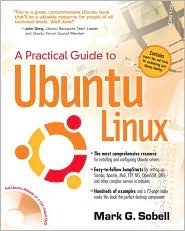
A new edition of this title is available, 0137003889 9780137003884 Praise for A Practical Guide to Ubuntu Linux® “I am so impressed by how Mark Sobell can approach a complex topic in such an understandable manner. His command examples are especially useful in providing a novice (or even advanced) administrator with a cookbook on how to accomplish real-world tasks on Linux. He is truly an inspired technical writer!” –George Vish II, Senior Education Consultant, Hewlett-Packard Company “Overall, I think it’s a great, comprehensive Ubuntu book that’ll be a valuable resource for people of all technical levels.” –John Dong, Ubuntu Forum Council Member, Backports Team Leader “The JumpStart sections really offer a quick way to get things up and running, allowing you to dig into the details of his books later.” –Scott Mann, Aztek Networks “Ubuntu is gaining popularity at the rate alcohol did during prohibition, and it’s great to see a well-known author write a book on the latest and greatest version. Not only does it contain Ubuntu-specific information, but it also touches on general computer-related topics, which will help the average computer user to better understand what’s going on in the background. Great work, Mark!” –Daniel R. Arfsten, Pro/ENGINEER Drafter/Designer “I read a lot of Linux technical information every day, but I’m rarely impressed by tech books. I usually prefer online information sources instead. Mark Sobell’s books are a notable exception. They’re clearly written, technically accurate, comprehensive-and actually enjoyable to read.” –Matthew Miller, Senior Systems Analyst/Administrator, BU Linux Project, Boston University Office, of Information Technology “I would so love to be able to use this book to teach a class about not just Ubuntu or Linux but about computers in general. It is thorough and well written with good illustrations that explain important concepts for computer usage.” –Nathan Eckenrode, New York Local Community Team Praise for Other Books by Mark Sobell “I currently own one of your books, A Practical Guide to Linux ® . I believe this book is one of the most comprehensive and, as the title says, practical guides to Linux I have ever read. I consider myself a novice and I come back to this book over and over again.” –Albert J. Nguyen “Thank you for writing a book to help me get away from Windows XP and to never touch Windows Vista. The book is great; I am learning a lot of new concepts and commands. Linux is definitely getting easier to use.” –James Moritz “I have been wanting to make the jump to Linux but did not have the guts to do so-until I saw your familiarly titled A Practical Guide to Red Hat ® Linux ® at the bookstore. I picked up a copy and am eagerly looking forward to regaining my freedom.” –Carmine Stoffo, Machine and Process Designer to pharmaceutical industry
Mark G. Sobell, author of many best-selling books, including A Practical Guide to Fedora and Red Hat Enterprise Linux, Sixth Edition, A Practical Guide to Ubuntu Linux, Third EditionA Practical Guide to Linux Commands, Editors, and Shell Programming, Third Edition (all from Prentice Hall), has more than thirty years of experience working with UNIX and Linux. He is the president of Sobell Associates Inc., a consulting firm that designs and builds custom software applications for UNIX and Linux systems and provides training and support.
Mr. Sobell started working with computers part time after high-school where he worked on the Dartmouth Time-sharing system where they developed the BASIC programming language and on IBM OS/360 systems. He started writing when he worked for microcomputer company Cromemco in the late 1970's. He published his first book A Practical Guide to UNIX in 1982 and started Sobell Associates in 1984. He has been writing and consulting ever since.
Okay. This book is a little dated, but I purchased it for under a dollar at a going-out-of-business sale of our local Half Price Books store. And it helped me orient myself towards the most recent Long-Term Support (LTS) of Ubuntu (version 16.04, Xenial Xerxes) which I have installed on a fifteen-year-old laptop.
For most tasks, Ubuntu is as easy and intuitive to learn and use as Windows or Apple operating systems. And Linux, of which Ubuntu is a "flavor" of, is quite safe, since 1) there are so few Linux machines out there running Ubuntu, and 2) Ubuntu updates it's core OS frequently, with thousands of programmers crawling through the open-source code to locate vulnerabilities, making it more secure than Microsoft of Apple's offerings, which are proprietary and closed-source.
And best of all, Ubuntu is FREE.
That said, Linux is far from Shangrala. There are drawbacks. To do some things that you can do on a PC or Mac easily, like install an Apache/ MySQL/ PHP stack to develop a test server, you'll need to use the command-line, called "terminal" in Linux. And the syntax is loads different than the Microsoft commands most techies are used to.
That's where this book was invaluable. Because it highlights the basic syntax of core tasks you'll need to do in order to succeed in running a Linux machine. And even where the syntax has changed, you'll understand enough about the basic terminal syntax, and what Linux can do, to Google a look at the current code.
Three stars. It didn't knock my socks off, but it familiarized me with the basics.
I use various versions of Ubuntu Linux for both work and home, so I consider myself well qualified to review a book on this topic. The following is a reprint of the review I wrote for my blog:
I upgraded my Ubuntu VM to 8.10 just for this review (well, not "just" for this review, but mostly). Of course, Sobell's second edition of this "I-weigh-a-ton" tome covers both 8.04 and 8.10, but I run 8.04 on my production machine, so I figure I've got the book covered. Judging by the size of the book though, I'd have to assume that Sobell has it covered as well. But does he? Unlike Godzilla, size doesn't always matter. Let's have a look.
A casual viewing of the book's back cover tells the reader that they can expect to find out just about everything there is to know about anything they can do with Ubuntu. While most folks think of Ubuntu as the most "desktop user" friendly version of Linux, and the most likely contender to chip away at Microsoft Windows' death grip on the home desktop market, there's a lot more to consider. At least according to the blurb I read, the server aspects of Ubuntu are well covered here. The list includes Apache, DNS, LDAP, NIS, and Samba, and that's just for starters. This isn't a "switch from Windows to Ubuntu Linux" text written for the average home PC user. It's, at least in theory, an "all-in-one" guide for everything you ever wanted to know about Ubuntu (but were afraid to ask).
Purchased this book intended to learn a bit more about Linux in general. At the time I read this book I was already familiar with Linux, just wanted to go in deeper. Working with Ubuntu on my laptop and Arch on my desktop. I believe it's well written for the beginner as for the more advanced user.
If you want to learn more about the Linux system; directory structures, linux filesystem, shell (a little bit of bash scripting), security and even compiling your own kernel, then this book is a good way to start.