Food chemistry, atom crashing, wave power, food chemistry, and robots! These are just a few of the topics covered in this fantastic new science encyclopedia, which presents a comprehensive overview of physical and life sciences from A to Z. Super smart and kid-friendly, it’s packed with full-color photographs, weird but true facts, amazing statistics, do-it-yourself experiments, plus profiles of scientists and National Geographic's explorers who rock the world of science. Keep up with the changes happening all around us with this stellar science reference book.
With more than 600 titles—including the popular Weird But True franchise and the New York Times Best Selling National Geographic Kids Almanac—National Geographic Kids Books is the recognized leader in nonfiction for kids. Published in 28 languages, NGK Books reaches approximately 85 million kids every year.
Offering K-12 educators resources that align to and support the Common Core State Standards, National Geographic has a long history of providing high-quality informational texts suitable for primary, upper elementary, and middle school English language arts, social studies, and science classrooms.
How do you say "Wow" with super exclamations that go pow and wow? Well, that's what Science Encyclopedia: Atom Smashing, Food Chemistry, Animals, Space, and More deserves.
This is a giant of a book in size (measures 9.5 x 0.9 x 12.2 inches), in pages (304), and in mind-blasting information. Be prepared to sit for hours, days, months delving into the facts and fun information that is packed inside this real treat of a book for kids ages 8 to 12. Well, older and younger kids and adults will all spend much time sifting through the vast amount of information it contains. The pictures capture the reader's attention and the occasional side-joke softens the learning a bit. We all know that good teachers are often the ones that bring a bit of levity to the classroom.
I love the index and glossary at the back beause they make investigative reading and learning easier. There are also lists of other materials the reader can source for further study.
This is a superb book for home, school, and public libraries and I can highly recommend it to my readers. Another superb publication from National Geographic Kids.
DISCLOSURE: I received a complimentary copy to facilitate this review of my own opinions which are freely given without censure.
What is science? Science is the way humans figure out how everything in the world works. Many scientists find ways to make new medicines, discover cures for diseases or invent new materials. Scientists focus their study on the world around us. There is so much to learn a scientist will never run out of things to study. There are two parts to this guide. The Physical Science chapters include Matter, Energy, Electronic Forces and Machines. The other part is Life Science, which covers the universe, Life on Earth, Planet Earth and the Huma Body. There is a glossary and online references to learn more. Stunning photos, fun facts and even a Try This area found throughout the pages invites readers to create their own experiments.
An example of some of the topics found within the guide is a section on electromagnetic waves which are used in wireless communication, solar power and even in x-rays. Readers can learn about planets and how all living things are classified. Water cycles and weather patterns can be found here too. Parents and teachers will find this guide a handy tool for learning and inspiring readers to learn about their world. This guide will have no problem keeping readers of all ages engaged and intrigued.
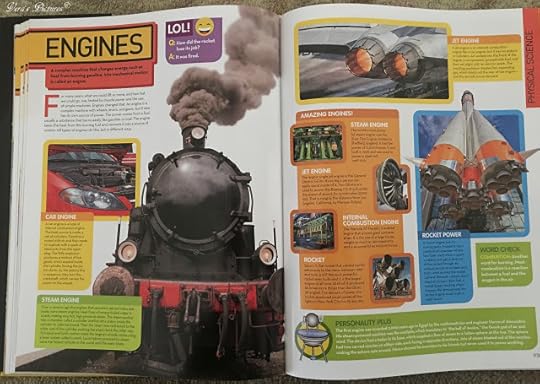
The Science Encyclopedia is info-packed with everything kids need to know about physical and life sciences, covering matter, energy, electronics, the universe, and more. There are record breakers, key dates in atomic science, and activities to try at home. Information is presented in 2-page spreads broken out into subject-specific blocks, with stunning photos, fun facts, and hilariously bad jokes (Where does bad light go? A prism!) A glossary, index, and additional resources round this volume out. Fantastic gift for any tween who wants to know more about everything.
This book is amazing. It combines learning with fun. It has science experiments and has jokes. It is very educational and i highly recomend it to young students who love science
Science is really such a broad subject covering a multitude of different areas, and science, according to this book, is all around us. After answering the question What is Science? this book go on to explore the two contrasting areas of Physical Science and Life Science. Physical Science covers everything from atoms to light, which would include Matter, Forces and Machines, Energy, and, especially near and dear to a kid's heart, Electronics. Each page has an abundance of information, safe and easy experiments for kids to try, and there is even an LOL section with topic specific jokes, for example: Q. Why can't you trust an atom? A. Because they make up everything. So if your kids want to know why that is funny, they need only read the section on Atoms. Or if they wonder why they don't go spinning of into space, they can find the answer in the Gravity section, and even meet the man who brought gravity to the forefront, Albert Einstein.
The Life Science section is basically set up the same way as the Physical Science section, but covers all life forms in the universe. Starting big, kids will learn what the big bang theory really is, all about galaxies, stars, constellations, and planets, finally arriving at life on earth. Here, there are sections about how life began, how to classify living things, followed by earth's living things, from microbes, to plants to the wide variety of living creatures, then on to man and his biology. The science of earth itself is also covered - important timely topics like climate, conservation, biomes and more. There is an extensive glossary as well as a section for kids wanting to find out more. Each page is chockablock with information accompanied by absolutely exquisite photographs (I wouldn't be surprised if more than one reader looks at all of these books and considers taking up photography). This is another book that will please both the budding scientist and the merely curious reader, not to mention their parents (myself included).
Everything you ever wanted to know about Science is in this book. Nothing was left out and the photography is absolutely amazing. This is National Geographic at its best....taking a subject and sharing everything possible in an easy-to-understand format for kids....and adults! The pictures will grab your attention and the tidbits of information on each page will make you want to learn more.
The book is broken up into two parts of science, Physical Science and Life Science. Physical Science includes sections on Matter, Forces and Machines, Energy, and Electronics. Life Science includes The Universe, Life on Earth, The Human Body, and Planet Earth. There is also a huge glossary of terms and an index of places to get more information including websites, books, and movies.
I was especially interested in the Flowering Plants section. Did you know the sunflower is made up of thousands of tiny flowers? I had no idea. The world's biggest flower is found in Indonesia and measures about three feet across but shockingly it smells like rotten meat! I think I will pass on growing that flower!
I was also extremely fascinated with the section on ancient medicine and how Leonardo's sketches of the human organs were amazingly accurate. Also, the use of everyday materials, like honey, can truly heal and something that many of us today are choosing to use rather than chemicals.
Throughout the book, there are also several experiments for the kids to try, for example, using a magnet with cereal fortified with iron or making your own magnifier.
This is a book that has everything you need for that science-loving child. There is much to learn in this book and one that can be referred to throughout upper elementary or middle school years. I'll be gifting this to our daughter's sixth-grade science teacher as I am sure it will get a lot of use there.
This book is one of the BEST I have seen! It is awesome how it is laid out!!! It is like a vision sensation! There is so much to look at and read! I am sure that you could read this over and over and over and learn something new. Here is a fun tidbit: In 2013, scientists discovered fossils of a new species of human relatives in a cave in Africa. Learn about this and so many more awesome and wacky facts in this book! It is jam packed with things that I find fun, interesting and oh so interesting! My kids are going to love this book so much too.
This book is a fabulous compilation of all things nerd and it's a volume few science-loving kids will tire reading. I'm so glad I have this in my home.