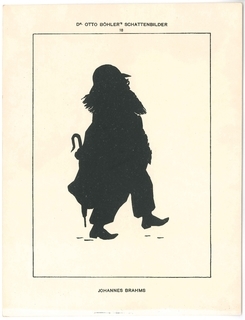
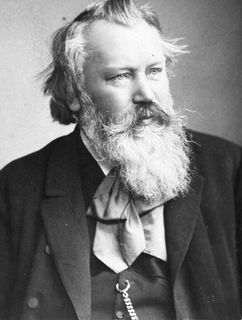
Johannes Brahms gehört zu den herausragenden Komponisten des 19. Jahrhunderts. Seine Kammermusik und seine Orchesterwerke, aber auch seine Vokalkompositionen eröffneten der Tonkunst neue Dimensionen. Brahms, der gebürtige Hamburger und Wahl-Wiener, wurde zum Antipoden vor allem Richard Wagners; zugleich reicht sein Einfluß bis weit hinein in die Musik der Moderne. Arnold Schönberg, der von Brahms wesentliche Impulse empfing, brachte dessen Musik auf eine prägnante Formel: "Ökonomie und dennoch: Reichtum."
Aimez-vous Brahms? When I was 17 and confined to a hospital bed for a month because of a car accident, my father brought me an omnibus of Françoise Sagan’s novels from the library, containing Aimez-vous Brahms? in which a young man uses this question to invite a middle-aged woman to a concert and into a love affair. How could I have possibly divined that when I had to answer that very same question myself 10 years later, Brahms subsequently would become a nearly day-to-day presence for the next 20 years in my life, both by listening to recordings of his music as by hearing him played on the piano or the violin at home?
Differently than with Bach and Beethoven, Johannes Brahms’s music caused no coup de foudre. During my first exposure to one of his symphonies I was struck by its opaqueness, indistinctness, a certain feel of stuffiness and incomprehensibility. My attitude towards his music changed slowly and steadily by listening mostly to his chamber music, evoking an unimagined, otherworldly beauty, a crystal transparency striking unknown chords within me, a few cello lines at times enough to bring tears. While I still wouldn’t call myself an unconditional Brahms devotee, I nonetheless got hooked. Brahms now embodies a whole range of colours, tones and moods, his music imbued with intimacy, tenderness, vehemence, turmoil, grief. Passion vanquished and swept away dust. As Brahms’s chamber works include three string quartets, two string quintets, two string sextets, a clarinet quintet, a clarinet trio, a horn trio, a piano quintet, three piano quartets, and four piano trios several instrumental sonatas with piano, including three for violin, two for cello, and two for clarinet, not to mention his magnificent piano solo works, I would be hard-pressed to single out the work that I admire most.
This compact biography offers a peak into the life, work and times of Johannes Brahms (1833-1897), the Hamburg piano virtuoso and composer who eventually and reluctantly settled down in the heart of musical culture in 19th century Europe, Vienna. Through letters(*) , works of former biographers and statements of his wide range of friends and acquaintances, Neuzig conveys a lively image of Brahms’s irrefutably complex personality, his family background, his deep love of nature and walks, his extreme perfectionism - he destroyed many of his works - his candour and curmudgeon reputation.
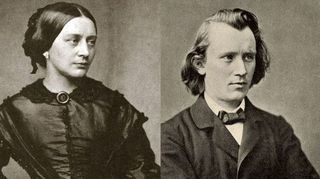
In its brevity and obviously written with sympathy for his subject, linking psychological insights and comments to major life events and activities of Brahms, Neunzig offers a rather balanced and solid view on Brahms as a person and as an artists, without wholly tilting over to a psychological study. There is other literature elaborating on the various sides of Brahms’s personality and psyche, routing his soul, mostly speculative, also focussing on his whoremonging and alleged misogyny, why he shunned marriage and speculating on the nature of his relationship with Clara Schumann (To whom it may concern, Johannes Brahms and Clara Schumann, ‘Did they or didn't they?’). According to Michael Ferguson’s critical article on studies on Brahms’s personality like Jan Swafford’s Johannes Brahms: A Biography, these studies reveal essentially the need of his biographers to shape an image of Brahms consistent with their own conservative morals and social biases, depicting him as a psychological misfit and damaged victim of childhood abuse, ignoring Brahms’s contradictory attitudes towards women as very typical for 19th century Europe and the impact of the unhappy marriage of his parents). Neunzig mentions Brahms’s emotional life when relevant for the creation of his music, drawing parallels between Brahms’s character and his music, by depicting his shyness, his need for solitude, his life-long friendship with Clara and the impact of his ‘Werther-episode’ on his music, in the same respect slightly touching on other loves like the one for Agathe von Siebold which Brahms translated in the sublime String Sextet Op 36 (with the Agathe-motif in the first movement). Some of the excerpts from his tender letters to Clara are very moving, although the overwrought tone and extreme sensitiveness has to be seen in the context of that time (I begrudge every word I write to you that does not speak of love).
Friends were very important in his life, although often ending up on bad terms and later restored. Neunzig recounts his career moves and choices, his driving ambition and insatiable hunger for recognition as ‘the first’ amongst the contemporary composers, his musical development like his discovery of popular music and his love for folk music, aspects like the publishing and sale of music, and his attitudes towards the ‘New German’ programme music, contemporaries and rivals like Wagner and Mahler. Respectful to his predecessors, Brahms could be bitingly unfriendly and severe for his contemporaries, like for Hugo Wolf and especially Anton Bruckner, which music he loathed (“What are these symphonic boa constrictors about?”), or sarcastic, like to Max Bruch showing him a big oratorio (”Tell me, where do you procure this lovely manuscript paper?”); only a, equal lover of folk music like Dvořák could rejoice in the mercy and support of the Master.
The closing chapter analyses his musical antecedents, how Brahms was tributary to Bach and Beethoven, the different views of his place in or outside a school or a movement in the history of music – situated both between musical tradition and Romanticism and between Romanticism and incipient Modernism - the periodization of his creative production, the reception of his music and the direct line of his music to the polyrhythmic structure of later composers like Stravinsky and Ligeti. Neunzig ends with a description of his oeuvre, touching on the ‘ideal synthesis of variation form and sonata movement’ as the quintessence of his technique, and more technical observations on the complex structure and construction of his music.
Originally published in German in 1973, I read this in a 1991 Dutch and in a 2003 English translation, the latter considerably edited as to structure and language and complemented with references to more recently published biographies, however giving more gossipy turns to the text (on which I wonder who had the hand in, the author or the translator). Aside for this, getting acquainted with Brahms and his music has enriched my life immensely; however I could perfectly fill the rest of my time with his chamber and piano music alone, perhaps meanwhile the time has come to grow a beard and to learn to better appreciate his orchestral works which so far less resonated less with me (the symphonies and piano concertos, the violin concerto), and continuing walking on the interrupted path towards profound melancholy by listening to his opus 54, das Schicksalslied, an orchestrally accompanied choral setting of a poem written by Friedrich Hölderlin.
Doch uns ist gegeben Auf keiner Stӓtte zu ruh’n; Es schwinden, es fallen Die leidenden Menschen Blindlings von einer Stunde zur andern, Wie Wasser von Klippe Zu Klippe geworfen Jahrlang in's Ungewisse hinab.
To us is allotted No restful haven to find; They falter, they perish, Poor suffering mortals Blindly as moment Follows to moment, Like water from mountain to mountain impelled, Destined to disappearance below.
According to Neunzig, the sheer breadth of Brahms enormous range of expression can be seen in his chamber music, the genre that best suited his talents, offering a pretext to insert a few links to my favourite chamber music and piano works:
A short overview of Brahms's life, relationships, and works. Fairly light reading, and focuses slightly overmuch on Brahms's personal affairs for my interest (I found myself skimming through extended quotations of his letters to and from Clara Schumman).
Actual analysis and critique of Brahms's music is sparse. The section dedicated to his music comprises approximately 15% of the book. Good insight in general, though some of the information is wrong (Neunzig incorrectly attributes the theme of Symphony No.4, Mvmt IV to Bach's Chaconne for solo violin. It is in fact Bach's Chaconne from his cantata "Nach dir, Herr, verlanget mich," BWV 150).