Jump to ratings and reviews
Rate this book

Night of the Animals

Rate this book
In this imaginative debut, the tale of Noah’s Ark is brilliantly recast as a story of fate and family, set in a near-future London.

Over the course of a single night in 2052, a homeless man named Cuthbert Handley sets out on an astonishing quest: to release the animals of the London Zoo. When he was a young boy, Cuthbert’s grandmother had told him he inherited a magical ability to communicate with the animal world—a gift she called the Wonderments. Ever since his older brother’s death in childhood, Cuthbert has heard voices. These maddening whispers must be the Wonderments, he believes, and recently they have promised to reunite him with his lost brother and bring about the coming of a Lord of Animals . . . if he fulfills this curious request.

Cuthbert flickers in and out of awareness throughout his desperate pursuit. But his grand plan is not the only thing that threatens to disturb the collective unease of the city. Around him is greater turmoil, as the rest of the world anxiously anticipates the rise of a suicide cult set on destroying the world’s animals along with themselves.

Meanwhile, Cuthbert doggedly roams the zoo, cutting open the enclosures, while pressing the animals for information about his brother. Just as this unlikely yet loveable hero begins to release the animals, the cult’s members flood the city’s streets. Has Cuthbert succeeded in harnessing the power of the Wonderments, or has he only added to the chaos—and sealed these innocent animals’ fates?

Night of the Animals is an enchanting and inventive tale that explores the boundaries of reality, the ghosts of love and trauma, and the power of redemption.

Audiobook

First published July 5, 2016

96 people are currently reading
3144 people want to read

About the author

Bill Broun

3 books21 followers

Ratings & Reviews

What do you think?
Rate this book

Friends & Following

Create a free account to discover what your friends think of this book!

Community Reviews

5 stars
101 (15%)
4 stars
122 (18%)
3 stars
205 (31%)
2 stars
144 (21%)
1 star
83 (12%)
Displaying 1 - 30 of 148 reviews
Profile Image for Will Byrnes.
1,372 reviews121k followers
July 25, 2024
Cuthbert Handley is a man on a mission. Never mind that he is 90. Nor that he is obese. Nor that he is a drug addict, and a member of the underclass known as Indigents. Never mind that he is probably psychotic. Never mind that the particularly unpleasant police branch known as the Red Watch have a BOLO out for him.

description
Bill Broun - from Philly.com

Consider instead that Cuthbert has a heart as big as England, and I don’t mean his medical condition. Consider instead that he may be the last carrier of an ancient tradition known as The Wonderments. Consider instead that the horror he seeks to foil may be real, as an American-based death cult is eager to exterminate all animal life on Earth, although Cuddy knows only that something bad is coming and he needs to act now. When you consider that the London Zoo is the last working zoo on the planet in 2052, and that it contains not only the last wild animals on earth but the DNA of thousands of species that no longer exist, it makes Cuddy’s urge seem less peculiar. Cuddy may be a ponderous Lancelot, but his grail is no less noble, just because it is not an object you can hold in your hands. He wants to let all the animals out.
The seed for Broun's story was planted one day in the 1990s when he was living in Texas and went to the Houston Zoo with a friend who has schizophrenia. "He started talking to the howler monkeys," Broun recalls. "It just lit a fuse for me. - from the McCall article
Night of the Animals is both horrifying and heart-warming, a dystopian vision rich with the technological details of oppression, but not so much as to interfere with wonderful story-telling. Cuddy may be damaged goods. Having had an abusive father did not help. Seeing his brother, Drystan, drown while out in the woods when he was six sealed the deal. There is a part of Cuddy that still expects Drystan to reappear someday. Despite some regrettable moments in his life, Cuddy is damaged goods you will very much root and care for. But his youth held more than misery. There was his Gran.
since their earliest childhood, their gran had told them various tales, notions, and advices she referred to collectively as The Wonderments. All along Welsh Marches, where Offa’s Dyke once bullied the Welsh with Mercian royal might, a dwindling number of families bound “neither by rank nor nation,” as their gran put it, had for centuries quietly bequeathed the Wonderments, from granddad to granddaughter, then grandmother to grandson, and so on.
Is it from magic or psychosis and a lifetime of substance issues that this Dystopian Doctor Doolittle can converse with animals? Is it hubris or a religious summons that makes him feel he has been chosen to carry out this mighty task? Will his quest to be reunited with his long lost brother prove a fool’s errand?
At the time, there were news reports about mentally ill men trying to enter animal enclosures in zoos, often alluding to them being religiously motivated. In creating his protagonist, Broun could draw from personal experience with his own struggles with addiction and mental health problems... "I'm a recovering alcoholic and addict. I've been clean and sober for 25 years." Broun said he quit drinking when he was 24. "It was either quit or die and it was so clear," he says. Twice, he was voluntarily hospitalized for mental health issues. - from the McCalls article
As for the nutters, they are drawn from far too real an example. Called Heaven’s Gate in the book, they are based on a cult that was founded in Texas and moved to California. Also named Heaven’s Gate, they believed much the same things ascribed to this cult. Even the leader has the same name as the model on which he is based. Difference is these folks have some pretty nifty tech, and a huge, global following. I guess if humanity has pretty much spoiled the planet, offloading one’s being onto the spaceship contained in a passing comet might seem appealing. No crazier than building a gigantic wall. And if that entails committing suicide to free one’s spirit, well, it wouldn’t be the first time suicide has been sold as a gateway to paradise. (I have included a link to information about the real Heaven’s Gate cult in EXTRA STUFF)
description
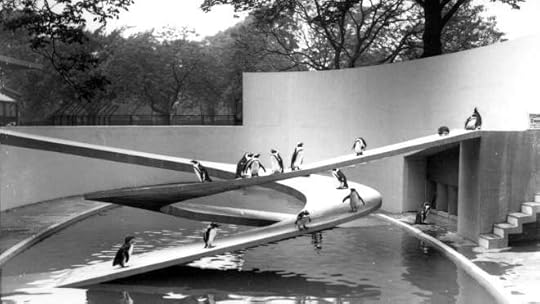
The Penguin Exhibit at the London Zoo

The bulk of the novel takes place during and around Cuddy’s attempt to spring the caged, with looks back at his childhood, and early adulthood.

There is much that is dark in Broun’s near future world. It is a place where the current extraction of all wealth by the wealthy has continued apace, with civil liberties following suit. There are plenty of tech details offered. Google Glass taken a step further with eye-implants. Spray-on video screens, a new addictive, hallucinogenic consumable called Flôt, that has generated enough addiction to merit its own Anonymous. It is Cuddy’s drug of choice. There is an overarching theme of Anthropocene destruction. And a hearkening back to a sylvan, magical ideal that is at odds with the very anti-nature nature of much of modern civilization.
I didn’t consciously think much of the story of the ark as [I] wrote until later in the drafting process. I did think constantly of the post-flood covenant between God and humanity, as depicted in Genesis 9:13: “I do set my bow in the cloud, and it shall be for a token of a covenant between me and the earth.” This line promises that God will protect the animals of earth, but as humans, we must be God’s stewards. - from the Qwillery piece
Broun calls on the history of talking animals in English literature for some backup and some fun. Cuddy has conversations with the four-footed that made me smile with a Hitchhiker’s sort of gleam, particularly during Cuddy’s exchanges with an Islamic sand cat, which also made me think of Sheherezade. A lion is given a particularly fitting name. But these are not all sweetness and light cuddlies. There is plenty of tooth and claw, and attitudes that would be right at home in homo sap. There is a bit of a fairy tale sensibility at work here, but this is definitely no book for the kids. More of a parable about the Fifth Extinction, or, as Broun notes in the Houston Chronicle article, “a modern-day saint story.”
description
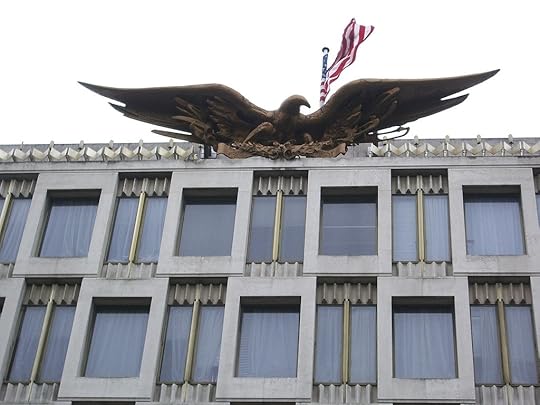
The US embassy at Grosvenor Square looms large - from Architectsjournal.co.uk

Some things to keep an eye on include the color green with all the hearkenings you would expect. Moths flit in and about with some frequency. You might look for a parallel, or a contrast between Cuddy and the cult leader in their relationship to the magical. Tony Blair comes in for a mention or two, and the dictator offered is one who you might recognize. Religion permeates, from the Druidic through Christian and Islamic into the darkly new ageist.
As Winefride [Cuddy’s gran] remembered it, the Wyre Forest before the Second World War seemed like the last verdant haven against all this, a place of glory and grief somewhere between Eden and Gethsemane.
This is a special and very unusual book, with large ambitions that are mostly realized. The grand finale was certainly booming and lively. I confess that parts of the big finish were a miss for me, as a bit of tech, that goes a long way to explaining a lot, is introduced late enough to qualify as a deus ex machina contrivance. Given its significance a few clues to its existence should have been inserted earlier on. There is a bit of murkiness with the big show at the end that slowed it down for me. But that is really my only gripe, enough to knock it down to 4.5 stars, but not enough to keep from rounding up to five.

description
What Muezza the sand cat probably looks like - from bigcatswildcats.com

There is so much in this book that is wonderful that one glitch should not keep you from giving it a go. I fully expect that you will enjoy Night of the Animals immensely and that it will be a breakout hit this summer.

Publication date – 7/5/2016

Review first posted – 7/8/16


=============================EXTRA STUFF

Links to the author’s personal, Twitter, and FB pages

Interviews and Articles
-----The Qwillery interview
-----Local writer Bill Broun lets the animals out - into a fine new novel - by Lynn Rosen - from Philly.com
-----'Night of the Animals': Novel by Hellertown's Bill Broun gets strong reviews by Margie Peterson for The Morning Call feature of McCall.com

Intel
-----Marshall Applewhite and Heaven’s Gate
-----The Undley bracteate is an item that figures in the story’s iconography – the link is to Wiki
-----a collection of photos of the Wyre
-----A wiki on the Wyre Forest
-----A Druidic take on the yew tree, a significant item in the story. (It’s not me, it’s yew)
----- Saint Cuthbert comes in for some attention. Here is a bit of information that should enhance your read.

Other
-----An audio sample - Read by Ralph Lister – 5 minutes
-----What muezza might have looked like when younger - ta die faw - link found by GR friend Mary Duckworth Demis Mimouna
Profile Image for Carlos.
672 reviews304 followers
October 17, 2016
This book felt like a bad high ( I still am not completely sure of what I just read), therefore I cannot properly review it but ill give it a try, When I first started this book ,I knew that it wasn't what I usually go for, (history, YA, psychological thrillers and dystopian), but I want it to give a try. The story centers in a 90 year old who believes he can hear animals, he wants to free them from the zoo (apparently there is only one zoo left in London and almost all animals have gone extinct). That's the main story but the author goes into wild flashbacks at the beginning , up to page 200 almost, then another main character is introduced and then we learn about her life, how these 2 are connected is never clear in the book , but we are given wild assumptions, like I said previously , this whole book felt like it happened in a dreamlike state, there is no cohesiveness, no major plot really and no actual knowledge . But im giving it 2.75 stars because like I said I knew it wasn't for me but is still readable in a way and the animals in the story did make for a nice setting, the zoo too. Hey it wasn't for me , but maybe its the right book for you, just read the intro in the dust jacket, then you will know... but all the same you are in for a mental trip.
Profile Image for Lori.
308 reviews96 followers
December 1, 2017
Saint Cuthbert and the otters!

In the not too distant future, a nice old schizophrenic, who is redundantly addicted to a powerful hallucinogenic drug of abuse, wants to save the last remaining animals in the last remaining zoo from a suicide cult. The story is in a London that is a lot like Houston.

Ga! Go! Ga! Gagoga maga medu! Long live those good creatures!
Profile Image for Pandaduh.
284 reviews30 followers
September 6, 2021
This is technically a DNF, though I did skim every page. I think skimming it made it make just as much sense as it would wasting 100+ more hours on this story.

Basically the plot is: Old drug-addict man hears "voices" of animals and wants to let them out of the last zoo on earth. Sad, right? Except these are basically the last animals on earth too. Sadder, right? He is going to let them out and justice will be served? Meh.
Profile Image for mad mags.
1,276 reviews91 followers
Read
May 30, 2016
(Full disclosure: I received a free electronic ARC for review through Edelweiss.)

DNF at 11%.

I struggled with this book. On the one hand, the plot really tickled my fancy. Set in the near future - a world almost completely devoid of nonhuman animals - an Indigent man and Flôt addict named Cuthbert Handley gets it into his mind that he must set the animals in the London Zoo free. With the Urga-Rampos comet bearing down on earth, whipping its assorted death cults into a frenzy, Cuthbert fears that the London Zoo - the world's largest repository of animals, both living and mapped - is the Heaven's Gate prime target. (Possible relation to the Hale-Bopp-Heaven's Gate? Undetermined.) The animals can speak to Cuthbert, and they want out. (Or at least the hippos do. I'm afraid I didn't stick with it long enough to hear from the polar bears and boa constrictors.)

Sadly, the story gets bogged down in the details. (So many details!) The world-building is extensive, and mostly takes place via massive info dumps. Normally I can excuse a fair amount of telling-not-showing, but the sheer amount of information presented by Broun is just overwhelming. Every tenth paragraph, it seems, is exposition, and it hangs heavy on the bones of the story. Just when I found myself getting into the story - the animal telepathy, Cuthbert's institutionalization, the break-in at the zoo - the action came grinding to a halt as Broun went off on a tangent to explain the rule of Henry IX, or how Flôt withdrawal works. Between the tech, the politics, the evolving social issues, and the history, it's just a lot to take in. Which is a bummer, because there are some really fascinating ideas here.

There's a lot going on with the language, too. In the author's note, Broun explains:

The novel employs language from both fading and emerging dialects and slang of Birmingham, the Black Country, old Worcestershire, and the Clee Hills region of England, from Guyana, as well as future-set, speculative words and phrases along with common phrases from British English. With more arcane or esoteric regionalisms, or opaque terms, footnotes are added where I felt they would help readers better appreciate the story.

Cuthbert seems to lapse in and out of a Cockneyed accent, and his sentences are often peppered with words spelled phonetically. I found much of the slang and regional terms confusing. While Broun does include definitions for some words in the form of footnotes, I've no idea how he decided which words require further explanation, and which ones don't. I could infer the meanings of many of the footnoted terms by considering them in context, while I puzzled over the words that went unremarked upon.

Between the language and the verbosity, Night of the Animals is ... not impenetrable, exactly ... but really very difficult to get into. Readers from the UK might have an easier time of it, but even absent the unfamiliar dialects, this is hardly a breezy read.

http://www.easyvegan.info/2016/07/15/...
1 review
May 20, 2016
I love books with heroes who aren't the regular kind, and Cuthbert -- old, fat, haunted, and imaginative -- is a hero for me. Not to mention a psychiatrist lifting barbells in his office and a speaking Sand Cat. Cuthbert has lost someone, and he's on a quest to recover him, and to recover himself, and this is a quest I and I think probably many others can relate to. The language is rich, the London night is strange and deep. Encounters like the one between the sick trader and the wandering jackals seem unforgettable to me. This is a book about loss and possibility, although it is also scary and unsettling, with its vision of the spooky rise of an authoritarian state and demonization of the ill and the poor. In this, Cuthbert's story has a political voice that I think is important.
Profile Image for Astrid.
1,037 reviews5 followers
August 18, 2016
I tried, I really tried. Almost gave up on it twice in the first 50 pages, then decided to stick with it to find out if Cuthbert really can talk to the animals or the flot just got to him. Made it to page 163 and finally decided that it just was not worth it. There were over 350 pages more to go and I was not interested enough, as I figured that gagoga didn't mean anything and he was just nuts from the flot. Too much built-up to who knows what and the language was getting on my nerves, also. Besides, one of my cats has been peeing on the floor again, occasionally, and the chipmunks are chewing a hole through the frame of my garage door, so I'm not too keen on animals at this very moment. . .(I'm kidding, I think)
Profile Image for Jake.
334 reviews19 followers
February 7, 2017
...And after a time as he lay thus, there came two otters which licked every place of his body, and then went again to the water that they came from. And then Cuthbert arose all whole.
"The Life of St. Cuthbert"
The Golden Legend, A.D. 1260


London, 2052. The UK is an extreme surveillance state governed by Henry IX, a.k.a. "Harry9." Inequality and substance abuse are rampant. The natural world has all but disappeared, most of the world's remaining "natural" animals (i.e., not genetic clones) are confined to zoos. To add to unpleasantness, the sighting of the Urga-Rampos comet is causing cultists to come out of the woodwork. They're conducting mass ritualistic suicide, and they're bent on taking animals with them.

Enter Cuthbert Handley--homeless, addicted to Flôt (a legal hallucinogen with ruinous withdrawal effects), and ninety years old (advanced medical technology--including artificial organs--is one positive of the future). As a child, Cutty's brother Drystan disappeared while playing in the woods on day. Drystan may or may not have become a sort of "Christ of the Otters," as evidenced by the large mustelid Cutty saw in his brother's stead. Since then, Cutty may or may not have gained the ability to communicate with animals. His grandmother called this gift "The Wonderments," his primary care provider, Dr. Baj, calls it a sign of mental illness. Either way, Cutty has taken it upon himself to free the animals from the London Zoo--especially the otters--as an act of atonement, and a way of seeking closure with his long lost brother.

At the risk of sounding cliche, this book is unlike anything I have ever read. The story works together speculative fiction, magical realism, and world religions (Christian, Sufi, and Sikh faiths play important roles in the characters' lives). The lessons affect us on a personal and societal level. Aside from a too-lengthy (in my opinion) pairing with a Sufi sand cat, the pace of the narrative is just about perfect. The writing weaves together "fading and emerging" dialects, slang, and jargon, with footnotes to help us out when needed. I know for sure that I will be recommending this to fans of offbeat literary fiction and animal lovers once it becomes available to the general public. I'll definitely check out what Bill Broun does next.

Fine print: This review is for an advance reader copy. It may differ from the version that hits stores and libraries in two months.
Profile Image for Audie.
193 reviews7 followers
April 5, 2018
This started off as a strong 3.5 - 4 stars until about the last 100 pages when it went full-blown sci-fi and lost the plot - and I lost interest.

Prior to that, the only two real complaints I had would be that: a) Broun seemed to be trying a little *too* hard to bring in every obscure bit of the British vernacular, which was hokey and more farcical than genuine. We get it, your dad was British (this tidbit was inexplicably necessary to include in his bio as if to say, “See! I know a real English person! They really speak like this!) It was disappointing to see such captivating characters reduced to cliches.

Secondly, Broun’s needless and random footnotes were more of a distraction than anything of real use. British colloquialisms really don’t warrant a footnote. Give your readers enough credit to know what MI-6 or “The Big Smoke” is - and if they don’t, trust that they’ll know where to look to find the answer. And if you absolutely insist on using footnotes, you’d better well be dedicated to the task - while common words and phrases were given footnotes, almost none of Cuthbert’s grandmother’s Black Country dialect is translated. Curiously, neither is the Chinese term “Dà xîngxîng” (gorilla) - yet on the same page, “bag” is footnoted - in case you were wondering, a bag is a “large hold-all sack.” Broun was able to successfully incorporate Swahili into actual sentences on the following page without utilizing a footnote so I’m not sure why he couldn’t figure out how to do this throughout.

Despite the footnotes and the overuse of English slang, I raced through the first 400 pages. I always loved reading about the lives of the saints and in theory, this could have been an absolutely fantastic story - if the ending had been taken in a different direction. Such a disappointment that it wasn’t!
Profile Image for Chaitra.
4,489 reviews
September 8, 2016
I finished! It's pretty much the best thing I can say about this book. It's not the book's fault that it took me so long, but after I started it, I realized I had to return a ton of other books to the library before this one, and kept skipping out on reading it. At that point, at around 70 pages, it was still compelling. I think right until "Enter Astrid from stage left", it had something going for it. After which, to be honest, I've no idea what happened. If you like talking animals, a suicide cult that's aimed at taking animals along with them with some weird idea of using their souls as vessels since they were all evil anyway, and unreliable narrators owing to addiction making up prophecies in their heads, this might be for you. Or it might not be, considering I like all of the above and still didn't like the book. Pity too, since that cover is beautiful. Also, it's not accurate, because there's no bear, none at all.
Profile Image for Lindsay.
84 reviews
June 26, 2017
Very surreal. It took me forever to finish because every time I stopped reading, I'd lose the thread of the story. I liked certain parts of it quite a bit (Cuthbert's past as a boy, his grandmother and losing Drystan, the familiar weirdness of the dystopian elements, the nonchalantly dropped bits about this future society that were just absolutely crackers ) but the entire episode of the night felt like one long, drawn-out hallucination and I still don't know what was real and what was dreamed.

I think I liked it. I definitely liked the idea of it. I don't think I will ever read it again, but I am glad I finished it and saw closure and happiness for St. Cuthbert.
Profile Image for Margaret.
1,524 reviews67 followers
July 7, 2017
Well, that was weird! And I like weird. But the pacing was weird too, and while I dig weird content, this felt rambling in some places, and then breezed over really important developments in other places.

The main character, Cuthbert, is a 90 year old addict who hears animals talking to him. And he's convinced his long-dead brother Drystan is an otter. In this future dystopia, animals are rapidly becoming extinct, and a pervasive suicide cult kills off animals. The animals ask Cuthbert to release the animals in the London Zoo, the last remaining zoo.

Interspersed with his story is that of Dr. Bajwa, his psychiatric doctor, and Astrid, a police inspector.

In the beginning the pace is sluggish, with flashbacks to Cuthbert's childhood, his struggles with Flot addiction, and his visits with Dr. Bajwa. It takes FOREVER to get to the zoo breakout. And then suddenly all the plot developments happen. Astrid and her motivations are given cursory explanation, and then once she and Cuthbert start interacting it's like reading an acid trip (I guess. Not really speaking from experience here!). But some things really needed development.

And what's with the footnotes? I could easily understand all the footnoted terms in context.

I don't regret reading this. I enjoyed Cuthbert as an unreliable narrator, and I actually wish the authorial voice had stepped in less often during his pov chapters, so I could fully question what was real vs. what Cuthbert imagined was real. Cuthbert is a loveable guy, and I enjoyed his character. I also love animals, so that was fun. (Though some of the philosophical discussions with Muezza the sand cat could've been cut.)

2.5/5
Profile Image for Tex.
1,570 reviews24 followers
May 28, 2021
Wowowowowowow! I don’t read much “what if” fiction so this was pretty new territory for me. It didn’t take long at all for me to develop a strong desire to protect nonagenarian Cuthbert from all harm and to help him to find the Otter Messiah. I’ve seen it called a retelling of Noah’s ark but that doesn’t resonate with me. It seemed far more of a “finding yourself at whatever point in your life needed” kind of book.
I can visualize a movie, but hope it doesn’t get made and vanish my own images. Very vivid writing.
Profile Image for Steve Wiggins.
Author 9 books91 followers
February 18, 2017
Vast and somewhat rambling, this dystopian debut novel is worth the effort. I read this book because of a favorable review, and I'm glad I did. Set in a future that appears to be unfolding as Broun envisioned it, this is a socially insane Britain of the 2050s. Broun takes a hard and sympathetic look at addiction as people respond the only way they can to a society that favors the rich while effectively making anyone not privileged a kind of slave to the system. Where do the animals come in?

Cuthbert, the protagonist, is one of the addicts. He believes the animals in the London Zoo—many of them the last of their kind on earth—are speaking to him, asking him to release them. In my blog post about this book, Sects and Violence in the Ancient World, I focus on the Noah's Ark aspect of the story. There's much more than that going on, however. The crazed lack of meaning in this plutocracy leads many to revive Heaven's Gate as the answer to earth's problems. A new protagonist is introduced late in the story and brings the vast, raging insanity to a somewhat peaceful conclusion. The system remains, however. The rich will never give up anything. There's a realism here that makes the book compelling. At times the action drags a bit, but this is a book to be chewed over and thought about. Given his clear view of the future, I think Broun is set to be considered a new George Orwell in days to come.
Profile Image for Dave Z.
2 reviews
January 2, 2017
Finally finished and so impressed and “wildly” moved tbh. Freaky how much of Night of the Animals reads like prophecy for what’s happening in our world this last year. It’s a pro-animal radical environmental fable on the loss of the Animal Kingdom. No question it’s a literary achievement and personally I’d say pretty damn masterpiece-isa.

Read a lot online written about this book online. Fact is night of the Animals has received almost uniform raves ..NYT, WSJ, SFChron, Chicago Trib etc from what I can tell. Almost every single published review gushes over the book’s wordcraft, originality and ambition. I don't always agree with the pundits but in this case I found I really did.

Does that mean you will like it? Maybe not, but either virtually every single mainstream critic is wrong …… or they are not. And in this case I think they are 1000% right. It’s absorbing grownup literary fiction that reminded me sort of of Thomas Pynchon and even some of Margaret Atwood, but if you want a breezy Harry Potter read, you will probably be disappointed. But if you want to take a walk on the wild side in a strange and very emotionally moving universe this may be for you!!!!!!
Profile Image for Sam.
246 reviews1 follower
August 14, 2016
I was not content with having started this book until I completed it. Almost every time I picked it up I thought "should I just quit this one or not". Some part of the world created in this book made me continue. I guess I just wanted to know what happened to the animals and while the dialogue was hard to swallow it had a nice rhythm. The future created in this book was interesting. I wish there'd been more details about that actually, especially prior to the end of the book. I'm glad I finished but not sure its one I could recommend to anyone.
Profile Image for Charles.
99 reviews4 followers
October 1, 2016
Stopped around page 300. Good writing, interesting protagonist, well-realilzed future London, and a unique plot device that works better than it should (are the animals really speaking to Cuthbert or has his Flot additiction so destroyed his mind that he imagines they want to be released from the London Zoo?). The problem started around page 250 when the dialogue picked up. The characters continued to act consistently but now they spoke in perplexing ways and then a comic relief stereotype rolled in and I decided I would move on. Life is too short.
Profile Image for Amy McLay Paterson.
228 reviews22 followers
September 4, 2016
There were a lot of ways this book could have gone wrong, but I did not expect it to be so boring.
Profile Image for Laura.
625 reviews19 followers
August 15, 2020
I loved Broun's lyrical prose which reminded me a bit of The Golem and the Jinni, and was an absolute pleasure to read. It isn't often that sci-fi books can achieve the lush world building of fantasy novels, but Night of the Animals achieved the best of both genres. Given 5 stars or a rating of "Perfect". Full review to come!
Profile Image for Angelika.
472 reviews2 followers
July 7, 2018
This was a tough read. I finally had to forget about trying to understand it all, and just keep reading. This helped, although at times I felt it wasn't worth it. Basically I think I would have liked it much better if it hadn't been so darn long. Sheesh! Doesn't anyone use an editor anymore?
Profile Image for Mary Jo.
490 reviews13 followers
April 29, 2024
2.5 stars rounded down. This book is definitely for someone but it was not for me.
Profile Image for Angie Reisetter.
506 reviews6 followers
September 20, 2017
I don't usually go for dystopian novels, but this one was beautiful. It was a surprise find at a small bookshop, one of the staff recommendations. Cuthbert is an old drug addict. But as Woody Allen more or less said, just because you're crazy and high doesn't mean you don't have the Wonderments.

The story starts in a place that more or less makes sense and then slowly spins out of control, and the last 100 pages or so are wild gyrations that are blinding and confusing, but there's beauty in them, like maybe a Jackson Pollock painting. The author clearly bent over every word, taking 14 years to complete the story of one crazy night. And always in the back of my head I had a pounding sense that this could not end well, but it would be a thrilling ride. I found it beautiful, but as is clear from the other reviews, it's not for everyone.
Profile Image for Matt.
467 reviews30 followers
May 10, 2016
Speculative fiction takes what currently is and shows us what the future could be. Fantasy uses what cannot be to expand our ideas of what is possible. Bill Broun's Night of the Animals is a strange immersive brew, part speculative fiction, part fantasy, part ancient folklore/Celtic spiritualism...and wholly original. In 2052, 90 year-old Culthbert Handley, an indigent addict, believes he's the last person to possess The Wonderments, the ancient power to speak to animals. It seems the animals at the London Zoo, each the last of their kind on earth, have implored Handley to set them free. The animals insist this is the only way to save Handley's beloved England--now under the rule of the invasive, iron-fisted and capricious King Harry--from destruction at the hands of the world's most insidious suicide cult. Is Handley in possession of The Wonderments or an insane addict? Do "suicide cults" actually threaten England or are they an instrument of propaganda for The Crown to control its subjects? While Broun spins current societal forces and technologies 35-plus years into the future to interesting effect, what sets Night of the Animals apart is its understanding of the future that speculative fiction so often misses: in our present moment, we are terrible at predicting the future. Broun uses contemporary afterthoughts to great, unexpected (and often comedic) effect. The story explores how technology, like a drug, creates an eternal "now" and flattens history; do we have the capacity any longer to truly differentiate what from the past needs to be saved?

Sadly--but not fatally--Broun has some difficulty, I feel, in pulling it all together. There are third act issues relating to pacing and proportion and the climax felt a bit frantic and muddled...teetering into lazy and rampant deus ex machina plot devices. I'd venture that a stronger editorial hand could have really sent this one into the stratosphere of thoughtful, sui generis speculative fiction.

A weird, possibly profound tale of personal, national and spiritual history, and the preservation of each, Night of the Animals is a trip. An immersive, imperfect, unforgettable trip.
249 reviews3 followers
December 21, 2016
I started out really enjoying this book, but it lost me in the second half. I struggled to finish it. And ended up skipping a large section of the zoo happenings and just reading the final chapter to see what happened to the characters. I don't know, I just thought the zoo bit was too lengthy. I liked the general idea of the book, but the way it was executed wasn't for me. If a friend said they loved the book, I could see that. I wouldn't dissuade people from reading it, but someone else loving it, isn't going to change my mind on it.

A few excerpts:

"The animal's great rack spread like a huge bone map of anger, an inscape of worlds Cuthbert never knew." p 118

"The zoo was closing, and anywhere one glanced, a fraught child yearned for something." p 138

"His flashes of lucidity often served only to confuse and to depress him more deeply, like matches lit in a pitch-black crypt." p 154

"'At the end of time, you will come back to the lions. ...We are the only animals with the power to make empires.'" p 237

"'Whoever is kind to the creatures of God is kind to God also.'" p 247

"'Such cruelties remind people of their own power all the better.'" p 269

"happyfury, happyfury" p 427
Profile Image for Rae.
619 reviews
November 27, 2016
Back when I was online dating I quickly learned to trust when a person tells you something bad about themselves. Turns out this was a lesson I also needed to learn about books.

I read all 539 pages of this book and I'm still not exactly clear about what the fuck I just read. The first page warning about writing in various dialects including "speculative words" should have served as alert enough, however I have started and stopped at least 10 books this year and, falling way short of my reading goal, decided to move forward. It gets an extra star because I did, in fact, finish this book. However I can't imagine the person I would recommend this to, can't justify the hours of my life lost, and can't forgive .

If an author sees fit to warn you before you even begin the book, LISTEN.

Recommend to no one, sincerely.
726 reviews25 followers
August 2, 2016
Set in London, 2052, Cuthber Handley, nonagenerian, indigent, overweight, 'flot' addict and a little mad has been gifted with 'the Wonderments', an ability to communicate with animals. When a comet heads toward earth our hero believes the animals above all else must be preserved. Over the course of one night he sets about to free the animals in the London Zoo, the last of it's kind on earth.
Very close to four stars for Broun's sheer inventiveness and character development. I urge people to try this strange and compelling novel that simply does not fit into any category. Another reason it leans heavily toward four stars.
The author's language is a bit heavy handed, which is quite likely what stops me at just the three stars.
But do try it. It is unlike anything you've read and stands apart from most contemporary novels.
143 reviews2 followers
November 16, 2016
About twenty percent in, and not sure yet what I'm reading here -- or to be more specific, "listening to." the story is all over the place, Cuthbert's childhood memories, the psychiatrist's own trip to the doctor, English politics, cult suicides, drug withdrawal. it's intriguing enough that I'll probably stick with it, but I don't have the slightest idea how to rate it.

Update: Didn't get much further than above. Maybe 25%. An intriguing set up, but it was just wandering around, and not really going anywhere. I checked some reviews; I thought if reviewers talked about a real stunner of an ending, I would keep going for the pay off, but instead I found that even those who love this book mentioned a disappointing ending. If you have a big tolerance for long books that don't move much, give this a read, and then let me know what you think. I, however, am done.
Profile Image for Horror Bookworm Reviews.
535 reviews191 followers
April 10, 2016
Night of the Animals
by Bill Broun

Homeless Flot addicted Cuthbert Handley forms an unlikely bond with his physician / therapist Dr. Bajwas as the last living animal inhabitants of the London Zoo is threatened by a newly discovered comet nearing Earth. Taking place in 2052, Author Bill Broun's novel Night of the Animals cleverly conducts a well orchestrated visit to a mentally futuristic ark that bides in the mind of main character Cuthbert Handley. Species such as otters, lions, and bears begin speaking to Handley to set them free formulating an omen that will unfold in front of the reader like a warped Kipling dream.
1 review
January 27, 2017
Wonderful novel! The language is absolutely beautiful and the story is really clever and captivating. To me, the story was balancing on the edge where I could not tell whether the main character was simply delusional or the events were happening to him, but it kept me wanting to figure it out.
I was worried that I might not like the ending because I really liked the story. I liked the ending. This is a book that speaks to your mind and heart if you are ready to open them. Excellent work!
Profile Image for Andi.
84 reviews
May 11, 2016
I read an early version of the novel, "Night of the Animals," and it was an all-consuming read. I am someone who loves books that take you to a new place and let the world around you fall away. Broun's novel provides that kind of story. I'm excited to get my hands on the published version in July. I've already blocked out time to get lost in the "Night of the Animals" once again.
Displaying 1 - 30 of 148 reviews

Can't find what you're looking for?

Get help and learn more about the design.