Jump to ratings and reviews
Rate this book

Мальчик во мгле и другие рассказы

Rate this book
«Мальчик во мгле» – первое русскоязычное издание сборника рассказов классика английской литературы Мервина Пика, автора трилогии «Горменгаст».

Эта книга – танец смерти привычного нам взгляда на мир. Эта книга – приглашение в диковинное путешествие далеко за пределы Горменгаста. Полейте пальму перед выходом. Встречаемся тогда же, там же.
«В этих рассказах отражается сам темперамент писателя, они — шесть весьма различных взглядов на мир среди бессчетных умственных пейзажей, нарисованных этим переменчивейшим из фантазеров».
Джоанн Хэррис

248 pages, Hardcover

First published January 1, 2007

6 people are currently reading
1017 people want to read

About the author

Mervyn Peake

112 books1,152 followers
Mervyn Laurence Peake was an English modernist writer, artist, poet and illustrator. He is best known for what are usually referred to as the Gormenghast books, though the Titus books would be more accurate: the three works that exist were the beginning of what Peake conceived as a lengthy cycle, following his protagonist Titus Groan from cradle to grave, but Peake's untimely death prevented completion of the cycle, which is now commonly but erroneously referred to as a trilogy. They are sometimes compared to the work of his older contemporary J.R.R. Tolkien, but his surreal fiction was influenced by his early love for Charles Dickens and Robert Louis Stevenson rather than Tolkien's studies of mythology and philology.

Peake also wrote poetry and literary nonsense in verse form, short stories for adults and children ("Letters from a Lost Uncle"), stage and radio plays, and Mr Pye, a relatively tightly-structured novel in which God implicitly mocks the evangelical pretensions and cosy world-view of the eponymous hero.

Peake first made his reputation as a painter and illustrator during the 1930s and 1940s, when he lived in London, and he was commissioned to produce portraits of well-known people. A collection of these drawings is still in the possession of his family. Although he gained little popular success in his lifetime, his work was highly respected by his peers, and his friends included Dylan Thomas and Graham Greene. His works are now included in the collections of the National Portrait Gallery and the Imperial War Museum.

Ratings & Reviews

What do you think?
Rate this book

Friends & Following

Create a free account to discover what your friends think of this book!

Community Reviews

5 stars
125 (33%)
4 stars
164 (43%)
3 stars
61 (16%)
2 stars
21 (5%)
1 star
2 (<1%)
Displaying 1 - 30 of 37 reviews
Profile Image for Cecily.
1,326 reviews5,377 followers
April 9, 2017
The main story in this volume is the novella, Boy in Darkness, about Titus Groan. I’ve reviewed that separately HERE.

Like the main Gormenghast books, these stories are hard to categorise, but all feature subtle (and sometimes unsubtle menace) and wonderfully vivid descriptions, including quietness “resembling that of a cobweb crumbling to the floor or the step of a mouse on moss”; “a land of whiteness where no colours could breathe... I screamed for colour and none came... whiteness like a theory, draining the love from life”, and re the defiantly ephemeral nature of dreams “a memory of what I had seen disturbed me, yet I could not remember what it was”. It was also interesting to see “knobhead” used as an insult (more than once) as long ago as 1957.

• The Weird Journey (a colourful dream-cum-non-specific nightmare)
• I Bought a Palm Tree (an amusing tale of Peake trying to sound impressive when ordering one!)
• The Connoisseurs (a self-consciously witty piece about the nature of art)
• Danse Macabre (a chilling supernatural story)
• Same Time, Same Place (a coup de foudre that starts off realistically, but then diverges).

My edition is printed on good quality paper, has a good introduction and is interspersed with many of Peake’s drawings, yet sadly has very obvious typesetting errors in TWO places, which slightly detracts from the overall quality.

Overall, an excellent - nay essential - counterpoint to Gormenghast.

All My Peake Reviews

All my Peake/Gormenghast reviews (including biographies/memoirs and books about his art) are on a shelf,
HERE.
Profile Image for Anna.
2,127 reviews1,031 followers
October 11, 2017
Mervyn Peake’s writing was formative for me. I repeatedly read The Gormenghast Trilogy at the age of 14 and daydreamed of endless towers and stone pavements. Gormenghast, in a combination of Peake’s writing and the BBC adaptation, permanently influenced my dreams. Gormenghast is a dreamlike place of course, but the causation goes both ways; it feels like a dream and has anchored itself within my dreamscape. My dreams are often set in vast, crumbling castles of winding corridors, long stairways, and secret passages. I haven’t re-read the trilogy for more than a decade now, as I am afraid to. I have such vivid memories of how much I loved it, such a strong emotional attachment, that if my current self didn’t feel the same pull, or found flaws my teenage self hadn’t noticed, it would be very upsetting. Its place in my memory seems too important to imperil. I still own my old tattered copy, though, and sometimes remind myself of the opening paragraph or flick through Peake’s drawings of the characters. Despite not reading any of his books for years, I would still describe him as my favourite writer, and one of my favourite artists for that matter. The British Library had an enchanting exhibition of his drawings a few years ago, and I saw his stunning painting of glass blowers in the Imperial War Museum. Everything he created seems to be touched by a mysterious, dark, dreamlike sensibility that I find deeply appealing.

So when I saw this book of short stories on the library shelf, I obviously pounced on it. I hadn’t realised that Peake wrote short stories, presumably because they were all out of print when I was a teenager. This little volume includes a novella about Titus Groan’s 14th birthday, a beautiful selection of Peake’s drawings and paintings, and five short stories. The titular novella reassured me that when I do re-read Gormenghast I will still adore it. Peake’s long sentences, languorous descriptions, and unfamiliar words (‘mollience’ was new to me) remain utterly beguiling to me. In the foreword, Joanne Harris suggests the possibility of ‘Boy in Darkness’ as a political allegory. Although I’m usually ready to see those everywhere, in the case of Peake’s work there is something too primordial for clear allegories to be discerned. Titus acts as if in a dream and appears to be confronting avatars of his own fears. Haven’t we all had dreams in which we followed an unknown path, conveniently found ourselves with a torch in the dark, briefly encountered enigmatic creatures, and faced a terrifying monster? I certainly found the story sufficient intense and involving that I had to take a break in the middle and read some of Drugs Without the Hot Air: Minimizing the Harms of Legal and Illegal Drugs. Like Borges, Peake’s work must be consumed with care lest you slip into a sense of unreality, which is not always desirable. This is a particular risk if you’ve slept for a particularly long time the night before.

I am taking a very long time to say that if you love the Gormenghast Trilogy, Mr Pye, and Peake’s art, this short book will delight you. It took me right back to my teenage years, during which I had zero interest in drinking, partying, or romance (no change there), and spent much of my time reading stacks of library books or daydreaming while listening to trance music on a walkman. While reading ‘Boy in Darkness’, it was deeply reassuring to discover that I can still enter the world of Gormenghast; I suppose it showed me that my adult self hasn’t become alienated from who I used to be in the past decade and a half. I don’t know how other people define the phases in their life, but books serve that purpose for me. Reading anything by Peake gives me a sense of stepping back in time, or perhaps revisiting a space in mind where I don’t spend as much time as I used to. It’s a profound and hard-to-articulate feeling.

What is it about Peake’s writing that strikes such a chord for me? I think I discovered it at exactly the right time, which is always wonderful. The significance of places, especially gigantic ruined buildings, is something I’ve always loved. I have a very visual imagination and crave a sense of space and place in fiction. His characters are strange, grotesque, and yet sympathetic, never accorded simple or clear motivations. Their names are elaborate, bizarre, and always always memorable. The plots of his stories have a circumspect yet undeniable momentum and flow just like dreams. His use of imagery and metaphor is distinctive, visceral, and haunting. Haunting is by far the most appropriate word for his work; I am haunted by it like nothing else I’ve ever read. C.S. Lewis agreed, commenting on Gormenghast, ‘You have seen nothing like it before you read the book, but after that you see things like it everywhere’.

Dragging myself back to the review in hand, ‘Boy in Darkness’ tells of a nightmarish 14th birthday for Titus Groan. To pick an illustrative quote essentially at random:

And while the mocking sun poured out its beams, and while there was no other movement in the whole vast amphitheatre, there was something stirring, something far below the level of the ground. Something that was alone and alive, something that smiled very gently to itself as it sat upon a throne in a great vaulted chamber, lit by a crowd of candles.

But for all the effulgence thrown out by these candles, the greater part of the vault was thick with shadow. The contrast between the dead and glowing light of the outer world with its hot, metallic sheen, and the chiaroscuro of this subterranean vault, was something that the Goat and the Hyena, insensitive as they were, never failed to be aware of.


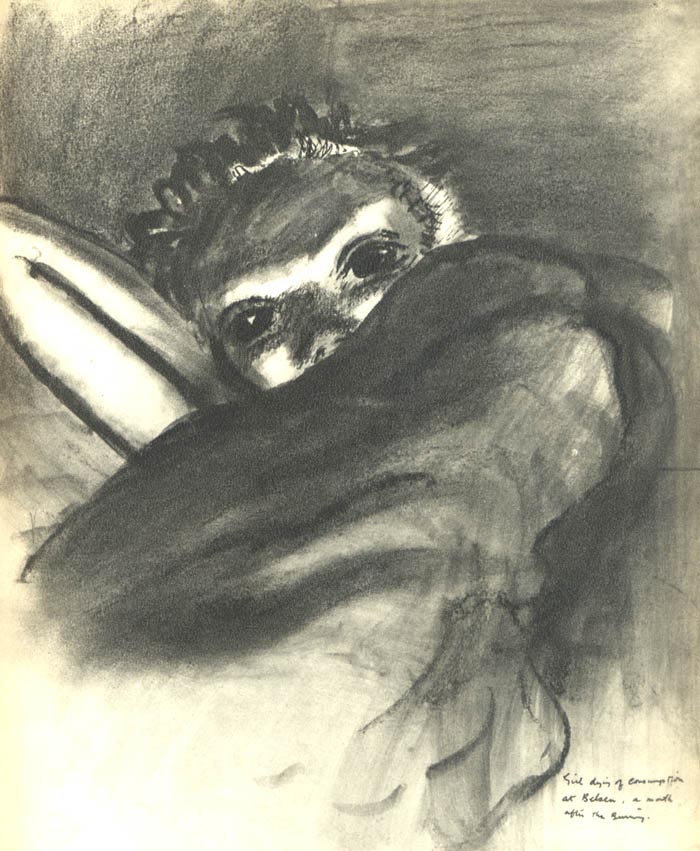
None of the pieces of Peake’s art included in the book were intended to accompany the stories within, yet they fit beautifully. Somehow, he was equally adept with pencil, pen, and watercolours. His portraits are especially striking - all the faces he drew or painted have a striking vividness. His picture of a dying girl in Belsen concentration camp is extraordinary (albeit not included in this book).

The remaining five stories show Peake’s range as a writer. They include two comic vignettes, a ghost story, a vivid dream, and a harder to classify final tale. I have to admit, I didn’t really like this concluding story, titled ‘Same Time, Same Place’. It was the only occasion in his writing when there was a lack of sympathy for one of his peculiar characters. Perhaps because, unlike much of his oeuvre, it was set in the real, mundane world. After immersion in the world of Gormenghast, followed by the surrealism of ‘The Weird Journey’ and ‘Danse Macabre’, normality felt shocking and abrupt. In ‘Same Time, Same Place’, the narrator does not accept the weirdness he encounters, which is a stark contrast to the rest of Peake’s writing. Peake has a gift for presenting the deeply odd, quasi-supernatural, and horrifying as unexceptional. I wonder what made him write a story that repudiated this?

The pervasive unexceptional weirdness, to me, is what brings reading Peake so close to dreaming. In a dream, you don’t ask for explanations, you accept the experience. It’s paradoxical, in a way, that I love to analyse what I read, while also yearning for writing that transcends the need for analysis. In the Gormenghast trilogy, Steerpike is essentially a Marxist serial killer, yet I find that description deeply unsatisfactory. It seems to dismiss rather than explain him as a character. Peake (and Borges) bypass my analytical side by presenting visions that appeal on a different level. I don’t want to say deeper, as I don’t believe that emotions and reason are stacked neatly on top of one another. I think certain writing calls to my unconscious, while also delighting my conscious mind with adept use of language. Imagine being able to do that! What an incredible, potentially dangerous talent to have.
Profile Image for S̶e̶a̶n̶.
983 reviews591 followers
July 17, 2019
This short collection of previously out-of-print short fiction showcases Mervyn Peake's virtuosity as a writer. The titular novella featuring Titus from Gormenghast is by far the centerpiece here, although the other stories are a more than fine accompaniment.

'Boy in Darkness' (4.5 stars) - an incongruously malevolent creature rules over a mostly failed dominion of his own creation, populated now sparsely by humans 'realigned' into animal form. Permeated by dread, yet peppered with humor and pathos, the narrative drives relentlessly toward a denouement of which my only complaint is its abruptness. Given the depth of the mythology he was building here, Peake could easily have kept going and I would have eagerly followed. I'm docking a half star for feeling let down by the rapid and somewhat cursory conclusion.

'Weird Journey' (4 stars) - a reverse oneiric sequence with inexplicable biblical undertones. I read this one appropriately enough as I was nodding in and out of sleep.

'I Bought a Palm-Tree' (3.5 stars) - a droll tale whose narrator attempts to follow through on a sudden urge to acquire a palm tree.

'The Connoisseurs' (2 stars) - a satirical vignette featuring two art snobs that felt a bit too obvious in its message.

'Danse Macabre' (3 stars) - a brief Gothic tale that effectively teeters between horror and absurdity.

'Same Time, Same Place' (4 stars) - 'One of us! One of us!' Or not.

This doesn't average out to a four-star rating, but I'm rounding up since I watched The Cure's 40th anniversary concert film last week and I'm feeling nostalgic. Also, Peake's writing is smart and quirky in a way I really like, even when the narratives don't fully win me over.
Profile Image for Michael.
650 reviews133 followers
July 22, 2018
The title story of this collection is fabulous. If the details in Titus Alone weren't enough evidence, the setting of this novella firmly places the world of Gormenghast in some kind of post-apocalypse future in which vestiges of an advanced technology linger in scattered places. In Boy in Darkness, Peake gives us the horror of the Lamb, a being able to dominate others by force of will and to bend their bodies into the bestial shapes of their id.

14-year old Titus (explicitly named), escapes from his castle home (not explicitly named, but clearly Gormenghast) on the festive date of his birth, wandering into an adjoining, but utterly foreign and unfamiliar wasteland, where he falls first into the clutches of the Goat, and then Hyena, emissaries and thralls of the terrifying Lamb.

Peake's description of the deserts of dust, broken buildings, fractured girders and shattered machinery evokes a post-industrial cataclysm from which, perhaps, Gormenghast was a refuge and sanctuary for survivors - speculative, but possible. I wonder whether Peake's experiences of the London blitz and of being an official War Artist in Germany are channelled through these images?

Boy in Darkness is a worthy supplement to Peake's Gormenghast novels, and an inspired work of literary genius in its own right.
Profile Image for Leonardo.
781 reviews47 followers
April 15, 2010
The Gormengahst books have always been among my favourite books, every since I let myself become enraptured by Mervy Peake's "purple prose". Throughout the years, I had been eagerly looking forward to getting my hands on "Boy in Darkness". I was almost afraid that praise for this Gormenghast offshoot wouldn't be able to live up to the praise that it had received. Fortunately, I can now say that "Boy in Darkness" fulfilled and surpassed my expectations and shares with Gormenghast and other books a special place in my colleciton and my heart. The title short story is a compelling narrative, that is both ominous and enrapturing, as well as a harsh reflection on teocracy and religion. The other short stories that complete the volume showcase Peake's mastery of a wide range of styles and subjects, from parodies to ghost stories. A must-read.
Profile Image for Rhys.
Author 327 books320 followers
September 23, 2024
This slim volume contains the novella 'Boy in Darkness' and a handful of lesser stories by the multi-talented Peake: it also features a selection of his illustrations, though none of them were created specifically for the texts in this book. 'Boy in Darkness' is an outtake from TITUS GROAN; the boy who is the main character is also Titus (Peake gives this fact away casually only once; the rest of the time the main character is referred to as 'The Boy' and in fact the foreword incorrectly insists that he never names the character as Titus).

The story involves the escape of the Boy from the rituals that are his prison and his bizarre adventures in one of the outer worlds, where the blind awful Lamb is a tyrant with only two followers left alive, Hyena and Goat; both have been created by the Lamb from ordinary human beings, for that's what the Lamb does, he mutates people into weird hybrids.

Peake's prose is as cool and accomplished as ever and his eye for descriptive detail and atmosphere is unmatched. The dialogue is crisp and menacing, though unintentional comedy is provided by the Hyena's favourite insult when speaking to Goat ('knobhead!' had a different meaning back then...) I was also amused when the Lamb said, "Now then... Now then..." in a voice that (to me at least) anticipated that of the equally abominable Jimmy Savile years later.
Profile Image for Robert.
827 reviews44 followers
Read
May 28, 2014
On the blurb and in the Introduction, it's stated that the title story is about Titus Groan, though he is never named. Well, he's called "Titus" twice and the setting so closely resembles the Castle of the Groans that there is no doubt at all, as far as I can tell. It's a good, weird, story, too - worth the tiny second-hand price I paid on its own.

THIS REVIEW HAS BEEN CURTAILED IN PROTEST AT GOODREADS' CENSORSHIP POLICY

See the complete review here:

http://arbieroo.booklikes.com/post/89...
Profile Image for Mladen.
Author 26 books94 followers
October 9, 2015
Niti kraće i tanje niti lepše priče. Mervin Pik, potcenjeni biser engleske književnosti, napisao je nekoliko priča, koje su ovde objedinjene uz pripovetku "Boy in Darkness" o Titusu Grounu, junaku trilogije Gormengast. Poetične, kao da slika reči priče na platnu, Pikove rečenice uvlače se pod kožu i u um, fantastične, slikovite, tečne.
Najdraža knjiga ove godine. Od pet mogućih - desetka!
Profile Image for Jonathan.
994 reviews54 followers
March 12, 2017
A great collection of stories by Mervyn Peake, also containing illustrations by the author (although not directly related to the stories). Boy In Darkness is of particular interest to Gormenghast fans as it is a story about Titus Groan on the eve of his 14th birthday. Oddly all the introductions say it never mentions his name, but it does once (his first name anyway), which could have been a typo as he is otherwise referred to as The Boy. In it Titus runs away from the rituals surrounding his life in the castle, but is taken captive by some unsavory characters.

The other stories are mostly a touch macabre, but all are entertaining.
Profile Image for Annika Howells.
Author 3 books7 followers
August 31, 2010
Peake is so incredibly talented. I would give my right leg to be able to write as beautifully as him. Hell, take both my legs! Take my arms! I'll type with my nose!
Profile Image for Lizzie.
689 reviews116 followers
September 10, 2016
I read this book as an insertion into my project of reading through the Gormenghast series. It is actually a brief collection of miscellaneous short pieces and artwork, collected after the author's death, and they can and should be read independently of his other work. But the title story is a 90-page novella that also operates as an interlude in the life of Titus, the hero of the novels for which Peake was famous.

The story occupies an unusual spot in the canon: it is considered to have been undoubtedly written in it, with Titus as the hero, but the events stand apart from the novels, and the Boy of the story is never explicitly named. He is recognizable, and it is pretty clear (to readers of Gormenghast anyway) where he comes from. Timeline-wise, the story takes place partway through the second novel; the Boy is fourteen, and Gormenghast contains Titus at age twelve and age seventeen, so presumably somewhere in between, this story happened. It was also published in between Books Two and Three of the trilogy. So, before I started the final book, I read this.

Okay, so anyway, what is this? Well, it's a really awesome story, and I recommend it independently of anything else. It reads like a weird, eerie blend of fable and horror story. The Boy, having run away from home, is escorted across a river by a pack of spooky dogs. Exhausted, he falls into the hands of Goat and Hyena, hideous men who have been changed into animals, longer ago than they can remember, by their lord the Lamb.

The Lamb, too, seems to have been human once (he has human hands with the head and wool of a sheep, though his body has a mysteriously incorporeal quality) but now rules this land — whatever it is — as some sort of quasi-religious Dr. Moreau. When a human gets lost there, the Lamb decides what creature he is by nature, and performs some sort of procedure to turn the people into semi-human animals. Mostly, they die. Goat and Hyena are the only ones still hanging out with him, in a petty rivalry and great fearful love of their master.

The story is a lot closer to the horror genre than I expected. It's pretty goddamn freaky, and though inevitably the Boy overcomes and makes a heroic escape, the tension is pretty high and the creepy factor is through the roof, in a great way, and the ending is quick and clever. When the story was originally published, it was subtitled "The Dream," and the ending is also nicely ambiguous in that way — the Boy returns home and wakes up on the shore, but what really happened to him?

It does also reward a bit of closer literary inspection for parallels to the novels of the Gormenghast world. It is a familiar moment early in the story when the Boy, fed up to an utterly existential degree with the dusty and painstaking rituals of his birthday, decides to run away from home. This type of thing happens several times during Book Two. Book Three (I've since found) also opens with these wanderings — and even a hyena laughing.

My favorite parallel, though, relates back to the chapter of Gormenghast containing Titus's tenth birthday, for which he is entertained by an animal fable starring a Lion, a Wolf, a Horse, and a Lamb, performed as a mesmerizing panto play with gigantic puppets. After finishing the story, I went back to read this section, which is incredibly lovely although its plot isn't explained.

Peake, however, apparently is deeply fascinated by the animalistic natures of humans, and this type of transformation as carried out by the Lamb is not completely foreign. Book One's single fantastical element, the disease by which Titus's father dies, is connected to a terrible animal transformation that is full of deep horror.

It would be cool to have found out what animal it was that the Lamb had chosen to turn the Boy into, had he not been stopped. What could it have been — an owl? (YEAH I WENT THERE!!!)

Anyway, the book's other inclusions are all extremely short and varied. The first few were kind of a drag. But I loved the last two, ghostly and Gaiman-y: "Danse Macabre," about an enchantment taking over a separated couple in a most terrible way, and "Same Time, Same Place," about a bewitching engagement. Both incredibly spooky, spookier than I expected Peake's natural style to be. It was impressive, and I am curious if there is anything left like this of his to read.

There's also a lot of art in this edition, and though most of Peake's art isn't really my style, it's cool to have published, and sometimes the artworks are used to complement the stories really excellently. (FWIW, Peake is often cited as having the only self-portrait in the UK National Portrait Gallery.)

He's an interesting writer, for sure. Maddeningly inconsistent, perhaps, but it's been so wonderful to discover him for myself.
Profile Image for Daniel Polansky.
Author 35 books1,248 followers
Read
April 1, 2019
A novella in the Gormenghast universe and a couple of short nightmares. I like Peake more in theory, when considering his innovative adaptation of the fantasy genre, then I do in practice, when I’m actually reading long descriptions of crumbling masonry. Some lovely illustrations, though.
132 reviews19 followers
July 1, 2016
I must say I was not as impressed by this compilation of Peake’s stories as I’d hoped I’d be. I am a big fan of “Gormenghast” and I absolutely loved “Same Time, Same Place” when I read it in the Weird Compendium. So naturally I expected to treasure all of the works in here as I do the aforementioned works but sadly this is not the case. I’ll be honest I didn’t care for the title novelette “The Boy in Darkness.” Although it was descriptive the language felt overbearing to me like the author was describing a lot just to extend the word count of the story. As a satire on tyranny it was quite good I suppose though. The word count should have just been cut and then maybe then I would have liked it better. Then that way it wouldn’t feel so longwinded.

As for the other stories in this collection some of them I just didn’t get, particularly the one about the palm-tree. That one had me scratching my head in puzzlement, even after I read it for the second time. I guess that’s the thing about impressionist works. Sometimes you get it and sometimes you don’t. The sense that I get from completing this collection is that Peake was a much better novelist than he was writing in the short format. The format of the novel gave his descriptive style a lot of room to breathe so that his writing could work wonders. In the short format you have to cut to the chase really fast meaning there is less build up, which is Peake’s greatest strength. So in these stories for the most part I didn’t feel like his strengths were well served.

Part of the reason I liked “Same Time, Same Place” so much was because it was in a stripped down style, better suited to the short format and it was also very weird, of course. Danse Macabre was also an interesting, weird, and very dark horror kind of thing. So those are my two favorites in the compilation and the rest of it I didn’t care for that much. I must say after reading this compilation there is no denying that Peake is highly unique whether or not he’s writing a novel or a short story. My reservations won’t change that fact one bit.
Profile Image for Octavia Cade.
Author 94 books136 followers
May 25, 2019
This collection of short fiction from Mervyn Peake has three forewords and six stories, which is an amusing ratio. The bulk of the collection, though, is made up of the novella "Boy in Darkness", which has previously been published separately (I read and reviewed one of those separate editions just recently). It's an outstanding piece of work, and I gave it five stars, so it's mildly unfortunate that it gets dragged down a little here by the other five creative pieces. All short stories, there's a couple that didn't really work for me - "The Connoisseurs" is non-genre and very slight, with an ending a blind man could see coming, and despite Peake's always interesting prose I simply couldn't get into "The Weird Journey". Of the rest, the other general fiction story here, "I Bought a Palm-Tree" is autobiographical and at least mildly amusing. However both "Danse Macabre" and "Same Time, Same Place" are excellent, being both tinged with the bizarre and just flat-out creepy. Given that "Boy in Darkness" is as much horror as fantasy, it seems to me it would have been more sensible to pair it with stories like the last two, rather than diluting the emotional effect with palm trees and old vases.
Profile Image for Michael Eisenberg.
16 reviews3 followers
April 24, 2011
Just finished Boy in Darkness and other stories by Mervyn Peake. Loved the quirkieness of it all, but the novella "Boy in Darkness" was fantastic, not to mention disturbing and very sinister to boot. For me, Peake has this talent of lifting the reader up, and dropping them right in the middle of the action...his descriptions are that good! The story left me with an unease last night, that is still with me this morning.

The other 5 short stories contained in the volume are very good too, some of them actually reminding me of Dunsany...not in his writing style, but more in ability to make a mundane "slice of life" situation something much more than that. I'm thinking specifically of "I bought a Palm-Tree" if anyone has read that one by Peake. There is also a great gothic ghost story here called "Danse Macabre" and a rather terrifying boy meets girl situation that goes terribly wrong in "Same time, Same Place".

Overall, M. Peake continues to astound and amaze me to the nth degree!!!
Profile Image for Melanti.
1,256 reviews140 followers
July 3, 2012
My least favorite of the Gormenghast series was Titus Alone, partly because it wasn't as fleshed out as the previous novels and partly because Gormenghast and its inhabitants weren't included.

So, I was a bit leery of picking up this novella and anthology since neither Titus or Gormenghast are ever named. In content, it is very similar to Titus Alone, and an unnamed Titus is playing hooky for a day and exploring the territory around the castle. Despite the similarity, I did enjoy it - maybe because it was short enough I could just enjoy the eeriness and Gothic atmosphere and not have time to miss the castle.

The other (very short) stories included in the volume were wonderful. "Dance Macabre", the story of a haunted suit of clothing, was by far my favorite.
Profile Image for Monty Milne.
1,038 reviews76 followers
April 4, 2014
Disturbing and bizarre, I enjoyed trying to tease out what might have been going on in Peake's mind as he wrote Boy in Darkness. But in the end I just surrendered to that awesome creative intellect, as dark and mysterious and intriguing as some gothic outwork of Gormenghast itself.
Profile Image for Tom.
707 reviews41 followers
September 26, 2018
I read Boy in Darkness seperately, previously. This centenary edition features additional introductions, short stories and a scattering of Peake's wonderful illustrations, it's a very attractive edition.
July 28, 2019
Curiously, this is the only book by Peake that the local library has. I have been meaning to read his books for some time now, but so far, this is the only one I have found. In any case, if this is indicative of the quality of his work, I expect to enjoy it immensely.
Profile Image for Bryan Young.
Author 121 books157 followers
December 19, 2011
I've never before read Mervyn Peake and this was an interesting introduction to him. His short stories were all over the place in a good way.

It was a quick, entertaining read.
Profile Image for Charlie Byers.
77 reviews1 follower
August 20, 2012
I fell in love with Gormenghast years ago, so it was a thrill to find this collection of Mervyn Peake's short stories at my library. It's always a joy to fall into Peake's inimitably vivid settings.
Profile Image for The Scribbling Man.
271 reviews12 followers
December 22, 2020
My rating covers the overall package, as well as the stories; the forewords and accompanying art. It's a nice little package, even if nothing is quite as good as the title story. 

While not outstanding, the collection shows that Peake bordered on literary chameleon. His style, rhythm and pace seems to change from story to story according to what feels apt for the narrative. Always pretty, often whimsical, but the range of writing feels wide. 


Boy In Darkness - 4

Nothing beats Titus Groan for me, but this is an enjoyable little nightmare and a nice extension to the world of Gormenghast (and beyond). It starts and ends a little clunkily, but the meat of the tale is engrossing and packed with delicious prose. I'm sad I've now read everything the world has to offer.


The Weird Journey - 3.5

Beautiful prose weaves a breif, whimsical narrative, producing less wonder than expected. 


I Bought A Palm-tree - 3.5

A simple, witty story about the spontaneous and uninformed purchasing of a palm-tree. 


The Connoisseurs - 3.5

An on the nose, but amusing, satire on art. 


Danse Macabre - 3.75

A dark, ghostly tale. I found the writing a tad laborious at first, but the direction the story takes toward the end is intriguing and the ending nothing short of brutal. 


Same Time, Same Place - 3.5

A runaway youth and his naive, romantic pursuit. Nicely written, very readable. 


Overall a nice little collection. Worth picking up as a fan of Peake, and certainly worth it for the title story alone if you're a Gormenghast completionist. 
Author 1 book6 followers
February 4, 2013
This is a curious, intermittently successful collection of stories, the strongest of which is definitely "Boy in Darkness," in which Titus of the Gormenghast novels runs away from home and finds himself in the run-down kingdom of a blind, demonic lamb who delights in transforming people into hideous animal caricatures of themselves. Like Titus Alone, the story suffers a bit from overheated prose; Mervyn Peake really, really loves words like "sinister" and "vile" and phrases like "infinite emptiness." Nonetheless it is totally unique and genuinely creepy. Despite the oppressive atmosphere of horror and vocabulary like "carious," "aegis," and "adumbrate," it was apparently first published as a children's book!

The other selections seem primarily experimental, more writing exercises than fully-fledged stories. I think it's safe to say that Mervyn Peake did not consider himself much of a short story writer, considering he only wrote . . . well, these? If he wrote any others, I'm not aware of them. So it's not a medium he practiced enough to master. At least you get a variety. There is an amusing little autobiographical piece ("I Bought a Palm-Tree"), a weirdly miscalculated ghost story about clothing coming to life ("Danse Macabre"), a sort of Oscar Wilde-ish satire ("The Connoisseurs"). My favorite is probably "The Weird Journey," a short surrealist thing that reminded me vaguely of both Kafka and Carroll, while being the best example in this collection of Peake's astounding writing style.
Profile Image for Adam.
664 reviews
Read
January 14, 2011
Peake's biographer, Malcolm Yorke--in a book written with the "full cooperation" of the Peake family--says of "Boy in Darkness":

"...this is a powerful adult nightmare from which there is no awakening. It is possible for books to harm children as well as to heal them, to corrupt their view of the world rather than embrace it, and in this book the evil is so powerfully felt, the desolation so utterly dire, that any fears the child may have had beforehand will be handed back in intensified form. ...Children can and should enjoy being frightened by stories, but only if they can be reassured that the monster under the bed, the sinister stranger or the blood-sucking ghoul will ultimately be overcome by the hero, even if it's a close-run thing. This restoration of normality was a feature of all the books Peake read as a boy, but he makes only a perfunctory gesture towards it here. ...Boy in Darkness remains a puzzling, unbalance and very disquieting story and one wonders about the mental health of a person who could engender such a bleak world."
Profile Image for Arpad Okay.
73 reviews10 followers
June 23, 2015
Boy in Darkness is viscerally creepy fantasy. Half-men, half-beasts who dwell in an abandoned mine, their master a horrifying, blind lamb-balloon of white curls and evil genius, the young Titus Groan. This is a nightmare departure from Gormenghast, its dark reflection. Charged with terrible details. Imagery that deeply pleases and imagery that makes the skin crawl. Must read for the Lord Dunsany fans out there.

I give the collection 4 stars instead of 5 because the rest of the stories are throw-aways of mixed value. One well-told crazy tale, one well done slice o life and a bunch of ho hum magazine work to pad out the volume. 100% worth the price of admission for the novella.
Profile Image for Tricia Gadd.
24 reviews6 followers
August 11, 2016
Excellent! It's not every day you come across creepy, surreal writing that is also entertaining without being cryptic. These make perfect bedtime stories. This book contains six short stories ranging from eight pages to seventy-two. My favorite was the title story "Boy in Darkness" about a bored child who runs away and finds himself in danger in a very strange place. I believe most, if not all, of the illustrations are by Peake himself, and they are just wonderful and full of eerie loneliness. I'm so glad I found this book at the library. This is one I will definitely purchase for myself.
Profile Image for Jeff.
691 reviews31 followers
July 20, 2019
This volume is a mixed bag, with standouts being the title story and "The Weird Journey", both of which have a hypnotic, mystical power that make them worthwhile experiences for fans of the Gormenghast trilogy.

The rest of the stories in this collection are pretty forgettable, but the inclusion of copious artwork from the author throughout the volume adds considerable interest, so Peake fanatics won't be disappointed even if some of the individual stories are essentially filler.
Profile Image for V.A. Hezaran.
Author 1 book7 followers
March 5, 2014
Solid book of bizarre short stories. The title story was especially creepy.
Displaying 1 - 30 of 37 reviews

Can't find what you're looking for?

Get help and learn more about the design.