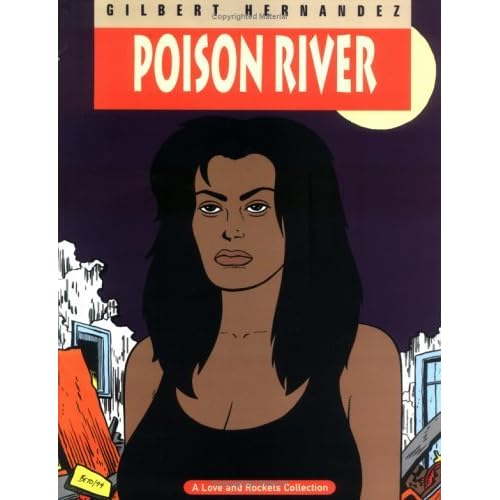
260 pages! Beyond Palomar collects two of Gilbert's groundbreaking works about the Central American hamlet of Palomar in one affordable book."Poison River" is a dizzying period piece often hailed as one of Hernandez's masterpieces. It traces the pre-Palomar childhood of Luba, her teenage marriage to gangster Peter Rio, the secrets behind her mysterious mother, all the way up to her subsequent escape and arrival in Palomar. "Love and Rockets X," set in the early 1990s (in the waning years of Bush I's post-Reagan hangover, with Gulf War I in the background), takes us from plush Beverly Hills to the dangerous east side and introduces us to a dizzyingly diverse cast of characters, including a lowlife rock 'n' roll band, a "posse" of black youths, a ditzy Hollywood mom and her spoiled son, a gay activist filmmaker and his rebellious, half-Iraqi daughter, and a group of racist thugs whose violent attack on an older woman sets the plot in motion.
Gilbert and his brother Jaime Hernández mostly publish their separate storylines together in Love And Rockets and are often referred to as 'Los Bros Hernandez'.
Gilbert Hernandez is an American cartoonist best known for the Palomar and Heartbreak Soup stories in Love and Rockets, the groundbreaking alternative comic series he created with his brothers Jaime and Mario. Raised in Oxnard, California in a lively household shaped by comics, rock music and a strong creative streak, he developed an early fascination with graphic storytelling. His influences ranged from Marvel legends Jack Kirby and Steve Ditko to the humor and clarity of Hank Ketcham and the Archie line, as well as the raw energy of the underground comix that entered his life through his brother Mario. In 1981 the brothers self-published the first issue of Love and Rockets, which quickly drew the attention of Fantagraphics Books. The series became a defining work of the independent comics movement, notable for its punk spirit, emotional depth and multiracial cast. Gilbert's Palomar stories, centered on the residents of a fictional Latin American village, combined magic realism with soap-opera intimacy and grew into an ambitious narrative cycle admired for its complex characters and bold storytelling. Works like Human Diastrophism helped solidify his reputation as one of the medium's most inventive voices. Across periods when Love and Rockets was on hiatus, Hernandez built out a parallel body of work, creating titles such as New Love, Luba, and Luba's Comics and Stories, as well as later graphic novels including Sloth and The Troublemakers. He also collaborated with Peter Bagge on the short-lived series Yeah! and continued to explore new directions in Love and Rockets: New Stories. Celebrated for his portrayal of independent women and for his distinctive blend of realism and myth, Hernandez remains a major figure in contemporary comics and a lasting influence on generations of artists.
Beyond Palomar collects Poison River and Love and Rockets X by Gilbert Hernandez.
As I continue to chew through the Palomar books, I'm amazed at what Gilbert Hernandez has done here.
Poison River, the story of how Luba wound up in Palomar, is a sordid tale of revolution, sex, drugs, heartbreak, and more sex and drugs. Gorgo's ties to Luba's family are revealed, is as much of Luba's tragic backstory, being married at fifteen to a man over three times her age.
Love & Rockets X is the story of a LA band called Love & Rockets and everyone caught in their orbit. All roads lead to Palomar so everything gets tied together eventually. Love & Rockets X is a tale of sex, drugs, racism, violence, heartbreak, and all the other good shit.
Gilbert's art continues to wow me, his style slick and minimalist but still very expressive. Working in black and white with a cast this large, he still manages to give everyone a distinctive look.
Beyond Palomar is another winner from Gilbert Hernandez that makes me wish I'd started reading these books twenty years ago. Five out of five stars.
Collecting 'Poison River' the Luba life story leading up to her time in Palomar, words escape for the creativity, it all just feels so real, like I lived this life. This is then followed by short stories around 'Love & Rockets X', which captures the world that Maricela and Riri find when they moved to the United the States. 8 out of 12
Poison River. Wow, what an amazing epic story of Luba. It's amazingly big and surprisingly tragic and does such a good job of retrospectively revealing why Luba is who she is. So many characters, so many stories. It's long, but somehow manages to fit much more than you'd expect from the page count [5/5].
Love & Rockets X. It's cool that Gilbert decided to play with one of the bands that scooped up the Love & Rockets name, but I wasn't sure how much I'd be interested in yet another set of characters. I should have known better. This is a great little slice of life, and it also turns out to be a crucial piece of the Love & Rockets (comic) puzzle as it reveals what happened to Maricella & Riri who Steve is, and a few other tidbits that fits into the story so far. This non-linear storytelling is one of the things I really love about Gilbert's Palomar stories. [4+/5].
As a whole, definitely one of Gilbert's strongest.
I enjoyed this a lot more now than I did the first time I read it. I think the sharp tonal change that occurs towards the end of the second Palomar volume and continues here bothered me. Also Poison River (the story that takes up 3/4ths of this book) is infamously hard to follow. This time I read slowly and carefully and flipped back a lot to double-check things. It's certainly complex, but this time I didn't find it confusing. Mostly I was just in awe of Gilbert's ability to weave such a complex plot with so many characters and so many time jumps, and yet keep it coherent. It's almost Dickensian. The complexity isn't just for show; it makes this a richer, more rewarding read. For example, a lot of people complain about the frequent time jumps. But at one point, a crucial past event is revealed that changes everything about how you perceived the story thus far, and then the story jumps back in time to chronicle that event. If the story was told chronologically, you wouldn't have had that surprise. Like if you saw the Star Wars prequels before you saw the original trilogy and knew in advance that Darth Vader was Luke's father, then your first viewing of the Empire Strikes Back would have been a lot less fun.
The second story, Love and Rockets X, has a similar level of complexity (though minus the time jumps), but is mostly a character study that lacks that central plot to give it that extra punch. It meanders a little too much and isn't as satisfying as the previous story, though it's also a lot shorter. Gilbert also gets a little heavy-handed, though I appreciate his refusal to give easy answers (Spike Lee style).
Only time for a v brief review of this re-read. Two of Gilbert Hernandez’ big early 90s stories. They take the disjunctive, multi-stranded storytelling he’d mastered with Human Diastrophism and expand on it. Poison River does with time what his Palomar work did with location, telling one person’s story across multiple cross-cutting eras, and it’s stunning, more coherent than its reputation (and my memory) suggests. His grandest work and one of his best.
Meanwhile, X takes the Palomar approach and moves it to late 80s LA with a mixed cast of formerly minor characters and newbies and a story about rising racial tensions. Everything’s very fast moving and very broad brushed, which sometimes works - the relationship between Kris and her Dad is tautly and memorably drawn - and sometimes doesn’t - Erf’quake and his posse never comfortably transcend the stereotype Hernandez is working off. Massively readable, technically bravura, but still an awkward comic.
This book was crazy. I got really caught up within the pages though. Drama, poor childhoods, alcholism, sex, unplanned pregnancies, miscarriages.... woah. This stuff is not my normal brand of rice chex, but you know, it was pretty refeshing. The graphical style of black & white art was amazing as well. Get caught up in this series for all you comic lovers, it is enjoyable.
Em 'Além de Palomar' somos apresentados ao passado de Luba, filha de pais improváveis, que sai do vilarejo pobre pra viver sua sina na cidade grande, regada a música, drogas e muito sexo. Completando a coletânea, 'Love and Rockets" mostra o dia a dia de adolescentes em Los Angeles nos anos 80, cujas vidas são entrelaçadas na comunidade em que vivem.
Assim que saímos de Palomar, sai de cena o realismo fantástico que dá lugar à um estilo mais sóbrio, focado na segunda metade do século XX, uma jornada pelos anos 50 aos 80 da América Latina. A obra é uma aula de referências, mostrando o desenvolvimento do cenário musical, o boom das drogas e sexo dos anos 70, avanços na medicina e ciência, a constante presença dos cartéis de drogas e da violência que moldou a região, tudo isso orientado pelo debate político que reinou na época: comunismo x capitalismo.
Gilbert Hernández nos presenteia com o desenvolvimento magnífico de uma boa história. Diversos personagens mostrados ao longo de suas vidas, com diferentes objetivos e sonhos. A passagem do tempo é marcada tanto na mudança dos traços que compõe cada um como nas variações em suas ideologias.
Assim como no "cortiço" de Aluísio de Azevedo, os personagens vivem suas vidas atolados em seus próprios dramas e defeitos, em uma história que evita tomar partidos específicos ou criar uma falsa moral. Hernandez escancara os problemas sociais sem privar suas criaturas de humanidade: gays, mafiosos, neonazistas, negros, ricos, pobres, putas, feios e toda uma miríade de estereótipos se matando e se amando em meio à preconceitos, cumplicidade, ódio e desejo.
Viajar em suas páginas é viajar na história da América, onde milícias chacinam inocentes enquanto ricaços sofrem overdoses em seus palacetes, onde os desgraçados abandonam seu mundo para tentar a sorte do sonho americano e onde personagens virtuosos e deploráveis vivem juntos como ingredientes numa verdadeira "sopa de lágrimas"!
4 and a half stars. though i don't know why i'm docking it the half. maybe for Book 4? Gilbert Hernandez is a master of dialogue, of interwoven storylines, of ever-changing time. but it's always clear. every character, however minor, is distinct, and has a story. the Palomar saga here opens up into a larger verse, before and after Palomar, before Luba, and later as her children migrate to Los Angeles. but Palomar remains, at first undiscovered, then half-hidden in the midst of war (a promised land), then reimagined by the third generation as the treasured home, an unchanging source of family and strength - and Heartbreak Soup. it's almost impossible to overstate how good this book (Book 3 of the Palomar tales - and they should be read in order, even though Gilbert's storytelling skips back and forth in time and in perspective) really is. the author is in total control of every bit of both art and story, and it slides seamlessly between the family saga and magic realism models. when the narrative moves between locales or segments of time, there's no jolt: every character remains recognizable at any age, and the particular moment in time, although unstated, is easy to pinpoint through the story. this book has three centers: the story centered on Luba's elusive mother Maria (Poison River), the story centered on Luba's first marriage at fifteen to the gangster Peter Rios, and the story called Love and Rockets X set in modern Los Angeles. at first the last part seems only marginally connected to the Palomar stories: it's basically Gilbert's revenge on the 80s band Love and Rockets for claiming the name of the Hernandez Brothers' comics anthologies as their own. and it's very funny as it skewers both the band(s), that unique teenage period of sexual and identity confusion, and all the different cultures of Los Angeles especially at points of contact. but every new character is beautifully rendered, gradually Luba's children enter into it, people go back to and leave Palomar, and the whole thing just gets richer as it goes, a lovely thing and a fine example of both Gilbert's technique and his mastery of both craft and art. the Palomar stories are a kind of One Hundred Years of Solitude that should be classic reading, not just in the medium of graphic novels but as novels themselves, told like a Latin DreamTime path, continually evolving as the master storyteller switches in time and in timelessness his narrative boundaries. it's gritty on the subject of war, and politics, drug cultures, adolescence, and even here transsexual strip clubs. it often changes the established narrative by retelling an incident from the perspective of a different eyewitness. it makes allusions that move the reader backwards and forwards in time and space to see and to question the origin story of everything. and it's so beautifully executed that it seems seamless; the reader never loses her place, and the author never slips from being in total control of his story, and of his enormous cast of characters. it's a modern masterpiece. 256 pp.
although the two stories in this volume don't have quite the same flavor as the Palomar stories, they are similarly brilliant and intricate in their web of interconnectedness. in the first, luba's checkered past is revealed while also illuminating the surprising past of other characters in the Palomar stories. the second story is an interesting slice of LA in the 1990s, with several Palomar characters involved in the plot. an exciting follow-up to the Palomar stories.
For readers who've been following Gilbert Hernandez's Palomar/Luba storyline up to this point, the title of this volume might suggest a continuation of the stories in the previous volume: the further tale of the diaspora from Palomar to Los Angeles. However, what Beto does in the two long stories contained here is to move backwards in time from the previous volume. We're moving 'Beyond Palomar' here in the sense that neither of these stories focuses at all on events in Palomar. In fact, the town gets featured only in the last few pages of the volume. It's obvious that Beto was done telling Palomar-centric stories, and wanted instead to use its characters to move to different settings and tell different kinds of stories.
In "Poison River" - the long story that comprises most of this volume - Beto recounts the entire life history of Luba in an unnamed/imaginary Latin American country right up to the moment when she and her family moved to Palomar at the very beginning of Love and Rockets. The guiding theme of this story is tragic ignorance: the ways in which past violence, indifference, and suffering are repressed or simply forgotten, only to resurface later in ever more cruel forms. As a very young child, Luba is abandoned by her mother to the care of her father, who, utterly destitute, walks 900 kilometers to carry Luba to his blind sister and her daughter Ofelia. As Luba grows up, we get an extensive look at Ofelia's own backstory: her life as a young leftist agitator rebelling against a right-wing government that commits heinous crimes with the backing of the US government. This phase of the story culminates in the brutal attack that caused Ofelia the lifelong, debilitating back pain we know from the earlier Palomar stories, and which Ofelia always claimed was the result of a 'church falling on her back'. In telling this story, Beto not only adds incredible richness to the character of Ofelia - always something of a side character in the Palomar stories - but provides a window onto the horrific consequences of the American manipulation of Latin American politics in the late 20th century. Chomsky would be proud.
As the story hones in on Luba herself, we learn of how she's essentially kidnapped as a 15 year old by the middle-aged musician and gangster Peter Rio - forced, not only into a marriage she doesn't want, but also into a dark urban underworld of drug cartels. Luba ends up being a kind of gangster's moll - a teenage trophy wife who spirals into loneliness until she's on the verge of becoming a broken-down cocaine addict. Yet, this isn't your average gangland romp. Peter Rio's cartel boss runs a seedy night club/brothel peopled by trans women and frequented by gay gangsters whose queerness is constantly at odds with their toxic masculinity and the judgment of an ultra-macho and conservative society. Further, Beto avoids the mistake of portraying Luba as a pathetic, helpless victim of circumstances. On the contrary, what we find in the teenage Luba is a formidable survivor: a hellraiser with far tougher skin than most of the men around her. Without giving away any spoilers, when "Poison River" jumps back to the years when Luba was a small child, we learn that Peter's motives in kidnapping her originally are far darker and more twisted than we ever expected.
In the second, shorter story here, "Love and Rockets X", we get the story of Luba's daughter Maricela and her lover Riri during the first few years of their time in Los Angeles, shortly after they fled Palomar to escape Luba and live their lesbian identities to the full. They make their way there full of hope, but find, not only that life as an undocumented immigrant in Los Angeles is incredibly hard, but that America is not nearly as welcoming to queer people as they thought. Their landlord and Maricela's boss constantly threaten to sic la migra on them, and they find that they have to pose as 'roommates' to survive.
However, "Love and Rockets X" isn't just the story of Maricela and Riri. Instead, Beto makes them characters in an ensemble cast, telling the story of a handful of teenagers who have formed a band called Love and Rockets, as well as their social milieux. These mileux include a band of white supremacists who spark the story into motion by savagely beating a black woman who chews one of them out for pissing behind a supermarket, sending waves of chaos through all the other characters' lives. One of the major highlights here is they way Maricela's and Riri's closeted lives are mirrored by the story of Mike Niznick, an out gay man whose daughter Kristen is deeply ashamed of his homosexuality, Kristen becomes enamored of Love and Rockets' singer, and so gets sucked into the world of Hollywood decadence and thinly veiled bigotry that suffuses their lives, drawing her father into a crisis that provides a moving counterpoint to the decay and dissolution of Maricela's and Riri's beautiful but doomed romance.
When I first found out that Beto shifted his focus away from his wonderful fictional town of Palomar in the 90s, I was disappointed. I love those stories so much that of course, I wanted more. However, the way in which he traces the lives of various characters from Palomar to far-flung places and times has been well worth it. If there's a guiding thread to the whole decades-long epic, it's Luba and her family - her parents, her many children - and each of them is endlessly fascinating.
Oh, this was just mind blowing. The story of Luba, the most controversial character in Palomar. This book expands the world of Hernandez brothers. They take the reader to the world of Mexican drugdealers and mafiosos. Still, it's all about beutiful women, who try to make their life in a brutal world of men, and men who can't controll their desire for women - and are therefore brutal.
The final installment of the reprinted Heartbreak Soup Stories Omnibus may have ended up being my favorite. It acted as a great double-bookend to the Palomar saga. First, "Poison River" is the novel-length backstory of Luba, from her conception up to her arrival in Palomar. Then the second half of the book, "Love & Rockets X," continues the original chronology after Human Diastrophism.
"Poison River" is a whirlwind account of about two decades of history in undisclosed, fictional Central American towns. There's a war raging between leftist radicals and the government... or is it freedom fighters vs. the fascist regime? No wait, it's all just anarchist terrorists trying to trick everyone into believing that the righteous government is involved in it at all. So much of the story is hard to follow, as the reader is tossed back-and-forth through time and characters, never given a moment to ponder what's happened because the story's already moved on to the next scene two days or two months later. It's a brilliant tactic by Gilbert; none of the characters really know what the hell is going on in their country, even those caught up in it... all they know is that everything is fucked, so you either gotta get out or get on top. And through all of this political unrest and terror, many of the characters are either gay, bi, pan, trans, or homophobic. (This was written in the mid-'80s and takes place in the early '60s when labels didn't really exist or matter, so the sexualities of the characters are never specified.)
Then "L&R X" launches us to the '80s, where Luba's daughter Maricela (last seen as an infant when "Poison River" ends just a few pages prior) is living with her girlfriend Riri in a well-to-do Californian town, struggling to make it as undocumented immigrants. Riri is the housemaid for a wealthy Hollywood wife who looks out for her, but her son, Rex, is a fledging neo-Nazi who really just wants to like, ROCK, man!! but not if the kids from the ghetto or the "illegals" are invited to the gig. In the second half of Beyond Palomar, we're given a story of social unrest instead of political; and we have characters who are forced to choose an identity instead of characters unable to understand theirs. The biracial kid never mentions that he's ALSO black or ALSO Chicano whenever he's around someone slurring against one or the other. The Nazi punk with dubious heritage keeps telling his comrades that he's "whiter'n you!" Kris is half-Jewish, half-Muslim, but all the other rich kids at her school just assume she's Mexican, and by the end she's forced to choose between her two heritages. A "white trash" girl is in love with the local Japanese hottie, but since he won't reciprocate she dates the local KKK-leader to piss him off. A lot of violence is happening, but almost all of it is heard about second-or-third hand.
Between the pages of Beyond Palomar, we're given two stories that show two vastly different places in two vastly different times; but somehow, everyone is still plagued by their own demons, prejudices, injustices, identity crises, and general insecurities. Life is inescapably garbage for all of us everywhere, but when we're surrounded by the right people, we can get through it for a time.
Luba became a fixture in Gilbert's stories in Love and Rockets early into the serialization of "The Heartbreak Soup" stories, and she was an immediately alluring character due to a hinted at complex history. It's not until Gilbert began the serialization of "Poison River" that the readers are fully exposed to the intricate history behind how Luba came to live in the small Latin American town, Palomar.
"Poison River" was at the time Gilbert's most ambitious story yet, as he juggles a dizzying amount of characters to fully flesh out Luba's life story. Starting from her childhood, we learn that Luba's mother, Maria, is forced out of her life of luxury after her husband finds out that Luba is not his child. The pair leave with Maria's poor lover, but Maria soon abandons Luba in favor of a rich lover. Luba is later cared for by her cousin Ofelia, who is herself associated with a communist movement. "Poison River" is many things - a story of political upheaval, a gangster story and even romance, but at its heart is the story of many people within Luba's orbit. Gilbert's ingenuity here is that the story isn't even really about Luba. Sure, she appears in most chapters of the story, but each chapter actually spends time on a character connected with Luba at any given stage of her life. In a sense, "Poison River" is a means for which Gilbert further fleshes out his side of the Love and Rockets enterprise, and it's done at a surprisingly sophisticated level. Gilbert does present a lot of his more juvenile bits of humor in here too, but it actually folds in well to the narrative and is never distracting. And all through this, Gilbert strikes a fantastic balance between the written dialogue and the visual storytelling, which is exceedingly top notch here.
The second story in this omnibus edition is "Love and Rockets X" which features an LA high school band through which Gilbert satirizes the MTV generation but also spotlights the ongoing political polarization and prejudices common in the mid/late 1980's. Though not strongly connected to any of the other Love and Rockets stories, "Love and Rockets X" is a pretty robust character study that explores pretty mature themes in a rather elegant way.
I wouldn't ever be able to pick just one of Gilbert Hernández's comics to recommend since I'm just a massive fan of a lot of his work, but "Poison River" comes close to being one of his best works ever. His later story, "Julio's Day", would perhaps be the one to really rival this one, but "Poison River" marks an early apex in Gilbert's career.
It's been a long time since I read "Poison River" and "Love & Rockets X," the two storylines that are collected in this volume, and must admit that I appreciated the former much more the second time around, and the latter somewhat less the second time.
"Poison River" is the biography of Luba from birth to her arrival in Palomar. In this story, Beto takes his time, giving room for each of the characters to develop convincingly. Everybody displays positive and negative traits, but Beto never tries to judge them. He simply tells the story as it happens. I appreciate the Luba herself is as screwed up as anybody - she's protagonist but not a hero. She's a survivor, but she doesn't necessarily care about the people around her who suffer, she's uses drugs and alcohol (while pregnant!), and treats her family pretty poorly at times. But she's also vulnerable and feels loss when her child dies or what people close to her suffer. I like that Beto skims over the political and criminal elements, just letting you know that Luba's husband and his colleagues are crooks, but not allowing those elements to overwhelm or distract from the humanity at the story's core. We also get to see a good slice of Luba's mother Maria's life, which explains a lot about why the people in Luba's life behave as they do toward her.
It's not a happy story, nor does it show humanity in its best light, but "Poison River" is undoubtedly one of the most realized comics I've read.
"Love & Rockets X" spins out of a repeated joke about the origin of the name Love & Rockets, whether the 80s British band had it before a lousy LA garage band. One of the band members claims that he got the name from Mexican brothers, which sounds like the most believable story to me. ;) The main plot actually involves a diverse cast of people in and around LA, showcasing their various prejudices while also highlighting how intertwined all of their lives are. The story could go deeper at times, and seems to spin its wheels briefly when Steve goes to Palomar to get his head on straight and spends too much page time there, but each of the characters seem to wind up somewhere different than where they began the tale, and Beto does a terrific job capturing the speech patterns and biases of each person.
Bom, continuamos com o Hernadezverso e suas míticas criações, a primeira história, Rio Veneno, conta a história de Luba até sua chegada em Palomar. E, amigos, é uma tragédia atrás da outra, crime, sexo, violência, mafiosos da extrema direita, mais sexo, inclusive, o pessoal trepa mesmo nessa história, problemas psicológicos, mais violência e mais sexo. Contudo o mais interessante é que cada capítulo leva o nome de um personagem e estabelece a sua relação com a Luba, desde a pequena infância até, já adulta, a chegada à Palomar. Há vários pontos a comentar sobre a história e seus desdobramentos, mas talvez o mais interessante seja a destruição da identidade e a necessidade da sua reconstrução, quando comecei a ler, senti falta da Luba protagonista dos outros livros, mas, novamente, aqui é a formação da Luba que começa como pouco mais de um troféu doentio para um dos personagens, então, de certa maneira, a história da Luba acaba sendo a história de vários outros personagens que, através das suas tragédias pessoais, formam a nova identidade da Luba. Ao contrário dos outros, há uma diminuição na magia do realismo mágico e um aumento na dura e fria realidade dos conflitos entre criminosos e, paralelamente, os conflitos interpessoais entre os personagens. Já a segunda história, Love and Rockets X, também tem um elenco gigante e com vários eventos coincidentes ocorrendo entre si, mas numa Los Angeles de 1989, com MTV, conflitos raciais, rebeldia adolescente e aquela vontade de trepar que só a juventude tem. Eu achei que demorou um pouco para pegar ritmo - elencos gigantes me cansam -, mas depois que os diferentes núcleos se misturam quase parece uma comédia sexual dos anos 80. De novo, é mais um excelente volume de uma série que não decepciona.
For a while I thought that this was going to be the first book in this series that I'd give four stars to - Ofelia's horrible backstory and how it intersected with the political and military chaos of the times, and Luba's life as a teenage bride, were really affecting. But Luba's husband Peter Rio was a gangster, and the increasing focus on gangster activities was something I found less appealing. I was glad to see her escape that life and find her way to Palomar, which is where my interest in this whole ongoing story is centred.
I think one of the most interesting things about this series is that it's made up of individual comics - which is a facile thing to say, considering - but they're frequently not in order, and go back and forth in time. In a novel, I find this technique a fun challenge, but in a graphic story, I have to admit I find it sometimes difficult to grasp. I don't have the most visual brain - when I was young it took me years to remember what colour my mum's car was, despite seeing it every day, and I could only ever reliably find it in a parking lot because of the number plate (numbers were easier to remember than colours) - and so I often find myself floundering a bit with this series, just because it's so visually complex. I remain interested, though, so even though it's a challenge to read I plan on keeping up with it.
This third volume of Gilbert Hernández's collected Palomar stories includes two novella-length pieces, the first of which ("Poison River") is one of the best things to ever flow from his pen. This is essentially the origin story of Hernández's primary protagonist (Luba) and focuses on her teenage years before taking up residence in the remote town of Palomar. It's a dense story of personal, political, and sexual intrigue with many interweaving threads, and despite its complexity, the author manages to keep the narrative moving at a brisk pace, broken up by the clever device of chapter-heading pages that each focus on one of the main characters. It's not an easy read, since violence is ever-present throughout the tale, but it's powerful stuff that makes for one heck of a compelling read.
Then there's the second work in this volume, "Love and Rockets X", which brings the action forward in time to focus on Luba's children who have moved to the United States. It's an intentionally comic work (as opposed to the dramatic "Poison River"), and while parts of it are amusing, overall it's nothing special, despite the author's attempt to include some social commentary (much of which feels rather forced).
As I push through my quest of reading the entire Love and Rockets/ Palomar back catalog, I continue to be impressed. The stories get bigger and the cast of characters just explodes. Sometimes it edges into melodrama, maybe even magical realism. But I find myself getting attached. I want to know how things turn out for the citizens of Palomar and Maggie and Hopey.
Something I appreciate is how well crafted each character is. Even with the cartoonish drawing style, this book really shows the dedication. We start to see characters in all stages of life - and they remain recognizable. Even the children of familiar characters can be recognized for sharing the visual traits of their parents.
This was a particularly dense volume. And in a way, it got a little out of control at the end. Yet still tied itself back together in time.
It's a crazy world that Hernandez has created, with characters who are larger than life. Too many stories though, too many path, and I struggled with the transitions; sometimes even from panels to panels. Of course, this might have been done for a specific reason; if so it eluded me. After all, real life as well can be jumpy and confusing... Like the roots of a Banyan tree; spectacular perhaps when considered as a whole but oh so hard to follow when you look close.
Regardless, there are many, many satisfying moments. It is a real tapestry and the connections and detours created by Hernandez can also be, at time, spectacular. Not always smooth sailing, but often entertaining enough, as messy and rich as real life with a touch of magic.
I was hesitant to get into the Palomar stories at first because I was worried they would just remind me of and make me wish I was reading the Locas stories I’m so attached too. So glad I was able to lose myself completely in what is at least as rich a world filled with its own dizzying cast of unique and complex characters. Investment in the story deepens the more you read. While the Heartbreak Soup and Human Diastrophism stories were wonderful, Poison River takes the top place for me. I nearly read the entire thing in one sitting at a coffee shop where I missed two meals. I’m not done with all of Love and Rockets yet but I can already tell it’s the best thing I’ve ever read.
Brilliant, if sometimes hard to follow (at least for me). Also, it's a testament to the author's talent that I'm willing to read this, as there's a lot of gangster violence that would normally turn me off too much to want to keep reading. But I've been a fan of this author for a long time, so I stuck with it, and I'm glad I did. There's a lot of really interesting politics, including sexual politics, in this, including a very interesting gay character, Blas.
I struggled a bit with Gilbert's pacing. Some panels flow right to the next topic and others can take huge jumps. Poison River was a great story and I'm not sure Gilbert has ever looked better than he does here. It was interesting to see Luba's whole story told. I've read so much about that character in Gilbert's later books.
I wasn't as intrigued by the second story set in the 90s Rockets X about the fictional band Love and Rockets.
I'll have to revisit these first 3 volumes again in the future.
This one was harder at first for me to get into, though still incredible. But by the end, I couldn't put it down. I am blown away by Gilbert's ability to cover big swaths of time in just a few panels and yet make the narrative deeply compelling. Love and Rockets is just one of (if not the) best comic series ever written. And this collection is another outstanding entry.
i guess i am still thinking abt the necessity of v graphically sexual violence against women which ofc first became a convo in my mind re: film, though a graphic novel is visual—
it’s a complicated topic but besides that i did enjoy how these two stories engage with communism and emigration, as well as the nuanced thing that is race in south america / south american diaspora
Potentially I will change my rating to 5 stars when I read it again. GH can work so much story into a single panel, and then fill the page with those panels, that I sometimes have a hard time keeping track of everything that happens. There's also more violence in this volume than in the previous Palomar stories which I don't appreciate so much.
Que narrativa. Que personagens. Que texto. Dez páginas de Além de Palomar valem todas as publicações autoproclamadas “intimistas” dos últimos dez anos. Isso sim, é ficção naturalista bem feita, sem apelar para sentimentalismo fácil e “angústia adolescente” deslocada no tempo. Gilbert Hernandez explicita o que temos por dentro sem pudor ou meias-verdades. HQ para gente grande.
My biggest complaint is the same as the third volume of Maggie and Hopie stories - it bounces around so fast with so much happening that nothing gets a chance to develop. Pretty much everything that happens in Luba's backstory also feels ripped right out of a soap opera. The art is still good but the writing felt like a major step down from the previous volumes.
4.5 Stars, another intricately-plotted tale from Gilbert Hernandez that despite its fast pace and constantly shifting timelines and perspectives, never sacrifices its exceptional storytelling and character building.