

What do you think?
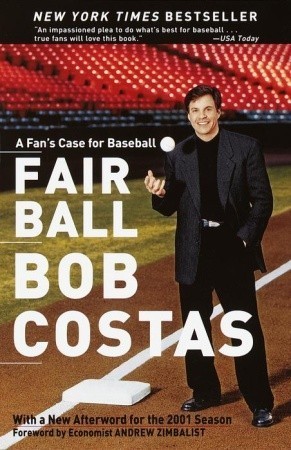
Fair Ball: A Fan's Case for Baseball
From his perspective as a journalist and a true fan, Bob Costas, NBC's award-winning broadcaster, shares his unflinching views on the forces that are diminishing the appeal of major league baseball and proposes realistic changes that can be made to protect and promote the game's best interests.
In this cogent--and provocative--book, Costas examines the growing financial disparities that have resulted in nearly two-thirds of the teams in major league baseball having virtually no chance of contending for the World Series. He argues that those who run baseball have missed the crucial difference between mere change and real progress. And he presents a withering critique of the positions of both the owners and players while providing insights on the wild-card system, the designated-hitter rule, and interleague play. Costas answers each problem he cites with an often innovative, always achievable strategy for restoring genuine competition and rescuing fans from the forces that have diluted the sheer joy of the game.
Balanced by Costas's unbridled appreciation for what he calls the "moments of authenticity" that can still make baseball inspiring, Fair Ball offers a vision of our national pastime as it can be, a game that retains its traditional appeal while initiating thoughtful changes that will allow it to thrive into the next century.
In this cogent--and provocative--book, Costas examines the growing financial disparities that have resulted in nearly two-thirds of the teams in major league baseball having virtually no chance of contending for the World Series. He argues that those who run baseball have missed the crucial difference between mere change and real progress. And he presents a withering critique of the positions of both the owners and players while providing insights on the wild-card system, the designated-hitter rule, and interleague play. Costas answers each problem he cites with an often innovative, always achievable strategy for restoring genuine competition and rescuing fans from the forces that have diluted the sheer joy of the game.
Balanced by Costas's unbridled appreciation for what he calls the "moments of authenticity" that can still make baseball inspiring, Fair Ball offers a vision of our national pastime as it can be, a game that retains its traditional appeal while initiating thoughtful changes that will allow it to thrive into the next century.
197 pages, Paperback
First published January 1, 2000
About the author
Bob Costas
57 books6 followersRobert Quinlan "Bob" Costas is an American sportscaster, on the air for the NBC network since the early 1980s.
Ratings & Reviews
Friends & Following
Create a free account to discover what your friends think of this book!
Community Reviews
Displaying 1 - 30 of 82 reviews

March 31, 2017
Bob Costas, one of the smartest sports commentators of his time, makes his argument for revenue sharing in baseball and for the elimination of the wild-card from post-season consideration.
Basically, he claims that the vast income differential between the large and small market franchises means that small market towns will almost never have an opportunity to fully compete. He points out that in recent history the teams with the highest payrolls are almost always the ones in the playoffs. (There are notable exceptions of course. The Oakland franchise mastered the art of using advanced metrics to get the most bang for their bucks, and there is the KC Royals success of recent vintage.) Of course, a high payroll does not automatically get one onto post-season, but it is a prerequisite for contending. He proposes that both national and a portion of local broadcast and gate revenue be pooled and distributed evenly. This would reduce the top to bottom ratio from one-to-five (as it was between the Yankees and what was then the Montreal Expos) to a less drastic two to one. He also proposes that teams have a minimum player salary budget to ensure that greedy small market owners do not pocket the extra cash. In addition he proposes capping player salaries, while increasing the minimum salary players might receive. The net effect is to put significantly more money into the hands of players, at the expense of the highest paid players.

Bob Costas - from ABC News
He is opposed to radical realignment, claiming that baseball is linked to its history like no other sport, and mixing and matching national and american league teams would be the wrong thing to do. Instead he proposes a slight shuffle that would put the Houston Astros in the American League West. (which did indeed come to pass)
Re playoffs, he contends that the wild card, far from ensuring access to the playoffs for small market teams, has worked to the benefit of big market teams, almost exclusively. He says that there is no clear evidence that attendance figures are enhanced by the increase in the number of contending teams. He claims that the wild card, instead of enhancing the end-of-season races, in fact eliminates them, since what might once have been meaningful games are frequently reduced to exhibitions played by teams who both know they will be in post-season. He proposes instead that there be simple division winners, and no wild card. The team with the best record in the league would get a first round bye, while the second and third place teams play in the first round. There would be fewer games, but they would be more meaningful, and would reward those who finished atop their divisions.
I am not certain I agree with Costas on his proposals. Perhaps it is just the fan in me wanting the Mets to have a chance to make the playoffs each year, while saddled with what was then the Atlanta Braves dominance in their division. But the wild-card does keep me interested in September when I could easily fade away as Atlanta (then) or the Nationals (now) surge to another title. I confess that I am less concerned for the small market teams than Costas. I imagine if lived in one of them I might feel differently. And Billy Beane has shown that smarts can compete with cash. And as for revenue sharing, my only real problem with it is that if players must accept a cap on their salaries, there should be some mechanism by which owners would be capped as well, all, of course, for the good of the game. And while we are at it, baseball executives should be subjected to drug testing as well as players. We would not want executive decisions about our favorite teams being made by people who were under the influence of whatever.
PS - I must add a caveat here. This book was published in 2000, which was when I read it and wrote this. I made small edits to update some details, but it remains as I wrote it a lifetime ago. I have not checked back to see if Costas has changed his views since then.
Basically, he claims that the vast income differential between the large and small market franchises means that small market towns will almost never have an opportunity to fully compete. He points out that in recent history the teams with the highest payrolls are almost always the ones in the playoffs. (There are notable exceptions of course. The Oakland franchise mastered the art of using advanced metrics to get the most bang for their bucks, and there is the KC Royals success of recent vintage.) Of course, a high payroll does not automatically get one onto post-season, but it is a prerequisite for contending. He proposes that both national and a portion of local broadcast and gate revenue be pooled and distributed evenly. This would reduce the top to bottom ratio from one-to-five (as it was between the Yankees and what was then the Montreal Expos) to a less drastic two to one. He also proposes that teams have a minimum player salary budget to ensure that greedy small market owners do not pocket the extra cash. In addition he proposes capping player salaries, while increasing the minimum salary players might receive. The net effect is to put significantly more money into the hands of players, at the expense of the highest paid players.
Bob Costas - from ABC News
He is opposed to radical realignment, claiming that baseball is linked to its history like no other sport, and mixing and matching national and american league teams would be the wrong thing to do. Instead he proposes a slight shuffle that would put the Houston Astros in the American League West. (which did indeed come to pass)
Re playoffs, he contends that the wild card, far from ensuring access to the playoffs for small market teams, has worked to the benefit of big market teams, almost exclusively. He says that there is no clear evidence that attendance figures are enhanced by the increase in the number of contending teams. He claims that the wild card, instead of enhancing the end-of-season races, in fact eliminates them, since what might once have been meaningful games are frequently reduced to exhibitions played by teams who both know they will be in post-season. He proposes instead that there be simple division winners, and no wild card. The team with the best record in the league would get a first round bye, while the second and third place teams play in the first round. There would be fewer games, but they would be more meaningful, and would reward those who finished atop their divisions.
I am not certain I agree with Costas on his proposals. Perhaps it is just the fan in me wanting the Mets to have a chance to make the playoffs each year, while saddled with what was then the Atlanta Braves dominance in their division. But the wild-card does keep me interested in September when I could easily fade away as Atlanta (then) or the Nationals (now) surge to another title. I confess that I am less concerned for the small market teams than Costas. I imagine if lived in one of them I might feel differently. And Billy Beane has shown that smarts can compete with cash. And as for revenue sharing, my only real problem with it is that if players must accept a cap on their salaries, there should be some mechanism by which owners would be capped as well, all, of course, for the good of the game. And while we are at it, baseball executives should be subjected to drug testing as well as players. We would not want executive decisions about our favorite teams being made by people who were under the influence of whatever.
PS - I must add a caveat here. This book was published in 2000, which was when I read it and wrote this. I made small edits to update some details, but it remains as I wrote it a lifetime ago. I have not checked back to see if Costas has changed his views since then.

May 31, 2021
Ok
Fair Ball is And enjoyable read but because it was written in year 2000, it is outdated. So if I transport myself back to the year 2000, I think I have a better understanding of what Barb’s trying to say.
In the end baseball is a business and the owners around to make money! Bob is knowledgeable, engaging, and even-handed. Yet the Overall read can be extremely dry & “boring” at times.
If you are a baseball business and numbers person, this book is for you. For the rest of us, find a synopsis.
I am mildly recommend
Fair Ball is And enjoyable read but because it was written in year 2000, it is outdated. So if I transport myself back to the year 2000, I think I have a better understanding of what Barb’s trying to say.
In the end baseball is a business and the owners around to make money! Bob is knowledgeable, engaging, and even-handed. Yet the Overall read can be extremely dry & “boring” at times.
If you are a baseball business and numbers person, this book is for you. For the rest of us, find a synopsis.
I am mildly recommend

March 10, 2012
Bob Costas gets to the meat of a huge problem for baseball. Or rather a series of problems. Baseball is losing its appeal, and its sense of history, and as it loses those it becomes irrelevant. I am a baseball fan because my parents were baseball fans, and because my dad would play catch with me nearly every spring and summer day after work. (I think I only broke two windows. We would go to games once in a while, and he played on a league team for his work, and I would go to those games...
Sorry for the nostalgia, but that is what baseball should inspire, everyone should have a series of pleasant memories of watching the game, playing the game, and going to the game. We are losing that. I can't afford to take my family to a Giants game very often, and the game loses it appeal on tv because as the book/movie Moneyball rightfully addressed, teams with more money, win, more so then in any other sport. Which takes the drama right out of it, as does the wild card system.
But what I loved about this book was that it presented solutions instead of harping on the problems. I thought his solutions seemed sound, and they addressed all of my disgruntlement with major league baseball.
Sorry for the nostalgia, but that is what baseball should inspire, everyone should have a series of pleasant memories of watching the game, playing the game, and going to the game. We are losing that. I can't afford to take my family to a Giants game very often, and the game loses it appeal on tv because as the book/movie Moneyball rightfully addressed, teams with more money, win, more so then in any other sport. Which takes the drama right out of it, as does the wild card system.
But what I loved about this book was that it presented solutions instead of harping on the problems. I thought his solutions seemed sound, and they addressed all of my disgruntlement with major league baseball.
April 1, 2021
Despite being dated (book is 20 years old and many things in baseball have changed since), Costas still makes salient points regarding the integrity and legacy of the game. This book is just further proof why it was a travesty that it took so long for Costas to win the Frick Award, and EVEN FURTHER proof why Bob Costas should be the Commissioner of baseball.

June 29, 2010
Bob Costas is one of America's best-known baseball, and for that matter, sports broadcasters. He has called numerous World Series, All Star, and League Championship games His book, Fair Ball: A Fan's Case for Baseball offers up thought-provoking and holistic solutions to help restore and maintain competitive balance in Major League Baseball. The 2001 book has some parts which are dated, but many of Fair Play's points remain relevant today.
MLB players, the Players' Union, and baseball's owners are beginning early discussions on the next Collective Bargaining Agreement (CBA). As such,it is a good time to re-examine some of the more contentious labor-management issues. Costas' book gives us a perfect retro platform to do so.
The premise of Fair Ball is that the fans don't really care about the business side of baseball. Yet today, baseball discussions can sometimes be more about the revenue haves vs. the have nots than actual on-the-field play. MLB fans, from New York to Kansas City, want their teams to have the opportunity to compete consistently for the playoffs.
Costas' book, avoids the Polyanna-ish route, to make the point that some teams will make good use of this opportunity while others will squander it through bone-headed trades, bad management, or sheer bad luck. However, it is the opportunity for teams to consistently compete which lies at the heart of Fair Play.
Some of Costas' recommendations include:
--Revenue Sharing -- All teams should share 50% of their TV, Radio, Internet, and Ticket Sales revenue. This still allows successful teams to make more money, but flattens out the huge disparity in local revenues that exists today.
--Salary Cap and Floor - Tied to the revenue sharing and based on a formula, all MLB teams cannot spend beyond a certain point and must spend a minimum amount. The ceiling is two times the amount of the floor. The "luxury tax", baseball's current mechanism to enforce a semblance of salary equity is failing miserably in this area.
--SuperStar Salary Cap - Put a cap on the maximum amount you can pay any one player. This would allow all teams to theoretically compete for the premiere players.
--Tighter Salary Slotting for Younger Players -- Create specific floor and ceiling pay rates for players first coming into the league. Allow teams to "bank" some of their salary cap to lock up prospects according to need as long as they spend, on average across 5 years, withing the floor to ceiling range.
--International Draft -- include international players in a draft. Today, big-market teams are generally the only ones competing for the elite foreign players.
Readers might correctly point out that some small market teams have been able to compete, some even consistently so, for the playoffs. While this is true, there are many more small-market teams that don't compete at all and this has harmed the value of many of these franchises and thus, the game's overall value.
Others may believe that baseball is a business, should be subject to free market competition, and that Fair Play's recommendations smack of socialism. The belief that baseball exists in a free market is completely non-sensical. Baseball enjoys many restrictive covenants (e.g. territorial rights, centralized TV contracts) that limit competition. Each club's welfare is intrinsically tied to one another-a rising tide that lifts all boats, so to speak.
Because the book is somewhat dated, some of Costas' suggestions have already been implemented and others might not seem as urgent as they did several years ago. However, on balance, the book makes a number of important common-sense suggestions to improve the game without dramatically altering all that is good about our national pastime.
I am an unabashed Bob Costas fan. He has a wonderful ability to combine the history of the game into today's discussion. Some have even gone as far to suggest he would make a good Commissioner when Bud Selig's term comes to an end. While not likely, I would second that sentiment.
Books on Baseball Rating -- Triple (Would have been a home run had I read it when it was first written)
Costas has recently joined the MLB Network and can be heard calling games on the network's Thursday Night Baseball broadcasts. He also produces Studio 42 for the network. This program, which garnered an Emmy Nomination for Best Weekly Sports Show, takes a detailed looks at various historical games, teams, and situations. Studio 42 has featured Cal Ripken, Willie Mays, Richie "Dick" Allen, Bob Gibson and Tim McCarver, Ernie Harwell, Don Larsen and Yogi Berra, and MLB Umpires.
MLB players, the Players' Union, and baseball's owners are beginning early discussions on the next Collective Bargaining Agreement (CBA). As such,it is a good time to re-examine some of the more contentious labor-management issues. Costas' book gives us a perfect retro platform to do so.
The premise of Fair Ball is that the fans don't really care about the business side of baseball. Yet today, baseball discussions can sometimes be more about the revenue haves vs. the have nots than actual on-the-field play. MLB fans, from New York to Kansas City, want their teams to have the opportunity to compete consistently for the playoffs.
Costas' book, avoids the Polyanna-ish route, to make the point that some teams will make good use of this opportunity while others will squander it through bone-headed trades, bad management, or sheer bad luck. However, it is the opportunity for teams to consistently compete which lies at the heart of Fair Play.
Some of Costas' recommendations include:
--Revenue Sharing -- All teams should share 50% of their TV, Radio, Internet, and Ticket Sales revenue. This still allows successful teams to make more money, but flattens out the huge disparity in local revenues that exists today.
--Salary Cap and Floor - Tied to the revenue sharing and based on a formula, all MLB teams cannot spend beyond a certain point and must spend a minimum amount. The ceiling is two times the amount of the floor. The "luxury tax", baseball's current mechanism to enforce a semblance of salary equity is failing miserably in this area.
--SuperStar Salary Cap - Put a cap on the maximum amount you can pay any one player. This would allow all teams to theoretically compete for the premiere players.
--Tighter Salary Slotting for Younger Players -- Create specific floor and ceiling pay rates for players first coming into the league. Allow teams to "bank" some of their salary cap to lock up prospects according to need as long as they spend, on average across 5 years, withing the floor to ceiling range.
--International Draft -- include international players in a draft. Today, big-market teams are generally the only ones competing for the elite foreign players.
Readers might correctly point out that some small market teams have been able to compete, some even consistently so, for the playoffs. While this is true, there are many more small-market teams that don't compete at all and this has harmed the value of many of these franchises and thus, the game's overall value.
Others may believe that baseball is a business, should be subject to free market competition, and that Fair Play's recommendations smack of socialism. The belief that baseball exists in a free market is completely non-sensical. Baseball enjoys many restrictive covenants (e.g. territorial rights, centralized TV contracts) that limit competition. Each club's welfare is intrinsically tied to one another-a rising tide that lifts all boats, so to speak.
Because the book is somewhat dated, some of Costas' suggestions have already been implemented and others might not seem as urgent as they did several years ago. However, on balance, the book makes a number of important common-sense suggestions to improve the game without dramatically altering all that is good about our national pastime.
I am an unabashed Bob Costas fan. He has a wonderful ability to combine the history of the game into today's discussion. Some have even gone as far to suggest he would make a good Commissioner when Bud Selig's term comes to an end. While not likely, I would second that sentiment.
Books on Baseball Rating -- Triple (Would have been a home run had I read it when it was first written)
Costas has recently joined the MLB Network and can be heard calling games on the network's Thursday Night Baseball broadcasts. He also produces Studio 42 for the network. This program, which garnered an Emmy Nomination for Best Weekly Sports Show, takes a detailed looks at various historical games, teams, and situations. Studio 42 has featured Cal Ripken, Willie Mays, Richie "Dick" Allen, Bob Gibson and Tim McCarver, Ernie Harwell, Don Larsen and Yogi Berra, and MLB Umpires.

March 1, 2012
Costas' book is mostly an analysis of the economic and structural organization of MLB, what's wrong with it and how it might be fixed.
The focus is on the economic disparity that seems to have increased after the strike of '94-'95, and with it, a loss of competitive balance among the league's teams.
I found myself convinced by nearly every one of Costas' arguments, largely because the statistics make his indictments nearly undeniable: for example, for the six years after the strike, 10 of the 12 World Series competitors were in the top five payrolls in the majors, and the two that weren't came in at 7th and 10th in the payroll rankings. Costas argues that with the MLB economic structure as it exists (as of 2000), there are some teams that simply have no chance of competing for the end-of-the-season prize.
Of course, his book having been published in 2000, it is clearly outdated in some aspects, and I'm sure the economic structure has been through some changes since then, but for the most part each season still confirms this pitiful imbalance in competitive opportunity. A chance to win is stacked crazily in favor of the teams with the most money to blow. Of course, this actually reflects the capitalistic values of the U.S., but in baseball these values have tragic results. The goal in baseball is not to put other teams out of business; the best interest of the league as a whole is to have a high and balanced level of competition.
It's hard to be a fan in a small market and not get royally pissed off each season when big bully organizations with money take our potential stars from us and consistently have a payroll three to fives times higher than we do each year.
Whatever. Go Royals!
The focus is on the economic disparity that seems to have increased after the strike of '94-'95, and with it, a loss of competitive balance among the league's teams.
I found myself convinced by nearly every one of Costas' arguments, largely because the statistics make his indictments nearly undeniable: for example, for the six years after the strike, 10 of the 12 World Series competitors were in the top five payrolls in the majors, and the two that weren't came in at 7th and 10th in the payroll rankings. Costas argues that with the MLB economic structure as it exists (as of 2000), there are some teams that simply have no chance of competing for the end-of-the-season prize.
Of course, his book having been published in 2000, it is clearly outdated in some aspects, and I'm sure the economic structure has been through some changes since then, but for the most part each season still confirms this pitiful imbalance in competitive opportunity. A chance to win is stacked crazily in favor of the teams with the most money to blow. Of course, this actually reflects the capitalistic values of the U.S., but in baseball these values have tragic results. The goal in baseball is not to put other teams out of business; the best interest of the league as a whole is to have a high and balanced level of competition.
It's hard to be a fan in a small market and not get royally pissed off each season when big bully organizations with money take our potential stars from us and consistently have a payroll three to fives times higher than we do each year.
Whatever. Go Royals!

January 4, 2012
While this is not quite a novel that will go down as one of the greats, it is definitely interesting in a time when sports is such a major part of our society. Even those people who are not major fans recognize that baseball, “America’s pastime” has changed over the last few years and is no longer the sport that many grandfathers and fathers remember from their youths. This book gives a good, well-presented, argument on how baseball needs to change if it wants to stay “America’s pastime.” As a person who may not love baseball but loves the American that it represents, I hope that baseball officials will listen to Costas and make it something that can regain its lost strength in the future.

August 10, 2011
If you consider baseball to be an administrative/business model mess but still love the game, this is the book for you. Though some of his ideas are now dated, Costas puts forward a new business model that would right the policies that are slowing strangling the game. A couple of these ideas were adopted already, most will probably never be adopted even though they should, and a few may be adopted in the future. I don’t agree with everything in this book, but Costas’s ideas are worth considering. Baseball is beautiful, but it is a mess and an amass of selfishness and greed.

September 15, 2008
Classic Costas. Well thought out, ideas clearly presented, creative. I love his cases for MLB realignment, different scheduling, and revenue sharing.

September 24, 2017
An interesting read, particularly in retrospect, since the book's premise is "here's what baseball should do entering its next labor negotiations."
Many of the suggestions are prescient, but the arguments for some are belabored. On more than one occasion I felt like Costas was trying to bolster his contention simply by the volume of his rhetoric rather than by the strength and wisdom of his position. In talking about playoffs in particular, his perspective, while possibly valid, is not backed by irrefutable evidence as much as by opinion and, unfortunately for his case, belittling.
But for the most part his arguments make sense and were subsequently adopted and implemented.
And here is the thing most interesting to me: to read someone's perspective prior to adoption of his points makes one wonder to what extent this book impacted today's game. There is an update at the end of the edition I read, added after the collective bargaining agreement and including more information.
Costas is a great commentator on the game and a good writer. To step back in time and see what could have been as well as what was changed is interesting.
A good read, though its title is a bit misleading. It's not so much a case for baseball as a case for changes in baseball. The former would be even more timeless - Costas should write that, too.
And if you like the history of baseball management it is a very good read.
Many of the suggestions are prescient, but the arguments for some are belabored. On more than one occasion I felt like Costas was trying to bolster his contention simply by the volume of his rhetoric rather than by the strength and wisdom of his position. In talking about playoffs in particular, his perspective, while possibly valid, is not backed by irrefutable evidence as much as by opinion and, unfortunately for his case, belittling.
But for the most part his arguments make sense and were subsequently adopted and implemented.
And here is the thing most interesting to me: to read someone's perspective prior to adoption of his points makes one wonder to what extent this book impacted today's game. There is an update at the end of the edition I read, added after the collective bargaining agreement and including more information.
Costas is a great commentator on the game and a good writer. To step back in time and see what could have been as well as what was changed is interesting.
A good read, though its title is a bit misleading. It's not so much a case for baseball as a case for changes in baseball. The former would be even more timeless - Costas should write that, too.
And if you like the history of baseball management it is a very good read.
March 3, 2024
It is very interested to read this book some 24 years later. I wasn’t alive for the strike and was too young to understand the consequences of it. The points brought up are interesting and it is intriguing to see them through a modern lense where the issues expressed were either dealt with, adapted with by the teams, or still felt today. I have to be honest that I am not a huge fan of Costas’s rigid “know it all” tone. Though he does make efforts at times to address the other side of his arguments, he still leaves many arguments with a, “because I said so,” type feel to his justifications (especially in chapter 10). However, perspective is everything and I didn’t read this book to prove anything or anyone right or wrong. Overall, I appreciate that he decided to speak up and bring up real points of contention in the spirit of trying to make baseball better. We can all learn a thing or two from his perspective and overall sentiments of the sport and league.

January 14, 2025
I kept wanting to think he’s an out of touch loser but I wound up being mostly convinced. Baseball is weirdly obsessed with making small changes like the pitch clock and making the bases bigger that might make individual games more interesting on a micro level but that largely compensate for the fact that the regular season is not that interesting anymore.
I didn’t really understand why he’s so opposed to expansion when it seems like 8 divisions with 4 teams each where the winner goes to the DS (and no wild cards) would be a workable solution to make everyone happy but he just calls these “farcical mini divisions” or something to that effect.
Idk maybe you just have to like baseball more than I do to really enjoy this.
I didn’t really understand why he’s so opposed to expansion when it seems like 8 divisions with 4 teams each where the winner goes to the DS (and no wild cards) would be a workable solution to make everyone happy but he just calls these “farcical mini divisions” or something to that effect.
Idk maybe you just have to like baseball more than I do to really enjoy this.

December 4, 2017
Read just like Costas speaks - a good thing.
The only reason I finished was that I am cheating and putting it on my Book Riot 2016 Reading Challenge list. It was dumb that I couldn't seem to finish a book about sports! This is super-dated, and I really don't know how things stand now with revenue sharing and making the playoffs more meaningful. To the extent that I understood his arguments, I agree with his solutions, but this book is 20 years out of date; the only reason to consult it now would be To see what people back in the late 90s thought about the state of baseball.
The only reason I finished was that I am cheating and putting it on my Book Riot 2016 Reading Challenge list. It was dumb that I couldn't seem to finish a book about sports! This is super-dated, and I really don't know how things stand now with revenue sharing and making the playoffs more meaningful. To the extent that I understood his arguments, I agree with his solutions, but this book is 20 years out of date; the only reason to consult it now would be To see what people back in the late 90s thought about the state of baseball.

March 28, 2020
Beloved and smart, Bob Costas gives his prescription for saving baseball. Two thirds of the book outlines his plan to bring back competitive equity among the teams, by implementing a revenue sharing plan that reduces the disparity between baseball’s haves and have-nots. In the last third, he ruminates on his opposition to the wild card, and designated hitter. All great ideas, but with the benefit of twenty years hindsight, the game continues down the road that Costas warned about.
January 26, 2026
3.5 rating. Bob Costas makes some valid rationales for changing the way MLB runs its business. Some of the reading is a bit technical, and although I love baseball, I don't have that 'sports-memory' that instantly recalls facts from previous years. I just had to take his word on many of the scenarios.
It is also important to note that this book was published 25 years ago so some of the events noted have happened, but many have not. Interesting read if you're into this sort of stuff.
It is also important to note that this book was published 25 years ago so some of the events noted have happened, but many have not. Interesting read if you're into this sort of stuff.

February 23, 2020
Way past due on the review, read this when it first came out.
Many of the things Bob Costas asked for have happened in some form or another.
The rich getting richer and the poor getting poorer (and losing more) has gotten better.
Not sure baseball will ever have a salary cap like the NFL, but the parity is getting better and THIS BOOK has a lot to do with it.
Many of the things Bob Costas asked for have happened in some form or another.
The rich getting richer and the poor getting poorer (and losing more) has gotten better.
Not sure baseball will ever have a salary cap like the NFL, but the parity is getting better and THIS BOOK has a lot to do with it.

November 8, 2022
Always meant to read this book since it came out 20 years ago. I enjoyed it even all these years later. Bob Costas provides well thought through suggestions on improving baseball. Although a few points are outdated in today's context, many other are there for players and owners to incorporate into today's game. Very nice read.

November 11, 2022
Granted this take on Major League Baseball was published in 2000 and a lot has changed in 22 years.
I enjoyed Costas' writing style and insight into what was necessary to help MLB be a healthy organization and keep its fanbase. It was interesting to see what changes MLB owners and players did and did not make over the past decades.
I enjoyed Costas' writing style and insight into what was necessary to help MLB be a healthy organization and keep its fanbase. It was interesting to see what changes MLB owners and players did and did not make over the past decades.

December 29, 2023
This while dated is still relevant . The outrageous spending of the Shohei Ohtani deal is emblematic of the ridiculous salary and inequity of the current MLB. System. The playoff system, the DH and other facets of the current system are examined and are well worth considering. You may not agree but the ideas are worth thinking about.

April 15, 2024
If you are really into super inside baseball baseball, this is the book for you, especially if you want to learn more about 1990s MLB issues. I think I know more than the average person about baseball and this got waaaaay too deep for me on more than one occasion.
Costas knows his stuff then and now- the book holds up 24 years later.
Costas knows his stuff then and now- the book holds up 24 years later.

June 24, 2019
I love the game of baseball, so enjoyed reading this. Since it was written almost 20 years ago, I am not sure how revenue sharing currently works. He did foresee the 3 divisions in each league with Houston moving to the AL. I like his ideas on getting rid of the wild card!
November 12, 2019
I don't care enough about baseball to know whether these sensible suggestions were followed, but it seems like Major League Baseball is broken past the point where it could be fixed, which makes me sad for people like Bob Costas who love the game so much.
May 17, 2020
Fascinating look at ways that would have improved baseball in a variety of ways, both for those actually involved in the game, as well as the fans. Unfortunately, very few of these suggestions were implemented. Well worth reading.
April 2, 2021
A re-read gor me. It feels dated because the money numbers he discusses re player salaries and revenues are from c. 2000, but the concepts still hold. He should have been named commissioner a long time ago.

August 4, 2022
A very well thought out look at the state of baseball in 2001, with many suggestions for improving the game. Bob Costas predicted the move of the Houston Astros from the National League to the American League.

November 30, 2023
Short read with interesting points. They did end up moving the Astros to theAL but they have expanded the playoffs even more and adopted the DH in the NL. I haven’t watched a full game in along time. I hope I can get back to watching and enjoying it.
April 3, 2024
This was interesting to read close to 25 years after the fact to see what things Costas hated back then that have become even more prevalent now. Most of his arguments were decent, though a few he was a bit obnoxious about, while a few other arguments felt weak.
May 4, 2026
The 3 rating is mostly because it is outdated (plus, it would have benefited from a bit more editing). That said, I would love to read a sequel as we approach the 2027 season and another round of labor negotiations. I promise I will give that a 5 if Costas writes that!

September 27, 2017
Bob Costas has great insights on America's favorite past time.

October 7, 2017
Can't do it...can't bring myself to keep reading this. It is outdated, boring and not worth the time I wasted on it. Sorry Mr. Costas, you seem like a good guy, who's trying, but I'm done...
Displaying 1 - 30 of 82 reviews