

What do you think?

The Caped Crusade: Batman and the Rise of Nerd Culture
“A roaring getaway car of guilty pleasures” (The New York Times Book Review), Glen Weldon’s The Caped Crusade is a fascinating, critically acclaimed chronicle of the rises and falls of one of the world’s most iconic superheroes and the fans who love him—now with a new afterword.Since his debut in Detective Comics #27, Batman has been many a two-fisted detective; a planet-hopping gadabout; a campy Pop Art sensation; a pointy-eared master spy; and a grim ninja of the urban night. Yet, despite these endless transformations, he remains one of our most revered cultural icons. In this “smart, witty, and engrossing” (The Wall Street Journal) cultural critique, NPR contributor and book critic Glen Weldon provides “a sharp, deeply knowledgeable, and often funny look at the cultural history of Batman and his fandom” (Chicago Tribune) to discover why it is that we can’t get enough of the Dark Knight. For nearly a century, Batman has cycled through eras of dark melodrama and light comedy and back again. How we perceive his character, whether he’s delivering dire threats in a raspy Christian Bale growl or trading blithely homoerotic double entendres with Robin the Boy Wonder, speaks to who we are and how we wish to be seen by the world. It’s this endless adaptability that has made him so lasting, and ultimately human. But it’s also Batman’s fundamental nerdiness that uniquely resonates with his fans and makes them fiercely protective of him. As Weldon charts the evolution of Gotham’s Guardian from Bob Kane and Bill Finger’s hyphenated hero to Christopher Nolan’s post-9/11 Dark Knight, he reveals how this symbol of justice has made us who we are today and why his legacy remains so strong. The result is “possibly the most erudite and well-researched fanboy manifesto ever” (Booklist). Well-researched, insightful, and engaging, The Caped Crusade, with a new afterword by the author, has something for “If you’re a Bat-neophyte, this is an accessible introduction; if you’re a dyed-in-the-Latex Bat-nerd, this is a colorfully rendered magical history tour redolent with nostalgia” (The Washington Post).
337 pages, Kindle Edition
First published March 22, 2016
About the author
Glen Weldon
12 books183 followersGlen Weldon is a contributor to NPR's pop culture blog Monkey See, where he posts weekly about comics and comics culture. He also reviews books and movies for NPR.org and is a regular panelist on NPR's Pop Culture Happy Hour podcast.
Over the course of his career, he has spent time as a theater critic, a science writer, an oral historian, a writing teacher, a bookstore clerk, a PR flack, a seriously terrible marine biologist and a slightly better-than-average competitive swimmer.
Weldon is the author of Superman: The Unauthorized Biography, a cultural history of the iconic characte. His fiction and criticism have appeared in The Philadelphia Inquirer Magazine, Story, The Iowa Review, McSweeney's Internet Tendency, The Dallas Morning-News, Washington City Paper, Quarterly West, the American Literary Review and many other publications. He received an NEA Arts Journalism Fellowship, a Ragdale Writing Fellowship and a PEW Fellowship in the Arts for Fiction.
Over the course of his career, he has spent time as a theater critic, a science writer, an oral historian, a writing teacher, a bookstore clerk, a PR flack, a seriously terrible marine biologist and a slightly better-than-average competitive swimmer.
Weldon is the author of Superman: The Unauthorized Biography, a cultural history of the iconic characte. His fiction and criticism have appeared in The Philadelphia Inquirer Magazine, Story, The Iowa Review, McSweeney's Internet Tendency, The Dallas Morning-News, Washington City Paper, Quarterly West, the American Literary Review and many other publications. He received an NEA Arts Journalism Fellowship, a Ragdale Writing Fellowship and a PEW Fellowship in the Arts for Fiction.
Ratings & Reviews
Friends & Following
Create a free account to discover what your friends think of this book!
Community Reviews
Displaying 1 - 30 of 540 reviews

May 26, 2017
Let's open this review with the hilarious Lego Batman's self composed death metal song--which should have been the theme song for all of the Batman movies! (Youtube video here: https://www.youtube.com/watch?v=pqv_L...
And who can forget the followinginfamous famous line from Frank Miller's All Star Batman & Robin, the Boy Wonder?

(Link: http://jsos.deviantart.com/art/I-am-t...)
You think 'I'm Batman' is so badass?
Hell nooooo....you had seen nothing yet....it isn't how it should be uttered...
How would you put the first ever appearance of Batman (he was called Bat-Man back then) in the history of comic book?
As for myself, I think I first encountered Batman when I watched Tim Burton's two Batman movies from the 1990s as a child, I only started seriously read some Batman comics in the last few years. (Arkham Asylum: A Serious House on Serious Earth is my first serious Bat-reading material.)
And look, I watched both Batman Forever and Batman & Robin when I was a kid (most likely it was my dad who rented the videos out of the purpose of family bonding) I don't think Batman Forever is so bad, but Batman & Robin is just so...........hilariously bad and stupid, even in my then-child's-eyes.
Plus, the Bat-nipples and Bat-asses do look ridiculous, although when I first watched the movies as a kid, I never noticed they were there.
Batman & Robin Honest Trailer!
https://www.youtube.com/watch?v=FCS_k...
The Batman fanboys' hatred toward director Joel Schumacher is just so legendary.
Now to think about it, the few episodes of Batman the animated series (which Glen Weldon praised into the high heavens, with good reasons) from the 1990s which I'd manged to watch on TV are probably the first ever Gothic+crime-noir anime I'd ever watched.

(Link: https://giphy.com/gifs/batman-comics-...)
Now look at this Intro! It's basically Gothic+crime-noir plays into the mother fucking perfection! https://www.youtube.com/watch?v=oQVC2...
Favorite Batman the Animated Series Moments: https://www.youtube.com/watch?v=mq5vN...
5 stars. The blurb calls it a 'A witty, intelligent cultural history' book and I totally agree. Now I know more about the reasons behind the gay-reading of Batman (aside from the obvious reasons such as B-man's masculine body, skin-tight outfit, his young sidekick Robin and how the two are living together). LOL
The Camp Crusader or The Caped Crusader? You pick!
Well, I have no problem with Bruce being handsome when he is dating Selina Kyle. Selina deserves the best. XD
To be frank, there are so many visions of Batman, and people tend to be divided about what the Bat stands for:
Shut it, Talia al Ghul/Grant Morrison! I want Batman battling mental patients, that's what I want; not some international terrorists or spies! LOL
Batman: The Brave and the Bold is so amazing!!! LOL
PS: Although I don't believe 100% that Batman is gay or bisexual...but it makes me LOL so hard when some of these diehard straight male Bat-fans deny so desperately that Batman is even the slightest bit of gay. LOL
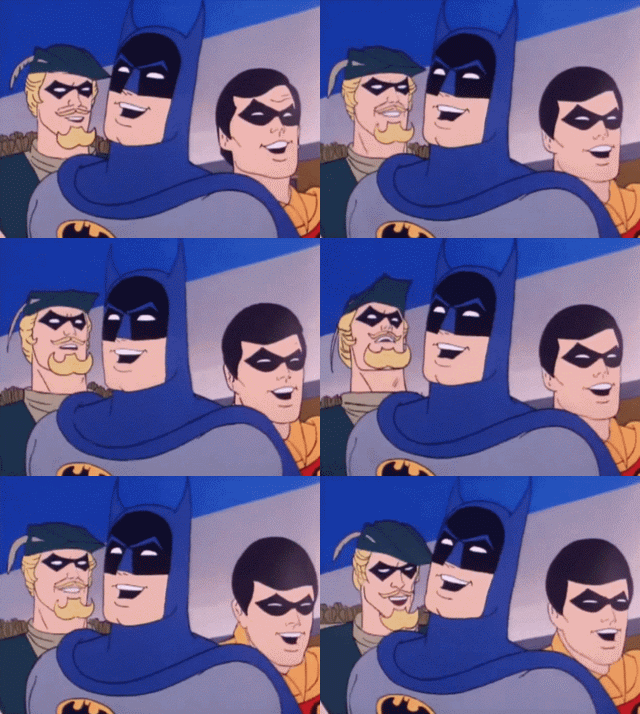
(LINK: http://imgur.com/gallery/pVtz4x2)
PSS: I also learned from this book that to many nerds, the 80 years journey of Batman is a long progress of him being viewed as a character for kids developing into him being viewed as a grim n' gritty serious character who is badass and should be taken seriously by adults, and definitely NOT gay. LOL
See the nerds struggling so hard to be 'taken seriously' by the mainstream and then once the mainstream started paying a lot more attention to the B-man, then suddenly the nerds realized the mainstream wasn't projecting their version of the 'serious, grim-and-gritty' B-man and they screamed 'This is not my Batman!', I think I can relate to that feeling. XD

(LINK: https://giphy.com/gifs/fox-batman-got...)
PSSS: I really, really need to see the live-action movie of Under the Hood! Or......just give me the animated version of The Long Halloween and Dark Victory already!
After thought@20/06/2017:
Off topic! But yesterday, when I saw a news article interviewing a gay man who voted for Donald Trump and the guy, was letdown when Trump said nothing in supporting Pride Month, my reaction to it is to LOL, like the Joker himself.
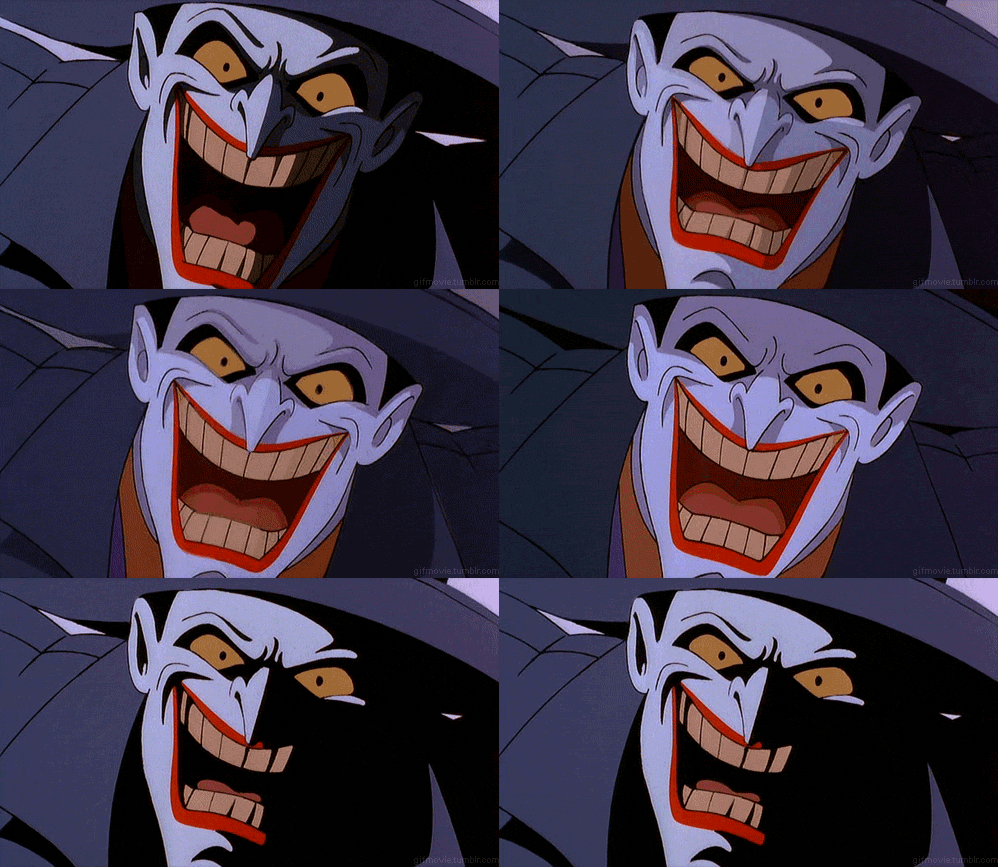
(LINK: https://giphy.com/gifs/joker-movie-re...)
Edited@01/06/2019:
On pg. 213, the author of this book, Glen Weldon, freely admits he is one of the 5000+ who had voted on the telephone hotline that Jason Todd, the second Robin, should die.
Now, I'm impressed, I'm really and seriously impressed. LOL
Extra:
Fun fact no.1: Batman and Robin had survived WWII, but they almost didn't make it through homophobia. LOL
Fun fact no.2: The Dinosaur specimen has been in the Batcave ever since 1947!
Fun fact no.3: Ace the Bat-Hound has been around since the 1950s!
Darkness!
No parents!
Continued Darkness!
Get it?
The opposite of light!"
And who can forget the following
(Link: http://jsos.deviantart.com/art/I-am-t...)
You think 'I'm Batman' is so badass?
Hell nooooo....you had seen nothing yet....it isn't how it should be uttered...
How would you put the first ever appearance of Batman (he was called Bat-Man back then) in the history of comic book?
“Detective Comic #27: The very first glimpse we get of the guy and already he looks pissed.”
As for myself, I think I first encountered Batman when I watched Tim Burton's two Batman movies from the 1990s as a child, I only started seriously read some Batman comics in the last few years. (Arkham Asylum: A Serious House on Serious Earth is my first serious Bat-reading material.)
And look, I watched both Batman Forever and Batman & Robin when I was a kid (most likely it was my dad who rented the videos out of the purpose of family bonding) I don't think Batman Forever is so bad, but Batman & Robin is just so...........hilariously bad and stupid, even in my then-child's-eyes.
Plus, the Bat-nipples and Bat-asses do look ridiculous, although when I first watched the movies as a kid, I never noticed they were there.
Batman & Robin Honest Trailer!
https://www.youtube.com/watch?v=FCS_k...
The Batman fanboys' hatred toward director Joel Schumacher is just so legendary.
Now to think about it, the few episodes of Batman the animated series (which Glen Weldon praised into the high heavens, with good reasons) from the 1990s which I'd manged to watch on TV are probably the first ever Gothic+crime-noir anime I'd ever watched.
(Link: https://giphy.com/gifs/batman-comics-...)
Now look at this Intro! It's basically Gothic+crime-noir plays into the mother fucking perfection! https://www.youtube.com/watch?v=oQVC2...
Favorite Batman the Animated Series Moments: https://www.youtube.com/watch?v=mq5vN...
5 stars. The blurb calls it a 'A witty, intelligent cultural history' book and I totally agree. Now I know more about the reasons behind the gay-reading of Batman (aside from the obvious reasons such as B-man's masculine body, skin-tight outfit, his young sidekick Robin and how the two are living together). LOL
The Camp Crusader or The Caped Crusader? You pick!
"I always had trouble with the Bruce Wayne in the comic book," Burton said. "I mean, if this guy is so handsome, so rich, and so strong, why the fuck is he putting on a Batsuit?"
-Tim Burton on Bruce Wayne
Well, I have no problem with Bruce being handsome when he is dating Selina Kyle. Selina deserves the best. XD
To be frank, there are so many visions of Batman, and people tend to be divided about what the Bat stands for:
"You with your jokers and riddlers, your evil doctors. All those grotesque mental patients you choose to 'match wits' with. You will never rise above them. You'll play in the mud for the rest of your life."
Shut it, Talia al Ghul/Grant Morrison! I want Batman battling mental patients, that's what I want; not some international terrorists or spies! LOL
FANBOY: I would say Batman was best suited in the role of gritty urban crime detective, but now you guys have him up against Santas? And EASTER BUNNIES? I'm sorry! That's not my Batman!
BAT-MITE: (reading from a card handed to him by the show's producers) "Batman's rich history allows him to be interpreted in a multitude of ways. To be sure, this is a lighter incarnation, but it's certainly no less valid and true to the character's root as [sic] the tortured avenger crying out for Mommy and Daddy."
page. 282
Batman: The Brave and the Bold is so amazing!!! LOL
PS: Although I don't believe 100% that Batman is gay or bisexual...but it makes me LOL so hard when some of these diehard straight male Bat-fans deny so desperately that Batman is even the slightest bit of gay. LOL
(LINK: http://imgur.com/gallery/pVtz4x2)
PSS: I also learned from this book that to many nerds, the 80 years journey of Batman is a long progress of him being viewed as a character for kids developing into him being viewed as a grim n' gritty serious character who is badass and should be taken seriously by adults, and definitely NOT gay. LOL
See the nerds struggling so hard to be 'taken seriously' by the mainstream and then once the mainstream started paying a lot more attention to the B-man, then suddenly the nerds realized the mainstream wasn't projecting their version of the 'serious, grim-and-gritty' B-man and they screamed 'This is not my Batman!', I think I can relate to that feeling. XD
(LINK: https://giphy.com/gifs/fox-batman-got...)
PSSS: I really, really need to see the live-action movie of Under the Hood! Or......just give me the animated version of The Long Halloween and Dark Victory already!
After thought@20/06/2017:
Off topic! But yesterday, when I saw a news article interviewing a gay man who voted for Donald Trump and the guy, was letdown when Trump said nothing in supporting Pride Month, my reaction to it is to LOL, like the Joker himself.
(LINK: https://giphy.com/gifs/joker-movie-re...)
Edited@01/06/2019:
On pg. 213, the author of this book, Glen Weldon, freely admits he is one of the 5000+ who had voted on the telephone hotline that Jason Todd, the second Robin, should die.
Now, I'm impressed, I'm really and seriously impressed. LOL
Extra:
Fun fact no.1: Batman and Robin had survived WWII, but they almost didn't make it through homophobia. LOL
Fun fact no.2: The Dinosaur specimen has been in the Batcave ever since 1947!
Fun fact no.3: Ace the Bat-Hound has been around since the 1950s!

March 28, 2016
So just who, or what, is Batman?
Is he the dark prowler of the night that protected the rich from working class thieves (often throwing them gleefully off tall buildings) as he was originally conceived back in the 1930's?

Is he the wacky Adam West character whose TV show showed the lighter side of the caped crusader and introduced America to the Batusi?

Maybe he is Frank Miller's borderline psychotic and abusive dark knight.

Perhaps the more toned down, but iconic Batman from the animated series.
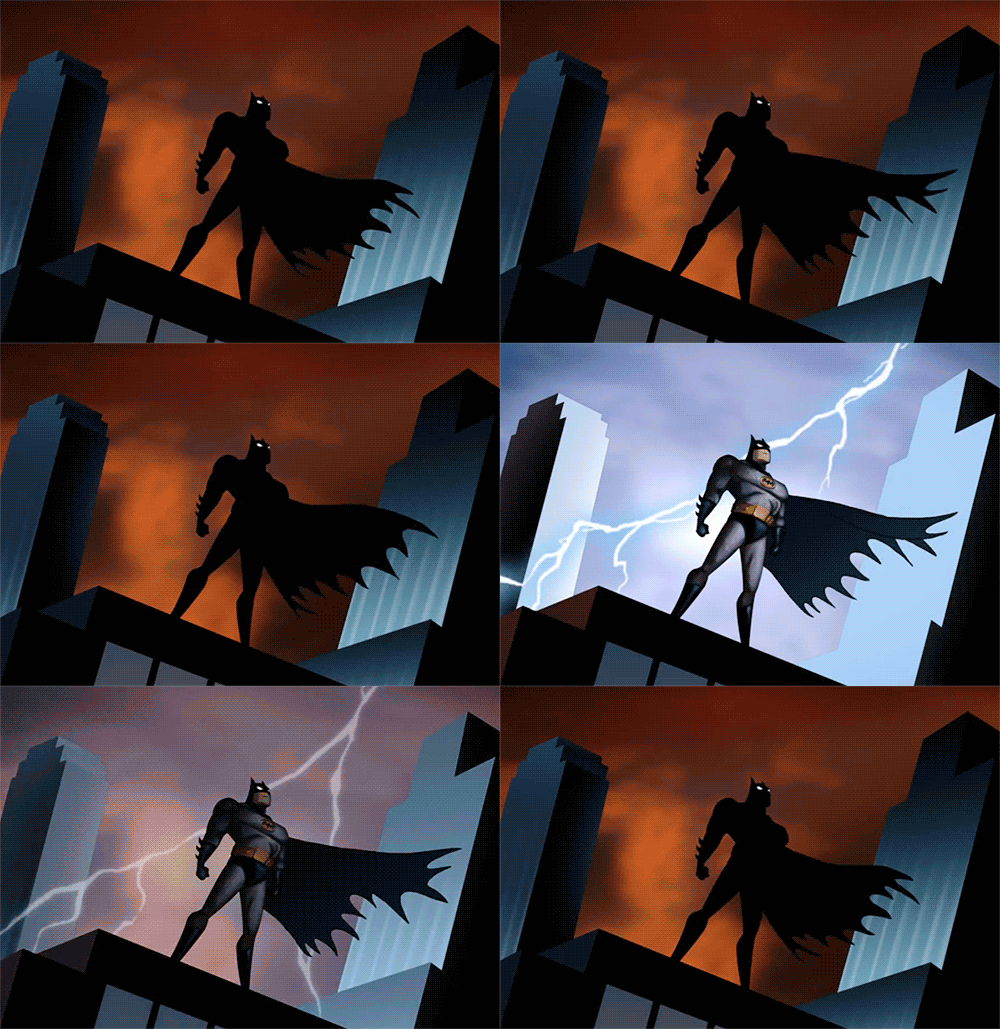
Or heck, maybe he is a lego character
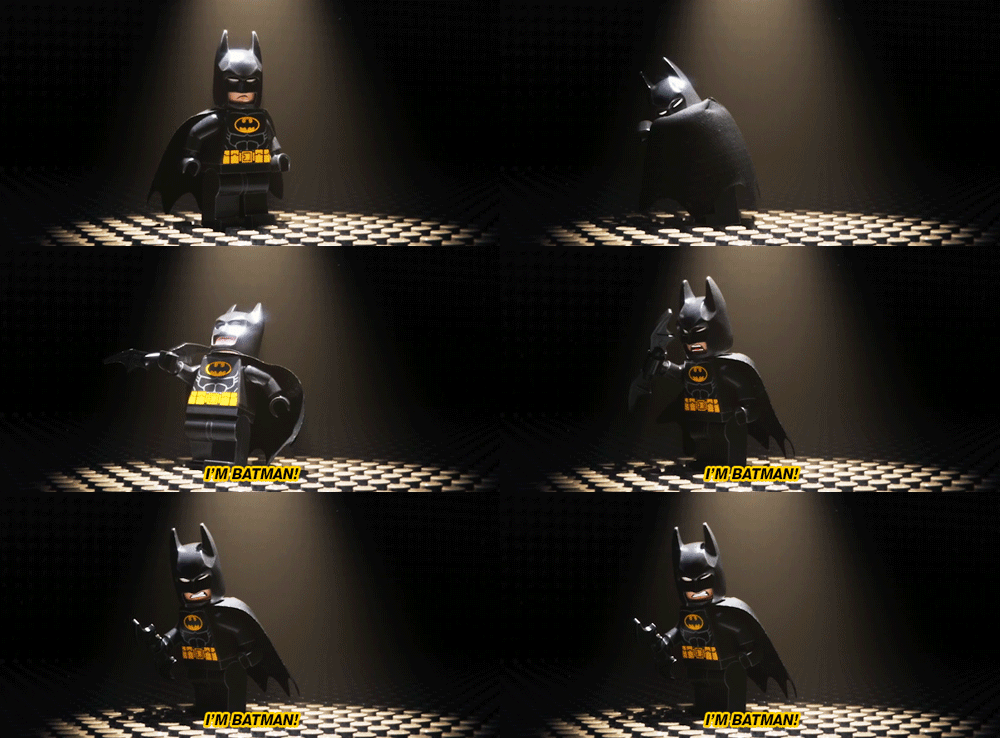
Batman is all of these and many more. He is a character that was first conceived in the late thirties, a veritable Frankenstein's monster of existing characters sown together to add one more cape to an already crowded comic book landscape. The fact that he has survived and thrived over the course of his 75+ years existence is a fascinating story with many twists and turns. Weldon does a very admirable job telling the story of Batman, the character and the idea, as well as he place within nerd culture.
I was never into the Batman comics. I am more of a Marvel/X-Men guy. My formative experience with this icon was Batman: the Animated series and the 1990's movies (batnipple and all). I didn't really have much of a dog in this fight but I still found the story of Batman (or The Bat-Man as he was originally known) to be really neat and insightful into the larger history comic books and super heroes.
Batman has worn many masks over the years ranging from campy and light best epitomized by the 1960's TV show

(Some days you just can't get rid of a bomb)
To dark and brooding as seen in Frank Miller's The Dark Knight Returns.
As much as some corners of nerdom might lay claim to the One, True Batman, there truly isn't one. The badass, psychopathic loner is just as much batman as Adam West's wacky hero. Batman evolves, and changes with society reflecting different facets of it. While there may be some defining pillars of the character (dead parents, oath to fight all crime, bat imagery, etc.) there is plenty of room for different, equally authentic Batmans (Batmen?) to manifest. One over arching theme Weldon brings up is that with each change or deviation from some imagined ideal the nerd community unites in a single voice proclaiming "That's not MY Batman."
Weldon's approach to this subject was very chronological. The book steps through Batman during key periods of his existence and discusses how and why the changes came about. Sometimes they were internal, where the editors might have wanted a lighter, more family friendly story and add Robin, the boy wonder sidekick. Other times it is external with the introduction of the Comic's Code.
Often times the splitting of Batman into different mediums, notably film, led to drastic tonal differences between the comics and the movies. Movies which had an exponentially larger audience and exposure than the comics. Naturally this was not always for the best:
Batman has a very rich, if often overlooked history. When trying to defend a One, True Batman (typically a brooding loner (no sidekicks here!) who punches people and is such a badass he can do toe to toe with near gods and easily win), fans will typically ignore the parts of Batman's long history that strays from this ideal. Weldon shows the many faces of the caped crusader and explains how they came to pass and what part they play in the overarching Batman mythos. I found Weldon's insights and analysis of the character over the decades both enlightening and fascinating. Batman has been both the loner and the head of an extended bat family (including Batdog!). He has been both a badass vigilante and a Leave-it-to-Beaver brightly clad associate of the police. He has both joyfully killed and eschewed killing as an absolute. And don't even get me started on the many, many, MANY gay undertones of the character over its entire history. Batman, simply put, contains multitudes.
While most of the book is a history of the character, nerds begin to take up more of the story with the introduction of the internet. There were always forums for fans to share their views (comic book stores and fanzines for instance), but the internet was the first time they could congregate and exchange options on a truly massive in real time scale. This had the obvious benefit of creating a space for comic enthusiasts to geek out together, but it also created a dangerous echo room where preexisting views were reinforced and countervailing ones were often shouted down or ignored. United as never before the hardcore comic reading segment of nerdom could create a disproportionate amount of noise about upcoming movies and wield that noise as influence. While this did lead to some excellent Nolan films, it also lead to some seriously social-maladaptive behavior (death threats among other unkind things) when film critics started to (justly) criticize the last Nolan film. For all the joys that nerdom and fandom bring, there is always a dark underbelly that embodies the very worst of people's passions.
Weldon tells an engaging and compelling story about one of America's greatest pop-culture icons, shining light on otherwise ignored or forgotten corners of the dark knight's legacy. His casual, familiar prose draws the reader in and conveys the story in a friendly and accessible manner. This is an absolute must read of those who enjoy batman or comics
But that isn't to say it was a flawless book. For a book about comics there was a startling lack of pictures to link to passages in the book. There is a middle section with selected, important comic frames, but they pale in comparison to the sheer volume of comics Weldon discusses. I'm not sure if it was a copyright issue or a pricing issue that kept the truckload of visual references this book needed, but their absence did diminish the story Weldon was trying to tell.
I was also a bit rankled by Weldon's bifurcation of society as nerds and normals. As though either segment is monolithic and react to events in just one way. While many nerds might be crying foul over a given change or event, I am sure there was a not insignificant portion that were fine or even happy with it. Likewise normals in all likelihood also had a wide range of reaction to various Batman events in poplar culture. For whatever reason Weldon's treatment of these two groups as vastly different and monolithic sort of rubbed me the wrong way. I think he injected just a bit too much editorial views on this topic into the book.
Is he the dark prowler of the night that protected the rich from working class thieves (often throwing them gleefully off tall buildings) as he was originally conceived back in the 1930's?
Is he the wacky Adam West character whose TV show showed the lighter side of the caped crusader and introduced America to the Batusi?
Maybe he is Frank Miller's borderline psychotic and abusive dark knight.
Perhaps the more toned down, but iconic Batman from the animated series.
Or heck, maybe he is a lego character
Batman is all of these and many more. He is a character that was first conceived in the late thirties, a veritable Frankenstein's monster of existing characters sown together to add one more cape to an already crowded comic book landscape. The fact that he has survived and thrived over the course of his 75+ years existence is a fascinating story with many twists and turns. Weldon does a very admirable job telling the story of Batman, the character and the idea, as well as he place within nerd culture.
I was never into the Batman comics. I am more of a Marvel/X-Men guy. My formative experience with this icon was Batman: the Animated series and the 1990's movies (batnipple and all). I didn't really have much of a dog in this fight but I still found the story of Batman (or The Bat-Man as he was originally known) to be really neat and insightful into the larger history comic books and super heroes.
Batman has worn many masks over the years ranging from campy and light best epitomized by the 1960's TV show
(Some days you just can't get rid of a bomb)
To dark and brooding as seen in Frank Miller's The Dark Knight Returns.
As much as some corners of nerdom might lay claim to the One, True Batman, there truly isn't one. The badass, psychopathic loner is just as much batman as Adam West's wacky hero. Batman evolves, and changes with society reflecting different facets of it. While there may be some defining pillars of the character (dead parents, oath to fight all crime, bat imagery, etc.) there is plenty of room for different, equally authentic Batmans (Batmen?) to manifest. One over arching theme Weldon brings up is that with each change or deviation from some imagined ideal the nerd community unites in a single voice proclaiming "That's not MY Batman."
Weldon's approach to this subject was very chronological. The book steps through Batman during key periods of his existence and discusses how and why the changes came about. Sometimes they were internal, where the editors might have wanted a lighter, more family friendly story and add Robin, the boy wonder sidekick. Other times it is external with the introduction of the Comic's Code.
Often times the splitting of Batman into different mediums, notably film, led to drastic tonal differences between the comics and the movies. Movies which had an exponentially larger audience and exposure than the comics. Naturally this was not always for the best:
To stay in the good graces of the corporation whose spokes-clown pumped saturated fat to children like a whimsical chalk-faced avatar of arteriosclerosis, Warners promised that McDonald's officials would be granted the ability to review the next film's script."Unsurprisingly the result, Batman Forever, was a artistic train wreck and introduced to the world the word batnipple.
Batman has a very rich, if often overlooked history. When trying to defend a One, True Batman (typically a brooding loner (no sidekicks here!) who punches people and is such a badass he can do toe to toe with near gods and easily win), fans will typically ignore the parts of Batman's long history that strays from this ideal. Weldon shows the many faces of the caped crusader and explains how they came to pass and what part they play in the overarching Batman mythos. I found Weldon's insights and analysis of the character over the decades both enlightening and fascinating. Batman has been both the loner and the head of an extended bat family (including Batdog!). He has been both a badass vigilante and a Leave-it-to-Beaver brightly clad associate of the police. He has both joyfully killed and eschewed killing as an absolute. And don't even get me started on the many, many, MANY gay undertones of the character over its entire history. Batman, simply put, contains multitudes.
While most of the book is a history of the character, nerds begin to take up more of the story with the introduction of the internet. There were always forums for fans to share their views (comic book stores and fanzines for instance), but the internet was the first time they could congregate and exchange options on a truly massive in real time scale. This had the obvious benefit of creating a space for comic enthusiasts to geek out together, but it also created a dangerous echo room where preexisting views were reinforced and countervailing ones were often shouted down or ignored. United as never before the hardcore comic reading segment of nerdom could create a disproportionate amount of noise about upcoming movies and wield that noise as influence. While this did lead to some excellent Nolan films, it also lead to some seriously social-maladaptive behavior (death threats among other unkind things) when film critics started to (justly) criticize the last Nolan film. For all the joys that nerdom and fandom bring, there is always a dark underbelly that embodies the very worst of people's passions.
Weldon tells an engaging and compelling story about one of America's greatest pop-culture icons, shining light on otherwise ignored or forgotten corners of the dark knight's legacy. His casual, familiar prose draws the reader in and conveys the story in a friendly and accessible manner. This is an absolute must read of those who enjoy batman or comics
But that isn't to say it was a flawless book. For a book about comics there was a startling lack of pictures to link to passages in the book. There is a middle section with selected, important comic frames, but they pale in comparison to the sheer volume of comics Weldon discusses. I'm not sure if it was a copyright issue or a pricing issue that kept the truckload of visual references this book needed, but their absence did diminish the story Weldon was trying to tell.
I was also a bit rankled by Weldon's bifurcation of society as nerds and normals. As though either segment is monolithic and react to events in just one way. While many nerds might be crying foul over a given change or event, I am sure there was a not insignificant portion that were fine or even happy with it. Likewise normals in all likelihood also had a wide range of reaction to various Batman events in poplar culture. For whatever reason Weldon's treatment of these two groups as vastly different and monolithic sort of rubbed me the wrong way. I think he injected just a bit too much editorial views on this topic into the book.

April 6, 2016
Oh, my god. You guys, this was SO good.
Ok, so cards on the table. I am not a Batman fan. I am a huge fan of Glen Weldon, though. I listen to the Pop Culture Happy Hour podcast every week without fail and hold my breath in the hopes that we'll get another "Weldonian Taxonomy" this time. So, I knew going in that I was going to enjoy the tone of the book regardless of the content.
But, goodness, this book was so interesting! I love a good deep dive and this certainly delivers. Weldon guides the reader through the entire history of Batmen, complete with comic character, television depictions, and movie versions. He covers the fan reaction all the way through and does a pretty good job of explaining the collective nerd psyche, without making excuses for its gatekeeping and occasional pomposity. He also levels a very stern side eye on how the nerdy drive to assert its culture as hyper-masculine and Very Serious can often manifest in some pretty homophobic ways. Really good cultural studies, but with enough humor and squirrelly word choice to keep things light.
This book was informative and interesting, but also just really, really fun. Do yourself a favor and get the audio book. Weldon's humor really comes through in his inflection and his ridiculous accents are wonderful.
Seriously, read this book. It's a real treat.
Plus, now I am fully equipped to irritate my husband with Bat Trivia.
---Reread Review----
So, I'm not actually a Batman fan. I've seen maybe three movies and a handful of episodes of Batman Beyond. I like comics and graphic novels, but generally avoid superheroes of any and all sorts. But this book made Batman so interesting to me. Glen managed to take a character that has always seemed utterly ridiculous to me (he has EARS you guys. I don't care who he is brutally killing. He. Has. Bat. Ears.) and explained how this ever-changing, multifaceted, army of Batmans-that-are-all-one-Batman is culturally important.
I already wrote a review of this book the last time I read it, so I'm not going to go on and on, but seriously. This is a great, culturally-aware history of Batman that really gets into nerd psychology, how fandom does and doesn't work, and how one character can mean so many things. It's fascinating. Even for "normals" who can't get past the dumb ears. Highly recommend
Ok, so cards on the table. I am not a Batman fan. I am a huge fan of Glen Weldon, though. I listen to the Pop Culture Happy Hour podcast every week without fail and hold my breath in the hopes that we'll get another "Weldonian Taxonomy" this time. So, I knew going in that I was going to enjoy the tone of the book regardless of the content.
But, goodness, this book was so interesting! I love a good deep dive and this certainly delivers. Weldon guides the reader through the entire history of Batmen, complete with comic character, television depictions, and movie versions. He covers the fan reaction all the way through and does a pretty good job of explaining the collective nerd psyche, without making excuses for its gatekeeping and occasional pomposity. He also levels a very stern side eye on how the nerdy drive to assert its culture as hyper-masculine and Very Serious can often manifest in some pretty homophobic ways. Really good cultural studies, but with enough humor and squirrelly word choice to keep things light.
This book was informative and interesting, but also just really, really fun. Do yourself a favor and get the audio book. Weldon's humor really comes through in his inflection and his ridiculous accents are wonderful.
Seriously, read this book. It's a real treat.
Plus, now I am fully equipped to irritate my husband with Bat Trivia.
---Reread Review----
So, I'm not actually a Batman fan. I've seen maybe three movies and a handful of episodes of Batman Beyond. I like comics and graphic novels, but generally avoid superheroes of any and all sorts. But this book made Batman so interesting to me. Glen managed to take a character that has always seemed utterly ridiculous to me (he has EARS you guys. I don't care who he is brutally killing. He. Has. Bat. Ears.) and explained how this ever-changing, multifaceted, army of Batmans-that-are-all-one-Batman is culturally important.
I already wrote a review of this book the last time I read it, so I'm not going to go on and on, but seriously. This is a great, culturally-aware history of Batman that really gets into nerd psychology, how fandom does and doesn't work, and how one character can mean so many things. It's fascinating. Even for "normals" who can't get past the dumb ears. Highly recommend

November 23, 2018
I knew Batman had undergone quite a few changes since he first appeared in a detective comic in 1939. After all, my father gave me some of his old comics in the 1960s, so I knew he used to get in gun fights, but developed a family of Bat-friend & then I watched Adam West doing the Batusi. Later, I heard he died & I've watched most of the movies since the 1990s. I'm currently enjoying the TV series Gotham. So I know his path has been a strange one, but it was great to find out why & I found that it was stranger than I knew.
Weldon does a great job showing how economics & our shifting culture pushed Batman through all his different forms. He kept his basic character, but different points were added or emphasized depending on the times. Long ago, he swore to fight evil, he has no super powers, & he's always been a loner, but other than that he's been changed dramatically. It's made for a bumpy ride as DC strives to make a buck. Fans have always picked "THEIR" Batman version & railed against the rest.
I can't say that I'm terribly invested in any DC character. Even though I grew up watching the Adam West Batman, I never really thought of him as the real one. Even when I was 8 or 10, I thought it was too cheesy (campy) to be the 'real' one, but it was a lot of fun. I think I like the latest one with Christian Bale the best.
I highly recommend this for anyone interested in comics or super heroes at all. It's instructive for the genre as a whole. It's really great as an audiobook. The author does a great job reading it. Fan voices are done as the comic guy from the Simpsons while experts sound like the janitor's brogue. Fun! Interesting! Educational!
Weldon does a great job showing how economics & our shifting culture pushed Batman through all his different forms. He kept his basic character, but different points were added or emphasized depending on the times. Long ago, he swore to fight evil, he has no super powers, & he's always been a loner, but other than that he's been changed dramatically. It's made for a bumpy ride as DC strives to make a buck. Fans have always picked "THEIR" Batman version & railed against the rest.
I can't say that I'm terribly invested in any DC character. Even though I grew up watching the Adam West Batman, I never really thought of him as the real one. Even when I was 8 or 10, I thought it was too cheesy (campy) to be the 'real' one, but it was a lot of fun. I think I like the latest one with Christian Bale the best.
I highly recommend this for anyone interested in comics or super heroes at all. It's instructive for the genre as a whole. It's really great as an audiobook. The author does a great job reading it. Fan voices are done as the comic guy from the Simpsons while experts sound like the janitor's brogue. Fun! Interesting! Educational!

April 14, 2020
It's 1939, and tired of The Shadow getting all the love, a host of comics similarly tried their hand at millionaire vigilantes. You've probably heard of The Green Hornet and of course his fellow copycat crusader The Batman. Now The Bat-Man, as he was known back then, didn't come out of the gate quite the cultural phenomenon we recognize now. In his first year alone he would kill 24 men, 2 vampires, a pack of werewolves and several giant mutants - often with the help of a gun.
But as Glen Weldon works out, Batman over the years became more than just a character but an idea. One that has room for Adam West's pop art infused camp, Lego Batman's self-absorbed parody, Christopher Nolan's gravel-voiced Dark Knight and Tim Burton's twisted outsider - just maybe not Joel Schumaker's bat-nipples.
It's a comprehensive history of Gotham's greatest hero that non-nerds can follow along with hitting all the gleeful classic comic stops like Neal Adam's gritty new take in the 70's, Frank Miller's Dark Knight Returns in the 80's, to Scott Snyder's recent run with the series.
Wheldon also carefully prods at the idea of nerd culture, already fully rabid back in the 80's but with the addition of the internet, becoming toxic. Gnashing of teeth over the casting of Mr. Mom in Burton's Batman to full on conniptions over Schumaker's bat-nipples there is this protective ownership of the character that will emerge wherein only the badass Batman of comics should exist and those that tamper otherwise will suffer their righteous indignation. A microcosm of the various trolls that scream behind their computer screens over video game reviews, Star Wars canon, and whether Idris Alba could ever play James Bond.
But as Glen Weldon works out, Batman over the years became more than just a character but an idea. One that has room for Adam West's pop art infused camp, Lego Batman's self-absorbed parody, Christopher Nolan's gravel-voiced Dark Knight and Tim Burton's twisted outsider - just maybe not Joel Schumaker's bat-nipples.
It's a comprehensive history of Gotham's greatest hero that non-nerds can follow along with hitting all the gleeful classic comic stops like Neal Adam's gritty new take in the 70's, Frank Miller's Dark Knight Returns in the 80's, to Scott Snyder's recent run with the series.
Wheldon also carefully prods at the idea of nerd culture, already fully rabid back in the 80's but with the addition of the internet, becoming toxic. Gnashing of teeth over the casting of Mr. Mom in Burton's Batman to full on conniptions over Schumaker's bat-nipples there is this protective ownership of the character that will emerge wherein only the badass Batman of comics should exist and those that tamper otherwise will suffer their righteous indignation. A microcosm of the various trolls that scream behind their computer screens over video game reviews, Star Wars canon, and whether Idris Alba could ever play James Bond.

June 2, 2022
Last year, I was at a comic book convention, which featured artists Jock and Joelle Jones, both of which attended a panel about a certain Dark Knight. I asked a question at this panel, regarding the then-upcoming Matt Reeves-directed movie The Batman, which was hugely anticipated, but it’s yet another dark, gritty reboot of the character, of which there is always a demand for. Both artists acknowledged this and they don’t mind seeing a family-friendly side of Batman, who was created for kids, even Jock going as far as saying that he loves the Adam West TV series from the '60s.
In recent years, at least towards the live-action movies, the majority of fans have only embraced Batman as this dark, brooding loner, whereas people like Glen Weldon makes the argument that Batman as an idea is more fascinating than as a character, with the variety of interpretations throughout the decades. With this book, Weldon goes through the history of Batman, from comics and other media, and how that has informed the evolution of nerd culture, from the kids who grew up reading the character when he was first conceived, all the way to the Internet giving everyone a voice for better or worse.
Having written for a number of publications, Weldon is not only a journalist, but also a self-described nerd with one important factor: a sense of humour. As a gay man himself, Weldon has fun in acknowledging the queer subtext that has always been part of Batman, whether it is panels from the old comics that are open to suggestion, or Joel Schumacher goes full-steam ahead with the Bat-nipples with his much-derided Bat-movies. However, with this queer subtext, it painted Batman (and other comic book characters for other reasons) as a target by German-born American psychiatrist Fredric Wertham, whose book Seduction of the Innocent ridiculously warned that comic books were a negative form of popular literature and a serious cause of juvenile delinquency; though Weldon also suggests that Wertham’s statements aren’t entirely wrong.
As a lifelong Batman fan, what I loved about this book is its exploration towards the evolution of Batman, a character who may have been created by Bob Kane and Bill Finger – though the former took sole credit for decades – Batman was arguably a trial-and-error creation in that a number of traits he had didn’t always stick. He was basically a rip-off of the pulp magazines character The Shadow, he had a gun, he killed people and even rocked purple gloves. It was only a few issues after his introduction in Detective Comics #27 that we get his origin story, beginning a trope that continues to this day: seeing Thomas and Martha Wayne getting gunned down in front of their now-orphaned child. From that moment, young Bruce Wayne makes an oath, which is to avenge their parents’ deaths by spending the rest of his life warring on all criminals. What makes Batman special is not his relatability, because no one can never really be Batman, but it’s that oath that drives him to this day and no matter how many creators put their own ending for the character, Batman as both a character and an idea will always be warring on all criminals.
Originally conceived as the antithesis to Superman and has always kept one foot in the world of pulp fiction, Batman was much loved by a devoted community who read his comics, despite the varying stages that he has gone through, such as the 50s sci-fi adventures, but never really gained mainstream appeal, until a certain ‘60s show arrived. Created by William Dozier, the show that starred Adam West as Batman and Burt Ward as Robin has always been a love-hate thing for Bat-fans. Many thought it was a parody of the comics themselves, despite the show embracing many of the stories and techniques that the source material was doing, and for others, it was their gateway into the character and his crime-fighting world, with the addition of the Batusi and the Shark Repellent Batspray.
Following the success and eventual cancellation of Dozier’s show, the camp was still a thing and was part of the Batman comics, much to the dismay of fans and it was only when in 1969, DC decided to change the status quo, in order to ditch the legacy of the ‘60s show. Whilst a number of creators contributed to this “reboot”, the collaboration between writer Dennis O’Neil and artist Neal Adams paved the way for what has defined Batman, influencing creators like Frank Miller, Scott Snyder and even the 90s animated series, which does get discussed here. This version of Batman, which somewhat evokes his initial years, whilst moving him forward to social relevance – as well as ditching his kid sidekick who was off to college – influenced the idea that a big-budgeted Batman movie could be made and embrace this darker side.
Once we get to the movies, going through the various cycles of Tim Burton, Joel Schumacher and Christopher Nolan, is where the clashing of nerd culture and mainstream appeal comes in and how it informs what we narrowly want from the character. Although these cinematic versions have been talked to death over the years, Weldon does his research about the process in each film was made and marketed, whilst him giving his critical views on Burton’s Gothic take; Schumacher’s failed attempt of recreating the Adam West charm; and the War on Terror that is thematically represented in Nolan’s trilogy. After Schumacher’s Bat-nipples and during Nolan’s grounded Batman, the internet was really becoming a thing and certainly allowed comic book fans to have their voices heard without feeling like outsiders. That said, as we learn from the Zack Snyder era, which does get commented upon in the book’s afterword, any negative thoughts towards any dark, brooding take on Batman, get ready to be harassed and trolled by “fans”.
There is always a negativity to come out of being a nerd, but there is also positivity, such as the rise of cosplaying, which is a way of representing one’s love of something geeky. Considering how Batman has been reinterpreted many times, to now being this kick-ass modern idea of the World’s Greatest Detective who is very strategic and five steps ahead of everybody, Weldon argues that Batman himself is the ultimate nerd. He is a character whose history has been re-evoked as seen in Grant Morrison’s seven-year run, and can be used to psychoanalysis what the creators are going through. The Caped Crusade is an ideal book for any Bat-fans.
In recent years, at least towards the live-action movies, the majority of fans have only embraced Batman as this dark, brooding loner, whereas people like Glen Weldon makes the argument that Batman as an idea is more fascinating than as a character, with the variety of interpretations throughout the decades. With this book, Weldon goes through the history of Batman, from comics and other media, and how that has informed the evolution of nerd culture, from the kids who grew up reading the character when he was first conceived, all the way to the Internet giving everyone a voice for better or worse.
Having written for a number of publications, Weldon is not only a journalist, but also a self-described nerd with one important factor: a sense of humour. As a gay man himself, Weldon has fun in acknowledging the queer subtext that has always been part of Batman, whether it is panels from the old comics that are open to suggestion, or Joel Schumacher goes full-steam ahead with the Bat-nipples with his much-derided Bat-movies. However, with this queer subtext, it painted Batman (and other comic book characters for other reasons) as a target by German-born American psychiatrist Fredric Wertham, whose book Seduction of the Innocent ridiculously warned that comic books were a negative form of popular literature and a serious cause of juvenile delinquency; though Weldon also suggests that Wertham’s statements aren’t entirely wrong.
As a lifelong Batman fan, what I loved about this book is its exploration towards the evolution of Batman, a character who may have been created by Bob Kane and Bill Finger – though the former took sole credit for decades – Batman was arguably a trial-and-error creation in that a number of traits he had didn’t always stick. He was basically a rip-off of the pulp magazines character The Shadow, he had a gun, he killed people and even rocked purple gloves. It was only a few issues after his introduction in Detective Comics #27 that we get his origin story, beginning a trope that continues to this day: seeing Thomas and Martha Wayne getting gunned down in front of their now-orphaned child. From that moment, young Bruce Wayne makes an oath, which is to avenge their parents’ deaths by spending the rest of his life warring on all criminals. What makes Batman special is not his relatability, because no one can never really be Batman, but it’s that oath that drives him to this day and no matter how many creators put their own ending for the character, Batman as both a character and an idea will always be warring on all criminals.
Originally conceived as the antithesis to Superman and has always kept one foot in the world of pulp fiction, Batman was much loved by a devoted community who read his comics, despite the varying stages that he has gone through, such as the 50s sci-fi adventures, but never really gained mainstream appeal, until a certain ‘60s show arrived. Created by William Dozier, the show that starred Adam West as Batman and Burt Ward as Robin has always been a love-hate thing for Bat-fans. Many thought it was a parody of the comics themselves, despite the show embracing many of the stories and techniques that the source material was doing, and for others, it was their gateway into the character and his crime-fighting world, with the addition of the Batusi and the Shark Repellent Batspray.
Following the success and eventual cancellation of Dozier’s show, the camp was still a thing and was part of the Batman comics, much to the dismay of fans and it was only when in 1969, DC decided to change the status quo, in order to ditch the legacy of the ‘60s show. Whilst a number of creators contributed to this “reboot”, the collaboration between writer Dennis O’Neil and artist Neal Adams paved the way for what has defined Batman, influencing creators like Frank Miller, Scott Snyder and even the 90s animated series, which does get discussed here. This version of Batman, which somewhat evokes his initial years, whilst moving him forward to social relevance – as well as ditching his kid sidekick who was off to college – influenced the idea that a big-budgeted Batman movie could be made and embrace this darker side.
Once we get to the movies, going through the various cycles of Tim Burton, Joel Schumacher and Christopher Nolan, is where the clashing of nerd culture and mainstream appeal comes in and how it informs what we narrowly want from the character. Although these cinematic versions have been talked to death over the years, Weldon does his research about the process in each film was made and marketed, whilst him giving his critical views on Burton’s Gothic take; Schumacher’s failed attempt of recreating the Adam West charm; and the War on Terror that is thematically represented in Nolan’s trilogy. After Schumacher’s Bat-nipples and during Nolan’s grounded Batman, the internet was really becoming a thing and certainly allowed comic book fans to have their voices heard without feeling like outsiders. That said, as we learn from the Zack Snyder era, which does get commented upon in the book’s afterword, any negative thoughts towards any dark, brooding take on Batman, get ready to be harassed and trolled by “fans”.
There is always a negativity to come out of being a nerd, but there is also positivity, such as the rise of cosplaying, which is a way of representing one’s love of something geeky. Considering how Batman has been reinterpreted many times, to now being this kick-ass modern idea of the World’s Greatest Detective who is very strategic and five steps ahead of everybody, Weldon argues that Batman himself is the ultimate nerd. He is a character whose history has been re-evoked as seen in Grant Morrison’s seven-year run, and can be used to psychoanalysis what the creators are going through. The Caped Crusade is an ideal book for any Bat-fans.

May 15, 2019
A fascinating history of Batman from his first appearance in 1939 in Detective Comics to the present day. Batman's been through many changes over the years, with the caped, taciturn, dark in garb and mien fellow being the one we so often think of when we think of the Bat. This wasn't entirely or always who Batman was (witness the Adam West goofy camp series of the 1960s), but seems to be the one that we keep returning to every so many iterations or so. And the one Glen Weldon reminds us that so many of us nerds insist is the Batman.
Weldon describes the slow evolution of the character from detective to vigilante, to mentor, to loner, and even silly, self-centred jerk, in an engaging and occasionally wry way. Weldon spends time on the comics, obviously, but also on the tv and movie versions of the character, and how Batman has endured and permeated even the non-nerd community, showing just how malleable the character is. (I was particularly pleased with the analysis of Batman: The Animated Series, as this was a show I watched regularly, and when I think of Batman, this is the version that immediately springs to my mind.) The author also describes the possessiveness within the nerd community of a particular iteration of the Bat (a dark and violent one), but also shows how Batman the character is capable of being many things, and it's this fluidity that allows so many of us over so many years to enjoy stories about the Caped Crusader.
Weldon describes the slow evolution of the character from detective to vigilante, to mentor, to loner, and even silly, self-centred jerk, in an engaging and occasionally wry way. Weldon spends time on the comics, obviously, but also on the tv and movie versions of the character, and how Batman has endured and permeated even the non-nerd community, showing just how malleable the character is. (I was particularly pleased with the analysis of Batman: The Animated Series, as this was a show I watched regularly, and when I think of Batman, this is the version that immediately springs to my mind.) The author also describes the possessiveness within the nerd community of a particular iteration of the Bat (a dark and violent one), but also shows how Batman the character is capable of being many things, and it's this fluidity that allows so many of us over so many years to enjoy stories about the Caped Crusader.

December 26, 2020
A Bat-fan since birth -- I grew up only blocks from the Bronx park where Bob Kane and Bill Finger created the character -- I thought I knew everything about Batman, but The Caped Crusade is full of fascinating information I'd never before heard and insights I'd never previously considered. This is a well-researched, well-written book (with an annotated bibliography, no less!) that is not only a definitive history of the Dark Knight, but a scholarly chronicle of the rise of nerd culture from ostracized subculture to avariciously coveted demographic whose idiosyncratic interests are now catered to by Hollywood to the exclusion of virtually all other audiences and genres. What's more, Weldon posits that one can't fully appreciate the latter -- the mainstreaming of nerd culture -- without understanding how it directly relates to the former -- to Batman above all other nerdy obsessions. The two go hand in hand. (Glove in glove?)
Weldon, a self-identified nerd himself, is objectively critical of the subculture -- including many of its less-flattering characteristics (which were given steroidal augmentation in the Digital Age) -- without ever being subjectively reproachful of it; he leaves it up to the reader to render judgment. I both admire his restraint and kinda wish he'd shown a little less. He provides such excellent context here to understand how exactly our popular culture has become an ongoing paean to Gen X arrested development, and it provokes so many questions meriting further exploration:
- Is it emotionally, even culturally, healthy for grown adults to obsess over costumed superheroes?
- Doesn't superhero fiction -- as Alan Moore tried (and lamentably failed) to caution us with Watchmen -- become morally dubious, even treacherous, when it caters to adults tastes and sensibilities?
- What does it mean for the culture when an entire generation has become more fixated with the finer points of fictive worlds than that of the actual one?
- Do nerds understand (or even, for that matter, care) that their once-niche interests haven't been legitimized in the 21st century so much as commodified -- that "geek" shifted from a stigmatized social category to a lucrative economic one? The superhero-industrial complex, after all, keeps us consuming the same stories -- and purchasing the same useless branded merchandise -- year after year after year after year. And to what end -- besides chasing after the most elusive prize of all: our irretrievable innocence?
Weldon certainly calls out the toxicity of nerd culture, but doesn't necessarily put it in the context of a larger cultural critique -- he doesn't question whether we should still be reading Batman comics, with their problematic, status quo–affirming values and corporate mandate to move merch. That omission isn't a shortcoming of his treatise, necessarily, but it's definitely a pertinent crusade worth taking up in its own right.
Weldon, a self-identified nerd himself, is objectively critical of the subculture -- including many of its less-flattering characteristics (which were given steroidal augmentation in the Digital Age) -- without ever being subjectively reproachful of it; he leaves it up to the reader to render judgment. I both admire his restraint and kinda wish he'd shown a little less. He provides such excellent context here to understand how exactly our popular culture has become an ongoing paean to Gen X arrested development, and it provokes so many questions meriting further exploration:
- Is it emotionally, even culturally, healthy for grown adults to obsess over costumed superheroes?
- Doesn't superhero fiction -- as Alan Moore tried (and lamentably failed) to caution us with Watchmen -- become morally dubious, even treacherous, when it caters to adults tastes and sensibilities?
- What does it mean for the culture when an entire generation has become more fixated with the finer points of fictive worlds than that of the actual one?
- Do nerds understand (or even, for that matter, care) that their once-niche interests haven't been legitimized in the 21st century so much as commodified -- that "geek" shifted from a stigmatized social category to a lucrative economic one? The superhero-industrial complex, after all, keeps us consuming the same stories -- and purchasing the same useless branded merchandise -- year after year after year after year. And to what end -- besides chasing after the most elusive prize of all: our irretrievable innocence?
Weldon certainly calls out the toxicity of nerd culture, but doesn't necessarily put it in the context of a larger cultural critique -- he doesn't question whether we should still be reading Batman comics, with their problematic, status quo–affirming values and corporate mandate to move merch. That omission isn't a shortcoming of his treatise, necessarily, but it's definitely a pertinent crusade worth taking up in its own right.

April 30, 2016
This is a tough book to review. I LIKE Glen Weldon and I have to preface this by saying that because this is a snobby book. The audio book (where everyone he doesn't agree with, which, trust me, is a lot of us, is read in the voice of the comic book nerd guy from The Simpsons) doubly so.
Here's a litany of Weldon's points... Robin is crucial.
If you revel in gritty, severe Batman, you're misguided.
The Tim Burton movies stink.
If you think The 60s Batman TV show (Weldon's favorite version of the character) is dumb, you don't understand Batman.
Also, get out of your parents' basement, loser!
Some of this is legitimately that severe, but... Weldon actually makes some VERY solid arguments for a lot of these points, which is why the book is better than it's meanness. He makes arguments convincingly enough that I'm about to sit down and rewatch some of the 60s series and am doubting my love for Frank Miller's "Dark Knight Returns." (Though I will NEVER give up on that second Burton film, Glen!)
And his take on Robin is revelatory.
There's a lot of brilliance here as well as some cruelty, which is ironic because, on the whole, the point of this book is, in a large part, that the cruelty in Batman has gone too far.
Ok, he hasn't beaten anyone to death with a pipe here, but you get my point.
Here's a litany of Weldon's points... Robin is crucial.
If you revel in gritty, severe Batman, you're misguided.
The Tim Burton movies stink.
If you think The 60s Batman TV show (Weldon's favorite version of the character) is dumb, you don't understand Batman.
Also, get out of your parents' basement, loser!
Some of this is legitimately that severe, but... Weldon actually makes some VERY solid arguments for a lot of these points, which is why the book is better than it's meanness. He makes arguments convincingly enough that I'm about to sit down and rewatch some of the 60s series and am doubting my love for Frank Miller's "Dark Knight Returns." (Though I will NEVER give up on that second Burton film, Glen!)
And his take on Robin is revelatory.
There's a lot of brilliance here as well as some cruelty, which is ironic because, on the whole, the point of this book is, in a large part, that the cruelty in Batman has gone too far.
Ok, he hasn't beaten anyone to death with a pipe here, but you get my point.

May 29, 2019
#3 Best Book I Read in 2019
Excellent book. Weldon does a deep-dive on the history of Batman, and it's very well-written and funny. There were a lot of great parts - the behind-the-scenes details from the productions of the movies, the time fans voted to kill off Robin in the 80s, the different cartoon versions, etc. I also appreciated the bird's-eye view of the character arc, and I wrote down some of the comic titles to read later. I have always kind of assumed the Batman canon was too convoluted to jump into, but this helped.
For me, the gem of the book was the section on the 60's TV show - the controversy around it at the time and the impact it had on the future of the franchise. That was worth the price of the book.
After thinking about it, I've ranked my favorite Batmans and it's heavily weighted toward the ones I grew up with (but I like all of them):
1) Michael Keaton
2) Adam West
3) the 80's Justice League cartoon version
4) Val Kilmer
5) the Batman: The Animated Series version
6) George Clooney
7) Ben Affleck
8) Christian Bale
Excellent book. Weldon does a deep-dive on the history of Batman, and it's very well-written and funny. There were a lot of great parts - the behind-the-scenes details from the productions of the movies, the time fans voted to kill off Robin in the 80s, the different cartoon versions, etc. I also appreciated the bird's-eye view of the character arc, and I wrote down some of the comic titles to read later. I have always kind of assumed the Batman canon was too convoluted to jump into, but this helped.
For me, the gem of the book was the section on the 60's TV show - the controversy around it at the time and the impact it had on the future of the franchise. That was worth the price of the book.
After thinking about it, I've ranked my favorite Batmans and it's heavily weighted toward the ones I grew up with (but I like all of them):
1) Michael Keaton
2) Adam West
3) the 80's Justice League cartoon version
4) Val Kilmer
5) the Batman: The Animated Series version
6) George Clooney
7) Ben Affleck
8) Christian Bale

January 15, 2016
Five stars on its own merit - a fascinating, funny, insanely well researched and realized look at the Batman franchise and how it fits into the overall landscape of nerddom.
Three stars because WOW, that was a much deeper dive into the subject than I personally needed.
Averaging four stars.
Really like Mr. Weldon's writing style - I've been listening to him on NPR's Pop Culture Happy Hour, and could hear his voice and timing come through. I hope he reads any audio version of this, he would hit all the beats perfectly.
Three stars because WOW, that was a much deeper dive into the subject than I personally needed.
Averaging four stars.
Really like Mr. Weldon's writing style - I've been listening to him on NPR's Pop Culture Happy Hour, and could hear his voice and timing come through. I hope he reads any audio version of this, he would hit all the beats perfectly.

January 20, 2018
It was my fascination with the relationship between changes in society through time and changes in genre and my admiration of Glen Wheldon’s wit and perceptiveness that drew me into ‘the Caped Crusade”, and although I have never really been a comic book hero aficionado, I certainly wasn’t disappointed. It was interesting to be transported through the various regenerations of Batman from champion of the rich, to crime fighter, to time traveler, and to angst ridden superhero. Worth the time!

March 6, 2017
Witty and well-researched, respecting both the character (in all of his incarnations) and the diverse fans, this was an enjoyable read with equals doses pop culture and pop sociology. Author Weldon hooked me right away with his nostalgic reference to viewing reruns of the 60's series on (then) WTAF-29 in Philadelphia - I was one of those kids, too.

February 7, 2018
I listened to the audiobook & it was phenomenal. The history of Batman intersects in fascinating ways with the history of comics as a medium and the evolution of nerd culture. But this book never gets bogged down in detail and is very easy to follow without knowing much (or anything) about the original comics. And of course Glen Weldon reads with his usual on-air panache (and has a wider range of spot on accents than I ever realized). A great read/listen.
June 3, 2017
I thoroughly enjoyed this account of Batman's history. It covers Batman from the very beginning up until Batman vs. Superman. What's new is that this is not just a history of Batman, but also of the fan culture surrounding Batman. It's fascinating to see how Batman shaped his fans, and how his fans shaped him in return. Overall, this was a very fun read. The author has a sense of humor, so there are laughs throughout. I'd highly recommend this for Batman fans.

July 16, 2017
It's pretty fascinating to me how much this in-depth history of Batman centers around the fans who, for decades, resisted any interpretation of Batman that wasn't grim and gritty, and devoid of any emotion but glowering anger.
It's pretty hilarious to me how many reviews of this book are from angry fans who resent the idea that their grim-and-gritty-devoid-of-any-emotion-but-glowering-anger Batman is not the One True Batman All Others Must Bow To.
It's pretty hilarious to me how many reviews of this book are from angry fans who resent the idea that their grim-and-gritty-devoid-of-any-emotion-but-glowering-anger Batman is not the One True Batman All Others Must Bow To.

December 12, 2018
Over three hundred pages about the history of the bat man and they can't find time to mention the batdance by Prince?
Can't squeeze in even a mention of Hispanic Batman?
Just teasing. There have been so many versions of the caped crusader it can make your head spin. Just take the character Robin, for example. (Please take him!) If you open a random batman you might find that Robin is really Dick Grayson, or he is Jason Todd, or he is Tim Drake, or (s)he is Stephanie Brown, or he is Damian Wayne, or he simply doesn't exist. And if that sounds confusing, just try asking a nerd about the history of Spiderman. At least there is only one batman, even if all the characters around him change. (Eek! Someone will probably correct me to tell me that actually there are 17 different batmen. Just stop! I'm sorry I brought it up!) This is the main reason I don't read superhero comics: the center does not hold. Characters and story lines have been pushed and pulled in so many different directions that it makes no sense any more.
And yet, there are some damn good individual batman books and movies.
As for this book itself? A nice overview that doesn't go too far in digging up every permutation of the characters. Explains how some changes were driven by individual creators, and others by fan pressure, and others by marketing tie-in decisions. Something about the style of writing is a bit off-putting to me, but maybe not to you.
Can't squeeze in even a mention of
Hispanic Batman? Just teasing. There have been so many versions of the caped crusader it can make your head spin. Just take the character Robin, for example. (Please take him!) If you open a random batman you might find that Robin is really Dick Grayson, or he is Jason Todd, or he is Tim Drake, or (s)he is Stephanie Brown, or he is Damian Wayne, or he simply doesn't exist. And if that sounds confusing, just try asking a nerd about the history of Spiderman. At least there is only one batman, even if all the characters around him change. (Eek! Someone will probably correct me to tell me that actually there are 17 different batmen. Just stop! I'm sorry I brought it up!) This is the main reason I don't read superhero comics: the center does not hold. Characters and story lines have been pushed and pulled in so many different directions that it makes no sense any more.
And yet, there are some damn good individual batman books and movies.
As for this book itself? A nice overview that doesn't go too far in digging up every permutation of the characters. Explains how some changes were driven by individual creators, and others by fan pressure, and others by marketing tie-in decisions. Something about the style of writing is a bit off-putting to me, but maybe not to you.

June 23, 2016
Initially, I was tempted to give this book 2 stars, but I took a moment to think about it and realized two things: 1) Despite it being written with a hugely snobbish attitude the entire time, in which I often felt attacked or demeaned for liking a certain version of Batman, there is still quite a lot of really good information and I learned a lot. I can't deny that the book is educational and enlightening. 2) I listened to the audiobook, which was grating and frustrating and hard to get through. Glen decided to do voices for EVERYONE (A Chuck Dixon impression? Seriously!?)!!! Literally, if something is quoted, there's a voice for it and it's distracting and incredibly frustrating. I do realize that fandom is generally a messed-up thing and there are a large number of fans that give it a horribly bad name. HOWEVER, it got tiring to be constantly represented by the Simpsons' "Comic Book Guy." It seems the book would have been better had I just read it instead of listened to it, and I did enjoy Glen's Superman book previously, but unfortunately, my time is limited and audiobooks are easier.
My biggest frustration here, is that while I personally love and accept every version of Batman, Glen doesn't seem to. He's privy especially to Adam West and his disdain for "Gritty, Brooding Badass Batman" is evident throughout. That's fine, because as Glen says in the book, every version of Batman that you love is valid. They all count because characters like this are important to lots of people and developed by lots of people. It's a great point. Unfortunately, Glen doesn't take his own advice and routinely mocks and dismisses the gritty Batman that has become the de-facto version of the character. As a fan, I champion his opinion, but when reading a book like this, intended to provide the history, I'd prefer to not feel subtly accosted for actually loving "Badass" Batman. Glen calls out the horrible fans who threaten and get upset when an adaptation strays from their ideal version and yet, he himself, is a nerd trying to convince you that HIS version of what Batman is is the best version. It's that hypocrisy throughout that frustrated the living hell out of me. And even more so because Glen DOES do a great job of recounting the history and I found it consistently interesting, which is the only thing that got me through the damn thing. I'm one of those rare fans that would easily put "Batman: The Brave and the Bold" alongside "Batman: The Animated Series" in terms of quality and characterization when it comes to Batman, but I find it important to give them both their equal due, and also realize that "Batman: The Brave and the Bold" works as a counter-narrative only BECAUSE the main narrative is grittier. You can't appreciate the light if you don't have the dark. And I'm not someone who particularly likes "The Dark Knight Returns" and much of it's fallout, but I appreciate the effort of the thousands of nerds, and the artists and writers like O'Neal and Adams (my personal favorite version) and those who came after who helped transform Batman into a unique and important character. You may not like "Gritty, Badass Batman," Glen, but just like you say, THAT'S OKAY! And those of us who do like him are not misguided or wrong. We're just different. I wish nerds were far more flexible, and it seems like not even Glen can be, despite writing a book that attempts to disqualify many of them from his idea of TRUE Batman fandom.
My biggest frustration here, is that while I personally love and accept every version of Batman, Glen doesn't seem to. He's privy especially to Adam West and his disdain for "Gritty, Brooding Badass Batman" is evident throughout. That's fine, because as Glen says in the book, every version of Batman that you love is valid. They all count because characters like this are important to lots of people and developed by lots of people. It's a great point. Unfortunately, Glen doesn't take his own advice and routinely mocks and dismisses the gritty Batman that has become the de-facto version of the character. As a fan, I champion his opinion, but when reading a book like this, intended to provide the history, I'd prefer to not feel subtly accosted for actually loving "Badass" Batman. Glen calls out the horrible fans who threaten and get upset when an adaptation strays from their ideal version and yet, he himself, is a nerd trying to convince you that HIS version of what Batman is is the best version. It's that hypocrisy throughout that frustrated the living hell out of me. And even more so because Glen DOES do a great job of recounting the history and I found it consistently interesting, which is the only thing that got me through the damn thing. I'm one of those rare fans that would easily put "Batman: The Brave and the Bold" alongside "Batman: The Animated Series" in terms of quality and characterization when it comes to Batman, but I find it important to give them both their equal due, and also realize that "Batman: The Brave and the Bold" works as a counter-narrative only BECAUSE the main narrative is grittier. You can't appreciate the light if you don't have the dark. And I'm not someone who particularly likes "The Dark Knight Returns" and much of it's fallout, but I appreciate the effort of the thousands of nerds, and the artists and writers like O'Neal and Adams (my personal favorite version) and those who came after who helped transform Batman into a unique and important character. You may not like "Gritty, Badass Batman," Glen, but just like you say, THAT'S OKAY! And those of us who do like him are not misguided or wrong. We're just different. I wish nerds were far more flexible, and it seems like not even Glen can be, despite writing a book that attempts to disqualify many of them from his idea of TRUE Batman fandom.

May 23, 2016
Glen Weldon at times to be a true fan of the character and at other times seems contemptuous of the very Fandom he is a part of. This is an informative survey of Batman as a cultural icon from his pulp - drenched roots to the many flavors available today from video games to DVD to the current Rebirth titles. You can enjoy the Batman you grew up on or any assortment, each representing the era in which it was produced. He does not spend much time on co-creator Bob Kane's diminishing involvement until his return as shill for the movies. this is a good, solid red if you can get past the derision heaped on the growing influence of the fans thanks to the arrival of the Internet. Nicely illustrated and certainly well-researched.

December 3, 2021
At first, I thought The Caped Crusade: Batman and the Rise of Nerd Culture was written by an individual who had sympathy for nerd culture, a person who recognized that underneath the flame wars and strange hobbies was an appreciation for a culture of imagination, innovation, and creativity. It is not. It is written by a reactionary snob, a culture warrior who wants to foist his idea of aesthetics and meaning onto the rest of the world. Glen Weldon comes across as a cultural “Karen” in this book. The Caped Crusade is well-researched and offers many valuable tid-bits, but once the comics industry is described as successful beyond the kiddie audience, Weldon’s bias gets more and more pronounced through the remainder of the book.
Initially, it seemed like the book’s history was lovingly crafted. Even when he cited evidence from earlier years that might support Fredric Wertham’s homoerotic notions of that Batman, he seemed to put such references to the side (at least, until he covers the definitively flamboyant Joel Schumacher film versions of the property). But before that portion of the book, Weldon hadn’t revealed his true colors. When Julie Schwartz was remaking DC Comics in 1965, I had reached a point where the few comics I bought were Marvel so that I could trade (as loans) with my friend who was so invested in Marvel that I remember riding with his family when they stopped at a drug store. He asked his Mom to get him any of the kind he liked from the spinner rack and she responded, “Yes, the one with the characters in the rectangle of the upper left corner.” So, I hadn’t realized that they had killed off Alfred Pennyworth with a boulder and brought in Aunt Harriet (p. 64). I thought television had done that in the next year.
Weldon weaves a compelling yarn about the early appearances in comics, as well as the most interesting (and fair) account of what ABC television was trying to do with the television series. I remember the excitement we all felt about the series because it was a comic book character, regardless of the campiness. The account in The Caped Crusade rings true, especially when television producer William Dozier said that television, “…is a merchanidizing medium not an entertainment medium.” (p. 89) I had never heard of the ABC premiere party where avant-garde artist Andy Warhol and pop artist Roy Lichtenstein seemed indifferent to the show, but loudly cheered a Corn Flakes commercial (p. 90). I also had never heard that it was the stunt double and not Adam West who sported the beer belly (p. 90n).
I was impressed with the Grant Morrison quotation on p. 102 about fans who wanted comics taken seriously: “These were teenagers who began to insist that comics could and should be for adults, mostly because they didn’t want to let go of their childhood and had to find a new way to sell its pleasures bak to themselves….” It certainly fits Weldon’s thesis that the fans who wanted the maturing of comics were the destroyers of the medium. Weldon gleefully expounds upon the circulation drop from 36 million total paid circulation of comic titles to the mid-20 millions by the end of 1969 (p. 103), but doesn’t seem to consider that this could have been a generational cycle or, more ominously, that the next generation might even read less [I’m not saying that this was the cause of the drop—just pointing out how Weldon has grasped the one-size fits all cause because it fits his thesis.]
But where the book really gets ugly for me is when Weldon makes Frank Miller’s Dark Knight Returns either the poster boy or master villain for what he disliked in comics. “Miller combines a penchant for Wagnerian bombast with a reductionist’s eye for form: this is Batman reduced to iconography.” (p. 133) Even while I think there is such a thing as too gritty and I have purposefully avoided seeing Superman vs. Batman and the third film of the Christopher Nolan trilogy, I still think Miller’s graphic novel was a masterpiece. Weldon did not: “This is Batman-as-inkblot, an endlessly interpretable figure who accepts the meanings projected onto him by authors and audience alike. He can uphold the status quo and violently overthrow it.” (p. 139) Then, after noting that Miller gave Batman an ending, making it a story more than an adventure, he undermined his own point by writing, “The nerds wanted adventures, but the normal wanted stories.” (p. 139) Yet, he has been arguing that Miller has given the nerds what they wanted (Yes, but he gave nerds and more what they wanted. I know lots of “normal” who didn’t like comics who truly savored Miller’s work, as well as Moore’s that came later.) Weldon didn’t like Dark Knight: Year One either, though he almost conflates Miller with the Marvel formula by noting: “Miller knew that a hero is least interesting when he is most effective.” (p. 143)
Weldon shows where his heart is when he waxes enthusiastically about the near-perfect Batman, Batman: The Animated Series, the only Batman product in the film/television medium that he felt truly succeeded in meeting the aesthetic of nerds and normal: “It’s more than a cartoon. It’s Schrodinger’s cat.” (p. 188) But he has to move on from there to deal with the abominations known as Batman Forever and Batman and Robin. The problem is largely found in Joel Schumacher’s attitude: “They’re called comic books, not tragic books.” (p. 189) They are called comic books and my relatives all called them funny books, even when they were full of war stories, horror stories, crime stories, and superhero stories. That doesn’t mean that they have to be “funny.” It also doesn’t mean that they have to be so strait-laced that even children know something is wrong. Weldon was right to refer to Superman as seeming like “…some kind of Mormon dinosaur.” (p. 191)
In all fairness, Weldon does observe the boom in comics in 1993 (11,000 comic shops ordering 48 million comics per month—p. 194). But these were the same dark comics that he earlier lamented as the cause of the decline in the late ‘60s to early ‘70s. He also looses all journalistic objectivity when he objects to the Warners people whoring out to McDonald’s. “To stay in the good graces of the corporation whose spokesclown pimped saturated fat to children like a whimsical chalk-faced avatar of arteriosclerosis, Warners promised that McDonald’s officials would be granted the ability to review the next film’s script before filming began.” (p. 198)
Let me note that I liked his line about Internet (now social media) interaction before we get back to considering Weldon’s knee-jerk biases. “It was discourse as RPG [role-playing game]. Users for whom face-to-face interaction proved trying or discombobulating could compose elegant, crystalline prose that elucidated their positions with cogent wit.” (p. 207) Well, that era of elegant, crystalline prose didn’t last long. In fact, like the “good old days” that people talk about, I don’t remember that era existing and I was on early user groups. I agree with the posturing as what you may not be as per an RPG, but the rest of the statement is suspect. I also loved his dismissal of the Batman & Robin film as featuring “Kabuki-like-emotionalism.” (p. 215) But from there, I hated the book.
The Miller follow-up to Dark Knight Returns (usually called DK2) gets even harsher treatment that the original DKR. “Miller’s story is a faint and thready signal that only too willfully gets lost in the visual noise: …” (p. 223) He then gets snarky at comic readers as a whole: “The old saw that any nerd’s favorite comics are whatever he or she was reading at age thirteen carries the weight of truth.” (p. 225) Well, I realize this is anecdotal evidence, but at 13 I was reading Fantastic Four, Spider-Man, The Mighty Thor, Sgt. Fury and the Howling Commandos, and the adventures of Sgt. Rock in Our Army at War. Today, my favorite comics are titles like Alan Moore’s Providence, Mark Waid’s Black Widow, The Shadow in both the Dark Horse and Dynamite incarnations, and Ed Brubaker’s The Fade-Out.
As for Weldon, he can’t even admit the success of Batman Begins without whining about Batman being the dark, brooding badass that nerds wanted and undermining some of the profound lines by wishing for a “moratorium on abstract nouns.” (p. 244) I did appreciate his recounting of the use of twenty fake websites laced with clues and games as a promotion for The Dark Knight movie (p. 248). As I noted earlier, I didn’t see the third movie of the trilogy. I didn’t like the Knightfall storyline (even though I read it in novel format) and thought Bane was too much. At first, I thought Weldon was piling on when he talked about the reactions to the Aurora shooting by writing, “Batman is a character who engages our darkest selves—the fear and violence we carry with us, the sudden desire for bloody vengeance that so easily seizes us…” (p. 257) but he goes on to say: “But though he lives in darkness, Batman is not of it. He was birthed in a senseless act of violence, but his mission, his life’s work, is to prevent such acts….” (p. 257).
But then, he immediately goes back to his verbal crucifixion of Frank Miller’s All-Star Batman & Robin: “…Miller’s narrative purpose, whatever it might be, never quite manages to rise above the background noise of his crazy macho bullshit.” (p. 266) Weldon seems much more enamored with Lego Batman than Miller’s Batman because Weldon is in love with Batman as “Idea.” (p. 285) Indeed, he even closes out the book with the idea of a cos-play Adam West Batman as being “perfect.” Suffice it to say, Glen Weldon is not my Batman critic.
Initially, it seemed like the book’s history was lovingly crafted. Even when he cited evidence from earlier years that might support Fredric Wertham’s homoerotic notions of that Batman, he seemed to put such references to the side (at least, until he covers the definitively flamboyant Joel Schumacher film versions of the property). But before that portion of the book, Weldon hadn’t revealed his true colors. When Julie Schwartz was remaking DC Comics in 1965, I had reached a point where the few comics I bought were Marvel so that I could trade (as loans) with my friend who was so invested in Marvel that I remember riding with his family when they stopped at a drug store. He asked his Mom to get him any of the kind he liked from the spinner rack and she responded, “Yes, the one with the characters in the rectangle of the upper left corner.” So, I hadn’t realized that they had killed off Alfred Pennyworth with a boulder and brought in Aunt Harriet (p. 64). I thought television had done that in the next year.
Weldon weaves a compelling yarn about the early appearances in comics, as well as the most interesting (and fair) account of what ABC television was trying to do with the television series. I remember the excitement we all felt about the series because it was a comic book character, regardless of the campiness. The account in The Caped Crusade rings true, especially when television producer William Dozier said that television, “…is a merchanidizing medium not an entertainment medium.” (p. 89) I had never heard of the ABC premiere party where avant-garde artist Andy Warhol and pop artist Roy Lichtenstein seemed indifferent to the show, but loudly cheered a Corn Flakes commercial (p. 90). I also had never heard that it was the stunt double and not Adam West who sported the beer belly (p. 90n).
I was impressed with the Grant Morrison quotation on p. 102 about fans who wanted comics taken seriously: “These were teenagers who began to insist that comics could and should be for adults, mostly because they didn’t want to let go of their childhood and had to find a new way to sell its pleasures bak to themselves….” It certainly fits Weldon’s thesis that the fans who wanted the maturing of comics were the destroyers of the medium. Weldon gleefully expounds upon the circulation drop from 36 million total paid circulation of comic titles to the mid-20 millions by the end of 1969 (p. 103), but doesn’t seem to consider that this could have been a generational cycle or, more ominously, that the next generation might even read less [I’m not saying that this was the cause of the drop—just pointing out how Weldon has grasped the one-size fits all cause because it fits his thesis.]
But where the book really gets ugly for me is when Weldon makes Frank Miller’s Dark Knight Returns either the poster boy or master villain for what he disliked in comics. “Miller combines a penchant for Wagnerian bombast with a reductionist’s eye for form: this is Batman reduced to iconography.” (p. 133) Even while I think there is such a thing as too gritty and I have purposefully avoided seeing Superman vs. Batman and the third film of the Christopher Nolan trilogy, I still think Miller’s graphic novel was a masterpiece. Weldon did not: “This is Batman-as-inkblot, an endlessly interpretable figure who accepts the meanings projected onto him by authors and audience alike. He can uphold the status quo and violently overthrow it.” (p. 139) Then, after noting that Miller gave Batman an ending, making it a story more than an adventure, he undermined his own point by writing, “The nerds wanted adventures, but the normal wanted stories.” (p. 139) Yet, he has been arguing that Miller has given the nerds what they wanted (Yes, but he gave nerds and more what they wanted. I know lots of “normal” who didn’t like comics who truly savored Miller’s work, as well as Moore’s that came later.) Weldon didn’t like Dark Knight: Year One either, though he almost conflates Miller with the Marvel formula by noting: “Miller knew that a hero is least interesting when he is most effective.” (p. 143)
Weldon shows where his heart is when he waxes enthusiastically about the near-perfect Batman, Batman: The Animated Series, the only Batman product in the film/television medium that he felt truly succeeded in meeting the aesthetic of nerds and normal: “It’s more than a cartoon. It’s Schrodinger’s cat.” (p. 188) But he has to move on from there to deal with the abominations known as Batman Forever and Batman and Robin. The problem is largely found in Joel Schumacher’s attitude: “They’re called comic books, not tragic books.” (p. 189) They are called comic books and my relatives all called them funny books, even when they were full of war stories, horror stories, crime stories, and superhero stories. That doesn’t mean that they have to be “funny.” It also doesn’t mean that they have to be so strait-laced that even children know something is wrong. Weldon was right to refer to Superman as seeming like “…some kind of Mormon dinosaur.” (p. 191)
In all fairness, Weldon does observe the boom in comics in 1993 (11,000 comic shops ordering 48 million comics per month—p. 194). But these were the same dark comics that he earlier lamented as the cause of the decline in the late ‘60s to early ‘70s. He also looses all journalistic objectivity when he objects to the Warners people whoring out to McDonald’s. “To stay in the good graces of the corporation whose spokesclown pimped saturated fat to children like a whimsical chalk-faced avatar of arteriosclerosis, Warners promised that McDonald’s officials would be granted the ability to review the next film’s script before filming began.” (p. 198)
Let me note that I liked his line about Internet (now social media) interaction before we get back to considering Weldon’s knee-jerk biases. “It was discourse as RPG [role-playing game]. Users for whom face-to-face interaction proved trying or discombobulating could compose elegant, crystalline prose that elucidated their positions with cogent wit.” (p. 207) Well, that era of elegant, crystalline prose didn’t last long. In fact, like the “good old days” that people talk about, I don’t remember that era existing and I was on early user groups. I agree with the posturing as what you may not be as per an RPG, but the rest of the statement is suspect. I also loved his dismissal of the Batman & Robin film as featuring “Kabuki-like-emotionalism.” (p. 215) But from there, I hated the book.
The Miller follow-up to Dark Knight Returns (usually called DK2) gets even harsher treatment that the original DKR. “Miller’s story is a faint and thready signal that only too willfully gets lost in the visual noise: …” (p. 223) He then gets snarky at comic readers as a whole: “The old saw that any nerd’s favorite comics are whatever he or she was reading at age thirteen carries the weight of truth.” (p. 225) Well, I realize this is anecdotal evidence, but at 13 I was reading Fantastic Four, Spider-Man, The Mighty Thor, Sgt. Fury and the Howling Commandos, and the adventures of Sgt. Rock in Our Army at War. Today, my favorite comics are titles like Alan Moore’s Providence, Mark Waid’s Black Widow, The Shadow in both the Dark Horse and Dynamite incarnations, and Ed Brubaker’s The Fade-Out.
As for Weldon, he can’t even admit the success of Batman Begins without whining about Batman being the dark, brooding badass that nerds wanted and undermining some of the profound lines by wishing for a “moratorium on abstract nouns.” (p. 244) I did appreciate his recounting of the use of twenty fake websites laced with clues and games as a promotion for The Dark Knight movie (p. 248). As I noted earlier, I didn’t see the third movie of the trilogy. I didn’t like the Knightfall storyline (even though I read it in novel format) and thought Bane was too much. At first, I thought Weldon was piling on when he talked about the reactions to the Aurora shooting by writing, “Batman is a character who engages our darkest selves—the fear and violence we carry with us, the sudden desire for bloody vengeance that so easily seizes us…” (p. 257) but he goes on to say: “But though he lives in darkness, Batman is not of it. He was birthed in a senseless act of violence, but his mission, his life’s work, is to prevent such acts….” (p. 257).
But then, he immediately goes back to his verbal crucifixion of Frank Miller’s All-Star Batman & Robin: “…Miller’s narrative purpose, whatever it might be, never quite manages to rise above the background noise of his crazy macho bullshit.” (p. 266) Weldon seems much more enamored with Lego Batman than Miller’s Batman because Weldon is in love with Batman as “Idea.” (p. 285) Indeed, he even closes out the book with the idea of a cos-play Adam West Batman as being “perfect.” Suffice it to say, Glen Weldon is not my Batman critic.

March 12, 2022
Historie Batmana s důrazem na komiksovou předlohu a nerdy, kteří o ní rádi mluví. Sám autor by se určitě podle několika historek k nerdům řadit měl a přesto jeho kniha nerdy neustále popichuje a to už od samého začátku.
Sám jsem přečetl hromadu komiksů, takže jsem si ten pečlivě sestavený souhrn batmanovských komiksů s ohledem na společenské změny i celý komiksový průmysl velice užíval. Díky knize mám však lepší přehled, proč ty komiksy jsou takové, jaké jsou, a jak je tehdejší čtenáři vnímali. Komiksy s Batmanem byly desítky let velice dětské (jako většina superhrdinských komiksů), ale prvních pár let byly temnější a čím dál větší komunita nerdů se dožadovala právě tohoto zachmuřeného svalovce ve stínech. Bylo jim vyhověno až po nějakých třiceti letech v sedmdesátkách, ale na druhou stranu nerdy také rozčilovali například ujetý hraný seriál ze 60. let a filmy Batman navždy a Batman a Robin, které cílily víc na děti (a asi i na gaye).
Marvel i DC má pár kostlivců ve skříni a zde se samozřejmě musí vytáhnout ten, že Bob Kane, jenž je dodnes podepsán u všech komiksů i filmových zpracování jako původní autor postavy, je obyčejný podvodník a grázl. Další klasikou je také kontroverze kolem Batmanovy sexuality, protože v komiksech se Batman obklopuje spíše muži, především chlapeckými pomocníčky. A to nemluvím o tom, že jeden z nedávných prominentních scenáristů Batmana prohlásil, že Batman samozřejmě gay je. Autor Glen Weldon si sice rád z nerdů utahuje, ale i když je jeho spisovatelský styl odlehčený, obě témata zkoumá více do hloubky.
Weldon hodně vtipkuje na účet nerdů, ale zároveň se je snaží až psychologicky zanalyzovat. Bez jakýchkoliv skrupulí vypráví o tom, jak tihle zapálení komiksoví fanoušci (kteří jsou obvykle mnohonásobně starší než je cílovka) vnímají komiksové sešity jako nějaké posvátné jezírko, ale přitom si spíše spokojeně rochni v bažině plné průměrných a podůrměrných komiksů (můžu potvrdit). Autor jde ale ještě dál a říká, že nerdi milují Batmana proto, že - často podvědomě - touží být jako oni, a protože na rozdíl od většiny superhrdinů nemá superschopnosti, věří tomu, že by MOHLI být Batmanem, kdyby dost chtěli (...nedojídat ten další pytlík chipsů... A měli mrtvé, miliardářské rodiče). Když někdo vnímá Batmana jako vtip nebo prostě ne jako takového drsňáka, za kterého ho oni považují, neberou to jen jako útok na svého superhrdinu, berou to jako útok na sebe.
Tyto myšlenky, které jsou tu ještě dále rozvíjeny, se mi dost líbily a věřím, že na nich něco je. Mě osobně vůbec neuráží, protože jsem rozumný, neurážím se kvůli blbostem... a můj oblíbený superhrdina je Spider-Man - a to by si jen zkusil něco proti němu říct!
Těžko říct, jak může kniha bavit někoho, kdo se moc o komiksy nezajímá, protože jsou hlavně o nich. V každém případě je styl knihy mimořádně poutavý. Autorem je novinář a kniha se čte jako nějaký mimořádně dlouhý článek, kde autor nešetří dobrými vtipy. Dokonce mu i nechybí jakési "cliffhangery" na další kapitoly, takže pro mě bylo někdy vyloženě těžké knihu odložit.
Vyprávění Glena Weldona o Batmanovi a o jeho fanoušcích mě opravdu bavilo. Dozvěděl jsem se hodně věcí o (ne vždy tak) Temném rytíři, ale taky něco málo o sobě.
Deset superhrdinů, kteří jsou úplně jako já a jen oni mi rozumí, z deseti.
Sám jsem přečetl hromadu komiksů, takže jsem si ten pečlivě sestavený souhrn batmanovských komiksů s ohledem na společenské změny i celý komiksový průmysl velice užíval. Díky knize mám však lepší přehled, proč ty komiksy jsou takové, jaké jsou, a jak je tehdejší čtenáři vnímali. Komiksy s Batmanem byly desítky let velice dětské (jako většina superhrdinských komiksů), ale prvních pár let byly temnější a čím dál větší komunita nerdů se dožadovala právě tohoto zachmuřeného svalovce ve stínech. Bylo jim vyhověno až po nějakých třiceti letech v sedmdesátkách, ale na druhou stranu nerdy také rozčilovali například ujetý hraný seriál ze 60. let a filmy Batman navždy a Batman a Robin, které cílily víc na děti (a asi i na gaye).
Marvel i DC má pár kostlivců ve skříni a zde se samozřejmě musí vytáhnout ten, že Bob Kane, jenž je dodnes podepsán u všech komiksů i filmových zpracování jako původní autor postavy, je obyčejný podvodník a grázl. Další klasikou je také kontroverze kolem Batmanovy sexuality, protože v komiksech se Batman obklopuje spíše muži, především chlapeckými pomocníčky. A to nemluvím o tom, že jeden z nedávných prominentních scenáristů Batmana prohlásil, že Batman samozřejmě gay je. Autor Glen Weldon si sice rád z nerdů utahuje, ale i když je jeho spisovatelský styl odlehčený, obě témata zkoumá více do hloubky.
Weldon hodně vtipkuje na účet nerdů, ale zároveň se je snaží až psychologicky zanalyzovat. Bez jakýchkoliv skrupulí vypráví o tom, jak tihle zapálení komiksoví fanoušci (kteří jsou obvykle mnohonásobně starší než je cílovka) vnímají komiksové sešity jako nějaké posvátné jezírko, ale přitom si spíše spokojeně rochni v bažině plné průměrných a podůrměrných komiksů (můžu potvrdit). Autor jde ale ještě dál a říká, že nerdi milují Batmana proto, že - často podvědomě - touží být jako oni, a protože na rozdíl od většiny superhrdinů nemá superschopnosti, věří tomu, že by MOHLI být Batmanem, kdyby dost chtěli (...nedojídat ten další pytlík chipsů... A měli mrtvé, miliardářské rodiče). Když někdo vnímá Batmana jako vtip nebo prostě ne jako takového drsňáka, za kterého ho oni považují, neberou to jen jako útok na svého superhrdinu, berou to jako útok na sebe.
Tyto myšlenky, které jsou tu ještě dále rozvíjeny, se mi dost líbily a věřím, že na nich něco je. Mě osobně vůbec neuráží, protože jsem rozumný, neurážím se kvůli blbostem... a můj oblíbený superhrdina je Spider-Man - a to by si jen zkusil něco proti němu říct!
Těžko říct, jak může kniha bavit někoho, kdo se moc o komiksy nezajímá, protože jsou hlavně o nich. V každém případě je styl knihy mimořádně poutavý. Autorem je novinář a kniha se čte jako nějaký mimořádně dlouhý článek, kde autor nešetří dobrými vtipy. Dokonce mu i nechybí jakési "cliffhangery" na další kapitoly, takže pro mě bylo někdy vyloženě těžké knihu odložit.
Vyprávění Glena Weldona o Batmanovi a o jeho fanoušcích mě opravdu bavilo. Dozvěděl jsem se hodně věcí o (ne vždy tak) Temném rytíři, ale taky něco málo o sobě.
Deset superhrdinů, kteří jsou úplně jako já a jen oni mi rozumí, z deseti.

January 4, 2022
Batman, in his many iterations, is many things to many people. In this book, Glen Weldon explores both the notion of Batman in general as well as what he represents to different people, as a whole.
Because if we take a step back and look at Batman's whole career - from comic books, to tv shows, to movies, to games - we see that the character has many facets to him. Different versions represent different time periods, sensibilities, and trends. People tend to pick one or two periods or versions of the character and say THIS is Batman - nothing else. But in reality, it's all Batman. Weldon, with a very Morrison like approach, reminds us that everything counts. Everything IS Batman.
Weldon writes in a very clear and concise way that let's the information be easily absorbed and understood. He approaches each time period targeting that decades most popular version of Batman, but doesn't ignore the other versions that may be happening at the time. For example, he will be talking about Batman Returns, then touch on the animated series. So this way, you get a very rounded out picture of the different iterations of the character and how they were created.
But more than how they were created, he writes about how they are received. And by whom. Weldon does the dual task of not only giving us the history of Batman, but his fanbase alongside with it. This fan base spans out to create the wider "geek culture" in general, but Weldon anchors it to Batman for simplicity. And that growing crowd of people's love and vitriol and how it evolves (and devolves sometimes) is highly entertaining and relevant to read about nowadays especially.
I really liked this book as it was a fun, informational and very entertaining read. At the end of it all, your version of Batman may be different from your friends or the internet strangers online.... but it's all good. It's all Batman.
“Maybe that’s what batman is about. Not winning...but failing, and getting back up. Knowing he’ll fail, fail a thousand times, but still won’t give up.”
-Scott Snyder; Zero Year
Because if we take a step back and look at Batman's whole career - from comic books, to tv shows, to movies, to games - we see that the character has many facets to him. Different versions represent different time periods, sensibilities, and trends. People tend to pick one or two periods or versions of the character and say THIS is Batman - nothing else. But in reality, it's all Batman. Weldon, with a very Morrison like approach, reminds us that everything counts. Everything IS Batman.
Weldon writes in a very clear and concise way that let's the information be easily absorbed and understood. He approaches each time period targeting that decades most popular version of Batman, but doesn't ignore the other versions that may be happening at the time. For example, he will be talking about Batman Returns, then touch on the animated series. So this way, you get a very rounded out picture of the different iterations of the character and how they were created.
But more than how they were created, he writes about how they are received. And by whom. Weldon does the dual task of not only giving us the history of Batman, but his fanbase alongside with it. This fan base spans out to create the wider "geek culture" in general, but Weldon anchors it to Batman for simplicity. And that growing crowd of people's love and vitriol and how it evolves (and devolves sometimes) is highly entertaining and relevant to read about nowadays especially.
I really liked this book as it was a fun, informational and very entertaining read. At the end of it all, your version of Batman may be different from your friends or the internet strangers online.... but it's all good. It's all Batman.
“Maybe that’s what batman is about. Not winning...but failing, and getting back up. Knowing he’ll fail, fail a thousand times, but still won’t give up.”
-Scott Snyder; Zero Year

February 20, 2018
I’ve been a non-rabid Batman fan since I got hooked on the reruns of the Adam West TV show a number of decades back. I also remember winning a reprint copy of an old Detective Comics featuring the first appearance of Batman. That was an excellent win at the PTA carnival – the publisher was local and had donated hundreds of copies. But as time went on, I just casually kept up on the caped crusader, seeing a couple of the movies, reading one of the Frank Miller books that people had mentioned. “The Caped Crusade” brought the whole ball of wax back together and put it in perspective. Batman went from gritty to camp to plain creepy over the years, then took bits of all of those. Everyone knew the Batman you got from a movie, a cartoon, a comic, or a TV show could live in any of those contexts. This book, while not going all the way and providing a Venn diagram, explains this and provides a kind of guide, so you could figure out where “your Batman” hung out in media. Since I tend to like overviews like this, and I like cultural analysis of pop culture, I did find this quite an interesting book. I can see why the term “nerd” shows up here in the title and book description, and I found the nerd analysis resonated.
The author narrated the audio. He really made the audio more campy than academic. The author used voices throughout, often over-the-top stereotypical voices. The German scientist sounds like a radio Nazi. The Hollywood folks tend to have oversized lisps. And at times, the narrator does the voice of the nasal announcer from the Adam West TV show. You know the voice, he’d say things like “Meanwhile, at the Bat Cave…”. And, of course, “Same Bat-Time, same Bat-Channel.” At times the voices and the intonation were quite funny, other times it was just over-the-top. Overall, quite enjoyable.
The author narrated the audio. He really made the audio more campy than academic. The author used voices throughout, often over-the-top stereotypical voices. The German scientist sounds like a radio Nazi. The Hollywood folks tend to have oversized lisps. And at times, the narrator does the voice of the nasal announcer from the Adam West TV show. You know the voice, he’d say things like “Meanwhile, at the Bat Cave…”. And, of course, “Same Bat-Time, same Bat-Channel.” At times the voices and the intonation were quite funny, other times it was just over-the-top. Overall, quite enjoyable.

February 23, 2017
It may seem odd that some of my fondest memories of childhood involved my being sick. I can remember curling up on the couch, fevered, sipping on a delicious ginger ale (these were the days when soda was as rare a commodity in our house as peace and quiet), and watching the Star Wars Trilogy: Special Edition videotapes that I treasured. I skipped to my favorite battle scenes and lightsaber duels, watched AT-ATs wreck the rebel base over and over again, and appreciated the melodramatic heights of Obi-Wan's death and Vader's revelation that no, HE is Luke's father (Spoiler Alert, by the way). Through illness I felt relative bliss in the comfort of a blanket and a Star Wars universe filled with adventure and excitement, along with all that emotional coming-of-age crap that I didn't fully understand at the time.
Fast forward to 2004. We're in the midst of the Star Wars prequels. I liked them the first time I saw them but with each passing year I notice things that start to bother me. Darth Maul is cool but he barely has any lines, why did they kill him off so early? Sure Jar Jar is annoying but not as annoying as, ugh, child actors . And what's the deal with midichlorians... Isn't the force sort of more spiritual than scientific? More cosmos than calculation? And as I grew older still I turned from moments of observation to frustration to hatred for those prequels, and there are millions of reasons I still hate them to this day. But I think what I hate most of all is the fact that there is nothing I can do to erase them. They are a part of the Star Wars universe whether I like it or not, and I really don't like them because they aren't MY Star Wars movies. They aren't catering to ME.
The reason I bring all this up is because this is exactly the sort of nerdy attitude addressed by Glen Weldon in this The Caped Crusade. The central thesis of the book is that Batman is a cultural icon, and as much as his geekiest adherents argue for one version or another, ALL versions of Batman are a part of his story. ALL versions are equally valid. Weldon takes his time (sometimes to an excruciating amount of detail) going through each major era and iteration of Batman. The original Bob Kane/Bill Finger Bat-Man, the campy Adam West tv show, the Frank Miller mini-series, the Tim Burton gothic films followed by the Joel Schumacher bat nipples, the Nolan Trilogy, they're all there with everything in-between. Weldon deftly explains how there is an ebb and flow to the evolution of Batman. As he became one thing, writers began to counter him and turn him into another thing. This is why you have a Batman who murders by face punching and simultaneously have a Batman who chases around LSD-inspired clowns while dancing the "Batusi."
The points made by Weldon can be applied to any fandom whose favorite franchise has become a part of pop culture at large. When nerdy characters and stories are expanded upon and accepted, there are bound to be seeming contradictions within the different versions of those stories and characters. But that's okay, because the fact that they have been accepted in the mainstream means that more stories will be written for years to come. More people can become fans, and as Weldon points out, the internet has made it easier than ever for these fans to connect and debate and share in the culture they created. We just have to be careful about imposing our own versions of our fandom on other fans who we deem as "doing it wrong." I probably need to learn this lesson most of all, since I'm probably somewhere in the bargaining stage of the five stages of accepting the Star Wars prequels. But my journey to acceptance has been and will continue to be coarse and rough and irritating. Like sand.
P.S. One thing Weldon does that annoys me out of my skin is his use of the term "normals" for casual fans. It is a part of his general snobbishness but if you can get past it, you'll learn a lot about the dark knight.
Fast forward to 2004. We're in the midst of the Star Wars prequels. I liked them the first time I saw them but with each passing year I notice things that start to bother me. Darth Maul is cool but he barely has any lines, why did they kill him off so early? Sure Jar Jar is annoying but not as annoying as, ugh, child actors . And what's the deal with midichlorians... Isn't the force sort of more spiritual than scientific? More cosmos than calculation? And as I grew older still I turned from moments of observation to frustration to hatred for those prequels, and there are millions of reasons I still hate them to this day. But I think what I hate most of all is the fact that there is nothing I can do to erase them. They are a part of the Star Wars universe whether I like it or not, and I really don't like them because they aren't MY Star Wars movies. They aren't catering to ME.
The reason I bring all this up is because this is exactly the sort of nerdy attitude addressed by Glen Weldon in this The Caped Crusade. The central thesis of the book is that Batman is a cultural icon, and as much as his geekiest adherents argue for one version or another, ALL versions of Batman are a part of his story. ALL versions are equally valid. Weldon takes his time (sometimes to an excruciating amount of detail) going through each major era and iteration of Batman. The original Bob Kane/Bill Finger Bat-Man, the campy Adam West tv show, the Frank Miller mini-series, the Tim Burton gothic films followed by the Joel Schumacher bat nipples, the Nolan Trilogy, they're all there with everything in-between. Weldon deftly explains how there is an ebb and flow to the evolution of Batman. As he became one thing, writers began to counter him and turn him into another thing. This is why you have a Batman who murders by face punching and simultaneously have a Batman who chases around LSD-inspired clowns while dancing the "Batusi."
The points made by Weldon can be applied to any fandom whose favorite franchise has become a part of pop culture at large. When nerdy characters and stories are expanded upon and accepted, there are bound to be seeming contradictions within the different versions of those stories and characters. But that's okay, because the fact that they have been accepted in the mainstream means that more stories will be written for years to come. More people can become fans, and as Weldon points out, the internet has made it easier than ever for these fans to connect and debate and share in the culture they created. We just have to be careful about imposing our own versions of our fandom on other fans who we deem as "doing it wrong." I probably need to learn this lesson most of all, since I'm probably somewhere in the bargaining stage of the five stages of accepting the Star Wars prequels. But my journey to acceptance has been and will continue to be coarse and rough and irritating. Like sand.
P.S. One thing Weldon does that annoys me out of my skin is his use of the term "normals" for casual fans. It is a part of his general snobbishness but if you can get past it, you'll learn a lot about the dark knight.

October 27, 2021
This is a great little book about Batman and Batman’s fans—giving both the history of the characters and how fans have responded to his evolution. The point that comes through most strongly is that there are actually many “batmen” – not just the one. In a non-comprehensive list: there is the Batman of the 1960s television series, Frank Miller’s Dark Knight Returns, several from the various movies, the detective, the Super Friends, and well you get the idea—and no fan appears to like all of these different “batmen”.
This book will walk you through all of it, showing how things like the charges of indecency that led to the comics code, and the reactions of fans, helped the character to evolve. To make the book even more fun, you will see yourself in many of the pages, responding to the new Batman being offered at any given time.
If you liked this review, you can find more at www.gilbertstack.com/reviews.
This book will walk you through all of it, showing how things like the charges of indecency that led to the comics code, and the reactions of fans, helped the character to evolve. To make the book even more fun, you will see yourself in many of the pages, responding to the new Batman being offered at any given time.
If you liked this review, you can find more at www.gilbertstack.com/reviews.

August 1, 2020
Glen Weldon is one of my favorite critics, because his analyses are unfailingly thoughtful, insightful, fair, and hilarious (we also seem to have similar tastes, which helps too). So when I found out that not only was he a fellow comic book nerd, but he had written books on the cultural histories of Batman and Superman, they were both instant buys.
And this one does NOT disappoint. Batman’s origins, iterations, and cultural permutations are chronicled here in detail, and every page is dripping with Weldon’s wit and humor. He does a fantastic job of injecting himself into the book without coming through as obnoxious, and his commentary on “nerd culture” feels vital, since it is a culture that he so clearly belongs to. Everything is well-researched and organized, and my only complaint is that a few major stories/movies get glossed over in favor of others that might not be as significant, at least in this geek’s humble opinion.
But overall, I couldn’t get enough of this. I can’t wait to read his take on Superman sometime soon and I’ll be the first in line to pick up whatever he writes next.
And this one does NOT disappoint. Batman’s origins, iterations, and cultural permutations are chronicled here in detail, and every page is dripping with Weldon’s wit and humor. He does a fantastic job of injecting himself into the book without coming through as obnoxious, and his commentary on “nerd culture” feels vital, since it is a culture that he so clearly belongs to. Everything is well-researched and organized, and my only complaint is that a few major stories/movies get glossed over in favor of others that might not be as significant, at least in this geek’s humble opinion.
But overall, I couldn’t get enough of this. I can’t wait to read his take on Superman sometime soon and I’ll be the first in line to pick up whatever he writes next.

January 10, 2022
A fantastic telling of the history of Batman. A must read for any bat fan.

June 26, 2023
Brief review follows:
Really had fun with this history of Batman the character and his depictions in media. While the book didn’t work as well as a general history on nerd culture, as promised by the book’s subtitle, it worked well for me. It has a POV and a great sense of humour which made this fun for me. I am not the biggest fan of Batman as a comic character but I still had a lot of fun with this.
Well written and quite comprehensive - this made me happy.
Really had fun with this history of Batman the character and his depictions in media. While the book didn’t work as well as a general history on nerd culture, as promised by the book’s subtitle, it worked well for me. It has a POV and a great sense of humour which made this fun for me. I am not the biggest fan of Batman as a comic character but I still had a lot of fun with this.
Well written and quite comprehensive - this made me happy.

October 16, 2016
I know a lot about Batman. I say that with nearly equal parts pride and shame. I read way too much, I collect way too much, I...pretend I'm Batman in my head way too much. These things create a perfect storm of obsession, and one that results in me having a brain full of Bat-trivia that I don't necessarily want, let alone need. That may be part of the reason it took me the better part of a year to get around to reading Glen Weldon's latest book "The Caped Crusade: Batman and the Rise of Nerd Culture." I kind of assumed I knew it all. So although I enjoyed his "Superman: The Unauthorized Biography," I held off on the Bat-book. I shouldn't have.
Weldon does what I expected him to: give us a telling of the history of Batman, from 1939 through today. He carries us chronologically through the very first stories, often credited to Bob Kane but with the lion's share of work done by Bill Finger. He traces the evolution of Batman and Robin through decades of comic book publishing, and connects the small and great shifts in character to historical and pop culture events happening at the same time. He provides an entertaining look at how the 1966 "Batman" television series came to be, and the explosion of Batmania that accompanied it. We see the darkening of the Dark Knight through the 1970s, the grittier even more darkening in the 1980s, and the renaissance of public interest that came with the movies from Keaton through Bale and beyond. I expected all of that. And I got it. If you don't know as much about the history of Batman, but just know you love the character and his heroics, this book is a great primer for how Batman became the Batman you know and love. Whether the one you love is the one currently on screens and comics or some version of the past, you'll meet him in this pages. The vast majority of the things in these pages "I knew already." But reading again with Weldon's voice and analysis made me love and geek out over the history of Batman all over again.
What I found even more interesting, what I didn't understand before reading, was the second part of that subtitle -- "the Rise of Nerd Culture." Weldon connects Batman with extreme fandom: nerd culture. People like me, essentially. People who latch onto a character, a book, a movie, a game, and want to know everything about it. They feel like those characters are friends or family. They write fan fiction, they create art, they go to comic con, they collect, they cosplay. There's a darker side of fandom as well, where those fans can turn ugly when they think those characters are being mishandled. They threaten boycotts, they rail online about how Ben Affleck will be "the Worst Batman Ever" (he wasn't), they send death threats to creators. Weldon finds the seeds of that even in the early days of comic books, but finds the real spark in the 1966 television series. When it premiered, it was met by the general public with delight, but by many nerds with rage:
"They began to shape, for the very first time, the sentiment that all nerds who followed after them would employ whenever they found their niche interests embraced by the mass culture: 'You do not appreciate this thing you profess to love in precisely the same way, to precisely the same extent, and for precisely the same reasons that I do.' Or, more simply, 'You're doing it wrong.'"
We see these voices grow more strident and with more places for expression over the years -- now of course everyone with a Twitter account can voice their rage, despair, and condemnation -- and gain followers and create narrower and narrower niches of fandom. Weldon seems to see that expression as valuable, but also needlessly splintering. It's okay to like things differently from someone else.
With all of the vicissitudes and controversies in the book, it would be easy to come away with a bad taste in your mouth about fandom, or even about Batman. But Weldon's voice is positive, the anecdotes are funny, and he sees the most recent evolution of Batman into a "grand unified theory" -- that is, all versions of Batman can coexist. If you hate Ben Affleck's Batman, there's always the best Batman ("Batman: The Animated Series")(my opinion)(and Weldon's)(and yours) to retreat to. If you're a fan of Batman, there will be something Batmannish about a New Batman that you can find to appreciate. And if not, there's always the internet. Let your hate flow.
Weldon does what I expected him to: give us a telling of the history of Batman, from 1939 through today. He carries us chronologically through the very first stories, often credited to Bob Kane but with the lion's share of work done by Bill Finger. He traces the evolution of Batman and Robin through decades of comic book publishing, and connects the small and great shifts in character to historical and pop culture events happening at the same time. He provides an entertaining look at how the 1966 "Batman" television series came to be, and the explosion of Batmania that accompanied it. We see the darkening of the Dark Knight through the 1970s, the grittier even more darkening in the 1980s, and the renaissance of public interest that came with the movies from Keaton through Bale and beyond. I expected all of that. And I got it. If you don't know as much about the history of Batman, but just know you love the character and his heroics, this book is a great primer for how Batman became the Batman you know and love. Whether the one you love is the one currently on screens and comics or some version of the past, you'll meet him in this pages. The vast majority of the things in these pages "I knew already." But reading again with Weldon's voice and analysis made me love and geek out over the history of Batman all over again.
What I found even more interesting, what I didn't understand before reading, was the second part of that subtitle -- "the Rise of Nerd Culture." Weldon connects Batman with extreme fandom: nerd culture. People like me, essentially. People who latch onto a character, a book, a movie, a game, and want to know everything about it. They feel like those characters are friends or family. They write fan fiction, they create art, they go to comic con, they collect, they cosplay. There's a darker side of fandom as well, where those fans can turn ugly when they think those characters are being mishandled. They threaten boycotts, they rail online about how Ben Affleck will be "the Worst Batman Ever" (he wasn't), they send death threats to creators. Weldon finds the seeds of that even in the early days of comic books, but finds the real spark in the 1966 television series. When it premiered, it was met by the general public with delight, but by many nerds with rage:
"They began to shape, for the very first time, the sentiment that all nerds who followed after them would employ whenever they found their niche interests embraced by the mass culture: 'You do not appreciate this thing you profess to love in precisely the same way, to precisely the same extent, and for precisely the same reasons that I do.' Or, more simply, 'You're doing it wrong.'"
We see these voices grow more strident and with more places for expression over the years -- now of course everyone with a Twitter account can voice their rage, despair, and condemnation -- and gain followers and create narrower and narrower niches of fandom. Weldon seems to see that expression as valuable, but also needlessly splintering. It's okay to like things differently from someone else.
With all of the vicissitudes and controversies in the book, it would be easy to come away with a bad taste in your mouth about fandom, or even about Batman. But Weldon's voice is positive, the anecdotes are funny, and he sees the most recent evolution of Batman into a "grand unified theory" -- that is, all versions of Batman can coexist. If you hate Ben Affleck's Batman, there's always the best Batman ("Batman: The Animated Series")(my opinion)(and Weldon's)(and yours) to retreat to. If you're a fan of Batman, there will be something Batmannish about a New Batman that you can find to appreciate. And if not, there's always the internet. Let your hate flow.

March 12, 2022
A terrific romp through Bat-history, with a wise and witty author serving as guide. I felt like some of the subjects broached here could have done with more analysis, whether it was the homophobia of Internet fan culture or the ways fan fiction spoke to more diverse audiences, but I was always intrigued to read on. It’s a fascinating look at one of the twentieth century’s most enduring icons, and made for great reading in anticipation of not only Matt Reeves’ new film, but also Chip Zdarsky’s upcoming run on the comics.
Displaying 1 - 30 of 540 reviews