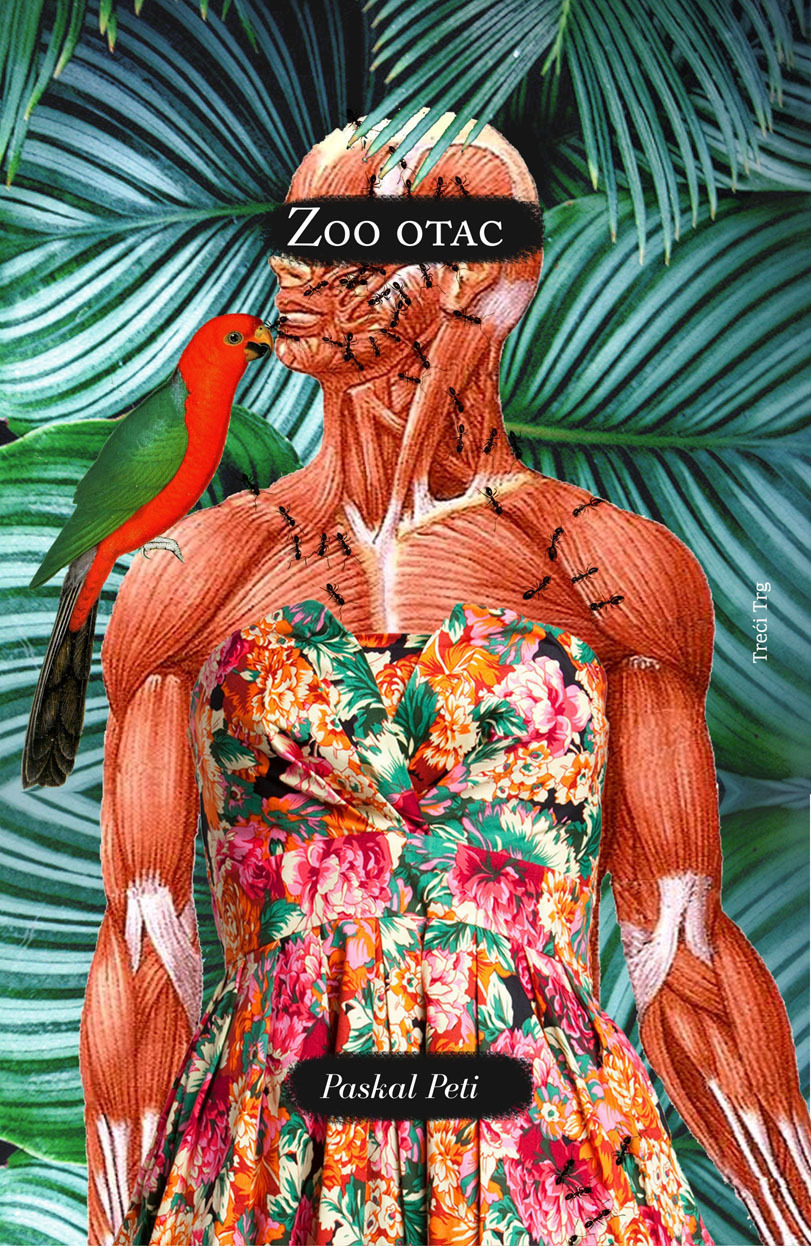
Druga zbirka francusko-velške pesnikinje Paskal Peti, Zoo otac, je podeljena u dva dela. Prvi govori o odnosu pesnikinje sa ocem, a drugi sa majkom. Prvi je obeležen slikama sa putovanja po Južnoj Americi i istraživanjima o kulturi i ekologiji Venecuele. Bol, bes, divljina su prelomljeni kroz živopisne i senzualne opise faune, halucinogenih droga i plemenskih verovanja. Ovo daje pesmama originalnost i na taj način sublimira temu napuštanja i zlostavljanja u detinjstvu. Drugi deo je smešten na jugu Francuske i tiče se letnjih odmora u porodičnom vinogradu i pesnikinjinog ponovnog otkrića tog mesta. Pesme potcrtavaju primarnu vezu (sa majkom), kroz sjajnu imaginaciju stavljenu u iznenađujući kontekst razvoja njihovog odnosa.
Zoo otac je dobio više nagrada, proglašen je knjigom godine u časopisima Independent i Times Literary Supplement, a kao delo u nastajanju dobio je dve velike stipendije Umetničkog saveta Engleske.
Pascale Petit is a French-born British poet of French, Welsh and Indian heritage. Her debut novel is My Hummingbird Father, published by Salt in 2024. Her eighth collection of poetry, Tiger Girl, published by Bloodaxe in 2020, was shortlisted for the Forward Prize for Best Collection and for Wales Book of the Year. A poem from the book, 'Indian Paradise Flycatcher', won the Keats-Shelley Poetry Prize. Her seventh collection Mama Amazonica, published by Bloodaxe in 2017, won the inaugural Laurel Prize 2020, and the Royal Society of Literature's Ondaatje Prize 2018. It was a Poetry Book Society Choice and was shortlisted for the Roehampton Poetry Prize 2018. Her sixth collection, Fauverie, was her fourth to be shortlisted for the T.S. Eliot Prize. A portfolio of poems from the book won the 2013 Manchester Poetry Prize. Petit trained at the Royal College of Art and spent the first part of her life as a visual artist before deciding to concentrate on poetry. Three of her books were Books of the Year in the Times Literary Supplement, the Independent and the Observer. In 2004 the Poetry Book Society selected Petit as one of the Next Generation Poets. She is widely travelled, including in India, Mexico and the Venezuelan and Peruvian Amazon.
'I am in love with this book! Haunting, grotesque, lush and strangely tender. A stunning debut novel, afraid of nothing and deeply poetic.' – Warsan Shire
'My Hummingbird Father shatters and heals, distils redemption out of a history of pain and abuse, and is one of the most affecting books you will read this year.' – Nilanjana Roy
'Rarely has the personal and environmental lament found such imaginative fusion, such outlandish and shocking expression that is at once spectacularly vigorous, intimate and heartbroken.’ - Daljit Nagra (judge for the RSL Ondaatje Prize 2018)
‘Beautifully sad, the imagery inexhaustible, the sorrow and torment both tempered and sharpened by the relish for language and the ingenuity of the imagination.’ – Simon Armitage on Mama Amazonica
‘Radiant, and viscerally evocative… this image confirms the value of Petit’s work… in Mama Amazonica to make poems that are as radical as they are necessary – because they enable us to see in new ways.’ – Alice Hiller, The Poetry Review
'Pascale Petit’s Fauverie is astonishing, one of those books that breaks new ground in how to approach writing about the unwritable.' – Ruth Padel, London Review Bookshop Books of the Year
'Pascale's poems are as fresh as paint, and make you look all over again at Frida and her brilliant and tragic life.' Jackie Kay Books of the Year, Observer
'a hard-hitting, palette-knife evocation of the effect that bus crash had on Kahlo's life and work, exploring the way trauma hurts an artist into creation' – Ruth Padel, The Guardian
With the upcoming summer event organised by Bath Spa University’s MA Creative Writing course, most of us creative writing lot have to read (or was advised to read) the books by authors who will teach our chosen groups. For mine, I chose a different, completely different, group as my choice. I chose poetry – I needed the change and plus, it’s always nice to appreciate poetry from time to time, when you’ve been constantly writing prose for more than half a year!
So, I’ve been reading Pascale Petit poetry collection. First starting with Fauverie, then The Zoo Father (published in 2002), and many other collections once I borrow more from the university’s library.
Reflecting on yesterday’s poetry reading while I eat my strawberry granola with banana, and yes, strawberries (I had a valid excuse: there weren’t enough strawberries in the granola itself!) this morning, I’ve realised how intense the collection, The Zoo Father by Pascale Petit was in comparison to Fauverie. Perhaps the fact this collection was from her early days of poetry writing and how it may have been based on her raw (hatred) emotion towards her abusive father. I won’t lie and will give a fair bit of warning if you intend to read this collection. It’s dark, disturbing and rather haunting for some I would expect. If anyone had gone through an abusive trauma, it’s not a lighthearted read. Read at your own risk (for obvious reasons that I won’t say).
Despite the intensity of the poems, the language was clear, even beautifully written in a magical realism sort of way. I wasn’t left confused about what Petit was trying to evoke or say rather, about her relationship with her father and mother during her childhood. There were simplistically written poems, some very literal, and others more abstract told in the imagery of animals. (Hence the title, The Zoo Father.) I would go on forth talking about why I think Petit may have chosen the title, but that would be a little “spoilery” which might ruin the magical immersion.
Since I took the “Writing and the Environment” module for my second term on my masters course, I do appreciate and enjoy how Petit uses the Amazonian jungle environment to describe such a humanistic level of experience when it comes to trauma (during and post-trauma experience). It is commonly known (I hope) that any sort of trauma, whether first-hand or not or small or big, could affect any individual in the long-term of their life. And we see that through Petit’s The Zoo Father – how much she hated her father, how much she had wanted to smother him and how her maniac mother was like as Petit grew into an adult.
My favourite poems were so far: Home was a Cyanide Bottle, Self-Portrait as a Were-Jaguar, The Second MaZét and A Wasp's Nest.
I liked the variety of simplistic and literal poems to the abstracted magical realism poems. The literal poems, from how I perceived it, showed her raw emotions right on the surface without a mask on (see: The Horse Mask). Sometimes even the most simplistic of poems can be the most powerful pieces. Another favourite of mine was My Father’s Body, where her literal description of her fantasising in killing her father… I almost felt the self-centered narrator’s morbid fantasy. I won’t show this poem since I think if you do wish to read this book, it’s a poem that should be read without me having to show it.
Overall, I would give 3.75 stars out of 5 stars on Goodreads, but I had to round it off to 4 stars since good ol’ Goodreads doesn’t half arse their stars. They like things whole, you see. Why the 3.75 rating? Because there were a few poems where I thought were weak in comparison to the stronger pieces in this collection and Fauverie. Not that they were badly written, but they could have been poems with much more potential to it.
I did enjoy this collection and we will continue to see Pascale Petit’s explored reflections into her abusive childhood, portrayed even more deeply in a wild Amazonian jungle that is known as Fauverie.
Porodični odnosi nikada ne mogu biti prosti, naprotiv, ako bi bili jednostavni sa pravom bi mogli da posumnjamo u njihovu ispravnost.
Paskal Peti, englesko-francuska autorka nas u svojoj zbirci poezije "ZOO otac" vodi na jedan krajnje neuobičajen put. Put koji nas vodi preko dalekih i nepoznatih džungli Amazona, preko neverovatnog sveta divljine i sve do mračnih intimnih sećanja na autorkino detinjstvo.
Osnovni motiv u njenoj zbirke su upravo odnos između nje i njenog otac. Njihov krajnje pogrešan, najblaže rečeno neprimeren odnos u kojem dominiraju nasilje i seksualno uznemiravanje su kruna njihovog razdora. Upravo zbog ozbiljnosti teme kojom se Paskal Peti bavi u svojoj poeziji njene reči su jako konkretne i mračne, upravo uz malu kombinaciju opisa u stilu magičnog realizma autorka nam jasno dočarava tamu i bol koju je u ranoj mladosti pretrpela živeći sa takvim nasilnim ocem i psihički bolesnom majkom.
Peti se ne trudi da u svojoj poeziji zamaskira činjenice, očigledne situacije koje je preživela. Mada stvari treba nazvati pravim imenom, situacije su u stvari očigledne trauma zlostavljanja koje su ostavile neizbrisiv trag na autorku, čime su logično stvorile veliku količinu opravdane mržnje prema počiniocu. Rođenom ocu. Čoveku koji je nju napravio!
Autorka te traumatične momente vešto ilustruje trudeći se da na jako, rekao bih kreativan način, nama kao nemim čitaocima ove zbirke prosto dočara atmosferu gde dominiraju tamu, bes, nemoć i mržnja.
Emocije u njenim pesmama su vidljive, jasne, sirove. Prosto u nekim njenim stihovima možete osetiti tu duševnu bol i ozbiljnost datog momenta, dok u drugim autorka uz vešto poigravanje motivima, koristeći animalno da bi pojača svoje emocije i slikovito dočarala te trenutke. Činjenica da svaka njega pesma, bez obzira na obim isijava izvesnom energijom kojom samo stihovima može biti jasno kanalisana.
Takođe je bitno napomenuti da tokom čitanja ove, nimalo naivne zbirke, dodatni književni ugođaj predstavljaju neverovatne ilustracije, tako fascinantno urađene da se mogu smatrati idealnom dopunom određenim pesama Paskal Peti.
A daughters relationship with her dying father whose legacy was violence and abandonment. Her poems breath in the Amazonian jungle; mouth to mouth like redemption, inhaling in what brings me to my knees, reminds me of my own self-centeredness that need to amended daily.